"Get out. People like you don't belong here."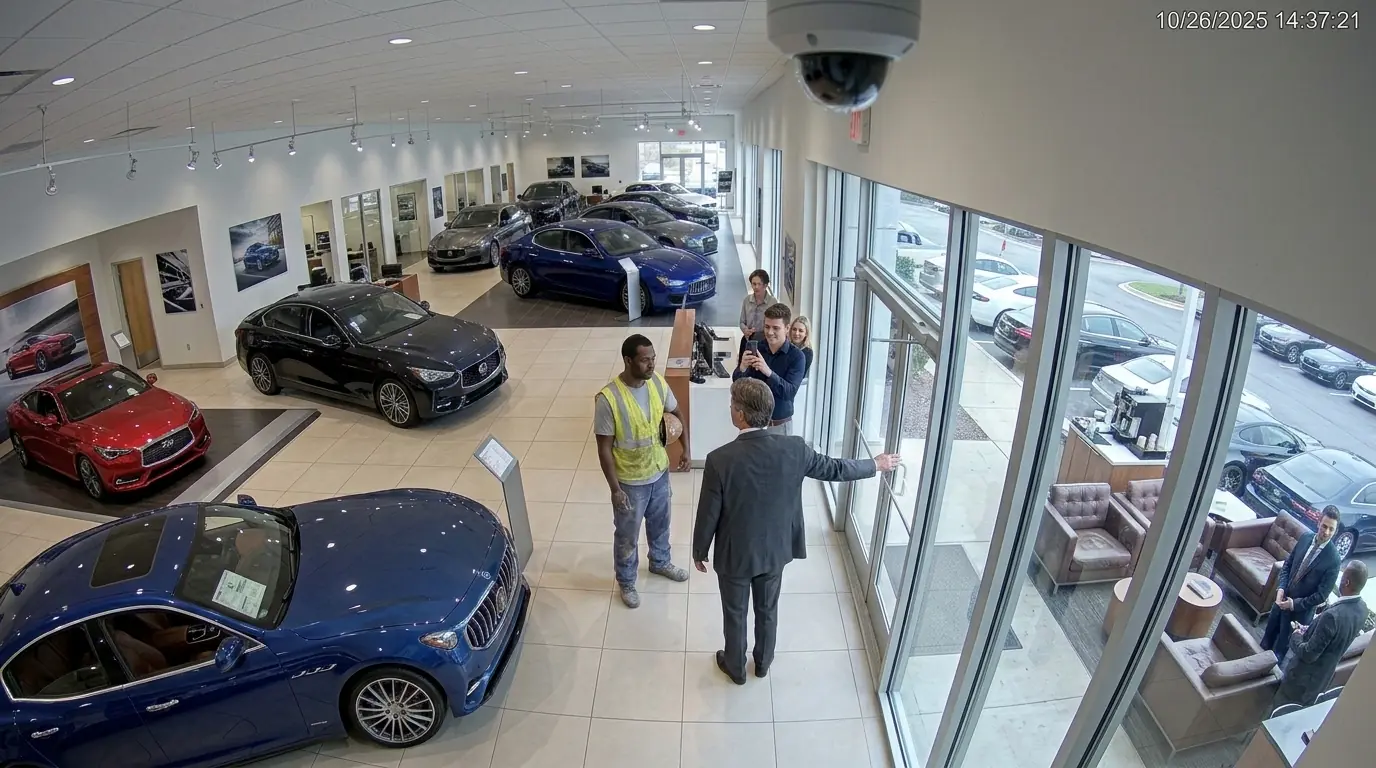
That was the welcome a dusty man in a reflective vest received the moment he stepped into the Northstar showroom. No one asked where he came from. No one wondered why he looked exhausted. They simply stared at the dirt on his clothes and laughed.
Clyde raised his phone and whispered, "Guys, watch this. A broke construction guy thinks he can buy a luxury car." Readington gave the man a slow, dismissive look. "Sir, these cars aren't for browsing." But the man did not back away. He quietly set down his hard hat, steady and calm, then reached into his pocket and pulled out a worn ID card. For the first time, the room was about to learn his name: Jackson Crowell.
Back in his old brick-walled office, Jackson had sat in front of a stack of faded letters. Real paper, not emails. The first, from an older man, read shakily, "I've never felt so small. Not in a dealership that carries your name." Another came from a truck driver: "I came in after a long shift. They told me I wasn't rich enough to look at a new model."
Jackson paused and reread the lines. "Choose your customers. Don't waste time on people who look poor." The words clung to him like grease that would not wash off. He lifted his eyes toward an old photograph of his father, a mechanic with calloused hands and an easy smile, and something inside him tightened. If this was what Northstar had become, then something had already gone terribly wrong.
The next morning, Jackson opened his closet and pushed his suits aside. His hand stopped on a faded safety vest that had belonged to his father, dusty and stiff at the seams. He lifted it, hesitated for a second, then slipped it on. In the mirror, the CEO disappeared. What stared back was a tired, middle-aged man with work-worn hands and a quiet resolve forming behind his eyes.
"If they only respect people who look wealthy," he muttered, "then they don't deserve the name on that building." He placed a fake road-worker ID in his front pocket and tucked his real CEO badge deep into the other. After one slow breath, he stepped outside. That morning, a construction worker walked toward Northstar Motors carrying a truth that could rewrite someone's life.
The moment Jackson pushed open the glass door, the street noise faded and was replaced by the steady hum of dealership air conditioning. He stepped in wearing the dusty vest, hard hat in hand, leaving faint dirt marks on the shiny tile. A couple of heads lifted. Their eyes moved over him the way someone might inspect a rusted old pickup at an auction, slow and dismissive.
Miss Readington glanced up, frowned, then subtly angled her screen as though hiding her irritation behind it. Jackson offered a small, polite smile. "Ma'am, I'm hoping to look at a car." With that one simple greeting, the room shifted. The tension and judgment began gathering around him.
She did not answer right away. For a second, Jackson wondered whether she had heard him, but her eyes remained fixed on the monitor as though his voice were background noise she was trying to tune out. Then she finally lifted her gaze, not to his face, but to the dust on his vest, his scuffed boots, and the hard hat in his hand.
"Do you have an appointment?" she asked, her tone scraping the air like a chair dragged across tile.
Jackson shook his head gently. "No, ma'am. I just wanted to see that blue sedan. When I was a kid, I-"
It was a small sentence, but it carried the weight of a much larger message: You do not belong here. And that was only the beginning.
Jackson pointed gently toward the deep blue sedan, the one that reminded him of childhood and of wanting something just once without being judged for it. Miss Readington let out a long, tired sigh, turned her back, and picked up a brochure with two fingers as though touching it for him were an inconvenience. Instead of handing it to him, she dropped it on the counter.
The brochure slid toward the edge and stopped there, trembling slightly like a piece of trash someone had forgotten to sweep away. "You can check the price first," she said. "Save our time."
An older man nearby frowned. It was only a small crease between his brows, but it said everything. He had seen this kind of dismissal before, perhaps too many times, and Jackson felt the shift. A quiet sting that was not anger yet, but was getting there.
Mr. Doyle noticed the brochure scene, and a half smile slid across his face, the kind people wear when they believe they already know someone else's whole story. He gave Jackson a quick once-over, glanced at the sedan, and let out a short laugh. "That model's usually paid in full," he said. "Not many folks need bank approval."
The pause before "bank approval" hung in the air as though Doyle had drawn a line between two worlds. Jackson tried to steady the moment. "I just wanted a little information, sir."
But Doyle turned to Readington and spoke loudly enough for others to hear. "Guy like him? Probably better off with something that's already got fifty thousand miles on it."
The disrespect was no longer subtle. It was out in the open, wearing a smile.
The older man from earlier was still standing a few steps away, his fingers tightening around the brim of his faded baseball cap. He watched Jackson quietly, and for a moment something flickered in his eyes. Recognition, perhaps, the kind that comes when you see someone living a moment you once lived yourself in some bank, office, or store where your clothes spoke louder than your words.
He let out a soft breath, almost a sigh. He did not say anything. He did not need to. Jackson glanced over and offered a small smile, gentle and apologetic, almost as though saying, "I know. I get it."
Doyle turned away, brushing the moment off as if the humiliation he had added were nothing more than a passing joke during a slow workday. The room felt a little heavier, as though empathy were trying to surface but pride kept pushing it back down.
Then came Miss Taber, tablet in hand, a smile on her lips but coldness in her eyes that Jackson felt before he fully understood it. She did not greet him. She simply leaned toward her coworkers and said, without even lowering her voice, "Does he even have a credit file, or is he just here to browse?"
Jackson swallowed and kept his voice steady. "What if I'd like to test-drive it?"
"Oh, test drives." Her laugh was soft but sharp. "Those are for qualified buyers. Got a bank statement? Pre-approval letter?"
Each question felt like another small shove toward the door. Then she delivered the line that cut deeper than she probably realized.
"This isn't a place for free dreaming."
It was only a sentence, but it stripped away another piece of the dignity he had been carefully holding onto. Somewhere inside him, something shifted quietly but unmistakably.
That was when Clyde leaned back against the counter, casual as though he had seen scenes like this a hundred times, and pulled out his phone. The screen lit up. "Guys, look at this," he whispered excitedly. "A construction worker trying to buy a luxury car."
He angled the camera just enough to catch Jackson standing near the blue sedan, unaware that he had become entertainment for someone's feed. Clyde chuckled under his breath as he typed the caption, "When your dreams cost more than your wallet."
One coworker glanced over, then another. A suppressed laugh here, a smirk there, and suddenly it was no longer merely poor service. It had become public mockery, broadcast and amplified, turning a man's quiet moment into a punchline.
Miss Readington noticed Clyde's phone and saw the small red live icon. Instead of stopping him, she smiled, a tiny knowing smile as though the cruelty had become routine. She turned back to Jackson. "If you're serious, do you have a bank statement?"
Jackson paused, not because he did not have one, but because of the way she said it, as though he needed to prove he deserved to stand inside the building at all. "I'm just trying to learn about the car today," he replied, steady and respectful.
"Well," she said, her voice sharpening, "you might want to do that somewhere else."
Somewhere else. As though he were clutter. An inconvenience. With that one sentence, the line was crossed from subtle disrespect to openly pushing him out.
Then came the sound of sharp, clipped footsteps echoing across the showroom floor. Mr. Halcom, the manager, emerged from his glass office with the look of a man convinced he was about to fix something, or someone. He scanned Jackson from head to toe, then turned to his staff.
Readington summarized what had happened, framing the story in a way that made Jackson appear to be the one slowing business down. Halcom nodded once, as though he had already decided the verdict, and walked directly toward Jackson, standing closer than necessary.
"This is a high-end dealership," Halcom said. "If you're not planning to buy, you're disrupting our work."
And there it was. Authority being used not to lead, but to dismiss. A man meant to uphold standards lowering them with every word.
Something about that struck Jackson harder than the earlier insults because now it was not just rude behavior. It sounded like policy.
Jackson kept his voice calm. "I only asked about the price and the financing options. Simple, reasonable, nothing out of line."
Halcom did not soften. "I told you. You're not our target customer."
Behind him, Clyde muttered just loudly enough, "He doesn't even look like someone who should walk through the door."
The words landed with quiet cruelty. Before Jackson could answer, Halcom leaned slightly closer and delivered the final push. "If you don't leave now, I'll have security assist you."
Security, as though Jackson were a threat instead of a man asking about a car.
A small smirk crossed Doyle's face, as if the humiliation had become a team sport. The room's atmosphere shifted again. This was no longer harmless arrogance. It was an effort to shrink a person down until he disappeared.
But Jackson did not move.
While he stayed quiet, trying to steady the heat rising in his chest, Halcom leaned toward his staff. His voice was low, but not low enough. "I've said it before. Don't waste time on people who don't look like they have money."
The words drifted through the showroom like fumes from old gasoline, sharp, sour, impossible to ignore. Doyle nodded without hesitation. Clyde let out a quick laugh. Taber said nothing, but silence had become its own kind of agreement.
A woman nearby clutched her purse a little tighter, frowning. She had heard it. Everyone had.
Jackson lifted his head slowly, his eyes narrowing just a little. Not rage, but the quiet, dangerous focus that comes before someone decides he has had enough. The room felt different now. Not merely rude. Rotten.
In the corner, Intern Mills was stacking paperwork, trying to look busy and trying not to stare, but failing. He watched the entire scene, shoulders tense, as though he wished he were anywhere else. Finally, he walked over, hesitant steps but honest ones.
"If you'd like," he said quietly, "I can explain a few things about that model."
Readington shot him a sharp look. "Mills, you have other tasks."
He froze for a second, then turned back to Jackson. "I'm sorry for the way they're speaking to you," he said, his voice barely above a breath.
That was all. Simple, unpolished kindness. But in a room filled with smirks and whispered judgment, it landed like light breaking through a heavy door. Jackson's expression softened for a moment, and that small change hinted that the story was not over.
Clyde moved closer, this time making no attempt to hide the phone or the grin. "Look, everyone," he said loudly. "Guy wants a dream sedan but won't even show a bank statement."
The words cut across the room. Readington laughed, one hand covering her mouth even though the delight in her eyes was impossible to hide. Halcom did not stop it. He merely folded his arms and watched as though the whole scene were midday entertainment.
Jackson stood in the center of it all, still, steady, and quiet. His eyes moved slowly from face to face, studying each reaction, each smirk, and each person who looked away. There was no explosion of anger. Only the stillness of someone who had finally reached enough.
At last, Jackson spoke. "So, to look at a car here, someone has to prove they're wealthy first?"
Halcom did not hesitate. "We have a brand to protect. We can't let just anyone walk in without the means to buy."
Just anyone. The phrase hung there, heavy and almost echoing. A couple of nearby customers shifted uncomfortably, as though the insult had brushed against them too. But none of the staff flinched. Not Doyle with his smirk, not Clyde with his phone, not even Readington.
Jackson breathed in slowly, like a man setting bricks in a wall who had finally laid the last one. A truth had formed, solid and undeniable. If this was how they treated someone they believed was beneath them, then the place needed more than a reminder. It needed a reckoning.
For a moment, Jackson let the noise of the showroom fade: the smirks, the whispers, Halcom's arrogance. His eyes drifted to the Northstar Motors sign hanging on the back wall, bold letters he had once been proud of. Now they felt heavier, almost accusing.
He thought of the complaint letters on his desk. He thought of long-haul drivers, mechanics, road crews, and the people who built the roads everyone else drove on. He thought of his father's hands, calloused, cracked, and honest. If he stayed silent even one more minute, this place would become exactly what those letters had described.
He set his hard hat down on a nearby chair. Then, slowly, almost too slowly, his hand slipped into his pocket. To the staff it looked like defeat, like he was finally preparing to walk out. But inside Jackson, something had snapped into place.
He drew his hand back out, his fingers closed around something small. When he opened them, a simple badge rested there, its laminated edges slightly worn from time and responsibility. He lifted it, not high and not theatrically, just enough for the people nearest him to read.
Jackson Crowell. Chief Executive Officer. Northstar Motors.
Clyde's grin disappeared so quickly it almost looked painful. His phone dipped, the screen shaking because his hands were no longer steady. Readington's breath caught. Taber froze. Halcom, who had stood so close only moments earlier, took half a step back as though the badge were a spotlight exposing everything he had just said.
No one spoke because every insult, every laugh, and every rule they thought they could hide had suddenly come crashing back at them. Jackson had not even raised his voice.
The room, once buzzing with chatter and quiet mockery, fell into a strange, heavy silence. Only the steady hum of the air conditioner remained.
Jackson finally spoke. "I've heard the complaints. Today I wanted to see if they were true."
No one met his eyes. Not Doyle. Not Readington. Not Taber. Only Intern Mills, standing near the corner, looked back at him, steady and unafraid.
Clyde fumbled with his phone, the live stream still open for another second before he shut it down, clearly wondering how far his words might already have traveled. Halcom tried to speak, but his voice cracked. "Sir, you should have told us earlier-"
Jackson did not answer. His silence said enough.
Then he repeated their own words back to them, quietly and deliberately. "You're in the wrong place. This isn't where people come to dream for free. Don't waste time on someone who doesn't look like they have money."
Each sentence fell into the stillness with weight. He did not need to raise his voice. He looked at the people responsible as he quoted them: Doyle when he repeated the remark about looking poor, Readington when he echoed her dismissal, and Taber when he repeated her words about free dreaming.
Readington lowered her head. Doyle swallowed hard. Taber clutched her tablet as though it could shield her. Only Mills remained upright, his expression soft but clear, watching the truth settle over the room.
For the first time that day, the staff were being forced to hear themselves.
Jackson turned to Halcom and held out his hand. "Your work phone."
Halcom hesitated, but in a room that silent, refusal was not really an option. He handed it over. Jackson tapped through the forwarded chats he already knew were there.
"Rule number one," Jackson read aloud. "Don't waste time on customers who look poor."
A small shiver passed through the room. Then he read the next message. "Blue collar equals time waster."
He let the words remain in the air for a moment before looking up. "This is how you train each other?"
No one answered because the system they had built was now being shown to them in their own handwriting.
Jackson let the phone fall silent in his hand before turning toward Readington. "You're the first face people see when they walk in," he said. "And today that face told me I didn't belong here."
She opened her mouth, perhaps to explain, perhaps to deny it, but the words tangled before they escaped.
"Effective immediately," Jackson continued, calm but unshakable, "you are no longer employed at Northstar Motors."
A sharp breath came from somewhere behind him. Readington tried to speak again, but the moment had already moved past excuses.
Jackson then faced Halcom. "You're the manager. This culture didn't appear on its own."
He repeated the man's own words back to him: the threat to call security and the declaration that Jackson was not their target customer. Each phrase landed heavier than the last.
"You're not fit to lead anyone here," Jackson said.
Then his eyes moved to Clyde. There was no rage in his expression, only disappointment. "You felt proud turning a person into a joke in front of hundreds, didn't you?"
Clyde's face drained of color.
"Your contract ends today."
The room did not cheer, but the silence felt like accountability finally taking a breath.
Jackson did not immediately fire Doyle or Taber. Instead, he asked, almost too calmly, "How many people have you told they didn't belong here? How many people have you told this place wasn't for their dreams?"
Doyle's jaw tightened as moments returned to him, too many occasions when he had laughed at someone who walked in wearing work boots. Taber's eyes filled before she could look away. Perhaps it was the first time she had truly heard her own words echoed back at her.
"I don't need the top sellers," Jackson said softly. "I need people who remember that the person standing in front of them is a person."
He gave Doyle and Taber one final chance, along with a warning that left no room for pretending. It was not an easy escape. It was a mirror, and what happened next would depend on whether they were willing to look into it honestly.
Then Jackson called Mills's name, and the whole showroom turned.
The intern stiffened, papers still in his hands, as though he were afraid he had done something wrong. But Jackson's voice softened.
"You apologized when you thought I was just a construction worker. No audience. No reward. That's when a person's character speaks the loudest."
Mills blinked quickly, trying to keep his eyes from shining. "I just did what felt right," he whispered.
Jackson nodded. "And that's why I want you in the full sales training program. I'll oversee it myself."
A flush crept up Mills's neck, half shock and half gratitude. Kindness, finally, was not the quiet thing in the room. It was the thing being honored.
Jackson moved back to the center of the showroom and let the weight of everything settle before speaking again.
"From this day on, there will be no more choosing customers in this dealership. Every person who walks through that door, whether they're in a suit or in work boots, deserves the same respect."
He announced the new policy clearly. Any discrimination based on appearance would be grounds for immediate termination. A few customers standing nearby began to clap softly, not in celebration of someone's downfall, but in relief and recognition.
The air felt cleaner, as though the dealership were finally becoming what it should have been all along.
When everything settled, the older man who had watched quietly from the beginning walked over to Jackson. He held his cap in both hands as though the memory he was about to share still carried weight.
"I was treated like that once," he said softly. "Only difference is, nobody stood up for me."
Jackson took his hand and shook it firmly, grounding the moment. "You should never have had to go through that."
They both looked toward the deep blue sedan, two men who had spent much of their lives believing that certain dreams were meant for other people.
Jackson nodded toward the driver's seat. "Go on," he said quietly. "Dreams shouldn't be stopped at the door."
For a moment, the room felt healed.
That day did not end with a sale. It ended with a shift, one large enough to change the way an entire dealership breathed. Customers filtered out, whispering to one another. The story was already spreading: the worker who turned out to be the CEO, the staff who learned the hard way, and the intern who stayed kind when no one was watching.
People would carry that story home and tell it to their children, their neighbors, and the people around them. Slowly, the lesson would ripple out of that showroom and into other places where respect had been missing for far too long.
Jackson glanced at the Northstar Motors sign on the wall. For the first time in years, it felt worthy of his father's name.
A worker humiliated in front of an entire room had turned out to be the CEO. But the harder question remained: What if he had not been? What happens to the person with no title, no authority, and no badge to reveal? Do they ever receive an apology, or do they simply carry the humiliation quietly for the rest of their life?
No one should have to flash a CEO card before being treated with basic respect. Sometimes a dusty jacket belongs to a man who worked hard that day. Sometimes worn boots belong to someone holding an entire family together. Character reveals itself most clearly in the way a person treats someone who appears to have nothing to offer in return.
That was the truth Jackson had walked into Northstar Motors to find, and it was the truth no one in the showroom would be able to forget.