Asha Williams entered Aurora Fashion House at 11:17 on a Thursday morning and immediately noticed that no one welcomed her.
For most shoppers, that might have meant nothing.
For Asha, it meant the experiment had begun.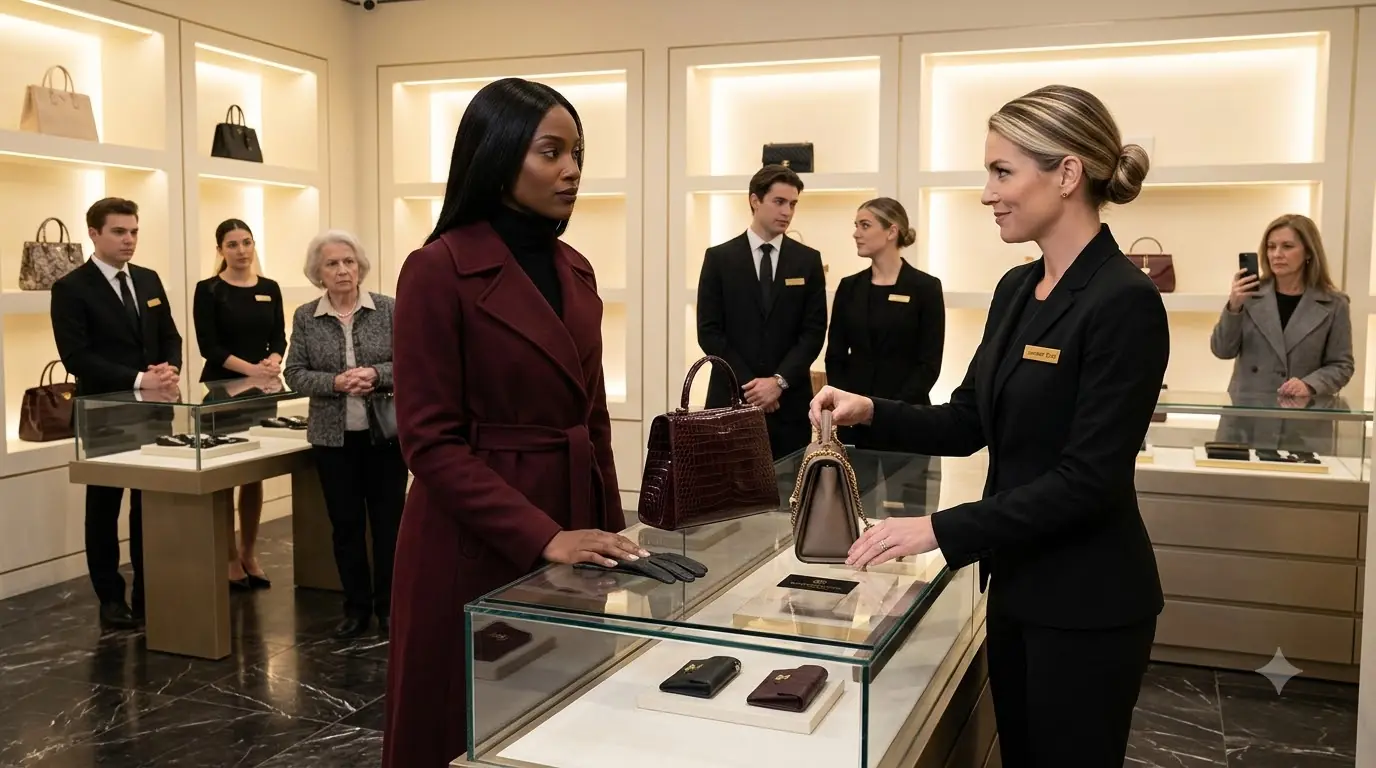
The Fifth Avenue flagship had been designed to make every customer feel noticed before they touched a single product. A greeter was supposed to acknowledge visitors within ten seconds. Sales associates were expected to make eye contact within twenty. Nobody was required to pressure a shopper or ask what they could afford. The purpose was simple: luxury service began with attention, not intimidation.
Asha knew those rules because she had approved them herself.
Three years earlier, she had personally rejected the first customer-service manual after reading a section titled QUALIFYING THE CLIENT.
The language had annoyed her.
“What does qualify mean?” she asked the consultant.
The man responded with corporate language.
Assessing buying intent.
Understanding spending capacity.
Protecting associate time.
Asha had closed the binder.
“You are describing a polite way to decide who deserves service.”
The section disappeared.
At least officially.
Now Asha stood inside the flagship wearing a deep burgundy wool coat over a black turtleneck, fitted black trousers, leather gloves, and polished ankle boots. A structured dark burgundy handbag hung from her left arm. Her long black hair fell smoothly past her shoulders, and diamond studs caught the light beneath glowing cream display niches.
She looked wealthy.
Very wealthy.
But she did not wear visible Aurora pieces.
No VIP account appeared when she entered.
No personal shopper had been alerted.
No assistant walked beside her carrying appointments.
Most importantly, none of the employees knew she was coming.
Aurora Fashion House had seventy-four stores internationally, but the Fifth Avenue flagship mattered more than the rest.
It was the company’s public face.
Tourists photographed the windows.
Celebrities attended private launches upstairs.
Fashion editors borrowed pieces from the archive.
International clients spent six figures during holiday visits.
Asha had signed off on the flagship’s $28 million renovation two years earlier.
She knew every marble slab, every lighting temperature, every display niche, every private salon.
Yet nobody near the entrance recognized her.
That was deliberate.
Asha was famous in finance, less famous in fashion.
Aurora marketing rarely used her face.
She believed brands became fragile when customers associated them too strongly with one executive personality.
Today that anonymity was useful.
A young sales associate glanced at her.
Then away.
Another associate continued talking quietly to a well-dressed couple.
Behind the jewelry counter, two employees were arranging bracelets.
Asha walked toward the handbag gallery.
Still nothing.
She counted silently.
Ten seconds.
Twenty.
Thirty-five.
Fifty.
At fifty-eight seconds, a blonde woman finally approached.
“Can I help you?”
The tone was not welcoming.
It sounded like a challenge disguised as customer service.
Asha turned.
The woman’s badge read:
JENNIFER COLE
FLAGSHIP GENERAL MANAGER
Asha knew the name.
Jennifer Cole, forty-two.
Four years at Aurora.
Previously with two competing luxury retailers.
Excellent quarterly numbers.
Strong VIP retention.
High average transaction value.
Management notes consistently described her as “decisive,” “commercially disciplined,” and “highly protective of the brand.”
Asha had never met her personally.
That suddenly seemed like a mistake.
“I’m looking at handbags,” Asha said.
Jennifer smiled.
It did not reach her eyes.
“Of course.”
She looked Asha over.
Not subtly.
Her gaze moved from burgundy coat to boots to handbag.
Then back to Asha’s face.
“Do you have an appointment?”
“No.”
“We usually recommend appointments for private collection pieces.”
“I’m not asking for a private collection.”
Jennifer nodded toward several shelves.
“Our entry pieces are along the rear wall.”
Asha followed her gesture.
The rear wall contained older seasonal accessories, small leather goods, and discounted items awaiting transfer to an outlet location.
She looked back.
“I’d like to see that one.”
She pointed toward a structured handbag displayed beneath warm light.
Taupe leather.
Silver clasp.
Limited seasonal run.
Retail price: $3,200.
Jennifer’s smile tightened.
“That one?”
“Yes.”
Jennifer did not move.
Asha waited.
“Is there a problem?”
“No.”
“Then may I see it?”
Jennifer glanced toward the bag.
Then toward another employee.
The hesitation was almost theatrical.
Finally:
“That piece is delicate.”
Asha raised one eyebrow.
“I assumed it wasn’t indestructible.”
Jennifer forced another smile.
“What I mean is we try not to handle certain pieces unless a client is seriously considering purchase.”
Asha remained calm.
“I am considering purchase.”
Jennifer’s eyes shifted again.
“Do you know the price?”
Asha looked directly at her.
“No.”
Jennifer smiled as if Asha had just confirmed something.
“It’s thirty-two hundred dollars before tax.”
“Thank you.”
Jennifer waited.
Asha waited too.
Neither moved.
Finally Asha said:
“May I see it?”
Jennifer’s smile disappeared.
“I’m not sure that would be appropriate.”
There it was.
Not subtle anymore.
Asha felt something familiar settle in her chest.
Not shock.
Recognition.
She had experienced versions of this since she was sixteen.
A cosmetics counter where the associate followed her but ignored two white girls opening testers.
A department store where a security guard asked whether she needed directions to the exit.
A hotel clerk who assumed she was attending staff training instead of checking into the presidential suite.
As Asha became wealthier, the incidents changed.
They became rarer.
More polished.
More deniable.
But they never fully disappeared.
That was one reason she was standing here today.
Two months earlier, Aurora’s confidential ethics hotline had received three complaints from the Fifth Avenue store.
One alleged associates were instructed to “prioritize visibly affluent clientele.”
Another claimed Black employees were routinely assigned lower-performing sections.
The third accused management of moving commission credit from junior associates to favored senior sellers.
Human Resources had opened inquiries.
Nothing had been substantiated.
Asha disliked the phrase.
Nothing substantiated.
Sometimes it meant the complaint was false.
Sometimes it meant investigators asked management whether management had done anything wrong.
She wanted to see for herself.
Jennifer reached toward the $3,200 handbag.
For one moment, Asha thought she had reconsidered.
Instead, Jennifer physically moved it farther back on the display.
Then she pointed toward the rear.
“You may be more comfortable with some of our lower-priced options.”
The words hung in the air.
Asha looked at the bag.
Then Jennifer.
“More comfortable?”
“Yes.”
“With the price?”
Jennifer’s expression tightened.
“With the selection.”
“That isn’t what you said.”
“Ma’am.”
Asha held her gaze.
“What exactly about me suggested I would be more comfortable in your discount section?”
Jennifer’s cheeks reddened.
The nearby assistant managers had started listening.
One, a young South Asian woman named Priya Nair, looked uncomfortable.
Another, Sophie Grant, stood behind the jewelry counter with her arms crossed.
A male associate named Ethan Walsh pretended to rearrange boxes while clearly watching.
Jennifer lowered her voice.
“I think you’re misunderstanding professional guidance.”
“Then explain it professionally.”
Jennifer’s mouth tightened.
“These pieces require a certain clientele.”
The elderly woman shopping near the scarf display stopped moving.
Asha heard a quiet intake of breath from behind the counter.
She asked:
“What is a certain clientele?”
Jennifer stared.
“You know what I mean.”
“No.”
Asha’s voice remained even.
“I want you to tell me.”
Jennifer glanced around.
She now realized people were listening.
Instead of correcting herself, she became more defensive.
“We maintain a luxury environment.”
“So do I.”
Jennifer almost laughed.
Asha continued.
“What characteristic do your preferred clients have that I appear not to?”
Jennifer’s expression hardened.
“Purchasing history.”
“Did you ask mine?”
“No.”
“Did you check?”
“No.”
“Do you know whether I have an Aurora account?”
“No.”
“Then purchasing history cannot be your reason.”
Jennifer looked toward Priya.
“Can you please take care of the client?”
Priya hesitated.
Asha noticed the word changed.
Not customer.
Client.
Jennifer wanted distance.
Priya stepped forward.
“Of course.”
Asha looked at her.
“Would you let me examine the handbag?”