At 10:30 on a Thursday morning, every sound inside Riverside Cafe stopped.
Forks froze in midair, coffee stopped pouring, and conversations died in the middle of sentences because the man walking through the door seemed impossible.
He wore a charcoal suit that cost more than most people made in a year, two assistants in sharp suits flanked him, and security stood behind them. Every head in the packed diner turned in perfect unison.
A customer whispered, "That's Arthur Brennan. The billionaire."
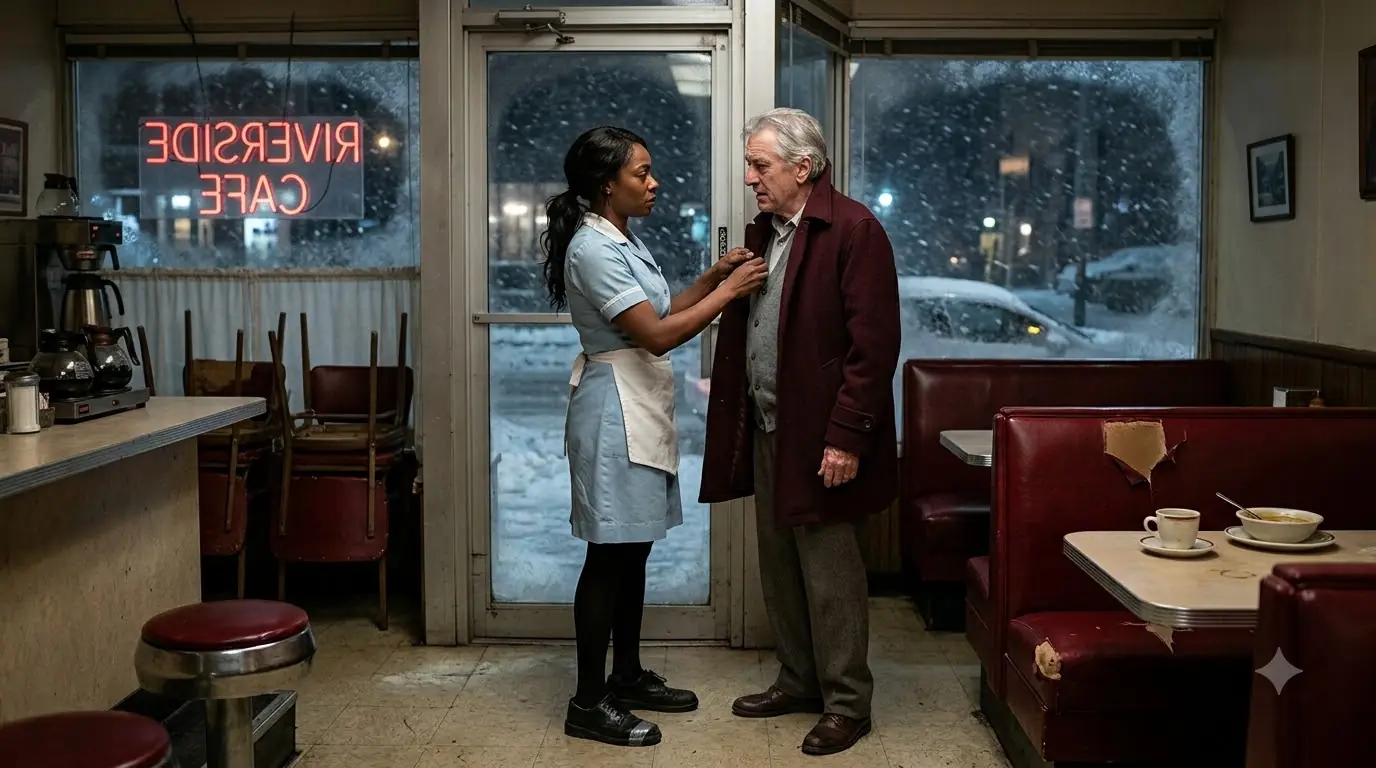
Lashonda Hayes stood at table seven holding a coffee pot, her entire body frozen. Less than a week earlier, she had given this stranger her only good coat in the middle of a blizzard and walked him 15 blocks through temperatures that felt unbearable. Then she had gone home alone, shivering and certain she would never see him again.
She was wrong.
What happened next did not just change Lashonda's life. It changed an entire neighborhood. But before any of that could happen, she had to survive one of the hardest weeks of her life.
Friday morning began at 5:30 a.m. Lashonda Hayes had exactly $163 to her name, and in three days her rent was due. She needed $420.
The alarm clock rattled on the milk crate beside her mattress. Lashonda slapped it silent and stared at the cracked ceiling of her studio apartment while the radiator clanged without producing much heat. Her breath formed faint clouds in the cold air as she pulled herself upright, wrapped a thin blanket around her shoulders, and shuffled toward the corner that served as her kitchen.
There was one hot plate and a plastic electric kettle with a frayed cord she had repaired with tape more than once. The instant coffee jar was almost empty, so Lashonda had spent three days stretching what remained, adding just a little fresh coffee whenever she could. It tasted mostly like brown water now, but it was hot, and hot mattered.
She poured a small amount of oatmeal into a bowl. Half a serving. The rest would be breakfast tomorrow.
While it cooked, Lashonda examined her work shoes. The sole on the right one had begun separating from the leather, so she reached beneath the sink for a roll of duct tape and wrapped it carefully around the shoe. She pressed the tape down firmly with her thumb.
Those shoes needed to survive another month.
New ones were not in the budget.
Lashonda stood in front of the cracked mirror beside the door and practiced her smile. Waitresses who smiled received better tips. She had read that somewhere, and after two years at Riverside Cafe, she had discovered there was some truth to it.
The woman in the mirror looked tired. Gray hairs were beginning to appear near her temples, even though Lashonda was only 34. Life had a way of aging a person faster than birthdays did.
She pulled her hair back into a neat ponytail, then reached toward the coat hanging from the hook by the door.
The burgundy wool coat.
Her mother's coat.
Lashonda ran her fingers slowly across the fabric. It was real wool with a satin lining that still carried the faintest trace of her mother's perfume, White Diamonds, the inexpensive drugstore scent Diane Hayes had worn for years. To anyone else, it was just perfume.
To Lashonda, it smelled like home.
Diane Hayes had died two years earlier from advanced breast cancer. By the time doctors discovered how serious it was, the medical bills had already begun crushing both of them. Lashonda worked double shifts for 18 months trying to stay ahead of the debt.
She sold almost everything.
Her mother's furniture.
Her jewelry.
Her own car.
Anything with value eventually disappeared.
Everything except the coat.
That coat was all Lashonda had kept.
She put it on carefully, buttoned it against the morning cold, and stepped into the predawn darkness.
Getting to Riverside Cafe required two buses. Lashonda could have taken a more direct route, but it cost an extra $1.50 each way. Three dollars a day seemed small until it was multiplied across weeks and months.
She sat near the window and watched the city change as the bus passed through different neighborhoods. First came apartment buildings like hers, aging structures with broken entry lights and notices taped to doors. Then came recently redeveloped blocks filled with coffee shops charging six dollars for drinks people carried away without finishing.
After that came tree-lined streets and beautiful brownstones worth more than Lashonda expected to earn in her lifetime.
A woman wearing a camel-colored coat sat across from her scrolling through her phone. The fabric looked soft and expensive, probably cashmere. Lashonda automatically did the math.
That coat probably cost more than three months of her wages.
She looked away.
Outside the window, the bus passed the neighborhood community center where Lashonda volunteered every Sunday, helping children with reading. It was the one regular thing she did that had nothing to do with money, rent, medical debt, or survival. It was the place where she felt most like Diane Hayes's daughter.
As the bus turned onto Market Street, Lashonda saw another eviction notice on the front door of Mrs. Lane's apartment building. It was the third notice she had seen on that floor that month. Rents were rising everywhere, landlords were selling to developers, and longtime residents were being pushed away from neighborhoods they had spent decades building.
Lashonda knew she could easily be next.
Riverside Cafe stood at the corner of Market and Ninth. It had been part of the neighborhood for 40 years. The vinyl booths were patched, the floors were scuffed, and one letter in the neon CAFE sign had been flickering for so long that regular customers barely noticed anymore.
But the place was clean.
The food was good.
And the people were family.
Dmitri Palos, the owner, was already working in the kitchen when Lashonda arrived. He was 67, a Greek immigrant who had purchased Riverside Cafe in 1985 with nearly everything he had saved.
She hung her burgundy coat inside the tiny staff closet.
"Morning, Dmitri."
"Morning, koritsi mou," he answered, his Greek accent still noticeable after four decades in America. "You look tired."
"I'm fine."
She wasn't.
But Dmitri had problems of his own, and Lashonda could see that.
Inside her locker, she kept a small photograph taped to the door. It showed her and Diane at Lashonda's high-school graduation 15 years earlier. They had squeezed together into the frame, laughing, with Diane's arm around her daughter's shoulders.
The burgundy coat was in the picture too.
Lashonda touched the photograph gently and closed the locker.
She tied on her apron, clipped the scratched and faded name tag to her uniform, and walked onto the floor.
Maria Rodriguez was already setting tables. Maria was a single mother of two who worked mornings so she could pick her children up from school in the afternoon. She and Lashonda had become close after years of shared early shifts and whispered conversations behind the counter.
"Girl, you look exhausted," Maria said.
"Didn't sleep great."
Maria raised an eyebrow.
"Have you ever slept great?"
Lashonda smiled.
"Not lately."
Tommy Bennett came through the back door a few minutes later, still looking half asleep. Tommy was 19, attending community college while working breakfast shifts to pay his way through school. Lashonda had taken him under her wing when he started six months earlier.
She taught him how to balance plates, read customers, remember regular orders, and keep smiling during shifts when everything seemed to be going wrong.
The morning rush started at seven.
Lashonda knew nearly every regular's order by memory.
Mr. Patterson wanted two eggs over easy, white toast, and black coffee. Mrs. Williams wanted oatmeal with brown sugar and hot tea. The construction crew from the site down the block ordered six breakfast specials with extra hash browns.
Lashonda moved through it all automatically.
Pour.
Smile.
Remember.
Carry.
Clear.
Refill.
But behind the routine, her mind kept running numbers.
Rent: $420.
Money available: $163.
Shortfall: $257.
If tips were good Friday and Saturday, and if Dmitri gave her a double shift Sunday, she might cover it.
Maybe.
At 11:30, during a brief lull, Dmitri called her into the kitchen.
His face looked different.
Drawn.
Worried.
"Lashonda, I need to tell you something," he said quietly. "But not today. Tomorrow. I'm having a meeting with everyone tomorrow morning."
Her stomach tightened.
"Dmitri, what's wrong?"
"Tomorrow," he said. "I promise."
A customer called for more coffee.
Lashonda grabbed the pot and returned to the floor, but Dmitri's face stayed in her thoughts for the rest of the shift.
She assumed Friday night would be quiet.
She thought she would close the diner, catch the last bus home, sleep a few hours, and wake up to another day of barely staying ahead.
She had no idea that within hours, everything would begin changing.
At 9:47 that night, a blizzard warning appeared on every phone inside the diner.
By 10:15, Market Street was almost empty.
The dinner rush had been steady but disappointing. Lashonda had earned $63 in tips.
Still not enough.
A television mounted in the corner displayed a weather alert. The meteorologist pointed toward a rapidly worsening storm and warned that temperatures were dropping toward 12 degrees Fahrenheit, with wind making conditions feel even colder.
People were being urged to get indoors immediately.
Customers began requesting their checks.
Maria wiped down her final table and grabbed her coat.
"Lashonda, I have to go. The babysitter just texted. She's worried about getting home."
"Go," Lashonda said. "I'll close."
"You sure?"
"I need the extra hour anyway."
Another hour meant another $12.
Maria squeezed Lashonda's arm.
"Be safe, okay? Last bus is 11:30."
By 10:30, the final customer had left.
Wind rattled the windows.
Ice began forming along the corners of the glass, and snow came down so heavily that the streetlights were becoming difficult to see.
Dmitri had left Lashonda the keys with strict instructions to close before midnight and be careful going home.
She began the familiar routine.
Wipe the tables.
Stack chairs.
Count the register.
Sweep.
The radiator clanged as it struggled against the cold.
Lashonda glanced at the clock.
10:43.
If she finished by 11:15, she could still catch the last bus.
Then she saw him.
A figure moved beyond the frosted window.
Lashonda stopped sweeping.
She stepped closer to the glass.
The man appeared to be around 70, with silver hair. He wore wool trousers, leather dress shoes, and a thin cardigan sweater.
No coat.
No hat.
No gloves.
He stood in the middle of the sidewalk turning slowly, as though searching for something he could not remember.
His shoulders were hunched against the wind.
Even through the window, Lashonda could see him shivering.
She stood holding the broom and watched.
He did not knock.
Did not wave.
Did not ask for help.
He simply stood there patting his pockets again and again, confusion visible on his face.
A stronger gust hit him.
Snow swirled around his body.
He stumbled and caught himself.
Lashonda looked toward the clock.
10:47.
Forty-three minutes until the last bus.
She should finish closing.
Leave.
Catch the bus.
Get home.
This was not her problem.
Then Diane's voice appeared in her memory as clearly as if her mother were standing beside her.
Baby, we don't have much, but we have enough to share.
Lashonda set the broom aside.
She walked to the front door and tapped against the glass.
The older man turned toward her, squinting through the storm.
She motioned for him to come inside.
He hesitated.
Then slowly crossed the sidewalk.
Lashonda unlocked the door and pulled it open.
The cold struck her face immediately.
The man stumbled inside.
She closed and locked the door behind him.
Up close, the situation looked worse.
His lips had a bluish tint.
His hands trembled violently.