Emily Carter had learned to count every dollar twice.
She counted the tips in her apron pocket before leaving work. She counted the bills hidden inside the cracked ceramic jar on her kitchen shelf. She counted the days until rent was due, the meals left in the refrigerator, the bus fare for the week, and the medicine her younger brother sometimes needed when his breathing turned bad in cold weather.
At twenty-six years old, Emily did not have the luxury of wasting anything.
She lived in a small apartment above a laundromat in Cedar Falls, Ohio, with her sixteen-year-old brother, Noah. Their mother had died three years earlier after a long illness that drained their savings and left behind more silence than either sibling knew what to do with. Their father had left long before that, becoming more of a story than a person.
So Emily became the person who stayed.
She worked six days a week at Marlow’s Diner, a bright little restaurant near the bus station with red vinyl booths, chrome-edged tables, and a bell above the front door that jingled every time someone came in. The diner served pancakes all day, meatloaf on Thursdays, coffee strong enough to wake the dead, and the kind of pies that made people forgive a bad morning.
Emily knew every corner of the place.
She knew which booth wobbled, which regulars wanted coffee before they sat down, which cook cursed under his breath when someone ordered eggs after noon, and which customers left coins under napkins as if ashamed to tip too little.
She also knew her manager, Frank Willis, cared more about rules than people.
Frank was a thick-necked man in his early fifties with a clipped gray mustache, shiny black shoes, and a voice that always sounded like he was correcting someone. He had managed Marlow’s Diner for eight years and treated the place like a kingdom built on receipts, inventory sheets, and fear.
“No freebies,” he said at least once a week.
He said it to the servers. He said it to the cooks. He said it to the dishwashers. He said it loudly enough for customers to hear.
“Food costs money. Coffee costs money. Napkins cost money. Mercy doesn’t pay rent.”
Emily hated that sentence most of all.
Mercy doesn’t pay rent.
It echoed in her mind every time she took home a discounted container of soup for Noah. Every time she chose not to buy herself lunch so she could pay his school activity fee. Every time she smiled through exhaustion because one bad customer complaint could cost her shifts.
And she needed those shifts.
Noah was smart, gentle, and quiet in a way that made teachers call him “mature for his age,” though Emily knew maturity was often just sadness forced to grow up early. He loved drawing buildings, bridges, storefronts, and impossible city skylines in the margins of his homework. He wanted to become an architect one day.
Emily wanted that for him more than she wanted anything for herself.
Every paycheck from Marlow’s Diner went toward keeping that dream alive.
Rent. Groceries. Electricity. Noah’s school supplies. Bus passes. Doctor visits when his asthma flared. A used laptop she had bought from a pawn shop so he could do design assignments online.
Sometimes, late at night, after Noah fell asleep at the kitchen table with pencil marks on his fingers, Emily would stand in the doorway and watch him breathe.
Then she would whisper, “Just keep going.”
She never knew whether she was talking to him or to herself.
One bitter Thursday evening in February, the cold settled over Cedar Falls like a punishment. Snow had fallen earlier, not enough to close schools, but enough to turn sidewalks gray and slushy. The wind cut between buildings and rattled the windows of Marlow’s Diner.
Inside, the dinner rush had slowed. A few customers lingered over coffee. A truck driver sat at the counter eating chili. Two college students shared fries in a booth near the back. The neon sign outside buzzed softly against the glass.
Emily was wiping down table seven when she saw him.
The homeless man stood outside the diner window, not directly in front of the door, but off to the side where the wind hit hardest. He was tall but bent slightly, as if trying to make himself smaller. His coat was thin and frayed at the sleeves. His beard was gray and uneven. His hands were tucked beneath his arms, and his face had the tired, hollow look of someone who had gone too long without food and too many nights without warmth.
He did not knock.
He did not beg.
He only looked through the glass at the people eating.
Emily paused with the rag in her hand.
She had seen homeless people around the bus station before. Sometimes they came in to warm up. Sometimes Frank chased them out before they could reach the counter. He claimed they made customers uncomfortable.
Emily watched the man for a few seconds longer.
Then he turned away.
Something in that small movement broke her.
It was not dramatic. It was not loud. It was simply the way he accepted hunger as if it were expected. As if the world had already answered him before he asked.
Emily looked toward the kitchen. Frank was in the back office, arguing with a supplier over the phone. The cook, Luis, was scraping the grill. The other waitress, Brenda, was refilling ketchup bottles.
Emily walked to the register and opened her apron pocket.
She had twenty-two dollars in tips from the evening.
Not much.
Enough for milk, bread, and bus fare.
She thought of Noah at home, probably reheating rice and beans from last night. She thought of the grocery list folded in her coat pocket. Then she thought of the man outside, standing in the freezing wind with empty hands.
Emily took out twelve dollars.
She rang up a bowl of chicken noodle soup, two dinner rolls, and a coffee under her own employee meal discount. Then she printed the receipt, folded it, and tucked it into her pocket.
When Luis placed the soup bowl on the counter, he glanced at her.
“You eating now?”
Emily shook her head. “Not for me.”
Luis looked toward the front window and understood. His eyes softened, but he said nothing.
Emily poured coffee into a paper cup, placed everything into a takeout bag, and stepped outside before she could change her mind.
The cold struck her face immediately.
“Sir?” she called gently.
The man had only made it halfway down the sidewalk. He turned slowly, cautious.
Emily walked toward him, holding out the bag.
“I bought this for you,” she said. “Soup, rolls, and coffee. It’s hot.”
The man stared at the bag as though he did not understand.
“I can’t pay,” he said.
His voice was rough, but not angry. Just tired.
“You don’t have to,” Emily replied. “I already did.”
His eyes lifted to hers. They were pale blue, watery from the cold, and filled with something that looked almost like fear.
“Why?”
Emily tried to smile. “Because it’s freezing, and everybody deserves to eat.”
For a moment, the man did not move.
Then he accepted the bag with both hands.
“Thank you,” he whispered.
Emily nodded. “There’s a bench inside the bus station. It’s warmer than out here.”
He looked down at the food. “What’s your name?”
“Emily.”
The man repeated it softly, as if committing it to memory.
“Emily,” he said. “I won’t forget this.”
She almost laughed, not because it was funny, but because people said things like that when they had nothing else to give.
“Just get warm,” she told him.
Then she hurried back inside.
She had barely stepped through the door when she saw Frank standing near the register.
His face was red.
“What did you just do?” he asked.
The diner seemed to quiet all at once.
Emily’s hand tightened around the receipt in her pocket.
“I bought a meal,” she said carefully.
“For who?”
Emily glanced toward the window.
Frank followed her gaze and saw the homeless man walking toward the bus station with the takeout bag in his hand.
His jaw clenched.
“You gave diner food to a vagrant?”
“I paid for it,” Emily said quickly. “I have the receipt.”
She pulled it from her pocket and held it out.
Frank did not take it.
“You think that matters?”
Emily blinked. “Yes. I paid for it myself.”
“You used the employee discount.”
“I’m allowed to buy food with my discount.”
“For yourself,” Frank snapped. “Not for every stray who wanders past the window.”
A few customers turned in their seats.
Emily felt heat rise in her face.
“He was hungry,” she said.
Frank stepped closer, lowering his voice just enough to sound more dangerous.
“And now what? Tomorrow there’ll be three more outside. Then five. Then customers stop coming because this place looks like a shelter.”
“It was one meal.”
“It was theft of policy.”
Emily swallowed. “That doesn’t even make sense.”
Frank’s eyes narrowed. “Don’t get smart with me.”
Brenda stood frozen near the coffee station. Luis appeared in the kitchen doorway, wiping his hands on a towel.
Emily looked around the diner and suddenly hated how visible she was.
“Frank,” she said, forcing her voice not to shake. “Please. I paid for the food. Take the difference out of my tips if the discount is the problem.”
“That is not the problem.”
“Then what is?”
“The problem is you decided your feelings matter more than my rules.”
Emily’s throat tightened.
“I need this job,” she said quietly.
Frank gave a short laugh. “Then you should have thought about that before turning my diner into a charity line.”
“My brother depends on me,” she said. “You know that.”
Frank’s expression did not change.
“I’m raising him,” Emily continued, her voice breaking despite her efforts. “This job pays our rent. I didn’t steal anything. I would never steal from you. I paid for that food because he was hungry.”
For one second, something passed through the room. Not pity exactly, but discomfort. The kind people feel when cruelty becomes too obvious to ignore.
The truck driver at the counter shifted in his seat. One of the college students looked down at her plate. Luis muttered something in Spanish under his breath.
Frank saw all of it.
His pride hardened.
“Take off your apron,” he said.
Emily stared at him.
“What?”
“You heard me. Take off your apron. You’re done.”
The words struck harder than she expected.
“No,” she whispered. “Frank, please.”
“I won’t have employees ignoring policy.”
“I can work extra shifts. I can pay back whatever you think I owe. Please.”
“Apron.”
The bell above the door jingled as a new customer entered, then stopped awkwardly inside as he sensed the tension.
Emily stood in the middle of Marlow’s Diner with every eye on her.
Slowly, with trembling fingers, she untied the apron from her waist.
The pocket held her remaining ten dollars in tips, a pen, and Noah’s folded grocery list. She removed them, then placed the apron on the counter.
Frank took it as if accepting evidence.
“Pick up your last check tomorrow,” he said.
Emily nodded, but she could barely see him through the tears in her eyes.
She grabbed her coat from the back room. Luis tried to speak as she passed, but she shook her head. If anyone said one kind word, she would fall apart completely.
The cold outside felt different now.
Sharper.
More personal.
Emily walked the six blocks home because she could not bear to spend bus fare. Snow crunched beneath her shoes. Her breath came in uneven bursts. She kept thinking about Noah, about rent, about the electric bill, about the school trip he had mentioned with careful hope, pretending he did not care whether he could go.
When she reached their apartment, she stood outside the door for a full minute, wiping her face with her sleeve.
Then she unlocked it.
Noah sat at the kitchen table with homework spread out in front of him. He looked up immediately.
“You’re home early.”
Emily forced a smile. “Slow night.”
He studied her face.
Noah was too observant. He always had been.
“What happened?”
“Nothing.”
“Emily.”
She turned away, hanging her coat on the hook. “Eat dinner?”
“Yeah. There’s some left for you.”
“I’m not hungry.”
That was the wrong answer. They both knew it.
Noah stood.
“Did Frank do something?”
Emily closed her eyes.
The truth settled between them before she spoke.
“I lost my job.”
Noah’s face changed in a way that hurt more than Frank’s words. He did not look angry. He looked scared, and then immediately ashamed of being scared.
“Because of me?” he asked.
Emily turned quickly. “No. No, absolutely not.”
“Because you had to leave early last week for my doctor appointment?”
“No.”
“Because I called the diner when my inhaler ran out?”
“Noah, no.”
“Then why?”
Emily sat at the table because her knees suddenly felt weak.
“There was a man outside,” she said. “He was hungry. I bought him food. Frank saw me give it to him.”
Noah stared at her.
“You paid for it?”
“Yes.”
“And he fired you?”
Emily nodded.
For a moment, Noah said nothing.
Then he looked down at his drawings.
“I can quit the architecture club,” he said.
The words broke her.
“No.”
“It costs money.”
“Noah.”
“I can get a job after school.”
“No.”
“I’m sixteen, Em.”
“You are a kid.”
“So were you when you started taking care of me.”
Emily had no answer for that.
Noah sat back down slowly.
“I’m sorry,” he said.
She reached across the table and took his hand.
“Don’t you ever apologize for being the reason I keep going.”
He looked away, blinking fast.
That night, Emily lay awake long after Noah went to bed. The laundromat below hummed through the floor. A car alarm sounded somewhere in the distance and stopped. Pipes clicked in the walls.
She calculated everything again.
Rent was due in nine days.
Their savings would cover half.
Her final paycheck might cover groceries and part of the electric bill.
If she found another job quickly, maybe they could survive.
If she did not, she had no idea what would happen.
The next morning, Emily put on her best blouse, printed five copies of her resume at the library, and began walking.
She applied at two coffee shops, a grocery store, a bakery, a hotel breakfast bar, and a family restaurant across town. At each place, she smiled, explained her experience, and tried not to sound desperate.
By afternoon, her feet ached and her hope had thinned.
At the third restaurant, the owner recognized Marlow’s Diner.
“You worked for Frank Willis?” he asked.
“Yes.”
“Why’d you leave?”
Emily hesitated one second too long.
The owner’s expression changed.
“We’ll call you.”
No one called.
By the fifth day, Emily had sold her mother’s old bracelet to pay the electric bill.
By the seventh, Noah quietly placed his sketchbook on the kitchen counter.
“What’s this?” Emily asked.
“I can sell it online. Some people buy art.”
She pushed it back toward him.
“No.”
“We need money.”
“You need dreams.”
His mouth tightened. “Dreams don’t pay rent either.”
Emily heard Frank’s voice in that sentence and hated him all over again.
On the eighth day, she returned to Marlow’s Diner to pick up her final check.
She waited near the register while Frank counted cash from the lunch rush. The diner smelled the same as always: coffee, grease, sugar, and toast. Brenda saw Emily and looked away, guilt written across her face. Luis lifted one hand from the kitchen, but Frank noticed and glared until he disappeared again.
Frank handed Emily an envelope.
“Here.”
She opened it and checked the amount. It was smaller than expected.
“You didn’t include my last shift.”
“I deducted the meal.”
Emily looked up slowly.
“I paid for the meal.”
“You used an unauthorized discount.”
Her face burned. “You fired me and still took the money?”
Frank leaned closer.
“Be grateful I didn’t report you.”
Emily stared at him, stunned by the emptiness inside his words.
Then the bell above the door rang.
A man in a dark wool coat entered the diner.
For a moment, Emily barely noticed him. She was too focused on not crying in front of Frank again.
But Frank straightened immediately.
The man was clean-shaven now, his gray hair neatly combed, his posture upright despite his age. He wore polished shoes and carried a leather folder under one arm. Behind him came a younger woman in a navy business suit, holding a tablet.
Emily looked at his face.
The pale blue eyes stopped her cold.
It was the homeless man.
But not as she had seen him.
Not bent against the wind. Not shivering under a thin coat. Not invisible.
He stood in the doorway of Marlow’s Diner like a man who owned more than the room.
His eyes found Emily.
“Miss Carter,” he said gently.
Frank looked between them. “You know her?”
The man stepped forward.
“I do.”
Emily’s voice barely came out. “Sir?”
He smiled, but there was sadness in it.
“My name is Thomas Whitaker.”
The younger woman beside him spoke crisply. “Mr. Whitaker is the founder of Whitaker Hospitality Group.”
Frank’s face drained of color.
Everyone in Cedar Falls knew that name. Whitaker Hospitality owned hotels, restaurants, catering companies, and several commercial properties across the state. Even Emily had heard the name on local news.
Frank’s mouth opened, then closed.
Thomas Whitaker looked around the diner.
“I spent three nights in this neighborhood last week,” he said. “No phone. No wallet. No identification. I had been discharged from the hospital after a minor accident, confused and without my belongings. My daughter’s staff was searching for me.”
The woman beside him swallowed, her professional mask slipping for a second.
“By the time I reached this street, I had been turned away from four businesses,” Thomas continued. “Some ignored me. Some threatened me. One employee at a convenience store told me to disappear before customers saw me.”
His gaze returned to Emily.
“Then Miss Carter bought me soup.”
The diner was silent.
Emily could hear the hum of the refrigerator behind the counter.
Frank forced a laugh. “Well, of course, we’re glad she showed kindness. We care about the community here at Marlow’s.”
Thomas looked at him.
“No, you don’t.”
Frank stiffened.
“Excuse me?”
Thomas opened the leather folder and removed a document.
“I came here to thank the young woman who helped me. I asked around first. Several people told me she had been fired for feeding me, even though she paid for the meal herself.”
Frank’s eyes flicked toward Brenda, then Luis.
Neither looked at him.
“That’s not exactly the full context,” Frank said.
Thomas nodded. “Then explain it.”
Frank’s confidence faltered.
“It was a policy issue.”
“What policy?”
“We can’t have employees giving food away.”
“She paid.”
“With a discount.”
Thomas turned to Emily. “Did you pay for the food?”
Emily nodded. “Yes, sir.”
“Did you ask the diner to cover it?”
“No.”
“Did you take anything without ringing it up?”
“No. I have the receipt.”
Frank snapped, “That’s not the point.”
Thomas’s face hardened.
“It is exactly the point.”
The college students from the earlier night were not there, but the lunch customers had begun to watch openly. The truck driver from Thursday sat at the counter again, his arms crossed.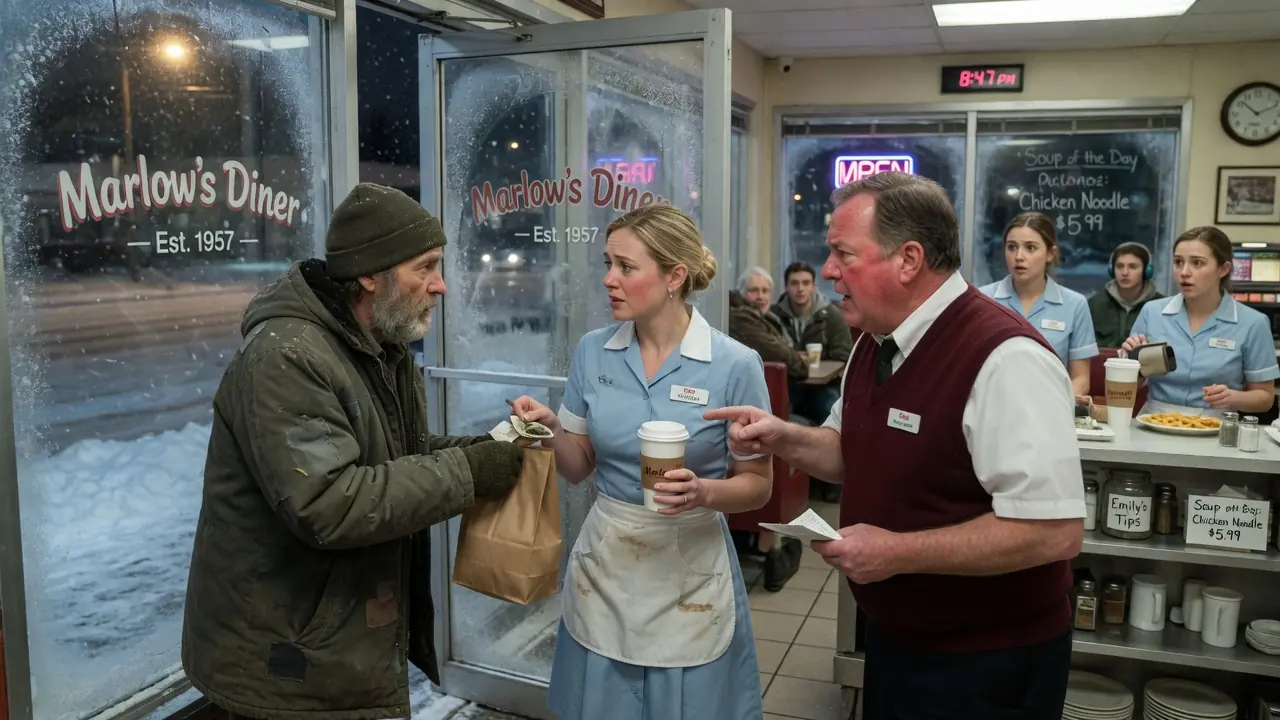
Thomas placed the document on the counter.
“I was considering Marlow’s Diner for acquisition,” he said.
Frank blinked. “Acquisition?”
“My company has been purchasing local restaurants to preserve them, improve wages, and expand community food partnerships. This diner was on our review list.”
Frank’s expression shifted instantly.
“Mr. Whitaker, I’m sure we can discuss this privately.”
“No.”
The word was calm, but final.
Thomas looked toward the kitchen.
“Is the owner here?”
Frank hesitated.
The younger woman lifted her tablet. “We have already contacted Mrs. Marlow. She is joining by phone in three minutes.”
Frank’s face turned a deeper shade of red.
Emily stood frozen, hardly breathing.
Thomas looked back at her.
“Miss Carter, may I ask you something?”
She nodded.
“Why did you help me?”
Emily glanced down at the envelope in her hands.
“Because you were hungry.”
“That’s all?”
She thought of the cold. The window. The way he had turned away.
“No,” she said softly. “Because I know what it feels like to need help and be ashamed to ask.”
Thomas’s eyes softened.
“And your brother?”
Emily looked up sharply.
He held up a hand. “Only what people told me. That you support him. That this job mattered.”
Emily’s voice tightened. “It did.”
Frank jumped in. “Mr. Whitaker, Emily was a decent employee, but she was emotional. She often brought personal problems into work.”
Brenda suddenly spoke from behind the counter.
“That’s not true.”
Everyone turned.
Brenda’s hands shook, but she continued.
“She covered shifts when people called out. She stayed late. She cleaned sections that weren’t hers. She never stole a thing.”
Luis stepped out of the kitchen.
“She paid for that food,” he said. “I saw the ticket.”
The truck driver at the counter added, “And I saw him fire her like she’d robbed the place.”
Frank looked trapped.
Thomas nodded slowly.
“Thank you.”
The phone on the counter rang.
Frank stared at it.
The younger woman answered and placed it on speaker.
“Mrs. Marlow, Mr. Whitaker is here with Frank Willis and Emily Carter.”
An elderly woman’s voice crackled through the speaker.
“Frank, what did you do?”
Frank’s mouth tightened. “Mrs. Marlow, this has been blown out of proportion.”
“Did you fire that girl for buying a hungry man soup?”
“Policy required discipline.”
“Did she pay for it?”
Frank said nothing.
“Frank?”
“Yes, but with an employee discount.”
Mrs. Marlow made a sound of disbelief.
“My late husband started that discount so employees could afford to eat. Not so you could punish kindness.”
Frank’s face twisted. “You hired me to protect your business.”
“I hired you to run a diner, not kill its soul.”
The words landed heavily.
Thomas looked at the phone.
“Mrs. Marlow, my offer still stands, but not under current management.”
Frank jerked his head toward him.
Mrs. Marlow was quiet for a moment.
Then she said, “Frank, collect your things.”
Frank went still.
“You can’t be serious.”
“I am.”
“I gave eight years to this place.”
“And forgot why it existed.”
Frank looked around the diner as if someone might defend him.
No one did.
Not Brenda. Not Luis. Not the truck driver. Not the customers who had heard enough.
Frank’s eyes landed on Emily, and for a second, she saw pure resentment.
Then he ripped his keys from his belt and slammed them on the counter.
“This place will fall apart without me.”
Mrs. Marlow’s voice was steady.
“We’ll take that chance.”
Frank walked to the back office, shoved papers into a box, and left through the rear door without looking at anyone.
The bell above the front door did not ring for him.
For several seconds, nobody moved.
Then Thomas turned to Emily.
“I owe you an apology,” he said.
Emily shook her head. “You don’t owe me anything.”
“Yes,” he said. “I do. Not because you helped me, but because you paid a price for doing something decent.”
Emily looked toward the diner floor.
“I just need a job,” she whispered.
Thomas smiled gently.
“I was hoping you would say that.”
She blinked.
“My company is opening a community café downtown in six weeks,” he said. “It will serve paying customers, but it will also provide meal vouchers through local shelters and schools. We need someone who understands both service and dignity.”
Emily stared at him.
“I don’t have management experience.”
“You have something harder to teach.”
The younger woman stepped forward. “The position would begin with paid training next week. Full-time salary. Health benefits. Predictable hours.”
Emily’s lips parted, but no sound came out.
Thomas continued, “And if you want it, I would like you to help design the program that prevents people from being turned away simply because they are poor.”
Her eyes filled.
“I don’t know what to say.”
“Say yes if it helps you and your brother.”
At the mention of Noah, Emily covered her mouth.
A full-time salary. Health benefits. Predictable hours.
Words that sounded almost unreal.
“I need to work,” she said. “I’ll work hard.”
“I know.”
Mrs. Marlow spoke through the phone again.
“Emily?”
Emily turned toward it.
“Yes, ma’am?”
“I’m sorry.”
That nearly broke her more than the job offer.
Mrs. Marlow continued, “If you’re willing, I’d like you to stay today and help Brenda and Luis get through the shift. Paid, of course. And if Mr. Whitaker’s café is where you belong, I won’t stand in your way.”
Emily wiped her cheek quickly.
“Yes, ma’am. I can do that.”
The truck driver at the counter raised his coffee mug.
“Good,” he said. “Because nobody here remembers my pie order except her.”
A small laugh moved through the diner.
For the first time in days, Emily breathed.
That evening, after finishing the shift, she walked home with more than her final paycheck. She carried an official job offer letter, a temporary advance for training expenses, and a paper bag from Luis filled with soup, rolls, and a slice of cherry pie for Noah.
When she reached the apartment, Noah was at the kitchen table again, but he was not drawing.
He was staring at a stack of bills.
Emily set the paper bag down.
“I got a job.”
Noah looked up so fast his chair scraped the floor.
“What?”
She handed him the offer letter.
He read it once.
Then again.
Then his eyes widened.
“Emily.”
“I know.”
“Health benefits?”
“I know.”
“Full-time salary?”
“I know.”
“Community café program assistant?” He looked at her. “That sounds important.”
Emily laughed through fresh tears.
“I think it is.”
Noah stood and hugged her tightly.
She held him like she had when he was small, when storms frightened him and he believed she could fix anything by staying close.
“I thought we were going to lose everything,” he whispered.
She closed her eyes.
“So did I.”
“What happened?”
Emily looked at the soup bag on the counter.
“The man I fed came back.”
Noah pulled away, stunned. “The homeless man?”
“Yes.”
“And he gave you a job?”
“He gave me a chance.”
Noah sat down slowly, still holding the letter.
For a long time, he said nothing.
Then he whispered, “You were right.”
“About what?”
“Dreams need food too.”
Emily smiled, tired and grateful.
“Yes,” she said. “They do.”
Six weeks later, the Whitaker Community Café opened on the corner of Maple and Third, inside a renovated brick building with wide windows, blue booths, and a small sign near the counter that read:
A meal served with dignity feeds more than hunger.
Emily helped choose those words.
The café did not look like a shelter. That was important to her. It looked like a place anyone could enter without shame. Office workers came in for sandwiches. Students came in for coffee. Parents came in with children after school. And every day, people with meal vouchers stepped up to the same counter, ordered from the same menu, and sat at the same tables as everyone else.
No separate line.
No lowered eyes.
No whispered judgment.
Emily trained the staff herself.
“Look people in the face,” she told them. “Use their names if they give them. Don’t make anyone explain their whole life to earn a bowl of soup.”
Thomas visited often, sometimes with his daughter, sometimes alone. He never made a show of what he had done. He simply sat near the window, drank coffee, and watched the café fill with life.
One afternoon, months after the opening, Emily was reviewing inventory when Noah came in wearing a button-down shirt and carrying a folder.
“What are you doing here?” she asked.
He grinned nervously.
“I wanted to show you something.”
He opened the folder.
Inside were sketches of the café.
Not just drawings, but detailed architectural renderings: the front windows, the counter, the seating layout, the sign near the register. He had drawn people inside too. A mother holding a child’s hand. An older man reading a newspaper. A young waitress behind the counter.
Emily stared at the final drawing.
It showed her standing near the door, holding a takeout bag.
Outside the glass was a man in a thin coat.
But in the drawing, the door was open.
Emily looked up at Noah, tears already gathering.
“My architecture teacher wants me to submit these for a scholarship contest,” he said. “The theme is spaces that change lives.”
Emily touched the edge of the paper.
“This is beautiful.”
Noah smiled softly.
“It’s our story.”
She shook her head. “It’s yours too.”
A voice behind them said, “It should be framed.”
Emily turned and saw Thomas standing nearby.
Noah straightened, suddenly shy.
Thomas looked at the drawings with genuine admiration.
“You have talent,” he said.
“Thank you, sir.”
“Do you plan to study architecture?”
Noah glanced at Emily.
“I hope so.”
Thomas nodded. “Then let’s make sure hope has paperwork.”
Emily frowned slightly. “Mr. Whitaker.”
He smiled. “Not charity. Investment. My foundation offers scholarships for students interested in designing community spaces. I think Noah should apply.”
Noah’s face went pale with disbelief.
Emily wanted to protest, not because she was ungrateful, but because receiving help still frightened her.
Thomas seemed to understand.
“Emily,” he said gently, “you opened a door for me when everyone else looked away. Let someone open one for him.”
She looked at Noah.
His eyes were shining, but he was waiting for her permission, as if he would give up even this if it made her uncomfortable.
Emily thought of all the years she had counted dollars, counted meals, counted days until bills were due.
Then she thought of the night she had spent twelve dollars on soup.
She had believed she was losing money.
Instead, she had been planting something.
She nodded.
Noah exhaled shakily.
“Thank you,” he whispered.
Thomas placed a hand over his heart. “Earn it by building places where people feel human.”
Noah nodded. “I will.”
That winter, Marlow’s Diner changed too.
Mrs. Marlow sold part of the business to Whitaker Hospitality but stayed involved as a consultant. Frank Willis never returned. Brenda became general manager. Luis received a raise and eventually added his mother’s chicken stew to the Thursday menu.
Near the register, Mrs. Marlow placed a small framed policy.
No employee will be punished for compassion. If someone is hungry, call a manager. We will find a way.
People talked about it for weeks.
Some mocked it. Some praised it. Some came in just to see if it was real.
It was.
And every Thursday, Marlow’s Diner donated soup to the Whitaker Community Café.
Emily did not visit often. Not because she was bitter, but because life had moved forward. Still, one snowy evening nearly a year after she had been fired, she stopped by to pick up a donation order.
The bell above the door jingled.
For a moment, the sound pulled her back to that night: Frank’s red face, the apron in her hands, the humiliation of being watched.
Then Brenda came from behind the counter and smiled.
“Emily Carter,” she said. “Best waitress this place ever lost.”
Emily laughed.
Luis waved from the kitchen.
The truck driver, still a regular, raised his mug.
“Cherry pie girl.”
Emily shook her head, smiling.
As Brenda helped load containers of soup, Emily noticed a young server standing near the window, staring outside with worry.
“What is it?” Emily asked.
The girl looked embarrassed.
“There’s a woman out there with two kids. She came in earlier asking if we had leftovers, but I didn’t know what to do.”
Brenda looked at Emily.
Emily looked at the girl.
Then she walked to the window.
Outside, a mother stood beneath the streetlight, holding a child’s hand while another child leaned against her side. Their coats were too thin for the weather. The mother’s face carried the same expression Emily had seen before.
Hunger mixed with shame.
Emily turned back.
“Pack three meals,” she said.
The young server hesitated. “Can we?”
Brenda pointed to the framed policy.
“We can.”
The girl smiled with relief and hurried to the kitchen.
Emily stood near the counter, looking at the sign, and felt something inside her settle.
A year ago, kindness had cost her everything she thought she could not afford to lose.
But it had also revealed what was worth keeping.
Not the job.
Not Frank’s approval.
Not the fragile safety of staying silent.
What mattered was the choice she made when nobody expected her to make it.
The door opened, and the mother with two children stepped hesitantly inside.
Emily met her before she could apologize.
“Come in,” Emily said gently. “It’s cold out there.”
The woman’s eyes filled instantly.
“I don’t have money.”
Emily smiled.
“That’s okay. Tonight, dinner is already handled.”
The little boy looked up.
“Really?”
“Really.”
Brenda brought the meals. The young server added hot chocolate. Luis came out with extra rolls and pretended it was an accident.
The mother sat in a booth with her children, covering her face for a moment as if the kindness hurt.
Emily understood that feeling.
Kindness could hurt when life had trained someone to expect rejection.
As she left Marlow’s Diner with the donation boxes, snow began falling again. Soft flakes drifted beneath the streetlights, coating the sidewalk in white.
Her phone buzzed.
A message from Noah.
Scholarship results came in. I got it.
Emily stopped walking.
For a moment, she simply stood there in the snow, staring at the screen.
Then another message appeared.
We got it.
Emily pressed the phone to her chest and laughed through tears.
Across the street, the Whitaker Community Café glowed bright and full. People sat at tables with bowls of soup, cups of coffee, open notebooks, tired hands, hopeful faces. Through the window, she could see Thomas Whitaker sitting near the front, speaking with a man who looked newly arrived from the cold.
Emily walked toward the café, carrying soup that would feed strangers she might never know.
She thought of the night she had given away one meal.
She thought of Frank saying mercy did not pay rent.
He had been wrong.
Mercy had not paid rent that night.
It had done something bigger.
It had opened a door.
And through that door came a job, a future, a scholarship for her brother, a new policy at an old diner, and a café where hunger did not have to beg before being seen.
Emily stepped inside.
The bell above the door rang gently.
Thomas looked up from his table and smiled.
Noah’s message still glowed on her phone.
For the first time in years, Emily counted nothing.
Not dollars.
Not days.
Not fear.
She simply stood in the warmth of the place her kindness had helped build, and for once, she let herself believe that what she had given away had finally come back as something no one could take from her.
Hope.