Marcus Dalton walked into Maple Street Diner expecting eggs, coffee, and an hour of solitude before his Christmas shift started. What he found instead would expose a crime hiding in plain sight for 10 months. Please don't tell them I told you. Six words, barely audible, spoken by a child who'd learned that asking for help was dangerous.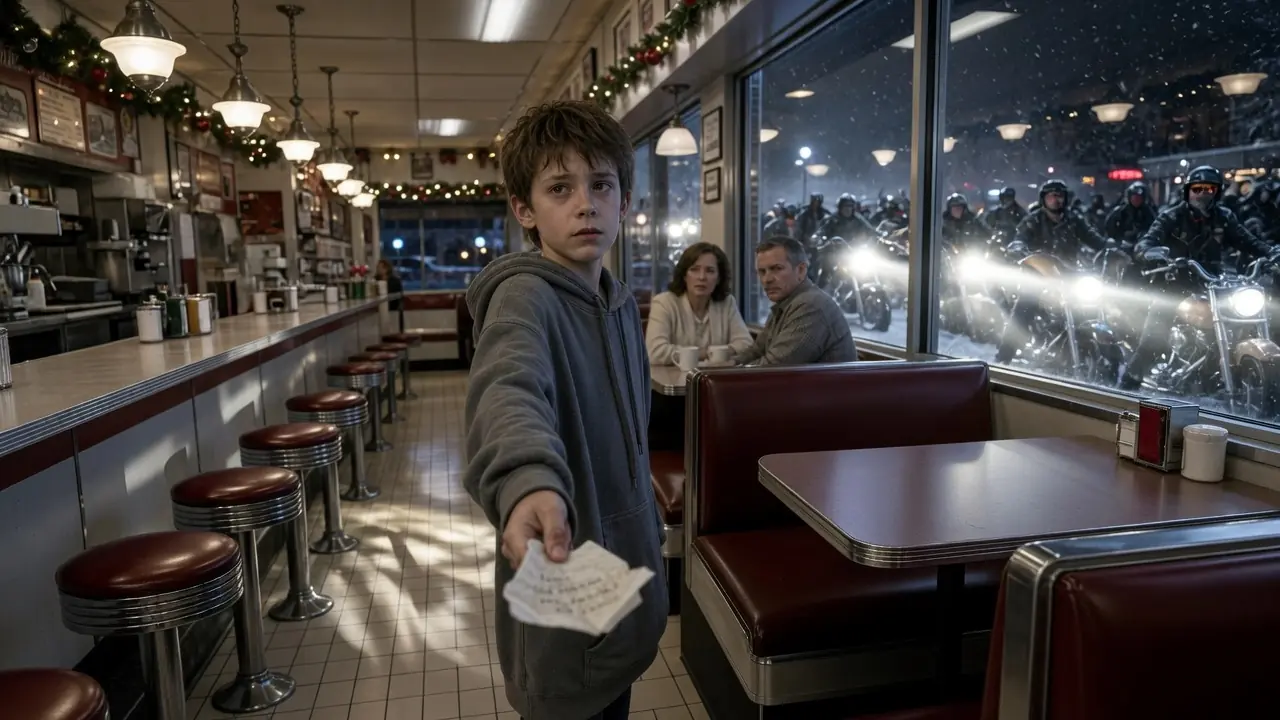
But staying silent was death. Marcus looked up from his paperback thriller, some forgettable Jack Reacher knockoff he'd grabbed at a gas station, and found himself staring into the most terrified eyes he'd seen since Afghanistan. The boy stood three feet from his booth, swaying slightly on feet that seemed too unsteady for a child his age. His hand trembled as he extended it, palm up.
Blood dripped from his index finger onto the white tile floor. Drip, drip, drip. Each drop landing with a sound that seemed impossibly loud in the sudden silence. In his other hand, a paper napkin.
Two words written in blood. Shaky letters that took real effort to read. Help me. Marcus set his book down carefully, slowly.
The way you move around spooked animals or trauma victims, which this kid clearly was. Every instinct from eleven years as a combat medic and eighteen years riding with the Hell's Angels screamed that this child was in immediate danger. "You're safe now, son," Marcus said quietly, his voice low and calm. "I promise." The boy's eyes flicked toward the back of the diner, his whole body tensed.
Marcus followed his gaze and saw them. A middle-aged couple in a booth near the bathroom. The woman had that smile, the one Marcus had learned to recognize in his years volunteering with CASA. The smile that said, "I'm a good person doing a noble thing." While everything beneath it screamed lies.
Marcus stood slowly, then dropped to one knee, so he was eye level with the boy. He held out his left hand, the one with the missing ring and pinky fingers, severed in an industrial accident twenty-four years ago. "See this?" Marcus said. "Means I know what pain looks like.
Means I know how to help." He reached forward carefully, telegraphing the movement, and placed his right hand on the boy's shoulder. Gentle, steady, grounding. "What is your name?"
"Matthew." The word came out like a confession. "Matthew Brener. And I have proof." Now you might be thinking, a hell's angel finds an abused child and violence is about to follow. Fists flying.
Leather and chrome and rage. That's not this story. Because Marcus Dalton had buried his 7-year-old daughter 8 years ago. And the lesson Leukemia taught him was this.
Anger doesn't save children. Strategy does. Evidence does. Staying calm when everything in you wants to burn the world down.
That's what saves lives. So Marcus angled his body between Matthew and that couple in the back booth. A human shield. Then he asked the question that would crack this case wide open.
"Where are they?" Matthew's eyes darted back toward the booth. Right there. Linda and Robert Hayes. my foster parents.
They brought me here so people would see us together. So everyone would think we're a normal family celebrating Christmas Eve. Marcus pulled out his phone, not to call 911. Not yet.
First, he needed to understand what he was dealing with. "Tell me what is happening, Matthew. All of it." And Matthew did. The words came fast once they started.
10 months of horror compressed into 90 seconds of whispered confession while Linda and Robert Hayes sat 40 ft away, probably congratulating themselves on another successful public appearance. There's eight of us, Matthew said. His voice shook but didn't break. All foster kids.
They keep us locked in the basement. We're not allowed upstairs except for church once a month. And even then, we have to smile and say we're blessed. We barely eat.
I used to weigh 71 lb before I came to live with them. Now I weigh 52. Marcus felt something cold settle in his chest. The kind of cold that came before action.
Before decisions that couldn't be undone. "How long has this been happening?" "Since May of last year. That's when my mom died and I went into foster care. It was okay at first.
Normal house rules. regular meals. But after about 2 months, they started moving us to the basement. Said it was temporary, just while they renovated our rooms.
Except our rooms never got renovated. We just stayed down there. And it got worse. Marcus pulled a napkin from the chrome dispenser on the table and pressed it gently to Matthew's bleeding finger.
"Have you told anyone? Teachers, doctors?" "Three times." Matthew's voice went hollow. I tried to tell my teacher, Mrs. Romano, when I still went to school.
She filed a report with CPS. A caseworker came to the house, but Linda showed them a fake bedroom upstairs that we never use. They closed the case in 2 days. Then Linda pulled me out of school for homeschooling, but we don't do any school work.
We just sit in the basement. "What about the second time?" "Our neighbor heard us crying at night. She called the police. Two officers came, but Linda said we'd been watching a scary movie and got upset.
The officers never even asked to see us. They just left. "And the third time?" "Doctor's appointment 6 months ago, required by the state. But Linda stayed in the room the whole time.
Three attempts, three failures, a child screaming for help in every way he knew how, and when the system just kept failing him. "Matthew," Marcus said carefully. "You mentioned proof." The boy reached into his hoodie pocket, the oversized gray thing that swallowed his thin frame, and pulled out an old smartphone. The screen was cracked, the case held together with duct tape.
I found this in the basement. It belonged to a foster kid who was there before me. Linda and Robert never found it when they cleaned out his stuff. I charged it using an outlet behind the water heater, and I recorded them talking.
Matthew's hands shook as he unlocked the phone. "They did not know I could hear them through the heating vent. They were talking about the CPS inspection coming up, about how much money they make from keeping us. He pulled up an audio file.
November 19th, 10:47 p.m. 4 minutes and 37 seconds long. Marcus hit play, volume low enough that only he and Matthew could hear. Robert Hayes's voice, tiny but clear.
We've had the full eight for almost two years now. As long as we pass the December inspection, we're clear for another 220K next year. Linda's voice. Matter of fact, I did the math.
Even with the new car payment, we're still clearing $185,000 profit. Best decision we ever made was scaling up to eight. The more you take, the more you make, and nobody checks that closely. Robert again, the key is keeping them weak enough that they won't fight, but healthy enough that they pass the basic exam.
That's the sweet spot. Marcus stopped the recording. He'd heard enough, more than enough. For 3 seconds, Marcus counted them.
Habit from years of tactical training. He sat perfectly still, processing, strategizing, calculating his next move. Then he stood, shrugging off his leather vest, the one with his Hell's Angels Wisconsin chapter patch, the one he'd earned after 18 years of brotherhood and blood. He draped it over Matthew's shoulders.
You see this patch? Marcus said, "Means under club protection now. means anyone who wants to hurt you has to go through all of us. And son, we number in the hundreds.
Matthew looked up at him. Something shifted in those exhausted hazel eyes. Not hope. Not yet.
But maybe the ghost of a possibility that hope could exist. You're never going back to that house. Marcus said, "Whatever happens next, you're done being hurt. That's my promise to you.
He pulled out his phone. Two calls to make. The first one to 911 would follow proper protocol. He was a mandated reporter, legally required to call when he witnessed child abuse.
But the second call, that was Brotherhood. First, 911. What's your emergency? This is Marcus Dalton, paramedic with Madison Fire Department.
I'm at Maple Street Diner, 847 East Johnson Street. I have a 10-year-old foster child with evidence of severe neglect and abuse. I'm looking at visible injuries, malnutrition, and I have a recording that documents criminal intent by his foster parents. They're in the building right now.
Officers are being dispatched. Stay on the line. They're here in 3 minutes or I'm handling this myself. Child is in immediate danger.
Marcus ended the call. Then he pulled up a different contact. Victor Dalton, his older brother, club president, former army chaplain who'd passed the bar but chose brotherhood over a courtroom. One ring.
"Priest, it's Reaper." "Marcus, Merry Christmas Eve, brother. You working tonight?" I need every brother within 50 mi at Maple Street Diner on East Johnson. Now, a pause. Marcus could picture Victor straightening in his chair.
That lawyer brain already spinning into tactical mode. What's going on? 10-year-old foster kid just handed me evidence of 10 months of abuse and financial exploitation. Eight children total, all trapped in a basement.
Foster parents are here in the diner right now, and I've got about 90 seconds before they realize their victim is talking to me. We're not waiting for the system to take their time on this one. "Say no more. We're coming." The line went dead.
That was it. No questions about proof or evidence. No concerns about legal complications. Just instant commitment because that's what brotherhood meant.
Showing up when a child needed protection, and when the system had already failed three times. Marcus looked down at Matthew, who was clutching the leather vest like a life raft. "How many brothers?" Matthew whispered. Marcus checked his watch.
11:52 p.m. By 2 a.m., I'd guess 200, maybe more. It's Christmas Eve, so most of them are local, probably at home or at the clubhouse. and every single one of them is about to drop whatever they're doing to make sure you and those seven other kids are safe by sunrise.
"Why?" It was a fair question. Marcus had known this child for less than 5 minutes. Most people would walk away. Most people had walked away.
Matthew had just told him about three failed attempts to get help. About a neighbor who heard crying and did nothing after one police visit. about a teacher whose report got buried. Marcus dropped to one knee again, so he was eye level with Matthew.
Eight years ago, I lost my daughter to leukemia. Hannah was 7 years old, and I couldn't save her. But you, you walked up to a stranger in a diner, bleeding and terrified, and asked for help. You were brave enough to record evidence.
Brave enough to keep that phone hidden for weeks. Brave enough to approach the scariest looking man in this room because you had no one else left to ask. He squeezed Matthew's shoulder gently. So, here's why.
Because I couldn't save Hannah, but I can save you. Because I was just following protocol is what people say when they're too afraid to do what's right. And because no child should ever have to be that brave alone, the next 15 minutes moved fast. Patrol officers arrived first.
Daniels and Kim, the same two who'd responded to the neighbors call 11 months ago and left without checking the basement. Marcus recognized them from the recording Matthew had played. Linda Hayes had mentioned their names when she'd bragged to Robert about how easy it had been to fool them. officers," Marcus said, voice calm and professional.
"Marcus Dalton, paramedic with MFD. I have a foster child here reporting severe abuse and neglect. I have a recording documenting financial exploitation and criminal intent. The alleged perpetrators are Linda and Robert Hayes, currently seated in the back booth." Officer Daniels looked at Matthew.
Really looked at him for the first time. the oversized hoodie, the bleeding finger, the way the kid flinched when Robert Hayes stood up to see what was taking so long. "We've been to that address before," Kim said slowly, recognition dawning. "Welfare check about a year ago.
Everything seemed fine." "Everything was not fine," Marcus said. "And this child has proof." That's when Linda Hayes made her move. She stood, smoothed her cardigan, put on that smile, and walked over like she was greeting old friends. Officers, Matthew, honey, what's going on?
You've been gone from the table for so long. We were getting worried. Her voice was pure sugar. Concerned mother, blessed caregiver.
The mask fit perfectly. Ma'am, Officer Daniel said, we're going to need you to wait over there while we talk to Matthew. Linda's smile flickered just for a second. I don't understand.
Matthew is our foster son. We have every right. Ma'am, please step back. That's when the sound started.
Low at first, distant, like thunder rolling in from the horizon. Then louder. Motorcycles. Dozens of them.
By the time Linda Hayes turned toward the diner's front window, the parking lot was filling with Harley-Davidsons. Row after row, chrome gleaming under the street lights, leather-clad riders dismounting in coordinated waves. Marcus checked his watch. 12:11 a.m.
19 minutes since his call to Victor. 67 brothers had just arrived, and they were just the first wave. The diner went silent except for the rumble of engines cutting off one by one. 67 Harley-Davidsons parked in perfect formation across the lot and along East Johnson Street.
The riders dismounted with synchronized efficiency. Men and women in black leather vests, all bearing the same patch, all moving like they'd done this a thousand times before. because they had. Now, I know what you're thinking.
200 bikers about to descend on a diner. A terrified foster family. Christmas Eve chaos about to explode. Fists flying.
Chrome and leather and vigilante justice. That's not what happened. What happened was something most people never see from the Hell's Angels. discipline, strategy, the kind of coordinated operation that comes from decades of brotherhood and a collective understanding that this wasn't about revenge.
It was about rescue. Victor Priest Dalton walked through the diner's front door first. 58 years old, gray beard down to his chest, wearing reading glasses that made him look more like a professor than a biker, which made sense. He'd passed the Wisconsin bar in 1994, spent two years as an Army chaplain before that.
Behind him, four others, each chosen for a specific role. Bones Thompson, 52, ex-homicide detective from Milwaukee PD, 26 years on the force before he retired with full pension and joined his brother's club. He knew every legal procedure, every admissible evidence rule, every way to make sure this case stuck. Doc Vasquez, 47, trauma nurse at UW Hospital for 19 years.
the only female officer in the chapter and the one everyone wanted around when things went medical. She was already assessing Matthew with trained eyes, noting the weight loss, the bleeding finger, the rope burns visible when his sleeves rode up. Scholar Park, 39, former social worker turned bike mechanic. He'd spent 11 years in the foster system, both as a kid who'd survived it, and as a case worker who'd tried to fix it from inside.
He understood how these operations worked, how they hid, how they justified themselves in paperwork that looked legitimate until you knew what questions to ask. Wire Chen, 34, IT security specialist who ran penetration testing for banks during the day and handled all digital evidence for the club at night. He'd already pulled out his laptop, already connected to a mobile hotspot, already preparing to document everything that was about to unfold. Marcus met them near Matthew, who was still wearing the leather vest, still gripping it like armor.
Brother, Victor said quietly, his voice carrying that pastoral calm that made people instinctively trust him. Tell me what we've got. Marcus handed him the phone with the recording. Matthew Brener, age 10, foster care placement with Linda and Robert Hayes for 10 months.
Eight children total in the home, all kept in the basement. I've got a 4 and 1/2 minute recording of the Hayes discussing financial motive. $220,000 annual profit from foster care stipends. Child presents with visible malnutrition, injuries consistent with restraint, and credible testimony of three failed intervention attempts by authorities.
Victor listened to 30 seconds of the recording. That's all it took. He looked at Bones, who nodded once. That's felony child abuse, child endangerment, fraud, and about six other charges I can think of off the top of my head.
Bones said recording is admissible. Wisconsin is a one-party consent state, and Matthew had reasonable expectation that he was being threatened. Plus, he's a minor in immediate danger. This is solid.
Officer Daniels was still standing near Linda Hayes, looking increasingly uncomfortable as more bikers filed into the diner, not aggressive, not shouting, just present, taking up space, bearing witness. Sir, Daniel said to Victor, "This is an active police investigation. I'm going to need your people to My people, Victor interrupted gently, are witnesses. We're citizens exercising our First Amendment right to observe law enforcement activity in a public space.
We're not interfering. We're documenting. Wire Chen held up his laptop. Recording everything.
audio, video, timestamps, full chain of custody documentation for any evidence we observe. All completely legal. Scholar stepped forward, pulling out a folder that seemed to materialize from nowhere. I've also got Matthew's full foster care file.
I pulled it 20 minutes ago through FOIA request I filed last week. I volunteer with CASA, so I have access. You want to know something interesting, Officer Daniels? What's that?
This is the fourth CPS investigation into the Hayes household in 3 years. Fourth, every single one closed as unfounded within 72 hours. Now, either these are the most unlucky innocent foster parents in Wisconsin or someone at Dane County Child Protective Services has been systematically burying complaints. The room shifted.
You could feel it. That moment when the narrative changed from bikers interfering with police work to bikers exposing systemic corruption. Officer Kim pulled Daniels aside. Their voices were low, but Marcus caught fragments.
Pattern of complaints. Look bad if we ignore this. Recording is pretty damning. Linda Hayes's smile was gone now.
She'd moved back to the booth where Robert sat, both of them whispering urgently. Robert's hand was in his pocket, probably reaching for his phone, probably texting his lawyer. Too late. Victor turned to the crowd of brothers now filling the diner and spilling out onto the sidewalk.
He didn't raise his voice. Didn't need to. Here's what's going to happen, he said. Officers Daniels and Kim are going to arrest Linda and Robert Hayes.
They're going to secure the residence at 1847 Riverside Avenue and conduct a welfare check on seven additional children currently at that location. And we're going to accompany them as witnesses, as advocates, and as citizens who give a damn about whether children live or die in our community. He turned to Matthew. Kelt down so he was eye level with the boy, just like Marcus had.
Matthew, you did something incredibly brave tonight. You asked for help when every adult in your life had taught you that asking for help only made things worse. You collected evidence. You survived 10 months of hell, and you kept fighting.
That's courage. Real courage. Matthew's eyes were wet. He wiped them with the sleeve of Marcus's vest.
"Are the other kids going to be okay?" he whispered. "Yeah, son. They are. I promise you that." Dorothy Keane had been a waitress at Maple Street Diner for 14 years.
She'd seen everything. Drunks, fights, marriage proposals, breakups, late night confessions that came with too much coffee and not enough sleep. But she'd never seen anything like the Hayes family. When Detective Bones Thompson interviewed her 20 minutes later, right there in the diner, while Wire documented everything, and Scholar took notes, her hands shook as she poured coffee.
"I served them," Dorothy said. She was 62, gray hair pulled back in a tight bun, wearing a name tag that had lost its shine years ago. They came in around 7:30 p.m. The boy, Matthew, he looked terrified.
Wouldn't make eye contact, barely spoke. "What did you observe specifically?" Bones asked, his detective voice calm and methodical. "The foster mother, Linda, she did all the talking. Ordered for all three of them." When Matthew asked quietly if he could have water, she smiled at me and said, "He's always so dramatic.
We just want him to finish his vegetables first, teaching responsibility. You know how it is." Dorothy's voice cracked. I thought I thought she was just a strict parent. I didn't realize.
What else did you notice? His finger was bleeding. I saw it when he was sitting at their table, like he'd bitten the cuticle until it bled. and his clothes were dirty.
Not like kid playing outside dirty, like he'd been wearing them for days. There was a smell, too. Mildew, like clothes that had been left wet and never properly dried. She looked down at her notepad at the orders she'd written hours ago.
They ordered two full meals, steak and eggs, for both adults, probably $35 total. for Matthew. They ordered a side of steamed vegetables. No protein, no starch, just vegetables.
And Linda kept talking about how blessed they were to care for children nobody else wanted, how it was their Christian duty, even when the kids were difficult. Dorothy met Bones's eyes. I knew something was wrong. I've been waitressing long enough to know what fear looks like.
But it was Christmas Eve and they seemed so respectable, so normal. And I thought, maybe I'm wrong. Maybe I'm seeing things that aren't there. So, I just I brought them their food and I didn't say anything.
Her voice dropped to a whisper. I should have said something. Carlos Mendoza, 71, sat at the counter nursing his third cup of coffee when Scholar approached him. Carlos came to the diner every Thursday night, had for the past 6 years, ever since his wife passed, and the house got too quiet.
He'd seen the whole thing unfold. I heard them, Carlos said. His English carried a slight accent. He'd immigrated from Mexico in 1978, worked construction for 40 years before retiring.
The foster mother, when she was talking to the waitress, she said, he paused, pulling out a small notebook where he'd written it down. We're blessed to care for children nobody else wanted. It's our Christian duty, even when they're difficult. Why did you write that down?
Scholar asked. because it bothered me the way she said it, like she was performing, like she wanted everyone to hear how good she was. Carlos shook his head. My daughter is a social worker in Texas.
She tells me about people like this. People who foster children for the money, for the image, but not for the children. When I saw the boy walk up to that biker, when I saw the blood on his finger, I knew I knew I was watching something bad. Did you consider intervening?
Carlos looked ashamed. I thought about it, but I'm an old man. What would I do? And they looked so respectable.
Nice clothes, clean, polite. Who would believe me over them? He gestured to the brothers filling the diner. That's why I'm glad you all came, because someone needed to believe that boy, and if the police wouldn't, at least you did.
By 1:15 a.m., the operation had expanded to 1847 Riverside Avenue. 83 motorcycles now lined the residential street, a quiet suburban development, where every house looked the same, where Christmas lights twinkled on porches and inflatable Santaas glowed in front yards, where neighbors had heard children crying for months and told themselves it was nothing. Melissa Rodriguez stood on her front porch at 1849 Riverside Avenue wrapped in a bathrobe watching officers enter the Hayes house next door. She'd lived there for 9 years.
She'd called the police once 11 months ago. They'd told her everything was fine. Doc Vasquez approached her while Scholar stood nearby, ready to document. Rodriguez.
Doc's voice was gentle. professional. I'm Patricia Vasquez, trauma nurse at UW Hospital. I'm also a volunteer advocate with the Hell's Angels Child Protection Initiative.
Can I ask you a few questions? Melissa nodded, tears already forming. I knew I knew something was wrong. Tell me what you heard.
Children crying at night. Not just normal crying. The kind of crying that sounds like fear, like pain. sometimes screaming.
It happened two, three times a week, always late at night after 10:00 p.m. Melissa wrapped her arms around herself. I called the police in January. Two officers came.
They went next door, talked to the Hayes, and left. They told me they'd checked and everything was fine, that the Hayes had been watching a scary movie with the kids. Did you believe that? No.
But what was I supposed to do? I called the police. They investigated. They said it was fine.
I'm just a neighbor. Who was I to argue with trained officers? She wiped her eyes. But I should have done more.
I should have called again. I should have demanded they actually check the basement. I should have Ms. Rodriguez.
Doc interrupted gently. You did what you thought was right. You called the authorities. The system failed.
That's not on you. But those children, those children are about to be safe. Because someone finally listened. Because a 10-year-old boy was brave enough to ask for help one more time.
And because 180 bikers decided that Christmas Eve was the perfect night to make sure no child spent another night in hell. Melissa looked at the motorcycles lining the street, at the men and women in leather vests standing in disciplined formation, not threatening, just present, bearing witness. "Thank you," she whispered. "Thank you for doing what I should have done." Inside the house, officers found exactly what Matthew had described.
The basement door had three dead bolts on the outside. all locked. It took Officer Kim four minutes to get them open. The smell hit them first.
Eight children, one toilet, no ventilation. The basement was freezing. 58° according to the thermostat on the wall, which had been manually set and locked with a key. Four metal bunk beds, thin blankets, no toys, no books, no comfort items of any kind.
Seven children, ages 4 to 12, huddled together on one bottom bunk. They flinched when the officers entered. The youngest, a girl who looked about four, started crying immediately. Doc Vasquez pushed past the officers.
She'd seen trauma before. burns, gunshots, car accidents, child abuse cases that made seasoned nurses vomit in supply closets. But this, the systematic, calculated neglect, this was different. "Hey, sweethearts," she said softly, kneeling near the bunk.
"My name is Patricia. I'm a nurse. These police officers are here to help you. Nobody's going to hurt you anymore.
Okay. The oldest girl, maybe 11, spoke. Where's Matthew? Matthew is safe.
He's with my friend Marcus. He's the one who asked us to come get you. Is he in trouble? The girl's voice shook.
They always said if we told anyone, we'd be in trouble, that we'd be separated, that nobody would ever want us. No, baby. Matthew's not in trouble. Matthew's a hero and you're all heroes because you survived and now we're taking you somewhere warm and safe.
Doc pulled out her phone and called the hospital. This is Patricia Vasquez, RN, calling from 1847 Riverside Avenue. I need ambulances for seven pediatric patients, ages approximately 4 to 12, all presenting with signs of severe neglect and malnutrition. We need full medical workups, mandatory reporters notified, and DCF emergency custody arranged.
Yes, I'll wait with them. No, they cannot wait until morning. These children need medical attention now. While Doc coordinated medical care, Scholar was in the Hayes's home office upstairs, going through their financial records with wire documenting everything.
"You need to see this," Scholar said to Detective Bones, who'd followed them up. The evidence was damning, organized, almost methodical in how it revealed the scope of the operation. Bank statements showed deposits of $18,333.33 per month from the Wisconsin Department of Children and Families, regular as clockwork. eight children at $2,291.67 per month each.
Total annual income $220,000. Expense records showing the Hayes spent approximately $1,200 per month on food for all eight children. That's $150 per child per month. For comparison, the USDA estimates it costs $250 to $350 per month to adequately feed one child.
Credit card statements $68,000 purchase at a Chevy dealership in October 2024. $32,000 payment to Crystal Blue Pools in August 2020. for a $8,500 charge to Disney World vacation packages in December 2023 dated for a week when according to school records scholar had pulled Matthew had been marked as homeschooled and would have been locked in the basement. They left them alone for 6 days, Scholar said his voice tight with rage he was barely controlling.
They went to Disney World and left eight children locked in a basement with minimal food for 6 days. Wire's fingers flew across his keyboard. I'm pulling their full financial history. Give me 10 minutes.
It took him seven. Got something. Wire said. Previous foster care incident from 2021.
A 7-year-old girl named Emma Rodriguez was removed from their care after showing up to a routine medical checkup with suspicious injuries. CPS investigated. Hayes claimed the child was self-harming due to trauma. Investigation found insufficient evidence of abuse.
What happened to Emma? Bones asked. She was placed with a different family. But here's the thing.
Look at the Hayes bank records from that time period. Wisconsin DCF paid them a $15,000 settlement in March 2021 to avoid a lawsuit. The Hayes claimed the investigation damaged their reputation. Scholar pulled up Emma's case file on his own laptop.
She's 13 now, living with an adoptive family in Michigan. I can reach out to her caseworker, but I'm guessing if we dig deeper, we'll find a pattern. The Hayes take vulnerable children, exploit them until someone gets suspicious. Then either the complaint gets buried or they transfer the child out before any real investigation happens.
Clean slate. Start over. How many times? Bones asked.
According to DCF records, Scholar scrolled through pages of placements, 23 different foster children over 7 years, not a single placement lasted longer than 11 months. Children always moved to better placements or reunified with family. Nobody questioned why a couple supposedly dedicated to foster care never adopted a single child, never had a long-term placement, just a constant rotation of kids coming and going. Wire pulled up another document.
And here's why. Look at this email exchange between Linda Hayes and Robert Hayes from November. Internal email sent from her personal account to his work account. The email dated November 23rd, 2024 from [email protected] to [email protected].
Subject: December planning. We need to tighten things up before the 28th inspection. I've already cut their portions by 15%. If we can pass this review, we're guaranteed another 220K next year.
With your raise coming through and our new investment properties, we're on track to hit 400K household income by 2026. Not bad for charity work. The only concern is Matthew. He's old enough to be credible if he talks.
The younger ones are easy. Nobody believes them. But a 10-year-old, we might need to consider requesting his transfer after the holidays. Document some behavioral issues and get a fresh placement.
Safer that way. Wire looked up from his screen. They were planning to get rid of him right after Christmas before he could become a bigger liability. which means tonight was Matthew's last chance," Marcus said from the doorway.
He'd been standing there for the last five minutes listening. If he hadn't asked for help tonight, he would have been transferred to another home, or worse, within 2 weeks, and none of us would have ever known about the other seven. Bones pulled out his phone. I'm calling the DA.
We've got more than enough for arrest warrants, multiple felony charges, and I'm recommending they pull every single case CPS closed on the Haye and reopen investigations because if there's one Emma Rodriguez, there are probably others. At 2:47 a.m., a detective named Sarah Yun pulled up a file that made everyone in that home office go silent. "I found something," she said. She'd been working with the Illinois chapter, 38 members who'd written in from Chicago when they heard the call.
Sarah was ex FBI, white-collar crimes division. She knew how to follow money. The Hayes didn't just exploit the foster system. They committed insurance fraud.
In 2010, before they started fostering, Linda Hayes took out a $164,000 life insurance policy on her elderly mother, Margaret Hayes. Standard policy, named herself as beneficiary. That's not illegal. Bones said, "No, but this is Margaret Hayes died in July 2020.
Cause of death listed as accidental fall down basement stairs. She'd been living with Linda and Robert for 3 months at that point. Medical examiner ruled it accidental. Case closed.
Sarah pulled up more documents. But look at Margaret's medical records from the 6 months before she died. Three different doctors noted suspicious bruising. One ER visit for malnutrition in a woman who had a comfortable pension and no history of eating disorders.
a neighbor complaint to adult protective services that was closed as unfounded after one visit. She looked around the room. Same pattern. Take in vulnerable people who depend on you.
Isolate them, neglect them, profit from them. And if anyone questions it, you're the respectable church-going couple doing noble charity work. Who's going to believe a traumatized foster kid or a confused elderly woman over you? Scholar closed his laptop slowly.
How many victims are we talking about? If we count the 23 foster children, Margaret Hayes and however many other elderly relatives or dependents they might have had access to. Sarah shook her head. Could be dozens.
We'll need to dig through every death certificate, every insurance policy, every placement that ended in transfer or reunification that we can't verify. The room went quiet, just the hum of laptops and the distant sound of ambulances arriving for the seven children still in the basement. Victor Dalton stood near the window, looking out at the street full of motorcycles, at the brothers and sisters who'd dropped everything on Christmas Eve to show up for eight children they'd never met. "Bones," he said quietly.
"What are we looking at for charges?" Bones pulled out his own notepad. For starters, eight counts of felony child abuse, one for each child. Eight counts of child endangerment, fraud against the Wisconsin Department of Children and Families, grand theft, false imprisonment, conspiracy to commit fraud, depending on what we find when we dig deeper, possibly elder abuse charges related to Margaret Hayes, possibly insurance fraud, possibly manslaughter, if we can prove negligence led to her death. What's the sentencing look like?
Conservative estimate: 15 years. more realistic given the scale and premeditation, 25 to 30 each. And bail, I'm going to recommend no bail. Flight risk, danger to vulnerable populations, strong evidence of premeditation.
But even if a judge grants bail, we're talking $500,000 minimum. The Hayes have equity in this house and about $70,000 in savings. But that's not enough to make bail and hire a lawyer good enough to beat this case. Victor turned back to the room.
Then let's make the arrest clean, legal, airtight. No mistakes that give them grounds for appeal. At 3:12 a.m., police arrested Linda and Robert Hayes. Not at their home, not in some dramatic standoff.
At Mike's Gambling Den, a 24-hour casino bar four miles from their house. Because when officers went to arrest them at 1847 Riverside Avenue, the Hayes weren't there. They'd left shortly after the police arrived, right after they realized they couldn't talk their way out of this one. They'd driven straight to Mike's where Robert Hayes was a regular.
Officers found them at a slot machine. Robert was playing video poker, a beer in one hand, casually feeding $20 bills into the machine like it was any other Thursday night. Linda sat next to him, scrolling through her phone, probably deleting evidence or texting her lawyer. They looked up when six officers approached, Daniels and Kim, plus four others from the night shift.
Behind them, Victor Dalton and Bones Thompson. Behind them, 43 Hell's Angels members who'd followed from the house. Robert Hayes looked annoyed. Actually annoyed, like he'd been interrupted during an important meeting, not caught fleeing the scene of a crime that had destroyed eight children's lives for 10 months.
"Can I help you?" Robert said. "Robert James Hayes and Linda Marie Hayes," Officer Daniels said, voice formal and careful. You're under arrest for felony child abuse, child endangerment, fraud, and false imprisonment. He read them their Miranda writes right there in the casino.
Every word clear, every procedure followed exactly. Robert's face went red. This is ridiculous. You can't just, "Sir, put your hands behind your back." Linda started crying.
Real tears. the kind that might have worked on a church congregation or a CPS case worker. We've done nothing wrong. We've dedicated our lives to helping children that nobody else wanted.
This is persecution. This is ma'am, hands behind your back now. The casino had gone silent. Slot machines still chiming, but every person in the building watching as two respectable looking suburban foster parents were handcuffed and led toward the exit.
That's when Linda saw the bikers. 43 men and women in leather vests standing in formation near the door. Not blocking the exit. Not threatening, just watching, bearing witness.
Linda's mask finally cracked. "You can't do this," she screamed. "We're good people. We go to church.
We volunteer. We've done nothing but try to help those damaged children, and this is how we're repaid with persecution, with lies from ungrateful. That's enough, Officer Kim said. They led Linda and Robert Hayes out through the casino, past the bikers, into separate patrol cars.
The casino parking lot was lit up like daylight. Police cruisers, ambulances, 43 motorcycles, and every employee and patron who'd come outside to watch. Victor Dalton stood near Marcus, both watching the patrol cars pull away. "Think it'll stick?" Marcus asked.
"Yeah," Victor said. "Recording alone would probably be enough. Add in the financial records, the witness testimonies, the seven other children, the pattern of previous investigations, and the possible insurance fraud. They'll take a plea deal before this sees trial.
My guess is 15 years each, eligible for parole in 8." That's not enough. No, Victor agreed. It's not, but it's what we've got, and it's more than those kids had yesterday. He turned to face the brothers and sisters who'd shown up tonight, 83 members from Wisconsin, 45 from Illinois, 38 from Minnesota, 30 from Iowa, plus another dozen who'd started driving but turned back when they got word the arrests had been made.
Nearly 200 Hell's Angels had mobilized in under 4 hours on Christmas Eve. Victor didn't raise his voice. He never needed to. What we did tonight was legal, strategic, clean.
We didn't threaten anyone. We didn't touch anyone. We showed up. We documented everything.
We assisted law enforcement. and we made sure eight children who'd been invisible for 10 months were finally seen. He paused. By 4:30 a.m., all eight children were at University of Wisconsin Hospital.
Doc Vasquez coordinated triage. Matthew first. He'd been without proper medical attention the longest and showed signs of possible infection from his self-inflicted finger wound. Then the seven others in order of medical urgency.
The four-year-old girl with a persistent cough that suggested respiratory infection, a six-year-old boy with untreated dental abscesses, two sisters, ages seven and nine, both presenting with severe malnutrition, and three others whose bodies told stories their mouths were still too afraid to speak. Marcus stayed with Matthew through every exam, every x-ray, every blood draw. The kid never let go of that leather vest, even when nurses needed to check his vitals. You can keep it, Marcus said at one point, watching Matthew clutch it tighter.
"Consider it yours until you don't need it anymore." "When will that be?" Marcus thought about his daughter Hannah, about how long it had taken him to stop reaching for his phone to call her. About how grief didn't follow a schedule and healing didn't work on a timeline. However long it takes, he said, "Could be weeks, could be months, could be you wake up one day, 5 years from now, and realize you haven't thought about them in a while. There's no rush, Matthew.
You survived 10 months of hell. You get to heal at whatever pace feels right. Dr. Sandra Ye, the same pediatrician who'd examined Matthew 8 months ago and accepted Linda's lies about him being a picky eater, stood in the doorway.
Her face was pale, hands shaking slightly as she held Matthew's medical chart. "I failed him," she said quietly to Doc Vasquez. He was sitting right there in my exam room in April, underweight and terrified. And I believed her.
I believed the foster mother when she said he was just traumatized. I noted his weight loss and did nothing. Doc didn't sugarcoat it. Yeah, you did fail him.
You missed signs that should have been obvious, but you know what? So did teachers, neighbors, police officers, and CPS case workers. This wasn't one person's failure. It was a system designed to believe respectable looking adults over vulnerable children.
That doesn't excuse No, it doesn't. But you're here now. At 4:30 in the morning on Christmas Day, you're here. So, either you can drown in guilt or you can help make sure Matthew and those seven other kids get the care they should have gotten 18 months ago.
Your choice. Dr. Ye wiped her eyes, straightened her shoulders. What do they need?
Everything, Doc said. Complete medical workups, dental care. Three of them have cavities that have probably been hurting for months. nutritional plans that account for refeeding syndrome, trauma therapy, educational assessments to figure out where they're at academically after months of no schooling, and someone to coordinate all of it because DCF is going to be overwhelmed.
I'll coordinate it, Dr. Ye said. All eight kids. I'll make sure they get every appointment, every followup, every service they need.
Consider it my penance. Don't do it for penance, Marcus said from Matthew's bedside. Do it because they deserve it. By 6:15 a.m., Scholar had emergency housing arranged.
Not a group home, not a temporary shelter. eight separate foster placements with families he'd personally vetted. Families from the CASA network who'd been through extensive training, who'd passed enhanced background checks, who understood that these children would need patience and safety and consistency. Matthew would stay with the Johnsons, Daryl and Patricia Johnson, both in their 50s, who'd fostered 12 children over the past decade.
Two of those children they'd adopted. The others they'd helped reunify with biological family or transition to permanent placements. They had a track record. References a home that had been inspected not by overwhelmed case workers, but by advocates who actually gave a damn.
Scholar sat with Matthew in his hospital room at 7 a.m. showing him pictures on his phone. This is where you'll be staying. Scholar said it's temporary, just until DCF figures out a long-term plan.
But the Johnsons are good people. I've known them for 6 years. They've got a guest room that's already set up. Warm bed, your own bathroom, books on the shelves if you like reading.
And their house rule is simple. If you're scared, if you need something, if anything feels wrong, you speak up. They listen. What about the others?
Matthew asked. The other seven kids. Will I see them? Yeah.
Scholars coordinating weekly group sessions. A chance for all eight of you to see each other. Spend time together. You've been through something nobody should go through.
And you did it together. That matters. Those bonds matter. Matthew nodded slowly.
And Linda and Robert? They're in jail. Marcus said. Dane County lockup bail hearing is scheduled for December 27th, but the DA is recommending no bail.
Even if a judge grants it, they can't afford it. They spent all their money on trucks and pools and vacations. They've got nothing left. How long will they be in prison?
Marcus and Scholar exchanged glances. How much truth did a 10-year-old need? All of it. Marcus decided Matthew had earned honesty.
The DA is building a case for 25 to 30 years each. Could end up being less if they take a plea deal, maybe 15 years, eligible for parole after 8. But even the minimum, you'll be 18 years old before they're up for parole. And if they do get released, there'll be restraining orders.
They can't contact you, can't come near you. They're done hurting people. For the first time since Marcus had met him, Matthew's shoulders relaxed. Not all the way.
Trauma doesn't release its grip that easily, but enough that you could see the child underneath. The kid who'd lost his mother at 8 years old and then lost everything else for 10 months after that. I'm tired, Matthew said. Then sleep, Marcus said.
Real sleep. Safe sleep. Nobody's going to hurt you. Nobody's going to lock you in a basement.
You're in a hospital with nurses and doctors and about 15 bikers standing guard outside making sure nobody gets in here who shouldn't. Matthew looked toward the door. Sure enough, through the small window, you could see Bones Thompson sitting in a chair in the hallway reading a paperback, sipping coffee, just there present. Why do they care?
Matthew asked. They don't even know me. Marcus thought about how to answer that. About brotherhood and protection and the unspoken code that meant you showed up when someone needed you, even if you'd never met them before.
8 years ago, Marcus said, "I lost my daughter to leukemia. I spent every day of her illness trying to save her, and I couldn't. But you, you saved yourself. You were brave enough to walk up to a scary-looking stranger and ask for help.
You were smart enough to collect evidence. You were strong enough to survive 10 months of adults telling you that you didn't matter. So when you asked for help, when you handed me that napkin with blood on it, you weren't just asking me. You were asking every person who's ever felt powerless, who's ever wished someone had shown up for them, who's ever known what it's like to need protection and not get it.
He squeezed Matthew's shoulder gently. We care because you matter, because every kid matters, and because I was just following protocol or I didn't want to interfere, or I thought someone else would handle it. Those are the excuses people give when they choose comfort over courage. We're not those people.
Matthew pulled Marcus's leather vest tighter around his shoulders. Can I keep this for a while? Yeah, son. However long you need it.
By noon on Christmas Day, Wire had established the Angels Watch program, a coordinated network across four Hell's Angels chapters, Wisconsin, Illinois, Minnesota, and Iowa. 216 members, including 10 with law enforcement backgrounds, nine with social work experience, 12 with medical training, and six with legal degrees. Their mission, assist with foster care oversight in their communities, attend CPS hearings as advocates, conduct welfare checks on at risk placements, provide emergency resources when the system moved too slowly, and most importantly, believe children when they said something was wrong. Wire built a secure database, encrypted communication channels, training protocols for how to document evidence, how to work within legal boundaries, how to assist law enforcement without interfering.
This wasn't vigilante justice. This was organized advocacy backed by people who understood that the system couldn't fix itself, but it could be pressured, monitored, forced to do better when citizens refused to look away. We're calling it Angel's Watch, Victor told Marcus at the hospital that afternoon. Because eight kids were invisible for 10 months, and we're making damn sure that never happens again in any community where we've got brothers and sisters paying attention.
Think it'll work? Already working. Wisconsin DCF received 62 complaints in the last 8 hours from our members who've been reviewing closed cases. Every single case involving the haze that was marked unfounded were demanding they reopen and the DA's office called me an hour ago.
They want to meet with Scholar and Bones tomorrow to discuss systematic reforms. Marcus looked through the window into Matthew's room where the kid was finally sleeping. Real sleep. The kind that came with safety instead of exhaustion.
Good, Marcus said. That's good. 3 days later at the Hayes bail hearing, Judge Caroline Martinez set bail at $750,000 each. Linda and Robert Hayes couldn't make it.
Their lawyer, a public defender who looked exhausted just reading the case file, argued for reduced bail based on community ties and lack of prior criminal record. The DA countered with evidence 23 previous foster children, four closed investigations, one suspicious death of an elderly parent with a $164,000 life insurance payout, and eight current victims who would spend the next decade in therapy trying to recover from 10 months of calculated abuse. Judge Martinez took less than 5 minutes to decide. Mr.
and Mrs. Hayes, she said, looking at them over her reading glasses. The evidence presented suggests a pattern of exploitation spanning multiple years and multiple victims. The vulnerable populations you had access to, foster children, elderly dependents, trusted you with their care, and you systematically betrayed that trust for financial gain.
I'm setting bail at $750,000 each with electronic monitoring. If you somehow make bail, you are not to have contact with any of the eight minor victims, any former foster children, or any individuals under the age of 18. Preliminary hearing is set for January 18th. She banged her gavel.
Linda Hayes cried. Robert Hayes stared straight ahead, face blank. They were led back to county lockup where they'd stay until trial. In the gallery, Matthew sat between Marcus and Patricia Johnson, his new temporary foster mother.
He wore clean clothes, jeans that actually fit, a blue sweater, sneakers that were his size. He'd gained 3 lb in 3 days of proper meals. His finger had been treated, bandaged, was healing. When the judge announced the bail amount, Matthew looked up at Marcus.
"Is it over?" "The legal part is just starting," Marcus said honestly. "There will be a trial probably next year. You might have to testify, though. The DA will try to avoid that.
But the important part, the part where you were in danger, yeah, that's over. You're safe now." Matthew nodded, then quietly. "Merry Christmas." It was three days late, but Marcus smiled anyway. "Merry Christmas, Matthew." 6 months later, on a warm June afternoon, the Hell's Angels Wisconsin chapter threw a birthday party.
Not at a clubhouse, not at a bar, at Lake Kegonsa State Park, 45 minutes outside Madison, where 180 bikers and their families gathered with grills and picnic tables and a birthday cake shaped like a motorcycle. Matthew Cole Brener turned 11 years old, surrounded by people who'd shown up for him when everyone else had failed. The Johnsons had adopted him officially in April. full legal adoption, permanent placement.
He had a family, a real one, the kind where nobody locked doors from the outside, and breakfast happened every morning, and I love you meant actual love, not performance. He'd gained 23 lb, grown 2 in, started sixth grade at a new school where he'd made the honor roll by December, and joined the science club. His therapist said he was doing remarkably well, which meant he still had nightmares sometimes. Still flinched at sudden movements.
Still carried Marcus's leather vest in his backpack even though he didn't wear it anymore. But he was healing slowly in his own time. The other seven children were thriving, too. Different families, different schools, but they saw each other every other week for group sessions.
coordinated by Scholar where they could talk about what they'd survived and remind each other that they weren't alone. Angel's Watch had expanded to 11 states. 437 Hell's Angels members trained as child advocates. They'd assisted with 127 cases in 6 months.
Some as simple as attending a CPS hearing to ask hard questions. Others as complex as coordinating multi-state investigations when vulnerable children were moved across borders. Bullying reports at Matthews school had dropped 78% after the principal invited Victor Dalton to speak at an assembly about what courage actually looked like. Not fighting, not intimidation, but standing up for people who couldn't stand up for themselves.
and Linda and Robert Hayes. They'd taken a plea deal in March, 15 years each in state prison. No parole eligibility for 8 years. When they were released, they'd be registered offenders, barred from working with children or vulnerable adults, monitored for the rest of their lives.
It wasn't enough. It would never be enough. But it was something. Marcus stood near the grills flipping burgers while Doc Vasquez argued with Bones about whether medium rare was actually safe or just asking for food poisoning.
Matthew ran past with two other kids his age, children of club members, friends he'd made in the 6 months since that Christmas Eve. He was laughing. That sound, a child laughing without fear, without checking over his shoulder to make sure nobody was watching, without wondering if he'd be punished for being too loud. That was the sound of healing.
Victor walked over, handed Marcus a beer. You did good, brother. We all did. No.
Victor said, "You made the choice. When that kid walked up to you in the diner, you could have looked away. could have told yourself it wasn't your problem, that he'd probably be fine, that someone else would handle it. Most people would have.
Most people did. Three teachers, two police officers, one doctor, half a dozen neighbors. But you didn't. You believed him.
You called for backup. You stayed with him through every step. Marcus watched Matthew blow out candles on his cake. 11 candles, one for each year of a life that almost ended at 10.
"I think about that night a lot," Marcus said. "About how close we came to missing him." If the Hayes had left the diner five minutes earlier. If Matthew had been too scared to approach me.
If I'd been too focused on my book to notice a bleeding kid walking toward my table. How many kids are we missing right now? Because the timing isn't right or they're too scared or we're too distracted. That's why Angel's Watch matters.
Victor said, "We can't save everyone, but we can pay attention. We can show up. We can refuse to accept unfounded as an answer when a child says they're being hurt." This story isn't really about bikers or patches or leather vests. It's about what happens when ordinary people decide that comfort is less important than courage.
When I don't want to get involved stops being an acceptable excuse for looking away from suffering. When a community decides that protecting vulnerable people matters more than maintaining the appearance of respectability. If you've ever felt invisible. If you've ever been the person crying for help while everyone walked past, this story is for you.
Because sometimes the scariest looking person in a room is exactly who you need. Sometimes the people society tells you to fear are the ones who show up when everyone else finds excuses. And if you've ever been the person who saw something wrong and looked away, who convinced yourself it wasn't your business or someone else would handle it, this story is also for you. Because Matthew tried three times to get help before Christmas Eve.
Three times adults could have saved him. And three times they chose protocol over protection, paperwork over people, institutional reputation over one child's life. The fourth time he asked a stranger, a man with scars and missing fingers and a leather vest covered in patches that made parents pull their children away. A man who society taught you to fear.
And that man dropped to one knee, looked Matthew in the eye, and said, "You're safe now." That's the difference between following rules and doing what's right, between believing what's convenient and believing what's true. Between being a bystander and being a protector. There are Matthews everywhere in your neighborhood, in your school district, in that house on your street where you hear yelling sometimes but tell yourself it's none of your business. They're the kids who seem too quiet, too small, too afraid.
The ones wearing the same clothes multiple days in a row. The ones who flinch when adults raise their hands. The ones whose stories don't quite add up, but who've learned that telling the truth only makes things worse. You don't need 200 motorcycles to change their story.
You just need to pay attention. To listen when a child hesitates. To ask uncomfortable questions instead of accepting comfortable lies. To call authorities not once but twice, three times, however many times it takes until someone actually investigates.
To show up, to believe, to care enough to be inconvenient because the system will fail. It failed Matthew three times. It failed Emma Rodriguez. It probably failed dozens of others we'll never know about because they didn't survive long enough to tell their stories.
But people, individual people who decide that protecting a child matters more than avoiding awkward conversations. People don't fail when they choose courage over comfort. Matthew stood on a picnic table later that afternoon. Marcus's old leather vest draped over his shoulders one last time.
Eleven years old, alive, safe, surrounded by 180 bikers who'd shown up on Christmas Eve because one child asked for help and one man believed him. "I want to say thank you," Matthew said, his voice carrying across the park. "For showing up, for believing me when nobody else would. For making sure I didn't have to spend one more night in that basement." He looked at Marcus.
"And I want to give this back." He started to take off the vest. Marcus stopped him. "You keep it until you're ready to pass it on. Pass it on to the next kid who needs to know they're not alone.
Could be next month. Could be ten years from now. But when you meet someone who's where you were, scared and invisible and convinced nobody cares, you give them this vest. You tell them they're under protection, and you show up for them the way we showed up for you."
Matthew nodded, pulling the vest back on. "I can do that." "I know you can," Marcus said. "Because you're a survivor, and survivors don't just heal, they help others heal, too."
Victor looked at the brothers and sisters gathered around them. "This is what we do. This is what brotherhood means.
Not the stereotype, not the image people have in their heads. This is showing up when vulnerable people need protection. and when the system has failed three times in a row." The brothers nodded. Some of them had tears in their eyes.
Grown men who'd seen combat, who'd buried friends, who'd survived things most civilians couldn't imagine. Crying because eight children were finally safe. "Merry Christmas," Victor said quietly. "Now, let's go make sure those kids wake up somewhere warm."