The first insult came before Adrian Mercer had even finished his coffee. 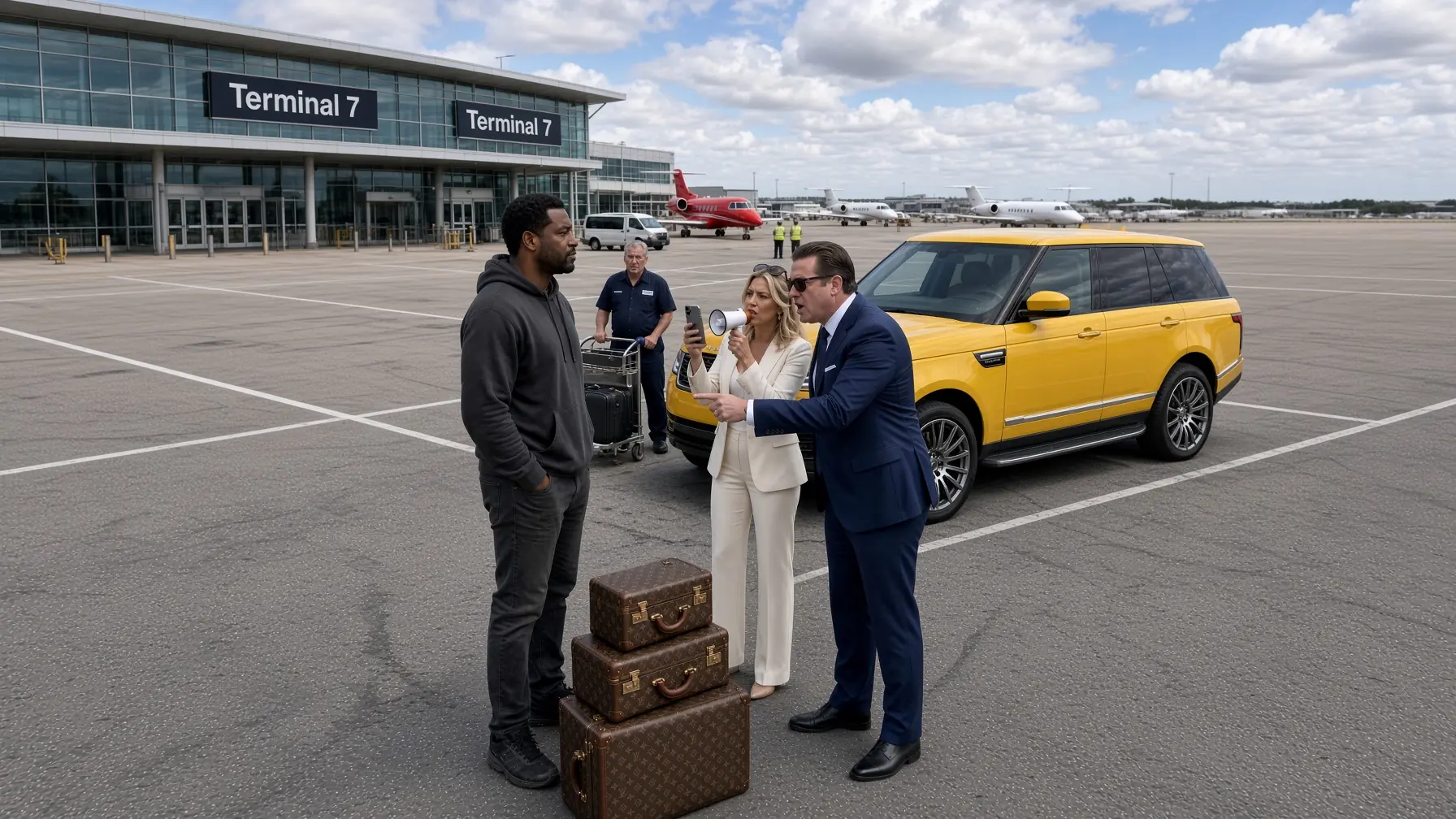
“I don’t care whether you’re on break,” a man in a tailored navy suit snapped, pointing toward three leather suitcases beside a black Range Rover near LaGuardia’s private-service terminal. “Put those bags on the cart and get them to the aircraft.” Adrian glanced at the luggage, then back at the stranger, and calmly said, “I don’t work baggage.”
The man laughed as though Adrian had just attempted a joke. His name was Preston Hale, forty-one, founder of a flashy investment company that had spent the previous year plastering his face across financial podcasts and airport billboards. Beside him stood Madison Voss, a lifestyle influencer with nearly three million followers, holding her phone at arm’s length while documenting their weekend departure to Vail. Neither had asked Adrian’s name before deciding what he was.
Adrian wore faded jeans, a dark hoodie, and old running shoes that had long since lost their original white color. He was six-foot-two, Black, forty years old, and standing inside a restricted terminal zone with the relaxed posture of somebody who knew exactly why he was there. To Preston, none of those facts mattered except the clothes and skin color. The story had already been written in his head.
“Don’t play dumb,” Preston said, stepping closer. “I spend more with this airline in a year than you’ll make in ten, so if I tell you to load something, you load it.” Adrian looked at him for a moment and asked, “What airline do you think I work for?” Preston rolled his eyes. “Northstar, obviously.”
Adrian nodded toward his clothes. “Do you see a Northstar uniform?” Preston glanced at the hoodie and laughed again. “People like you always have an excuse.” Madison turned her camera toward Adrian and added, “This is why traveling is exhausting now.”
Her livestream was already running. “Guys, we are literally trying to leave New York and some airport employee is refusing to do his job,” she told her followers while framing Adrian in the background. “You pay for premium service and still have to deal with attitude.” Adrian watched her create a version of events in real time that none of the people watching could verify.
A baggage handler named Frank Romano stood twenty feet away beside a luggage tug. Frank was sixty-two, had worked at LaGuardia for more than thirty years, and had seen passengers behave badly in every imaginable way. He walked over slowly and said, “Sir, he’s not part of our baggage crew.” Preston barely looked at him.
“I didn’t ask you,” Preston replied. Frank’s face tightened, but he remained professional. “I’m telling you because I know every person assigned to this ramp today, and that gentleman is not one of us.” Preston waved toward Adrian and said, “Then what exactly is he doing standing here dressed like that?”
“Maybe traveling,” Frank answered. Madison laughed loudly enough for her phone microphone to pick it up. “Traveling on this side of the terminal?” she said, zooming toward Adrian’s face. “Come on.”
Adrian could feel the old familiarity of being evaluated before being known. He had experienced it as a teenager in Cleveland while helping his mother clean office buildings late at night, and later as a college student when classmates assumed his scholarship had come from basketball rather than mathematics. Wealth had changed his access to rooms, but it had never completely changed what strangers believed when he entered those rooms without the expected costume. That was one reason he was standing at Gate 7 dressed exactly as he was.
“You’re making an assumption,” Adrian said. Preston stepped close enough that Adrian could smell expensive cologne. “Do you know who I am?” he demanded, and Adrian answered, “No.”
Preston actually looked offended. “Preston Hale, founder of Meridian Capital Technologies,” he said, emphasizing each word like a résumé line. “My company moves billions, and I’m one of Northstar’s highest-value customers.” Adrian nodded. “Then I assume you know how to speak to people.”
The remark changed Preston’s expression. “That’s it,” he said, pulling out his phone. “I’m calling operations and getting you removed from this terminal.” Madison swung her camera closer, delighted that the conflict had become better content.
Adrian reached into his own pocket. His phone looked ordinary except for the encrypted corporate application running beneath the lock screen. He typed four words to his chief of staff: Gate Seven. Start recording. Then he put the phone away.
Three buildings over, Nicole Grant saw the message arrive on her laptop. She was Adrian’s executive chief of staff and had spent four months helping him design an internal assessment program that senior executives privately called Walkthrough. The idea was simple: Adrian would appear at airports without the suit, entourage, and recognizable executive treatment that normally followed him. The result had already been uncomfortable at three other locations.
Northstar Airways had grown faster than any midsize carrier in the country during the previous four years. Customer ratings were high, revenue had doubled, and investors praised Adrian Mercer as the executive who had turned an aging regional airline into a serious national competitor. What public reports did not show was the pile of customer complaints Adrian read every month. The same kinds of passengers kept reporting the same kinds of problems.
Black passengers were questioned about premium boarding more often than others. Latino families described being redirected from priority lines despite correct tickets, Muslim travelers reported unusually aggressive documentation checks, and employees complained that wealthy passengers were allowed behavior that would get anyone else removed. LaGuardia’s private-service terminal appeared in those complaints more than any other Northstar partner facility. One operations manager’s name kept appearing beside them.
That manager was Vincent Rizzo. He had worked airport operations for twenty-one years, managed the terminal for eight, and cultivated a reputation for taking excellent care of “important clients.” Corporate audits showed that passengers with elite status loved him. Employees lower in the hierarchy told a different story.
Complaint records disappeared after reaching Vincent’s office. Certain private-service customers received access they technically had not paid for, while travelers who looked “out of place” were disproportionately flagged for additional verification. Tips from high-value passengers routinely appeared around the same dates as exceptions in service records. Adrian wanted to know whether the numbers represented coincidence, incompetence, or something worse.
The white airport operations vehicle came across the tarmac seven minutes after Preston made the call. Vincent Rizzo stepped out before it fully stopped, thick through the shoulders and visibly irritated. He looked first at Preston’s suit, then at Madison’s designer luggage, then at Adrian’s hoodie. Adrian noticed that order.
“What’s going on?” Vincent asked Preston. Not Adrian. Not Frank. Preston immediately said, “This guy is trespassing and pretending he doesn’t work here after refusing to handle my luggage.”
Adrian watched Vincent process the accusation. There was no visible effort to determine whether it made sense. A wealthy white passenger claimed a casually dressed Black man did not belong in the private terminal, and Vincent’s body language settled before any facts did. “Sir,” he said to Adrian, “I need identification.”
Adrian nodded. “Before we do that, what exactly am I suspected of doing?” Vincent’s eyes narrowed. “Being somewhere you’re not authorized to be.” Adrian asked, “Have you checked whether I am authorized?”
“That’s what I’m doing now.” Vincent extended his hand. “Identification.” Adrian said, “I’m waiting for a meeting.”
“What kind of meeting?” Vincent asked. Adrian looked around the terminal and answered, “One about why discrimination complaints associated with this location are almost triple our company average.” Vincent stopped moving.
Preston laughed. “Now he’s some corporate investigator?” he said. “What’s next, he tells us he owns the airline?” Adrian turned toward him. “Would that change how you’ve treated me?”
“Obviously,” Preston said. “But you don’t own anything here.” Adrian nodded slowly. “That might be the most useful answer anybody gives me today.”
Vincent’s phone buzzed. He glanced at the screen and saw a corporate email marked EXECUTIVE PRIORITY — GATE 7 ASSESSMENT. The message came from Nicole Grant and informed him that an active customer-treatment audit was being conducted under direct authorization of Northstar CEO Adrian Mercer. Vincent read the name twice.
He looked toward Adrian. Then back at the email. Then toward Preston, as though someone else might tell him how to interpret what he was seeing.
“This isn’t real,” Vincent said quietly. Adrian’s expression did not change. “You can verify it.”
Madison pointed her phone toward Vincent. Comments were moving too fast for her to follow now, because viewers had heard enough to sense a twist. Some still mocked Adrian, while others began asking why the operations manager had never checked whether he had a ticket. Madison laughed nervously and told her audience, “Apparently this guy thinks he’s the CEO now.”
A travel journalist named Elena Morales had been filming from farther down the terminal. She was thirty-four, Latina, and built a modest online following around airport accessibility and consumer travel problems rather than luxury content. She had noticed the confrontation because the body language looked familiar. Now she moved closer.
“Excuse me,” Elena said to Adrian. “I’m a journalist, and I’ve been recording from before operations arrived.” Adrian nodded once. “Keep the original file.”
Preston frowned. “Why are all these people acting like this guy matters?” A former Army officer named David Chen, waiting nearby for a flight to Chicago, looked over and answered, “He mattered before anybody knew who he was.” Preston turned toward him, but David’s expression made further argument look unwise.
Vincent finally said, “Sir, I still need identification.” Adrian took out a worn black wallet and handed over his driver’s license. The name read Adrian Nathaniel Mercer.
Vincent looked at the photograph. Then at Adrian. “This could still be someone with the same name.”
Adrian almost smiled. “Then check my boarding pass.” Vincent froze.
Until that moment, no one had asked for one.
Adrian reached into his hoodie pocket and produced a boarding pass for Northstar Flight 822 to Chicago. Seat 1C. Executive Platinum.
Vincent scanned the code. His handheld device beeped. The passenger record opened immediately.
MERCER, ADRIAN N. — SEAT 1C — EXECUTIVE SERVICES — SPECIAL CONTACT PROTOCOL
Vincent’s hand started to shake.
Preston stepped closer. “Tickets can be transferred.” Frank Romano muttered, “Not like that.”
Adrian handed Vincent his phone. The Northstar employee directory was open to his executive profile. His photograph appeared beside the title Chief Executive Officer and Majority Owner.
Vincent stared. “I need to call corporate.” Adrian answered, “Please do.”
Nicole picked up after one ring. “Northstar executive office, Nicole Grant speaking.” Vincent swallowed and said, “This is Vincent Rizzo at LaGuardia. I’m trying to verify an individual claiming to be—”
“Mr. Mercer?” Nicole asked. “Yes, he is conducting the Gate 7 assessment described in the email you received.” Vincent’s face lost color.
Nicole continued. “For clarity, Mr. Rizzo, every security camera covering that section has been preserved, and our legal and compliance teams are monitoring the evaluation.” Vincent looked toward Adrian. “Your decisions from first contact forward are part of that assessment.”
The phone nearly slipped from his hand.
Adrian took it back. “Nicole.” She answered, “We have all feeds.”
“Start the next phase,” Adrian said. “And preserve the prior complaint database exactly as it currently exists.” Nicole understood what that meant. “Already done.”
When Adrian ended the call, nobody spoke for several seconds. Preston had stopped smiling. Madison was staring at her livestream as comments flooded across the screen.
Vincent found his voice first. “Mr. Mercer, I didn’t realize—” Adrian held up one hand. “Finish that sentence carefully.”
Vincent swallowed. “I didn’t realize who you were.” Adrian nodded. “That’s the problem.”
Preston stepped in. “Look, this whole thing got out of hand.” Adrian turned toward him. “You ordered me to carry your luggage because of how I looked.”
“I thought you worked here.” Preston spread his hands. “Simple misunderstanding.” Adrian asked, “Would it have been acceptable if I did work here?”
Preston said nothing.
Adrian continued. “You threatened to have me fired.” Preston shifted. “I was frustrated.”
“You told me people like me are lazy.” Adrian’s voice remained quiet. “Was that frustration too?”
Madison lowered the phone slightly.
Adrian turned toward her. “And you streamed it to millions of people as entertainment.” Madison’s face tightened. “I didn’t know you were—”
Adrian laughed once. Not warmly. “There it is again.”
Madison swallowed. Adrian continued, “You didn’t know I was rich enough to deserve courtesy.” The comment section on her livestream erupted.
A Northstar gate agent named Rosa Alvarez had been standing twenty yards away throughout the exchange. She had recognized Adrian from corporate leadership photos almost immediately, but fear kept her behind the counter. Her manager was Vincent, and everyone at the terminal knew employees who challenged him rarely received good schedules afterward. Finally, she walked over.
“Mr. Mercer.” Adrian looked at her. “Yes?”
“I knew who you were.” Her voice shook. “I should’ve said something.”
Adrian did not embarrass her. “Why didn’t you?”
Rosa looked toward Vincent. “Because I was afraid he’d make sure I lost my hours.” Vincent looked away.
Adrian nodded. “Then we have more than a customer-service problem.” Rosa’s eyes filled. “I’m sorry.”
“Don’t apologize to me yet,” Adrian said. “Help us understand why speaking up feels dangerous here.” Rosa nodded.
Frank Romano stepped closer. “She’s telling you the truth.” Adrian turned. “How long has it been like this?”
Frank exhaled. “Years.” Then he looked at Vincent. “People complain, and somehow the complaint becomes their problem.”
Vincent’s jaw tightened. “Frank, be careful.” Adrian immediately looked at him. “That sentence is exactly why he needs to keep talking.”
Frank did.
VIP passengers slipped cash to managers. Certain passengers bypassed ordinary service restrictions. Workers who reported abuse were reassigned to less desirable shifts.
Complaints involving racial profiling often vanished after reaching terminal management.
Adrian had suspected a pattern. Hearing a thirty-year employee describe the mechanism made it more concrete.
A corporate compliance vehicle arrived next, followed by two senior Northstar legal officers. Adrian had deliberately ordered them not to use sirens, uniforms, or dramatic security tactics. This was an employment and evidence-preservation matter first. Anything criminal would be referred through proper channels after records were secured.
Nicole arrived with them.
She stepped onto the tarmac holding a tablet. “Adrian, we froze the terminal complaint database six minutes ago.” Vincent’s face changed again.
“What does froze mean?” he asked.
Nicole looked at him. “It means nothing can be edited, deleted, reassigned, or closed without leaving an external audit record.” Adrian watched Vincent carefully.
“Mr. Rizzo,” Nicole continued, “corporate security needs your access badge and terminal-issued devices pending review.” Vincent stared.
“You’re suspending me?”
Adrian answered, “Effective immediately.”
Vincent’s voice dropped. “I have a family.” Adrian nodded. “So do the employees who were afraid to report what happened here.”
“That isn’t fair.” Adrian looked toward Rosa. “Neither was retaliation.”
Vincent surrendered his credentials.
Preston began backing toward the Range Rover. “I think we should leave.”
Adrian looked over. “You may not be flying Northstar today.”
Preston froze. “Excuse me?”
“You threatened an employee you believed was beneath you, made discriminatory remarks, interfered with terminal operations, and then attempted to have a ticketed passenger removed without cause.” Adrian paused. “Our conditions of carriage allow us to deny service when passenger conduct creates a hostile environment.”
“You can’t ban me.” Preston’s voice rose. “I spend hundreds of thousands with this company.”
Adrian nodded. “You mentioned that.”
“This is bad business.” Preston said. Adrian looked toward Frank, Rosa, and the watching passengers. “Treating dignity as something wealthy customers can purchase exemptions from is worse business.”
Preston’s face reddened.
“You’ll hear from my lawyers.” Adrian answered, “Please have them contact ours.”
Madison began lowering her phone completely. Adrian looked at her. “No, keep recording.”
She stared.
“You were comfortable recording when you believed I was powerless.” He nodded toward the phone. “Don’t stop because the story changed.”
Her eyes filled with tears.
“This is going to destroy me.” Adrian said, “That decision belongs to the people who watch your content, your sponsors, and you.”
“You’re not going to call them?” she asked.
“No.”
The answer surprised her.
Adrian continued. “I’m not interested in personally orchestrating your downfall.”
Madison glanced toward the livestream comments.
He added, “You already published the evidence yourself.”
Elena Morales moved closer with her camera. “Mr. Mercer, what happens next?”
Adrian looked at the growing crowd. “First, we find out whether today was an isolated embarrassment or the visible edge of a larger system.”
“And if it’s larger?” Elena asked.
“Then we stop pretending individual apologies are enough.”
That clip became the first one to go viral.
Within two hours, videos from Gate 7 appeared across every major platform.
Different angles.
Different microphones.
Different interpretations.
But the basic sequence remained impossible to dispute.
Preston ordering Adrian to handle luggage.
Madison mocking his appearance.
Vincent accepting Preston’s claims without verifying Adrian’s boarding pass.
Frank defending him.
Rosa admitting she was too afraid to intervene.
Then the corporate call.
The public loved the reveal.
AIRLINE CEO GOES UNDERCOVER AND GETS MISTAKEN FOR BAGGAGE WORKER
Adrian hated that headline.
It made the story sound like a prank.
Nothing about the complaint files had been funny.
By midnight, Northstar’s legal department had preserved eighteen months of terminal records.
The numbers were worse than Adrian expected.
Discrimination complaints associated with Vincent’s shifts were not merely higher.