"Where are you going, buddy?" "Moving in." "Whose place is this?" "Mine."
"You live here, sir? I need to check your plates. Wait here."
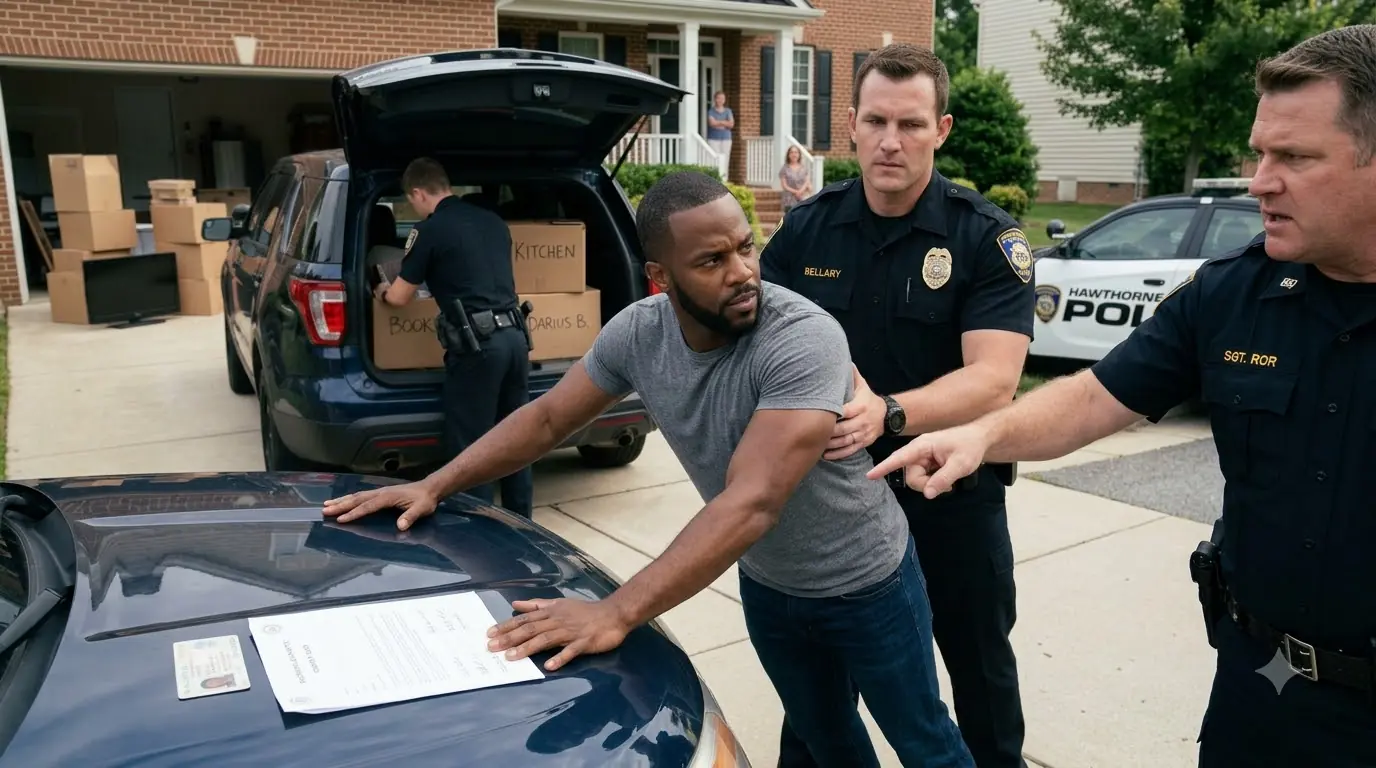
"Okay, officer. I'll get the papers. Everything is clean." "License and registration, please."
"Here you go." "Address matches. You're all set." "Valid papers don't mean you're clean."
"What? This is ridiculous." "Pin him against the hood." "Hey, get off me."
The three officers had no warrant, no probable cause, and no legal grounds to go a single step further. Every document Darius handed over confirmed exactly what he said from the start. But Ror wasn't done. He nodded at Keaton, who moved toward the SUV without waiting for permission.
No one asked, no one explained. Darius stood still and let it happen because he had just recognized something on Ror's name tag that changed everything. The question was no longer whether these men would stop. The question was how far they were willing to go.
Darius Benton had not planned to be the kind of man who stood in a driveway counting boxes. He was 41 years old, methodical by training, and careful by nature. And for the past several months, he had reduced the entirety of his Baltimore life down to 17 labeled cartons and four pieces of furniture worth keeping. Not because he was in a hurry, but because he was ready.
Cedar Ridge was the kind of neighborhood that rewarded patience. The houses sat back from the street behind generous lawns, the kind that took years of attention to look that effortless. Maple trees lined both sides of Crest View Drive, their branches arching overhead in a way that made the street feel private without being closed off. Darius had driven through the neighborhood three times before making an offer on the house at 4212.
The fourth time, he walked through the front door and knew the house had four bedrooms. He needed two. But the fourth room, the one at the end of the hall with the window that caught the afternoon light at exactly the right angle, was the reason he had signed the papers without negotiating. That room was for Camille.
His daughter was 17 and currently finishing her junior year at Harrove Academy, a boarding school 40 minutes outside of Charlottesville. She was preparing for college entrance exams and had, in the particular way of teenagers who understood more than they let on, told her father she did not need to be present for the move. She would see the house when she came home for the holiday break. Darius had taken that as permission to do things right.
He wanted the frames on the walls. He wanted her bookshelf assembled and her desk lamp plugged in. He wanted the house to feel like a home before she walked through the door, not like a project she would have to help finish. 6 years ago, her mother had walked out of a grocery store on a Tuesday afternoon and never made it to the car.
A driver ran a red light. Sandra Benton was 42 years old. Camille was 11. Darius was still in the middle of a federal investigation that had taken him 17 months to build.
And he had sat in a hospital waiting room for 4 hours before a doctor came to find him. He did not talk about that day often. He did not need to. It had simply become the dividing line in his life between before and after.
Since then he had worked. He had raised Camille. He had kept the job that gave structure to everything else. The job that demanded enough of him during the day that he could be fully present at night.
Darius was a special agent assigned to the FBI's civil rights division. And for the past 11 years, his work had centered on one specific category of case law enforcement misconduct. False reports, unauthorized searches, evidence suppression, the kind of abuse that was systematic, deliberate, and almost always invisible by design. He had just been reassigned from the Baltimore field office to the Richmond Division.
The transfer was professionally routine. Personally, it felt like the right time. Before leaving the storage unit that afternoon, Darius had done what he always did before driving. He checked the exterior camera feeds on the SUV, a habit he had developed 3 years into his career after a surveillance vehicle was tampered with during a long-term investigation.
The screens were clean. He also adjusted the watch on his left wrist, a field-issue piece that sat heavier than a civilian model. He did not think about either action. They were part of the rhythm of being who he was, even on a Saturday, even in jeans and a plain gray t-shirt, even when the only thing on his agenda was getting the last set of boxes into a house on Crest View Drive before sundown.
He was almost done. The drive back to Cedar Ridge took 22 minutes. Darius pulled the SUV into the driveway at 4:40 in the afternoon, the sun low enough to throw long shadows across the front lawn. He killed the engine and sat for a moment in the quiet looking at the house.
The movers had left the garage door up when they finished earlier that day. Darius climbed out of the SUV, moved around to the rear of the SUV, and began pulling boxes from the back. A television, two smaller boxes stacked on top, a duffel bag he had kept with him throughout the move. He carried the first load toward the open garage, set it down inside, and walked back to the vehicle.
That was when he heard the engine slow behind him. A Hawthorne County patrol car rolled along Crest View Drive at a speed just below the pace of normal traffic. Darius noticed it the way he noticed most things without looking directly at it. The car moved past, continued for perhaps 30 ft, then stopped.