The paint had not dried when Officer Nolan Price decided the Black man holding the roller did not belong there.
It was barely six-thirty on a Saturday morning, and Brightwell Commons was still empty except for birds, sprinklers, and the distant growl of delivery trucks waking up downtown Stonevale. A thin layer of fog rested above the grass, softening the outlines of the climbing towers and swings. In the center of the playground, Solomon Reed stood beneath a wooden arch, carefully covering a patch of ugly gray paint with a deep, warm blue.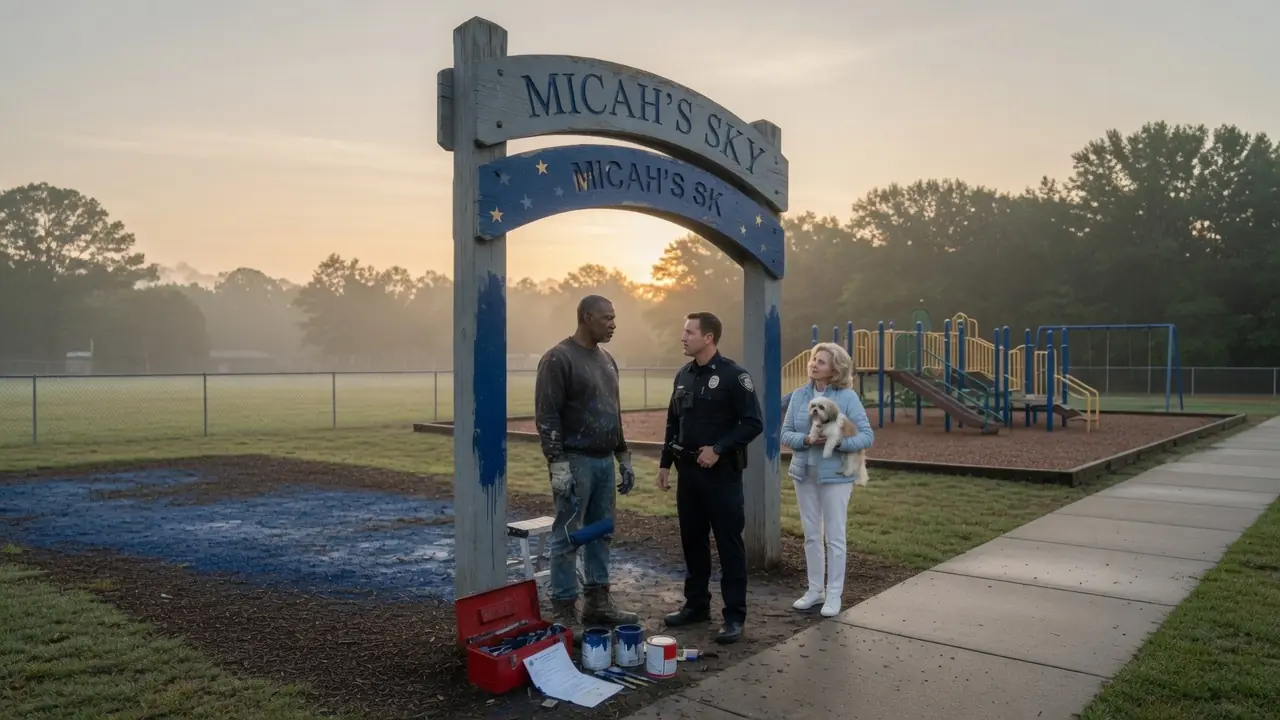
He wore faded jeans, work boots, and a black sweatshirt marked with old paint stains. A red toolbox sat open near his feet, along with several brushes, a folding ladder, and a framed photograph wrapped in a towel. Nothing about him looked hurried or secretive.
Still, Nolan parked his cruiser across the playground entrance as though stopping a getaway car.
He stepped out with one hand resting near his holster.
“Put the roller down.”
Solomon looked over his shoulder.
He was fifty-one, tall and broad-shouldered, with close-cropped hair beginning to gray at the temples. His face was calm, though the lines around his eyes suggested he had not slept much. He glanced at the roller in his hand, then at the officer.
“I’m almost finished with this section.”
“I didn’t ask whether you were finished.”
Solomon lowered the roller into the tray.
Nolan walked closer, studying the newly painted arch. Beneath the fresh blue surface, small golden stars were beginning to reappear. Someone had covered them with gray paint during the night, along with the words carved across the top.
MICAH’S SKY.
Only the first three letters of the name were visible now.
“What exactly do you think you’re doing?” Nolan asked.
“Repairing damage.”
“This is city property.”
“I know.”
“You have permission to paint it?”
“Yes.”
“From whom?”
Solomon picked up a folded document from the toolbox.
“From the organization that owns the land.”
Nolan did not take the paper.
“The city owns this park.”
“The city operates it.”
“That’s the same thing.”
“No, Officer. It isn’t.”
Nolan’s eyes narrowed.
There was something about Solomon’s tone that irritated him. The man was not nervous. He was not apologizing. He spoke with the quiet confidence of someone who expected to be heard, and Nolan had already decided that confidence was an act.
A call had come through dispatch ten minutes earlier.
A resident living across from the park reported a suspicious man painting over city property. The caller described him as tall, Black, dressed in dark clothes, with tools spread across the playground. She also said there had been recent vandalism in the neighborhood.
Nolan had not asked whether the caller saw the man damage anything.
He had heard “Black man,” “tools,” and “park before sunrise.”
That had been enough.
“Step away from the toolbox,” he said.
Solomon looked at the folded document still in his hand.
“Would you like to read the authorization?”
“I’d like you to follow instructions.”
“I am trying to show you why I’m here.”
“You can explain after you step away.”
Solomon placed the paper on top of the toolbox and moved back.
Nolan walked around the supplies. The paint cans had professional labels, and each one bore the seal of the Micah Reed Children’s Trust. A temporary work permit had been taped inside the toolbox lid.
Nolan saw the name but did not read the smaller print.
“Did you steal this equipment from a contractor?”
Solomon stared at him.
“No.”
“Where did you get it?”
“I brought it.”
“All of it?”
“Yes.”
“You expect me to believe you came out here alone before sunrise with commercial supplies to paint a public playground?”
“I don’t need you to believe me. I need you to look at the permit.”
Nolan gave a short, humorless laugh.
“You people always have some piece of paper when you get caught.”
The words settled between them.
Solomon’s face changed.
Not much. His jaw tightened, and his eyes held Nolan’s a second longer than before. The fog drifted across the grass behind him, and somewhere on the next block, a dog began barking.
“What people?” Solomon asked.
Nolan shifted his weight.
“People who think paperwork makes them untouchable.”
“That is not what you meant.”
“You want to tell me what I meant now?”
“No. Your body camera can do that later.”
Nolan’s hand moved instinctively toward the small camera clipped to his uniform. A red light blinked beneath the lens.
For the first time, uncertainty crossed his face.
Then anger replaced it.
“Turn around.”
Solomon did not move.
“Am I being arrested?”
“You’re being detained while I investigate vandalism.”
“The vandalism is the gray paint. I’m restoring what was damaged.”
“Turn around.”
“You still haven’t read the permit.”
Nolan stepped closer.
“Do not make this harder than it needs to be.”
Solomon looked toward the arch.
The golden stars had been painted there eleven years earlier by children from three Stonevale elementary schools. At the center of the arch was the outline of a small handprint, preserved beneath layers of protective coating.
It had belonged to Solomon’s son.
Micah Reed had been eight years old when he drew the first version of the playground on the back of a hospital menu. He had spent most of that year inside the Merriton Children’s Center, connected to monitors while doctors searched for a way to repair a heart that had never worked properly.
Micah hated the hospital playground.
It was a plastic slide beside a parking garage, surrounded by a chain-link fence. The ground smelled like hot rubber, and the only tree had died before Micah’s third surgery.
One afternoon, he asked Solomon why playgrounds for sick children always looked like places everyone had forgotten.
Solomon told him he did not know.
Micah picked up a blue crayon.
“Then let’s make one people remember.”
They designed Brightwell Commons together.
Micah wanted towers shaped like clouds, ramps wide enough for wheelchairs, musical panels for children who could not climb, and a long blue arch covered in stars. He insisted on a quiet garden for parents who needed to cry where their children would not see them.
He also wanted one rule painted near the entrance.
NO CHILD HAS TO EARN A PLACE HERE.
Micah died before construction began.
For months, Solomon could not open the sketchbook.
He kept it inside the bottom drawer of his desk while his company expanded across the country. Solomon had founded Reed Meridian Infrastructure with three employees and one borrowed truck. By the time Micah became ill, the company was building public transportation systems, hospitals, and energy facilities in twelve states.
Solomon had money, influence, and access to specialists.
None of it saved his son.
After the funeral, he returned to Stonevale, the town where he had grown up. He purchased the neglected six-acre lot across from the old library and transferred it to the Micah Reed Children’s Trust.
The city received a ninety-nine-year lease for one dollar.
The agreement was simple.
Stonevale could operate the playground, but the trust would retain ownership. The name, memorial arch, accessibility features, and community garden could never be removed. If the city altered the memorial or attempted to transfer the land for commercial use, the lease would immediately terminate.
Every year on Micah’s birthday, Solomon returned before sunrise and repainted the arch himself.
He never announced it.
He never brought photographers.
He painted until the morning grew warm, then sat beneath the handprint and told his son what had changed since the year before.
This year, someone had painted over Micah’s name.
The gray paint had been applied hastily during the night. It covered the stars, the dedication plaque, and half the handprint. City officials claimed no knowledge of it when Solomon called the maintenance department.
That was why he had come early.
He wanted to see the damage before anyone could clean up the evidence.
Nolan moved behind him.
“Hands on your head.”
Solomon turned slowly.
“You are making a serious mistake.”
“You don’t get to decide that.”
“A permit is sitting three feet from you.”
“I said hands on your head.”
Before Solomon could respond, a woman’s voice came from the sidewalk.
“Officer Price, thank goodness you’re here.”
Vivian Croft crossed the grass wearing white walking shoes, a pale blue jacket, and the expression of someone arriving to collect a prize. She was sixty-two and lived in the expensive Harbor Crown subdivision bordering the park.
She carried a small dog under one arm and her phone in the other hand.
Nolan nodded.
“Are you the caller?”
“Yes. I saw him from my upstairs window.”
Solomon recognized her.
Vivian served on the Stonevale Beautification Committee and had attended several city meetings concerning Brightwell Commons. During the most recent meeting, she complained that the playground attracted “the wrong traffic” into the neighborhood.
“What did you see?” Nolan asked.
“He was painting over the arch.”
“No,” Solomon said. “I was painting over gray vandalism.”
Vivian gave him a cold look.
“That arch is being removed.”
Nolan turned toward her.
“Removed?”
“The city is redesigning the park. We’re getting a proper pavilion, security fencing, and reserved community access.”
Solomon’s eyes remained on Vivian.
“There is no approved redesign.”
“There will be after Monday’s vote.”
“The land cannot be redesigned without permission from the trust.”
Vivian smiled.
“You keep mentioning this trust as if you represent it.”
“I do.”
Nolan looked between them.
Vivian’s smile widened slightly.
“Officer, this man was here alone with paint and tools. He could say he represents anyone.”
Solomon pointed toward the toolbox.
“My identification is in the side pocket. My authorization is on top.”
Nolan ignored him.
Vivian stepped closer to the arch and examined the fresh blue paint.
“You’ve ruined the primer.”
“It wasn’t primer.”
“The city contractor painted that section yesterday.”
Solomon’s gaze sharpened.
“You just said you saw me vandalizing the park. Now you’re admitting the gray paint was applied by a city contractor.”
Vivian’s lips pressed together.
“I said nothing of the kind.”
“You said the arch was being removed.”
“That is public information.”
“No. It isn’t.”
Nolan raised his voice.
“That’s enough.”
He took Solomon by the arm.
Solomon pulled back, more from surprise than resistance.
Nolan immediately twisted his wrist behind him.
“Stop resisting.”
“I’m not resisting.”
“You pulled away.”
“You grabbed me without cause.”
Vivian lifted her phone and began recording.
Nolan forced Solomon toward the nearest picnic table. Metal cuffs closed around his wrists, one after the other.
The sound was small.
To Solomon, it felt louder than the traffic beginning to move along Croft Avenue.
He looked at Micah’s half-covered name.
For years, he had imagined every difficult thing he might have to endure as a Black father. He worried about traffic stops when Micah became old enough to drive. He worried about school discipline, store security guards, and the moment someone first decided his son looked threatening.
Micah never lived long enough to face those things.
Solomon had spent years grateful for that and ashamed of the relief.
Now he stood handcuffed beneath his son’s name because an officer had decided a Black man with a paint roller must have stolen something.
“Search the toolbox,” Vivian said.
Nolan looked at her.
She seemed to realize she had spoken too quickly.
“I mean, shouldn’t you check for stolen property?”
Solomon turned his head.
“She knows what is in there.”
Vivian’s face stiffened.
“I do not.”
“You knew the gray paint came from a contractor.”
“I assumed.”
“You knew the arch was scheduled for removal.”
“It was discussed at committee level.”
“The committee has no authority over this land.”
Nolan pushed Solomon into a seated position on the bench.
“Stay there.”
Solomon’s cuffed hands rested behind him, pressing painfully against the edge of the table. Nolan opened the toolbox and found a leather folder beneath the brushes.
Inside was the work permit, a copy of the land deed, and an identification card.
He stared at the card.
SOLOMON ELIAS REED
CHAIRMAN, MICAH REED CHILDREN’S TRUST
Below it was another title.
COMMISSIONER, STATE BOARD OF LAW ENFORCEMENT STANDARDS
Nolan looked at Solomon, then back at the card.
“This is fake.”
Solomon almost smiled.
“Call the number.”
Nolan turned the card over.
The seal was embossed, not printed. A direct verification number appeared beneath a state identification code.
Vivian stepped beside him.
“What does it say?”
Nolan closed the folder.
“Nothing relevant.”
Solomon studied him.
“You read my name.”
“You’re still being detained.”
“You also read my title.”
“I read what somebody printed on a card.”
“The verification line is on the back.”
“I don’t take orders from suspects.”
Vivian looked uneasy now.
“Perhaps we should wait for someone from the city.”
Solomon glanced at her.
“You didn’t expect me to be here this morning.”
“I have no idea who you are.”
“Yes, you do.”
Before Vivian could answer, a small utility cart came around the path.
The driver was Raymond Ellis, the park’s maintenance supervisor. He was a white man in his late fifties with a sunburned face and heavy work gloves tucked into his belt.
He slowed when he saw Solomon in handcuffs.
“What happened?”
Nolan stepped into his path.
“Police matter.”
Raymond looked past him.
“Mr. Reed?”
Vivian lowered her phone.
Nolan’s expression hardened.
“You know him?”
Raymond climbed from the cart.
“Of course I know him. He owns the park.”
Nolan laughed.
“The city owns it.”
“No, the Reed Trust owns it. The city leases it.”
Solomon said nothing.
Raymond walked toward the arch and touched the gray paint still visible around Micah’s name.
His face darkened.
“I told Director Sloane this couldn’t be covered.”
Vivian snapped her head toward him.
“You should be careful what you say.”
Raymond looked at her.
“I should’ve been careful yesterday.”
Nolan stepped closer.
“What are you talking about?”
Raymond hesitated.
Then he looked at Solomon’s hands.
“They sent a contractor after closing time. Director Sloane told me the memorial had to be neutralized before Monday.”
“Neutralized?” Solomon asked.
“That was her word.”
“Who is Director Sloane?” Nolan asked.
“Marla Sloane,” Vivian answered quickly. “Stonevale’s development director. She has authority over city property.”
“Not this property,” Raymond said.
Vivian’s face flushed.
“The city has maintained this park for over a decade.”
“With trust money,” Solomon replied.
Raymond nodded.
“Mr. Reed’s foundation pays most of the operating costs.”
Nolan looked from Raymond to the identification folder.
A reasonable officer would have stopped then.
He would have removed the cuffs, verified the permit, and begun asking why a city contractor had painted over a protected memorial. He would have noticed that the facts no longer supported the story he had chosen.
Nolan did not stop.
He had already placed a Black man in handcuffs in front of a witness who was recording. Releasing Solomon would mean admitting he had been wrong from the beginning.
Pride became more important than evidence.
“Even if he represents the trust,” Nolan said, “he was creating a disturbance and refused lawful commands.”
“What disturbance?” Raymond asked.
“He was painting quietly,” Solomon said.
Nolan pointed at him.
“Stay out of this.”
Raymond looked around the empty playground.
“The only disturbance I see is your cruiser blocking the entrance.”
Vivian stepped toward Nolan.
“Officer, Director Sloane is on her way. She can explain the project.”
Solomon’s eyes stayed on her.
“Did she tell you to call the police if I appeared?”
Vivian did not answer.
“That is exactly what happened, isn’t it?”
“You were here before authorized work hours.”
“There are no restricted work hours in the lease.”
“You don’t know what the city has negotiated.”
“I wrote the lease.”
Vivian’s confidence faltered.
Nolan’s radio crackled.
“Unit twelve, confirm location.”
“Brightwell Commons,” he answered.
“Be advised, multiple state vehicles requesting access through the east gate. They report a scheduled event at your location.”
Nolan looked toward the road.
A line of dark vehicles had stopped behind his cruiser.
The first was a black state police SUV. Behind it were two sedans, a communications van, and a larger vehicle carrying the seal of the governor’s office.
Vivian went pale.
Solomon looked at his watch.
“They’re early.”
Nolan stared at him.
“Who is early?”
Solomon did not answer.
The state police SUV’s driver stepped out first. Captain Lena Ward, a Black woman in a formal uniform, surveyed the blocked entrance and then saw Solomon sitting at the picnic table.
Her entire posture changed.
She walked quickly across the grass.
Behind her came Police Chief Aaron Vale, Stonevale’s highest-ranking officer, still adjusting the collar of his dress uniform. He was followed by the governor’s public safety adviser, several state officials, and a group of journalists carrying cameras.
Chief Vale saw Nolan.
Then he saw the handcuffs.
He stopped so abruptly that the officials behind him nearly collided with him.
“Officer Price,” he said.
Nolan straightened.
“Chief.”
Vale walked toward Solomon.
“Commissioner Reed?”
The playground fell silent.
Nolan looked at the identification folder in his hand.
Captain Ward reached Solomon first.
“Sir, are you injured?”
“My wrists hurt. Otherwise, I’m fine.”
Ward turned to Nolan.
“Remove the restraints.”
Nolan swallowed.
“Captain, I’m investigating vandalism.”
“Remove them.”
“He was painting city property without—”
Chief Vale’s voice cut across him.
“That is Solomon Reed.”
Nolan said nothing.
Vale looked toward the gathering journalists, several of whom had already raised their cameras.
“He is the chairman of the State Board of Law Enforcement Standards.”
The color left Nolan’s face.
The board had been created six months earlier after a series of misconduct scandals across the state. It held authority to certify officers, investigate departments, review body-camera policies, and recommend the removal of officers who violated professional standards.
Solomon Reed had been appointed its first civilian chairman.
His name had appeared in department emails, academy bulletins, and mandatory training notices.
Nolan had deleted most of them without reading.
Chief Vale continued.
“He is also the founder of Reed Meridian Infrastructure and the owner of the trust that built this playground.”
Captain Ward took the handcuff key from Nolan.
She unlocked Solomon’s wrists and examined the red marks left behind.
Nolan looked toward Vivian.
She had lowered her phone, but it was too late. At least three journalists had filmed the final exchange.
Solomon stood slowly.
He rubbed one wrist and walked toward the toolbox.
Nolan held out the leather folder.
“Sir, I didn’t know who you were.”
Solomon took it from him.
“That is not the defense you think it is.”
“I responded to a suspicious-person call.”
“You found a permit.”
“I believed it might be fraudulent.”
“You found state identification.”
“I couldn’t verify it immediately.”
“You refused to call the number.”
Nolan glanced toward the cameras.
“The situation was unclear.”
Solomon looked at the paint roller resting in the tray.
“It was only unclear because the truth did not match the person you had already decided I was.”
Vivian stepped away from the group.
Solomon noticed.
“Mrs. Croft, please stay.”
She stopped.
A silver city vehicle arrived at the blocked entrance. Marla Sloane climbed out, carrying a red presentation folder. She was a white woman in her late forties with a severe blond bob and the polished appearance of someone accustomed to controlling meetings.
She walked toward the officials with a fixed smile.
“Commissioner Reed, we were not expecting you until the announcement.”
Her gaze landed on the handcuffs in Captain Ward’s hand.
The smile vanished.
“What happened?”
Solomon held up the work permit.
“Officer Price arrested me for restoring my son’s memorial.”
“Detained,” Nolan corrected quietly.
No one looked at him.
Marla glanced at the gray paint.
“This appears to be a misunderstanding by the contractor.”
“Raymond says you ordered the memorial neutralized.”
Marla looked toward the maintenance supervisor.
Raymond stood beside his utility cart without speaking.
“That is an irresponsible interpretation of a planning discussion,” Marla said.
Solomon opened the leather folder.
“Then explain the planning discussion.”
Marla adjusted her grip on the red folder.
“The city is considering accessibility and security improvements.”
“By painting over the name of the child for whom the playground was built?”
“It was a temporary surface treatment.”
“The stars were covered. The handprint was covered. The dedication plaque was removed.”
“The contractor may have exceeded instructions.”
Solomon walked toward the arch.
Behind the half-restored blue paint, rectangular holes showed where the bronze plaque had been bolted to the wood.
“Where is the plaque?”
Marla did not answer.
Solomon turned toward Chief Vale.
“Chief, secure the maintenance building and the development office. No city employee removes a document, computer, or piece of material until state investigators arrive.”
Marla stared at him.
“You cannot seize city offices.”
Captain Ward stepped forward.
“The governor authorized an integrity review at five-thirty this morning.”
That was the second revelation.
The officials had not come merely for a ceremonial announcement.
Solomon had received an anonymous envelope two weeks earlier. Inside were copies of private emails between Marla Sloane, Vivian Croft, Councilman Preston Gage, and Larken Crest Development.
The emails discussed Brightwell Commons as “underused premium land.” Larken Crest wanted to build a gated senior community with private medical facilities and luxury townhouses. The playground stood between the proposed development and the waterfront road.
The city could not sell the property because it did not own it.
So Marla created another plan.
If officials removed the memorial features and claimed the trust had abandoned its oversight duties, the city would argue that the lease restrictions were no longer enforceable. Larken Crest had promised campaign donations, consulting contracts, and discounted property to several people involved.
One email mentioned Solomon by name.
If Reed appears before Monday, delay him. Do not let him reach the records office before the vote.
Vivian had been assigned to watch the park.
Nolan had not been part of the development scheme.
He was simply the kind of officer Marla and Vivian expected to believe their story without asking difficult questions.
That made his role smaller.
It did not make it harmless.
Solomon faced Marla.
“The state review began before I arrived.”
Her expression tightened.
“You came here pretending to be a maintenance worker.”
“I came here dressed to paint.”
“You withheld your identity from Officer Price.”
“I gave him identification.”
Nolan looked down.
Solomon continued.
“I also gave him a permit, a verification number, and a witness who knew me. He ignored all three.”
Marla pointed toward the convoy.
“This is political theater.”
“No. Political theater would have involved warning the press.”
Solomon glanced at the journalists.
“They were invited to announce a statewide playground safety initiative. Your contractor and Officer Price created the rest.”
Vivian’s phone slipped from her hand and landed in the grass.
Captain Ward picked it up.
The recording was still running.
Ward looked at Vivian.
“Did Director Sloane instruct you to report Commissioner Reed as a trespasser?”
Vivian shook her head.
“No.”
Solomon opened the leather folder and removed a printed email.
“Would you like to reconsider?”
He read the message aloud.
“If Reed arrives before the surface work is complete, contact Officer Price directly. He understands the neighborhood’s concerns.”
Nolan’s head snapped toward Vivian.
“You asked dispatch for me?”
She said nothing.
Chief Vale looked at Nolan.
“Why would she request you?”
Nolan’s face tightened.
“I’ve responded to calls in Harbor Crown before.”
“Calls involving whom?” Solomon asked.
Nolan remained silent.
Chief Vale ordered dispatch to pull Nolan’s call history.
The results arrived within minutes.
Over the previous eighteen months, Nolan had responded to eleven “suspicious person” complaints from Harbor Crown residents. Nine involved Black residents, contractors, delivery drivers, or visitors. No arrests resulted.
In six cases, body-camera footage showed Nolan demanding identification from people who had committed no crime.
In one, he detained a Black teenager for sitting on the front steps of his aunt’s house.
The complaint had been closed after Nolan described the stop as a misunderstanding.
Chief Vale removed Nolan’s badge and service weapon in front of the playground.
“You are suspended pending investigation.”
Nolan looked at Solomon.
“This is because of who he is.”
Solomon’s expression did not change.
“No. This is because of what you did before learning who I am.”
Captain Ward escorted Nolan toward a state vehicle.
As he passed beneath the arch, he looked up at Micah’s partially restored name. For the first time that morning, he seemed to understand that the man he had handcuffed had not been painting a random structure.
He had been repairing his child’s memorial.
Marla Sloane tried to leave next.
State investigators stopped her at the gate.
The red folder in her hand contained a preliminary redevelopment contract between Stonevale and Larken Crest. It had already been signed by Marla and Councilman Gage, though no public vote had occurred.
The contract valued the six-acre property at forty-two million dollars.
The city expected to receive thirty million.
The difference had been divided among shell companies connected to Marla, Gage, Vivian’s husband, and two executives at Larken Crest.
The gray paint was not preparation for maintenance.
It was preparation for theft.
By noon, city investigators had recovered Micah’s bronze dedication plaque from a trash container behind the maintenance building. One corner had been bent where someone used a crowbar to remove it.
Solomon held the plaque in both hands.
Dried mud covered the words.
MICAH ELIAS REED
HE IMAGINED A PLACE WHERE EVERY CHILD BELONGED.
For the first time that morning, Solomon’s composure broke.
He ran his thumb across his son’s name.
The officials, journalists, and workers around him became quiet. Chief Vale looked away, giving him what little privacy the open playground could offer.
Raymond approached with a clean cloth.
“I’m sorry, Mr. Reed.”
Solomon accepted the cloth.
“You tried to stop them.”
“I should’ve called you sooner.”
“You were afraid of losing your job.”
Raymond looked toward Marla’s vehicle.
“I almost lost something more important.”
Together, they cleaned the plaque.
The statewide announcement was postponed, but the community began arriving anyway. Parents had heard about the confrontation through local news alerts. Former hospital families came carrying photographs of children who had played at Brightwell Commons.
Some brought paintbrushes.
A little girl in a wheelchair rolled beneath the arch and looked up at the gray section.
“Why did somebody cover the stars?” she asked.
Solomon knelt beside her.
“Because they wanted people to forget who put them there.”
“Are you going to fix them?”
“Yes.”
She held up a small brush.
“Can I help?”
Solomon looked toward Micah’s handprint.
For eleven years, he had repainted the arch alone because the ritual felt private. It was the one morning each year when he could pretend he was still completing a project with his son.
That day, he handed the girl a cup of blue paint.
“You can start right here.”
By early afternoon, dozens of families were restoring the arch.
Children repainted the golden stars. Parents cleaned the musical panels and wheelchair ramps. Raymond reattached the bronze plaque with new bolts while state investigators photographed every stage of the repair.
Solomon waited until the crowd grew quiet before speaking.
He stood beneath Micah’s name with the red marks from the handcuffs still visible around his wrists.
“I came here this morning as a father,” he said. “Not as a commissioner, not as a chief executive, and not as someone whose name appears on government letterhead.”
He looked toward the place where Nolan’s cruiser had blocked the gate.
“Officer Price did not know my title when he stopped me. That is exactly why what happened matters.”
Several officers standing near Chief Vale lowered their eyes.
“If respect appears only after a powerful name is revealed, it was never respect. It was fear of consequence.”
Solomon rested one hand on the repaired plaque.
“My son did not design this playground for powerful children. He designed it for children who were sick, frightened, poor, overlooked, or told that public spaces were not built with them in mind.”
He paused.
“This morning, I was told that I could not belong to the place my son created. Many Black Americans experience that accusation without a convoy arriving to correct it. They do not have a state identification card. They do not have reporters nearby. They simply carry the humiliation home.”
No one applauded immediately.
The silence felt more honest.
Then the little girl holding the paintbrush raised it above her head.
“Micah’s name is back!”
Laughter moved through the crowd.
Solomon smiled.
“Yes,” he said. “It is.”
The investigation lasted four months.
Marla Sloane, Preston Gage, and two Larken Crest executives were charged with conspiracy, fraud, bribery, and attempted theft of trust property. Vivian Croft avoided prison by cooperating, but she resigned from every city committee and sold her Harbor Crown home before the case went to trial.
Officer Nolan Price was dismissed from the Stonevale Police Department.
The state certification board reviewed his previous stops and found a pattern of racially biased enforcement, incomplete reports, and repeated failure to establish legal cause before detaining citizens. His law enforcement certification was revoked.
Some residents argued the punishment was excessive.
They said Nolan had made one mistake.
Solomon answered them at a public hearing.
“A mistake is turning left when the directions say right. A pattern is reaching the wrong destination over and over because you refuse to question the road.”
Chief Aaron Vale accepted responsibility for the department’s failures.
He ordered an independent review of complaint procedures and invited residents previously stopped by Nolan to have their cases reopened. The department also changed its policy so that officers could not demand identification during consensual encounters without clearly stating the legal basis.
Solomon’s state board used the case to create new training requirements.
He refused to name the program after himself.
Instead, he called it the Micah Standard.
The principle fit on one page.
Before using authority, establish facts. Before escalating, verify. Before deciding someone does not belong, ask whether bias has answered the question for you.
Brightwell Commons remained open.
The city lost its lease after violating the memorial clause, but Solomon did not close the playground or convert it into a private facility. He transferred management to a community board made up of parents, disability advocates, youth workers, and residents from neighborhoods across Stonevale.
The city was given one seat.
Not control.
One seat.
A year later, Solomon returned before sunrise on Micah’s birthday.
He wore the same paint-stained sweatshirt.
The arch no longer needed much work. Families had taken turns caring for it throughout the year, and children had added dozens of new stars around Micah’s handprint.
Solomon opened the red toolbox and removed the framed photograph wrapped in a towel.
Micah was seven in the picture. He sat at a hospital table with a blue crayon in one hand and a grin far too wide for his tired face.
The first playground sketch rested in front of him.
Solomon placed the photograph beneath the arch.
Then he sat on the swing nearest the quiet garden.
For several minutes, he said nothing.
Finally, he looked toward the photograph.
“You caused a lot of trouble this year.”
The morning wind moved softly through the trees.
Solomon smiled.
“I know. You would’ve enjoyed it.”
He told Micah about the children who helped restore the stars. He talked about the little girl in the wheelchair who now visited every Thursday. He explained that the city had added safer crosswalks, better lighting, and a free weekend shuttle from the hospital.
Then he told him about Nolan.
Not with anger.
Not with forgiveness either.
He simply told the truth.
“A man saw me holding a paint roller and decided he knew who I was,” Solomon said. “Then a convoy arrived, and suddenly he saw a commissioner.”
He looked at the small handprint above him.
“I wish he had only seen your father.”
Footsteps approached from the path.
Captain Lena Ward carried two cups of coffee and a small bag of breakfast sandwiches. She had promised not to bring officials, cameras, or state business.
She placed one cup beside Solomon.
“Talking to him?”
“Yes.”
“Is he answering?”
“Mostly criticizing my paintwork.”
Ward looked up at the arch.
“The blue is uneven near the top.”
“Get out.”
She laughed and sat on the next swing.
The sun rose behind the library, casting light across the ramps and towers. Soon, families would arrive. Wheels would roll across the smooth paths, children would race toward the climbing wall, and someone would press the music panel until every adult nearby regretted its installation.
For now, the playground was quiet.
Solomon looked at Micah’s name.
The letters were bright against the blue arch.
A year earlier, Marla Sloane had tried to erase them because a dead child could not attend city meetings, challenge a contract, or stop a bulldozer. Nolan Price had seen Solomon restoring those letters and assumed the man did not belong there.
Both had made the same mistake.
They believed power belonged only to the people who looked as though they possessed it.
They never understood that Solomon’s greatest authority did not come from his company, his appointment, or the state convoy that arrived at the gate.
It came from a promise made beside a hospital bed.
A promise to build the place his son had imagined.
A promise to keep it open.
A promise that no child—and no father standing beneath his child’s name—would ever have to earn the right to belong there.