Look at these people invading our neighborhood. Brad Whitmore spits the words while jabbing his finger at the wedding celebration. He storms across his lawn, phone pressed to his ear, voice loud enough for every guest to hear. "911. I'm calling about a gang gathering disguised as a wedding. They are probably casing houses right now. Send every unit you have." Samuel Jefferson, elegant in his tuxedo, stands frozen as his neighbor's venom fills the air.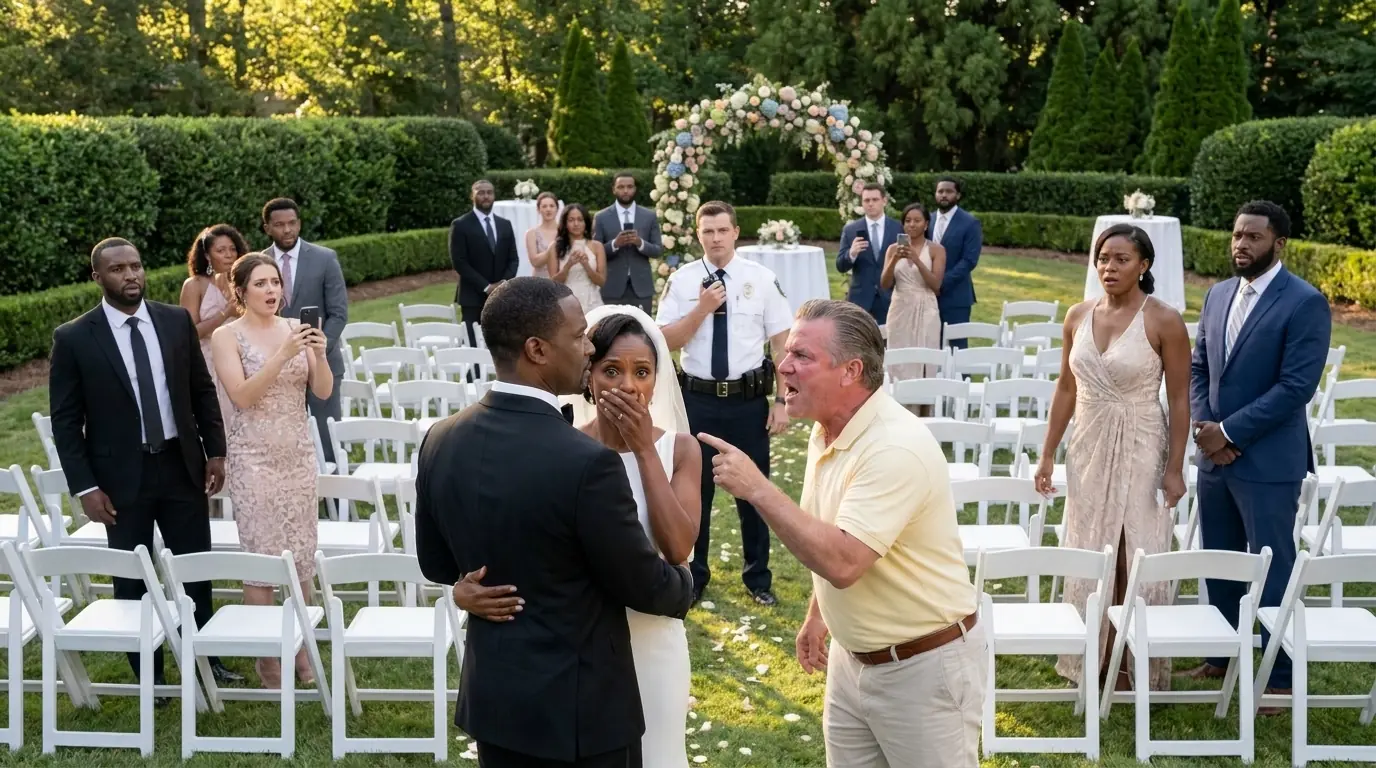
Angela grips her bouquet tighter, her wedding dress pristine against the ugly scene unfolding. Brad locks eyes with Sam while continuing his venomous call. "I don't care what formal clothes they're wearing. Criminal activity is criminal activity. Get them out before they rob us blind." The classical music from the backyard sounds hollow now.
Federal judges and prosecutors among the wedding guests watch in stunned silence as hate poisons what should be pure joy. What Brad doesn't know is that he just made the biggest mistake of his life. Three months earlier, Samuel Jefferson had carried Angela over the threshold of their dream home at 1247 Maple Drive. The colonial style house with its wraparound porch and mature oak trees represented everything they'd worked for.
Sam had spent twenty years climbing from street prosecutor to federal appointment. Angela had revolutionized pediatric surgery techniques that saved lives across the nation. Brook Haven Estates whispered wealth through every manicured detail. Million-doll homes lined streets named after trees.
Tennis courts and swimming pools hid behind privacy fences. It was the kind of neighborhood where success lived quietly behind closed doors. But success, they learned, was judged differently when it belonged to a Black family. The first incident happened during Sam's morning jog.
Brad Whitmore had stepped directly into his path, arms crossed like a human roadblock. "Excuse me, do you live here?" The question hung in the morning air like smoke. Sam had pointed to his house, sweat still cooling on his brow. Brad's eyes narrowed.
"I'm just looking out for the neighborhood." The words carried an unmistakable message. The harassment escalated weekly. Brad complained to the HOA about Sam's vintage motorcycle being inappropriate for neighborhood aesthetics. He questioned Angela when she watered their garden, asking if she was the new domestic help.
His voice always carried that same tone. Authority mixed with disgust. During neighborhood association meetings, Brad held court like a king among subjects. His voice boomed across the community center as he name-dropped connections.
"Chief Collins and I golf every month. Mayor Hayes comes to my barbecues. I keep this neighborhood safe through my relationships." Other residents nodded along, afraid to challenge the man who claimed to control their property values. The Johnsons, an elderly white couple, whispered support to Sam and Angela in private, but stayed silent in public.
Fear of Brad's retaliation kept voices quiet and injustice unchallenged. Sam's federal judicial appointment had been confirmed three weeks ago after grueling Senate hearings. Twenty years of prosecuting civil rights cases, defending the Constitution, and serving justice had culminated in this honor. He would soon wield the power to shape federal law, to protect the very rights Brad trampled daily.
The irony wasn't lost on him. While Brad bragged about knowing local officials, Sam would soon outrank them all in the federal hierarchy. Federal judges served for life, their decisions creating precedents that shaped American law for generations. Angela's medical practice had earned international recognition.
Her surgical techniques appeared in medical journals worldwide. She consulted for federal health agencies and spoke at conferences from Boston to Beijing. Yet Brad saw only skin color when he looked at her. Their wedding guest list read like a directory of federal power.
Judge Patricia Morrison, Sam's mentor, would fly in from DC. U.S. Attorney James Davidson had cleared his calendar. Federal marshals, prosecutors, and legal scholars would celebrate love while surrounded by hate. The morning of their wedding, Sam stood in his bedroom, adjusting his bow tie.
Through the window, he watched vendors transform their backyard into an elegant celebration. White tents billowed in the breeze. String lights waited to twinkle against the evening sky. Flowers created arcs of color across the lawn.
Angela emerged from their bathroom, wedding dress flowing like water. twenty years of fighting for justice, and today felt like victory. They had built something beautiful despite the ugliness around them. "Are you ready for this?" she asked, her voice mixing excitement with concern. Sam kissed her forehead gently.
"I've been ready my whole life." Outside, Brad paced his lawn like a caged animal. His complaints to city officials had been ignored. The wedding would proceed despite his protests. He watched federal vehicles arrive, their government plates, mocking his local connections.
Brad's wife, Patricia, had grown tired of her husband's obsession. Their children avoided coming home, embarrassed by their father's behavior. His real estate business was struggling as word spread about his reputation. Yet, pride and prejudice pushed him forward toward his own destruction.
As afternoon shadows lengthened, luxury vehicles began arriving. Federal judges stepped onto Maple Drive like dignitaries visiting a foreign land. Their presence transformed the suburban street into something approaching a state occasion. The stage was set for a collision between hate and justice, between local prejudice and federal power.
Brad Whitmore was about to learn that some battles cannot be won through connections and intimidation. He was about to discover the true meaning of federal authority. The wedding ceremony reaches its peak as Sam and Angela exchange vows beneath a flower-covered arch. Angela's voice trembles with emotion as she promises to love Sam through every challenge life brings.
The words feel prophetic in the golden afternoon light. Brad Whitmore can't contain himself any longer. He storms to his phone, dialing with shaking fingers. His voice carries across the peaceful gathering like a battle cry.
911. This is Bradley Whitmore, president of Brook Haven Estates HOA. I'm reporting major criminal activity at 1247 Maple Drive. large group of suspicious individuals, expensive vehicles that clearly don't belong to these people. This looks like gang activity disguised as a wedding.
His words drip with calculated malice. Every phrase is designed to trigger maximum police response. He paces his lawn like a predator circling prey, his expensive loafers crushing perfectly manicured grass. I personally know Police Chief Collins and Mayor Hayes.
They golf at my club every Sunday. I donate $50,000 annually to police charities. Chief Collins personally assured me that complaints from Brook Haven Estates receive priority attention. These officers better take this seriously or there will be consequences.
Brad's voice rises with each claim, ensuring wedding guests hear every venomous word. He wants them to understand his power, his connections, his ability to destroy their celebration. The emergency dispatcher's voice crackles through radio static. All units priority call Brook Haven Estates.
Complaint reports large gathering, possible criminal activity, suspected narcotics. Complainant identified as HOA president with verified city connections. Officer Rebecca Martinez glances at her partner, young sergeant David Carter. As their cruiser speeds toward the address, the siren wails through suburban silence like a banshee, announcing doom.
"Something's wrong here, David. That address belongs to Samuel Jefferson. He's a federal prosecutor. This call doesn't make sense." Carter's jaw tightens with rookie determination.
His knuckles whiten on the steering wheel. "It doesn't matter who lives there, Rebecca. We respond to all calls equally. The complainant has serious city connections." Their police cruiser rounds the corner just as Sam lifts Angela's veil for their first kiss as husband and wife.
The timing feels cruelly deliberate. Red and blue lights slice through the romantic atmosphere like knives through silk. Wedding guests freeze mid applause. Champagne glasses pause halfway to lips.
Children hide behind their parents as the cruiser's spotlight sweeps across the celebration like a prison search light. The classical quartet's music dies to awkward silence. Brad rushes toward the arriving officers, his face flushed with vindication. His expensive shoes crunch on gravel as he approaches like a prosecutor presenting damning evidence to a jury.
"Thank God you're here. I've been monitoring this suspicious activity for hours. Look at this chaos. Unauthorized vehicles are blocking our street. Unknown individuals are loitering with obvious criminal intent. These are clear violations of multiple city ordinances." His voice projects across the gathering, ensuring maximum humiliation for the wedding party.
Federal Judge Patricia Morrison, distinguished in navy silk, watches in horror as her protégé faces this public degradation. Officers, I'm Bradley Whitmore. Chief Collins and I golf together every month at Brook Haven Country Club. Mayor Hayes attended my daughter's graduation party last month.
I keep this neighborhood safe through my extensive connections, and this situation requires immediate decisive action. Brad pulls out his phone, scrolling through contacts. I have Chief Collins on speed dial. One call from me can make or break police careers in this city.
Officer Martinez approaches the gathering professionally, her trained eyes noting the elegant decorations, formal wedding attire, and obvious legitimacy of the celebration. Everything screams wedding celebration. Nothing suggests criminal activity. "Good evening, folks. We received a complaint about a large gathering and possible criminal activity. Is this a private celebration?" Sam steps forward, still holding Angela's trembling hand.
His wedding ring catches the dying sunlight. "Officers, I'm Samuel Jefferson, the homeowner. This is our wedding reception. We have all required permits for this private celebration on our property." Brad interrupts before the officers can respond. his voice rising with manufactured authority and undisguised contempt.
Don't let him lawyer his way out of this. Look at these expensive cars. Mercedes, BMWs, Lexuses. Where did these people get money for vehicles like this?
Drug money, stolen cars, money laundering through fake wedding gifts. He waves dismissively at the elegant gathering. I've seen this before. Criminals hiding behind fake respectability.
Officer Carter, if you run those license plates, you'll find stolen vehicles and outstanding warrants. Sergeant Carter, influenced by Brad's confident authority and repeatedly claimed connections, begins asserting control over the situation. Sir, we'll need to verify vehicle registrations and check all attendees for outstanding warrants. Everyone steps away from the vehicles.
David, Martinez whispers urgently. This is clearly a legitimate wedding celebration. Look around. This isn't criminal activity.
The complainant has serious allegations and verified city connections. Carter responds stiffly. We need to be thorough, especially given his relationship with our superiors. Brad becomes more aggressive, sensing police support materializing.
He points dramatically at wedding guests, his voice carrying across the neighborhood like a carnival barker announcing freaks. Look at these so-called wedding guests. Half of them probably have extensive criminal records. That man in the expensive suit looks like a drug kingpin.
Those women in fancy dresses are probably involved in the operation. Angela grips Sam's arm tighter, her wedding bouquet trembling in her free hand. twenty years of medical school, surgical residency, and saving children's lives. And she's being called a prostitute at her own wedding. Ma'am, what's your occupation?
Carter asks Angela directly, his notebook ready. I'm Dr. Angela Thompson Jefferson, chief of pediatric surgery at Metropolitan Children's Hospital. She responds with quiet dignity despite the humiliation. Brad scoffs loudly, his laughter echoing across the gathering.
Anyone can claim to be a doctor. Check her credentials, probably as fake as this entire wedding charade. U.S. Attorney James Davidson, distinguished in his formal wear, steps forward with federal authority. Officers, I'm U.S. Attorney James Davidson for the Northern District.
This harassment is completely inappropriate. These are respected federal officials celebrating a colleague's wedding. Federal officials? Brad's laughter becomes more mocking.
Now they're claiming to be federal employees. Officer Carter, they're getting more creative with their lies by the minute. The situation escalates dangerously as more wedding guests reveal their credentials. Federal Judge Rodriguez approaches with judicial calm.
I'm Judge Rodriguez from the Third Circuit Court of Appeals. This celebration is entirely legitimate and this harassment must stop immediately. Brad's confidence never waver. His voice grows louder, more theatrical.
I don't care what fake titles they claim. Anyone can print business cards and government IDs these days. Officer Carter, if you don't start making arrests immediately, I'm calling Chief Collins personally. You'll be directing elementary school traffic by tomorrow morning.
Carter feels the crushing pressure of Brad's threatened connections. His career hangs in the balance between competing authorities. "Based on the complainant's allegations, we need to conduct searches of all vehicles for contraband and weapons." "Sergeant," Sam says quietly, his legal training evident. "What specific probable cause do you have for conducting warrantless vehicle searches?" We have a reliable complainant with verified city connections reporting ongoing criminal activity.
Carter responds, his authority directly challenged by Sam's legal sophistication. Federal Marshal Robert Torres, attending as a wedding guest, intervenes with professional calm that cuts through the chaos. Sergeant, I'm Federal Marshal Torres. Badge number 4,429.
You're about to violate the Fourth Amendment rights of multiple federal officials. I strongly advise reconsidering your current approach. Brad becomes increasingly desperate as his carefully constructed narrative begins crumbling under federal scrutiny. Marshal, federal this, federal that.
They're all sophisticated liars using fake government credentials. Officer Carter, these are professional criminals who've studied government procedures to avoid detection. The confrontation reaches its most dangerous territory as Carter, completely overwhelmed by competing authorities and threatened consequences, makes his catastrophic decision. Sir, you're being argumentative and obstructive to this investigation.
I'm placing you under arrest for interfering with a police investigation and inciting public disorder. Wedding guests gasp audibly. Angela's face drains of color beneath her delicate veil. Federal officials watch in stunned, horrified silence as a local sergeant threatens to arrest a federal prosecutor at his own wedding ceremony.
Brad's triumph feels absolutely complete. His voice rises in vindicated celebration. That's exactly right. Arrest the ring leader first, then systematically work your way through the rest of these criminals.
Mayor Hayes and Police Chief Collins screech into the driveway, having frantically monitored police radio chatter about the unfolding disaster. Both men look physically ill as they rapidly assess the catastrophic situation. "Dear God," Chief Collins mutters under his breath. "What kind of disaster have we walked into?" The scene freezes in this moment of maximum injustice.
A distinguished federal prosecutor facing arrest at his own wedding, surrounded by federal officials, publicly humiliated by a racist neighbor's calculated lies, and a rookie sergeant's devastatingly poor judgment. The collision between local prejudice and federal authority is about to explode with overwhelming force. Brad's confidence reaches intoxicating heights as he watches Sergeant Carter prepare handcuffs. He struts across his lawn like a conquering general, his voice booming with authority that carries across the entire neighborhood.
Finally, some real police work. Officer Carter, I want you to know that Chief Collins will hear about your excellent performance tonight. You're exactly the kind of officer this city needs. Brad pulls out his phone with theatrical flourish, scrolling through contacts for maximum effect.
See this direct line to Chief Collins, Mayor Hayes, City Councilman Rodriguez. I text them regularly about neighborhood security. They trust my judgment completely. He waves the phone at the wedding guests like a weapon.
One call from me and careers are made or destroyed in this city. Officer Carter understands how power really works. Sergeant Carter feels emboldened by Brad's promised support. The rookie's chest swells with misplaced pride as he surveys the elegant gathering with newfound suspicion.
Everyone needs to step away from the vehicles immediately. We're conducting a full investigation based on credible reports of criminal activity. Officer Martinez tries desperately to intervene. David, this is clearly a wedding celebration.
Look at the decorations, the formal attire, the wedding cake. Nothing here suggests criminal activity. The complainant has documented evidence and verified connections. Carter snaps back.
We don't ignore serious allegations from respected community leaders. Brad senses the perfect moment to escalate his psychological warfare. He approaches the wedding guests directly, his voice dripping with manufactured concern. Ladies and gentlemen, I know you think you're at some kind of celebration, but you're actually witnesses to organized criminal activity.
I strongly advise cooperating with police before you become accessories to whatever crimes are happening here. Federal Judge Patricia Morrison, Sam's mentor, steps forward with decades of judicial authority radiating from her bearing. Sir, I'm Federal Judge Patricia Morrison. Your accusations are not only false, but potentially criminal themselves.
Brad laughs mockingly, his voice echoing across the gathering. Judge, you people are really committed to this charade. Officer Carter, they're using fake federal credentials now. This proves how sophisticated this criminal operation really is.
Dr. Angela Jefferson, still clutching her bouquet, watches her dream day transform into a nightmare. Her voice trembles with restrained emotion. We have marriage licenses, permits, vendor contracts. Everything here is completely legal and documented.
Documents can be forged, Brad declares with growing theatrical flare. I've seen these scams before. Criminals rent fancy clothes, print fake IDs, stage elaborate events to launder money, and conduct illegal business. He points dramatically at the wedding photographer.
Look, they're recording everything for intelligence purposes, probably mapping the neighborhood for future break-ins. Officer Carter, you should confiscate all cameras and phones as evidence. The photographer, a nervous young man named Marcus, lowers his camera with shaking hands. Sir, I'm just documenting their wedding day.
I have contracts, business licenses, everything legitimate. Contracts with criminals are worthless. Brad sneers. You're probably documenting security weaknesses for future robberies.
U.S. Attorney James Davidson attempts to restore sanity to the spiraling situation. "Officers, I'm U.S. Attorney Davidson. I can verify the credentials of everyone here. This harassment needs to stop immediately." Brad turns his venom toward Davidson with renewed intensity.
"U.S. Attorney? These fake titles are getting more elaborate." Officer Carter, they're obviously trying to intimidate you with phony federal authority. Don't let them manipulate you. Carter, completely overwhelmed and clinging to Brad's promised protection, makes increasingly dangerous decisions.
Everyone needs to produce identification for warrant checks. Anyone refusing will be arrested for obstruction. Federal Marshal Robert Torres steps forward, his badge gleaming in the evening light. Sergeant, I'm Federal Marshal Torres.
You're violating the constitutional rights of federal officials based on demonstrably false allegations. Another supposed federal marshal. Brad's voice rises to near hysteria. Officer Carter, they've obviously studied law enforcement procedures.
This is exactly what sophisticated criminal organizations do. Impersonate federal agents to avoid arrest. The situation spirals further as Brad becomes increasingly unhinged. His face reddens with exertion as he paces frantically, pointing at different wedding guests.
Look at those children. Probably trained pickpockets. Those elderly people. Perfect cover for drug smuggling operations.
Officer Carter, you need to search everyone thoroughly. eight-year-old Emma Thompson, Angela's niece and flower girl, begins crying as Brad's accusations target her directly. Her white dress and flower crown make her look like an innocent angel, but Brad's paranoia sees only criminal potential. That little girl could be carrying contraband. Criminal groups sometimes use children because police do not suspect them.
Officer Carter, search her immediately. Angela rushes to protect her niece, her wedding dress flowing as she kneels beside the terrified child. Emma's 8 years old. She's my flower girl.
How dare you accuse a child of criminal activity. Fake emotion, Brad shouts triumphantly. Classic criminal manipulation. Officer Carter, don't let them use children as human shields.
The wedding guests begin showing signs of genuine fear. Elderly relatives whisper prayers. Young adults start recording the incident on phones. The elegant celebration transforms into something resembling a police raid.
Sam's grandfather, ninety-year-old Reverend Thomas Jefferson, approaches with the dignity of a civil rights veteran. His frail voice carries decades of wisdom and pain. Son, I've seen this hatred before. In Montgomery, in Selma, in Birmingham, the uniforms and excuses change, but the hatred stays the same.
Brad turns his fury toward the elderly minister with shocking cruelty. Fake Reverend playing the victim card. Officer Carter, this is classic criminal psychology, using elderly accomplices to generate sympathy and avoid prosecution. The reverend's words cut through Brad's rage like a sword through darkness.
Young man, you're walking down a very dangerous path. Hatred destroys the hater more than the hated. Philosophical manipulation, Brad screams, completely losing rational control. Officer Carter, this proves they're sophisticated criminals using psychological warfare.
Arrest them all before they escape. Carter, thoroughly influenced by Brad's paranoia, makes his most devastating decision. I'm calling for backup units. This situation requires crowd control and a systematic investigation.
Officer Martinez makes one final desperate attempt to prevent catastrophe. David, we have no probable cause for arrests. These accusations are obviously false. We need to deescalate immediately.
The complainant has documented criminal activity, Carter responds with robotic authority. His connections to city leadership verify his credibility. We're proceeding with full investigation and arrests. Brad's triumph reaches its peak as police sirens wail in the distance.
Additional units respond to Carter's backup request, their red and blue lights painting the elegant neighborhood in harsh, threatening colors. Perfect. More real officers who understand how to handle criminal situations. Officer Carter makes sure they know about my relationships with Chief Collins and Mayor Hayes.
The arriving officers survey the scene with growing confusion. Wedding decorations, formal attire, and obvious celebration clash violently with dispatch reports of criminal activity and gang violence. Sergeant Williams, a veteran officer, approaches Carter with concern etched across his weathered face. Carter, what exactly are we looking at here?
This looks like a wedding celebration. Major criminal operation disguised as a wedding, Carter responds with misplaced confidence. The complainant has verified city connections and documented evidence of ongoing criminal activity. Brad rushes toward the backup officers like a politician greeting supporters.
Officers, thank God you're here. I've been trying to get these criminals arrested for hours. Chief Collins knows me personally. Call him right now.
The veteran officers exchange troubled glances. Years of experience tell them something is terribly wrong, but Carter's confidence and Brad's claimed connections create dangerous uncertainty. As more police arrive, the peaceful wedding celebration transforms into something resembling a large-scale police operation. Flashing lights reflect off champagne glasses.
Radio chatter drowns out classical music. The smell of police exhaust mingles with wedding flowers. Angela clings to Sam's arm, her dream day shattered by hatred and ignorance. Sam, make this stop.
Please make this nightmare stop. Sam's voice remains calm despite the chaos surrounding them. Angela, we're going to get through this. Truth always prevails, even when it takes time.
But even Sam cannot imagine how dramatically and completely the truth is about to explode across this scene of injustice. Mayor Hayes and Police Chief Collins sit in their emergency vehicle, monitoring radio traffic with growing horror. The political implications of this disaster begin crystallizing in their minds. Bob, the mayor whispers to the police chief.
If this is what I think it is, we're looking at a federal civil rights catastrophe. Chief Collins stares at his radio with the expression of a man watching his career evaporate. We need to get there now. This could destroy the entire department.
The stage is set for the most dramatic reversal in the history of Brook Haven Estates. As Sergeant Carter raises his handcuffs toward Sam's wrists, Federal Judge Patricia Morrison's voice cuts through the chaos like a lightning bolt. Sergeant Carter, stop immediately. You're about to arrest the newly confirmed federal district judge for the Northern District.
The words hit the scene like a shock wave. Every sound dies instantly. Brad's triumphant grin freezes mid-expression. Carter's hands tremble as the handcuffs slip from his grasp, clattering onto the pavement with metallic finality.
Sam reaches into his inner jacket pocket with deliberate calm. He produces official documents bearing federal seals and his judicial appointment papers signed by the president of the United States. Sergeant Carter, Mayor Hayes, I'm Judge Samuel Jefferson, confirmed as a federal district judge. I was confirmed by the United States Senate three weeks ago and will be sworn in next month.
The revelation moves through the gathering like a shock wave. Carter's face drains of all color, becoming ghostly white in the evening light. His legs visibly wobble as the magnitude of his catastrophic mistake crashes down upon him. Brad's confident smirk transforms into absolute terror.
His mouth opens and closes wordlessly like a fish gasping for air. The blood drains from his face so rapidly he appears to age 10 years in 10 seconds. A federal judge? Brad's voice comes out as a strangled whisper.
That's impossible. Federal judges don't live in regular neighborhoods. This has to be some kind of elaborate hoax. His hands shake uncontrollably as reality destroys his carefully constructed worldview.
Federal judges live in Washington. They don't buy houses in suburban neighborhoods like normal people. Judge Morrison steps forward with the full weight of federal authority. Mr. Whitmore, federal judges live in communities across America.
What's very real is that you've just filed false police reports against a federal official, which is a serious federal crime. Sam's voice remains perfectly controlled, judicial temperament intact despite the personal humiliation he's endured. Mr. Whitmore, you've accused federal officials of criminal activity, demanded illegal searches, and attempted to have me arrested at my own wedding. These are federal offenses with severe consequences.
The wedding guests erupt in a mixture of celebration and outrage. Federal colleagues applaud while family members weep with relief and anger. The sound echoes across the neighborhood like thunder after lightning. Brad begins hyperventilating, his chest heaving as panic consumes him completely.
"Your Honor, please. This is all a terrible misunderstanding. I had no idea. I would never knowingly harass a federal judge." "Ignorance of my position doesn't excuse filing false police reports or racial harassment." Sam responds with quiet authority.
Federal courts take civil rights violations very seriously. Mayor Hayes and Police Chief Collins screech into the driveway, their faces reflecting pure political terror. They leap from their vehicle like men fleeing a burning building. Judge Jefferson.
Mayor Hayes rushes forward, his voice cracking with desperation. On behalf of the entire city, I offer our deepest, most sincere apologies. This is a complete catastrophe of justice. Police Chief Collins looks physically ill as he surveys the disaster.
Your honor, Sergeant Carter is suspended immediately, effective this instant. This department will cooperate fully with any federal investigation. Carter's career evaporates before his eyes. His badge feels like lead in his pocket as the weight of federal consequences crushes his future.
Your honor, I destroyed my career because I listened to false accusations. I have no excuse for my actions. U.S. Attorney Davidson steps forward with prosecutorial authority. Judge Jefferson, this incident involves clear violations of federal civil rights statutes.
The FBI will conduct a comprehensive investigation into this harassment. Brad becomes increasingly frantic as the federal machinery begins grinding toward him. "Your Honor, I have a family and a business. I made one mistake. Please don't destroy my entire life over this misunderstanding." Mr. Whitmore, Sam responds with judicial precision.
This wasn't a mistake or misunderstanding. This was deliberate racial harassment using false police reports as weapons. Federal law exists specifically to address such violations. The media explosion begins immediately.
News crews arrive within minutes, alerted by social media posts from wedding guests. The story spreads across the internet like wildfire. Federal judge harassed at wedding by racist neighbor. Federal judge Rodriguez adds his voice to the condemnation.
Judge Jefferson, this harassment occurred in front of multiple federal officials. We have dozens of federal witnesses to these civil rights violations. The complete power reversal becomes starkly visible. Sam, the intended victim, now towers over the scene with federal authority.
Brad, the aggressor, cowers in the shadow of federal prosecution. Carter, the enforcer, faces career destruction and potential federal charges. Brad's phone begins ringing incessantly as his claimed connections distance themselves from the disaster. Mayor Hayes and Chief Collins, the very people Brad name dropped, now grovel before the federal officials.
I need to call my lawyer, Brad whispers, his voice barely audible. I need to call my lawyer right now. That would be wise, Sam responds with judicial calm. You'll need excellent legal representation for federal court.
The wedding photographer, no longer afraid, begins documenting the historic reversal. The contrast is breathtaking. Sam standing with quiet dignity while Brad collapses under the weight of his own hatred. Angela approaches her husband, her wedding dress pristine despite the chaos around them.
Sam, our wedding day became something more important than we ever imagined. Sam takes her hand gently. "Sometimes justice arrives in unexpected ways. Angela, this incident will help protect other families from experiencing what we endured today." The neighborhood watches through windows as federal authority asserts itself over local prejudice.
Property values won't decline. They'll increase due to association with federal judicial prestige. Brad's real estate empire begins crumbling in real time as clients cancel contracts via frantic phone calls. His social media feeds explode with condemnation as videos of his harassment go viral nationally.
The transformation is complete and irreversible. The person Brad tried to humiliate and remove from his neighborhood will soon have the power to shape civil rights law for the entire federal district for decades to come. Federal justice has arrived in Brook Haven Estates and it wears Sam Jefferson's face. Brad Whitmore's complete psychological collapse unfolds in real time as federal reality crushes his racist delusions.
His knees buckle, forcing him to grip his mailbox for support. Sweat pours down his face despite the cool evening air. Your honor, please. I'm begging you.
His voice cracks like a teenager's. All authority evaporated. I didn't know who you were. My business, my family.
Please don't destroy my entire life over one terrible mistake. Sam maintains perfect judicial composure despite the personal humiliation. Mr. Whitmore, filing false police reports against federal officials isn't a mistake. It's a calculated federal crime.
Federal prosecutors will determine the consequences. Mayor Hayes rushes between them like a desperate peacemaker, his political career flashing before his eyes. Judge Jefferson, the city accepts full responsibility. We're implementing immediate policy changes and will cooperate with any federal investigation.
Police Chief Collins moves with military precision. Judge Jefferson. Sergeant Carter is terminated immediately for civil rights violations. Security will escort him from the premises within the hour.
Carter's law enforcement career dies with public humiliation. His badge hits the pavement like a gunshot. Your honor, I destroyed twenty years of police work because I chose prejudice over justice. U.S. Attorney Davidson steps forward with prosecutorial authority.
Judge Jefferson, the Department of Justice will investigate this as a federal civil rights violation. Mr. Whitmore will face federal charges. Brad's remaining color drains completely. Federal charges?
I can't go to federal prison. I have children. You should have considered those consequences before weaponizing the police. Angela responds with surgical precision.
The media frenzy explodes instantly. News vans screech into the neighborhood like ambulances. Reporters leap from vehicles, cameras rolling. This is Sarah Carter reporting live from Brook Haven Estates, where a federal judge's wedding was disrupted by racially motivated false police reports.
Social media ignites like gasoline touched by flame. The hashtag FederalJudgeJustice trends within minutes as video clips receive thousands of shares. Neighbor relations transform dramatically. The Johnsons rush from their house carrying flowers.
Judge Jefferson, we're ashamed we didn't speak up sooner. This neighborhood is honored to have you. Several neighbors who'd supported Brad began frantic damage control. Mrs. Patterson approaches anxiously.
"Judge Jefferson, I never supported Brad's behavior. I was afraid to speak up." Brad's professional collapse accelerates like an avalanche. His phone buzzes with contract cancellations. Real estate clients flee like refugees.
Whitmore Realty is finished, he whispers. "Twenty years of building this business, destroyed in one afternoon," he whispers. Patricia Whitmore makes her decisive choice, approaching with genuine dignity. Judge Jefferson, I'm filing for divorce immediately.
My husband's racism doesn't represent my values. She removes her wedding ring with finality. I won't let his hatred destroy our children's future. Federal marshals arrive to provide security.
Their presence transforms the wedding from victim gathering to protected federal event. Marshal Torres coordinates protection efficiently. Your honor, we're providing federal security for the duration of your celebration. The wedding celebration prepares to resume despite trauma.
Sam and Angela choose love over hatred. We've witnessed justice prevailing over prejudice, Sam announces. Let's celebrate not just our marriage, but the triumph of federal law. Angela raises her bouquet like victory.
No racist neighbor will diminish our joy. Today we celebrate marriage and federal justice protecting all Americans. Phone calls flood city hall demanding accountability. Federal oversight appears inevitable as the story gains national attention.
Brad sits on his steps, empire crumbling. The man who claimed neighborhood control now faces federal prosecution from his intended victim. Federal justice moves swiftly, setting the stage for expanded consequences that will reshape civil rights enforcement. Two weeks later, the Department of Justice launches a comprehensive federal investigation with unprecedented resources.
FBI Special Agent Sarah Williams leads a team of civil rights investigators who descend on Brad's life like digital archaeologists excavating hatred. "Mr. Whitmore, you're being charged with federal civil rights violations, filing false reports to federal investigators, and conspiracy to violate the constitutional rights of federal officials," Agent Williams announces in the sterile federal building conference room. The investigation reveals Brad's extensive pattern of discrimination. FBI digital forensics uncovered years of documented hatred, email communications with city officials expressing desires to keep the neighborhood white, financial records showing donations tied to discriminatory policy advocacy, and social media posts containing explicit racial slurs.
"We found over 200 instances of racially motivated complaints targeting minority residents," Agent Williams explains to federal prosecutors. "This wasn't an isolated incident. It was systematic harassment using government resources as weapons." Three months later, Brad's federal trial begins in the imposing federal courthouse where Sam will soon preside. The irony isn't lost on anyone.
The man who tried to remove Sam from his neighborhood now faces justice in Sam's future workplace. Federal prosecutor Martinez addresses the jury with devastating precision. "Ladies and gentlemen, the defendant specifically targeted a federal judge and federal officials because of their race, attempting to use law enforcement as instruments of intimidation." Evidence overwhelms the courtroom like an avalanche. Video recordings from multiple angles show Brad's calculated cruelty.
Federal judges, prosecutors, and marshals testify about the unprecedented nature of the harassment. Expert witnesses explain the psychological warfare inherent in weaponizing police against minorities. Brad's defense attorney struggles against impossible odds. "My client made an error in judgment, but filing a noise complaint isn't a hate crime." "This wasn't a noise complaint," Prosecutor Martinez counters.
"This was coordinated intimidation disguised as civic duty." The federal jury delivers unanimous guilty verdicts on all charges after only two hours of deliberation. The speed suggests they found Brad's actions particularly egregious. Federal Judge Patricia Carter, no relation to the disgraced sergeant, delivers sentences with the weight of constitutional authority. "Mr. Whitmore, your actions represent a direct attack on federal authority and constitutional rights. This court sentences you to three years in federal prison, five years of supervised release, $150,000 in fines, and 2,000 hours of community service at civil rights organizations." Brad's legs give out completely as federal marshals approach with handcuffs.
His sobs echo through the courtroom like confessions. "Three years in federal prison. My children will lose everything." "You should have considered your children before attacking your neighbors," Judge Carter responds without sympathy. Former Sergeant Carter faces separate federal prosecution for civil rights violations under color of law.
His trial becomes a textbook case of how local prejudice can violate federal constitutional protections. "Defendant Carter used his authority as a police officer to enforce racial discrimination," Federal Prosecutor Johnson explains to another jury. "He transformed his badge into an instrument of oppression." Carter receives two years in federal prison and a permanent nationwide ban from law enforcement. No police department in America will ever hire him again.
The cases catalyze sweeping federal policy reforms. Attorney General Williams announces the Jefferson protocol for addressing racially motivated police complaints. "The Jefferson case demonstrates why we need federal oversight of local law enforcement responses to discrimination," the attorney general declares at a national press conference. New federal mandates include mandatory federal civil rights training for all police departments receiving federal funding, federal monitoring of 911 systems for racially motivated calls, Department of Justice oversight of police departments with discrimination patterns, and federal grants for community policing programs.
Sam and Angela file a comprehensive federal civil lawsuit seeking both damages and systemic reform. Civil rights attorney Robert Jackson represents them in federal court. "This case seeks not just compensation for our clients, but fundamental changes to prevent federal officials from facing racial harassment in their communities," Jackson argues before federal judge Morrison. The federal court awards unprecedented damages, $3.5 million in compensatory damages, $7 million in punitive damages, mandatory sensitivity training for the entire police department, federal monitoring of city policies for seven years, and creation of a federal civil rights ombudsman position.
The case establishes groundbreaking federal precedent. Law schools across America add Jefferson v. Whitmore to their civil rights curricula. Police academies incorporate the case into mandatory bias training programs.
Civil rights historian Dr. Washington analyzes the case's significance. Jefferson established new protections for federal officials from racially motivated harassment and demonstrated how local prejudice threatens federal authority. Congressional response is swift and decisive. Senator Rodriguez sponsors the Federal Officials Protection Act, inspired directly by Sam's experience.
"No federal judge, prosecutor, or official should face racial harassment in their communities," Senator Rodriguez declares during floor debate. This legislation ensures federal protection follows federal officials home. The law passes with overwhelming bipartisan support, creating enhanced penalties for targeting federal officials and establishing rapid federal response teams for civil rights violations. International attention follows as human rights organizations study the case.
United Nations Civil Rights Commissioner Lopez cites Jefferson as demonstrating how federal systems can protect minority rights when local authorities fail. Brad's complete destruction becomes a cautionary tale. Federal conviction triggers cascading consequences. His real estate license is permanently revoked, and business assets are seized to satisfy fines and damages.
Former associates cut ties, while his children require support to cope with the public consequences. His former country club revokes membership. Political allies publicly condemn his actions. Business partners dissolve all associations.
The man who claimed to control the neighborhood becomes its pariah. Community transformation accelerates under federal oversight. Brook Haven Estates receives federal grants for diversity programs and designation as a federal civil rights heritage site. Property values increase due to federal attention and judicial prestige.
Judge Jefferson's confirmation ceremony occurs six months later in the same federal courthouse where Brad was convicted. The symbolism resonates nationally as news coverage highlights the journey from wedding harassment to judicial authority. "Having experienced discrimination firsthand, this court understands the urgent need for federal civil rights protection," Judge Jefferson states during his first major ruling, establishing precedent that protects minority professionals nationwide. His judicial decisions create binding precedents for federal courts across America, expanded interpretation of civil rights statutes, enhanced protection for minority federal employees, stricter enforcement of anti-discrimination laws, and federal oversight of local government discrimination.
The case influences international policy as foreign governments study American federal civil rights enforcement. Academic conferences worldwide examine how federal authority can protect minorities from local persecution. Educational institutions revolutionize civil rights training. The Jefferson Standard becomes the benchmark for federal civil rights protection.
Scholarship programs support minority students pursuing federal careers. One year later, the transformation is complete. Federal oversight ensures sustainable change. Annual audits prevent discrimination.
And ongoing monitoring protects civil rights. The neighborhood that once harbored systematic racism becomes a model for federal civil rights enforcement. Brad serves his federal sentence while Sam shapes civil rights law intended to protect Americans for generations. The contrast between their fates illustrates how federal justice transforms both perpetrators and victims.
Federal power properly applied created systemic change that prevents future incidents through institutional reform, proving that individual courage can trigger federal protection for entire communities. Two years later, Judge Samuel Jefferson presided over civil rights cases in the imposing federal courthouse. Morning sunlight streams through tall windows, illuminating scales of justice carved into marble walls. "People ask if that wedding day changed me," Judge Jefferson reflects.
"Experiencing injustice while knowing I'd soon have federal authority taught me that justice delayed is justice denied." Dr. Angela Jefferson leveraged their trauma into national change. Her office displays federal appointments, surgeon general's advisory committee, federal health equity task force, national civil rights board. "Our wedding trauma became a catalyst for federal health care protection," Angela tells medical students. "I work to ensure minority communities receive federal safeguards that local prejudice cannot undermine." Judge Jefferson's courtroom became a civil rights landmark.
His rulings create binding precedents protecting Americans nationwide. Legal scholars study his opinions while international delegations observe federal civil rights enforcement. Brad Whitmore serves his third year in federal prison, his former empire completely destroyed. An orange jumpsuit has replaced his expensive suits.
He speaks to police recruits about racism's consequences. Brad tells officers in a hollow voice, "I destroyed everything because I couldn't accept the success of a Black family. I lost my family, business, freedom, and reputation because I chose hatred over humanity." His real estate collapsed under federal investigation. His former wife and children relocate, seeking distance from the public consequences of his actions.
He became a case study in federal prosecution. His mugshot appears in training materials. Former Sergeant Carter works with Justice Department training officers after serving federal time. His career destruction warns law enforcement about constitutional violations.
"My actions violated federal law and nearly destroyed innocent people," Carter tells recruits. "I speak so other officers do not make the same catastrophic mistakes." The Jefferson case created permanent federal changes. The Jefferson protocol screens racially motivated calls. Federal teams investigate civil rights violations immediately.
Justice Department oversight monitors police in integrated communities. Congressional legislation established enhanced protection for minority professionals. Federal funding supports integrated development, rapid response teams, and bias prevention education. Brook Haven Estates transformed into a federally recognized model community.
International delegations study the community's integration efforts. Federal incentives attract diverse professionals, creating sustainable integration. Judge Jefferson addresses the National Civil Rights Conference: "Federal power must protect all citizens from local prejudice. When we wear robes or carry federal authority, we serve justice for everyone." His judicial legacy creates constitutional protections, enhanced federal safeguards, expedited jurisdiction over harassment, stricter penalties for false reports, comprehensive oversight of local law enforcement.
The case influences federal legislation protecting rights across America. Senator Williams champions expanded enforcement, creating systemic change, preventing future incidents.