The sun beat down on the crowded pool, laughter and splashes filling the air, but in an instant the atmosphere changed. A sharp voice cut through the joy: “You don’t belong here.” All eyes turned to see a woman pointing accusingly at a young Black teen. What happened next left everyone stunned as the confrontation escalated. A twist of fate was about to teach this Karen a lesson she’d never forget.
Calvin, the newly hired lifeguard, moved with purpose along the pool’s edge, his eyes scanning the area for any signs of trouble despite the carefree atmosphere around him. As he approached the deep end, a middle-aged white woman emerged from the crowd, her face contorted with anger, and marched toward him with determined strides. “You, what do you think you’re doing here?” she demanded, jabbing a finger in Calvin’s direction. “This is a private pool, and you need to leave immediately,” she added. Calvin froze, caught off guard by the sudden confrontation.
Onlookers paused their activities, their attention drawn to the unfolding scene, and the woman’s words hung in the air, heavy with accusation and prejudice. Taking a deep breath, Calvin attempted to explain, “Ma’am, I’m the new lifeguard, and I’m just doing my job to keep everyone safe,” his voice steady despite the tension building in his chest. But the woman scoffed, her voice dripping with disdain, and called it a likely story. “I’ve never seen you here before, and I know all the regulars,” she said. “You don’t belong here, and I want you gone now.”
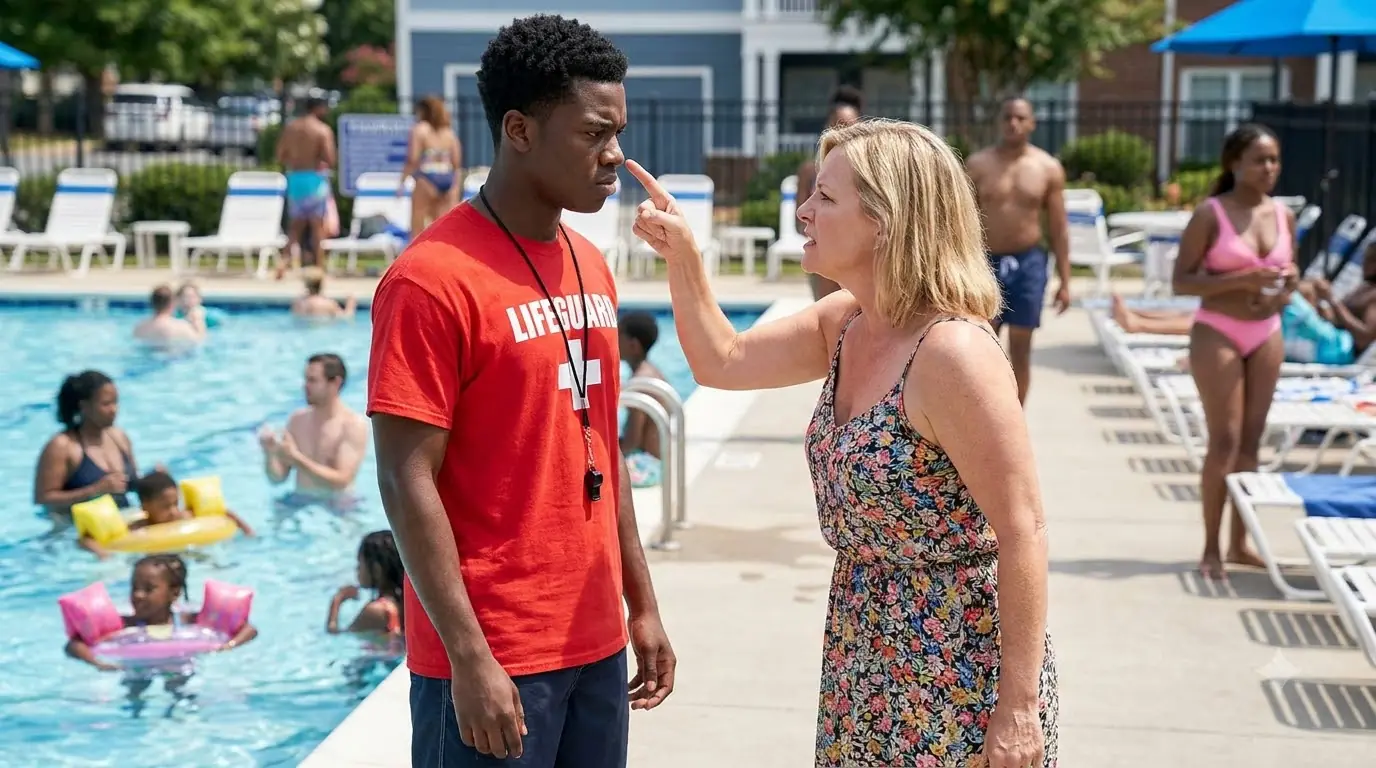
Calvin tried again, gesturing to his uniform and the lifeguard station, and assured her that he was employed there. He offered to speak to his supervisor with her to clear up any misunderstanding. The woman’s face flushed red with anger, and her words became more offensive, laced with racial undertones. “I don’t need to speak to anyone; I know your type, always trying to sneak in where you don’t belong,” she said. “This is a nice, family-friendly area, and we don’t need your kind causing trouble.”
As the confrontation escalated, the atmosphere around the pool shifted dramatically, and the joy and relaxation evaporated into a palpable sense of unease. Parents pulled their children closer, whispering hurried explanations, while some of the bolder patrons began to edge closer with faces showing concern and curiosity. Calvin stood his ground, but the woman’s relentless attack was taking its toll; his shoulders tensed, and a flicker of hurt crossed his face before he could mask it. The idyllic summer day had turned into a bitter reminder of the prejudices that still lurked beneath the surface of everyday life. The woman’s accusations grew more specific and hostile, her finger jabbing the air with each point and her voice rising above the now-hushed pool area.
“I’ve seen you hanging around here lately, always watching like you’re up to something,” she hissed, her eyes narrowing. “We don’t want trouble in our neighborhood.” Calvin felt his heart racing, a mix of anger and hurt surging through him, and he tried to speak, but the woman steamrolled over his attempts. “You probably don’t even belong here,” she continued, her words dripping with disdain. “How did you get in, and did you sneak past security?”
The power dynamics were palpable, with the woman fueled by her assumptions seeming to grow taller with each accusation while Calvin, despite his uniform and position as a lifeguard, found himself shrinking under the onslaught. It was a stark reminder of how quickly stereotypes could strip away a person’s dignity and perceived belonging. As the tirade continued, other pool-goers began to take notice, and hushed whispers rippled through the crowd. Some looked on with discomfort, while others seemed to nod along with the woman’s words, and the bystander effect was in full force as many hesitated to intervene. Calvin took a deep breath, struggling to maintain his composure as the humiliation and anxiety built with each passing moment and threatened to overwhelm him.
Finally, a middle-aged man stepped forward, his voice cutting through the tension, and said there had been a misunderstanding because Calvin was wearing a lifeguard uniform. Before he could finish suggesting that they pause, the woman whirled on him, her face flushed with indignation. “Are you blind, and can’t you see what’s happening here?” she demanded. “He’s not supposed to be here, and I’m getting the property manager right now.” As she stormed toward the pool office, Calvin felt a mix of relief and dread because the confrontation had momentarily shifted away from him, but he knew this was far from over.
Little did the woman know, a shocking revelation awaited her, one that would expose the dangerous consequences of unchecked prejudice. The air around the pool crackled with tension as everyone waited to see what would happen next. Calvin stood rooted to the spot, his mind racing, knowing that false accusations could have serious implications but thinking only about getting through the ordeal with his dignity intact. Just when it seemed the situation couldn’t get more intense, fate intervened. The next few moments would upend everything the accuser thought she knew about power, privilege, and property ownership.
As the woman stormed toward the pool office, the door swung open and a tall, elegantly dressed Black woman stepped out, her presence commanding attention. She moved with purpose, her eyes scanning the scene before settling on Calvin. “What’s going on here?” she asked, her voice calm but authoritative. Calvin straightened up, relief washing over his face, and began, “Mom, I—” before the accuser stopped dead in her tracks with her mouth agape. The newcomer turned to the woman with one eyebrow raised.
“I’m Tanya Johnson, the owner of this apartment complex, and I’d like you to explain why you’re harassing my son,” she said. The accuser’s face drained of color as the realization hit her, and she stammered, struggling to form words while her assumptions crumbled around her. The power dynamic had shifted dramatically, leaving her floundering. Tanya’s calm demeanor contrasted sharply with the accuser’s growing discomfort. “I understand there was some confusion about my son’s presence here, so perhaps you’d like to share your concerns with me directly.”
The woman’s earlier confidence evaporated as she looked from Tanya to Calvin and then to the gathering crowd of onlookers, the weight of her actions beginning to sink in and her face showing a mixture of embarrassment and shock. Tanya continued in a steady voice that racial profiling and false accusations could have serious consequences, both legally and for their community. The accuser’s shoulders slumped, and she opened her mouth to speak, but no words came out, leaving the stark reversal of her assumptions as a visual representation of prejudice confronted by reality. Tanya turned to the gathered crowd and said the incident highlighted a larger issue they needed to discuss as a community because assumptions based on race had no place there or anywhere. She added that they would organize a meeting to address the concerns and ensure everyone felt safe and respected in their home.
As Tanya spoke, ripples of conversation spread through the onlookers. Some nodded in agreement, while others shifted uncomfortably, perhaps recognizing that their own biases were reflected in the situation. Calvin stood tall beside his mother, the earlier hurt in his eyes replaced by a quiet strength. The incident, while painful, had become a powerful teachable moment, exposing the hidden prejudices that could lurk even in seemingly peaceful communities. As the tension began to dissipate, it was clear that the effects of this confrontation would linger long after the pool had emptied.
The incident had cracked open a conversation that many had been avoiding, forcing everyone to confront uncomfortable truths about race, power, and perception in their daily lives. The pool area buzzed with hushed conversations and shocked faces as the confrontation exposed the fault lines running beneath the surface of their seemingly peaceful community. Witnesses huddled in small groups, their voices a mix of disbelief and concern, with some expressing outrage at the woman’s behavior while others grappled with their complicity in staying silent. The accuser stood apart from the crowd, her earlier bravado replaced by visible shame, and her eyes darted around searching for an escape as Tanya approached her. Tanya’s voice was firm but measured as she explained the seriousness of racial profiling and false accusations.
The woman nodded silently, tears welling in her eyes as the full impact of her behavior sank in. The incident challenged long-held assumptions and forced people to confront uncomfortable truths about race and privilege. In response, the apartment complex management announced plans for community meetings to address concerns and implement new policies, while ideas circulated about diversity training, clearer guidelines for handling disputes, and creating more inclusive spaces. Calvin and Tanya became unexpected catalysts for change, their words carrying the weight of lived experience and resonating beyond the confines of the apartment complex. Social media amplified the incident, turning it into a rallying cry against racial profiling, and local news outlets picked up the story, sparking wider discussions about discrimination in public spaces.
As the sun began to set on that tumultuous day, the atmosphere around the pool had transformed, and the earlier tension had given way to a sense of purpose and unity. Residents exchanged contact information, eager to stay connected and work together on fostering a more inclusive community. The incident at the pool had cracked open a long-overdue conversation and served as a stark reminder that change often begins in unexpected places, even in the chlorine-scented air of a community pool on a sweltering summer day. As people dispersed, there was a palpable sense that this was just the beginning of a larger journey toward understanding and equality. As the sun dipped below the horizon, casting long shadows across the pool, the community found itself forever changed.
The confrontation exposed hidden biases and sparked a transformation, with neighbors engaging in deep, meaningful conversations, sharing stories, and listening with open hearts. They committed to building a more inclusive community, recognizing that change begins with each individual. This story serves as a powerful reminder of our collective responsibility. We are all called to action in our daily lives by challenging our own biases, speaking up against injustice, and fostering environments of respect and understanding. We create ripples of change that extend far beyond our immediate circles, and it’s through these small, consistent actions that we can build a more just and equitable society for all.