Jonas Harland set his hat on the table and asked if there was anything besides stew.
Edmund Hollis didn't look up from his ledger. The only sounds in the room were the scratch of his pencil and the clatter of someone's spoon.
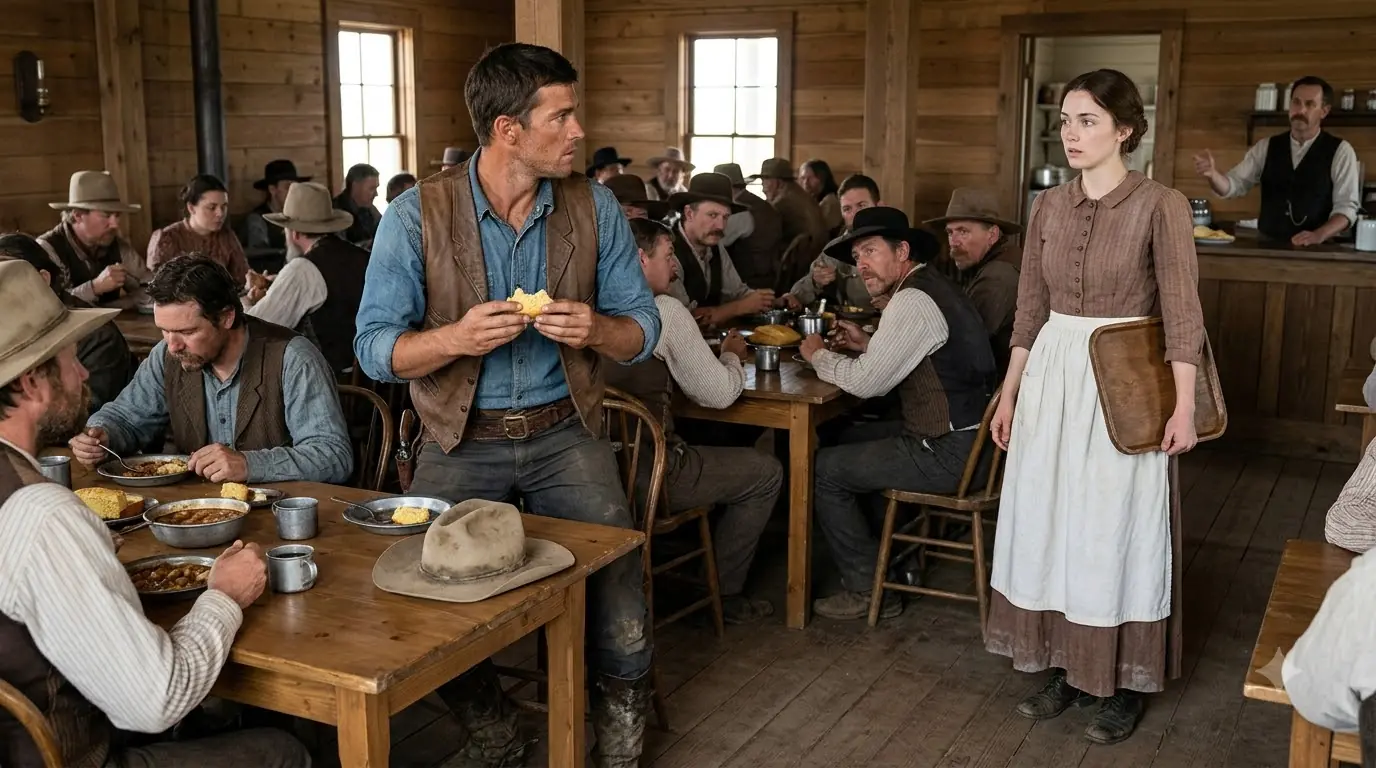
"There's cornbread if you want it. Woman in back made too much." He said it the way a man mentions leftover firewood. Lucy brought it out herself, plate in one hand, eyes somewhere past his shoulder. She set it down and turned to go.
"Hold on," Jonas said. He broke off a piece and ate it standing there in front of the whole dinner crowd because he hadn't thought to sit first. "That's the best cornbread I've ever had."
Lucy stopped. Something crossed her face that wasn't quite gratitude. "Glad it suits you." She went back to the kitchen like the compliment weighed something she didn't want to carry.
Jonas watched her go. The dinner crowd kept eating. Railmen in off the new grading work, a drummer with a case of tin samples, two ranch wives in for supplies. None of them looked up.
Whatever had just happened, it had happened only to him. He thought about it on the ride home, the way a man turns over a stone he doesn't understand the shape of. Jonas was 26, and the Harland Ranch was his, left to him three years back. A fair-sized spread for the area, not the largest in the county, but close enough to it, with a handful of hands and more cattle each season than the one before.
The town had grown up around him without his much noticing. A second street now, talk of a rail spur, and he'd grown with it in the dull, steady way of a man who puts his attention into fence line and forgets to ask what else there might be to want. He'd been engaged once, four years before, to a woman who packed her things and went home to her mother without telling him why. Since then, he had not gone looking for reasons to feel the lack of anything.
Lucy had grown up at the county orphanage two towns over and stayed on past the age she needed to because the cooking there needed doing and she was good at it. She came into town on her own two feet when it started needing more hands than it had. She found work at the boarding house and had kept it since. People mostly looked past her, plain-faced, quick about her business, nothing in her manner that invited a second look. She had gotten used to being looked past and had stopped expecting otherwise.
A few days later, Jonas rode through town on an errand that could have waited and saw her on the boarding house porch, crouched beside a boy of five or six, breaking a heel of bread in two and handing him the bigger half. The boy took it with both hands like it was the only thing he'd been given all week. His mother came up the street calling his name, found him, and thanked Lucy plainly, the way you'd thank someone for holding a door. Lucy smiled full and easy, the kind of smile Jonas hadn't once seen cross her face in the dining room.
Then Edmund's voice came from the doorway. "Lucy, back to it." Not unkind, exactly, just a man minding his business the way he minded everything else, with no more weight behind the words than he'd have given to telling her the stove wanted wood. The smile went out like a candle pinched between two fingers. Lucy wiped her hands on her apron and went inside without a word.
Jonas sat his horse a moment longer than his errand called for. He did not understand what he had just watched. He knew he had watched something. The town was busy getting ready for the harvest festival that week, banners going up along the main street, the bank polishing its own front window like it mattered to anyone.
Twice that week, Jonas found a reason to ride past the boarding house that hadn't existed the week before, and twice he told himself it had something to do with supplies. Old Mrs. Vain, who missed nothing from her chair on the mercantile porch, remarked to her daughter that the Harland boy seemed to be eating an awful lot of stew lately for a man who didn't care for stew. Her daughter said she hadn't noticed. Mrs. Vain said she had.
He ate at the boarding house again two days after that and didn't ask anything. He ate his stew and watched Lucy move through the room, quick, capable, closed up tight, and saw nothing of the woman who had knelt on the porch with a piece of bread. Whatever that had been, it didn't come out for customers.
He found himself paying closer attention than the meal warranted, noting the careful way she cleared a table, the way she never let her eyes rest on anyone's face longer than business required, and thought, not for the first time, that a person could spend a long while in a town this size and still manage to go mostly unseen.
That evening, he found Edmund at the saloon, where Edmund ended most evenings with the same glass of the same whiskey in the same chair, like a man keeping an appointment with himself. The room was loud with rail crews and card games, but Edmund's corner kept its own quiet country.
"That cook of yours," Jonas said. "She always like that?"
Edmund turned his glass a quarter turn. "Like what?"
Jonas turned his glass the way Edmund had turned his. "Quiet. Like she's waiting to be told to stop doing something."
Edmund didn't answer right off. He took his time with the whiskey the way he took his time with most things that mattered. "She's an orphan. Never had much cause to trust grown folks."
He drank. "Hardest worker I've got. She closes herself off like that with everybody, around grown people mostly. Children she goes soft for. Rest of us, she keeps her distance."
The saloon went on around them, loud in the way Thursdays always were, and for a while neither man said anything more. Jonas turned that over.