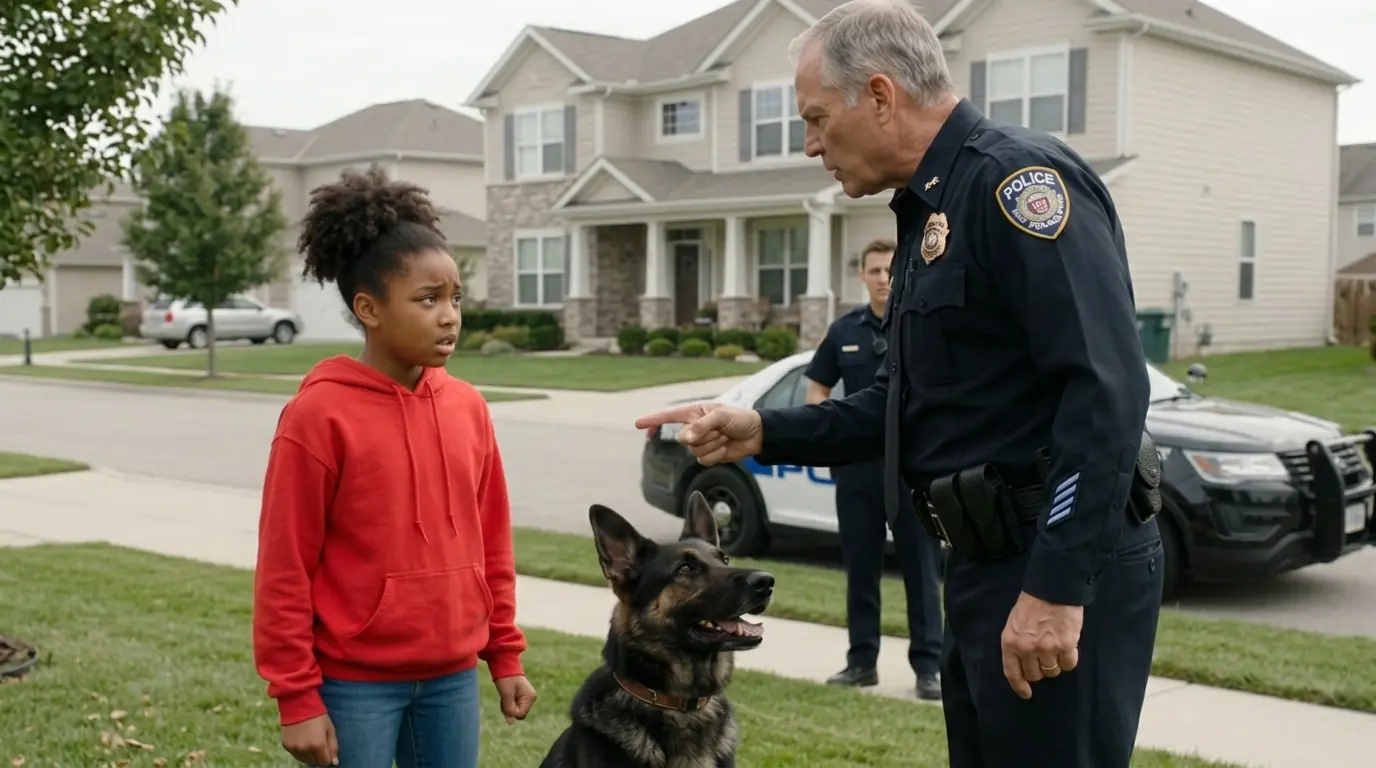
The first patrol car slowed twice before stopping in front of 1186 Magnolia Crest Drive. Nine-year-old Maya Carter noticed it but kept throwing the orange tennis ball across the front lawn because she had seen police cruisers roll through the neighborhood plenty of times before. Her German Shepherd, Atlas, chased the ball toward the oak tree, turned sharply, and brought it back with the same ridiculous seriousness he gave every game. Five minutes later, one officer would be standing over the dog with smoke lifting from his weapon while Maya screamed so loudly that people three houses away came running.
Magnolia Crest was one of those suburban neighborhoods north of Atlanta where every lawn seemed cut on the same afternoon. White mailboxes stood beside curved sidewalks, backyard pools hid behind cedar fences, and most homes sold for prices Maya did not understand but knew were “expensive” because adults always used that word around them. Her mother had bought the house three years earlier after promising Maya that moving would finally give them enough space for a dog.
Atlas arrived two months later.
He was supposed to be Maya’s father’s dog.
Daniel Carter had selected the German Shepherd puppy shortly before leaving for what became his final overseas assignment, telling his wife that every house with two stubborn Carter women needed one male smart enough to know when to stay out of the argument. Daniel died eight months afterward during an overseas contractor mission, and Atlas became something far more important than the family pet he had been intended to be.
The dog slept outside Maya’s bedroom when nightmares came.
He waited beside the front window every afternoon before her school bus arrived.
If Maya cried, Atlas placed his massive head against her knee and remained there until she stopped.
Her mother, Dr. Naomi Carter, sometimes joked that Atlas understood grief better than most licensed therapists.
That Friday evening, Naomi was still downtown.
She worked for the U.S. Department of Justice Office of Inspector General, where her job involved investigating misconduct involving federal grants, public agencies, and occasionally local law-enforcement partnerships. Maya knew only the simplest version.
Mom investigates people who are supposed to follow rules.
At 5:21 p.m., Officer Cole Mercer turned onto Magnolia Crest with his younger partner, Ethan Wallace.
The original dispatch sounded unremarkable.
Caller reporting suspicious juvenile.
Possible trespassing.
Large dog.
No reported burglary.
No weapon.
No threat.
No property damage.
The caller described “a Black girl wandering around one of the nicer houses with a loose German Shepherd.”
Cole repeated one part.
“One of the nicer houses.”
Ethan glanced toward him.
“Could just live there.”
Cole laughed.
“Maybe.”
They found Maya standing fifteen feet from the Carter porch.
She wore denim shorts, a red Atlanta Falcons sweatshirt despite the heat, and purple sneakers with one lace untied.
Atlas sat beside her.
Cole stopped the cruiser directly in front of the driveway.
Maya watched both officers get out.
“Hey.”
Cole’s voice was sharp enough that Maya immediately stopped smiling.
She held the tennis ball against her stomach.
“Yes?”
“What are you doing?”
Maya looked around.
“Playing.”
“Where do you live?”
She pointed behind herself.
“Here.”
Cole looked at the brick house.
Then back at Maya.
“Here?”
“Yes.”
“What’s the address?”
Maya gave it correctly.
Ethan looked toward the mailbox.
Matched.
That should have helped.
It did not.
Cole stepped onto the grass.
“Where are your parents?”
“My mom’s working.”
“Who else is inside?”
“Nobody.”
Cole exchanged a look with Ethan.
Maya noticed.
“What?”
Cole looked toward Atlas.
“Is that your dog?”
“Yes.”
“Licensed?”
Maya frowned.
“I don’t know.”
“Vaccinated?”
“Yes.”
“How do you know?”
“Because Mom takes him to the vet.”
Cole nodded slowly as though every answer created another reason to doubt her.
“Do you have a key to this house?”
Maya stared.
“I live here.”
“That wasn’t the question.”
Maya’s stomach tightened.
Her mother had taught her to be respectful with adults.
Especially police.
Especially if she felt afraid.
The problem was that respect had always sounded easier in conversations at the kitchen table.
“I have a key.”
“Show me.”
Maya reached toward the front pocket of her shorts.
Cole’s hand immediately moved toward his holster.
“Stop.”
Maya froze.
“You told me—”
“I said stop.”
Ethan looked toward his partner.
“Cole.”
“What?”
“She’s a kid.”
“I see that.”
Maya slowly lowered her hand.
Atlas stood.
Not aggressively.
Simply because his person had changed posture.
Cole noticed.
“Control your dog.”
“Atlas, sit.”
Atlas sat.
Maya looked toward the cruiser.
“Can I call my mom?”
Cole ignored the question.
“Why were you walking around the front yard?”
She blinked.
“Because it’s my yard.”
“No attitude.”
“I’m not giving attitude.”
Cole smiled without humor.
“Kids like you always say that.”
Maya did not understand every part of what bothered her about the sentence.
But Ethan did.
His face changed.
“Cole.”
Cole turned.
“What now?”
“Let’s just verify the address.”
“She doesn’t have ID.”
“She’s nine.”
Maya looked toward Ethan.
For the first time since the cruiser arrived, she felt slightly safer.
Then Cole laughed.
“You’d be surprised how many stories I hear.”
Ethan said nothing.
That small surrender mattered.
Years later, Maya would remember it almost as clearly as the gunshot.
A person recognizing something was wrong.
Then choosing quiet.
Cole stepped closer.
Atlas stood again.
“Sit.”
Maya pointed downward.
Atlas hesitated.
Cole’s hand moved toward his weapon.
“Get that dog under control.”
“He is.”
The German Shepherd placed himself between Maya and the officer.
No lunging.
No charging.
One bark.
Deep.
Sharp.
Protective.
Cole drew.
Ethan immediately raised one hand.
“Wait.”
Maya screamed:
“No!”
Three shots cracked across Magnolia Crest.
Atlas collapsed.
For half a second, Maya did not understand what she had seen.
The tennis ball dropped from her hand.
Rolled once.
Stopped.
Then she ran toward the dog.
“Atlas!”
Cole kept his weapon out.
“Stay back!”
Maya dropped to her knees anyway.
Blood darkened Atlas’s fur near his shoulder and ribs.
His breathing came shallow.
He tried lifting his head.
Could not.
Maya put both hands against him as though she could physically hold life inside his body.
“Please.”
Her voice broke.
“Please, Atlas.”
Neighbors were coming outside now.
Phones appeared.
A man across the street shouted:
“What did that dog do?”
Cole turned.
“Stay back.”
Another neighbor, Mrs. Evelyn Porter, seventy-one, stood barefoot at the end of her driveway.
“She lives there!”
Cole looked toward her.
“What?”
“That little girl lives in that house!”
Maya barely heard.
Atlas’s head rested against her leg.
She could feel him breathing.
Then not breathing.
Then breathing again.
Cole walked toward her.
“I told you to move.”
Maya looked up.
Her face was wet.
“You killed him.”
“The animal charged.”
“No.”
“He charged.”
“No, he didn’t.”
Cole’s jaw tightened.
“Stand up.”
Maya remained beside Atlas.
Ethan stepped closer to his partner.
“Let her stay with the dog.”
Cole looked at him.
“You suddenly supervising me?”
“No.”
“Then back me up.”
Maya heard every word.
Atlas made a weak sound.
She bent closer.
“Good boy.”
Cole raised his voice.
“On your feet.”
Maya turned toward him.
“No.”
It was a child’s answer.
Grief.
Fear.
Defiance.
Cole heard insubordination.
He grabbed her upper arm.
Evelyn Porter shouted.
“Take your hand off that child!”
Maya jerked away.
Cole seized her again.
Ethan finally stepped between them.
“Cole, enough.”