Taylor Voss pressed the heel of her black leather boot harder onto Rosa Bennett’s boarding pass and settled deeper into seat 2A as if the argument had already been decided. She was in her mid-fifties, white, with a sharp raven bob, a black turtleneck beneath a tailored wool coat, and the effortless polish of someone accustomed to expensive rooms making space for her. Across the aisle, Rosa stood perfectly still in a mustard turtleneck and pleated midi skirt, one hand wrapped around the handle of her small carry-on. Her breath caught once when she saw the edge of her boarding pass disappear beneath Taylor’s shoe, but her almond-shaped eyes remained level. Taylor smiled at the surrounding passengers and said loudly, “That pass isn't yours. Get out of my seat.”
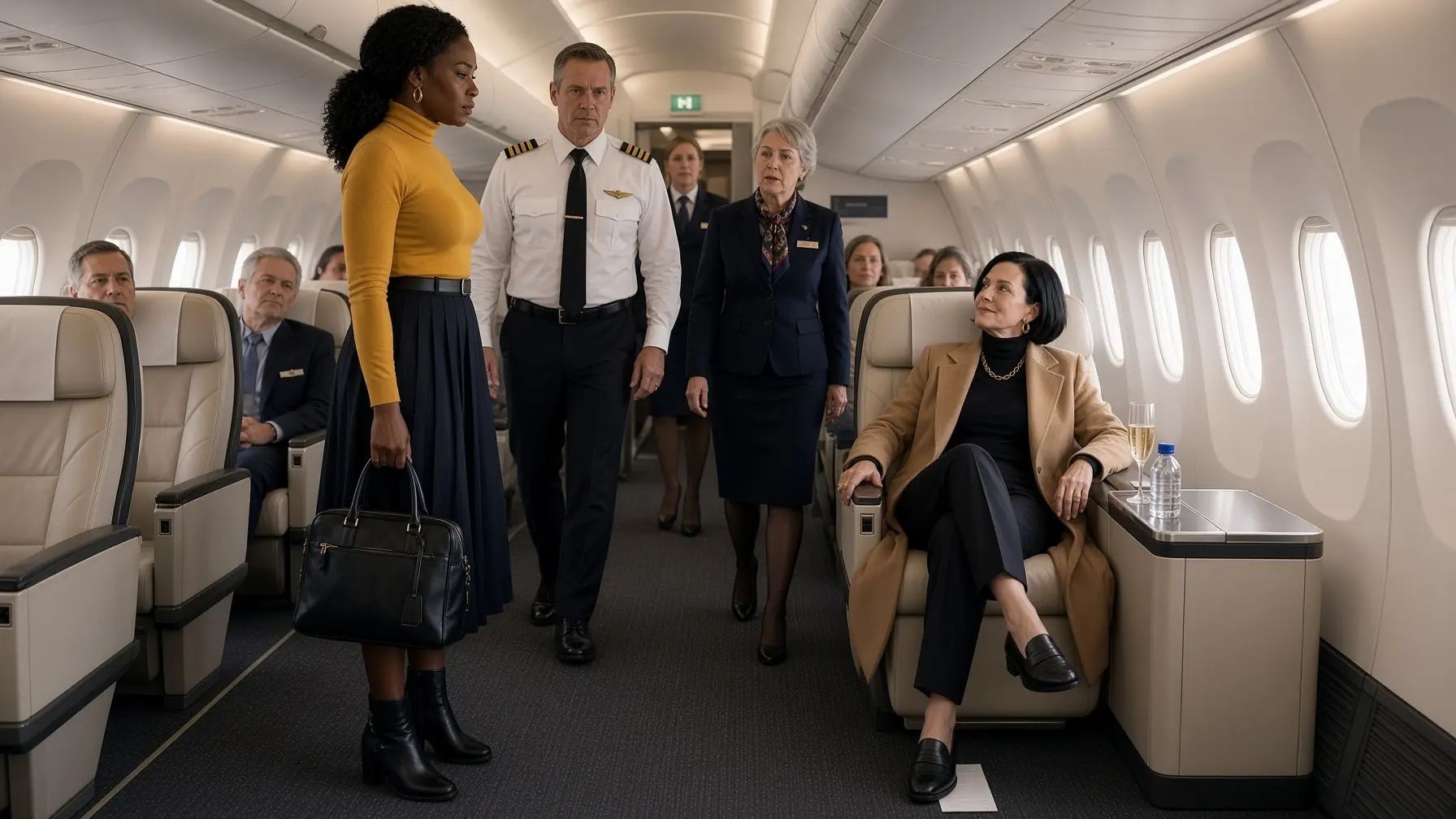
Two passengers turned immediately. A man in 1D lowered the business magazine he had been pretending to read, while a young mother in row three stopped fastening her son’s seat belt. Nobody in the first-class cabin mistook Taylor’s tone for confusion over duplicate seating. She was not asking whether a gate agent had made an error. She was announcing, to a cabin full of strangers, that the Black woman standing beside her could not possibly belong in the seat Taylor had decided was hers. Rosa looked down at the paper beneath Taylor’s heel and said, “Please move your foot.” Taylor gave a short laugh. “Honey, first class has rules. If somebody at the gate handed you an upgrade you weren't supposed to get, that's between you and them.”
Rosa did not reach for the boarding pass. That mattered because Taylor seemed to be waiting for exactly that movement, something she could transform into aggression the moment Rosa bent toward her. Instead Rosa placed her carry-on upright beside her leg and asked, “What seat is printed on your pass?” Taylor’s expression tightened. “I don't need to show you anything.” Rosa nodded once. “Then we can let the crew resolve it.” Taylor leaned back and crossed one leg over the other, keeping the sole of her boot deliberately on Rosa’s document. “I already know how this gets resolved.” Her eyes traveled from Rosa’s skirt to her simple leather tote and then to the cabin around them. “You go where you were actually assigned.”
The flight attendant approaching from the forward galley expected a routine seating mix-up. Casey Morgan was fifty-two, broad-shouldered, with short gray hair and twenty-eight years of cabin experience. She had dealt with duplicate boarding passes, last-minute upgrades, aircraft swaps, broken seats, families separated by automated rebooking, and passengers who sat in the wrong row because they preferred the window. Most disagreements disappeared after thirty seconds with a manifest. What made Casey slow as she reached row two was Taylor’s posture. Casey knew her. Taylor Voss was not just another frequent flyer; she was a senior director in the airline’s corporate partnerships division, traveling that morning on company business. Taylor looked up before Rosa could speak and announced, “Casey, thank God. She wandered into my seat and now she's making a scene.”
Rosa’s mouth tightened at one corner, then went still. “I haven’t raised my voice.” Taylor waved one hand toward the watching cabin. “You don't have to. You’re blocking boarding because you refuse to accept that somebody made a mistake.” Casey looked toward the floor. “Where is your boarding pass, ma’am?” Rosa indicated Taylor’s shoe. Casey’s expression changed. “Taylor, move your foot.” Taylor looked down as though she had only just noticed what she was standing on. “She dropped it there.” The man in 1D spoke without looking up from his magazine. “No, she didn’t.” Taylor turned sharply, and the man finally met her eyes. “You took it from her hand and put your foot on it.”
Casey bent to retrieve the document after Taylor reluctantly lifted her boot. The boarding pass was creased and marked with a faint black smear, but the information was clear: ROSA BENNETT — SEAT 2A — FIRST — CONFIRMED. Casey checked the flight number and date, then looked toward Taylor. “What seat are you assigned?” Taylor exhaled through her nose. “There was an operational change.” Casey held out her hand. “Your pass.” Taylor did not produce it. “I spoke with someone at the gate.” Rosa watched Casey carefully. “Please check the live manifest.” Taylor immediately spoke over her. “She doesn't need to tell you how to do your job.”
Casey looked at Rosa again. Something in her expression had shifted from neutral to uneasy. “I’ll verify both assignments.” Rosa said, “Thank you. And I need your employee number before the boarding door closes.” That stopped Casey for half a second. Taylor saw the pause and mistook it for intimidation. She smiled. “Oh, please. Now she’s filing complaints because she got caught.” Rosa did not look at her. “Casey, your employee number, please.” Casey gave it. Rosa repeated it once and entered it into her phone. Taylor laughed more loudly. “There. You happy? You’ve got somebody to threaten because you didn't get the seat you wanted.”
Rosa finally turned toward her. “I paid for the seat I wanted.” Taylor leaned forward. “Everybody says that.” Rosa’s eyes rested on her for several seconds. “No. Everybody with a confirmed ticket doesn't usually have to say it at all.” The young mother in row three looked down, concealing a small smile. Casey opened the cabin tablet and pulled up the latest manifest. Rosa’s name appeared exactly where the boarding pass said it would. Seat 2A. Confirmed revenue passenger. No upgrade indicator. No standby code. No employee-travel notation. Taylor Voss appeared in 2C under a corporate-travel designation.
Casey looked at Taylor. “You’re assigned 2C.” Taylor’s face hardened. “I was told 2A might open.” Casey answered, “It didn't.” Taylor glanced toward Rosa as if the problem had somehow become her fault. “Then somebody needs to explain why she was given priority over a corporate executive traveling on company business.” Rosa stared at her. Casey lowered her voice. “Taylor, she bought the seat. Your employee status does not displace a confirmed customer.” That should have ended the matter. Instead Taylor remained seated. “I am not moving until this is reviewed by someone with authority.”
Rosa looked toward the still-open boarding door, then toward the cockpit. The gate agent had begun signaling that departure clearance was approaching. A second flight attendant stood in the galley listening while trying to keep boarding moving behind the dispute. Rosa said quietly, “Before that door closes, the captain needs to verify what just happened.” Taylor laughed again, sharper this time. “Verify you for what?” Rosa did not answer. Casey studied her face, then the marked boarding pass, then Taylor. She reached for the interphone. “Captain, I need you in the cabin for a seating issue before close.”
Captain Andrew Mercer emerged less than a minute later. He was fifty-nine, silver-haired, and carried the particular calm of someone who understood that on an aircraft, loud authority was often a sign that calmer authority had arrived too late. He took the tablet from Casey, read the manifest, then looked at Rosa’s damaged pass. “Ms. Bennett, you are confirmed in 2A.” Rosa nodded. “Thank you.” Mercer turned toward Taylor. “Ms. Voss, you’re in 2C.” Taylor stared at him as if he had personally insulted her. “Andrew, you know who I am.” Mercer answered, “I do.” Taylor gestured toward Rosa. “Then you understand how ridiculous this is.”
Mercer’s face changed slightly. “What is ridiculous?” Taylor seemed startled by the question. “An internal corporate traveler getting displaced because somebody at the gate gave away inventory.” Mercer looked at the tablet again. “No inventory was given away. Ms. Bennett purchased 2A seventeen days ago.” Taylor’s lips parted. Casey glanced toward Rosa. The captain continued, “Your business-travel booking was issued in 2C. No reassignment occurred.” The entire cabin was listening now, though almost everyone pretended otherwise. Taylor looked toward Rosa and said, “Well, then maybe she bought it after somebody manipulated the system.”
Rosa picked up her carry-on handle. “That is the third different explanation you’ve given for why I can't own a ticket with my own name on it.” Taylor’s cheeks colored. “I never said you couldn't own a ticket.” The man in 1D finally lowered his magazine completely. “You literally said she couldn't own the seat.” Taylor turned toward him. “Stay out of this.” He shrugged. “You made it everybody’s business when you said it loud enough for the cabin to hear.”
Captain Mercer looked at Casey. “What happened before I came out?” Casey gave the short version: Rosa presented 2A, Taylor refused to move, the live manifest confirmed Rosa, and Taylor had physically held Rosa’s boarding pass under her shoe. Taylor interrupted immediately. “That is not what happened. She threw it down and started demanding employee information.” The young mother in row three spoke for the first time. “She didn't throw it.” Taylor turned. The mother continued, “You took it from her hand.” Another passenger said, “I saw that too.”
The cabin had crossed an invisible line. Taylor was no longer controlling the only version of events. Rosa did not smile. She did not look triumphant. She simply watched how Taylor responded when strangers began contradicting her. Taylor’s posture stiffened. “This is absurd. I have flown this airline for seventeen years as an employee. I know how these situations work.” Captain Mercer answered, “Then you know a company badge does not entitle you to occupy another passenger’s assigned seat.” Taylor looked toward Casey as though expecting support. Casey said nothing.
Rosa’s carry-on remained beside her leg. It was a compact black case, understated except for a narrow metal tag near the handle. Taylor had glanced at it several times during the confrontation and apparently decided it was ordinary luggage. Now Mercer noticed the tag. His eyes narrowed slightly, not from recognition of a luxury brand but because of the small engraved company crest. He looked at Rosa. “Ms. Bennett, may I ask whether that case contains company material?” Rosa nodded. “It does.” Taylor laughed incredulously. “Of course it does.”
Mercer asked, “Do you need secure handling?” Rosa considered the question. “Not if I remain aboard. But given that an employee has already accused me of using a fraudulent ticket and Casey initially allowed her to remain in my seat after seeing my confirmed pass, I need the station manager involved before departure.” Casey’s face flushed. Taylor stared at Rosa more carefully now. “Who exactly are you?” Rosa looked at her. “The same passenger I was five minutes ago.”
The station manager boarded before the door closed. His name was Victor Lang, and unlike Casey or Mercer, he recognized Rosa immediately. He stopped just inside the forward galley. “Ms. Bennett.” Taylor heard the change in his voice. Not fear. Familiarity. She sat straighter. Rosa said, “Victor, please don't turn this into a title issue. Confirm the records first.” He nodded and took the tablet from Mercer. Seat 2A belonged to Rosa Bennett. Full-fare ticket. Purchased through the public booking system. No employee discount. No upgrade. No special inventory override. Taylor Voss was confirmed in 2C on a company-paid ticket.
Victor asked Taylor to move.
She did not.
Instead she said, “I want HR involved before this becomes some kind of accusation.” Rosa’s eyebrows rose slightly. “HR?” Taylor realized she had just confirmed what several passengers had not known: she worked for the airline. “Yes,” she said. “Because I’m being publicly undermined by crew in front of customers.” Rosa looked toward the phones now openly visible throughout the cabin. “You are the person who put my boarding pass under your shoe.” Taylor answered, “And you’re obviously trying to make this racial.”
Rosa’s expression became very still.
“I have not used that word once.”
Taylor opened her mouth.
Rosa continued. “You told a Black woman standing beside a confirmed first-class seat that her pass was probably borrowed, that she must have manipulated an upgrade, and that she did not belong in the row. Those are your words. What they mean will be evaluated from your conduct, not from whatever label makes you most comfortable right now.”
Casey looked down.
Captain Mercer looked toward Victor.
Taylor finally stood.
The argument should have ended there.
Instead, as she stepped into the aisle, she picked up Rosa’s boarding pass and held it between two fingers. “You want your precious ticket?” Rosa extended her hand. Taylor dropped it.
Not into Rosa’s palm.
Onto the floor.
The man in 1D swore quietly.
Casey stared at Taylor.
Victor said, “Enough.”
Taylor looked at him. “Excuse me?”
“You are being removed from this flight.”
The words stunned her.
“I moved.”
“This is no longer a seating issue.”
“You cannot remove me from a business trip because she complained.”
Victor answered, “I can remove an employee passenger when their conduct is disrupting boarding and creating a cabin-management problem. Employment discipline is separate.”
Taylor turned toward Rosa. “You did this.”
Rosa bent, picked up the pass herself, and placed it inside her carry-on pocket. “No. You did.”
Taylor’s hands shook slightly now. “Who are you?”
Rosa looked toward Captain Mercer. “May I take my seat?”
“Of course.”
She sat in 2A.
Only then did Victor answer Taylor’s question.
“Rosa Bennett is a director of Bennett Meridian Holdings and a member of this airline’s board customer-experience advisory committee.”
Taylor stared at him.
The cabin went silent all over again.
But Victor was not finished.
“She is also Malcolm Bennett’s daughter.”
Recognition hit differently this time.
Malcolm Bennett was chairman of the board of Crown Atlantic Airways and the largest individual shareholder in its parent company. He had spent thirty years building a logistics and infrastructure fortune before leading the investment group that recapitalized the airline after a near-bankruptcy eight years earlier. Business magazines estimated his family’s holdings across aviation, ports, renewable energy, and industrial property in the tens of billions.
Taylor’s face drained.
“The chairman?”
Victor said nothing.
He did not need to.
Taylor looked at Rosa as if a completely different person had appeared in 2A.
That expression bothered Rosa more than anything Taylor had said so far.
“Oh my God,” Taylor whispered. “Ms. Bennett, I had no idea.”
Rosa looked at her.
“That is the first thing you’ve said this morning that makes the situation worse.”
Taylor blinked.
“I mean—I didn't recognize you.”
“I know.”
“If I had known who you were—”
Rosa raised one hand.
“Please stop.”
Taylor stopped.
Rosa’s voice remained calm. “You knew I was a passenger. You knew my name matched the pass. Casey showed you the manifest. The captain confirmed my seat. The station manager confirmed it again. None of those facts mattered to you until somebody told you who my father was.”
Taylor’s eyes dropped.
Rosa continued. “That is not an apology.”
Victor asked Taylor to collect her belongings.
For the first time, she complied without argument.
She retrieved her coat and handbag from the overhead bin while passengers watched. Nobody applauded. Rosa was grateful for that. Humiliation had already done enough work in the cabin. Turning Taylor’s removal into entertainment would only recreate the same public spectacle with the roles reversed.
Before Taylor stepped off the aircraft, she stopped beside Rosa.
“Please let me explain privately.”
Rosa looked up.
Taylor lowered her voice. “I thought there had been a gate upgrade issue. I handled it badly.”
“You thought three different things.”
Taylor swallowed.
“What?”
“First, that I had wandered into the wrong seat. Then that I had borrowed a boarding pass. Then that I manipulated an upgrade. After the manifest proved all three wrong, you suggested the booking system had been manipulated.”
Taylor said nothing.
Rosa leaned back.
“You never ran out of reasons. You only ran out of cabin.”
Taylor turned and walked off.
The door closed nine minutes late.
For several minutes after pushback, Rosa sat without touching the coffee Casey offered her. Her hands had begun trembling now that the confrontation was over. She folded them together in her lap beneath the small tray table, not wanting anyone to see. The carry-on at her feet contained a sealed board packet for the quarterly customer-experience review, including complaint trends, premium-cabin service metrics, discrimination allegations, and internal conduct data. That was the irony Taylor never understood.
Rosa had been traveling to Chicago to discuss how the airline treated customers when employees believed those customers possessed little influence.
The trip had not been an undercover test.
Nobody had told the crew to watch her.
Rosa had not chosen ordinary clothing to provoke anyone.
She had simply booked a ticket under her own name, boarded with everyone else, and expected seat 2A to function like seat 2A.
Casey approached after the seat-belt sign went off.
“Ms. Bennett?”
“Rosa is fine.”
Casey looked uncomfortable.
“I owe you an apology.”
Rosa waited.
“When Taylor said there had been an operational reassignment, I gave her statement more weight than yours because I knew she worked for the company.”
Rosa nodded.
“That’s part of it.”
Casey seemed surprised by the response.
“Part?”
“You saw my boarding pass.”
“Yes.”
“You saw her foot on it.”
“Yes.”
“And your first instinct was still to treat the problem as a disagreement between two equally plausible claims.”
Casey’s face flushed.
Rosa continued gently. “They weren't equally plausible.”
“No.”
“One person had a confirmed pass. The other person was sitting on it.”