A crowded martial arts academy falls silent. Students smirk. Instructors laugh. Standing in front of them is an aging biker named Jack Mercer. His leather vest is faded.
His tattoos are old. His muscles no longer look impressive. To everyone watching, he looks like an old man trying to relive his youth. The academy star instructor points at him and says, "You can't scratch me. " The crowd erupts with laughter.
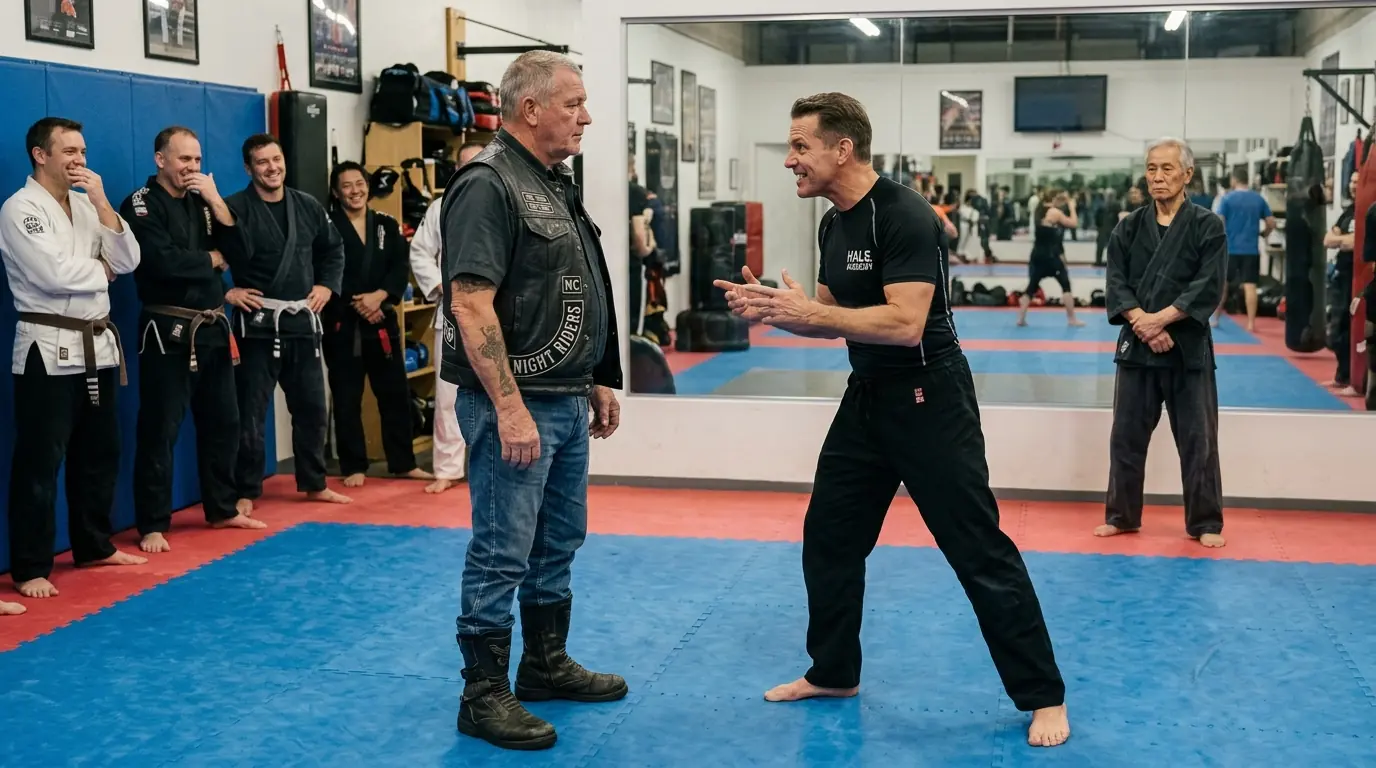
Some students begin recording. Others mock the biker openly. What nobody notices is that Jack never argues, never threatens, never raises his voice. Instead, he quietly adjusts his stance. One small movement, one tiny shift of his feet, and something impossible happens.
An elderly martial arts master standing across the room suddenly jumps to his feet. His face loses all color. He starts running, not walking, running. And then he screams, "Stop!"The entire academy freezes. Why would a legendary martial arts master panic over a simple fighting stance?
And why was this biker really there? The answer begins with a son who kept coming home heartbroken. What the academy did to that young man would eventually expose a secret none of them were prepared for. His name was Jack Mercer. 61 years old.
Broad shoulders that had softened just enough to fool you. Hands that looked like they'd poured concrete for a living. He rode a '98 Road King that coughed in cold weather and wore a cut so old the patches had started to curl at the edges. Nobody in that building knew his name when he walked in. By the time he walked out, nobody would forget it.
But to understand why Jack stepped through those doors that Tuesday morning, you have to go back. You have to meet his son. And once you do, you're going to find yourself asking one question over and over again. How does a kid that disciplined, that humble, that driven end up being the one they try to erase? Justice Mercer was 19.
He woke up before sunrise every single morning, laced his shoes in the dark, and ran three miles before most people had pressed snooze for the second time. He didn't talk much, didn't post online, didn't walk around looking for credit. He just worked. Every morning, the run. Every afternoon, the bag.
Every evening, footage, old matches, technique breakdowns, anything he could find. He wasn't training to impress anyone. He was training because discipline was the one thing in his life that had never lied to him. And for a kid who lost his mother at 11 years old, that meant everything. Jack had raised him alone.
No big family network. No safety net. Just a father, a son, a house that always needed something fixed, and a brotherhood that showed up without being asked. The Iron Covenant wasn't the kind of club that made headlines. No scandals.
No drama. Just men who kept their word. Jack had been a member for over two decades, and every single one of them would have told you the same thing about Justice. That boy was going to be something. You could feel it when you watched him move.
So when Justice enrolled at the Hale Academy of Martial Arts 14 months before any of this happened, he wasn't looking for trouble. He was looking for real instruction. Coach Victor Hale had built the place over 20 years. Regional champions, state competitors, a wall of trophies that greeted you at the door. Justice paid his enrollment fees with three months of weekend savings.
He showed up early to his first class, found a spot near the back, and for the first few weeks, things were fine. He trained, absorbed, and improved at a rate most instructors would have celebrated. Most instructors, not these ones. It started small. A drill Justice wasn't included in.
An advanced session he wasn't told about. Comments from senior students sharp enough to sting, but never direct enough to report. And then came the evaluations. Every six weeks, formal assessments, ranking tests, mat time allocations. Justice passed his techniques.
Every set of eyes watching could see it. But his scores always came back just short. Not quite. Not yet. Maybe next cycle.
He told himself he wasn't good enough yet. That's what discipline does to you. It turns you inward first. So he worked harder. He ran farther.
He got sharper. And the next evaluation came back the same way. And the one after that. There were three men at the center of what was happening to Justice. Victor Hale, 53, confident in the way ego can masquerade as mastery.
He had built something impressive and guarded it accordingly. He didn't like surprises. And he especially didn't like watching a 19-year-old kid with no connections quietly become the most technically precise student in his building. Then there was Brandon Knox, the academy's prize senior student, the face of the program, genuinely talented but accustomed to being the best in the room. Justice was dismantling that assumption every time they shared mat space.
And then there was Trent Mason, assistant instructor, 29, the man who ran the evaluations and filled out the score sheets. Not a cruel man by nature, but a man who understood which way the wind was blowing and adjusted accordingly. Together, those three had built something that looked like a meritocracy from the outside and functioned like a closed door on the inside. It came to a head on a Wednesday afternoon in late October. Justice was in the middle of a sparring session, outperforming a student ranked two levels above him, when he happened to glance toward a hallway.
A door was propped open. He recognized both voices coming through it. One was Victor. One was Trent. " If that kid stays another year, some of us lose our jobs. "
That was Victor. Flat. Certain. A pause. Then Trent. "
So what do we do?" " What we've been doing. Keep the scores where they are. There's always a reason. " Justice stood on that mat for a moment longer than he should have.
Then he walked to his bag, changed his shoes, and left without a word to anyone. He sat in the driveway for 40 minutes when he got home. Just sat there, not going inside. Jack was on the porch when he finally came in, reading something, glasses low on his nose. He looked up.
He didn't ask, but fathers notice things sons don't say. What he noticed was that his son's face had changed in a way that couldn't be fixed with sleep. Justice said he was fine. Jack nodded. And then he sat on that porch long after Justice went to bed.
Staring at the street with the look of a man who had already made a decision and was simply waiting for morning. The next day, Jack rode across town alone. No club. No backup. He just arrived.
The academy was mid-session when he walked in. Victor assessed him, leather vest, motorcycle, tattoos, and made the calculation that most people made in that moment. He walked over with the posture of a man who has already decided the interaction isn't worth his time. Jack introduced himself. Said his son had been here a year.
Said the evaluation scores didn't reflect what the boy was doing on the mat, and he wanted an honest conversation about why. Victor's expression moved through annoyance, dismissal, and then something like amusement. Students had stopped to watch. Brandon Knox was leaning against the far wall, smirking. Victor told Jack the evaluation process wasn't open to outside review.
Jack said calmly that he wasn't there to appeal a grade. He just wanted the truth. Victor's jaw tightened. He told Jack this was a private facility and suggested he speak to someone at the front desk. Jack said he was comfortable where he was.
That was when the tone changed. Victor wasn't used to being stood in front of. He was used to men backing down. Jack didn't move. Didn't raise his voice.
Didn't change his expression. He just stood there with an absence of anxiety that seemed to irritate Victor past his ability to manage it. He stepped into Jack's space and said, loud enough for everyone, "You want to know what this looks like to me? You look like an old man in a Halloween costume. You can't scratch me.