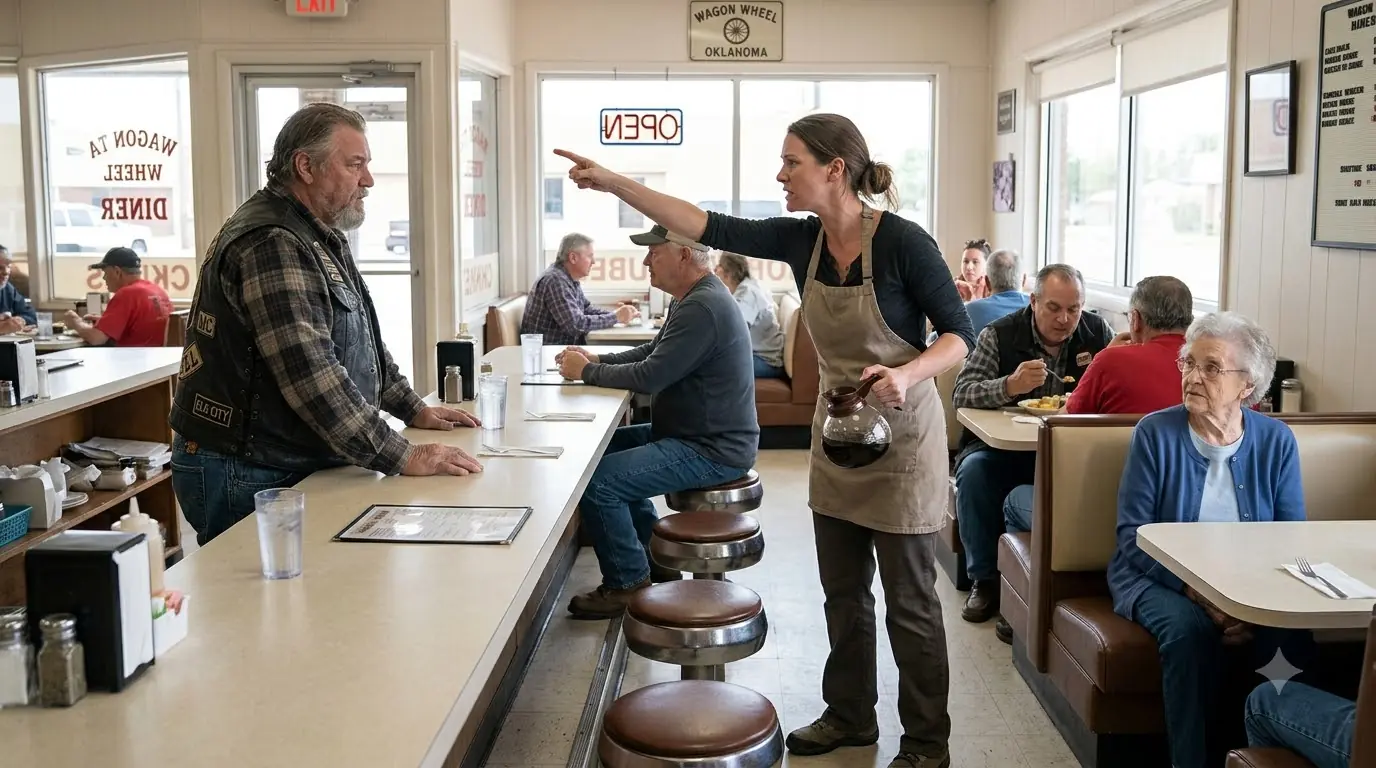
She was 83 years old, and most of the town had stopped expecting anything from her the day she turned 70. So when the woman in the apron pointed toward the door and told the man in leather he didn't deserve to sit at her counter, nobody in that diner thought to look at the old woman in the corner booth. Every fork stopped moving. Every conversation died mid-sentence. Every eye in the room turned toward the ink on his arms, the patch on his vest, the six years of quiet Tuesday mornings he'd spent at that counter without ever once raising his voice.
Nobody clapped. Nobody objected, and nobody in that diner had the first idea what the old woman in the corner was about to rise from her seat and do. The wind came down Third Street the way it always did in late September, dry and steady out of the west, rattling the neon tubing on the old Route 66 shield outside the museum and pushing a paper napkin end over end across the empty lot where the Conoco station used to be. Odessa Winslow watched it go from her booth by the window, the same booth she had taken every Tuesday and Friday morning for 11 years, and thought the way she thought most mornings, that the wind in this part of Oklahoma never seemed to tire of anything. It just kept moving.
She understood that better than most people her age were willing to admit they did. The Wagon Wheel Diner sat on West Third, half a block off Main, in a squat brick building with a striped awning faded from red to the color of old brick dust. It had been Ruth Talbert's place for 31 years before her son Grant took it over two winters back. And though Grant had put in new booths and a chalkboard menu, nobody over 60 could read without their glasses, the coffee was still the same coffee, and the regulars still sat where they had always sat. She was 83 years old, a widow of 9 years, and she did the Sunday crossword in ink, because a woman who had spent 38 years checking other men's arithmetic for a living, did not need the mercy of a pencil.
Most people in the diner knew her only as the quiet woman in the corner booth who ordered the same thing, two eggs over medium, wheat toast, coffee black, and who had a habit, if you watched closely, of glancing up at door frames and ceiling joists the way other people glanced at their phones. She had noticed the week Grant put in the new roofline over the register, that the header beam above the till was undersized for the span. She had never mentioned it. It was not anymore her business to mention such things, though her eyes had never gotten the message. Kelly Osgood came by with the coffee pot at 7:40, same as always.
34 years old, two kids in the elementary school on Pioneer Road, a divorce 4 years behind her that she didn't discuss, and everybody in town already knew about anyway. Kelly had waited tables at the Wagon Wheel since she was 19, and she was good at it. She remembered how you took your eggs without asking twice and could read from 15 ft away whether a table wanted to talk or be left alone. " Cold enough for you?" Kelly said, topping off the cup Odessa hadn't finished. "
It'll get colder before it gets warmer," Odessa said. " It always does." Kelly laughed the short easy laugh of someone who had heard most of Odessa's lines before and still liked them and moved off toward the counter where Emmett Larkin had just come through the door with the small bell over it giving its single flat ring. He came in most Tuesdays around 7:40, same as Odessa, though the two of them had never done more than nod across the room in six years of sharing that hour. He was a big man, built wide through the shoulders, the way men get from a lifetime of turning wrenches rather than lifting weights for the look of it, with a gray streaked beard kept close, and a leather vest worn soft and dark with age over a flannel shirt.
The tattoos ran down both forearms, old ink gone slightly blue green with time, and on his left arm, just below the elbow, the word "sons" sat in plain block letters, the tail end of a longer piece Odessa had never gotten a clear look at. He always took the second stool from the end, ordered black coffee and a short stack tipped well, and left by 8 to open the garage on the edge of town where the Steel Suns motorcycle club kept its clubhouse and its bikes. Nobody in Elk City would have called Emmett Larkin a friendly man. He wasn't unfriendly exactly. He simply didn't offer more than a nod and a thank-you required.
And in a town of 12,000 people who mostly knew each other's business, a quiet man in leather read to most eyes like a closed door nobody particularly wanted to open. What none of them knew, what none of them had ever asked in six years of Tuesday mornings was that Emmett Larkin's hands had once cleared 11 kilometers of road outside Fallujah without a single vehicle in his convoy, losing a wheel to what was buried underneath it, and that the tremor he sometimes worked to hide when he lifted his coffee cup too fast, had a name and a discharge paperwork that named it. Back at a VA office in Oklahoma City, he visited twice a year and told no one about. The bell over the door rang twice more before 8, and each time a different version of the same low murmur passed through the diner, heads turning half an inch, voices dropping half a register, then returning to their eggs. Two days earlier, someone had put a brick through the window of the Phillips 66 station out on the frontage road and taken the cash drawer with it.
A delivery driver claimed he'd glimpsed two young men running from the lot toward the highway, wearing leather jackets and riding what he was almost certain were motorcycles. It made the front page of the Elk City News Democrat that morning, three paragraphs under a headline that used the word bikers twice and the word alleged not at all. Odessa had read the article at this same booth an hour earlier, black coffee going cold at her elbow, and had felt something in her chest tighten the way it used to tighten decades ago. Sitting in meetings where a man twice her age explained her own calculation back to her, as though she hadn't been the one to run it. She recognized the shape of it even before she could name it.
A whole category of men was being asked to answer for a crime committed by two people nobody had actually identified. She looked over at Emmett Larkin, hunched slightly over his short stack, one boot hooked around the rung of his stool, entirely unaware that the newspaper folded under Grant Talbert's arm behind the register was about to change the shape of his morning. and she went back to her crossword and finished her coffee and had absolutely no idea yet that she was about to change the shape of it right back. By 8:15 the Wagon Wheel had filled in the way it always did on a weekday morning. The county road crew at the big table by the register, a table of retired oilmen who met there every day to argue about the Sooners.