She had a method. It wasn't precisely an ethical method, but it was certainly a thorough one. She arrived at dawn, when the light was the color of weak tea, and the mist still clung low across Witchwood Park's lawns, like something that hadn't quite decided to leave. She slipped through the gap in the kitchen garden wall, the one the ivy had covered since she was nine, and her father had first shown her that loose brick, pressing a finger to his lips, with the conspiratorial joy of a man who believed gardens belonged to whoever loved them best.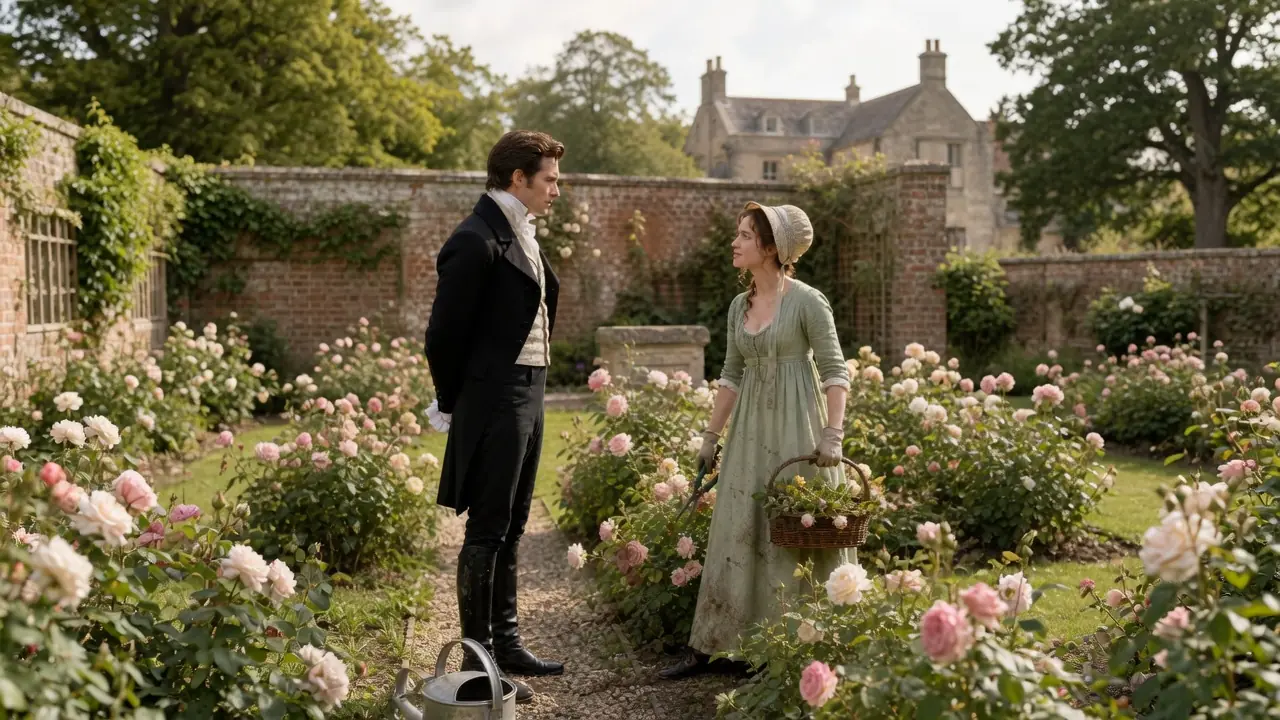
She was 23. She had been doing this by her own rough count for 3 years. She had told herself on each of those mornings that it would be the last. It never was. The roses needed her.
This wasn't arrogance. She wasn't generally given to arrogance. She was given to honesty which her mother had called a gift and her father a liability and which the roses seemed to appreciate unconditionally. The truth was simple. The walled garden at Witchwood had been planted by two people who were now gone, tended by a third person who had no earthly right to be there.
And without that third person's interference, it would have been 3 years of thorns and rot instead of this. There was the Langley rose scaling the south-facing wall in great arching canes, its second-year blooms finally reaching the height her father had predicted; the damask roses in the central beds, loyal and fragrant even in October; and the late-season climbers her mother had never seen finished, which Rosalind had trained herself, guessing at her mother's choices. She knew she was trespassing. She knew as of yesterday afternoon that the new duke had arrived, and she had come anyway because she was 23, and her father had died in April, and she didn't think she could bear to let the season's last roses go unvisited by anyone who actually knew their names.
“One more morning,” she murmured to the Langley rose, which she had called by her family name since its first flowering, and which held the slightly reproachful quality of a thing named after someone recently lost. The rose said nothing. Pliny emerged from beneath the bench where he spent his evenings, stretched in the elaborate manner of a cat, performing his morning constitutional, and settled precisely on her feet. He was a gray cat of uncertain age and absolute certainty of temperament, and he had lived in this garden since before Rosalind could remember.
He belonged to no one in his own estimation. He merely tolerated certain visitors. She scratched his ears and did not cry, which she considered an accomplishment. She didn't hear the footstep until it was quite close. The footstep belonged, as it turned out, to a tall man in a dark coat, who had clearly been awake for some time, and was not pleased about it.
He stopped at the entrance to the walled garden, the proper entrance through the arched gate, which Rosalind avoided on principle, and looked at her with the measured expression of someone arriving at a scene they hadn't expected, and weren't yet sure how to classify. Cassian Dunbar had not wanted to be the duke of Witchwood. This was not a position he advertised. Dukes, as a rule, weren't supposed to admit to wanting or not wanting the position. The position was in theory simply what one was passed down from one generation to the next with the bills and the obligations and the very long list of things the previous duke had promised people and never delivered.
The wanting of it was beside the point. Cassian had been the second son. The second son's path was well established. Military service, a decent commission, a career built on competence rather than inheritance. He had joined the cavalry at 19 with a horse, a kit bag, and the relief of a man stepping out of a shadow he had never asked to stand in.
He had spent seven years in various parts of the continent, including two years he didn't discuss in detail at dinner tables, learning things about himself that he suspected the English nobility would have found inconvenient. He had been good at it. That was the part that still felt wrong in his chest on certain mornings. His brother Piers had died in February. Not in battle, not with any of the ceremony that would have made the thing easier to discuss.
Piers had died in a private quarrel over a card debt at 6:00 in the morning on Hampstead Heath in a duel that the family solicitor described to Cassian in a letter as deeply unfortunate. The dukedom came to Cassian along with three estates, a house in Mayfair, debts that the solicitor's subsequent three letters handled with increasing delicacy, and the understanding that Witchwood Park, the principal seat, the one Cassian remembered from childhood, had been essentially unmanaged for 4 years. He had arrived the previous evening in weather that seemed specifically designed to communicate the estate's opinion of him, gray, damp, and non-committal. Mr. Hewitt, the steward, met him at the door with the expression of a man who had been left in charge of a ship in steadily deteriorating conditions and was genuinely relieved to see the captain arrive even if he had questions about the captain's timing.
“Your Grace,” Mr. Hewitt said, taking his coat with the efficiency of a man who had been waiting to take someone's coat for some considerable time. Cassian looked at the entrance hall. It was clean. Mr. Hewitt had clearly seen to that. But there was a particular quality to a house that has been maintained without being inhabited, like a held breath.
The flowers on the entrance table were fresh, but chosen without particular thought. The lamps were lit but dimly. “The estate,” Cassian said. “Give me the honest assessment.” Mr. Hewitt gave it to him over an hour with tea in the library. It was not a cheerful hour.
The rents were in reasonable order. Mr. Hewitt was competent, and the tenants were decent, but the household expenditure had contracted sharply. The park had been let go in several places, and the kitchen garden had been allowed to become largely ornamental. “The walled garden,” Mr. Hewitt mentioned at the end, with the tone of a man approaching a delicate subject, “has a particular situation.”
“What kind of situation?” Cassian asked.
“A woman,” Mr. Hewitt said, “has been tending the roses.”
“Who gave her permission?”
Mr. Hewitt looked briefly at the ceiling. “No one formally, Your Grace. She is the daughter of Mr. Thomas Langley, who passed in April. Mr. Langley was known to the late duchess. They collaborated on the rose garden some years ago. Miss Langley has maintained the habit of visiting.”
“Visiting?”
“At dawn, through the kitchen garden wall.” He paused. “The brick, I understand, has been loose for some years.”
Cassian set down his cup. “You have not addressed it?”
“The previous duke and I,” Mr. Hewitt said carefully, “were of the opinion that the garden was better for it.”
Cassian looked at the man for a moment. Mr. Hewitt was sixty-one and had served the estate for thirty years. He possessed the specific quality of a person who had watched a great deal happen and arrived at the capacity for measured silence. Cassian found he respected it.
Beautiful. Neglected in places, but beautiful. The walled garden gate was unlatched. He went in. She was crouching beside a rose that climbed the south wall in extraordinarily long canes with a basket at her side and a pair of worn gardening gloves she hadn't put on yet, and a gray cat sitting precisely on her feet, in a manner that suggested this was established policy.
She didn't hear him until he was quite close, and when she looked up, it was with a start that she controlled almost immediately into something like composure, color rising in her cheeks, a smudge of soil on her right wrist, honey brown eyes adjusting from surprise to something that looked oddly like resolution. “You're standing in my roses,” Cassian said. She looked at him properly for the first time: at the dark coat and the sharp face and the moss green eyes of a man who had been very far away and had only recently come back to the fact of being somewhere. And then she laughed.
It was not the laugh he had expected, not the embarrassed apologetic kind, not the performed kind, not the kind designed to charm its way out of a difficult situation. It was a genuine laugh, warm and brief, as if something he had said was precisely funny, and she couldn't help herself. “I know,” she said. He should have sent her away. He was aware of this.
He was standing in his own garden, his own, by law, by title, by the relentless logic of inheritance. And a young woman was kneeling in it without permission, and had laughed at him, and was now, with considerable competence, checking rose ties as though the situation were entirely normal. He should have told her to leave. He should have been more ducal about the whole thing. Instead, he watched her.
She moved through the garden with the ease of someone who had been here many times, not in the careful way of a visitor learning the space, but in the particular way of someone who knows where everything is without looking. Her hands on the rose canes were sure and gentle in the way that people are only gentle with things they genuinely love. She tucked a loosened tie back against the wall and stepped sideways to examine the next section. And Pliny, the gray cat, who had relocated from her feet to the bench the moment she moved, tracked her with folded paws and open judgment.
“You are not going to move,” he said. It was not a question.
“The Langley rose,” she said, gesturing at the cane behind her, “has its second-year blooms on it. If I move now without checking the ties, the wind will have the top canes down by Thursday.” She looked at him with perfect composure, if one discounted the fact that she was kneeling in someone else's garden in the early morning, having just been caught trespassing. “I will not be long.”
“The cat,” Cassian said, because it was a safer beginning than the other things he might have said. “Does he belong to the estate?”
“He belongs to himself,” she said without looking up. “He has been here since before I can remember. I call him Pliny. Pliny the Elder.”
He has strong opinions about territory. She glanced at the cat. He's forming one about you currently. I can see that. Pliny was in fact regarding him with the specific expression of a cat who has not yet decided whether to be offended or merely contemptuous.
Who are you? She did look up then briefly. Rosalind Langley. My father was Thomas Langley. She said the name with the particular precision of someone who has said it carefully many times since a certain point and has not yet stopped needing to.
He designed this garden with your great-aunt. My great-aunt, he repeated. He had a vague memory of his father's aunt, a small, fierce woman who had lived at Witchwood and died here some years before his own departure for the army. He hadn't known about a garden collaboration. He hadn't known about much in those years. the late duchess.
She and my father corresponded for 12 years about roses. There was warmth in how she said it, layered over something that was not quite grief, but was still tender. He came here every summer for 3 years to work on the planting. I used to come with him. “Since you were nine,” Cassian said, remembering what Hewitt had said about the loose brick.
She looked up fully. Her expression was sharp, the look of someone quick who notices things. Mr. Hewitt told you he mentioned it with some tact. He's very kind. She returned to the rose.
He never told my father to stop coming after the duchess died. And when my father became when he couldn't walk so well the last 2 years, he didn't tell me to stop either. Cassian was quiet. The morning had the particular early quality of October, a low golden light that made everything look slightly significant. The garden smelled of damp stone and the last of the damask roses and something herbal from a corner bed he hadn't examined yet.
Your father died in April, he said. A brief pause. Yes. And you've been coming since. I said I would.
She did not explain further. She did not seem to think she needed to. He walked further into the garden slowly with the deliberate pace of a man looking properly and took in what she had kept alive here. The central beds were well ordered, the roses cut back for autumn, but clearly healthy. The climbing roses on the south and west walls were extraordinary, long canes secured with evident care, and at the high point of the south wall, a variety he didn't recognize, different from the others, with the remains of what must have been remarkable blooms.
That one, he said. The climber. I haven't seen that variety before. She looked at the wall with an expression she hadn't shown him yet. Something private, pleased, and a little sad at once.
You won't have. My father developed it. Took him 9 years. A pause. He called it Rosalind.
Cassian looked at the rose. He looked at her. He had the feeling, faint but persistent, of having walked into a conversation that had been going on for some time before his arrival. “So you have been tending your own namesake,” he said. “Someone had to.” She stood finally and pulled on one glove, then the other, with the matter-of-act air of a woman concluding a task and preparing to be reasonable about the next thing.
“I know I don't have a legal right to be here. I know you could have me escorted out if you chose to. I'm not going to argue about that.” She looked at him directly with the calm steadiness of someone who has already made her peace with the difficult possibilities. But I would ask you to let me come back until the roses are properly settled for winter. Three more mornings, four at most.
After that, I won't trouble you. Pliny chose this moment to descend from the bench, cross the garden with the dignity of a small diplomatic envoy, and sit directly on Cassian's left boot. Cassian looked down at the cat. “He doesn't usually do that,” Rosalind said in the tone of a woman genuinely surprised. “No, he usually sits on people he intends to ignore.
It's a complex system,” she tilted her head slightly. “I think it might be a compliment.” Cassian looked at the gray cat on his boot, who looked back with the philosophical calm of a creature that has seen several dukes come and go, and is not particularly moved by the title. He looked at the garden, which was, he was beginning to understand, still alive because of this woman's 3 years of unauthorized dedication. He looked at the Langley rose on the south wall, named after the person in front of him, still standing because someone had cared enough.
“Four mornings,” he said. She blinked. “I—yes. Thank you.” But use the gate, he said. The loose brick is a structural concern.
The corner of her mouth moved. Not quite a smile, very nearly. Of course, your grace, he told himself he did not look out of the library window on the second morning. He looked out of the library window on the second morning. She arrived at 6 through the gate, which she had clearly taken to heart as a compromise, not because she thought he would be watching, he was fairly certain, but because she was the kind of person who, when she agreed to something, actually did it.
She carried the same worn basket. She was wearing a dark wool cloak over a practical gray dress, and her dark hair was pinned with the casual efficiency of someone who had done it without a mirror. He made himself go back to the accounts. The accounts were a significant problem. They were not the crisis his solicitor had implied in his most alarming letter.
The man had a theatrical streak that Cassian had begun to factor in, but they were genuine. Piers had borrowed against the estate, not ruinously, but enough that Cassian needed to be careful, needed to make decisions he had not yet made, needed to think about what was salvageable and what was not. He was not accustomed to this kind of thinking. He was accustomed to tactical problems with concrete solutions. The army had been good for that.
The problem was identified, the resources were assessed, the action was taken. Sentiment was not a useful variable. He found her on the third morning attempting to move a very large terra cotta pot single-handedly, which was clearly not working, and which Pliny was observing from the nearby bench, with an expression of a creature doing sums. “Stop,” he said from the gate. She stopped with the immediate instinct of someone who recognizes that the sentence has a correct continuation.
He crossed the garden, took the other side of the pot, and they moved it together 3 ft to the left onto the paving stones out of the path of the draining bed. “The drainage floods there in winter,” she said in the way people explain things they have known for a long time to someone who was not. “The roots were going to suffer.” “I know,” he said. “I played in this garden as a boy. The flooding corner was useful for a specific kind of mud.” He sat down his side of the pot and straightened.
The morning was colder than the previous days. The sky a flat pewter that suggested serious rain before noon. You're going to get caught out by the weather. I have a cloak. It is not a cloak designed for Oxfordshire in October.
She looked at the sky with the assessment of someone who has learned to make this judgment by being wrong about it before. I have perhaps an hour. Then don't waste it talking to me. She looked at him with an expression he couldn't quite read, something between amused and cautious, like a person who has decided to find something funny rather than alarming. “All right,” she said, and went back to work.
He did not leave. He walked the perimeter of the garden instead, slowly, examining the beds that hadn't been properly attended since before his great-aunt died. The structure was still there, the careful planning of it, the way the paths worked together, the beds arranged to catch the light from different angles through the day. It was good design, elegant in the kind of way that doesn't announce itself. My father drew maps of this garden, she said from across the space without looking at him.
Every spring after the visit, he kept them in a leather folder. 12 years of maps. Where are they now? I have them. A brief pause. I thought I thought they might matter to someone eventually when the estate had a duke again.
She looked at him directly with the particular frankness of someone who has decided to be honest, even if it's awkward. They're yours by rights, the plans and the maps. They were made in collaboration with the Duchess. If you want them, they might help with the garden in future. He thought about her father dead in April.
Three years of coming here alone at dawn, keeping something alive that belonged to someone else because there was no one else who would. Keep them, he said, for now. She looked at him with that expression again, the one he couldn't quite name. Then she said, “Thank you,” in the simple way that means it without decoration, and turned back to the roses. The rain came at a quarter to seven.
She was, as he had predicted, in a cloak that was not adequate for Oxfordshire in October. He brought her to the servants' entrance before it got worse, which was the practical thing. And Mrs. Prescott, the housekeeper, who had been at Witchwood for 15 years, and had the composed quality of a woman who had seen most things, and was not rattled by the addition of one more, brought tea without being asked, which told him something about the nature of Rosalind Langley's previous visits. They sat in the kitchen which was warm, and she wrapped her hands around the cup, and Pliny arrived through the cat door, and arranged himself between their chairs with the assurance of a creature who knew which rooms were warm, and considered entitlement sufficient authorization.
He's followed you in before, Cassian said. Several times. She looked at the cat with affection. Mrs. Prescott tolerates it. She feeds him, Mrs. Prescott said, passing through without breaking stride.
Occasionally, Rosalind said regularly, Mrs. Prescott said. Rosalind had the grace to look only slightly caught. He's very persuasive. Cassian looked at Pliny, who was looking at the ceiling with the expression of a creature that has heard none of this. He felt something in his chest, something small and unexpected, like a door that has been closed for a while and has just moved an inch.
He said nothing about it. He had not, he reminded himself, made any decisions about Witchwood yet. He drank his tea and listened to the rain. He found the letters 3 days later, which he should have found immediately, but had been putting off in the way that one puts off rooms that might contain grief. The library at Witchwood was a good library.
His great-aunt had built it over 40 years with the focused intent of a woman who had decided that books were the most reliable company available, and she had been thorough about it. Histories, natural philosophy, botanical texts that Cassian had not noticed as a boy, and noticed now with some recognition. The letters were in a box in the second drawer of the writing desk, labeled in his great-aunt's handwriting, Langley, correspondence, 1799, 1811. He opened it in the way one opens boxes that have been closed for 12 years, which is carefully with the understanding that the contents belong to a world that no longer exists.
There were 43 letters. He counted them before he read them, which was a habit from the army where knowing the total before you started meant you could track what was missing. Nothing was missing. The correspondence was complete. He read for 2 hours.
He did not intend to read for 2 hours. The letters were supposed to be a practical exercise, understanding the garden history, the collaboration, the nature of what had been planted and why. That was all. But his great-aunt's handwriting was unexpectedly vivid, sharp, and precise and occasionally funny, with the particular humor of a woman who had been very intelligent and somewhat lonely, and found that the roses and Thomas Langley's enthusiasm for them were among the best things available to her. And Thomas Langley's replies were warm and scholarly and full of botanical detail and also full without apparent self-consciousness of the kind of friendship that forms between people who correspond honestly for long enough.
In the 31st letter dated June 1808, Rosalind brought the new cuttings today, and I confess she managed the whole thing better than her father could have at twice the age. She is 12 and has strong opinions about placement. Dorothy, I hope you will not mind my familiar form. I believe she has more of this in her than she knows. I told her the south wall was hers to plan, and she spent 40 minutes walking back and forth looking at the light and said, “The climbing rose needs the morning, and the evening should be for the damask rose father.” She was right.
Cassian set the letter down. He thought about Rosalind at 12, walking back and forth along the south wall, deciding where the light should go. He thought about Rosalind at 23, in a worn cloak, checking the ties on the rose she'd been named for, which she'd been keeping alive alone for 3 years. His great-aunt's last letter from 1811 was short. She had been ill.
She wrote about the garden as though she was saying farewell to it. I hope the Langley rose comes into its own by 1814. I should like to think it will. Thomas tells me the second-year is always the revelation. I shall ask him to report to me wherever I find myself by then.
Both of them were gone by then. His great-aunt in 1812. Thomas Langley in 1814. He wondered if the rose had known. He found Rosalind in the garden the next morning, her fourth permitted morning, technically her last, and said before she could begin the conversation about leaving, “I've read the letters.” She went still.
The Langley correspondence. Yes. A pause. She turned to face him fully, her expression careful in the way of someone who is deciding how to feel about a thing before deciding how to say it. They're private.
They were in the estate library. I should have read them years ago. He paused. I didn't know my great-aunt well. I was away most of the years they were writing.
He looked at the south wall. She wrote about you when you were 12. The color that came into her face was not embarrassment. It was something more private, something that had to do with being seen from a direction you hadn't expected. What did she say?
That you told your father the climbing rose needed the morning sun and the evening should be for the damask rose. Rosalind looked at the south wall. She was quiet for a moment. I was 12, she said finally. I thought I was being very authoritative.
You were right. I was lucky. But she was fighting a smile which arrived anyway small and private. “Stay,” he said, as long as the garden needs tending. She looked at him with the direct, clear look that he was beginning to understand was simply how she looked at things without performance, without protective calculation, just looking.
That might be all winter. I'm aware you're not planning to be here all winter. I haven't decided what I'm planning. He had not, in fact, decided anything. That was the difficulty.
I'll be here until I've sorted the estate accounts and made some decisions. The accounts, she said with the tone of someone who has heard things from local tenants, are concerning somewhat. If there's anything, she stopped herself with the particular restraint of someone who knows they are about to offer something that wasn't asked for. the garden, I mean. If you need to understand the value of it, the planting, my father's maps would show the history. Bring them, he said, if you're willing.
“I should know what I have.” She nodded. And then, because she was the kind of person who said what was true without particular ceremony. I'm glad you read them. So am I, he said, and meant it, and was slightly surprised that he meant it. Pliny appeared from behind a rose cane and sat on his boot again.
“He definitely likes you,” Rosalind said. “I am choosing to take that seriously,” Cassian replied. Sir Marcus Ashby arrived on a Wednesday, which was the kind of day that was bad for receiving people you didn't particularly want to receive. He was a London man. That was obvious in the cut of his coat, and the way he looked at the park with the evaluating eye of someone thinking about what it could produce rather than what it was.
He was perhaps 50, prosperous in the way that people are prosperous when they have made money carefully over a long time, and have very clear opinions about people who haven't. He was not, Cassian thought, as Hewitt showed him into the library. A man who had ever eaten a difficult dinner and been grateful for it. He had heard about the Witchwood accounts. He had a proposal.
“The park itself,” he said, spreading a plan across the library table that someone had clearly prepared for this purpose, “is entirely suitable for division. The north section here might be sold outright. The tenant farms on the east are productive. If you retain the house and the home park, the sale of the outlying portions would clear the current obligations and leave you with a manageable estate.”
Cassian looked at the plan. The north section was the park that ran down to the river, the part he remembered from childhood, where his brother Piers had taught him to fish badly and where the oak trees were old enough to have opinions. The tenant farms on the east were the farms where families had worked the land for thirty, forty, or sixty years.
“And the walled garden?” Cassian asked.
Ashby glanced at the plan. “The kitchen gardens would go with the north-section sale. They are not self-sustaining as an estate feature. Pleasant, certainly, but the upkeep is considerable.” He smiled with the pleasantness of a man who considered himself helpful. “The purchaser would likely repurpose the space. There is a market for ornamental grounds for shooting parties, with the right improvements.”
“Repurpose?” Cassian repeated.
“Gravel paths. A cleared plan. The walls are solid and have good structural value.” Ashby was already looking at the next section. “Your Grace, I will be honest with you, because I believe in honesty in these matters. The estate, as it stands, is a sentimental attachment dressed as an asset. The Dunbar family sentiment is entirely understandable, but sentiment does not service debt.”
Cassian looked at the plan. He thought about Pliny on his boot, forty-three letters, and a twelve-year-old girl deciding where the morning sun should go. He thought, without particularly meaning to, about the Langley rose on the south wall, with its extraordinary canes that had taken nine years to develop.
“Leave the plan with me,” he said. “I will review it.”
Ashby left with the satisfied air of a man who considered delay an implicit agreement. Cassian was in the garden 20 minutes later. He was not sure why he had gone there. It was not gardening hours.
Rosalind would not be there. But he walked the paths in the flat afternoon light and looked at the beds she had maintained, the roses she had kept alive, and the south wall where the Langley rose was settling into its autumn rest.
She was there. She was not supposed to be there at that hour. She was crouching at the base of the south wall with what appeared to be late cuttings, and she looked up when she heard his footsteps with the unguarded expression of someone who had not expected to be caught doing something good.
“I brought the autumn cuttings,” she said. “The late duchess always planted them in October. The records showed—” She stopped, perhaps seeing something in his face. “What has happened?”
“A London man came to discuss the estate accounts.” He looked at the south wall. “He proposes selling the north section and the kitchen gardens.”
She became very still. “The kitchen gardens?”
“And the walled garden, as part of the north-section parcel.”
The stillness changed quality. It was no longer the stillness of someone who had not understood, but of someone who understood exactly and needed a moment before saying anything that could not be unsaid.
“What would happen to the roses?” she asked carefully.
“He said the purchaser would likely repurpose the space.”
Another pause. She stood slowly, with the dignity of someone whose dignity was the only thing available to her in that moment. “I see.”
“I have not decided anything.”
“Of course.” She picked up the basket. She was being very composed in the way people are composed when composure is costing them something. “It is your estate, Your Grace. Your decision.”
“Rosalind.”
She looked at him. For the first time, her composure showed a visible fault, something that was not quite anger and not quite grief, and perhaps both, held carefully behind her eyes.
“My father spent nine years developing this rose,” she said. “He spent three summers here working and planning. Your great-aunt spent forty years building this garden, corresponding and caring about it, and I have come here every dawn for three years because—because I did not know how else to—”
She stopped. She pressed her lips together and looked at the south wall rather than at him. “I know it is not mine. I know that. But it is the last place on earth where I can still feel—”
She did not finish. Cassian stood in the flat October light and felt the unfinished sentence somewhere in his own chest: in the place where his brother was, in the place where seven years of a career he had been good at had disappeared, in the place where he had been trying to be practical about all of it for eight months and was tired.
“I will not decide without telling you first,” he said.
She looked at him. The fault in her composure remained, but something else had entered her expression, assessing him carefully, as she had on the first morning when she laughed, refused to move, and decided within twenty seconds that he was worth directness.
“All right,” she said.
She left through the gate. Pliny, who had watched from the bench with the concerned expression of a cat who had heard several words he considered worrying, meowed once with emphasis.
“I know,” Cassian said.
The rain came properly three days later, in the way October rain in Oxfordshire eventually makes its point. It was not the ambiguous drizzle of the earlier weeks but a committed downpour that turned the paths into shallow rivers and drove everyone with sense indoors before four. Rosalind had left by three.
Cassian had not told her about his decision because he had not made it. He had spent three days reading financial documents, looking at the walled garden, and thinking about sentiment versus practicality in a way that was uncharacteristically circular for a man who prided himself on directness.
He was in the library at seven when he heard a knock at the servants' entrance, followed by Mrs. Prescott's voice and then quiet. A moment later, the housekeeper appeared at the library door.
“Miss Langley is here, Your Grace. She was caught in the rain on her way back from the village.” A brief pause. “I have put her in the kitchen, but I thought you should know.”
“Thank you, Mrs. Prescott.”
He went to the kitchen. Rosalind sat at the table with a cup of tea held in both hands, though she had clearly not begun to drink. Her cloak hung by the fire, soaked through, and her dark hair was coming loose from its pins where the rain had found it. She wore the particular expression of a person who had made a decision and was slightly surprised by having made it.
“I was coming to speak to you anyway,” she said without preamble. “The rainstorm was not part of the plan.”
He sat across from her. Mrs. Prescott set another cup on the table with the practiced invisibility of a good housekeeper, then departed with Pliny, who had apparently decided the rain was her responsibility.
“What was the plan?” Cassian asked.
Rosalind looked at her tea, choosing words with the care of someone who had rehearsed something and then decided on the threshold that the rehearsed version was inadequate.
“I owe you an apology,” she said. “The other day, I said things that were not fair.”
“You said them honestly.”
“Honestly and fairly are not always the same.” She looked up. “Your situation is not of your choosing. The debts, the estate, all of it. I made you feel that my grief was your responsibility, and it is not.”
He was quiet for a moment. Outside, the rain said something emphatic to the roof.
“May I ask you something?”
“Yes.”
“Why did you keep coming after your father died? Three years is considerable. You could have let it go.”
She looked at her tea for a long moment. When she raised her eyes, her expression was not the composed, careful version. It was the quieter and more honest one beneath.
“I told you my father was a botanist. He thought in years, not months. Nine years for the Langley rose. Twelve years of correspondence with the duchess. He once said the thing about roses is that they require faith in time. You plant something, wait, maintain it, and eventually it becomes what it was always going to become.”
She turned the cup in her hands. “During the last year, when he was ill, he could no longer come here. He kept saying he wished he could see the Langley rose in its second year because he believed that was when it would show itself properly.” She paused. “He did not live to see this spring.”
The rain continued its insistence on the roof.
“So I came to see it for him,” she said. “Then I could not stop. It became the only place where I felt the things he had done were still real.” She pressed her lips together, briefly keeping herself composed, and then chose lightness deliberately. “Which is not your problem. I know that.”
“Tell me about the army,” she said, changing the subject as much for his sake as her own.
“What about it?”
“You spent seven years in the cavalry, and you do not speak of it.” She met his eyes. “You do not have to. I simply think we have been having a conversation for ten days, and I know more about your rose garden than I know about you.”
He was quiet. He thought about what he usually said about the army, which was very little, and what it had actually been like, which was harder, more significant, and less tidily narratable than people generally wanted to hear.
“I was good at it,” he said. “That is the part I do not know what to do with now. I was not supposed to be a duke. I was supposed to be a cavalry officer. I was useful there. I knew what was required.”
He looked at his hands on the table, the hands of someone trained for competence and now forced to make decisions of a different kind.
“And then Piers died,” Rosalind said softly, “and you came home to a title you had not expected, an estate with problems you did not know how to solve, a family legacy from which you had largely been absent, and a woman in your rose garden who laughed at you and refused to move.”
He looked at her. She was watching him with the clear directness that was simply her face when she was paying attention. There was no pity in her expression. It held something warmer and more useful: the recognition people feel when they have known a similar loss.
“Yes,” he said.
“And you are not absent now,” she said gently.
“No.” He picked up his tea. “Though I am still not entirely certain what I am doing.”
“You are having tea in the kitchen during a rainstorm, which I find is one of the better things one can do when uncertain.”
He laughed, a short, genuine sound that seemed to surprise him. “That is a low threshold for a plan.”
“It is a very reliable one.” She finally drank her tea.
Outside, the rain relented fractionally into its more polite form.
“I will not try to make you keep the garden, Cassian.” It was the first time she had used his name without the title, and she looked briefly as though she had not decided to do so until the word had already left her mouth. He did not correct her. “But if there is a way that does not involve turning it into gravel paths for shooting parties, I would very much like to help you think, if you will allow it.”
He looked at her. He thought about the letters in the library, the woman in his garden at dawn, the cat who had decided three mornings earlier that his boot was an appropriate location, and the unfinished sentence: the last place where I can still feel.
“I will let you help think,” he said. He had been in the library with the accounts for 4 hours when Mrs. Prescott brought him coffee he hadn't asked for and said with the tranquil authority of a woman who has managed things for 15 years and considers it her right.
“Miss Langley is in the garden, Your Grace. She has been there since first light. You might go and see.”
“It is eight in the morning.”
“Yes,” said Mrs. Prescott, and left.
He went.
She was at the center of the walled garden, kneeling in the main bed, and she was doing something he hadn't seen her do before. There was a pot beside her and a sharp knife, and she was working slowly and with great care, taking a cutting from the base of the Langley rose where it met the soil, a new cane, green and young, carefully prepared, and set into the pot, with the particular focused attention of someone doing something that matters. He stood at the gate and watched. She knew he was there. He was fairly certain of that by the third minute, but she didn't look up.
She finished the cutting, tamped the soil down, pressed the heel of her hand gently against the base of the pot in a gesture that was not quite professional and not quite personal and was somewhere in between. Then she looked up. The original cane, she said, is healthy. The rose will stay where it is, whatever you decide. She held up the pot.
But I wanted to take a cutting for insurance to take it away, he said, if it becomes necessary. Her voice was even. She had decided clearly to be practical about this in the way that people are practical when the alternative is unbearable. If the garden goes with the north section, the rose should go somewhere it will be tended. I have a kitchen garden at the cottage.
It's not the south wall of Witchwood, but it's enough. He came into the garden. The morning was cold and clear after the rain. the air had that sharp, specific cleanliness of October after a proper downpour. The beds smelled of wet earth and the last damask roses. Pliny was on the bench, having made some kind of philosophical peace with the weather.
“I wrote to my solicitor last night,” he said.
She looked at him, still waiting.
“The north section will not be sold. The tenant farms are staying as they are.” He came to stand near her and the rose. “I had a different idea about the accounts, one I should have thought of sooner if I had been thinking clearly instead of trying to solve everything by subtraction.”
“What idea?”
“The fishing rights on the river. The previous duke never properly established the lease. They have been used informally by the village for thirty years. I can formalize that lease at a reasonable rate and recover a portion of what is owed without touching the land. And there is a Mayfair house I have no intention of ever living in. It was Piers's, and I have been treating it as an obligation, though it is actually worth rather a lot.”
Something was happening in her expression, a careful thing, like a person who had been holding something very tightly and was not yet sure it was safe to let go.
“Is that enough to matter?”
“With careful management of the rest, yes.” He looked at the south wall. “The garden stays.”
The silence lasted several seconds. She looked down at the pot in her hands, at the cutting she had taken because she had not known that this morning would be different. Then she looked up, and her expression had arrived somewhere new, beneath the composure, directness, and careful honesty.
“I was going to be all right about it,” she said. “I had decided to be. I rehearsed it.” Her voice was steady, but it had a quality that was not steadiness exactly. “I was going to say thank you for the winter, take the cutting, and go.”
“I know.”
“You could have told me last night at the kitchen table.”
“I had not decided last night. I decided at four in the morning, which is when I make my best decisions, apparently.” He looked at her. “And I wanted to see whether you would take the cutting anyway.”
She looked at him with the expression she wore when something had surprised her into honesty.
“That was unkind,” he offered.
“No. It is the kind of thing my father would have done, testing whether you meant it before you said it.” She looked at the pot, the rose, and then at him with the full directness she had given him since that first morning. “You should know that I was not pretending to be all right about it.”
“I know that, too.”
“You have been paying quite a lot of attention.”
“To be fair, you laughed at me in my own rose garden and refused to move. I found the experience worth attending to.”
The corner of her mouth moved. Then her expression settled into something quieter and more certain. She set the pot on the bench beside Pliny, who inspected it as though deciding whether to approve.
“The cutting can stay here for a second plant,” she said. “The south wall might want a twin.”
“The south wall would benefit considerably. I have been looking at it.”
“You are a very quick study for a man who arrived a month ago.”
“The army.”
She laughed, the real laugh, warm, brief, and entirely unguarded. The October garden felt several degrees warmer than the weather could account for. Pliny knocked the cutting pot two inches to the left with one paw, then affected complete innocence.
“He wants it repositioned,” Rosalind said.
“We will take his advice,” Cassian replied.
The Langley rose in its third year came into itself exactly as Thomas Langley had said it would. The spring of 1815 was uncertain in the way springs following difficult winters often are: hesitant, then sudden, with a fortnight in late April when everything seemed to happen at once. The walled garden at Witchwood went from bare canes and brown earth to something that stopped Cassian in the gate one early morning and kept him there considerably longer than he had planned.
The Langley rose had reached the full height of the south wall. Its blooms were a deep, warm rose-gold, not quite pink and not quite amber, a color that changed with the light through the day. There were hundreds of them, from the base canes to the highest reach of the wall. Thomas Langley had spent nine years developing that color. The late duchess of Witchwood had spent twelve years corresponding about it with the care of two people who had found in their collaboration something that mattered to both of them.
Rosalind was at the base of the wall with her hands in the soil when Cassian arrived. She looked up, saw his expression, and said nothing. She turned back toward the wall, and they stood together in the early morning in the garden kept alive by stubbornness, grief, dawn visits through a loose brick, forty-three letters, and the particular faith of people who believe in waiting for things to show themselves.
“Your father was right,” Cassian said.
“He usually was, about roses specifically.” Her voice was warm and a little uneven, the way it became when she was happy about something that also ached. “He said the second year shows you what the rose is. The third year shows you what it is for.”
Pliny appeared from behind the nearest rose cane, inspected a bloom with the expression of a cat who considered himself ultimately responsible for the garden's success, and sat in a patch of morning sun.
“He looks satisfied,” Cassian said.
“He always looks satisfied. That is the advantage of being Pliny.”
The garden smelled of roses, warm stone, and the particular green scent of spring after rain. Light came across the top of the wall at the angle Rosalind, at twelve years old, had identified as the morning light the climbing roses needed. She had been precisely correct.
“I have been thinking,” Cassian said, which was how he began most things that truly mattered.
She looked at him. Over the months, she had become very good at recognizing the difference between the things he said casually and the things he said when they mattered. This was the second kind.
“About the garden?”
“About what it needs. About whether it is sensible to maintain something this beautiful on behalf of a woman who will come through the gate every morning regardless of whether she has been invited.”
“That is a somewhat indirect approach.”
“I am normally a direct man. You have made me indirect.” He looked at her with the full steadiness of someone who had made up his mind. “Marry me. Not because of the rose, but because of that morning in the kitchen during the rain, because of decisions made at four in the morning, because Pliny trusts very few people and trusts you, and because I have been trying to be practical about everything for eight months and find that I am done trying.”
She looked at him for a long moment.
“The second cutting is doing very well,” she said. “It is at the east end of the south wall. It needed the morning light.”
“I noticed.”
“I was right about that.”
“Rosalind.”
“Yes,” she said. “Obviously, yes.”
She smiled at him with the full version of the smile he had first seen on a cold October morning, when he told her she was standing in his roses and she laughed, warm and unguarded, like someone entirely present for whatever came next.
“Though I should warn you that I intend to keep talking to the roses.”
“I would expect nothing less. I have started doing it myself.”
“I know. I heard you on Thursday. You were apologizing to the damask rose for the frost.”
“The frost was my fault.”
“Somewhat.” She stood, brushing soil from her hands. “The damask rose has forgiven you.”
He took her soil-marked hand because it was the one already in front of him, and she let him. The garden was entirely itself in the April light: warm, alive, and full of things that had taken years to become what they were.
Thomas Langley's roses bloomed on the south wall in extraordinary abundance all that season. Pliny walked among them with proprietary satisfaction. Cassian Dunbar, eighth Duke of Witchwood, learned to distinguish the Langley rose from the damask rose by scent alone, which Rosalind said was the mark of someone paying real attention. He considered this high praise.
The fishing lease, properly renewed that spring, was agreed to unanimously by the village, whose residents had always known it was a sensible arrangement and were gratified to have a duke with the sense to recognize it. Mr. Hewitt said nothing, but he reordered the garden-supply account under its own line in the household ledger, which was, in its way, the practical equivalent of a standing ovation.