Look at you, absolutely pathetic. You don't belong here. The champagne tower glittered like a weapon. Amara had only wanted a glass, one glass, to pass the time while her husband handled business elsewhere in the building. She moved toward the tower, her gown dark, understated, expensive in a way that didn't announce itself, brushing the marble floor.
A heel shifted, deliberate, barely visible. She caught herself on a passing tray. A flute wobbled, and before she could steady it, a hand manicured and smiling tilted it forward. Champagne cascaded down her shoulder, cold, humiliating, intentional. "Oh, I'm so sorry." The woman's voice carried just enough to draw eyes, then dismiss them.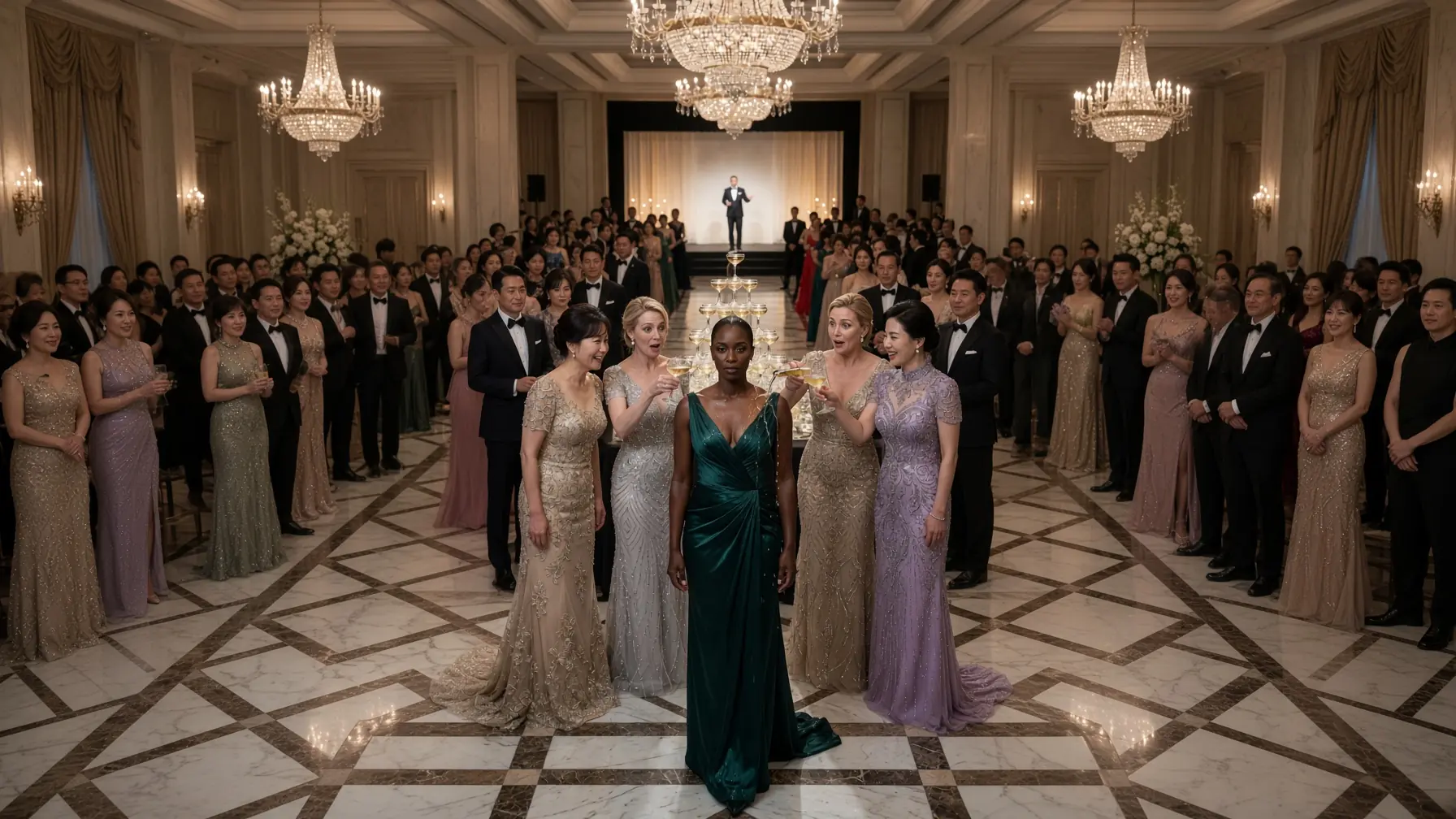
"That fabric, it's so dark, I didn't see where your dress ended and the shadow began." A second woman laughed into her wine. Some people wear what they can't afford to own. Look at the stitching. Borrowed, surely, or acquired. The third, American, direct, stepped closer.
"Sweetie, this is Asia's elite, not a diversity internship. Who let you past the door?" Amara straightened. Her voice didn't shake. "I didn't realize the guest list came with a color chart." The American's smile vanished. She leaned in, whispered something vile, and slapped her, hard.
The sound cracked through the room. A nearby couple turned, saw who stood there, and turned back, because they recognized the American's husband's company logo on the event banner. Because in this room, some people are furniture and some are fixtures. Amara's head turned with the impact. She didn't touch her cheek.
She looked at the three women with something that wasn't fear. It was assessment, like a surgeon noting a tumor. "Thank you," she said quietly, "for making the next part easy." She walked away. The three laughed behind her, uneasy, not knowing that in less than an hour, the most powerful woman in Asia would walk to that same stage and dedicate her speech to the exact moment they chose the wrong stranger to break. But, here's what they didn't know and what you need to hear before this ends.
Hey, welcome in. If this is your first time here, I'm glad you found us. This channel is where Afro-Korean stories come alive. The ones that make you lean forward, hold your breath, and hit replay. If you're feeling this already, do me a quick favor.
Hit that subscribe button and tap the bell. It tells YouTube this story deserves to reach someone else who needs it tonight. Every subscription is a vote that these voices matter. Now, let's get back to what happens when you bully the wrong woman. The bathroom was marble and silent.
Amara pressed a cold towel to her cheek. Her hand shook once. She stilled it. She opened her clutch for a tissue and her thumb brushed a photograph, edge-worn, of a young man in tactical gear, her brother. She didn't look at it long.
She closed the clutch. The click was loud. Lee found her there. He saw the mark. His jaw tightened when she told him all that had transpired.
You'd burn your own networks?" she asked. "Then what would we navigate by?" He caught her wrist. Not hard. Certain. He kissed her palm.
Two dangerous people choosing direction over destruction. Back in the hall, the final award remained. The presenter's voice cut through the murmur. "The most powerful woman in Asia, Amara Shin." The name hung in the air like smoke. The three women turned.
The black woman from the floor walked to the podium in the same wet gown. The heel that had tripped her, the shoulder still damp with champagne, the cheek still marked where Isabel's palm had landed. She walked like none of it had happened, like all of it had been expected. The presenter didn't hand her the trophy. He stepped back.
He bowed. Not a gesture of courtesy, a gesture of recognition. The kind of bow given to someone who could end the evening with a phone call. "Mrs. Shin," he said, "manages the Shin Syndicate's global operations.
Her investment portfolio spans four continents. Her charitable foundation educates 12,000 girls across Africa and Southeast Asia. She personally negotiated the trade agreement that prevented a currency collapse in this country 3 years ago. She is not the wife of Lee Shin-jun. He is the husband of Amara Shin." The room didn't applaud.
Not immediately. The room exhaled. The kind of sound made by people who had just realized they were in the presence of a force they had mistaken for absence. The camera found the three women. Kim Eun-ae's hand went to her throat.
Han Bo-young's smile had vanished so completely it seemed she had never learned how. Isabel Parker's face had gone the color of the champagne she had spilled. They were looking at the same woman. They were not seeing the same person. Amara took the microphone.
She didn't look at them. She looked through them. "Blindness to power," she said, "is the only true poverty." She paused. The silence was a blade. "3 hours ago," she continued, "I was on the floor of this room.
A woman I had never met told me I smelled like trash. Another told me my dress was borrowed. A third raised her hand to me. I did not raise mine in return. Not because I could not, because I was waiting to see if they would recognize what they were touching.
They did not. And now they will." She named no names. She didn't need to. The camera held on the three women long enough for the world to memorize their faces. Then the doors opened.
Lee Shin-jun entered with his squad. 12 men. Boots on marble. They didn't scan for threats. They watched him watch her.
When he moved, they moved. When he stopped, they stopped. No orders needed. He walked his wife to the car. The three women stood very still.
The room stood stiller. Their penthouse smelled of rain and cedar. Lee poured two glasses. He didn't hand hers over immediately. "How do you intend to handle those who dared harm you?" he said.
"Or should I handle them for you?" She laughed. Not the laugh of the woman on the gala floor. The laugh of someone who had already decided. "I've always been calm and quiet." she said. "It looks like if I don't step up my game, they will walk all over me.
So, step up. I will handle them as I see fit. But, I want you to take away their walls so they have nowhere to lean on when I push them." He smiled. The smile that had made men sign contracts they didn't understand. "I married you because I love you." he said.
"And you've got guts." They drank. The plan was set in motion. The next morning, the husbands' empires began to bleed. Kim Eun-ae's husband, Park, sat in his corner office when the call came. Customs had seized three container ships at Busan.
No paperwork irregularity cited. Just a flag. A hold. A whisper. He called his contact at the port.
The line was dead. Not busy. Dead. He called again. A recorded voice told him the number was no longer in service.
He stared at the phone. He had used that number for 12 years. Han Bo-young's husband, Choi, was in a board meeting when his CFO slid a tablet across the table. A warehouse in Incheon. Fire.
Total loss. The insurance policy had lapsed three days ago. A clerical error. Choi didn't believe in clerical errors. He believed in messages.
He looked at the tablet and saw his wife's face in the security footage he hadn't yet received. Isabel Parker's husband, Morrison, was on a golf course when his phone buzzed. The lead investor for his tech IPO had pulled out. No explanation. Just gone.
The IPO was tomorrow. Without the lead, it was dead. He stood on the green, club in hand, and felt the ground tilt. He didn't know about the slap yet. He didn't know his wife had signed his death warrant with her palm.
Lee summoned them to a private room. They arrived separately, desperate, sweating, bleeding money, clueless about the why. They didn't know each other had been hit. They didn't know they were meeting together until they saw each other's faces. Lee sat at the head of the table.
He didn't stand when they entered. He didn't offer water. He touched a remote. A screen flickered. Security footage.
The gala. The champagne tower. The heel. The tilted flute. The slurs.
The slap. The bystanders looking away. Park's hands went flat on the table. Choi's jaw worked. Morrison's eyes found the floor.
"Your wives embarrassed someone I love," Lee said. "That was Tuesday's damage. Today is worse. I can burn your empire or let it be if you stand behind and let my wife deal with your wives." Love or power? 30 seconds.
Park spoke first. "My wife didn't tell me." "She didn't need to. The slap was public. Your silence was private. Both cost you." Choi looked up.
"What do you want?" "I want you to stand very still. I want you to pretend you know nothing. I want you to deliver a message when my wife asks. And I want you to choose correctly because I have 12 more ways to hurt you and I am only showing three." Morrison's voice cracked. "She's my wife." "She was your wife when she raised her hand.
She became my problem when it landed. Choose." They chose power. Not because they were evil, because Lee had already made survival the only option. They signed nothing. They shook no hands.
They walked out broken men carrying secrets that would destroy their marriages by nightfall. Park went home and found his wife asleep. He sat on the edge of the bed and watched her breathe. He whispered, "I'm sorry," to her unconsciousness. She didn't hear.
He didn't mean it for her. He meant it for the man he had been before he chose. He left for the guest room. He had chosen his empire over her body. Now he had neither.
Choi stood in his kitchen and poured whiskey He didn't drink. His wife was upstairs showering, humming a song she had hummed since college. He had loved that hum once. Now it sounded like a countdown. He set the glass down full and walked to his study.
He locked the door. He didn't know what he was locking out. Morrison drove. He didn't know where. He ended up at the harbor watching ships he no longer controlled move in and out of the dark water.
His phone buzzed. His wife asking where he was. He didn't answer. He watched the container crane lift a box marked with his company's logo and realized he didn't know if it was his anymore. Amara hosted a lunch.
Same gown. Dry cleaned. Immaculate. The investors who funded the joint company. She offered first exit.
No penalty. Full buyout. Today only. Does your husband know you're here? one asked. She smiled.
Didn't answer. She signed. They signed under her. Later they would learn her husband suggested they take the meeting. An African man, older, knew her father.
He delivered an encrypted file to a journalist. He almost called her by a childhood name. Caught himself. She said, "It's fine." He said, "It's not. You're not anymore." "No," she agreed.
"I'm not." The journalist opened the file in a darkened office. The footage played. The slap. The champagne. The slurs.
The bystanders looking away. She watched it three times. Then she wrote the headline. She didn't sleep. She published at 3:00 a.m.
The footage dropped. The public did the rest. Brands dropped them. Their names became synonyms for cruelty. The three women woke to a world that had already replaced them.
Kim Eun-ae stared at her phone. A notification. Her skin care line, the one she had built from her husband's seed money, had terminated her contract. The post cited values misalignment. She laughed.
It sounded like breaking glass. She threw the phone. It didn't break. Nothing broke the way she needed it to. Han Bo-young sat in her car outside her husband's office.
She had come to ask him about the warehouse, about the fire, about why he wouldn't look at her at breakfast. She saw him through the glass talking to a man in a dark suit. The man handed him an envelope. Her husband took it without opening it. He knew what was inside.
She knew he knew. She didn't go inside. She drove home and sat in the garage with the engine running until the tank emptied. Isabel Parker received a call from her publicist. The call lasted 40 seconds.
When it ended, she stood in her dressing room surrounded by dresses she had worn to events where people photographed her smile and realized she had no event to wear them to. She picked one up. It smelled like the gala, like champagne, like her own hand raised. She put it back. She couldn't touch it anymore.
But Amara wasn't finished. She sent invitations. Hotel suite, same floor as the gala. The invitations delivered by their own husbands. The ultimate betrayal, logistical and domestic.
Kim Eun-ae opened her envelope and recognized her husband's handwriting. She called his name. He was in the study, door closed, not answering. She had never heard silence so loud. Han Bo-young found hers on the kitchen counter.
Her husband was already gone. A text on her phone, "Do not fight her. You cannot win." She stared at the screen until it went dark. She had never been told she couldn't win. She had never been told anything true.
Isabel Parker ripped hers in half before reading the whole thing. Then she taped it back together. Her husband watched from the doorway. He didn't speak. She didn't ask.
They both knew the answer to the question she wasn't asking. They entered the suite terrified. Amara sat by the window, backlit. The city spread beneath her like a map she had already redrawn. "You ruined us," Kim Eun-ae said, still proud, still desperate.
"You spilled wine on a stranger and called her trash. I took your company and your reputation. You tell me which of us escalated." "We didn't know who you were," Isabel said. "That was the point. You didn't know who I was.
You didn't know who the server was. You didn't know who the valet was. You didn't know because you never asked. You assumed powerlessness. That's not my fault.
That's your blindness. And now you see." Isabel launched. Amara caught her wrist midair, too fast, too precise. Held it. "My brother taught me 12 ways to break this.
He was disappointed I only learned four. I'm out of practice. Don't make me study." She released her. Isabel cradled her wrist like a bird with a broken wing. "Your husbands delivered these invitations," Amara said.
"They chose their empires over you. I didn't make them. I just made the choice costly. Remember that when you blame them tonight. Remember who had the power to protect you and who calculated your price.
She opened the door. Mercy upon you died when my gown was soaked with your wine. All that is left is retribution. They didn't follow. They had nowhere to go.
That night, Leopold sold you two glasses. The city blurred below. How do you feel? He asked. Like I remembered how to bite.
I forgot being your wife. Being domestic. I thought I'd softened. You sheathed, he said. There's a difference.
Does it scare you that I enjoyed it? It makes me hard and grateful and worried. Not of you. For what we are. What we bring children into.
Then we don't bring them into it. We build something else first. A door. A way out. For them.
For us someday. You think we can get out? She didn't answer. She set down her glass. Her hand found his in the dark.
The grip tightened. The promise wasn't spoken. It was held. The city hummed. Two dangerous people chose for this hour to be safe with each other.
If you felt that shift from the floor to the podium, drop a fire emoji in the comments. I want to know who caught the photograph in the clutch on the first watch and who needed the rewind. If this story hits you, smash that like button. It tells the algorithm these voices deserve to travel.
Subscribe if you want the story of how Lee met Amara's father. The man who trained her to break wrists before she learned long division. The next chapter drops when this hits 10,000 likes. Until then stay dangerous.