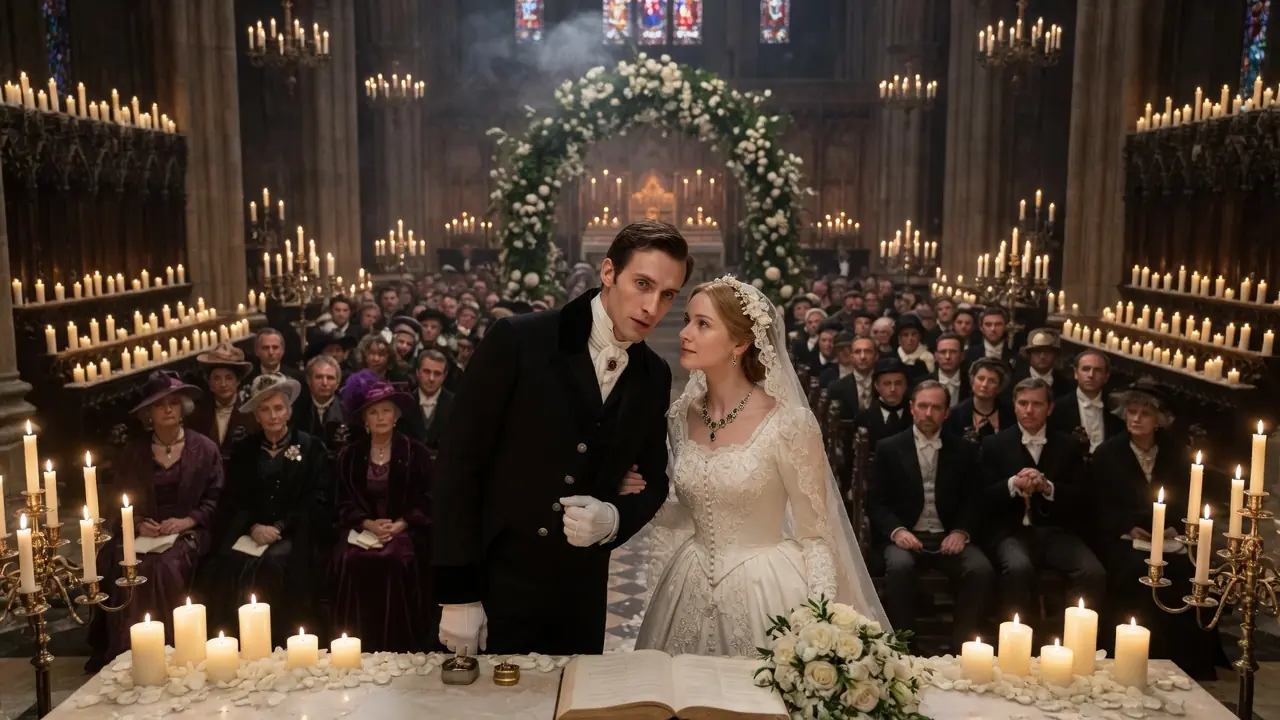
The cathedral burned with 1,200 candles, and not one of them flickered when the Duke of Halverston leaned down to his bride at the altar and whispered the words he had been saving for her since the contracts were signed.
You will beg for my favor.
His breath was warm against the lace at her temple. The choir was still singing somewhere above them, a high anthem about love everlasting. The bishop was turning the page of his book. Four hundred guests in silk and decoration were watching what London had already agreed to call the most advantageous marriage of the season.
Lady Genevieve Carrow smiled. It was a small smile, perfectly placed. The smile of a bride who had just been told she looked beautiful, or that the weather would hold for the wedding breakfast. She did not turn her head. She did not alter the angle of her shoulders. She simply lifted her chin half an inch and answered him in the same soft register he had used.
I have never begged for anything in my life.
The Duke went still. He had expected a flinch. He'd expected the small, beautiful tremor of a woman who understood finally what she had agreed to. He had not expected the calm of a woman who seemed to have understood it from the beginning and walked the length of the nave toward him anyway.
He looked at her then, actually looked, the way he had not bothered to look in any of the three meetings their fathers had arranged before this one. Pale gold hair beneath the veil, gray eyes the exact color of the November sea, a face composed with such complete authority that he could not tell whether she was frightened, amused, or carrying something he did not yet have a word for.
The bishop cleared his throat. The Duke turned back to the altar and spoke his vows in the clear, level voice that had won him three debates in the Lords this season. Lady Genevieve spoke hers in the same register. The ring slid onto her finger as smoothly as if it had been waiting there.
She did not look at him as they turned to face the congregation. She looked instead at the small door behind the south transept. The door through which her brother had been instructed to enter and had not. And against her ribs, sewn into the silk lining of her wedding gown, the folded letter pressed like a second, slower heartbeat.
The wedding breakfast was held in the long gallery at Halverston House beneath portraits of dead Halverstons who had been famous for either their virtue or their cruelty, depending on the century. Lady Genevieve, the new Duchess of Halverston now, though the title still sounded to her like a coat that did not yet fit, sat at her husband's right hand and ate three bites of pheasant and accepted the congratulations of strangers with the same exact smile she had worn at the altar.
She did not look at the door. Not once. She had decided in the carriage between the cathedral and the gallery that if she looked at the door, she would not stop. And if she did not stop, she would weep. And if she wept, she would lose the only thing that had ever protected her. The perfectly composed face of a woman who appeared to be at peace.
Nicholas had not come. Nicholas, who had written her three weeks ago to say, I have the documents. I will reach you before the ceremony. Wait for me. Nicholas, whose hand on the back of her wedding gown should have been the only hand she felt that day. Nicholas, who was somewhere on the road between Norfolk and London or somewhere worse.
Lucian Halverston watched his wife eat her three bites of pheasant and accept her congratulations and not look at the door, and he thought, with the cold precision he applied to railway accounts and political alliances, and now apparently to women, She is waiting for someone.
He did not know who. He did not yet wish to ask. Asking would imply curiosity, and curiosity in a man like him was a currency he did not spend without expecting a return.
He had married her for the timber rights on the Norfolk border and for the trouble her father's name would cease to cause him once that name was, by law, attached to his own. The old Viscount Caro had been a stain on the polite registers of three counties for as long as Lucian could remember. A man who had taken his family from respectability to ruin in a single year before Lucian was even born, and whose continued existence in a damp house in Norfolk was, in his mother's words, the kind of inconvenience one resolved by absorbing the daughter.
So, he had absorbed her. He had not expected her to be a woman who could be told, You will beg for my favor, and answer, I have never begged for anything in my life in the same register she might use to thank a footman for her shawl. It made him want to know what she would say next, which irritated him beyond reason.
They left for Halverston Park three days later in a carriage that had been built for a previous duchess and that smelled faintly of lavender and old leather. Lucian had business in town and intended to remain there. Genevieve was to settle into the country house, learn its keys, and be quiet until summoned. He told her this at the door of the carriage in the same level voice he had used at the altar.
You will find the staff competent, he said. Mrs. Hadley has had a long letter of instruction from my uncle. You will not be required to alter anything.
Of course.
My uncle will visit within the fortnight. Lord Crowley. You will extend him every courtesy.
Of course.
He looked at her then, the way he had looked at her at the altar, with the small troubled attention of a man examining a piece of evidence he could not quite name.
You agree to a great deal, madam.
I agree to everything that costs me nothing, she said presently, and stepped into the carriage.
He stood on the gravel a moment longer than necessary. Then he closed the door himself.
Halverston Park was forty miles north of London, a square pale house set against a wood that had been planted by a Halverston 140 years ago to discourage neighbors. Genevieve stepped into the entrance hall and removed her gloves with the deliberate care of a woman who intended to remain.
Within a week, she had walked the house room by room. Within two, she had asked Mrs. Hadley, politely, very politely, for the keys to the late duke's library and the muniment room. Mrs. Hadley produced one and not the other.
His grace's papers are not customarily disturbed, your grace.
I do not intend to disturb them. I intend to read them.
Mrs. Hadley delivered the second key the next morning with the expression of a woman who had received instructions from London and instructions from her duchess, and had decided, after consideration, that the duchess was the closer authority.
The muniment room was at the end of the east wing, behind a door that had not been opened by the dust of it in years. Genevieve carried in a candle and sat at the long oak table, and she did not come out for six hours.
She found what she was looking for in the second drawer of the third cabinet in a bundle tied with red linen ribbon. She did not untie it. She lifted it, weighed it, and put it back exactly as she had found it. Then she went to her room, locked the door, and finally, for the first time since the cathedral, allowed herself to shake.
The letter from her cousin arrived on the morning of the eleventh day. Genevieve read it standing by the breakfast room window in the cold November light, and the footman who had brought it noticed afterward to Mrs. Hadley that the new duchess had not made a single sound, but that her face had gone the color of paper.
Nicholas had been found, the letter said. Alive, badly used. He had been set upon two miles outside the village of Hadley by men who had taken his satchel and left him in a ditch, and a farmer had carried him home in a cart, and he was now in their aunt's house in Hertfordshire with a broken arm and a fever, and he was asking for her, and the satchel, the satchel with the papers, was gone.
Genevieve folded the letter once, folded it again, walked to the morning fire, and held it at the edge of the flame for a moment, and then did not burn it. She put it inside the bodice of her dress against the older letter she had carried since the altar, and the two papers rested there together like the halves of something broken.
She wrote three letters within the hour. One to her cousin, one to the village physician at Hadley, requesting an account of the men who had attacked her brother, and one to Lucian Halverston in London, requesting the courtesy of his presence at the park as soon as his business permitted on a matter she preferred not to commit to paper. She sealed all three with her own ring and rode to the village post herself rather than trust a footman.
Then she returned to the muniment room.
The bundle in the second drawer of the third cabinet contained seventeen documents dated between the years she had been a child of three and a child of five. They were in the hand of the late Duke of Halverston, Lucian's father, and they detailed in patient banker's prose how a certain Viscount Caro of Norfolk had been induced through a series of carefully arranged loans, false signatures, and one act of plain perjury to assume the financial guilt for a railway investment that had collapsed and ruined six families.
The investment had not been her father's. The signature had not been his. The ruin had not been deserved. Her father had taken the dishonor anyway because the alternative, laid out plainly in the seventeenth document in the late Duke's own hand, was that his wife, the woman who had been Genevieve's mother, would be charged with adultery and the children declared illegitimate.
Her father had chosen ruin over her mother's name, over her name, over Nicholas's.
Genevieve sat in the muniment room for a long time after she finished reading. She did not weep. She did not, in fact, do anything for almost an hour except watch the candle burn down and consider in patient surgical detail the question of what she was now going to do with the seventeen documents she had just found.
She was the Duchess of Halverston. She had married into the house of the man who had destroyed her father, and the man she had married did not, she was certain, know any of it.
Lucian arrived at the park six days later unannounced on a black horse that he had ridden harder than the weather warranted. He found his wife in the morning room at the southwest corner of the house where the light at four was clearest, and he found her writing at a desk that had been his mother's, and she did not stand when he entered.
You sent for me.
I did.
I should prefer a reason.
She set down her pen. She closed the inkwell with the deliberate care she applied to everything now. And she said,
Lucian.
It was the first time she had used his given name, and he registered it with a small involuntary tightening of the shoulders.
What do you know of my father?
He did not sit.
I know what every man in three counties knows. He embezzled. He was protected from prosecution by the consideration of better men. He has lived in retirement ever since on the kindness of relatives who had reason to wish him quiet.
And do you know who arranged that protection?
My father, I expect. It was the sort of generosity he was known for.
Yes, Genevieve said. It was the sort of generosity he was known for.
She rose. She went to the cabinet by the window. She unlocked it with a key she had not been given, but had had cut, and she took out the bundle in red linen ribbon, and she set it on the desk between them.
Read these in whichever order you like. I shall be in the garden.
She did not look at him as she passed. She did not need to. She had measured him from the altar to this room, and she knew, with the same cold accuracy with which she now did everything, that the man who had told her she would beg for his favor was about to discover that he had spent every day of his life standing on a floor that someone else had built out of his father's lies.
He read them. He read them once quickly, the way he read parliamentary briefs, and then he read them again very slowly with a pen in his hand and a sheet of paper beside him to record discrepancies. And there were none. The hand was his father's. The seals were his father's. The witnesses were two men he had grown up calling uncle, men who had bounced him on their knees in this very house, and who, the documents made plain, had taken a percentage of the Caro lands as payment for their silence.
His uncle Crowley's name was on the bottom of the seventeenth page.
The Duke of Halverston sat alone in the morning room for a long time. He did not move when the light failed. He did not move when a footman, sent to ask whether he would take dinner, opened the door, took one look at his face, and withdrew without speaking. He sat with his father's pages spread before him and reassembled in silence the entire architecture of his life.
His father had been a thief. His father had been a thief who had built his thefts into a story so persuasive that Lucian had grown up believing the daughters of Viscount Caro were the sort of women Halverston married only to neutralize. He had believed it at school. He had believed it in his clubs. He had believed it at the altar when he had bent down to a woman he had never bothered to know and whispered the cruelest sentence he had ever spoken in his life. Because he had believed, on the authority of a dead man, that she had earned it.
She had not earned it. She had walked into his cathedral knowing every word of these seventeen pages, and she had said her vows anyway in the same register he had used because she had a brother in a ditch and a father in disgrace, and she had needed access to a muniment room she could not enter as anything other than the woman who had married him.
He had not absorbed her. She had absorbed him.
He found her in the garden after midnight. She had been there for hours. She had walked the gravel paths in the cold until her hands could not feel the seam of her cloak, and then she had sat on the stone bench beneath the yew because she had decided some time ago that she would not return to the house until he came out to her.
At the altar, he said, when I told you that you would beg for my favor.
Yes.
And you said you had never begged for anything in your life.
I have not.
He looked up at her. There was nothing of the Duke about him now, nothing of the man who had won three debates in the Lords. There was only a man who had finally, eight years too late, understood that the woman in front of him had been the most dangerous person in any room she had ever entered. And that he had married her without seeing her at all.
What do you want from me? he said.
It was not a demand. It was the question of a man who had no idea what currency he had left.
Genevieve looked at him for a long time in the moonlight. The cold had reached her bones, but she did not move. She'd been preparing the answer to this question since the first night she'd read her brother's letter, three weeks before the wedding, and she had refined it through every hour of every day since.
I want my father's name restored, in writing, in the Gazette, by you, within a fortnight.
Done.
I want your uncle removed from every position he holds within the family. I do not care what story you tell to accomplish it. I want him in a small house in a small county, and I want him there for the rest of his natural life.
Done.
I want my brother brought here, to this house, to be cared for by your physician, at your expense, until he is well, and longer if he wishes.
Done.
And I want, she said, and here, for the first time since the cathedral, her voice softened by a measure so small that only a man who had been studying her for six weeks would have heard it. I want you to understand that I did not marry you for revenge. I married you for access. The revenge was not the point. The truth was the point. My father has lived for twenty years under a name that was not his to carry. I wanted it back.
You shall have it back.
I know I shall. I was not asking.
He did not try to touch her. He did not try to speak again for a long while. He sat on the cold stone wall in his shirt sleeves and watched his wife in the moonlight and thought about the fact that she had walked the length of his cathedral three weeks ago with seventeen pages of his father's crimes folded against her ribs and had answered his cruelty with the calm of a woman who had measured him and found him survivable.
She was the most extraordinary creature he had ever met and he had told her she would beg.
Genevieve, he said, and the use of her name, quiet, without ornament, was so unlike the man who had spoken at the altar that she turned her face toward him for the first time that night. I cannot undo what I said to you. I cannot undo what my father did. I cannot undo a single hour of the last twenty years, but I should like, if you will permit it, to spend the rest of my life arranging matters so that no one ever speaks of your family again without standing.
That is a great undertaking.
It is the only undertaking I have left that means anything.
She considered him. The November cold had settled into the garden and somewhere in the wood beyond the yew, a fox cried once.
You said I would beg, she said.
I did.
I will not. Not ever. Not for anything. You must understand this is not a position I will revisit.
I understand it. But if you do the things you have said you will do, if you restore my father and remove your uncle and bring my brother to this house and conduct yourself from this night forward as a man who has learned what it cost the woman he married to teach him, then in time perhaps I will offer you something I have never offered anyone.
She paused.
My company freely given. Not as your wife. As myself.
He bowed his head.
That is more than I have any right to ask for.
It is. Which is why you will not ask. You will earn it or you will not have it. And we shall see, Lord Halverston, which kind of man you turn out to be when no one is telling you what kind to be.
She rose then and walked past him toward the house and the gravel of the path made no sound beneath her slippers because she had been walking it for hours and knew exactly where each loose stone lay.
He stayed on the wall for another hour in the cold alone, the architecture of his life still in pieces on the morning room desk and a new architecture, slower, harder, beginning to assemble itself around the small bright fact of his wife.
The notice in the Gazette appeared eleven days later. It was brief. It stated that certain matters concerning the affairs of Viscount Caro of Norfolk twenty years past had been reviewed by the present Duke of Halverston and found to have been wrongly recorded, and that the late Duke's own papers established beyond dispute that the Viscount had been the victim of a fraud carried out by persons since deceased and persons since retired from public life. It restored the Viscount's name in the public record. It was signed in Lucian Halverston's own hand.
Lord Crowley left for a small estate in Wales the same week. He did not return.
Nicholas Caro arrived at Halverston Park in a covered carriage on a Tuesday in the middle of December with his arm in a sling and a fever still in him. And his sister met him at the door and held him for a long time without saying anything at all because there were no words for what they had survived and they had been raised, both of them, by a father who had taught them that some things were too important to put into words while the cost of them was still being paid.
The Duke stood three paces back in the entrance hall and watched them. He did not approach. He had begun to learn with the slow patience of a man relearning his own house that he was not the first person in any room his wife occupied and that he might in time become the second, not by demanding the place, but by earning it.
They built something in the months that followed. Not the marriage either of them had expected. Not the marriage anyone in London had predicted. Something quieter. Harder-edged. More honest. A marriage of two people who had each in their own way walked into a cathedral knowing exactly what they were doing and had only afterward discovered that what they had been doing was not at all the thing they had thought.
She never begged. He never asked her to.
And on a morning the following spring in the southwest morning room where the light at four was clearest, she set the folded letter from her brother on the desk beside him and she said,
You may read this now if you wish. It is the letter I carried at the altar. I believe you have earned it.
He read it. And when he had finished, he folded it again and he handed it back to her without a word because he had finally understood, six months too late and exactly in time, that the right thing to do with the most important paper in another person's life was to give it back to them whole.