A struggling diner waitress worked every dawn shift just to keep her family afloat. Every morning, an elderly man with pale, distant eyes walked in, quiet, withdrawn, barely acknowledged by the staff. But the waitress always treated him with gentle kindness, noticing the smallest details and even cutting his toast into neat pieces for his trembling hands. Slowly, he began to open up, and a quiet bond formed between them. But one morning, he didn’t show up. Instead, several men in sharp black suits walked through the door, and what they told her next left her completely stunned.
The brass bell above Clifton Street Diner gave a tired clang every time the door swung open. Renee Carter’s morning anthem. Not cheerful, just weary metal, announcing another shift, another day, hoping the regulars might leave something decent in the tip jar. The diner was the kind of place that time had simply forgotten to update: cracked green vinyl booths patched with electrical tape, sticky linoleum floors that had seen better decades, and the permanent smell of burnt coffee fused into every wall and ceiling tile.
Tucked into a quiet corner of Memphis, Tennessee, on a block where barber shops and laundromats outnumbered restaurants three to one, Clifton Street Diner had fed the same working neighborhood for nearly 50 years. For Renee Carter, 26 years old and already running on fumes most mornings, the diner was both her anchor and her trap. A Black woman with deep brown skin that seemed to dull under the harsh fluorescent lights and early hours, she carried herself with a quiet endurance that few ever noticed.
Six days a week, starting before the sun had any business being up, she performed the precise choreography of survival: balancing plates, refilling coffee mugs, smiling at people who barely looked at her, and moving so constantly that exhaustion felt like a natural state of being. Once, not so long ago, she had been a business student at a small college outside Nashville, full of quiet plans about opening a catering company, building something with her own hands. But life had redirected her sharply, the way it tends to do to people who cannot afford to argue back.
She had grown up in South Memphis, the oldest of two sisters, raised by a mother who worked the overnight shift at a hospital laundry and a father who coached youth football until a back injury retired him early. Their home was small and warm and full of music. Her mother played gospel on Sunday mornings, and their father told the same five stories from his high school glory days until everyone could recite them word for word. For a while, the future felt like a door that was opening slowly but definitely in her direction.
Then her mother got sick. Congestive heart failure, diagnosed on a Tuesday in April, three weeks before Renee’s college finals. She came home and never quite went back. Her younger sister Destiny was only 14 at the time, too young to be left without a responsible adult in the house, too old to be placed anywhere, and their father, good-hearted as he was, struggled to manage everything alone after years of the same back problems that had ended his coaching career. Renee deferred her enrollment, worked a full semester at a grocery store, then another, and somewhere along the way, the deferment became permanent and the grocery store became a diner.
Now Destiny was 19 and just beginning her first year at a community college, studying early childhood education, serious about it in the way Renee had once been serious about her own dreams. Renee worked so that her sister’s focus could remain exactly where it belonged, on her books, not on whether the lights were going to stay on. Their apartment was a two-bedroom unit on Hollowell Avenue, close enough to the bus line that Renee could make her 5:15 pickup and still get to the diner before Dennis, the manager, started his morning ritual of glancing pointedly at the clock.
The rent was $940 a month. Destiny’s community college tuition and fees came to roughly $300 a semester after her partial grant, but the gaps between semesters had a way of appearing like potholes, sudden, deep, and expensive. Utilities ran close to $160 most months. Groceries for two came to about $350. Their mother’s prescription co-pays added another $90. Bus fare for both of them ate through another $120 a month.
When Renee laid it all out on the back of an envelope on slow nights, which she had done more times than she cared to count, the total climbed past $2,000 before she got to anything unexpected. Her average monthly take-home, including tips on good weeks, landed somewhere between $1,800 and $2,100. On paper, she was always short. In practice, she made it work through a combination of skipping meals, wearing shoes until the soles separated, and refusing to examine the math too closely on any given Friday night.
She had a credit card with a balance of just over $6,000, most of it accumulated during her mother’s hospital stay before the insurance finally processed the claims. She paid the minimum most months and tried not to think about the interest accumulating in the background like a slow leak in a wall, hidden, persistent, eventually structural.
Still, Renee did not carry this weight visibly. The customers at Clifton Street Diner knew her as the young woman who remembered their orders, who laughed at the same jokes every Tuesday, who kept the coffee hot and the attitude warm. Destiny knew her as the sister who always said things were fine. Their mother knew her as the daughter who visited every Sunday and brought the good hand lotion, not the cheap kind. Nobody saw the envelope calculations. Nobody needed to.
She arrived at the diner most mornings at 5:43, which her manager, Dennis Pratt, a heavyset man in his mid-50s who wore the same three flannel shirts on a weekly rotation, considered anywhere between acceptable and three minutes late, depending on his mood.
“Bus was behind schedule,” Renee would say.
“Bus is always behind schedule,” Dennis would reply, already turning back toward the kitchen.
Martha Simmons, who had worked the Clifton Street counter for going on 23 years and had opinions about everything from the weather to the proper way to crack an egg, would shake her head slowly from behind the coffee station and say nothing, which somehow felt louder than anything she could have said out loud.
Renee tied her apron, brewed the first pot of the morning, and stepped into the rhythm of the day the way a person steps into cold water: deliberately, evenly, without flinching. The regulars were a familiar and unchanging collection. Gerald from the auto shop on Fifth came in every weekday and tipped exactly $1.50 regardless of the bill. The two women from the insurance office on the corner rotated between two conversations, one about their supervisor and one about a television show Renee had never seen. A retired postal worker named Herbert came in on Tuesdays and Thursdays and always ordered the same thing: two eggs, scrambled soft, wheat toast dry, and a glass of orange juice that he nursed for 45 minutes while reading the physical newspaper.
And then there was the old man in booth 7.
He was not simply a regular in the way that Gerald or Herbert were regulars. He had become part of the diner’s architecture, as fixed and unremarkable as the neon sign in the window or the framed photograph of the Memphis skyline above the register. Every morning at precisely 7:15, the door swung open, and Elliot came in.
No one at the diner knew his last name at first, and he never offered it, moving slowly, with the careful deliberateness of a man whose body had begun to negotiate terms with him. He walked with a dark wooden cane, the kind with a curved handle worn smooth from years of use. He dressed plainly: gray trousers, a button-down shirt that had been washed so many times the plaid had faded to suggestion, soft-soled shoes. His hair was white and neatly combed. His eyes were pale blue and slightly clouded, as though he were looking at the world through a window that needed cleaning. His face was deeply lined, the kind of lined that came not from age alone, but from weather and weight and time spent outdoors in earlier decades.
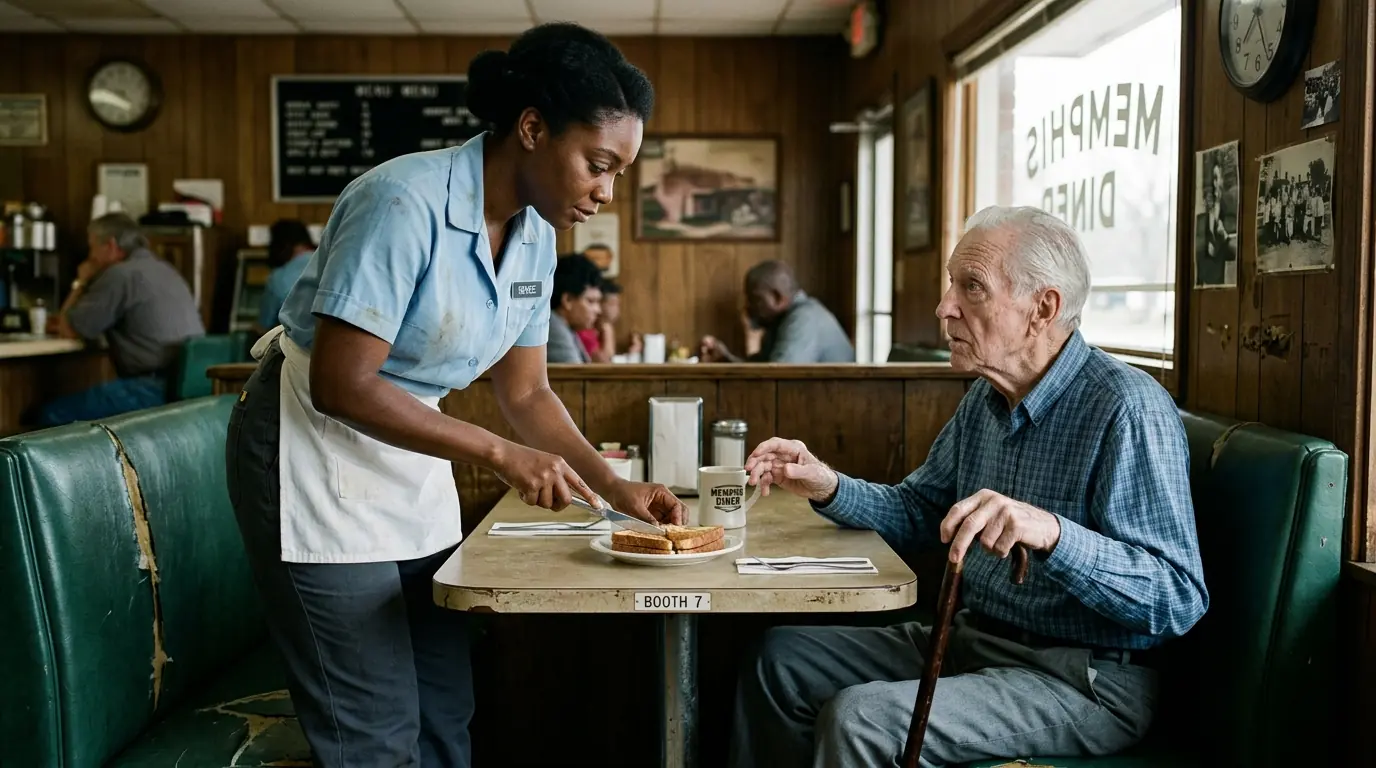
He sat at the same corner booth by the far window, booth 7, and he ordered the same thing every morning: black coffee, the breakfast special, and wheat toast. He always paid exact change, always counted it carefully from a worn leather coin purse, and he never spoke beyond the minimum necessary to complete the transaction.
The first morning he appeared, just under two years before the events that would change Renee’s life entirely, Dennis had given her the standard briefing.
“Black coffee, breakfast special. Don’t fuss over him. He doesn’t want conversation.”
Martha had added, without looking up, “Tips nothing. Not even rounding up. I’ve tried.”
But Renee noticed something neither of them seemed to. She noticed the way he sat straight-backed, hands folded on the table, looking out the window with an expression that was not peaceful, but careful, like a man who had trained himself not to show how much he was watching. She noticed that he was always early and always alone and always clean in the way that people are clean when they have no one to dress for but themselves, and they have kept the habit anyway out of something like pride.
She brought him a menu that first morning. “Good morning, sir. I’m Renee. Can I start you with some coffee?”
He didn’t look up. “Black. No sugar.”
She poured it and left him alone.
The next morning, she greeted him again. And the morning after that. For weeks, the response was the same. Brief, functional, nothing offered beyond the minimum. Dennis told her to stop wasting time on him. Martha said the same thing with a look. Renee kept going anyway.
“Toast is fresh this morning, sir.”
“Cold front coming in. Good day for coffee.”
“Special’s got the good sausage today, not the thin kind.”
He never responded. She kept talking softly, the way you talk to something you want to trust, not to fill silence, but to show you’re not a threat.
Then one morning in November, about four months into his routine, she brought his breakfast and noticed something that stopped her mid-motion. His hands were trembling. Not dramatically, not in a way that announced itself, but in the small, persistent way of a man whose arthritis had progressed past the point of concealment. He was struggling to get his knife under the edge of the toast, and each attempt made the plate scrape slightly against the table.
Renee set down her tray, without a word reached over gently, and cut the toast into four even pieces. She did it the way you do something for someone you care about, without making it a moment, without announcing the help, just doing it and stepping back.
The old man looked up. His pale blue eyes met hers. And for a fraction of a second, something passed across his face that she would think about for a long time afterward. Not just gratitude. Recognition. The look of a person who had forgotten what it felt like to be noticed by someone who wasn’t paid to notice them.
He gave the smallest nod.
Renee nodded back and moved on to her next table.
From that morning forward, something shifted. She brought his coffee, his breakfast special, his toast cut into four neat pieces every single morning. She began sharing small pieces of her life in the spaces between refills. Something funny Destiny had said the night before. Something she had read on the bus. Once, haltingly, the outline of her old plan to start a catering business, the one she had set aside.
He said nothing for months, but he listened. She could tell by the way his posture changed almost imperceptibly when she spoke, a slight easing of the shoulders, the tension around his jaw releasing just a fraction. Sometimes he left an extra quarter beside his exact payment. It became its own language.
Renee’s co-workers found the whole thing mildly entertaining and slightly baffling.
“Still having your one-sided conversation with the old man?” Martha asked one afternoon.
“He breathes,” Martha corrected. “That’s not the same thing.”
Renee let it go. Those ten minutes every morning had become the one part of her shift that felt genuinely human. Not performed. Not transactional. Just real.
She was not kind to the old man because she expected anything in return. She was kind because she recognized something in him that she understood from the inside: the experience of moving through rooms full of people and feeling entirely invisible. She had no idea he was doing the same to her.
Seventeen months passed in the way that long periods of ordinary time pass: steadily, without announcement, marked more by accumulation than by event. Every morning at 7:15, Elliot arrived. Every morning, Renee brought his coffee, his breakfast special, and his toast cut into four squares. The ritual had become as fixed as the furniture.
But as the summer heat in Memphis thickened toward its August peak, something began to change.
It was a Wednesday morning, close to the 16-month mark of their arrangement, when Elliot spoke first. Renee was refilling his coffee, her attention half on table 4, where a customer was signaling for his check, when she heard it: a voice low and deliberate and slightly hoarse from disuse.
“You have a sister.”
It was not a question. He had heard her mention Destiny in passing so many times over so many months that it had settled into his understanding as fact.
Renee looked at him, genuinely startled. In 16 months, he had never initiated a single exchange.
“Yes, sir. Her name’s Destiny. She’s 19.”
He looked at her with those pale, clear eyes. “She’s in school?”
“Community college, first year, studying early childhood education. She wants to work with little kids. Kindergarten, first grade.”
He was quiet for a moment, turning his coffee cup in both hands. “Who looks after your mother when you’re here?”
Renee paused, recalibrating. He had assembled these facts over months of half-heard sentences and quiet attention.
“My dad’s home most mornings. Destiny handles the afternoon. We make it work.”
“That sounds like a great deal to manage,” he said.
Something in the plainness of the statement, no pity, no performance, just simple acknowledgement, made Renee’s throat tighten unexpectedly.
“It’s what needs doing,” she said. “Destiny deserves to finish school. My mother deserves care. That’s just how it is.”
He studied her for a long moment. When he finally spoke again, his voice was measured and careful. “You’re a good person, Renee Carter. Better than most.”
She had to turn away before her face did something she couldn’t control, because nobody, not her father, not her mother on the good days, not a single person who knew her life, had ever said those words in exactly that configuration, with exactly that weight, at exactly the moment they landed.
From that morning forward, Elliot asked about Destiny regularly. He asked about their mother’s health with the specific vocabulary of someone who had experience with medical situations, not in a clinical way, but in the way a person asks who has sat in waiting rooms before and understands what the questions behind the questions actually mean. Renee answered gladly, surprised every time by how much she had to say now that someone was genuinely asking.
“Destiny’s doing well in her child development course. She’s the only one in her class who actually wants to discuss the reading. Her professor told her she should consider getting her bachelor’s eventually.”
Elliot nodded. “She should.”
“She will,” Renee said. “I’m going to make sure of it.”
Something in the old man’s expression shifted when she said that, something brief and complex, not quite a smile, but adjacent to one, as if she had confirmed something he had already concluded.
Then came the Saturday in late September, six months after their first real conversation, that would begin the chain of events changing everything, though Renee would not understand how completely until much later.
She received a text from Destiny at 6:40 in the morning. Mom had a rough night. Staying with her until Dad gets back. I’m sorry about the market.
The market was a small side arrangement. Renee had recently started selling homemade spice rubs and condiment jars at a local weekend market two Saturdays a month. She needed Destiny to staff the table while she worked her diner shift. With no one else available, she gathered the folding table, the crates of product, and the handwritten signs and brought them with her on the bus. She set up a small display near the diner’s entrance with Dennis’s grudging permission.
“Keep it out of the way and don’t make it weird.”
When the door opened at 7:15 and Elliot walked in, he stopped at the small display before continuing to his booth. He looked at the carefully labeled jars, Memphis Dry Rub, Sweet Heat Glaze, Grandma Carter’s Seasoning Salt, and the small handwritten sign, Renee’s Table, with a price list below.
When Renee brought his coffee, he was studying one of the jars.
“This is yours,” he said.
“Yes, sir. Side project. Just getting started.”
“Your grandmother’s recipe?” He pointed to the seasoning salt.
Renee smiled despite herself. “Sort of. I added a few things. She used to make it for the whole block on holidays.”
He set the jar down carefully. “Tell me about the business plan.”
She looked at him, caught off guard. “There isn’t much of one yet. Just the market table for now. Eventually, I want to do catering. Maybe a small product line, but that’s a long way off.”
“Why long?”
“Because it costs money to start a business, and I don’t have it.”
She said it matter-of-factly, without bitterness.
He looked at her for a long, steady moment. Then he looked back at the jar. “May I buy one?”
“Of course.”
He counted out exact change from his coin purse, the first time in nearly two years he had paid for anything beyond his breakfast. He tucked the jar carefully into the inside pocket of his jacket as though it were something fragile, something worth protecting.
Renee watched him do it and felt inexplicably like crying. She turned away before he could see her face.
She would not understand until much later that in that moment, Elliot Bowmont had already made his decision.
Six months after their first real conversation, on a Monday morning in late September, Renee arrived at the diner at 5:43, the same as any other day. She moved through the early hour on autopilot, her mind still halfway home, where Destiny had fallen asleep at the kitchen table over a textbook the night before. Coffee brewed. Breakfast special up on the chalkboard. The usual Monday crowd filtering in one by one.
At 7:15, Renee’s attention drifted toward the door, the way it always did at that time of morning. A small reflex she had developed without meaning to, the way you listen for a familiar sound before you consciously realize you’re waiting.
The door did not open.
7:18. 7:30. Nothing.
He was never late. Not once in nearly two years. A cold thread of unease began winding itself through her chest. By nine, she had poured two wrong orders and forgotten to put in a ticket for table six and burned her hand on the edge of the griddle because she wasn’t watching what her hands were doing.
“Renee, I need you present,” Dennis said, not unkindly.
“I know. I’m sorry.”
And then, at 9:22, the brass bell above the door sounded.
The diner went quiet immediately, completely, the way a room goes quiet when something enters it that doesn’t belong to its ordinary world.
Two men in dark professional suits came through the door first, moving with the deliberate precision of people paid to move that way. A third person followed: a man in his early 30s, tall, in a charcoal suit fitted with quiet precision, carrying a leather briefcase. He had dark hair, sharp dark eyes that swept the room with a single practiced motion, and the composed, unhurried manner of someone who had learned to move through difficult situations without telegraphing urgency.
His name was Nathan Alcott. He was 32 years old, a partner at Alcott Webb and Associates, and he had been Elliot James Bowmont’s personal attorney for the last five years of the old man’s life, brought on initially for a specific estate planning matter when Nathan was 27 and freshly established at the firm, and kept on indefinitely because Elliot, who had spent 60 years reading people, recognized immediately that this was a young man who would tell him the truth even when the truth was inconvenient.
His eyes found Renee at the counter with the directness of someone who had been given a specific description and recognized the match immediately.
He walked to the counter. “Are you Renee Alicia Carter?”
Renee’s hands went still on the coffee pot. “Yes, sir.”
“My name is Nathan Alcott. I’m a partner at Alcott Webb and Associates. I was Mr. Elliot James Bowmont’s personal attorney.”
The name hit her like a shift in altitude, the world slightly wrong for a second.
Elliot James Bowmont.
She had known his face for nearly two years. She had known his coffee order and the sound of his cane on the linoleum and the precise way he counted change from his coin purse. She had not known his full name.
“Mr. Bowmont,” she whispered. “Is he all right? He didn’t come in this morning.”
Something shifted in Nathan Alcott’s expression. Not much, but enough to tell her what was coming before the words did. He had known Elliot for five years. He had taken this man’s calls at late hours, had watched a brilliant and lonely person spend his final years looking for something the people closest to him had stopped offering. This part of the job never became routine.
“Mr. Bowmont passed away peacefully in his sleep on Saturday evening. I’m very sorry, Miss Carter.”
The coffee pot in Renee’s hand was suddenly very heavy. She set it down. The diner around her continued its ordinary business, forks scraping plates, someone laughing at table 4, the griddle hissing, and all of it felt profoundly wrong against the silence that had opened in her chest.
She had known him for nearly two years. She had served him breakfast nearly 500 times. She had told him about Destiny and her mother and the old dream of a catering business. She had cut his toast into four squares every morning because his hands shook. She had not known his last name until 30 seconds ago, and now he was gone.
“I’m so sorry,” she managed. “He was a good man. He deserved better than to be alone.”
Something moved across Nathan Alcott’s face, not the professional composure that had carried him through the door, but something underneath it, briefly visible.
“He named you in his will,” Nathan said, steadying his voice specifically and deliberately. “There is a car waiting. This cannot wait, Miss Carter.”
Renee stared. “A will? There must be some mistake. I was his waitress.”
“There is no mistake. You are described as the young woman who cut his toast into four pieces every morning because she noticed his hands shook, who treated him with dignity when others saw only an inconvenience.” Nathan paused. “He was very specific. He was always very specific. It’s the kind of man he was.”
Renee looked at Dennis, who had gone very still behind the register.
“Go,” Dennis said quietly. “I’ll cover your section.”
Martha said nothing, which was more eloquent than anything she might have said.
Renee untied her apron with hands that would not stop trembling.
In the black car on the way downtown, Renee sat across from Nathan Alcott and stared out the window at Memphis moving past. Nathan reviewed documents in his briefcase with focused efficiency. For the first 15 minutes, neither of them spoke.
Then he said, without looking up, “He talked about you in our last several meetings. Not by name at first, just the young woman at the diner, then by name.”
Renee turned from the window. “What did he say?”
Nathan finally looked up, and for a moment the briefcase and the documents and the professional distance were all slightly suspended.
“He said you reminded him of his daughter. Not in appearance. In character. The way you saw people.” He paused. “He said it like it was the most important thing he had observed in years, which for Elliot Bowmont, it probably was.”
Renee looked back out the window and did not trust herself to respond.
The law offices of Alcott Webb and Associates occupied four floors of a glass tower in downtown Memphis. Marble floors. Artwork on the walls. The sound of expensive shoes on polished surfaces. Renee, in her work sneakers and the jeans she wore under her apron, felt the contrast with a clarity that was almost physical.
She was led to a conference room on the 36th floor. Long mahogany table. Windows overlooking the city, designed to remind everyone present of the hierarchy of things.
Two people were already seated when she entered. A man in his late 30s, dark-haired, with the groomed certainty of someone accustomed to being the most important person in any room. His suit was expensive, and his posture was the posture of someone who had decided the meeting was already an insult before it began. Beside him, a younger man, perhaps 30, quieter, who looked more uncomfortable than angry, as though he were present not by choice, but by obligation.
Nathan Alcott cleared his throat as Renee sat down. “Mr. Garrett Bowmont. Mr. Thomas Bowmont. This is Miss Renee Carter, the final party named in Mr. Bowmont’s will.”
Garrett’s gaze moved over Renee with the kind of assessment that took in her clothes and her work shoes and reached a verdict in approximately three seconds.
“This is who we waited for? A diner waitress?” He let out a short exhale. “Our grandfather has been gone for less than 48 hours, and we’re sitting here with the breakfast girl.”
“Ms. Carter, please sit,” Nathan said, and his voice carried the kind of quiet authority that did not need to raise itself to make its point.
The reading began. Dense legal language. Numbers so large they seemed abstract. Endowments to universities, charitable foundations, scholarship funds. The scale was clear, even in fragments. Elliot Bowmont had been wealthy in a way that bore no resemblance to the man who counted exact change from a coin purse every morning.
Then Nathan reached a passage that made Garrett sit up sharply.
“To my grandson, Garrett James Bowmont, I bequeath the family property in Brentwood, along with a sum of $3 million to be held in trust for a period of five years, dispersible at the trustee’s discretion based on demonstrated financial responsibility.”
“Three million?” Garrett said flatly. “After everything?”
“Your grandfather liquidated most of his personal holdings over the last several years,” Nathan replied coolly. “He had full legal authority to do so.”
“He was our grandfather,” Garrett said, his composure cracking at the edges. “His only family. We were there for him.”
“According to records,” Nathan replied without particular emotion, “Mr. Garrett Bowmont visited his grandfather four times in the last three years. Each visit was preceded by a financial request. Mr. Thomas Bowmont visited twice, also following financial difficulties.” He paused just long enough to let that land. “That is the record of care.”
The silence that followed was the kind that has weight.
Nathan continued through the will methodically. Five hundred thousand to Thomas. Three hundred thousand to a longtime family physician who had treated Elliot with genuine compassion through his final years. Various sums to three charities Elliot had supported quietly for decades.
Then Nathan’s eyes came up from the document and found Renee directly.
“We now arrive at the final and most significant provisions.”
He read slowly and clearly. “To Ms. Renee Alicia Carter, who served me breakfast for nearly two years at Clifton Street Diner in Memphis, Tennessee, who extended genuine kindness to an old man when she had no reason to, who treated me as a person when the world had largely forgotten I existed, who never once asked me who I was or what I had, I leave the following.”
Renee sat very still.
“First, an immediate gift of $600,000 to be transferred into an account in her name within 10 business days to ease the burdens I watched her carry without complaint, just as she eased mine without being asked.”
The room tilted.
$600,000.
Garrett stood. “This is fraud. She manipulated a lonely old man. We will contest every word of this.”
“Sit down, Mr. Bowmont,” Nathan said, and this time his voice had an edge that was not subtle. “Three independent physicians certified your grandfather’s complete mental competency before he signed. The will has been reviewed by two external legal firms. There is nothing to contest. Sit down.”
Garrett sat, a beat too late and with the jaw of someone saving a different fight for a different day.
Nathan read on.
“And finally, because Clifton Street Diner was the last place on this earth where I was treated not as a name or a legacy or a disappointment or an obstacle, but as a human being worthy of a simple morning greeting, I bequeath to Miss Carter full ownership of the property at 418 Clifton Street, Memphis, Tennessee, purchased 14 months ago through Bowmont Properties LLC, along with all business assets, equipment, inventory, and existing operating agreements.”
Silence.
Renee stared. Elliot had owned the building she worked in for over a year. He had come in every morning and paid exact change and left his quarter tip and said nothing.
Garrett laughed, sharp and humorless. “He left her the diner. After all this theater, he left her a greasy spoon on a block nobody wants. Fine. Let her have it.”
Nathan did not smile. He looked at Garrett with the expression of someone who had been waiting to deliver a specific piece of information at precisely the right moment.
“The Clifton Street property is accompanied by the Bowmont commercial development portfolio, which Mr. Bowmont attached to secure its long-term viability. That portfolio is currently valued at approximately $7.4 million.”
The transformation was instant. Garrett’s laugh stopped mid-breath. Thomas looked at the table.
“Seven point four million.”
Garrett stood again. “Fraud. Manipulation. We will fight this in every court in this state.”
Renee looked at him. Her voice came out steadier than she felt. “I didn’t know who he was. I just tried to be decent to him.”
“Convenient story.”
“Your grandfather prepared for this response precisely as he prepared for everything.” Nathan pulled out a sealed folder. “A handwritten account of his reasoning. Twenty-two months of personal diary entries. A video statement recorded before two witnesses and a notary.” He looked at Garrett without warmth. “He did not leave things undone. Carelessness was not in his nature.”
Garrett left without another word. Thomas paused at the door and looked at Renee with an expression that was different from his brother’s. Not warm, but not cold either, just complicated. Then he left.
Nathan sat across from Renee in the emptied room. The professional composure was still present, but the edges of it had softened, the particular softening that happens when a long-held tension finally releases.
“I know this is a great deal to absorb,” he said. “Mr. Bowmont knew it would be. He left instructions for every step of the process.”
He slid a thick sealed folder across the table. “Inside is a personal letter from him to you. He was specific that you read it alone when you’re ready.”
He placed a small brass key on top of the folder. “And this opens his private study at his home. He wanted you to go there when you feel prepared. What you find there will explain more than I can explain in this room.”
He placed his business card on the table and then, doing something that was not in the formal procedure of the moment, added a second card with his personal number handwritten on the back.
“Day or night,” he said, “for any question at all. Mr. Bowmont asked me specifically to make myself available to you throughout this entire process, but I want to be clear that is not only a professional obligation. He trusted you completely. I intend to honor that.”
He paused. “Do not speak with the Bowmont family without me present.”
He stood, then stopped. Something in his expression made it clear he was choosing his next words more carefully than legal procedure required.
“For what it’s worth,” Nathan said quietly, “he was happier in his last year than I had seen him at any point in the five years I knew him. I don’t think that was an accident.” He looked at her directly. “He made a good choice. I believe you’ll prove him right.”
Then he left her alone with the folder, the key, and the view of Memphis from 36 floors up.
Three days passed before Renee was ready to use the key. She spent those days sitting very still and staring at surfaces, calling Destiny, and crying in the shower where her sister wouldn’t hear. She paid off the credit card balance in a single online transaction and sat for ten minutes staring at the confirmation screen. She called the landlord. She paid six months of rent in advance. She bought her mother the name-brand medication without calculating whether she could afford it. Small things. Concrete things. Things that made the number real by turning it into specifics she could touch.
On the fourth morning, she drove to the address Nathan had given her.
Elliot Bowmont’s home was in Germantown, east of Memphis proper, a neighborhood of old trees and long driveways, the kind of quiet that is purchased rather than found. His house was a two-story brick colonial with a wide porch and mature oaks lining the front walk. Large but not ostentatious. The kind of house that says, I have been here a long time.
Nathan was waiting on the porch steps, not because protocol required it, but because he had known Elliot for five years, because he had been inside this house before, because he understood what Renee was about to walk into, and he thought it deserved a person rather than a lockbox.
“He never had visitors here,” Nathan said quietly as he unlocked the front door. “His family came to the office. He kept this place separate.”
Inside: warm, well-lived-in, with wood floors and bookshelves used seriously. Framed photographs on the hall table. A younger Elliot with a woman who must have been his wife, both of them laughing at something outside the frame. A photograph of two boys at a fishing lake, young and unguarded. A portrait from perhaps 20 years ago, the whole family assembled, everyone smiling and nobody quite comfortable.
And the paintings. Landscapes done with a precision and feeling that made them feel like windows rather than pictures. A Tennessee Valley in early morning light. A river bend in autumn. A back porch with an empty chair.
“He collected quietly for 30 years,” Nathan said. “Preferred American painters, mostly working artists. He bought directly from studios when he could.” He paused. “He bought one piece of yours, actually.”
Renee looked at him. “Mine?”
“The jar of Grandma Carter’s Seasoning Salt. He kept it on the desk in his study. He told me it was the best investment he had made in years.”
Something crossed Nathan’s expression. Not quite a smile, but the space around one. “I thought he was being sentimental. Knowing him, he was being completely literal.”
Renee had to look away for a moment.
Nathan led her upstairs to a door of solid wood at the end of the hall and handed her the brass key. “I’ll be downstairs when you’re ready,” he said, giving her the room without being asked, which she noticed.
The study was the room of a man who thought for a living. Bookshelves packed without gaps: business, history, architecture, law, Southern history, biographies, an entire shelf devoted to Memphis specifically. A worn leather armchair beside a cold fireplace. A reading lamp. A crossword puzzle left half-finished on the arm as though he had stepped away for a moment and been prevented from returning.
And the wall behind the oak desk.
A corkboard, eight feet high, covering almost the entire surface. Photographs, clippings, financial documents, legal papers, handwritten notes, all connected by threads of red and blue and green. A timeline along the top radiating outward into networks below.
At the center, pinned carefully in a place of prominence, a photograph of a young woman, perhaps 30 years old, standing in front of a storefront. She was laughing at whoever held the camera, her hand raised mid-gesture as though making a point. She wore work clothes, paint on her forearms, her hair pulled back. The sign above her partially visible: Bowmont Restoration and Design.
The resemblance to the family portrait in the hall was unmistakable. This was Elliot’s daughter, captured in a moment of pure happiness.
Below the photograph, newspaper clippings arranged in careful chronological order:
Bowmont Design Founder Rebecca Bowmont, 34, Killed in Highway Accident. Memphis Commercial Appeal, August 2001.
Rebecca Bowmont Had Transformed Blighted Properties into Community Assets. Neighbors Mourn.
Bowmont Properties Founders Reeling from Loss. Step Back from Public Role.
Bowmont Properties Abandons Affordable Housing Initiative. Pivots to Luxury Development. Memphis Flyer, February 2002.
The pattern emerged from the clippings the way a face appears in a photograph as it develops, gradually, then all at once. Rebecca had been Elliot’s daughter. She had carved her own path within the family company, focusing on renovation and restoration, prioritizing affordable projects and neighborhood preservation over profit maximization. She had married young and had two sons, Garrett and Thomas, before the highway accident that took her at 34. In the grief and chaos that followed, with Garrett already grown and ambitious, the company had drifted toward exactly the approach his mother had spent her career pushing back against.
Renee moved along the board. A section on Garrett: failed luxury condo projects, a development deal that collapsed and cost the company significant money, a lawsuit from a contractor, properties left vacant after aggressive evictions. Next to these, in Elliot’s handwriting: Rebecca would have found a way to make these buildings work. He found a way to make them empty.
Then a smaller section, clearly added in the last year: photographs of Renee herself taken from a distance through the diner’s front window. Beside them, written in Elliot’s careful, slightly trembling script:
She carries what Rebecca carried, the belief that the work matters more than the transaction. That the person in front of you is the point, not the obstacle.
And below that, in fresher ink:
Watched her give up her lunch break to help a new girl learn the register. Watched her tell a customer his complaint was valid, even when it wasn’t her fault. Watched her buy an extra order of biscuits and set them near a man sleeping outside who hadn’t asked for anything. These are not performances. A person performing kindness for an audience stops when the audience stops watching. She doesn’t stop.
Underlined twice at the bottom:
Rebecca saw potential in places others had given up on. This is what I have been looking for. This is who I trust.
On the desk, a sealed envelope with her name in Elliot’s handwriting. Inside, a letter and an official document.
The letter read:
Renee, by now you have seen the room. You understand this is not random chance. The money is for your freedom. The diner is for your purpose. The document enclosed is a letter of introduction to the Bowmont Properties board, signed by me, recommending your appointment as community liaison overseeing the Rebecca Bowmont Restoration Initiative, a program I established six months ago and funded in perpetuity, dedicated to the kind of neighborhood work my daughter believed in.
Garrett will attempt to dismantle it. He will call for a vote to dissolve the initiative at the board meeting on the 15th of November, six weeks from now. He will call it sentimental. He will call it impractical. He will not mention what it would accomplish for the people it is meant to serve. You have the legal right to attend that meeting. The letter of introduction carries standing as a stakeholder. You cannot vote, but you can speak. And what you have to say is worth more than any vote.
I also want you to know something about Nathan Alcott. He came to me five years ago as a young attorney on a routine matter, and I kept him close because he proved himself to be something increasingly rare: a person who chose to do the right thing even when it cost him something. Watch how he treats the people who cannot offer him anything in return. You will understand why I trust him completely.
There is a woman named Patricia Walsh who worked alongside Rebecca for three years before the accident. Nathan knows how to reach her. Her knowledge of what Rebecca was building and what was lost will be invaluable to you in the weeks ahead.
Fight for it, Renee. I am sorry to leave the battle in your hands. But I watched you handle difficulty every day for nearly two years, and there is no one I trust more with what Rebecca left unfinished.
Yours always,
Elliot Bowmont
P.S. In the bottom right drawer of this desk, there is a gift for your sister Destiny, to be given to her when she finishes her associate degree. Not before. I am sorry I will not be there to see it.
Renee read the letter twice. Then she went to the door and called downstairs. “Nathan.”
His footsteps on the stairs were even and unhurried. He appeared at the door of the study, read her expression once, and walked in without being invited, which was exactly the right thing to do.
She handed him the letter. He read it. When he finished, he looked at the wall for a long moment, then back at her. Something moved across his face when he reached the lines about himself. He read them without comment, but they settled visibly into his expression and stayed there.
“Six weeks until the meeting,” he said.
“I know nothing about corporate governance,” she said.
“I know everything about it,” he said. “And Elliot knew I’d say that.” He folded the letter carefully and handed it back to her. “He was a matchmaker even at the end.”
Renee looked at him.
“For lawyers and waitresses. For people who aren’t afraid of hard things,” Nathan said simply, then more professionally, “We have a great deal of work to do. I’ll reach out to Patricia Walsh today. When do you want to start?”
“Now,” she said. “I want to start now.”
The six weeks between reading Elliot’s letter and the Bowmont Properties board meeting on November 15 were the most compressed and exhausting of Renee Carter’s life.
Every morning, she continued her shift at Clifton Street Diner. Nathan had been emphatic about this.
“Garrett has people watching. The moment you disappear from the diner, he frames it as a woman who got what she wanted and abandoned the people she claimed to care about. Stay.”
So Renee stayed. She served coffee and cut toast and managed her section with the same consistency she had always managed it, while her mind ran through corporate governance structures and shareholder agreements and the history of Bowmont Properties from its founding to the present day.
Every afternoon after the lunch rush wound down, Nathan came to the diner. He did not use the back office, which Dennis had offered. He sat in a booth, not booth 7, which had its own gravity, but the booth directly across from it, and spread documents across the table and ordered a cup of black coffee that he always paid for himself, which Martha found significant enough to mention to Dennis, and Dennis found significant enough to mention to no one.
He was a patient teacher who did not condescend, which Renee quickly identified as the most valuable of his professional qualities. He did not explain things twice in the same way when she didn’t understand something. He came at it from a different angle, found an analogy that connected to something she already knew, and trusted her to carry it from there.
“Shareholder rights work the way tenant rights work,” he told her during the second week, when she was struggling with the mechanics of proxy voting. “The property owner has authority, but tenants have specific legal protections that exist precisely because the power imbalance is so significant. The protections only work if the tenant knows they exist and is willing to use them.”
Renee looked up from the document. “You just made that make sense.”
“You already understood the principle,” he said. “You have been navigating power imbalances your whole life. I just translated.”
They worked through dinners that stretched past 9:00, 10:00, sometimes close to 11:00. And somewhere in the fourth week, the work sessions began to include things that were not strictly about corporate governance.
He told her about Rebecca, not from the corkboard’s perspective, but from his own. He had arrived at the firm four years after Rebecca’s death, but the shape of her absence was still present in how Elliot talked about the company, what he paid attention to, what made him go quiet.
“He had hired me for a specific estate planning matter,” Nathan said one evening, his coffee long cold on the table between them. “Routine work, but he kept extending the engagement. Found new things he needed. I think now he was testing me, seeing if I’d tell him what he wanted to hear or what was actually true. For about six months, I kept telling him the truth even when it wasn’t convenient. Then one day, he told me he wanted me on retainer indefinitely.” A pause. “He said I reminded him of Rebecca, which I understand now is the highest thing he knew how to say.”
Renee was quiet for a moment. “He said I reminded him of her, too.”
“He told me.”
Something passed between them in the quiet of the diner after hours, not quite acknowledged, not quite dismissed. The recognition that two people had been separately handed pieces of the same thing and were only now beginning to understand the full shape of it together.
Martha, who arrived early on those mornings to find the booth cleaned and the coffee cups washed and left on the counter, kept her commentary to a single raised eyebrow directed at Dennis, who kept his response to a single shrug directed back.
In the fifth week, Nathan brought Patricia Walsh in, the woman Elliot had named in his letter, who had worked alongside Rebecca for three years and now ran a preservation nonprofit with the particular intensity of someone still trying to finish what someone else started.
Patricia was in her late 40s, practical and unsentimental, and the three of them sat in the diner booth until close to midnight, mapping out the presentation for the board meeting.
“You need to give them something to vote for, not just something to vote against,” Patricia said. “The initiative cannot just be Elliot wanted this. It has to be, here is the business case. Here is the community impact. Here is why this serves the company’s long-term interest. Otherwise, Garrett wins on numbers even after you have won on feeling.”
“Both,” Nathan said, looking at Renee. “You can hold both. That is what Elliot saw in you.”
Renee looked at the documents spread across the table, at the two people across from her who had, in six weeks, become something she did not entirely have a word for yet.
“I think I’m ready,” she said.
“You have been ready,” Nathan said quietly. “For a long time before tonight.”
He held her gaze for just a second longer than the conversation required. Then he looked back at the documents.
Renee looked back at the documents too.
The night before the board meeting, Renee sat at the kitchen table in Elliot’s guest room, every document she had spent six weeks studying spread across the surface. Nathan had insisted she stay the night before, for logistics and for clarity of mind.
Destiny called at 10:00.
“You’re going to be amazing,” her sister said in the direct, confident way Destiny said most things.
“I know I’m going to show up,” Renee said. “That’s all I’m sure of.”
“Showing up is most of it. The rest is just talking.”
Renee laughed despite herself. “Go to sleep. You have class tomorrow.”
“I’m proud of you,” Destiny said. “Whatever happens.”
After she hung up, the house was quiet.
Renee walked through the downstairs rooms in the dark, looking at the paintings: the Tennessee Valley, the river bend, the back porch with the empty chair. She stood in front of the hall photographs for a while. Elliot and his wife laughing. The boys at the fishing lake, young and unguarded. The family portrait where nobody was quite comfortable.
She heard footsteps in the kitchen and found Nathan at the counter making coffee at 11:30 at night with the focused attention of a man who had learned that sleep before a significant hearing is largely aspirational.
“I couldn’t sleep either,” Renee said.
He looked up. “Want a cup?”
They sat at the kitchen table in the house that had belonged to a lonely old man who had trusted both of them, and they drank their coffee without reviewing any documents, without rehearsing any speeches, and talked about things that had nothing to do with the morning’s agenda. Destiny’s plans after finishing her degree. Nathan’s younger brother, who had recently started law school and called him with questions he found alternately flattering and alarming. The specific quality of early morning in Memphis when the light came through from the east and turned everything briefly gold.
“He used to sit on that back porch,” Nathan said, nodding toward the French doors. “First thing every morning. He told me once that it was the only time of day that felt completely uncontested.”
Renee looked at the dark glass of the doors, the porch beyond invisible in the November night. “I think that’s why he kept coming to the diner,” she said slowly. “Because 7:00 in the morning in a corner booth felt like the same thing. Uncontested. Nobody wanting anything from him.”
Nathan was quiet for a moment. “I think that’s exactly right.”
He looked at his coffee cup. “He knew the difference between people who were decent because it was safe and people who were decent because it was true.” He looked up at her. “He made a good call.”
Renee met his eyes across the table. The kitchen was warm and quiet, and the coffee was too strong, and outside the November dark pressed gently against the windows of a house that was technically now hers.
“Thank you,” she said, “for all of this. For doing more than was required.”
“It was required,” Nathan said simply. “He asked me to take care of this. I take that seriously.”
“I know,” Renee said. “That’s not what I mean.”
He held her gaze for a long moment. Something settled in his expression, not resolved, but acknowledged, the way you acknowledge something you intend to return to when the timing is less complicated.
“Go get some sleep,” he said. “You have a board to address in the morning.”
In the morning, she wore a deep blue suit, simple, well-fitted, the kind that said, I am here and I belong. Her hair was natural and neatly arranged. She looked like herself, clearly, without apology.
“Ready?” Nathan asked from the hallway.
“No,” Renee said honestly. “But I’m going anyway.”
Nathan almost smiled. “Good. That’s always the right answer.”
The Bowmont Properties Board convened on the 42nd floor of a downtown Memphis building that Elliot had developed in the 1990s. The conference room was formal and high-ceilinged, with a long table around which 12 board members were seated and two rows of additional chairs along the walls for attorneys, advisers, and stakeholders.
Renee entered with Nathan on one side and Patricia Walsh on the other. The attention was immediate. Whispers circled the room.
Garrett Bowmont was at the head of the table, dressed with careful precision. He saw Renee enter and his expression did not change, which told her more than a reaction would have.
The meeting opened with routine business: financial summaries, committee reports. Nathan sat beside Renee and, when she needed it, passed notes on folded paper that he slid across the seat between them without drawing attention.
Once: Chen is watching you, not the slides. Good sign.
Once: Don’t react to Garrett’s setup. Let it land flat.
She read his handwriting and held the steadiness he was quietly lending her.
When the board chair, Harriet Cole, announced the motion to dissolve the Rebecca Bowmont Restoration Initiative, Garrett rose. His presentation was polished, measured, deliberately reasonable-sounding. He framed the initiative as well-intentioned but financially impractical, incompatible with obligations to shareholders. He used the word sentimental twice, both times in the tone you use to describe something you respect but cannot afford.
He was persuasive. Renee could feel it working on the room.
When he finished, Harriet Cole said, “Are there any additional stakeholder statements?”
Nathan, without looking at her, shifted almost imperceptibly in his seat. The smallest possible signal.
Renee stood.
The room murmured.
“Ms. Renee Carter, stakeholder, speaking under the letter of introduction filed by Elliot Bowmont prior to his death.”
Garrett’s expression remained steady, but something tightened at the corners.
“Mr. Bowmont spoke about legacy,” Renee said. Her voice was clear. Her hands, below the table’s line of sight, were pressing hard against each other. “I want to tell you about the Elliot Bowmont I knew. Not the founder, not the executive. The man who came to a corner booth at 7:15 every morning and counted exact change from a leather coin purse because he was paying attention to something other than what he usually paid attention to.”
She told them about the mornings, about the toast, about the coin purse and the cane and the careful posture of a man who had once been powerful and was now invisible in public. She told them about the conversations, 17 months of silence followed by questions about her sister, her mother, the catering business she had put on the shelf.
The room went genuinely quiet.
“He didn’t test me with large moments,” Renee said. “He watched for small ones. Whether I would acknowledge a person who had nothing to offer me. Whether I would help without being asked. Whether I would keep doing the same decent thing on the hundredth morning as I did on the first.” She paused. “Those are Rebecca’s criteria, not mine. I only know this because I read her notes in his study. She built her whole approach around the same belief: that how you treat people when there is nothing in it for you is the only real measure of what you stand for.”
She looked at the board members, the neutral ones specifically.
“The Rebecca Bowmont Restoration Initiative is not a charity project. It is the completion of a business model that Rebecca proved was viable before she died. The three projects she had underway were on track to return value to the company and to the neighborhoods. The documentation independently verified in the folders before you shows it.”
She took a breath.
“Mr. Bowmont spent his last two years sitting quietly in a corner booth watching a young woman work a diner shift because he was looking for confirmation that something his daughter believed was still true: that a business could be run with both competence and decency, that the person across the counter from you is worth your full attention.” She paused one final time. “He found that confirmation. He trusted it completely. It would be a shame to dissolve that trust in the same meeting where we announce his passing.”
She sat down.
The silence lasted several seconds longer than silences usually last in boardrooms. Nathan, beside her, was still, but she felt the quality of his stillness change.
Then, from the far end of the table, Charles Whitfield, one of the board’s longest-serving members, someone who had known both Elliot and Rebecca personally, leaned forward.
“I knew Rebecca,” he said. “I watched her work. I watched what happened when we stopped.” He looked at Garrett without particular warmth. “The numbers are sound, Garrett. And Miss Carter is correct that the question of what your mother built in three years and what it would cost to rebuild it now is worth considering before you vote to erase it.”
He turned to the chairwoman. “I move to table the dissolution vote and appoint a review committee to evaluate the initiative’s business case over the next 90 days.”
A second came quickly.
The vote on the motion: eight in favor, four opposed.
The dissolution was tabled.
Garrett left before the meeting formally adjourned. His exit was controlled and purposeful and fooled no one.
In the hallway outside the conference room, Renee stood still for a moment while the noise of departing board members moved around her. Nathan appeared at her side.
“How are you?” he said.
“Still standing,” she said.
“That was enough,” he said. “That was everything.”
He was not talking only about the speech, and they both knew it.
A year and four months after the morning the brass bell rang for the last time at Elliot Bowmont’s usual hour, Clifton Street Diner had been rebuilt from the inside out and yet was recognizable to anyone who had loved it before.
The cracked green vinyl was gone, replaced by cushioned booths in a deep forest green, the color of the shutters in an old photograph Renee had found in Elliot’s study. The kitchen was clean and professional and equipped with tools that actually worked. The bathrooms had been renovated. The ventilation system, which had rattled ominously for a decade, had been replaced entirely. Fresh paint covered walls that had been dingy since before Renee was born.
But the diner still served the same neighborhood. The prices were lower than they had been before the renovation, not higher. A fresh pot of coffee cost the same as it always had. The breakfast special remained the most affordable sit-down breakfast within six blocks in any direction.
And booth 7 remained exactly as it had been, preserved behind a low wooden railing, not sealed off entirely, but kept with a reverence that visitors understood without needing a sign to explain it. Above it, a bronze plaque that caught the morning light and turned it warm:
Elliot’s Booth
Where everyone deserves to be seen
In memory of Elliot James Bowmont
1939 to 2024
and Rebecca Bowmont
1967 to 2001
Dennis Pratt continued as general manager with a salary that finally matched his experience. Martha Simmons, 24 years at the counter now, had taken a particular interest in training new staff and had become, in her direct and completely unsentimental way, something close to a mentor to the younger women working the floor.
“You have to pay attention,” Martha told them. “Not to the order. To the person giving it.”
And she had said some version of this to every new hire for 24 years without being able to fully explain why it mattered. Now she had a reason she could point to, and she pointed to it in her fashion: a gesture toward the plaque, a story told in pieces over multiple shifts, the way important lessons tend to travel.
The Rebecca Bowmont Restoration Initiative had survived the 90-day review with its funding intact and its mandate expanded. The dissolution motion was withdrawn without a formal vote. Garrett Bowmont resigned from the board six weeks later and relocated to Atlanta to pursue a separate investment opportunity with what remained of his inheritance.
Charles Whitfield, who had moved to table the dissolution, became one of Renee’s most reliable allies in the months that followed, showing up to quarterly reviews with questions that were sharp and fair and entirely free of sentimentality.
The initiative’s first completed project was a block of 14 housing units on Monroe Road, vacant for 11 years, eventually sold by the city at a below-market price as part of a neighborhood revitalization agreement, renovated and leased at rates that remained accessible to the families who had always lived on that block.
Renee had attended every planning meeting, every community session, every walkthrough. She had been the one who insisted the community sessions happen on Saturday afternoons rather than Tuesday evenings because the people most affected worked jobs that did not accommodate Tuesday evenings. And if you were serious about listening to a community, you scheduled meetings when the community could actually come.
Nathan had been there for most of it, not in the foreground. That was never his way. And Renee had come to understand that this was not modesty performed for an audience, but simply how he moved through things he cared about.
He managed the legal dimensions of every project without billing hours beyond his retainer. He pushed back on contractors who tried to substitute cheaper materials on the Monroe units. He drove with her to the neighborhood on the day the first family moved in and stood beside her on the sidewalk in the October cold and watched without saying a word, which was exactly the right thing to do.
What had grown between them over those months was not the kind of thing that announced itself. It was the kind that accumulates in late evenings in the diner booth with cold coffee and warm conversation, in the habit of calling each other first when something happened, whether good or difficult, in the easy silence that had replaced the professional distance of the beginning.
He was 32 years old, six years her senior, and there were moments when that felt like a small difference and moments when it felt like no difference at all. He had grown up in Knoxville, the son of a high school history teacher and a woman who ran a small insurance office. He had gotten into law on a full scholarship and worked every hour of every year to justify it. He understood, in the specific way that people understand things they have lived rather than merely observed, what it meant to carry the weight of other people’s hopes without letting the weight show.
Destiny, who had met Nathan at a family dinner four months into the initiative work, had assessed him in approximately 45 minutes and delivered her verdict the following morning.
“He asks about your work because he actually wants to know, not because he is being polite. That is rare.”
“I know,” Renee had said.
“He looks at you differently than he looks at other things,” Destiny had continued.
“I know that too,” Renee had said, and changed the subject, which Destiny allowed because she was patient when patience was required.
On a Thursday evening in late October, not a Saturday morning at the diner, not a public moment, not a ceremony, Nathan called and asked if she wanted to take a walk.
This was not unusual. They walked sometimes after long days, through the quiet streets near the diner or around the neighborhood where the Monroe Road project stood finished and occupied and full of ordinary evening light coming through windows that had been dark for 11 years.
She met him outside the diner after close. The evening was cool and clear, the kind of autumn evening in Memphis that feels like a gift because the summer has been long and the reprieve is genuinely earned.
They walked for a while without particular destination, talking about nothing especially significant. A funding meeting that had gone well. Something Destiny had said about a professor she admired. The renovation timeline for the second Monroe Road property.
Then Nathan stopped walking.
They were on a quiet block under a maple that had gone entirely amber, the streetlight coming through the leaves in a way that made the sidewalk look like the floor of something warm and enclosed. There was no one else on the street, no audience, no occasion, no setting that had been arranged or prepared.
He turned to face her.
“I have been trying to figure out the right way to say this for a while,” he said. “And I think the problem is that I keep trying to make it precise because precision is what I know, and this doesn’t want to be precise. It just wants to be true.”
Renee looked at him, the amber light, his face, which she knew now in every configuration: professional, exhausted, genuinely amused, moved by something, focused on a problem. This configuration she had not seen before, and it was the clearest of all of them.
“I love you,” Nathan said, simply, without preamble or qualification. “I have for a long time, and I want to spend the rest of my life being the person who shows up for you the way you show up for everyone else.”
He reached into his jacket pocket and held out a ring. It was simple, a thin gold band with a single small stone that caught the amber light and held it. His grandmother’s ring, he would tell her later, worn smooth from years of being passed between the people who mattered most in his family, warm from being carried close to him for two months while he waited for the timing to stop feeling complicated.
“Renee Carter,” he said quietly, “will you marry me?”
The maple leaves moved overhead in the slight evening wind. The streetlight held steady. Somewhere a block over, a car passed without slowing.
Renee looked at the ring in his hand, at his face, at the man who had walked into a diner at 9:22 in the morning with a briefcase and a car waiting and had never, from that first moment to this one, treated her as anything other than exactly who she was.
She thought about Elliot counting his change. About the letter: Watch how he treats the people who cannot offer him anything in return. About the crossword left unfinished on the armchair by a fireplace that had gone cold. And all the things a person leaves behind that are not possessions, but intentions, the shape of what they hoped for entrusted to whoever was paying attention.
She took the ring from his hand.
“Yes,” she said.
He exhaled, a small, quiet release of something held carefully for a long time. Then he smiled, and it was the kind of smile that a person produces not for an occasion, but for a truth that has finally been allowed to be exactly what it is.
He put the ring on her finger there on the quiet sidewalk under the amber maple, and they stayed in the stillness of it before she leaned into him, and he put his arms around her, and they remained like that while the evening settled gently around them.
There was no audience, no one watching, which was exactly right, because the best things in her life had always happened this way. Without ceremony, without performance, just truth quietly given, quietly received.
She called Destiny 20 minutes later, walking back toward the diner, hand in hand. Destiny was crying before Renee finished the sentence.
“I told you,” she managed through the kind of tears that are entirely happy. “I told you he looks at you differently.”
“You told me,” Renee agreed.
Their mother received the second call of the evening. She was quiet for a moment after hearing the news, the particular quiet of a woman who has spent years worrying about her oldest daughter and has just been given permission to stop.
Then she said, “Is he a good man?”
“He is the best man I know,” Renee said.
“Then that is everything,” her mother said. “Baby, that is all there is.”
Several weeks later, on a Saturday morning, while the diner was busy in its warm and ordinary way, Renee stood behind the counter and watched the room. Construction workers at the long table. Herbert with his newspaper. Two young women sharing a laptop and a plate of biscuits. An elderly couple in the booth by the window who came every Saturday and always held hands across the table while they waited for their food, which Renee had always found quietly extraordinary.
Nathan was in his regular booth across from booth 7, the ring on her finger catching the morning light every time she passed.
Destiny had finished her associate degree the previous spring. Two full years of steady work, completed at 21 years old, right on schedule, exactly as Elliot had predicted she would. The sealed envelope from the bottom right drawer of Elliot’s desk, carried home from his study more than a year ago and locked in Renee’s own desk until the degree was finished exactly as instructed, now sat on the table between them.
Destiny had come in for breakfast, and Renee had decided this morning was the moment.
Destiny opened it carefully. Inside, a handwritten note on Elliot’s heavy cream stationery, and behind it, a certified check.
The note read:
For Destiny Carter, your sister told me about you. Over 17 months of coffee refills, she spoke of you the way people speak of things they are genuinely proud of, not performative pride, but the real kind that lives quietly in ordinary sentences. That is a meaningful distinction, and one I had learned to listen for carefully.
This is not charity. This is an investment made by an old man who spent too many years watching young people with exceptional potential stopped by the gap between what they could afford and what they were capable of.
Use this for your education. And when you have the ability, find the next person standing at the same gap and close it for them. That is what your sister did for you. That is what you will do for someone else. This is how the good things survive.
Yours sincerely,
Elliot James Bowmont
Destiny read it twice. Then she looked at Renee.
“He never met me,” she said.
“He knew you through me,” Renee said. “Apparently, that was enough.”
Destiny pressed the note flat against the table with both hands carefully, the way you press something you want to keep exactly as it is.
“I am going to frame this,” she said.
“I thought you might.”
The certified check was for $40,000, enough to carry Destiny through her full bachelor’s degree without her sister needing to calculate anything on the back of an envelope ever again.
Destiny folded the check and put it in her jacket pocket. Then she looked at her sister for a long moment.
“You know what I keep thinking about?”
“What?”
“How he just came in every morning, counted his change, and you had no idea.”
Renee thought about that, about 17 months of 7:15, about the coin purse, about the first time she cut the toast and he looked up.
“I wasn’t being kind because I expected something,” she said. “He just looked like he needed someone to see him.”
“And he was watching you the whole time,” Destiny said.
“He was watching me the whole time,” Renee agreed.
Across the diner, Nathan looked up from the documents he had been reviewing and caught her eye. And for a moment, the whole room was just that: the morning light, the sound of an ordinary Saturday, the ring on her finger, the plaque above booth 7 glowing softly in the corner where everything had begun.
The brass bell above the door chimed.
An elderly man came through, thin, careful on his feet, looking around the diner with the hesitant expression of someone deciding whether they belong somewhere. Renee recognized the look. She had spent nearly two years learning to recognize it, learning what it meant and what it needed.
She moved toward him.
“Good morning, sir,” she said. “Table for one?”
He nodded, something in his posture easing at the warmth in the question.
She led him to a booth with good morning light and a clean table and a view of the street, and she brought him coffee without being asked and told him there was no hurry, and she meant it completely.
Some things you learn by being on the receiving end of them. Some things you carry forward because someone carried them to you first. And some things, the best things, you pass along not because you were asked to, but because you have come to understand, in the slow and certain way that real understanding arrives, that this is simply what it means to be the kind of person worth trusting with them.
The brass bell rang again and again, and the morning filled up with the ordinary, irreplaceable business of people coming in from the cold to sit somewhere warm and be seen, which was, in the end, all that Elliot Bowmont had ever been looking for and all that Renee Carter had ever really been offering, and the reason, on a quiet sidewalk under an amber maple in the October dark, two people who had both learned this lesson from the same lonely old man had decided, simply and without ceremony, to keep learning it together.
And so we come to the end of Renee’s story, though perhaps it’s more accurate to say we’ve reached a beginning. Because that’s the quiet truth. The most important things in our lives rarely announce themselves. They arrive in small moments. A plate of toast cut into four pieces. A cup of coffee poured without being asked. A young woman who chose, morning after morning, to see a lonely old man when the rest of the world had stopped looking.
Elliot Bowmont didn’t need someone to save him. He needed someone to simply acknowledge that he was still there. And Renee gave him that, not because she expected anything in return, but because it was the right thing to do. That is the lesson worth carrying with you today.
Kindness is never wasted. It is always being witnessed by someone.