On a busy morning at the station, a young woman hurries to a job interview, her one shot at escaping the struggles of her current life. But when she sees a blind elderly man stuck at the stairs, she stops without hesitation to help him, fully aware that it could cost her the interview and everything she has been holding on for. What she doesn’t know is that the man she just helped is about to change her life in a way she never even dreamed possible.
Naomi Ellis kept her head down as she moved through the sharp-edged current of bodies flowing across Union Station. The winter wind had followed everyone inside, sweeping through the cavernous hall like it belonged there, rattling loose papers and nerves alike. Naomi’s worn-out sneakers squeaked against the marble floor, their soles paper-thin and frayed at the toes. The left shoe had a tear near the side that kept catching on the edge of her jeans, which were too short and long past the stage of being called vintage. She had tied the laces three times that morning, each knot a quiet plea to hold just a little longer.
Her breath formed in faint clouds as she exhaled. The old coat she wore offered little defense against the morning chill still clinging to the stone and steel of the city. Her backpack hung heavy on one shoulder, not from books, but from the weight of necessity: documents, bills, and a printed résumé slightly smudged from the rain. She glanced up at the massive digital clock hanging like an accusation above the terminal. Ten minutes left. If she moved fast. If nothing else went wrong.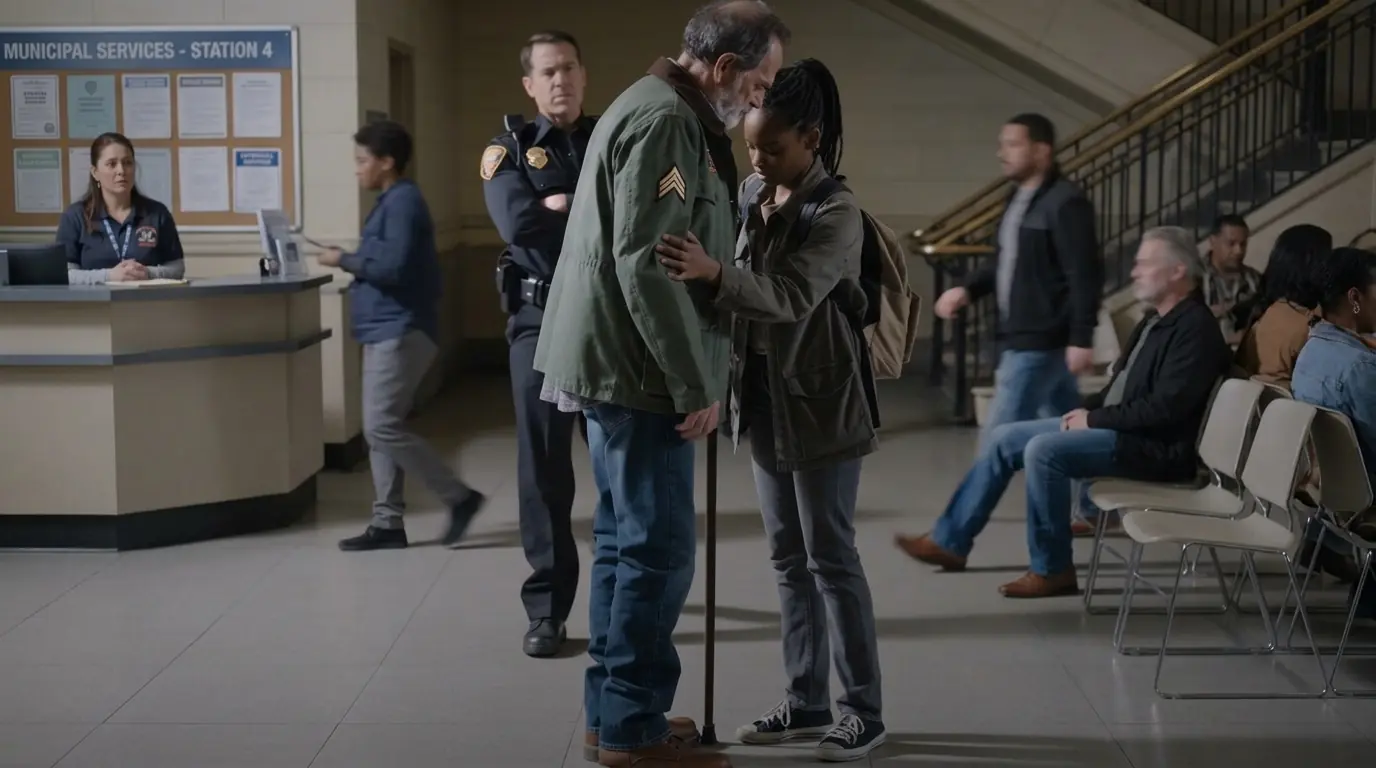
“Excuse me, sorry,” she murmured as she slipped past a man in a suit who barely looked at her. His briefcase knocked into her hip without acknowledgment.
She didn’t flinch. She was used to it by now. The city didn’t make room for girls like her, not girls who carried the exhaustion of survival in their eyes. But today was supposed to be different.
This interview at Monroe and West was the only callback she had gotten in weeks. Her stomach was tight with nerves and hunger, her mother’s weak cough from that morning echoing in the back of her mind. Naomi needed this job. Needed it like air.
As she approached the west concourse stairs, a sudden halt in her stride sent a ripple through the pace of her thoughts.
There he was.
An old white man, thin, clearly disoriented, stood alone at the top of the descending stairs, squinting, lips moving wordlessly. His cane was tucked beneath one arm untouched. His hands hovered uncertainly in the air, like they were searching for balance that wasn’t there.
People brushed past him one after another, not a single glance in his direction.
Naomi froze.
Her eyes darted to the time again.
Eight minutes.
She could still make it if she kept going. Someone else would help. Someone had to.
But her feet wouldn’t move.
The man’s shoulders sagged, a kind of defeated confusion etched into the creases of his skin, as if the world had shrunk him over the years into someone nobody saw anymore.
“Sir, do you need help?” she called, raising her voice over the rumble of luggage wheels and announcements.
He turned toward her voice, relief flashing across his cloudy eyes.
“I… I can’t quite make out the steps. Everything’s gotten foggy lately.”
His voice was thin, almost embarrassed.
Naomi stepped beside him, offering her arm.
“Let’s take it slow. I’ve got you.”
His bony fingers clung to her forearm, and together they began the descent.
Step by step, he moved with the uncertainty of someone not just unsteady, but invisible.
People behind them began muttering. A woman in heels sighed dramatically. A young man pushed past, bumping Naomi’s shoulder hard.
“Move it already,” he snapped.
Naomi’s jaw tightened, but she said nothing.
“One step,” she told the man gently. “Now another.”
They were halfway down when a sharp voice cut through the crowd.
“Is there a problem here?”
Naomi looked up.
A security guard stood at the base of the stairs, white, tall, bulky in his navy uniform, arms crossed, eyes pinned on her like a sniper scope.
She stiffened instinctively.
“No problem,” Naomi said calmly, steadying the old man. “He just needed some help.”
The guard’s gaze didn’t move from her.
“And who are you? You work here?”
Naomi blinked.
“No. I’m just helping.”
“Yeah,” the guard muttered, stepping closer. “Sure you are.”
He turned to the old man.
“You okay, sir?”
The man nodded.
“This young lady’s been helping me. She’s been very kind.”
But the guard didn’t soften. His eyes stayed locked on Naomi.
She knew that look. She had seen it in stores, on sidewalks, at front desks where the person behind the counter suddenly needed to double-check her ID. That quiet message: you don’t belong here.
Naomi’s chest rose and fell slowly.
“We’re almost done,” she said.
The guard didn’t move, but he didn’t stop them either.
She felt the burn of his suspicion follow her down every step.
When they reached the bottom, the old man let out a shaky breath and patted her hand.
“Thank you, young lady. You’re the first person who even saw me.”
Naomi forced a smile.
“You’re welcome.”
Then she glanced at the station clock.
Too late.
The smile faded.
Naomi ran.
She burst through the station doors into the freezing street, feet pounding concrete, backpack bouncing against her spine. Traffic roared, horns blared, but all she heard was her own heartbeat and her mother’s voice from that morning.
You got this, baby. Today’s your day.
It wasn’t.
By the time she reached the Monroe and West building, her lungs burned. She rushed through the revolving doors, breathless and sweating.
“I’m Naomi Ellis,” she said at the front desk. “I had an interview at ten.”
The receptionist glanced at the clock.
10:14.
“I’m sorry. Interviews ended at ten sharp.”
Naomi gripped the counter.
“I was helping an elderly man. He was alone, almost fell.”
The woman finally looked up, but not with compassion.
“With respect,” she said coolly, “policy is policy.”
“Can I reschedule?”
“You can call next week. If there’s anything open.”
Naomi nodded once.
There was nothing else to say.
She walked back outside into the cold and leaned against a lamppost, eyes closed.
She had given up her shot for a stranger.
But then she remembered his trembling hand on her arm. The way he whispered thank you like it meant everything.
No.
She had not made the wrong choice.
Right just didn’t always come easy.
She returned to Union Station with nowhere else to go.
And there he was again.
The old man sat on a bench near the platform windows, coat wrapped around his thin frame, struggling to open a bottle of water.
Naomi almost kept walking.
Instead, she sat beside him.
“Mr. Holt?”
He looked up and smiled.
“Naomi. I hoped I might see you again.”
“I missed the interview,” she admitted.
His smile faded.
“I’m sorry.”
“It’s not your fault.”
He studied her.
“Most people would be bitter.”
Naomi looked ahead at the moving crowd.
“Being decent shouldn’t come with conditions.”
For a moment he said nothing.
Then he reached into his coat and handed her a small business card.
“If you ever need a character reference,” he said, “or someone to speak for the kind of person you are, I’d be honored.”
The card simply read:
Bernard Holt
A phone number.
No company. No title.
“You’re the kind of person people remember, Naomi,” he said softly. “The kind that makes a place better just by stopping long enough to care.”
The next morning, a black sedan pulled up outside Naomi’s apartment building.
A sharply dressed driver stepped out holding an envelope.
“Ms. Ellis?”
She nodded cautiously.
“Mr. Bernard Holt asked me to deliver this personally.”
Inside was a handwritten letter.
Dear Naomi,
You may not realize the impact you had on me. Most walk past people like me without a second glance, but you saw me.
You reminded me that kindness without expectation still exists.
I would like to offer you an internship at Elm & Brook Group. As founder emeritus, I rarely exercise the influence I still hold. But in your case, I feel compelled to.
You deserve a chance to be seen for your worth, not just your struggle.
The driver will return tomorrow at 10:00 a.m. should you choose to accept.
With respect,
Bernard Holt
Naomi stared at the page.
Elm & Brook Group.
One of the most powerful firms in the city.
She pressed the letter to her chest and cried quietly in the kitchen while her mother coughed softly in the next room.
The next day she rode in the sedan to a glass tower that once felt untouchable.
This time, the receptionist smiled.
“Welcome, Naomi.”
She met Clara Reyes, director of programs, who showed her to a small office with a desk, computer, and a view of the skyline.
“This is yours,” Clara said.
Naomi touched the desk just to make sure it was real.
Days passed.
She learned systems, studied reports, worked late, asked questions, and made mistakes. But nobody sneered. Nobody rolled their eyes. Clara corrected her patiently.
When one executive sneered about “diversity initiatives,” Bernard Holt shut him down in front of the room.
“She is not here because of a quota,” Holt said evenly. “She is here because when no one else stopped, she did. While some of you measure value in revenue columns, I still believe character is the best long-term investment.”
Naomi felt something inside her change.
Not gratitude.
Belief.
A week later Holt called her into his office.
On the desk sat a folder.
“A full-time junior associate position,” he said. “Benefits. Competitive pay. Effective immediately.”
Naomi stared at him.
“I’ve only been here six days.”
“And I’ve seen more integrity and resilience from you in six days,” he replied, “than I’ve seen from some people in six years.”
That night Naomi sat beside her mother on the bed, the offer letter open between them.
Her mother ran trembling fingers over the paper.
“This is more than a job,” she whispered.
Naomi nodded through tears.
“It’s a beginning.”
Her mother smiled.
“You didn’t wait for a door to open. You held one open for someone else first. And somehow it opened back for you.”
Months later, Naomi stood in a company-wide meeting as Bernard Holt addressed the room.
“Many of you walked past me at Union Station,” he said. “That day I was just an old man near the stairs. No title. No power. No importance.”
He turned toward Naomi.
“One person stopped.”
The room followed his gaze.
“She offered help when it cost her the most. She asked for nothing in return. That woman now works here—not because she was handed anything, but because character opens doors long before credentials ever do.”
The room erupted in applause.
Naomi stood frozen, tears filling her eyes.
That evening she returned home, held up her badge, and showed her mother.
Her mother smiled through tears.
“You didn’t just get in, Naomi.”
She squeezed her daughter’s hand.
“You changed the room.”