At twenty-seven years old, Clara Bennett owned the smallest bakery on Willow Street.
It sat between a laundromat with flickering lights and an old barber shop where the owner still swept the sidewalk every morning in a white apron. The bakery’s sign was hand-painted in blue letters that read Bennett’s Bread & Butter, though one corner of the sign had begun to peel after too many rainy seasons.
Inside, the shop always smelled like warm bread, cinnamon, butter, and coffee. There were only four little tables near the front window, a glass case filled with pastries, and a wooden counter Clara had sanded and stained herself after buying it secondhand from a closing café.
To most people in Fairmont, Ohio, the bakery was a sweet little place.
To Clara, it was her mother’s last dream.
Her mother, Evelyn Bennett, had spent most of her life baking for other people. She baked birthday cakes for neighbors who could not afford store-bought ones. She baked dinner rolls for church fundraisers. She baked apple pies for grieving families and cinnamon bread for children who came home crying after bad days at school.
“When people are hungry,” Evelyn used to say, “feed them first. Then ask what happened.”
Clara had grown up believing that bread could do more than fill a stomach. It could soften anger. It could start conversations. It could make a lonely kitchen feel like home again.
But dreams were expensive.
After Evelyn died from cancer, Clara used every dollar of her inheritance, every bit of savings, and a small business loan to open the bakery. She painted the walls herself. She bought used ovens. She learned accounting from free videos online and slept in the back room for the first month because she could not afford rent and repairs at the same time.
For three years, she fought to keep the bakery alive.
Some months were good. Some months were terrifying.
That winter, terrifying had become normal.
The cost of flour had gone up. The heating bill had nearly doubled. A new chain café had opened two blocks away with polished floors, bright screens, and coffee cups printed with perfect little leaves.
Clara could not compete with perfect.
Her bakery was warm but worn. Honest but fragile.
And by February, fragile was beginning to crack.
On a gray Thursday afternoon, Clara stood behind the counter, counting the cash drawer for the third time, hoping the numbers would change if she stared long enough.
They did not.
She had made only eighty-six dollars that day.
Rent was due in nine days.
Her loan payment was due in twelve.
The landlord had already warned her that he had another tenant interested in the space.
A boutique dog treat store.
Clara tried not to hate the idea, but some days she imagined her mother’s bakery replaced by overpriced biscuits shaped like bones, and something inside her chest folded in on itself.
The bell above the door jingled.
Clara quickly closed the register and looked up with her practiced smile.
“Hi, welcome in.”
A woman in a long beige coat stepped inside, shook snow from her umbrella, and ordered two croissants and a latte. Clara warmed the croissants, made the drink, and wished her a good afternoon.
After the woman left, the bakery was quiet again.
Outside, snow drifted gently past the front window. Willow Street moved slowly under the cold: cars rolling by, pedestrians tucked into scarves, a delivery truck idling near the curb.
Clara leaned against the counter and rubbed her tired eyes.
She had been awake since four that morning.
The first batch of sourdough had burned because the old oven ran hotter on the left side. A supplier had called asking about an overdue invoice. The espresso machine had leaked again. And her younger brother, Miles, had texted from college asking if she could help with books for the semester.
She had typed, “Of course.”
Then she had stared at her bank account until her stomach hurt.
The bell above the door jingled again.
This time, no one came to the counter.
Clara looked up.
A boy stood just inside the doorway.
He was small, maybe eight or nine years old, with brown skin, wide dark eyes, and a winter jacket too thin for the weather. His sneakers were wet from the snow, and one of the laces dragged loose across the floor. He held himself very still, as if afraid that moving too much would make someone notice him.
Clara softened her voice.
“Hi there.”
The boy did not answer.
His eyes moved to the glass case.
Inside were blueberry muffins, butter rolls, cinnamon knots, and two loaves of honey wheat bread cooling on a rack.
Clara came around the counter slowly.
“Are you looking for someone?”
The boy shook his head.
“Are you lost?”
Another shake.
His gaze flicked toward the door, then back to the bread.
Clara understood hunger when she saw it.
She had seen it in customers pretending to buy coffee while counting coins. She had seen it in college students asking if yesterday’s pastries were discounted. She had seen it in her own reflection during the months after her mother’s hospital bills swallowed everything.
“What’s your name?” she asked gently.
The boy hesitated.
“Eli,” he whispered.
“Hi, Eli. I’m Clara.”
He looked at her face, searching for something.
Maybe danger.
Maybe judgment.
Maybe the moment she would ask him to leave.
Instead, Clara smiled.
“Would you like something warm?”
His lips parted, but no sound came out.
Clara walked behind the counter and picked up one of the butter rolls. It was still soft, its top shining faintly from the brush of melted butter.
She placed it in a paper bag.
Then she added a cinnamon knot.
Then a small carton of milk from the little refrigerator beneath the counter.
Eli watched every movement.
Clara carried the bag to him.
“Here,” she said. “No charge.”
He stepped back immediately.
“I don’t have money.”
“I know.”
“I can’t pay.”
“I know that too.”
His small hands curled into fists at his sides. “I didn’t steal anything.”
“I didn’t say you did.”
“I was just looking.”
“I believe you.”
That seemed to confuse him more than anger would have.
Clara held out the bag.
“My mom used to say food tastes better when it’s shared before someone has to ask twice.”
Eli stared at the bag for a long moment.
Then, slowly, he reached for it.
His fingers were cold when they brushed hers.
“Thank you,” he whispered.
“You can sit by the window if you want.”
“I should go.”
“It’s snowing pretty hard.”
He glanced outside.
For one second, Clara saw the child in him give way to something older. Something careful and worried.
“Someone waiting for you?” she asked.
He nodded too quickly.
“My aunt.”
“Okay. Does she know you’re here?”
He did not answer.
Clara did not push.
“Sit for five minutes,” she said. “Warm up a little. Then you can go.”
Eli looked at the door again.
Then he walked to the smallest table by the window and sat down.
He opened the paper bag carefully, as if afraid the food might disappear if he moved too fast. Then hunger took over. He ate the butter roll in quick bites, trying to stay polite but unable to hide how badly he needed it.
Clara turned away so he would not feel watched.
She wiped a clean counter that was already clean.
Behind her, she heard the soft crinkle of paper, the small swallow of milk, the pause before he started on the cinnamon knot.
A few minutes later, the door opened again.
A man in a dark coat entered, took one look at Eli, and frowned.
“Hey,” he said sharply. “You bothering this lady?”
Eli froze.
Clara looked at the man. He was probably in his thirties, with tired eyes and a delivery badge clipped to his jacket.
“No,” Clara said. “He’s fine.”
The man’s frown deepened. “You know him?”
“He’s my customer.”
Eli looked up quickly.
The word landed like a blanket around him.
Customer.
Not beggar.
Not trouble.
Not a kid to be chased away.
The man hesitated, embarrassed now. “Oh. Sorry.”
He ordered coffee and left without another word.
Eli kept staring at Clara.
She pretended not to notice.
When he finished eating, he folded the paper bag neatly and stood.
“Thank you,” he said again.
“You’re welcome.”
He took two steps toward the door, then stopped.
“My aunt lost her job,” he said without turning around.
Clara remained still.
“She says we’re okay, but we’re not.”
His voice was quiet and flat, the way children speak when they have learned adults break if you tell them too much.
Clara’s chest tightened.
“Is your aunt home?”
“She’s at the motel.”
“What motel?”
He shook his head. “I’m not supposed to say.”
“That’s okay.”
“I came because I saw the bread in the window yesterday.”
Clara looked at the display she had arranged that morning with care, trying to make the shop look fuller than it was.
“I’m glad you came in.”
Eli finally turned.
“You won’t call anyone?”
“Are you in danger?”
He looked confused.
“No.”
“Are you safe with your aunt?”
“Yes,” he said quickly. “She’s good. She just cries when she thinks I’m asleep.”
Clara swallowed.
“I won’t call anyone today,” she said carefully. “But if you ever feel unsafe, you can come here. I’ll help.”
Eli nodded.
Then he opened the door and stepped back into the snow.
Clara watched him through the window until he disappeared around the corner.
For the rest of the day, she could not stop thinking about him.
At closing time, she packed the unsold bread into bags. Usually, she donated leftovers to the church pantry on Fridays, but that night she set aside two loaves, three rolls, and a container of soup she had brought for lunch and never eaten.
Then she hesitated.
She did not know which motel.
Fairmont had four.
One by the highway. One near the old train station. One behind the gas station. One on the south end, where weekly rates were cheap and the curtains always looked closed.
Clara stood in the back room holding the bag of bread and felt foolish.
What was she going to do? Wander through motels asking for a hungry little boy?
Then the bell above the front door jingled.
She turned off the back light and stepped out.
Eli stood there again.
This time, he was breathing hard, like he had run.
Clara hurried toward him. “Eli?”
“I’m sorry,” he said quickly. “I know you’re closed.”
“It’s okay. What happened?”
“My aunt won’t eat.”
Clara’s heart dropped.
“What do you mean?”
“She says she’s not hungry, but she gave me the last crackers this morning. And she’s sick. She keeps coughing.”
Clara grabbed her coat.
“Take me to her.”
Eli’s eyes widened. “You don’t have to.”
“Yes, I do.”
“I can carry the food.”
“I’m coming with you.”
He looked scared.
Clara knelt so they were eye level.
“Eli, I’m not going to get your aunt in trouble. I just want to make sure she’s okay.”
He stared at her.
Then he nodded.
Clara locked the bakery, pulled on her gloves, and followed him into the snow.
They walked four blocks east, then two blocks south, until they reached the old Starlight Motel near the train station. Its neon sign buzzed weakly, only half-lit, so it read Star ight against the darkening sky.
Eli led her to room 12.
He knocked softly.
“Aunt Tessa?”
A woman’s voice answered from inside, weak and startled.
“Eli? Where were you?”
Eli opened the door with a key card and stepped in.
Clara followed slowly, careful not to seem like she was invading.
The room was small, dim, and cold. Two beds. One chair. A microwave on a wobbly table. A few plastic bags of clothes stacked near the wall.
On the bed closest to the heater sat a young Black woman in her early thirties, wrapped in a blanket, her face pale with exhaustion. She had beautiful features, but worry had sharpened them. Her hair was pulled back in a scarf, and her eyes widened when she saw Clara.
“Who are you?” she asked, sitting up too fast and coughing.
Clara held up the bag.
“My name is Clara Bennett. I own the bakery on Willow Street. Eli came in earlier.”
Tessa looked at Eli.
Her expression shifted from fear to shame.
“Eli,” she whispered. “You said you were going to the vending machine.”
“I was hungry,” he said.
Pain crossed her face.
Clara set the bag on the table.
“He didn’t do anything wrong.”
Tessa’s eyes flashed defensively. “I didn’t say he did.”
“I know. I just wanted you to know he was polite. And brave.”
That word made Eli look down at his shoes.
Tessa pressed a hand to her chest and coughed again.
Clara looked at the unplugged heater near the wall.
“Is the heater broken?”
Tessa gave a tired laugh. “It works when it feels generous.”
“Have you eaten today?”
“I’m fine.”
Eli looked at Clara.
Clara understood that answer too.
She took out the soup container and walked to the microwave.
“May I?”
Tessa opened her mouth, maybe to refuse, but another cough stopped her.
Clara warmed the soup, sliced bread with a plastic knife from the motel’s coffee tray, and poured water into two paper cups. She moved calmly, not like a savior, not like a stranger judging the room, but like someone who had been in enough hard places to know dignity mattered as much as dinner.
When she handed Tessa the soup, the woman stared at it for several seconds.
Then she whispered, “I can’t pay you.”
Clara sat on the edge of the other bed.
“I didn’t bring a bill.”
Tessa’s eyes filled suddenly, and she looked away.
“I’m not usually like this.”
“You don’t have to explain.”
“Yes, I do.” Tessa’s voice cracked. “Because people see a room like this, and they think they know the whole story.”
Clara said nothing.
Tessa took a shaky breath.
“My sister died last year. Eli’s mom. I became his guardian. I had a job at a nursing home, full-time. Then the facility closed. I found work at a warehouse, but I got bronchitis and missed too many days. We lost the apartment two weeks ago.”
Eli sat beside her, small and silent.
Tessa touched his hair gently.
“I keep telling him it’s temporary.”
Clara’s throat tightened.
“Maybe it still can be.”
Tessa laughed without humor. “You know anyone hiring a woman with no car, a bad cough, and a kid she refuses to give up?”
Clara thought of her own bakery. Empty tables. Weak register. Overdue invoices.
She could barely pay herself.
But she also thought of the mornings she baked alone, carrying trays too heavy for one person. The lunch rushes she missed because she had no help. The way customers loved kindness almost as much as croissants.
“I might,” Clara said.
Tessa looked at her.
Clara surprised herself by continuing.
“I need help at the bakery. Not full-time yet. I can’t afford that. But mornings. Prep work. Counter help. Maybe twenty hours a week to start.”
Tessa stared as if Clara had spoken another language.
“You don’t know me.”
“No.”
“I could be terrible at it.”
“Are you?”
“No,” Tessa said automatically.
Clara smiled. “Then we can start there.”
Tessa looked down at the soup.
“I don’t want charity.”
“Good. I need help. You need work. That’s not charity.”
Eli looked between them, hope rising carefully in his eyes like he was afraid to let it stand too tall.
Tessa’s voice softened.
“I know how to cook. Not fancy baking, but I learn fast.”
“Can you come tomorrow at six?”
“In the morning?”
“Bread doesn’t wait.”
For the first time, Tessa smiled.
It was small, tired, and beautiful.
“I can come.”
Clara glanced at Eli.
“Can he stay in the back room before school? I have a little office. It’s warm.”
Tessa covered her mouth with one hand.
“No one has to know your business,” Clara added. “He can do homework. Or sleep.”
Eli whispered, “I can sweep.”
Clara smiled at him. “We’ll discuss your salary.”
He almost laughed.
Almost.
The next morning, Tessa arrived at 5:52.
She wore black jeans, a clean sweater, and the same tired coat. Eli came with her, carrying a backpack nearly as big as he was. Clara had already set a chair in the back room beside the space heater, along with a mug of hot chocolate and a leftover muffin.
Eli looked at the muffin, then at Clara.
“For me?”
“For the assistant manager.”
He sat up straighter.
Tessa tied on an apron.
“You sure about this?” she asked.
“No,” Clara said honestly. “But most good things start that way.”
They began.
At first, Tessa was quiet and careful. She watched Clara measure flour, fold dough, brush egg wash over pastries, and arrange trays. She listened closely, asked smart questions, and apologized too often for mistakes that were not mistakes.
By nine o’clock, she had learned the register.
By ten, she had charmed Mrs. Alvarez, who came in every Friday for rye bread and complaints about her knees.
By eleven, she had sold six extra cinnamon knots simply by describing them as “soft enough to make you forgive somebody.”
Clara laughed so hard she nearly dropped a tray.
Customers noticed Tessa immediately.
She had warmth without performance. She remembered names. She called elderly customers “sir” and “ma’am” in a way that sounded respectful, not forced. She gave children napkins before they spilled anything, which made parents love her.
Eli stayed in the back until school, then returned at three and did his homework at the corner table. Sometimes Clara gave him small jobs: folding pastry boxes, wiping menus, filling sugar jars. He took each task seriously.
Within a week, the bakery felt different.
Not saved.
But alive.
Clara had someone to talk to during the long mornings. Tessa had work and hot coffee. Eli had a safe place to wait.
Still, money remained tight.
Very tight.
On the last Friday of February, Clara received a final notice from the landlord.
Thirty days.
Pay the overdue rent or vacate.
She read the letter in the back room while Tessa restocked napkins at the counter.
The words blurred.
Thirty days.
She had fought so hard.
She had given everything.
And still, the bakery might be taken from her.
Clara folded the letter and pressed it against her chest.
For a moment, she let herself feel the full weight of it.
Then Eli appeared in the doorway.
“Miss Clara?”
She quickly wiped her eyes. “Hey, buddy.”
“You okay?”
“Yes.”
He studied her.
Children who had seen too much could always recognize adult lies.
“You look like Aunt Tessa when she reads bills.”
Clara gave a shaky laugh.
“That bad?”
He nodded seriously.
Tessa came into the back room and saw Clara’s face.
“What happened?”
Clara handed her the letter.
Tessa read it silently.
Her jaw tightened.
“How much?”
“Too much.”
“How much, Clara?”
Clara told her.
Tessa sat down slowly.
“That landlord’s been waiting for you to fall behind.”
“I know.”
“What are you going to do?”
“I don’t know.”
The three of them sat in the back room, surrounded by flour sacks, cooling racks, and the warm smell of bread.
Then Eli said, “Can we sell more?”
Clara smiled sadly. “That’s the idea.”
“No, I mean more more. Like at school.”
Tessa looked at him. “What do you mean?”
“Everyone likes the cinnamon knots. What if kids could order them? Or teachers?”
Clara opened her mouth, then stopped.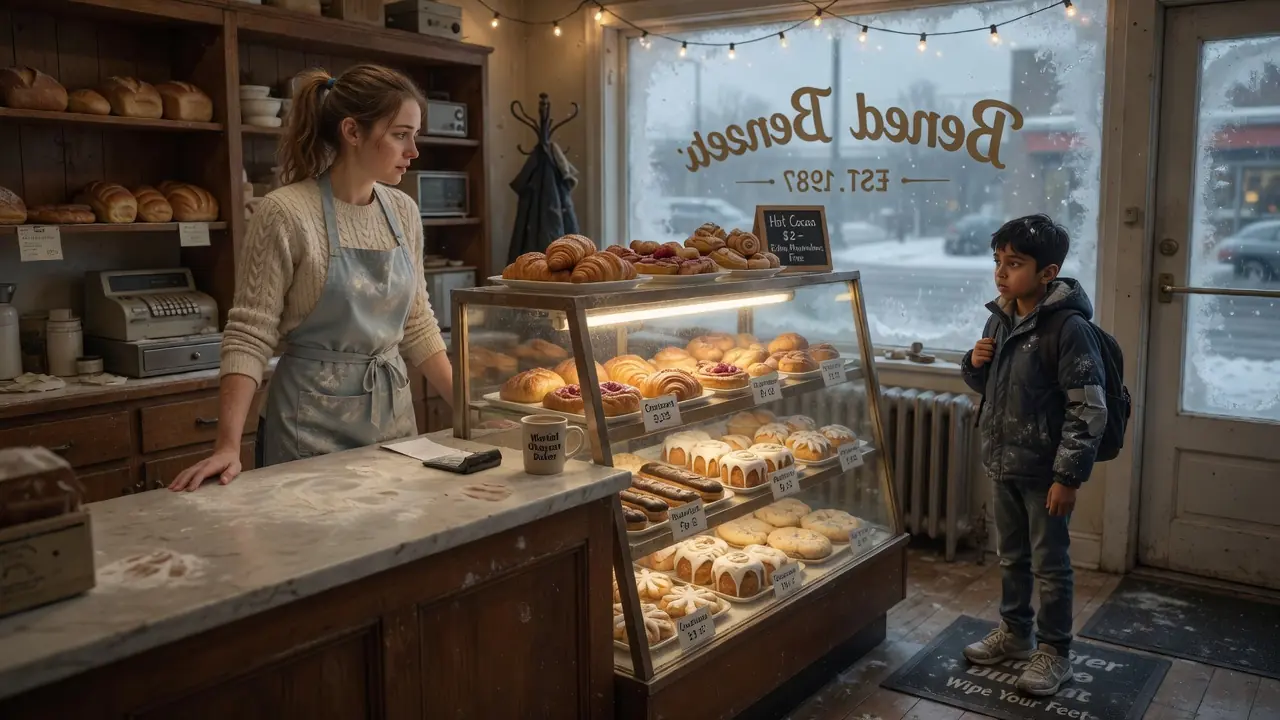
Tessa leaned forward.
“My cousin works at the elementary school cafeteria,” she said. “They sometimes buy from local vendors for staff meetings.”
Clara shook her head. “I don’t have commercial packaging.”
“But you could.”
“With what money?”
Tessa looked at the shelves. “Paper bags. Stickers. Twine. Make them look handmade on purpose.”
Eli nodded eagerly. “And we can call them Snow Day Knots.”
Clara looked at him.
“That’s actually good.”
“I know,” Eli said.
For the first time in days, Clara felt a spark.
Not a solution yet.
But a spark.
That night, they made a plan.
Tessa designed a simple order sheet on Clara’s old laptop. Eli drew a tiny cinnamon knot wearing a scarf. Clara created a discounted box of six pastries for teachers, office workers, and families.
They posted a handwritten sign in the window:
SNOW DAY KNOTS — BOX OF 6 — MADE FRESH EVERY MORNING
Tessa took a photo and shared it with every parent, cousin, former coworker, and neighbor in her phone.
Clara posted online.
Eli brought a flyer to school.
The next morning, they had seven orders.
By Monday, twenty-three.
By Wednesday, the elementary school asked for twelve boxes for a teacher training day.
By Friday, the nursing home across town ordered pastries for its weekend staff.
Clara worked until her hands cramped.
Tessa came early and stayed late.
Eli became unofficial box inspector, rejecting any pastry that looked “too squished to be proud.”
For the first time in months, the register filled.
Customers who had forgotten the bakery existed returned. Some came because of the pastries. Some came because they heard Clara had helped a boy and his aunt. Some came because Tessa greeted them like the world had not hardened her.
But even with the sudden rush, the deadline loomed.
Clara calculated every dollar.
They were still short.
Not by a lot.
But enough.
On the twenty-ninth day, Clara stood alone in the bakery after closing, looking at the rent envelope.
She had most of it.
Not all.
The landlord would not care about almost.
Tessa and Eli had already gone back to the motel. They had managed to pay another week there, and Tessa’s cough had improved, but they were still far from stable.
Clara did not tell them she was short.
They had carried enough.
She turned off the lights and sat at the front table, the same table where Eli had eaten his first butter roll.
Her mother’s framed photo hung on the wall behind the counter. Evelyn Bennett smiled from the picture, flour on her cheek, eyes bright with the kind of hope Clara had been trying to keep alive.
“I’m sorry,” Clara whispered.
The bakery did not answer.
The next morning, Clara arrived early, expecting dread.
Instead, she found a crowd outside.
At first, she thought something had happened.
Then she saw Tessa standing near the door, holding a clipboard. Eli stood beside her, bouncing on his heels with excitement.
“What is this?” Clara asked.
Tessa smiled nervously.
“Don’t be mad.”
“That sentence never ends well.”
Eli ran to her and grabbed her hand.
“We did a thing.”
Clara looked at the crowd.
Mrs. Alvarez was there. So was the barber from next door. The elementary school principal. Two nurses from the nursing home. Luis from the grocery store. A group of teachers. A police officer Clara recognized. Even the woman in the beige coat who bought croissants sometimes.
Tessa handed Clara the clipboard.
At the top, written in neat letters, were the words:
SAVE BENNETT’S BREAD & BUTTER — COMMUNITY PRE-ORDER DAY
Clara stared.
Tessa spoke quickly.
“We didn’t ask for donations. I knew you’d hate that. So we organized pre-orders. Bread subscriptions. Pastry boxes. Coffee cards. Birthday cake deposits. People are buying ahead.”
Clara’s mouth opened, but no words came out.
Eli beamed.
“And I made the scarf bread logo.”
Tessa pointed to a cardboard box on the table.
Inside were envelopes.
“Enough to cover what you’re short,” she said softly. “And a little extra for packaging.”
Clara looked from the box to the people waiting in the cold.
Her eyes filled.
“Tessa…”
The older woman shook her head.
“No. You don’t get to save everybody and then act surprised when people want to save you back.”
Clara pressed a hand over her mouth.
The barber raised his coffee cup.
“Open the door, Clara. Some of us are freezing for muffins.”
Everyone laughed.
Clara unlocked the bakery.
The bell above the door jingled again and again as people stepped inside.
For the next six hours, Bennett’s Bread & Butter was fuller than it had ever been.
People bought bread, ordered cakes, signed up for weekly pastry boxes, and told Clara stories she had never heard before.
“My wife loved your mother’s rolls.”
“You gave my daughter free cookies after her surgery.”
“You let me sit here once when my car wouldn’t start.”
“You always put extra bread in the pantry box.”
“You remember my grandson’s peanut allergy.”
“You make this street feel alive.”
Clara had thought the bakery was failing quietly because no one cared.
She had been wrong.
People cared.
They had simply not known she needed them.
By the end of the day, Clara had enough to pay the overdue rent.
Not just enough.
More than enough.
When she finally closed the door, she leaned against it and cried.
Tessa hugged her.
Eli wrapped his arms around both of them.
For a few minutes, they stood there behind the glass door, surrounded by empty pastry trays and the smell of sugar, butter, and survival.
“You saved it,” Clara whispered.
Tessa pulled back.
“No. You fed my boy when you had every reason to protect what little you had. That saved us first.”
Clara looked at Eli.
He smiled shyly.
“I was really hungry,” he said.
Clara laughed through tears. “I noticed.”
Spring came slowly to Fairmont.
The snow melted from Willow Street. The trees along the sidewalk grew small green buds. The chain café two blocks away continued selling perfect drinks in perfect cups, but Bennett’s Bread & Butter no longer felt overshadowed.
It felt rooted.
With the pre-order money, Clara bought better packaging and repaired the espresso machine. Tessa became a permanent employee, then assistant manager. She found a small apartment three streets away with help from a local housing program one of the bakery customers recommended.
Eli got his own room.
It was tiny, but he taped his scarf bread drawing above the bed and told Clara it was “good for business branding.”
Every morning before school, he ate breakfast at the bakery. Not because he had to anymore, but because he liked sitting near the ovens while Clara and Tessa worked.
By summer, the bakery launched a small community shelf.
No sign of pity.
No big announcement.
Just a wooden basket near the door with wrapped rolls, sandwiches, and fruit.
A handwritten note above it read:
If You’re Hungry, Take What You Need. If You Can Help, Leave What You Can.
People used it.
People filled it.
Nobody made a spectacle of it.
That was Clara’s rule.
One afternoon in July, a man in a suit came into the bakery and asked for Clara.
She wiped her hands on her apron and stepped forward.
“That’s me.”
He introduced himself as Marcus Hall, director of community partnerships for the city.
“We’ve heard a lot about this place,” he said.
Clara glanced at Tessa, who raised her eyebrows.
“Good things, I hope.”
“Very good things.”
He ordered coffee and sat by the window. Then he explained that the city was launching a small business revitalization program for local shops that served community needs. They wanted businesses that were not only profitable, but meaningful to their neighborhoods.
A bakery with a community shelf, local school orders, senior deliveries, and strong public support was exactly the kind of place they wanted to highlight.
Clara listened, stunned.
The program included a grant.
A real grant.
Enough to upgrade the ovens, repaint the storefront, and build a proper seating area.
When Marcus left, Clara locked the door and turned to Tessa.
“Did that just happen?”
Tessa grinned.
“I think your mother’s bakery just got adopted by the whole town.”
The grant changed everything.
By autumn, Bennett’s Bread & Butter had a fresh blue sign, repaired floors, six more tables, and a bright mural on the side wall painted by students from Eli’s school. The mural showed hands passing bread from one person to another under the words:
Feed First. Ask Later.
Clara cried when she saw it.
Eli pretended he had dust in his eyes.
The bakery became a place where people came not only to buy food, but to belong for a while.
Older people came in the mornings to drink coffee and argue gently about baseball.
Students came after school for muffins and homework help.
Parents ordered birthday cakes.
Workers picked up sandwiches.
Some people paid extra and said, “For the basket.”
Others quietly took from it and returned months later with coins, fruit, or notes of thanks.
Clara kept every note in a box beneath the counter.
One said:
You fed me during the worst week of my life. I got the job. Thank you.
Another said:
My kids thought the rolls were a gift from an angel. I told them angels sometimes wear aprons.
Another, written in Eli’s careful handwriting, said:
Thank you for making me a customer when I felt like a problem.
That one Clara kept in her wallet.
Two years passed.
Then three.
Eli grew taller. His voice changed. He still helped after school, though now he claimed he was too old for hot chocolate while drinking it whenever Clara made some.
Tessa eventually became co-owner.
Clara insisted.
Tessa resisted.
Clara won by printing the new business cards without asking.
Bennett’s Bread & Butter
Clara Bennett & Tessa Moore, Owners
Tessa stared at the card for a full minute, then cried into a dish towel and threatened to quit if Clara ever made her emotional in public again.
The bakery flourished.
But the greatest return Clara received was not the money.
It was not the grant.
It was not the repaired ovens, the new sign, or even the security of finally sleeping without calculating debt in the dark.
It was the family that formed around her.
Tessa became her closest friend, then something like a sister.
Eli became the nephew she never expected.
Miles graduated college and came home to help with the bakery’s books, claiming Clara’s accounting system looked like “a crime scene with receipts.”
Even the town seemed to soften around the shop.
People checked on each other more. Businesses shared leftovers. The barber next door kept spare gloves near his entrance in winter. The laundromat owner started a pay-it-forward washing fund. The school partnered with the bakery for breakfast boxes during exam weeks.
Kindness, Clara learned, could spread like yeast.
Quietly.
Slowly.
Then all at once.
On the fifth anniversary of the day Eli first walked into the bakery, Tessa planned a surprise.
Clara hated surprises, which everyone knew, so naturally the entire town participated.
That morning, Clara arrived to find the bakery dark.
She panicked for half a second, thinking the power had gone out.
Then the lights snapped on.
“Surprise!”
Clara jumped backward so hard she nearly dropped her keys.
The bakery was packed with people.
Tessa stood behind the counter, laughing. Eli, now fourteen and almost taller than Clara, held a cake shaped like a loaf of bread. Miles filmed everything on his phone.
“What is happening?” Clara demanded, one hand over her heart.
Tessa stepped forward.
“Five years ago today, Eli came into this bakery hungry.”
The room quieted.
Eli looked embarrassed but proud.
“And you gave him bread,” Tessa continued. “You gave him a place to sit. Then you gave me a job when you were barely holding your own life together.”
Clara’s eyes already burned.
“Tessa, don’t.”
“Oh, I’m absolutely going to.”
Everyone laughed softly.
Tessa took an envelope from the counter.
“Over the past month, people have been writing letters. Not donations. Not orders. Just letters. Stories about what this bakery meant to them.”
She handed Clara a thick box tied with blue ribbon.
Clara took it with trembling hands.
“There are over three hundred,” Tessa said.
Clara looked around the room.
Mrs. Alvarez wiped her eyes. The barber nodded. Teachers smiled. Nurses stood near the window. Former customers she had not seen in years had come back.
Eli stepped forward.
“I wrote one too.”
Clara tried to laugh. “Of course you did.”
He pulled a folded page from his pocket.
“Can I read it?”
The room went still.
Clara nodded.
Eli unfolded the paper.
His voice was deeper now, but Clara could still hear the small hungry boy in it.
“When I was nine, I thought adults only helped if they had extra. Extra money. Extra time. Extra food. Extra room in their lives. Then I met Miss Clara. She didn’t have extra. I know that now. She was scared too. But she still gave me bread. She still called me a customer. She still made me feel like I belonged somewhere.”
Clara covered her mouth.
Eli kept reading.
“My aunt says that day changed everything for us. I think it changed me because I learned that being poor can make you feel invisible, but one kind person can make you feel real again. I want to be that kind of person when I grow up. Maybe a social worker. Maybe a teacher. Maybe a baker if Clara ever admits I’m better at frosting than her.”
Everyone laughed.
Clara cried harder.
Eli looked up from the page.
“Thank you for feeding me first and asking later.”
The room erupted in applause.
Clara pulled him into a hug before he could escape.
“You are not better at frosting,” she whispered.
“Yes, I am,” he whispered back.
Tessa joined the hug.
Then Miles.
Then somehow half the bakery seemed to fold into one laughing, crying mess of arms and aprons and warmth.
Later, after the party, after the cake was cut and the last customer left, Clara sat alone by the front window with the box of letters.
Outside, Willow Street glowed under evening lights.
The bakery was quiet.
Not empty.
Quiet.
There was a difference.
She opened one letter after another.
Stories poured out.
A widower who came every morning because the bakery was the only place someone said his name.
A teenager who studied there because home was too loud.
A nurse who bought rolls after night shifts and felt less alone.
A mother who once took from the basket and now filled it every Friday.
A retired teacher who said Clara’s mother would have been proud.
Clara pressed that letter to her heart.
For so long, she had feared losing her mother’s dream.
Now she understood something.
A dream did not survive because it stayed exactly the same.
It survived because people carried it forward together.
The bell above the door jingled softly.
Clara looked up.
Eli stood there with a broom.
“You missed crumbs under table three.”
She smiled. “Assistant manager duties?”
“Quality control.”
He swept for a moment, then stopped.
“Miss Clara?”
“Yeah?”
“When I came in that day, why did you help me?”
Clara looked at him.
He was taller now, safer now, loved in ways the little boy who entered during the snowstorm could not have imagined.
But his question still mattered.
Clara thought of her mother.
Of warm bread.
Of empty registers.
Of fear.
Of choosing kindness when kindness seemed financially foolish.
“Because you were hungry,” she said.
Eli waited.
“That’s it?”
“That’s it.”
He leaned on the broom.
“But you didn’t know me.”
“No.”
“You didn’t know I’d come back.”
“No.”
“You didn’t know Aunt Tessa would help save the bakery.”
“No.”
“You didn’t know any of this would happen.”
Clara looked around the bakery, at the polished counter, the full shelves, the community basket, the mural on the wall, and the box of letters beside her.
“No,” she said softly. “I didn’t.”
Eli nodded, as if that answer confirmed something important.
Then he said, “I think that makes it better.”
Clara smiled.
“So do I.”
Years later, people in Fairmont would tell the story in different ways.
Some said Bennett’s Bread & Butter survived because of a brilliant community pre-order campaign.
Some said it survived because of the city grant.
Some said it survived because Clara Bennett was too stubborn to fail.
Those things were all partly true.
But Clara knew the real story began much smaller.
It began with a hungry boy standing in the doorway on a snowy afternoon, afraid to ask for food.
It began with a young woman who had almost nothing extra and still chose to give.
It began with a butter roll in a paper bag.
And it became a bakery full of people who learned, little by little, that help was not meant to move in one direction forever.
Sometimes you were the one holding out the bread.
Sometimes you were the one needing it.
And sometimes, if life was kind, the person you fed would come back years later and help save the very place that had saved them first.