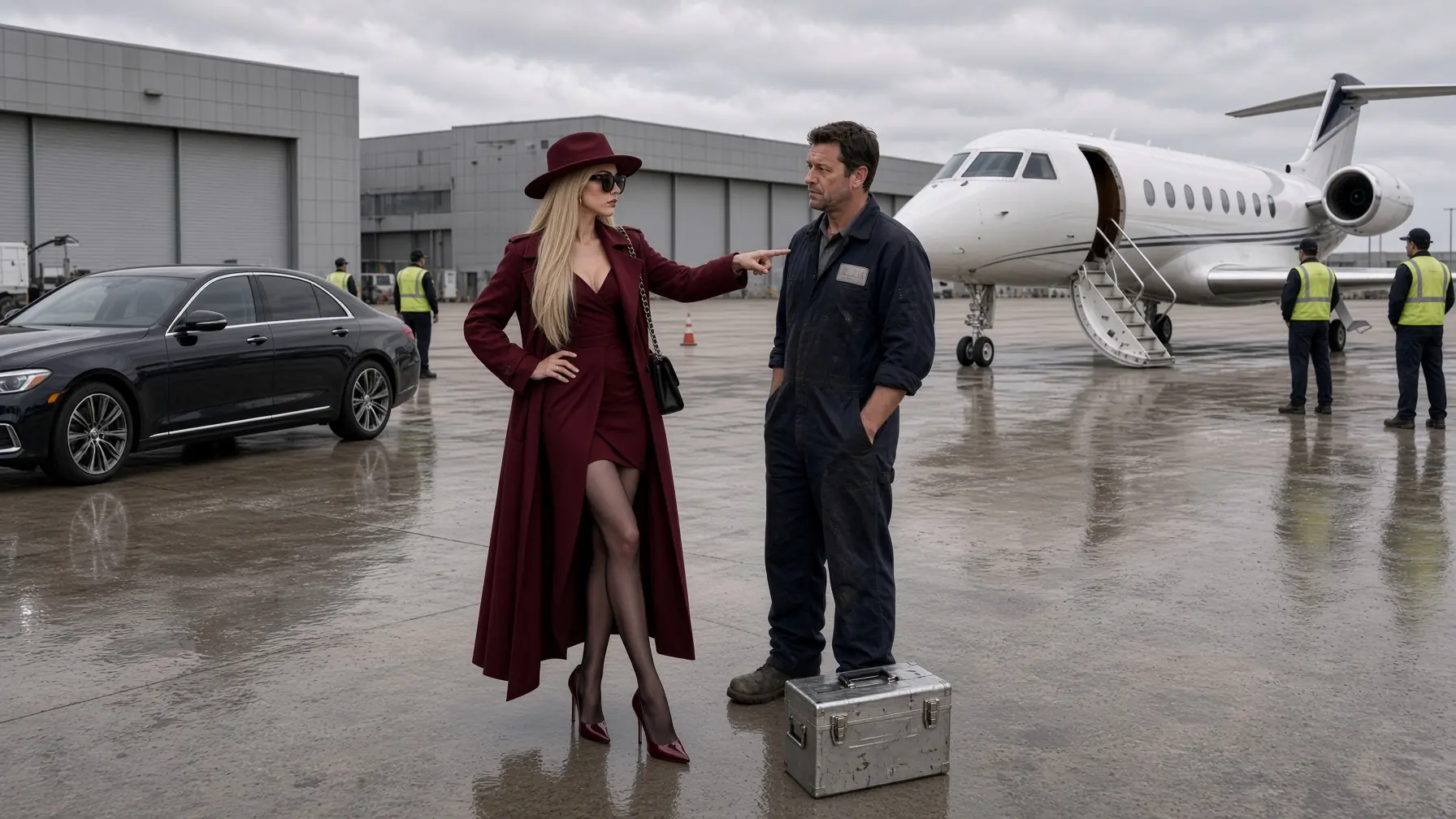
The words cut through the private terminal like a blade drawn across glass. "Your monthly salary is less than what I spend on dinner. " Celeste Marlowe said it without raising her voice, the way people say things they believe are simply true. The way a person states the color of the sky. Rowan Mercer, a maintenance contractor in a faded jacket with a scuffed toolbox at his feet, did not answer right away. He looked past her toward the sleek white jet gleaming under the runway lights, and he asked a single question that had nothing to do with money at all.
"Who approved the left engine modification? " Celeste laughed, a short, dismissive sound, the kind reserved for people she had already decided did not matter. Then, 40,000 ft above the Atlantic, the cabin lights flickered, an alarm screamed through the fuselage, and the pilot's hands went still on the controls. A voice crackled over the intercom, flat and terrified, announcing that both primary flight control systems were failing. Rowan stood. His voice steady in a way that made grown engineers listen.
"Give me 5 minutes. " The private terminal outside Boston that morning smelled of jet fuel and fresh coffee, the kind of place where wealth moved quietly and efficiently. Where nobody raised their voice because nobody needed to. Rain from the night before still pooled in shallow patches along the tarmac, catching the gray morning light and scattering it across the wet concrete in broken fragments. Somewhere beyond the hangars, a ground crew tested an engine on another aircraft, the low roar rolling across the field and settling into the kind of ambient noise that people who worked around airplanes stopped hearing after their first year. Inside the terminal, glass walls separated waiting passengers from a lounge stocked with pastries nobody would finish, and coffee nobody had to pour for themselves.
Rowan Mercer arrived in a truck with 200,000 mi on it, wearing a jacket that had been washed so many times the company patch on the sleeve had faded into a ghost of itself. He carried his own tools because he trusted his own tools, and he walked the tarmac the way a man walks a place he has walked a thousand times before, eyes moving without effort across bolts and panels and seams that most people would never notice. He did not introduce himself to anyone. He simply began working, running his hand along the fuselage, crouching beside the landing gear, listening to the quiet hum of systems most passengers never thought about until they failed. Nobody in the terminal paid him much attention, which was exactly how he preferred it.
There was a rhythm to the way Rowan worked, unhurried but never wasteful, the rhythm of a man who had long ago stopped needing an audience to validate the quality of his attention. He ran a gloved hand along a seam near the wing root, paused, then pressed his palm flat against the metal as though listening for something through his skin rather than his ears. A young ground crew member watched him for a moment, curious about the stranger who moved around the aircraft with more familiarity than most of the pilots who flew it, before a supervisor called the young man away to other duties. Celeste Marlowe arrived 20 minutes later in a car that cost more than most houses, flanked by two assistants who moved like satellites caught in her gravity. She wore a watch that had taken a master craftsman 4 months to build.
And she carried herself the way people do when the world has spent decades confirming that they are right. She was the chief executive of Vespera Aviation, a private aviation company that had grown under her leadership into one of the most profitable operations of its kind on the Eastern Seaboard. That morning she was preparing for a flight to Geneva, where a deal worth several hundred million dollars was waiting to be signed, a deal that would cement her legacy as the youngest chief executive to take the company public. She had no patience for delays and even less patience for men in faded jackets who stood too close to her aircraft. Rowan had been hired for a routine inspection, nothing more.
A formality that companies like Vespara required before any high-value flight. But routine inspections had a way of revealing things that were not routine at all. And within the first 10 minutes Rowan noticed something wrong with the secondary flight control wiring. A discrepancy so small that most inspectors would have missed it entirely. He traced the wiring back to a junction box that should not have been touched since the last certified inspection.
And his stomach tightened in the particular way it always did when instinct arrived before proof. He straightened up, wiped his hands on a rag, and told the gathering crew in a voice too calm to be dismissed as paranoia that he would not fly this aircraft yet. Celeste, who had just stepped onto the tarmac, heard him and asked with the faint amusement of someone who assumed the answer would embarrass him whether he understood how much the aircraft cost. Rowan replied simply that it cost enough to replace, which was more than could be said for the people inside it. Celeste laughed again, this time longer, and turned to her operations director, a broad-shouldered man named Gideon Vale, who had been with the company for nearly a decade and who carried himself with the practiced loyalty of a man who had learned exactly how far loyalty could be stretched before it broke.
Gideon assured her that the contractor was simply being cautious, that men who worked freelance often invented problems to justify their fees, and that the aircraft had passed every certified inspection on record. Celeste, satisfied, turned back to Rowan and delivered the line that would follow both of them through the darkest hours of that day. The line about his monthly salary and her dinner, spoken lightly, almost playfully, as though it were a joke between equals rather than a blade aimed at a man's dignity. Rowan did not flinch. He only said that dinner then must be very expensive, and something in his tone made two of the ground crew turn away to hide their smiles.
Gideon, eager to move things along, produced a clipboard and asked Rowan to sign off on the aircraft's readiness, a formality that would close out the inspection and clear the flight for departure. Rowan looked at the clipboard for a long moment, then looked at the aircraft, then set the clipboard down without signing it. He explained in the plainest terms he could manage, that someone had altered the flight control system after the most recent certified inspection, and that whoever had done it had not logged the change anywhere he could find. Celeste's smile faded by a fraction. Though she would not have admitted it, she asked him what exactly he thought he had found.
And Rowan, gathering his tools, told her only that someone had changed the system. And that changes like that were never made without a reason. He walked away before she could respond, leaving behind a silence that Gideon quickly filled with reassurances, though something in Celeste's expression suggested the reassurances had not fully landed. The truth about Rowan Mercer was buried deeper than anyone at Vesper Aviation could have guessed from the state of his jacket or the mileage on his truck. Years earlier, he had been the lead systems engineer on a defense aviation contract.
A young man trusted with problems that most engineers twice his age would have refused to touch. He had built a reputation in those years for finding the flaw nobody else could see, for sitting with schematics until 3:00 in the morning because something about a redundancy calculation refused to sit right with him. Then came the incident that ended that chapter of his life, a catastrophic failure during a test flight that killed one crew member and injured two others, a failure that an internal investigation eventually traced back to a component substitution made under budget pressure, a substitution Rowan had flagged in writing 6 weeks before it happened. Facing lawsuits and congressional scrutiny, needed a name to attach to the failure. And Rowan's warning, buried in an email chain, nobody wanted to produce in discovery, was quietly erased from the official record.
He was let go within a month. His reputation reduced to a single line in an incident report that never mentioned the warning he had given. He could have fought it. He had the emails, printed and saved, tucked away in a drawer he rarely opened, but fighting it would have meant years of depositions and public scrutiny. Years he did not have.