"Tell His Grace," said the foreign envoy in his own tongue, smiling pleasantly at the Duke of Mardenholt across the long table, "that we accept his terms, and that we shall have the better of him in the third clause before he has finished his wine."
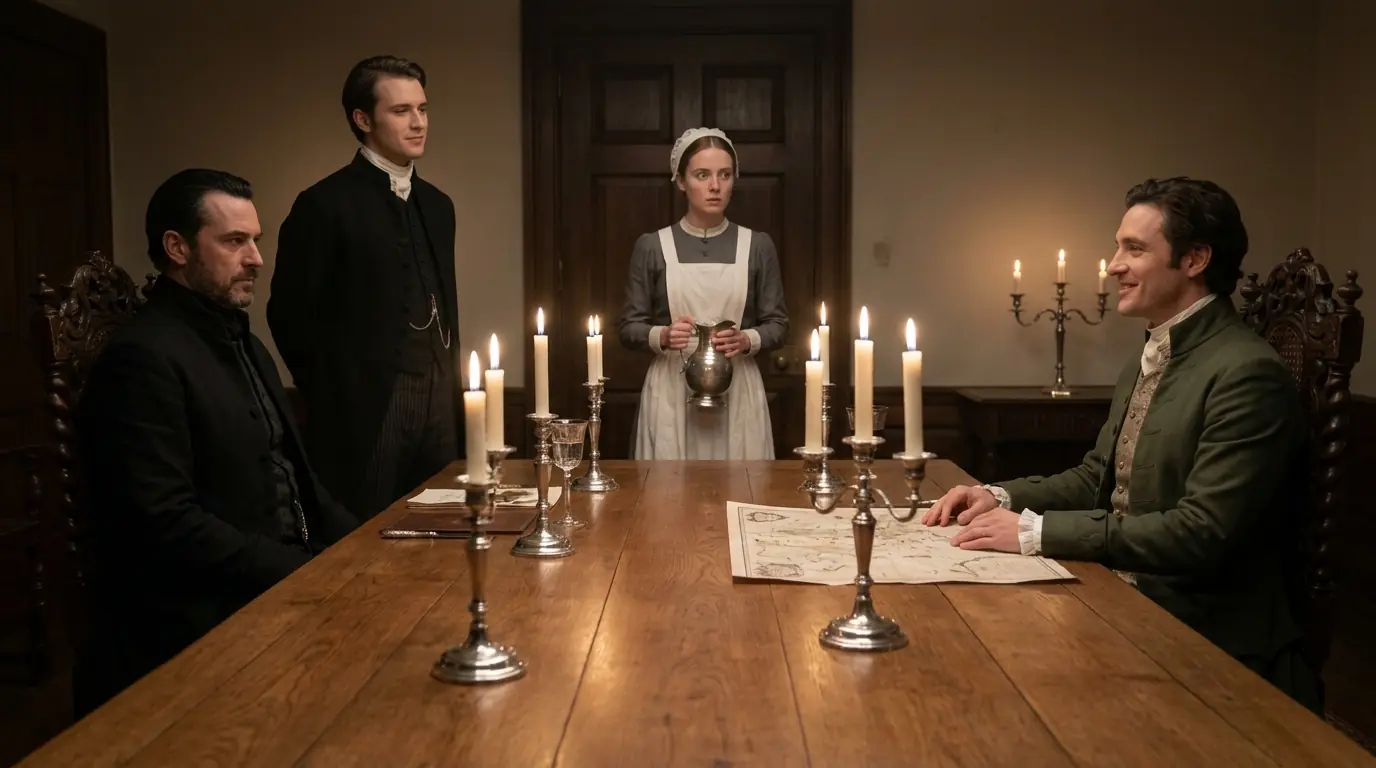
The hired translator inclined his head smoothly and turned to the Duke. "His Excellency accepts Your Grace's terms," he said in flawless English, "and looks forward to a long and equal friendship between your houses."
The maid standing at the sideboard refilling the water jugs did not move a muscle of her face, but her hands went very still.
Aveline Took had been sent in to keep the glasses filled and otherwise to be invisible, which was a thing she did well, having been a lady's companion before reduced circumstances had reduced her further still to the carrying of jugs in a great man's house. She kept her eyes down. She filled the water, and inside, behind her plain, unremarkable face, a cold alarm was ringing like a struck bell. Because the envoy had not said what the translator had said—not remotely.
And Aveline, who had been raised by a scholar father in three countries and spoke five languages as easily as breathing, had understood every single word of both.
She risked one glance up the table. The Duke of Mardenholt sat at its head, dark and still and formidable, a man whom half the county feared and the other half merely dreaded. He was watching the envoy with the controlled, courteous attention of a man who believes he is winning, and who does not know that the smiling foreigner across from him has just announced his intention to rob him blind, and that his own paid interpreter is helping.
The negotiation was a great one: a trade concession, harbor rights, something on which a quarter of the estate's fortune turned. She had gathered that much from the sealed letters and the maps weighted down with silver candlesticks. And it was being lost, clause by clause, in plain hearing to a man who did not know he could not trust his own ears.
She had no place here. She was a maid. A maid did not speak. A maid did not so much as appear to listen. A maid who interrupted a duke's diplomacy would be turned out into the road by nightfall with no character and no hope of another situation. Aveline knew all of this with perfect clarity.
She filled the next glass.
The envoy spoke again, a long, courteous, smiling speech in which he proposed to his own delegation in their shared tongue that they insert into the fourth article a clause granting them exclusive rights to the river crossing, "which the fool will sign because his man will tell him it concerns only the tariff on wool." His delegation murmured appreciatively.
The translator listened, nodded, and turned to the Duke.
"His Excellency proposes only a small clarification to the fourth article," he said, "concerning the tariff on wool. A trifle. He suggests Your Grace's secretary might initial it now to save time, and the formal seals applied this evening."
The Duke reached for his pen.
And Aveline Took, lady's companion turned water pourer, set down her jug, and heard herself say, in a voice that did not shake half so much as her hands did, "Your Grace, forgive me, but your translator is deceiving you."
The room went absolutely silent.
Every head turned. The Duke's pen stopped a half-inch above the paper. The translator's smooth face flickered, just once—a crack of pure alarm before he smoothed it over. And the envoy's pleasant smile froze in a way that told Aveline, more surely than anything, that she was right and that he had understood her English perfectly.
"I beg your pardon?" said the Duke of Mardenholt. His voice was very quiet and very dangerous, and it was not at all clear at whom the danger was aimed. His dark eyes had fixed on her with the full weight of his attention, and Aveline felt it land like a hand.
"The maid forgets herself," the translator said quickly, recovering, contempt flooding back into his voice. "Your Grace, I must protest. A serving woman interrupting affairs of state—"
"That clause does not concern the tariff on wool." Aveline did not look at the translator. She looked at the Duke, because if she was to be ruined for this, she would at least be ruined looking the man in the eye. "It concerns the river crossing. His Excellency proposed a moment ago to his own delegation, and in his own tongue, that you be given to understand the fourth article was a trifle about wool. His word, Your Grace, was 'fool,' so that you would initial away the exclusive rights to the crossing without reading it. And in the third clause, which your man rendered to you as 'a long and equal friendship,' His Excellency in fact said he would have the better of you before you had finished your wine."
She drew a breath. "I am only a maid, Your Grace, but I understood every word that has been spoken at this table this afternoon in every language spoken at it, and very little of it has reached your ear as it was said."
The silence that followed was a different kind of silence. It had texture. The Duke's gaze did not leave her face. The translator had gone the color of tallow. And the envoy—the envoy was looking at Aveline now with an expression of pure, arrested astonishment, as though one of the candlesticks had stood up and addressed him.
The Duke set down his pen.
Very slowly, very deliberately, he turned to the foreign envoy, and he said something—not to the translator, but directly to the envoy in the man's own language, halting and accented, but entirely comprehensible. A single sentence asking, with cold courtesy, whether what the maid had said was true.