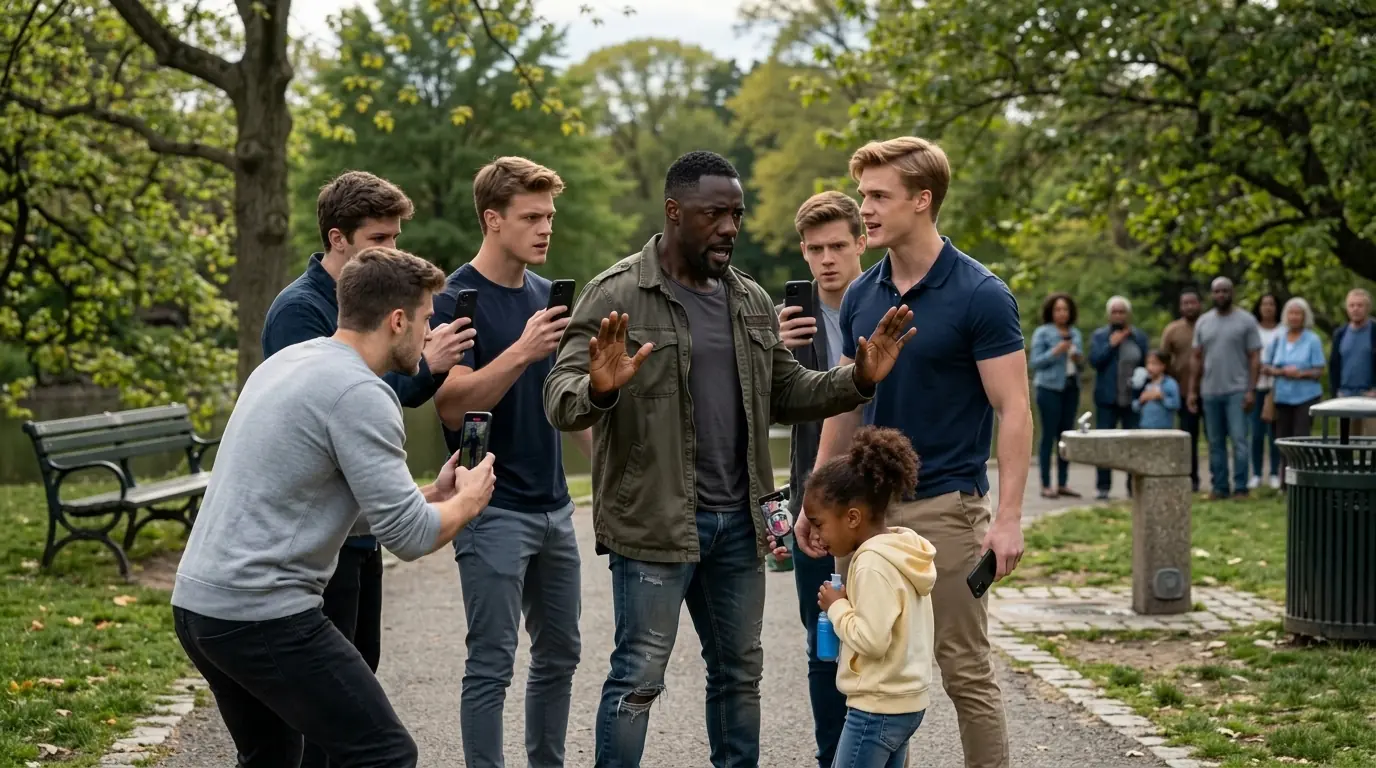
Look at that. Brave little dad showed up. Give her the bag. This one? Think we'll hold on to it.
My inhaler's in there. Please. 600 signatures against my family over a duck pond. She can't breathe. Hit me.
Show them what you really are. Five of them moved through Riverbend Park like they owned it because for years they had. Dylan Cross had learned from his father that money was permission and the man standing across from him was a mechanic, a single father, someone easy to break. Dylan had surrounded him in public, taken his daughter's backpack, and the man had barely spoken. Just stood there still and quiet while his little girl struggled to breathe.
Dylan read that silence as surrender. But what happens when the quietest man in the room has already survived things Dylan Cross couldn't even imagine. If you're the kind of person who stays for stories like this one, subscribe and hit the bell. We find these stories every single week and this one is just getting started. Every Tuesday afternoon, Marcus Reed packed two granola bars, a thermos of hot coffee, and a small notebook into his canvas bag before heading to Riverbend Park.
The routine had started 3 years ago as a way to get Ava outside after school and somewhere along the way it had become the steadiest thing in both their lives. Ava would crouch near the water with her binoculars scribbling notes about which ducks had returned that week while Marcus sat on the nearby bench and watched her the way most people watch a sunset. Like they know it won't last forever so they try to memorize every second of it. I was not a man who talked much about himself. At the garage where he worked on the east side of Riverbend, Ohio, the other mechanics knew him as the guy who stayed late without complaining, who never missed a day, and who kept a laminated photo of his daughter tucked inside his toolbox.
They knew he was raising her alone. They knew his wife had died when Ava was just 3 years old. A rainy night, a two-lane highway, a truck that crossed the center line. Beyond that, Marcus didn't offer details, and nobody pushed. Some men carry grief the way they carry a bad knee, quietly every single day without expecting anyone to notice.
What nobody in Riverbend knew was that Marcus Reed had once been somebody different. Not dangerous in the way people sometimes fear a man who is large and quiet. Dangerous in the way a locked door is dangerous because something serious lives behind it. In the years before Ava was born, before Nicole, before the garage, and the Tuesday afternoons, and the granola bars, Marcus had fought professionally under the name The Quiet Storm. 27 wins and two losses in regional welterweight MMA competition.
He had never been the kind of fighter who won by brute force. His coaches used to say he could read a man's body like a sentence. He knew what was coming before the other person had finished thinking it. When he controlled someone, he did it without rage. That was what made him so effective, and what made walking away from the sport so easy when the time came.
He had never needed the violence. He had only ever needed the discipline. After Nicole died, Marcus packed his championship belt, his gloves, and every newspaper clipping into an old military trunk, and carried it down to the basement. He didn't throw any of it away. He just locked the lid and didn't open it again.
Ava knew her father had done some kind of fighting when he was younger. She had never pressed for more than that, and Marcus had never volunteered it. Some things he believed belonged to a version of himself that no longer needed to exist. What existed now was the man who packed an extra inhaler in his jacket pocket whenever he took Ava anywhere because she had developed asthma at six, and the attacks could come fast and without warning. What existed now was a man who had taught himself to braid hair from a YouTube video at 2:00 in the morning because Ava had asked him once if he could make it look like her friends at school.
The duck pond, the oak trees, the winding path around the water, all of it had become something more than a park. It was the closest thing they had to a place where Nicole still existed in the present tense. When Marcus first heard that Victor Cross intended to demolish most of the park to build a luxury apartment complex. He had gone home that night, sat at the kitchen table for a long time, and then opened his laptop. He was not someone who attended city meetings or circulated petitions.
He was not the kind of man who put himself in the middle of public disputes. But he typed up a one-page summary of the plan, printed it out, and the next morning left a copy at every business on Main Street with a note asking people to sign if they wanted to stop it. Within 6 weeks, he had more than 600 signatures. Within eight, he had filed a formal objection citing inconsistencies in Cross Development's own environmental impact report. Victor Cross noticed.
And Dylan Cross, who had watched his father notice, decided to handle it personally. The first time Dylan's group showed up while Marcus and Ava were at the park. Marcus assumed it was coincidence. Five young men in their early 20s, loud, drifting toward the duck pond like they had nowhere better to be. Dylan was easy to identify, not because Marcus had met him before, but because he moved through a space the way people do when they have never once been told to stop.
He knocked an empty bottle off the park bench with his elbow and didn't bother looking down. He said something to his friends that made them laugh at a volume designed to be heard by everyone nearby. When one of them began throwing stones into the water near the ducks, Ava looked up from her notebook and said quietly that they were going to scare the birds away. She was not rude about it. She was 8 years old, and she had spent weeks tracking which species nested on the far bank, and she said it the way a child says something true without yet knowing that some adults don't care about true things.
Dylan picked up her notebook from where she had left it on the bench beside her. He looked at it for a moment like he was reading it, then dropped it into the mud near the water's edge. Marcus was on his feet before the notebook hit the ground. He walked across the grass at a pace that was unhurried but absolute, and he stood close enough that Dylan had to tilt his chin up slightly to hold his gaze. Marcus said simply and without heat that he would like Dylan to step away from his daughter.
Dylan looked at him with the particular kind of smile that people wear when they are deciding how much trouble they want to cause. You going to make me? Dylan said. Then louder as if performing for the others, What are you going to do? Hit me in front of your kid?
Marcus picked up the notebook from the mud. He wiped the cover with his sleeve, checked the pages, and handed it back to Ava. He told her they were leaving. She took the notebook and followed him without a word, glancing back only once. Before they reached the path, Dylan walked over to the campaign sign Marcus had staked near the garden and kicked the post until it leaned sideways and fell.
He spoke toward Marcus's back with the laziness of someone who knows the other person is still listening. You can't protect this park, he said. You couldn't protect anything that mattered. Marcus kept walking. He did not turn around.
But the words reached him the way cold water reaches a wound, not because they were accurate, but because they landed exactly on the place he had never fully stopped blaming himself. Nicole's accident. The two-lane highway. The phone call at 11:15 on a Tuesday night. The thing about grief is that it doesn't need to make logical sense to be devastating.
Marcus knew he could not have prevented what happened. He knew it in the front of his mind every single day. But the knowing and the feeling were two different countries and some nights he still lived in the wrong one. That evening, Marcus opened a fresh notebook of his own and began recording everything. Dates and times.
What was said and by whom. The names he recognized, the faces he didn't. He was methodical about it, the way he was methodical about everything. Not emotional, just thorough. The next morning, he took his notes to the Riverbend Police Department and filed a report.
The officer on duty was polite and unhelpful in the way that suggested he already knew whose son Dylan Cross was. He told Marcus there wasn't enough there to act on and suggested Marcus try to avoid further contact. Marcus went home and kept the notebook. Over the following 2 weeks, things escalated in ways that were just subtle enough to be difficult to prove. The front tires of his truck were flat on a Monday morning.
Someone spray-painted a crude message across the community garden's entrance sign overnight. Marcus photographed it, reported it, and cleaned it off himself before Ava could see it. A series of comments appeared on the garage's business page that described Marcus using language he would not have repeated in Ava's presence. And then one afternoon, one of the garage customers mentioned casually that he had seen someone taking photographs of Ava outside her school. And Marcus felt something shift inside his chest that he hadn't felt in years, not fear exactly, but a version of it that had teeth.
I was still processing that when he received the phone call. The voice on the other end was unfamiliar male, unhurried. It told him that if he withdrew the petition, all of this would stop. It told him that men in his posi- single fathers, hourly workers, people without resources, sometimes made the mistake of thinking they were protected by the same rules as everyone else. Then the line went dead.
The meeting with Victor Cross happened in the parking lot of City Hall 3 days after the council session where Marcus had presented his 600 signatures. Victor was a tall man with the kind of posture that comes from decades of having assistants anticipate his needs. He shook Marcus's hand with enough grip to be a statement rather than a greeting, then outlined his offer in the tone of someone doing Marcus a significant favor. He said he would retire the garage's debt. He said he would establish an educational fund for Ava.
He said there were better neighborhoods, better schools, better opportunities, all of which could be arranged quietly and quickly as long as Marcus understood that the petition had run its course. Marcus listened to all of it without interrupting. Then he said no. Victor's expression didn't change the way most people's expressions change when they hear something they don't want. It simply stilled the way a room goes quiet before a storm.
He told Marcus that a man raising a child alone could not afford to make enemies he didn't fully understand. He said it gently. He said it like advice. "One mistake," Victor said, "and you could lose a lot more than this park." Within 48 hours, an anonymous report was filed with the county child protective services office.
The report claimed that Marcus had a volatile temper and a history of violence and that his daughter lived in an environment of fear. Around the same time, a rumor began circulating among parents at Ava's school. Marcus had heard it third hand, that the quiet man at the garage had once done time for assault. Marcus sat with that information for a full evening before he made a phone call. The number he dialed had not changed in 11 years.
It rang four times before a man named Elijah Brooks picked up the same voice, the same unhurried baritone Marcus remembered from the years when Elijah had trained him six days a week in a converted warehouse outside Columbus. Marcus told him what was happening. Not everything, but enough. Elijah was quiet for a moment after Marcus finished. "I need you to understand something."
Elijah said. "You're not walking into that park to win a fight. You're walking in to bring your daughter home safe. That's the only thing that matters when you get there." They made arrangements.
Elijah drove to Riverbend the following weekend and the two of them spent a Saturday in Marcus's garage, not training in any dramatic sense, but preparing. Elijah helped him set up a small camera inside his jacket with a backup audio recorder that would upload automatically to a cloud server every 15 minutes. They talked through exit routes, through scenarios, through the specific techniques designed to control without causing lasting damage. Marcus wrote down three sentences on a piece of paper that he kept on the kitchen counter after Elijah left, where he could read them every morning. Protect Ava.
Don't retaliate. Use only what is necessary. He treated them less like rules and more like a reminder of who he was trying to remain when things got hard enough to make a person forget. Dylan Cross was not stupid. That was what made him genuinely dangerous.
He had watched Marcus walk away from every provocation without breaking and he understood that a man like that couldn't be handled through a simple confrontation. You couldn't make him swing first by insulting him. You couldn't rattle him by getting in his face. Marcus Reed had a quality that Dylan recognized and resented in equal measure, the quality of a person who has already decided in advance and without drama exactly how far he is willing to go. So, Dylan stopped aiming at Marcus and started aiming at the thing Marcus couldn't walk away from.
It began with small things, the kind that couldn't be traced. Ava's route home from school was only only four blocks and she walked it alone on the days Marcus had back-to-back appointments at the garage. One afternoon, she told her father that a car had driven slowly alongside her for nearly the whole length of Orchard Street keeping pace with her until she turned onto their block. She didn't recognize the car. She said she hadn't looked directly at it because something told her not to.
Marcus listened, nodded once, and called the school the next morning to arrange a different dismissal arrangement. He did not tell Ava why. He added the date and description to his notebook and said nothing else about it. The bird feeder Ava had built as a birthday gift to herself, balsa wood painted blue and yellow mounted on a post near the garden, was found snapped in half one Tuesday when they arrived at the park. Ava stood in front of it for a moment holding the broken pieces, then set them down carefully by the base as if they might still be useful for something.
She didn't cry. She was 8 years old and she had already learned that some things that break don't come back, so there wasn't much point in crying about wood. But that night she asked Marcus if they could maybe go somewhere else next Tuesday. Somewhere that wasn't the park. Marcus told her they'd talk about it in the morning.
Then came the drawings. Someone had reached the poster board Ava had mounted near the community garden, the one with her species count and migration notes for her school project, and drawn over it with a thick black marker. Marcus took it down before Ava could see what had been drawn on it. The same week Ava received a video message from an anonymous account. Just footage of the duck pond at night, silent and dark with a red circle drawn digitally around the tree where her wildlife camera was mounted.
She showed it to Marcus without saying anything. He looked at it twice, then set the phone down on the counter and asked her to go finish her homework. His face did not change in any way that she could read, which she had learned over eight years meant he was working very hard at something on the inside. The morning after this video, Ava found a rubber duck painted entirely red sitting on the ground directly below her wildlife camera positioned so that it faced the lens. Marcus removed it without touching it directly, sealed it in a plastic bag, and added it to the growing folder he kept on the high shelf in the hall closet.
Photographs, timestamps, the anonymous report, the letter from the police department, all of it organized in clear plastic sleeves. By then then the folder was thick enough that it needed a binder clip to stay closed. Ava started waking up in the middle of the night. She wouldn't always come to Marcus's room. Sometimes he would hear her moving around and find her sitting in the kitchen with the light on drawing birds in her sketchbook.
Because she said it helped her brain slow down. She told him once in that particular 4:00 in the morning honesty the children sometimes have that she kept dreaming that she came home from school and he wasn't there. And she didn't know where he had gone. Marcus sat down across from her at the kitchen table and told her that wasn't going to happen. Ava looked at him steadily for a moment and said she knew and went back to her drawing.
I was genuinely considering stepping back from the petition not because of what it would cost him, but because Ava's sense of safety was eroding in ways that a petition couldn't fix. The decision shifted on a Thursday evening when Ava was supposed to be in her room reading and Marcus was at the kitchen table reviewing the council meeting agenda. She came downstairs quietly and stood in the doorway and Marcus realized from her expression that she had been listening to the phone call he'd taken 20 minutes earlier. A call from someone at the council office who mentioned that Victor Cross had already arranged for excavation equipment to be on standby the morning after the final vote. Ava had heard enough.
She stood in the kitchen doorway in her pajamas and said with the kind of steadiness that sometimes appears in small people who have already lost something enormous that if they left because they were afraid other kids would have to leave too. Marcus looked at his daughter for a long moment. Then he closed the agenda and told her to go to bed. He didn't touch the withdrawal letter he had been drafting on his laptop. He closed that, too.
Dylan had chosen the following: Tuesday, deliberately. The park would have its usual mid-afternoon foot traffic, enough witnesses to create pressure, not so many that the group couldn't control the perimeter. He had run through the plan with the others. The night before, Travis and Evan would stay near the path with their phones already recording. Cole would position himself between Marcus and Ava the moment things started.
Noah would fall in behind Marcus to block the rear exit. And Dylan would be sitting on the bench nearest the duck pond like a man with nothing on his mind. The plan was simple because simple things were harder to misread under pressure. Dylan had described it to the group the way his father described business decisions, not with excitement, but with the certainty of someone who has already decided the outcome and is merely arranging the details. Marcus and Ava arrived at the park at their usual time, just past 3:30.
Ava had her notebook. Marcus had his canvas bag. He had checked the jacket camera that morning and confirmed the audio recorder was uploading correctly. He had also, before leaving the house, read the three sentences on the kitchen counter one more time, not because he had forgotten them, but because repetition is a form of commitment. The five of them were already there.
Dylan took the backpack off Ava's shoulder in one motion fluid and fast, as if he had simply reached out to catch something falling. Ava made a sound that was partly surprise and partly the beginning of panic, and she reached for the bag, and Dylan tossed it sideways to Cole without looking. Cole opened it, reached in, and held up the blue inhaler like he was examining something mildly interesting. Marcus had both hands up immediately, open palms visible, deliberate. And he told them in a voice completely stripped of anger that his daughter needed that inhaler.
And he needed them to hand it back right now. Ava's breathing was already audible. The sound of it was the most frightening thing in the park. Dylan stepped in and shoved Marcus hard into the slats of the bench. Marcus absorbed the impact and stayed upright.
And he called out to a woman on the path nearby, asking her to call 911. Dylan moved closer, close enough that Marcus could see the slight flush at his collar. That meant he was enjoying this, and said with a kind of flat amusement that Marcus should go ahead and hit him. Show everyone what kind of father he really was. Marcus tried to move toward Ava.
The others closed the gap. Then Dylan threw the first punch. What happened next took less than 60 seconds. Though it would later be described by the people who witnessed it in terms that made it sound like something much longer. Marcus didn't counter with a strike.
He redirected Dylan's swing by catching the wrist mid-arc. Applied downward pressure on the joint. And brought Dylan to one knee without a single impact. When Cole charged from the left Marcus used his own forward momentum to turn him. And put him face-first into the grass.
And when Cole hit the ground the blue inhaler skidded out of his hand and came to rest on the grass a short distance away. Travis came from behind with both arms outstretched. And Marcus caught one, locked the elbow, and held him bent at the waist until he stopped pulling. Evan had picked up a piece of metal edging from the garden border. Marcus kicked it out of his grip with the inside of his foot and put a hand on his chest until he sat back against the bench.
Then Marcus looked directly at Noah, who was standing very still near the path holding the backpack, and said one word, "Down." Noah set the bag on the ground. It was over. Not a single closed fist from Marcus, not one strike. Every person on the ground had put themselves there through their own forward motion, and Marcus had simply been the surface they encountered when they arrived.
He crossed the grass to where the inhaler had fallen, picked it up, and crouched beside Ava holding it steady for her while she breathed through the attack, one hand on her back, counting under his breath. Dylan was still on the ground when he looked up and asked with something that sounded almost like genuine confusion who Marcus was. Marcus did not look at him. He kept his eyes on Ava, one hand moving slowly across her shoulders, and said that he was her father. The video posted by bystanders spread fast enough that by the following morning local news had picked it up.
By the evening national outlets had it. For approximately 18 hours, Marcus was described by strangers as a hero. Victor Cross had spent far longer than 18 hours on problems more complicated than public narrative, and he moved with the efficiency of someone who keeps certain phone numbers in his personal contacts for exactly this kind of occasion. By the second day, a different video was circulating, one that began at the precise moment Marcus locked Dylan's wrist with no preceding context, no backpack, no inhaler, no Ava struggling to breathe, just a trained fighter bringing down five young men who appeared in that isolated clip to have been minding their own business. Dylan appeared at a press conference in a cervical collar.
Travis arrived with his left forearm wrapped. Cole gave a brief statement about psychological trauma. Victor stood at the podium with the measured gravity of a man describing an injustice he personally found painful and he told the assembled cameras that his son and four friends had been violently attacked by a professional fighter with documented experience in submission holds and combat techniques. He used the word unprovoked twice. The story reversed overnight.
The garage called Marcus that afternoon and told him not to come in until further notice. A temporary restraining order was served at his door the following morning prohibiting him from approaching Dylan Cross or the vicinity of Riverbend Park. Child Protective Services opened an emergency review, the same office that had received the anonymous complaint weeks earlier now supplemented by the edited video, Marcus's competitive fighting record, and a formal declaration that Ava had been deliberately placed in the middle of a violent confrontation staged by her father. The hearing regarding Ava's custody was set for 9:00 in the morning 3 days out. On the second evening, Marcus came home to a house that was entirely quiet in a way it had never been before.
Ava had been placed temporarily with her aunt on the other side of town while the review was active. Her breakfast bowl was still in the drying rack from that morning. A hair tie was looped around the faucet handle where she always left it. The light in her room was on because Marcus had forgotten to turn it off and from the hallway, it looked exactly the way it always looked when she was in there. Warm and cluttered and full of the particular energy of a child who fills a space simply by existing in it.
He stood in the doorway of her room for a while. Then he went to the kitchen and sat down. Victor's attorney called the next morning with a structured offer. Plead guilty to one count, accept three years of supervised probation, withdraw the petition, and sign a document agreeing not to pursue any legal action against the Cross family. In exchange, Victor would personally recommend to CPS that Ava be returned to Marcus's care.
Marcus's own attorney, a careful woman named Dana Price who had agreed to take the case on limited retainer, told him plainly that given his fighting record and the video as currently edited, a jury trial carried real risk. She said it gently and honestly, which Marcus appreciated even as it made the room feel smaller. I was considering it. Not because he believed he had done anything wrong, but because the calculus had shifted to a single variable, getting Ava home. The supervised visit happened in a beige conference room at the CPS office with a case worker sitting near the window.
Ava came in wearing her school clothes and sat across from Marcus and looked at him the way she always looked at him when she was trying to figure out something adults weren't saying directly. She asked him after a short silence whether he had fought those people because he was angry. Marcus told her he had only done what it took to get to her. Nothing more than that. Ava sat with that answer for a moment.
Then something moved across her expression, not quite memory, more like a connection between two things that had been stored separately, and she asked Marcus if the duck camera was still in the tree. The wildlife camera. The one mounted on the oak across from the bench. The one that saved directly to a memory card and hadn't been touched since before any of this began. Nobody had thought about it because nobody knew it was there.
It wasn't connected to a phone. It wasn't in the police report. It wasn't in Victor's calculation. After the visit ended, Ava found her aunt in the lobby and told her quietly that the duck camera had seen everything. The park had been fenced for pre-construction access, and Marcus was legally prohibited from setting foot near it.
The hearing was in less than 12 hours. Ava's aunt reached Elijah Brooks that evening through the number Marcus had left in her phone for emergencies. And Elijah called Dana Price before 9:00. Dana filed for an emergency evidentiary retrieval order on the grounds that potential exculpatory evidence was at imminent risk of destruction by scheduled construction activity. A judge signed the order at 11:40 at night.
Elijah and Dana were at the park fence before 5:00 in the morning, well ahead of the excavator crew's 6:00 start. The memory card was still in the camera, exactly where Ava had left it. The hearing room at Riverbend County Family Court was smaller than Marcus had expected, which somehow made it worse. The press had filled every available seat in the gallery, and the overflow stood in the hallway with the door propped open. Victor Cross sat at the opposing table in a charcoal suit flanked by three attorneys and a paralegal with Dylan beside him wearing the cervical collar that Marcus now understood had never been medically prescribed.
Marcus sat across from them with Dana Price on his left and a yellow legal pad in front of him that he had not written anything on. He kept his hands flat on the table pressing his palms against the surface the way a person steadies themselves against something solid when the ground feels uncertain. Victor's lead attorney opened with the edited video projected on a screen mounted near the judges bench. 32 seconds of Marcus controlling five people stripped of every second that came before. The attorney described Marcus' competitive record in detail, the 27 wins, the submission victories, the regional championship, and framed each fact as evidence not of discipline but of capacity for harm.
He argued that a man with Marcus' training background could not claim the same standard of proportional force as an ordinary citizen because his knowledge and physical capability elevated every encounter into something categorically more dangerous. Dylan's attorney added that Ava had been knowingly brought to a location where her father had reason to expect a confrontation and that this alone demonstrated a pattern of judgment that put her at risk. Marcus looked at the legal pad in front of him. He thought about the three sentences on his kitchen counter. He thought about Ava in the beige conference room asking whether he had fought those people because he was angry.
He picked up the pen, wrote nothing, and set it back down. Dana Price stood up. She said she had three pieces of evidence she needed the court to review before any further argument proceeded and she asked permission to approach. The judge, a measured woman named Judge Carol Hartley, who had said very little since the session opened, nodded once. Dana set a laptop on the evidence table, connected it to the room's display system, and slid the memory card into the drive.
The footage from Ava's wildlife camera was wide-angle and slightly overexposed in the afternoon light, the way outdoor cameras always are when they weren't designed with human subjects in mind. But it was clear. It was unambiguous. It showed everything from the moment Dylan's group converged on the bench, the deliberate positioning, the way Travis and Evan had raised their phones before anything happened, Cole moving to stand between Ava and the nearest exit. It showed Dylan lift the backpack from Ava's shoulder.
It showed Cole hold the blue inhaler up and examine it, while Ava's posture changed, her chest visibly tightening, her hand reaching toward him. It showed Marcus with both palms open and raised. It showed Ava sitting down on the grass because standing had become too much effort, and it showed the moment Dylan stepped forward and threw the first punch. The courtroom was silent in the way large rooms are silent when everyone in them is suddenly paying the same quality of attention to the same thing. Victor's lead attorney made a motion to speak, and Judge Hartley raised one finger without looking at him, and he sat back down.
The footage continued. It showed Marcus moving through the next 45 seconds without a single offensive strike. Every technique was redirectional. Every person who ended up on the ground had been traveling toward Marcus when they got there. And the moment Cole went down and the inhaler hit the grass, Marcus stopped completely.
He didn't look at the others. He crossed directly to the inhaler, picked it up, and went to Ava. Dana stopped the footage and let the room stay with what it had just seen. Then she moved to the audio. The jacket camera's visual feed had been compromised when Marcus hit the bench, the lens had shifted against his jacket lining and recorded nothing but fabric.
But the microphone, positioned higher, had captured everything. Dana played the relevant section without comment. Dylan's voice came through, first unmistakable telling Marcus to hit him and telling him his father would have Ava taken before sundown. Then Marcus's voice, flat and focused, saying that his daughter couldn't breathe and asking for the medication back. Dylan's attorney objected to the relevance of the audio, and Judge Hartley overruled him before he finished the sentence.
The third piece of evidence came from an unexpected direction. Noah had not looked directly at Marcus once during the entire session. He had been sitting at the end of the opposing bench in a way that suggested he was trying to occupy as little physical space as possible, and sometime during the playback of the wildlife footage, he had folded his hands in his lap and kept them there. When Dana announced that a third party had voluntarily surrendered a device containing communications between the five individuals involved, Victor's lead attorney rose sharply and began speaking about chain of custody and admissibility. Judge Hartley allowed Dana to continue.
Noah had handed over his phone the previous evening at Dana's office, guided by the specific and growing understanding that an 8-year-old girl might lose her father because Noah had been too afraid for too long to be the person in that group who said enough. The messages filled the screen in sequence. Dylan's planning was detailed in the way that people are detailed when they believe they are untouchable dates, assignments, specific instructions about camera angles, a reminder to Travis to start recording before anything physical happened. There was a message about the child protective services report sent the night before the encounter with a note that the groundwork was already laid. And near the bottom of the thread sent the morning of that Tuesday, a message from Dylan to the group that read, "We don't need to beat him.
We just need to make him look like a monster in front of his kid." Dana read it aloud, then closed the laptop. She looked across the table at Victor Cross and told the room in the measured tone of someone choosing precision over drama that the opposing party had not simply attacked a man in a public park. They had used a child with a respiratory condition as the mechanism of a premeditated trap designed specifically to destroy her father's life by exploiting his love for her. Judge Hartley called a brief recess.
When she returned, she denied the motion to remove Ava from Marcus's custody effective immediately and ordered Ava returned to her father's care before the close of business that day. The criminal assault charges against Marcus were formally dropped within the week after an independent martial arts analyst reviewed the unedited footage and submitted a written assessment to the court. The analyst noted with the precision of someone whose entire professional life is the study of how bodies move under pressure that Marcus Reed had possessed the positional advantage and the technical knowledge to cause serious injury to any or all five individuals at multiple points during the encounter and had not done so. He had used the minimum effective force at each moment and disengaged the instant the threat was neutralized. The analyst's conclusions stated that what was notable was not that Marcus had been capable of defeating five people, but that his capability and his restraint had existed simultaneously and that the restraint had won.
An old interview clip surfaced during the news cycle that followed footage from after a regional title defense more than a decade old, Marcus younger and quieter on camera telling the interviewer that a fighter who loses control hasn't become dangerous, he's just become afraid. The clip circulated widely enough that it became shorthand for the entire story. People who had never heard of Riverbend, Ohio shared it with captions about the difference between strength and character. The media organizations that had initially described Marcus as a volatile fighter with a history of violence issued corrections. The garage owner called Marcus personally to apologize and asked him to come back whenever he was ready.
Marcus said he would be in Monday morning. Dylan Cross and the others faced a consolidated set of charges, criminal conspiracy, reckless endangerment of a minor, assault, evidence tampering and filing a false report with a government agency. Noah's attorney negotiated a reduced arrangement in exchange for his cooperation, which the court accepted. Victor Cross's legal exposure was more complicated and therefore moved more slowly, but the combination of Dana's civil filings and a separate investigation opened by the county ethics board ensured that it moved. A financial audit of Cross Development identified significant discrepancies between the environmental impact report submitted to the city council and the actual survey data the company had commissioned.
The development project was suspended pending review and the suspension became indefinite when three members of the council publicly withdrew their prior support. Riverbend Park stayed. The community garden stayed. At a small ceremony the following spring, the city placed a new marker near the rose bushes on the west side. A proper engraved stone with Nicole Reed's name and the years she had lived and below that a single line the garden committee had agreed on immediately.
She planted things here that still grow. Marcus stood at the marker for a long time the day it was unveiled. Ava stood next to him and didn't say anything. After a while she took his hand. The settlement from the civil suit came through four months after the hearing.
Marcus paid off the remainder of the garage loan and set aside a portion for Ava's education. With the rest he rented a space in the community center two blocks from the park and opened a program he called Guardian Circle which met on Saturday mornings and was free to attend. The program did not teach people to fight. That was the first thing Marcus said at every session and he meant it precisely. What it taught was how to recognize when a situation was becoming dangerous before it became dangerous, how to document what was happening in ways that held up, how to de-escalate when the other person wanted escalation and how to stay grounded in your own values when someone was working very hard to make you abandon them.
Dana Price donated 2 hours a month. Marcus ran the rest of it himself in plain language without needing to perform his expertise. On the wall near the door, he mounted his championship belt in a simple frame, not at the center, not in the most prominent spot, but visible. Below it was a photograph taken outside the courthouse the day of the hearing. Ava running across this courtyard toward Marcus, arms out, and Marcus crouching to meet her at exactly her height.
The belt and the photograph shared the wall, and anyone who looked at them long enough could work out for themselves which one meant more. On the first Tuesday after the program opened, Marcus and Ava went back to Riverbend Park. The construction fencing had been removed. The duck pond was exactly as they had left it. Same families of mallards, same territorial goose that had always chased joggers near the east path, same oak tree with the camera mount still fixed to the trunk.
Ava had a new notebook, the same kind as the old one. She crouched near the water and started writing her count. Marcus sat on the bench and watched her. After a while, without looking up from her notebook, Ava asked him if he remembered what it felt like to be a champion. Marcus looked at her, the top of her head bent toward the water.
The way she held her pen with three fingers instead of two, the patience she had developed for watching things that moved slowly. And he told her that the day he won the belt, he had won one fight. He told her that the day he brought her home, he finally understood what winning actually was. Ava wrote something in her notebook. A duck moved across the surface of the water, leaving a long clean line behind it that slowly closed back into stillness.
Marcus leaned forward with his elbows on his knees, and the park held both of them in the particular quiet of a Tuesday afternoon in a place that had managed against considerable effort to remain exactly what it was. A strong man is not someone who never gets afraid. He's someone who stands inside the fear, inside the anger, inside the injustice, and still chooses to act for the people he loves rather than for himself. Marcus didn't walk out of that park a champion because of what he knew how to do with his hands. He walked out a champion because when everything was designed to turn him into something ugly, he refused.
If that's the kind of story that stays with you, subscribe and share it with someone who needs to hear it. Because stories like Marcus's are more common than we think, and they deserve to be told.