At 8:14 on a Saturday night, Vanessa Cole looked at an eight-year-old girl in a blue cardigan and said, “Staff families use the service entrance, sweetheart.”
The ballroom at the Ashford House Hotel did not go fully silent. The string quartet kept playing near the stage. Crystal glasses still touched. Donors still smiled beneath chandeliers older than most of their family names.
But people near the marble fountain heard her.
The little girl’s name was Lily Reed. She stood beside Miss June, the neighbor who had cared for her after school since Lily was five. They had not wandered into the gala. Miss June had signed them in at the employee desk and was walking Lily toward the service elevator because Lily’s father had promised to show her the rooftop garden after his shift.
Her father was ten feet away. He wore a black banquet jacket, scuffed work shoes, and a plastic badge that read S. Reed. His name was Silas Reed. To everyone in the ballroom, he was a temporary banquet porter, a tired single dad picking up every extra shift he could get.
Vanessa looked at Lily’s backpack, then at the paper bracelet around her wrist.
“This is a formal donor event,” Vanessa continued. “Children from the staff lounge should not be walking through the main ballroom.”
Lily looked at her father. Her eyes did not fill with tears. Lily had learned how to hold those back, but Silas saw the question in her face.
Do I belong here?
He set down the tray in his hands and crossed the floor.
“Hey, Lil,” he said softly. “I thought the garden was upstairs.”
“It is. Did I do something wrong?”
Silas knelt and fixed the strap of her backpack.
“No. And don’t let anyone make you think you did.”
Vanessa crossed her arms.
“This is exactly why staff should keep personal situations away from guests.”
Silas stood. His voice stayed quiet, but it changed.
“Do not talk about my daughter as though she is a problem.”
Vanessa blinked.
“I did not mean—”
“You did.”
The people nearest them stopped pretending not to listen. Silas kept one hand lightly on Lily’s shoulder.
“She is with her father. She is safe, and she belongs anywhere she is treated with respect.”
Before Vanessa could answer, another woman stepped forward from the edge of the ballroom. Her name was Norah Bennett. She wore a dark green dress, a headset around her neck, and two mismatched bobby pins holding up hair that had survived a fourteen-hour workday.
A clipboard rested against one hip. There was a streak of dust on her sleeve from fixing a stage backdrop thirty minutes earlier. Norah was not a donor. She was the independent event producer hired to run the gala.
She looked at Lily first.
“The rooftop elevator is right there,” she said gently. “I’ll walk with you and Miss June.”
Then she looked at Vanessa.
“And I’d appreciate it if we remembered that this is a children’s charity event, not a contest to see who can make a child feel smallest.”
Vanessa’s face tightened.
“You’re risking a major donor relationship over a porter.”
Norah did not look away.
“No,” she said. “You are.”
Silas watched her for one long second. Then he handed Lily’s small hand to Miss June.
“Go see the garden,” he told his daughter. “I’ll meet you in a few minutes.”
Lily nodded. But before she left, she looked at Norah.
“Will there really be lights?”
Norah smiled.
“Like little stars.”
Lily walked away with Miss June. Vanessa turned sharply and disappeared into the crowd. And Silas Reed stood in the middle of the Ashford House ballroom wearing a porter’s uniform, watching the woman who had defended his daughter.
Ten days earlier, Silas had walked into that same hotel under a name badge and a black jacket to answer one question that mattered more to him than money, power, or any board vote.
Who would still choose a single father and his little girl if they believed he had nothing?
Four years earlier, Silas Reed had been one of the most visible men in Savannah. He had been the executive vice president of Crestline Hospitality, the hotel company his parents had built from one struggling coastal inn into a group of luxury properties across the Southeast.
He knew every hotel in the company. He knew which kitchen managers ran clean operations and which ones cut corners. He knew how to read a budget, fix a staffing problem, negotiate with suppliers, and spot a lie before it reached a boardroom.
But after his wife Maya got sick, none of that mattered much anymore. The illness moved faster than anyone expected. By the time Lily was five, Silas knew the hospital nurses by name. He knew which coffee machine worked after midnight.
He knew how to sleep sitting upright in a plastic chair. And when Maya died, Silas stopped caring about investor dinners, hotel openings, and company speeches.
He stepped away from Crestline. He moved into a smaller house outside Savannah with Lily. He learned how to braid hair badly. He learned how to pack lunches without crushing the fruit.
He learned how to answer the hardest question a child could ask without breaking down in front of her.
“Dad?” Lily had asked one night. “Is Mom coming back when I’m older?”
Silas had held her hand and said, “No, sweetheart.”
Then he had stayed awake until sunrise because he had no idea how a person kept going after saying something like that.
For four years, Silas did not date, not because he believed love was over, but because he refused to let loneliness choose for him. Lily did not need a woman to replace her mother. She needed a father who stayed.
One Sunday afternoon, Silas went to lunch at his mother’s house. Diane Reed was seventy-two years old, silver-haired, sharp-eyed, and still carried herself like a woman who had survived recessions, lawsuits, hurricanes, and men who had underestimated her for forty years.
She was the founder of Crestline Hospitality, and she had never been easy to fool. She slid a thin folder across the dining table.
Silas opened it. Anonymous employee complaints. A housekeeper blamed for a guest’s lost watch that later turned up inside the guest’s own luggage. A dishwasher written up after refusing to work a fourteen-hour shift without a break.
A junior server blamed for a seating error that had actually been caused by a donor’s assistant. A banquet captain named Walter Morales accused of poor judgment after questioning instructions from a powerful event guest.
Silas read every page. Then he looked at his mother.
“You sent auditors.”
“I did.”
“You don’t trust them.”
“No.” Diane folded her hands. “People know how to behave when auditors are standing nearby. They know the right words. They know the right smiles.”
Silas closed the folder.
“What do you want from me?”
“I want you to come back.”
He gave a tired smile.
“You always say that like I left for vacation.”
“You left because your family needed you.”
“She still does.”
“I know.” Diane’s voice softened. “I am not asking you to abandon Lily. I am asking you to see what is happening inside the company your father and I built.”
Silas looked back at the folder.
Then Diane said, “There is one more thing.”
He sighed. “There is always one more thing.”
“Women have started asking about you again.”
Silas looked up.
“Mother.”
“I am not trying to arrange your marriage.”
“You say that right before arranging my marriage.”
“I am warning you.” She leaned back. “Vanessa Cole has been asking people whether you are returning to Crestline. Camille Hartwell has invited herself to three family dinners I never accepted. They do not ask directly, but they are circling your name.”
Silas rubbed his forehead.
“I am not looking for a wife.”
“Then don’t choose one.”
He paused. Diane continued.
“But if someone does come near you one day, Silas, you need to know whether she sees you and Lily, or your last name and everything it opens.”
The room grew still. Diane tapped the folder.
“People tell the truth when they believe someone has no power. That is what I need you to see.”
Silas looked through the complaints again. Then he thought about Lily, about the way she held Maya’s bracelet before bed, about how careful she was whenever adults mentioned someone new.
“I’ll do the field rotation,” he said.
Diane watched him closely.
“You’re sure?”
“I’ll work gala week at the Ashford House.”
“You’ve not worked banquet operations in years.”
“I remember enough.”
“You will be tired.”
Silas gave a small laugh.
“I’m already tired.”
Crestline had a legitimate leadership field rotation program. Senior executives sometimes worked real operational shifts to understand hotel systems from the ground up. Usually, everyone knew who they were.
This time, only Diane, the Ashford House general manager, and Crestline’s compliance director knew Silas was participating. He did not fake a tax file. He did not steal anyone’s job.
He worked an actual overflow position during the busiest event week of the year. His badge said S. Reed. Most employees had never seen him. He had been away from the company for four years.
To them, he was simply a single father taking temporary banquet shifts.
Silas arrived at the Ashford House at 5:30 on his first morning. The loading dock smelled like coffee, industrial cleaner, and wet cardboard. People moved through the corridor carrying flowers, glassware, linens, and folding chairs.
A gray-haired man with a limp stood near a banquet storage room, studying a seating chart.
“That is going to be a mess,” the man said.
Silas stopped beside him.
“What part?”
“The dessert station.” The man pointed at the floor plan. “They put it across the center aisle. Once the auction starts, guests will cut through there to reach the bar. Servers coming out of the kitchen will get trapped.”
Silas studied the layout. The man was right.
“Move the dessert six feet toward the east wall,” Silas said. “Put coffee on the opposite side. It splits the traffic.”
The older man glanced at him.
“You work events?”
“I’ve worked a few.”
“Everybody says that on the first day.”
Silas smiled. “My name’s Silas.”
“Walter Morales.”
They spent the morning moving chairs, checking table numbers, and hauling cases of glassware. Silas did not stand around giving instructions. He lifted what needed lifting. He rolled carts. He carried boxes.
When one floral stand blocked an emergency exit, he moved it before anyone had to ask. By lunch, Walter trusted him more than he trusted most temporary hires.
That was when Norah Bennett noticed him.
She stood in the ballroom arguing with a lighting technician.
“If you move the auction screen farther left,” the technician said, “the cameras will have a cleaner angle.”
“And the service crew will lose their route behind the stage,” Norah replied.
“Guests won’t see that.”
“They will when dinner is thirty minutes late.”
Walter called across the room.
“Norah, the new guy has an idea.”
Norah looked at Silas. He nodded toward the stage.
“If the screen shifts left, rotate the podium ten degrees. Cameras keep the angle. Servers still have the lane.”
The technician stared at the setup, then he frowned.
“That would work.”
Norah looked at Silas.
“How did you see that?”
“The room tells you where people are going to get stuck.”
She studied him for a moment.
“What’s your name?”
“Silas. Just Silas for now.”
A small smile crossed her face.
“Fine, Just Silas. Help Walter with the east side.”
That evening, Silas called Lily from the employee break room. He called every day at 6:30. No matter what, Lily answered on the second ring.
“Dad.”
“Hey, Lil.”
“Miss June made spaghetti.”
“Did you eat?”
“Most of it.”
“Most?”
“I ate the noodles. I did not eat the mushrooms.”
“That sounds like most.”
Lily laughed. Then her voice changed.
“Dad?”
“Yeah?”
“Did Mom like mushrooms?”
Silas looked down at the vending machine in front of him.
“She did.”
“Did she eat all of them?”
“She did.”
Lily was quiet for a second. Then she asked, “If you ever like someone, would she have to sit in Mom’s chair?”
Silas closed his eyes. Across the room, Norah was pouring coffee into a paper cup. She heard the question. She did not turn around. She did not pretend she had not heard.
She simply gave him privacy.
“No,” Silas said gently. “Nobody sits in Mom’s chair.”
“Because you don’t like people?”
“No. Because your mom was one person. Nobody can replace her.”
“Can someone still come over?”
“Maybe someday.”
“Would they have to like me?”
“They would.”
“Would I have to like them?”
“No.”
Lily thought about that.
“Okay.”
After the call ended, Silas remained seated. Norah walked past him with her coffee.
“I wasn’t trying to listen,” she said.
“I know.”
“She asked a hard question.”
“She asks a lot of hard questions.”
Norah nodded. Then she said, “You answered her well.”
Silas looked at her.
“She does not need someone to erase her mother,” Norah continued. “She just needs to know life can still make room for good things.”
Silas did not answer right away. Most people spoke about Maya like her name was made of glass. Norah did not. She spoke about Lily like she was a child with a real heart, not a problem to solve.
That was the first thing Silas noticed.
Vanessa Cole arrived the next morning. She wore a cream-colored suit, gold heels, and the expression of someone who believed every room had been waiting for her. Her father’s company was one of Crestline’s biggest donors.
Vanessa had a polished public image, a column in a local magazine, and a habit of speaking about generosity as though she had invented the word.
Silas was polishing water glasses near the ballroom entrance when she walked through.
“Excuse me,” he said. “That side of the floor is still damp.”
Vanessa stopped.
“Are you telling me where to walk?”
“I’m telling you it’s slippery.”
She looked down, then back at him.
“Maybe if you people cleaned at a better time, guests would not have to step around you.”
Silas held her gaze.
“I’ll dry it faster.”
“That would be useful.”
She walked away. Walter, standing beside a service cart, shook his head.
“You handled that better than I would have.”
Silas continued polishing the glass.
“She is not the first person to confuse a uniform with a person.”
Camille Hartwell was different. She was softer, more careful. She chaired several charity committees and often spoke about dignity, family, and community responsibility.
She was close enough to Diane Reed to assume she had a place inside the family’s future. She remembered employees’ names when donors were nearby. She smiled warmly in photographs.
But later that afternoon, Silas saw her in a service hallway with Tasha, a young housekeeper. Tasha had accidentally spilled coffee on the edge of Camille’s coat while reaching for a tray.
“I’m sorry,” Tasha said quickly. “It was an accident.”
Camille smiled because two guests were still within sight.
“Oh, honey, don’t worry. These things happen.”
The guests turned the corner. Camille’s smile disappeared. She caught Tasha’s wrist, not hard enough to leave a mark, but hard enough to make the girl freeze.
“You need to be more careful,” Camille whispered. “Do you understand how embarrassing this is?”
“Yes, ma’am.”
“You will have this cleaned before anyone notices, and do not make me explain why a staff member ruined my evening.”
Tasha nodded. Camille released her and walked away.
Silas stood behind a linen rack. He said nothing, but he remembered.
That night, he found Tasha near the laundry room.
“You okay?” he asked.
She looked startled.
“I’m fine.”
“You don’t have to say that if you’re not.”
Tasha stared at the floor. Then she whispered, “It’s not worth making trouble.”
Silas felt something settle in his chest. That sentence was everywhere in Diane’s folder.
It’s not worth making trouble.
Fear did not always scream. Sometimes it carried a tray and stayed quiet.
Over the next few days, Norah and Silas grew closer. Not quickly, not carelessly.
She found him moving stacked chairs after everyone else had gone home and asked whether he had eaten. He noticed she had skipped lunch because a florist had changed the ballroom layout without warning.
One night, he brought her soup from the staff kitchen.
“It’s not fancy,” he said.
“I work events,” Norah replied. “I don’t trust fancy food after ten at night.”
He laughed.
They sat on two overturned banquet crates near the service elevator. The hotel above them glowed with money. The corridor below smelled like lemon cleaner and steam.
Norah told him she had started her own event business after spending years working for people who thought creative meant available every hour of the day. Silas told her he had once worked a job that took too much from him.
He did not say what job. She did not ask.
That was the second thing he noticed. Norah did not pull at people’s scars just to prove she was curious.
On the sixth day, Lily came to the Ashford House after school with Miss June. Silas had promised to show her the rooftop garden before gala decorations went up.
Norah was in the lobby checking inventory when she saw Lily sitting beside a planter, trying to untangle a silver bracelet.
“My mom gave me this,” Lily said when Norah asked.
A tiny moon charm had caught in the clasp.
“It’s beautiful,” Norah said.
“She liked the moon.”
“Then she had good taste.”
Lily held the bracelet close.
“Do you want to be a mom?”
Norah paused. She did not laugh. She did not say whatever she thought Lily might want to hear.
“Maybe someday,” she said. “But I don’t know.”
Lily considered that.
“If you liked my dad, would you want to be my mom?”
Silas was returning from the elevators when he heard the question. He almost stepped in.
Then Norah looked at Lily and said, “No one gets to take your mother’s place. Not me. Not anyone.”
Lily’s face changed. Not into a smile, but into something quieter.
Relief.
Norah held out her hand.
“But I think someone can care about you and your dad without trying to erase what you already have.”
Lily looked at the bracelet. Then she placed it in Norah’s palm.
“Can you fix it?”
“Only if you let me.”
Lily nodded.
Silas stood a few feet away, unable to move.
That evening, after Lily and Miss June left, Silas went up to the rooftop garden. Norah stood near the railing, looking over Savannah’s lights.
“You handled that well,” he said.
“She’s a sweet kid.”
“She is.”
“She misses her mom.”
“So do I.”
Norah looked at him. Silas rarely said Maya’s name around people he had just met. But Norah did not look uncomfortable.
“I’m sorry,” she said.
“Thank you.”
For a while, neither of them spoke. Then Norah said, “You don’t have to tell me anything you’re not ready to tell me.”
Silas looked at her.
“That’s why I might tell you someday.”
The trouble began with the Harrow Ledger. It was a leather-bound guest register from 1927, one of the oldest pieces in the Ashford House archives. Presidents had signed it. War heroes had left notes in its margins.
Savannah families had used it for generations during charity events. For gala week, it sat inside a glass case near the silent auction. Walter Morales had set it up himself. He checked the locks twice.
Then Vanessa arrived with a photographer. She wanted pictures beside the display.
“Not too close, please,” Walter told her. “The case is old.”
Vanessa rolled her eyes.
“I’m not going to break it.”
“Just don’t lean on it.”
“I heard you.”
Silas was bringing bottled water through the room. Norah stood near the auction tables, reviewing bid sheets. Camille had just arrived.
Vanessa turned toward the camera.
“Make sure the hotel name is in the shot,” she said.
The photographer stepped back. Vanessa leaned one elbow against the case.
Walter moved toward her.
“Miss Cole.”
The case shifted. The ledger slid inside. One glass corner cracked.
The sound cut through the room.
Vanessa froze. Walter reached for the case.
“Don’t touch it,” he said.
Vanessa turned on him.
“Why was this unstable?”
“It was secured.”
“Then why did it move?”
“Because you leaned—”
Camille stepped forward.
“Walter,” she said softly. “This is not the time.”
He looked at her.
“I told her not to lean on it.”
Camille glanced at Vanessa. Then at the photographer. Then at the donors gathering nearby. Her face became calm. Too calm.
“Let’s not make accusations,” she said.
Vanessa said nothing.
That was the first lie. Not speaking, not correcting the record, not admitting what everyone had seen.
Within an hour, Walter was placed on paid administrative leave. While Crestline’s compliance team preserved the footage and reviewed witness statements, the general manager told him clearly, “This is not a finding against you. Your pay continues. We need the evidence protected before anyone pressures you.”
Walter nodded, but Silas could see the worry in his face.
Later that night, Silas found him sitting alone in the employee break room.
“I didn’t touch that case,” Walter said.
“I know.”
“Knowing isn’t always enough.”
“No,” Silas said. “But it matters.”
Walter looked at the badge on Silas’s jacket.
“You got a lot of faith for a temporary porter.”
Silas sat beside him.
“No. I just believe people should not lose their livelihood because someone powerful refuses to tell the truth.”
The next morning, Camille found Silas in a service corridor near the loading dock. Tasha was restocking napkins twenty feet away. Camille did not notice her.
“Silas,” she said.
He stopped pushing the linen cart.
“Yes.”
“I need to speak with you about yesterday.”
“Okay.”
“You are a temporary employee.”
“Yes.”
“You have a daughter.”
Silas looked at her. Camille smiled faintly.
“I mean no disrespect. I know how difficult that must be.”
“What do you need?”
“I need you to be practical.”
He said nothing.
“Walter may have made mistakes before,” Camille continued. “He is close to retirement. We do not need this to become a public mess.”
“He didn’t make a mistake yesterday.”
Camille’s expression barely changed.
“Vanessa’s family gives a great deal to this foundation.”
“So?”
“So certain situations require maturity.”
“You want me to say the case was unstable?”
“I want you to avoid creating damage you cannot afford.”
Silas looked at her.
“Is that a threat?”
“It is advice.”
Tasha had stopped moving. She was listening now.
Camille stepped closer.
“A single father working temporary shifts should understand what financial instability feels like.”
Silas’s voice remained low.
“You are asking me to lie because you think I need this job.”
“I am asking you to think about your daughter.”
Silas looked past Camille, at Tasha, at the service hallway, at the people who had been trained to believe silence was safer than truth.
Then he said, “My daughter deserves a father who tells the truth.”
Camille’s face hardened.
“You are making a mistake.”
“No,” Silas replied. “I think you are.”
That evening, Vanessa found Norah near the ballroom stage. The final gala was less than twenty-four hours away. The auction screen was being tested. Florists were hanging white roses along the staircase.
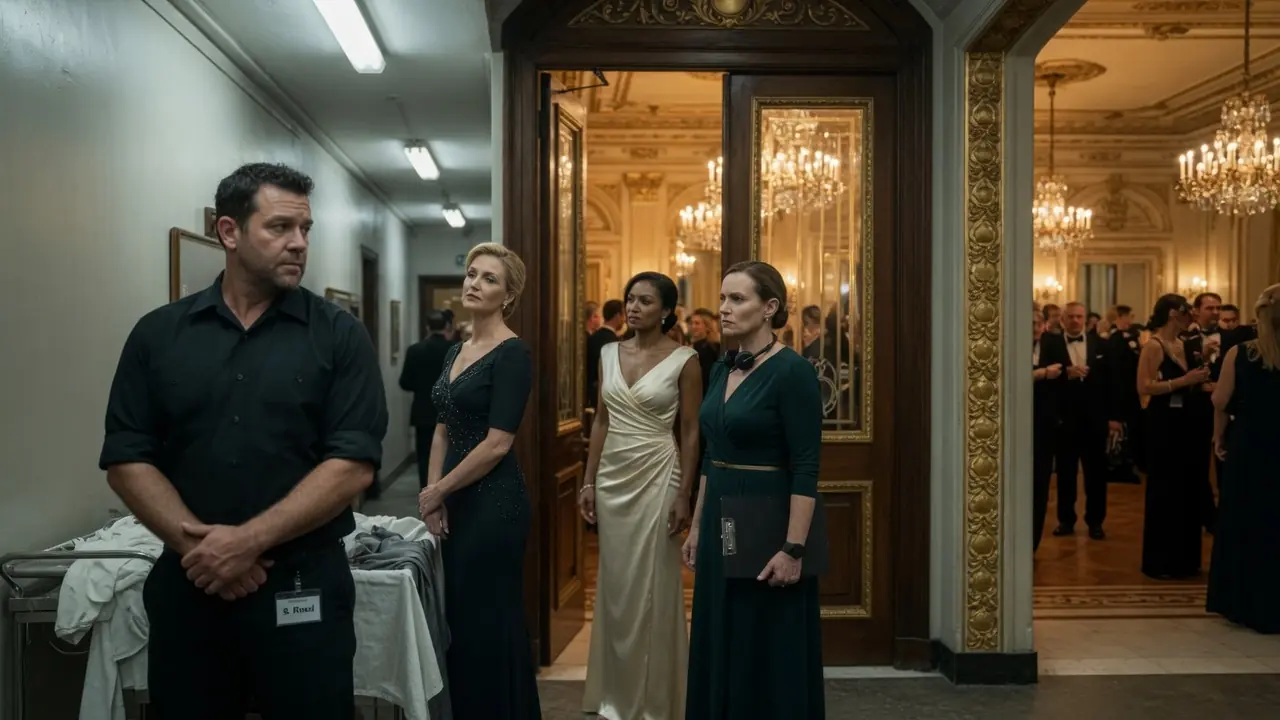
Norah had one hand on her headset and the other on a clipboard.
“I hear you are still supporting Walter’s version of events,” Vanessa said.
“I am supporting the truth.”
“Truth is not always simple.”
“It was simple. You leaned on the case.”
Vanessa smiled without warmth.
“My father is opening a resort in Naples next spring. He needs an event producer. The budget is large.”
Norah looked at her.
“Congratulations.”
“You could have the job.”
“I’m busy.”
Vanessa’s smile slipped.
“You do not even know the number.”
“I don’t need to.”
Vanessa stepped closer.
“Why are you doing this? For Walter? For that porter?”
Norah did not answer.
Vanessa glanced toward the service hallway. Silas was stacking banquet chairs at the far end.
“He is a poor single dad working temporary shifts,” Vanessa said. “He has a child. He has no future to offer you.”
Norah stared at her. Then she said, “You don’t know anything about him.”
“I know enough.”
“No,” Norah replied. “You know what he wears to work.”
Vanessa’s jaw tightened. Norah lowered her voice.
“You are offering me a contract if I help you hurt people who cannot fight back. Keep it.”
“You would throw away an opportunity like that?”
“I would throw away any opportunity that asks me to make a decent man feel small.”
Vanessa’s eyes flashed.
“You are choosing him.”
Norah looked at Silas, then back at Vanessa.
“I am choosing not to become you.”
Silas heard every word. He stood behind the service door unseen. And for the first time in ten days, he felt something close to fear.
Not because Norah might walk away, but because she deserved the truth. She had protected Lily’s heart. She had defended Walter. She had turned down money and influence before she knew who he was.
And Silas was still hiding the one thing that could change everything.
The next night, the gala brought them back to the marble fountain. Vanessa had just insulted Lily. Silas had drawn a line. Norah had stepped forward.
Miss June took Lily upstairs to the rooftop garden, and Norah watched them enter the elevator before returning to the ballroom.
At 9:30, Diane Reed arrived. She wore a navy gown and the gold watch Silas’s father had given her forty years earlier. The room shifted the moment she entered.
People stood straighter. Conversations softened.
Vanessa approached her immediately.
“Mrs. Reed,” she said brightly. “What a surprise.”
“It’s Diane.”
“Of course. Diane, we are honored you came.”
“I imagine you are.”
Vanessa smiled, unsure whether that was kindness or warning.
“I hope your son is doing well,” she said.
“He is.”
“I would love to meet him someday.”
Diane’s eyes moved past Vanessa, across the ballroom to Silas in his porter uniform. Then back.
“You may already have.”
Vanessa blinked. Before she could ask what that meant, the auction host stepped onto the stage.
The night moved forward. Speeches, pledges, applause, a short film about the children’s fund. Then the live auction began.
The first item sold for $70,000. The second went for $120,000. Vanessa raised her paddle for a private coastal retreat and smiled as people applauded.
Then Camille stepped onto the stage beside the host. She held a microphone in one hand.
“Before we continue,” she said, “I want to address a small matter from our preparations this week. An archival display was damaged during setup due to a staff handling error. The Ashford House has taken prompt action, and our guests can be assured that the matter has been handled responsibly.”
Norah’s face changed. Silas felt the room tighten.
Camille had just told a polished lie in front of four hundred people.
Norah stepped toward the stage.
“No,” she said.
Camille turned.
“Norah, please.”
“No.”
Norah climbed the two steps to the stage. She took the microphone carefully from Camille’s hand.
“That statement is not true,” she said.
A wave of whispers moved through the ballroom. Camille’s smile froze.
“This is not the time.”
“It is exactly the time,” Norah replied. “A decent man has spent two days wondering whether he would lose his career because someone with more money refused to admit what she did.”
Vanessa stood from her table.
“That is not what happened.”
“It is,” Norah said.
“You are accusing me in front of everyone.”
“I am telling the truth in front of everyone.”
Camille stepped closer.
“This is inappropriate.”
“What was inappropriate,” Norah said, “was trying to blame Walter Morales because he had less power than the person who caused the damage.”
Vanessa’s face hardened.
“You are really risking your company over a porter.”
Norah turned toward Silas. The ballroom watched her. Silas watched her.
Norah’s voice did not shake.
“I am not risking my company.”
Vanessa laughed bitterly.
“You are choosing a poor single dad with a child.”
Norah looked directly at Silas. Then she answered.
“Yes.”
The room went still.
“I am choosing the man who stops whatever he is doing when his daughter needs him. I am choosing the man who helped exhausted employees when no one important was watching. I am choosing the man who refused to lie when people tried to use his daughter’s future to frighten him.”
She held Silas’s eyes.
“If all he ever offered was honesty, hard work, and a home where a little girl feels safe, I would still choose him.”
For one second, nobody moved.
Then Diane Reed stood. The scrape of her chair across the floor somehow reached every corner of the ballroom. She walked toward the stage.
Miles Hennen, the Ashford House general manager, followed her. So did Crestline’s compliance director and two members of the foundation board.
Vanessa’s face lost color. Camille stepped back.
Diane reached the stage and looked at Silas.
“Please come up here,” she said.
Silas walked beside her. Then he removed the plastic badge from his jacket. Reed.
He held it in his hand.
Diane turned to the room.
“This is my son,” she said.
The ballroom went silent. Then came the whispers. Sharp, confused, unbelieving.
Diane continued, “This is Silas Reed, majority owner of Crestline Hospitality, the man some of you have been waiting to meet.”
Vanessa stared at him. Camille looked as though the floor had shifted beneath her.
Silas removed the black banquet jacket. Underneath, he wore a simple white dress shirt. Not a costume, not a disguise, just the man he had been all along.
He took the microphone.
“I did not come here to embarrass anyone,” he said.
His voice was calm, but it carried.
“I came here because this hotel received reports from people who believed no one would hear them. Housekeepers, servers, dishwashers, porters, people who thought their jobs could disappear if they told the truth.”
He looked toward the staff gathered near the back wall.
“I needed to understand what happened when leaders were not watching.”
Then he looked at Camille.
“And now I do.”
Camille tried to speak.
“Silas, this has been misunderstood.”
“No,” he said. “It has been understood very clearly.”
Miles stepped forward.
“Security footage, witness statements, and compliance records confirm that Walter Morales secured the Harrow Ledger display properly. He has been cleared.”
A quiet sound moved through the staff at the back of the ballroom. Relief.
Silas continued.
“Camille Hartwell attempted to pressure a temporary employee to give a false statement. That conversation was overheard, reported, and documented.”
Camille’s face tightened.
“I was protecting the foundation.”
Silas looked at her.
“You were protecting the person with money.”
The words were quiet. They did not need to be louder.
Miles spoke again.
“Miss Hartwell will be removed from gala leadership pending an independent review. Crestline will also review all employee complaints connected to this event.”
Vanessa stepped toward Silas.
“I didn’t know who you were,” she said.
He looked at her.
“That is the point.”
Her eyes filled.
“I made a mistake.”
“You made a choice.”
“I can change.”
“Maybe you can,” Silas said. “But change begins when you admit what you believed before the room changed.”
Vanessa looked toward the balcony entrance. Lily had returned with Miss June and stood beside Norah for the first time that night.
Vanessa seemed to understand what she had done. Not to a billionaire’s daughter. To a child.
Silas turned back to the ballroom.
“No worker in this company should have to earn basic respect because of a name badge,” he said. “No parent should fear losing a job for telling the truth. No donor, executive, guest, or board member is more important than the dignity of the people who keep this place alive.”
He looked toward Walter’s empty station beside the ballroom doors.
“Walter Morales will return to work tomorrow.”
The applause began near the back. Not from donors, but from the staff, the housekeepers, the servers, the kitchen crew, the people who had been invisible until that night.
Norah stood beside Lily, tears in her eyes. Silas looked at her for the first time since she said she would choose him.
He could not find words.
Three weeks later, the independent review was complete. Camille Hartwell resigned before the foundation board could vote on her removal. The findings documented donor favoritism, retaliation against junior employees, and repeated pressure placed on staff to soften or alter incident reports.
There was no courtroom, no handcuffs, no impossible revenge, just consequences.
Camille lost the title she had used to control people. She lost the trust she had built by performing kindness.
One rainy afternoon, she returned to the Ashford House alone. No assistant, no board members, no polished speech prepared for an audience.
She found Tasha in the employee cafe for a moment. Camille stood there without speaking.
Then she said, “I came to apologize.”
Tasha looked at her.
“For what?”
Camille swallowed.
“For making you afraid to tell the truth.”
Tasha said nothing. Camille lowered her eyes.
“I kept telling myself I was protecting the hotel, protecting the foundation, but I was protecting myself. I wanted powerful people to like me more than I wanted honest people to feel safe.”
Tasha looked at her for a long time.
Then she said, “That is what it felt like.”
Camille nodded. She was not forgiven that day. She did not ask to be for the first time. She left without demanding that someone make her feel better.
Vanessa’s consequences were quieter. Her father removed her from leadership in the family foundation. The Cole family’s future partnerships with Crestline were placed under new conduct requirements, and the influence Vanessa had assumed came with money no longer opened doors for her.
Two months later, she returned to the Ashford House. She found Lily in the rooftop garden with Miss June. Lily was drawing with chalk on the stone path.
Vanessa stood several feet away.
“I’m sorry,” she said.
Lily looked up.
“For what?”
“For saying you didn’t belong.”
Lily considered that. Then she said, “My dad says people belong where they are treated right.”
Vanessa’s eyes filled. No one was watching.
“I think your dad is right,” she said.
Lily went back to drawing. Vanessa stood there for another moment. Then she left quietly.
Norah did not forgive Silas immediately. That mattered.
Three days after the gala, she met him in the hotel courtyard. He wore jeans, a gray sweater, and the tired expression of a man who had spent too many nights wondering whether he had ruined something honest.
“I should have told you,” he said.
Norah looked at him.
“Yes.”
“I thought if I told you too soon, I would never know what people really thought.”
“And after you started letting me know you?”
Silas said nothing.
Norah’s voice softened. “You did not owe me your money on the first day. You did not owe me your family history. But once Lily trusted me, once I trusted you, you owed me the truth.”
“I know.”
“You asked people to show you who they were while you were hiding who you were.”
“I know.”
Silas did not defend himself. He did not say he did it for Lily. He did not say his mother suggested it. He did not say he had a good reason.
He simply stood there and accepted that a good reason could still hurt a good person.
Norah looked at him for a long time.
Then she said, “I chose the man I knew.”
Silas lowered his eyes.
“And now?”
“Now you have to show me that man was real.”
He nodded.
“He was.”
“Then prove it slowly.”
So he did.
Norah did not move in. Lily did not call her anything except Norah. Silas did not bring her into every family memory or expect her to heal every quiet room.
They moved carefully. Sunday dinners. School pickup when Miss June had an appointment. A paper moon charm on Lily’s bracelet fixed twice because Lily kept catching it on sweaters.
Norah did not replace Maya. She respected the space Maya left behind. And over time, Lily began to feel something she had not felt in a long while.
Not less grief. Just less loneliness.
Six months later, Silas and Lily sat at the kitchen table after dinner. Norah had left twenty minutes earlier, promising to bring pancakes the following Sunday.
Lily swung her feet beneath the chair.
“Dad.”
“Yeah?”
“Norah doesn’t make me miss Mom less.”
Silas looked at her.
“I know.”
“She just makes the house feel less quiet.”
Silas swallowed. Then he reached across the table and took his daughter’s hand.
“That is a good thing,” he said.
“I think so, too.”
One year after the gala, Silas took Norah and Lily to the rooftop garden at the Ashford House, the same garden Lily had wanted to see on the night Vanessa told her she did not belong.
Savannah shimmered below them. The city lights looked like scattered stars. Lily stood near the railing with hot chocolate in both hands.
Norah stood beside her. Silas reached into his jacket pocket. Lily saw the small box first, and her eyes widened.
“Dad.”
Silas smiled.
“What?”
“You’re doing it.”
“I think I am.”
Norah turned. Silas took her hand.
There was no crowd, no donors, no cameras, just the rooftop garden, the soft lights, and the family they had built slowly enough to trust.
“Nobody could ever replace Maya,” Silas said. “She will always be Lily’s mother. She will always be part of our lives.”
Norah’s eyes filled. Silas opened the box.
“But you taught us that love does not have to erase memory. You taught Lily that care can be patient. And you taught me that truth matters most when it costs something.”
He held out the ring.
“I did not come looking for someone to fill an empty chair. I came looking for someone safe enough to share a table with us.”
Norah covered her mouth. Silas looked at her.
“Will you marry me?”
Norah looked at Lily. Lily smiled into her hot chocolate. Then Norah looked back at Silas.
“Yes,” she said.
Lily ran toward them. Silas lifted her into his arms, and Norah wrapped both of them in a hug.
For a moment, nobody spoke. Then Lily looked at Norah.
“You know you don’t have to be my mom, right?”
Norah smiled through tears.
“I know.”
Lily nodded.
“Good.”
She thought for another second.
“But you can come to Sunday dinner every week.”
Norah laughed.
“I would like that very much.”
Below them, the Ashford House glowed against the Savannah night. Inside, housekeepers changed sheets. Servers cleared tables. Bellmen carried bags. Security guards watched doors.
And somewhere in a service hallway, another worker probably wondered whether anyone noticed them at all.
But at Crestline, things had changed. Not because a billionaire revealed himself. Not because a powerful man finally spoke. But because a single father remembered something simple.
The way people treat someone with no power tells the truth about who they are.
And sometimes the woman who chooses a man before she knows his worth becomes the person who teaches him what real worth looks like.