Winslow is the kind of town where the wind remembers everything.
It carries train horns across the flats at night. It drags dust along Route 66 until storefront windows look tired by noon. It rattles the chain-link fences behind gas stations and makes old motel signs hum even when no rooms are lit.
At 3 p.m., Desert View Elementary becomes the loudest place in town.
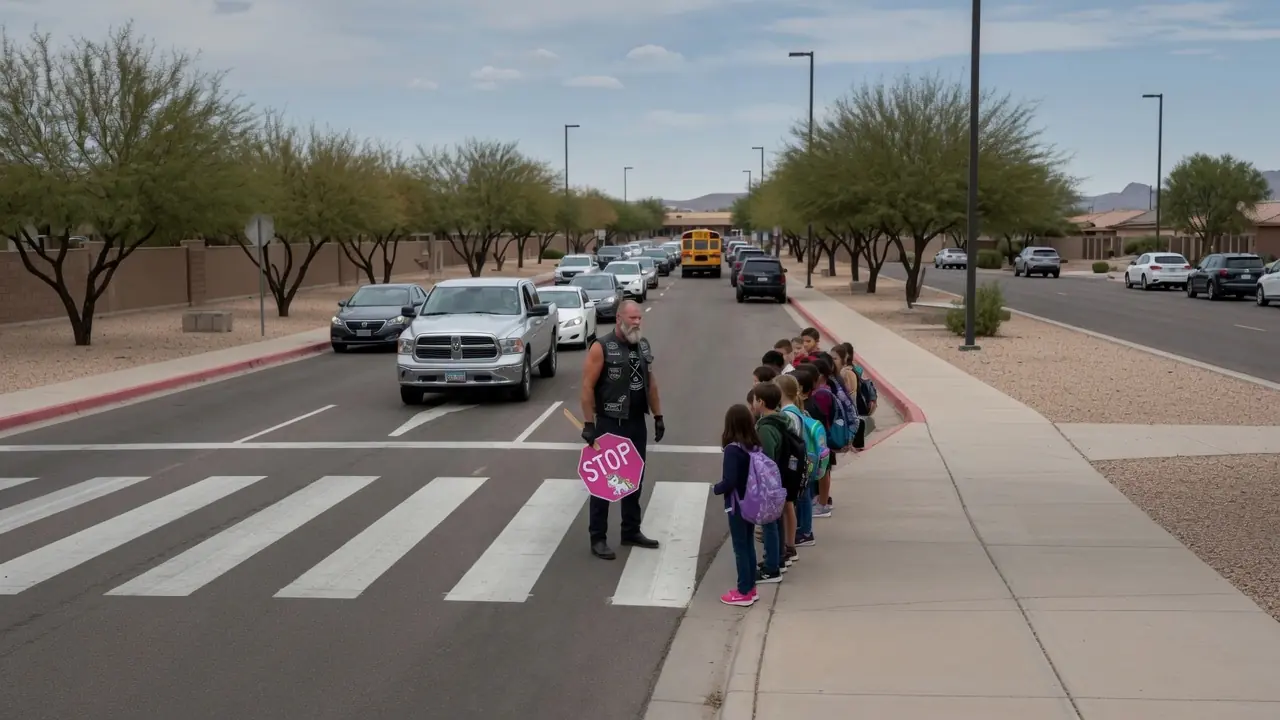
Children pour through the front gates with jackets half-zipped, folders bent under their arms, lunchboxes swinging hard enough to bruise knees. Parents idle in trucks and minivans. Teachers wave cars forward with exhausted smiles. The crossing light blinks yellow over the white stripes on Ash Street, blinking and blinking like a warning nobody takes seriously enough.
And then Cole Maddox arrives.
You always hear him first.
His Harley does not scream. It rumbles low and uneven, like thunder trapped under asphalt. He comes from the east, past the tire shop and the boarded-up motel office, wearing a black helmet, black gloves, black boots, and a black leather vest with a faded club patch across the back.
At exactly 3:06, he rolls to the curb.
He cuts the engine.
The quiet afterward feels heavier than the noise.
Then his boots hit the pavement.
Thump.
Thump.
Thump.
He reaches into his saddlebag and pulls out a small pink stop sign with chipped paint and a unicorn sticker peeling off one corner.
The first few weeks, people said he was unstable.
The next few weeks, they said he was looking for trouble.
By the end of the semester, even the drivers who complained about him slowed down before they reached the crosswalk.
Cole never smiled much at the children. His face did not seem built for it. But he counted them. I saw his lips moving every afternoon.
One.
Two.
Three.
Four.
His eyes moved over everything: bumpers, tires, drivers’ hands, phones glowing in laps, brake lights, impatient faces behind windshields. He watched the road like it had already betrayed him once and he expected it to try again.
He never grabbed a child.
Never cursed at a driver.
Never hit a hood.
He simply stepped into the street and stood there.
That made him harder to understand.
My name is Nora Whitfield, and my son Ben was in third grade at Desert View that year. I asked questions because mothers ask questions, and small towns reward curiosity with pieces of information whether you deserve them or not.
Cole’s full name was Coleman Maddox, though his club called him Iron. He had worked at a welding shop outside town for nearly thirty years. The name fit him, people said, because sparks could hit him and he would not flinch.
He rode with a small club called the Canyon Riders.
Not famous.
Not flashy.
Just thirteen men with old bikes, sore backs, ex-wives, bad reputations, and a habit of showing up when someone needed a funeral escort, a busted water heater fixed, or a winter coat delivered to a reservation school north of town.
Cole was not a saint.
That matters.
He had two DUIs in his twenties. Ninety days in county after a bar fight that broke another man’s jaw. A divorce that left scars on both sides. A grown daughter in Tucson who, according to the waitress at the Turquoise Diner, “still loved him, but from a distance, because sometimes distance is the only way love survives.”
So no, Cole Maddox was not a clean hero waiting to be discovered.
He was a complicated man standing in a crosswalk with a pink sign.
And there was one detail nobody could explain.
On the right side of his leather vest, just below the chest patch, was a dark brown stain shaped like a hand had dragged downward across the leather.
Most people assumed it was grease.
Oil.
Something from the road.
Cole never explained it.
But every afternoon before the bell rang, he touched it.
Two fingers.
Once.
Then he stepped into the street.
I noticed the stain because mothers notice stains. We notice them on shirts, backpacks, car seats, sidewalks. We notice what other people learn to ignore.
Once, after soccer practice, Ben and I took a wrong turn past the old feed store where Cole rented a little place behind the loading dock. His garage door was half open. Blue sparks flashed from a grinder inside. A yellow mutt slept near the doorway with one ear lifted.
On a hook beside Cole’s workbench hung a child’s crossing vest.
Bright orange.
Tiny.
Too small for any adult.
I must have stopped too long, because Cole looked up and saw me looking.
He lowered the garage door.
Not with anger.
With fear.
That was the first crack.
The second was the day the white pickup came too fast.
It was a Thursday in late April, the kind of Arizona afternoon where heat rose off the asphalt before summer had even officially arrived. Wind scattered homework pages across the lawn, and the children were louder than usual because state testing had ended that morning.
Freedom makes children careless.
Cole arrived at 3:06.
Engine.
Silence.
Boots.
Pink sign.
Everything the same.
Ben stood beside me holding a drawing of a lizard wearing sunglasses.
“Mom,” he whispered, pointing toward Cole, “why does the motorcycle man always look angry?”
I almost said, “Because he is.”
But that was not true.
Cole did not look angry at the children.
He looked angry at the world around them.
The pickup came from the west.
White Ford. Dusty windshield. Construction rack. A man in sunglasses behind the wheel. Not drunk. Not racing exactly. Just too fast for a school zone, with the casual carelessness of someone who believed saving three seconds was worth more than the safety of strangers.
Cole saw it before the rest of us did.
His head turned.
His shoulders squared.
Three children had already stepped off the curb, laughing, one of them dragging a backpack with squeaky wheels.
Cole moved.
Not like a young man.
Like an old wound ripping open.
He stepped into the lane and planted the pink stop sign in front of his chest.
The truck braked hard.
Tires screamed.
The sound tore through the schoolyard.
Every adult froze.
The pickup stopped maybe five feet from Cole’s knees.
Dust rolled past his boots.
For one second, nobody breathed.
Then the driver leaned on the horn.
Long.
Ugly.
Cole did not move.
The children scrambled back to the curb.
The driver shoved his door open and jumped out.
“What the hell is wrong with you, old man?”
Cole lowered the sign.
His hands were shaking.
That is what I remember most.
Not his size.
Not the tattoos.
Not the truck.
His hands.
They were shaking with something older than fear.
The driver kept yelling. He said he was late. He said Cole was blocking traffic. He said Cole had no right to play cop. His voice got louder with every sentence because men like that think volume can erase shame.
Cole said nothing.
A teacher called 911.
Another parent started recording.
Children watched from behind the fence with wide eyes.
Then the driver shoved the stop sign.
It clattered onto the asphalt.
That was the moment everyone expected violence.
A tattooed biker.
A disrespectful driver.
A hot afternoon full of screaming tires and children watching.
Cole’s right hand curled into a fist. His jaw worked. His chest rose hard beneath the leather vest. For half a second, I saw the man people had been afraid of from the beginning.
Then he looked down at the sign.
The unicorn sticker had scraped white against the pavement.
He opened his fist.
Slowly, he bent, picked up the sign, and held it out to a little girl crying on the curb.
“Hold this for me, sweetheart,” he said.
His voice was rough.
But gentle.
The little girl took it with both hands.
Cole turned back to the driver.
“If you’re late,” he said, “then be late.”
The police arrived seven minutes later.
Officer Grant Holloway knew Cole by name. That seemed important, though I did not understand why yet. He spoke in a low voice, trying to get Cole out of the road.
Cole refused.
The driver demanded Cole be arrested.
Parents whispered.
The principal, Mrs. Ellery, came out pale and flustered, holding a radio in one hand.
Cole kept his boots planted on the white crosswalk lines.
Officer Holloway finally wrote him a citation for obstructing traffic. I remember the scratch of the pen on the ticket pad. I remember Cole taking the ticket with two fingers, folding it once, and tucking it into his vest without reading it.
Then he turned back toward the children.
“Cross,” he said.
And they did.
That should have been the end of it.
The town should have argued about Cole for a few days, then moved on the way towns do. Some people would say he was a hero. Others would say he was a menace. The principal would hold a meeting. The school board would issue a statement. The pickup driver would tell his version at the hardware store.
But one woman had been sitting in a parked blue sedan across the street the entire time.
She had not filmed.
She had not shouted.
She had not gotten out during the confrontation.
She was a Black woman in her mid-thirties, with tired eyes and both hands gripping the steering wheel so tightly I could see it from the curb. In the back of her car sat a folded wheelchair.
When the last child crossed, she opened her door.
And Cole Maddox, the man no pickup truck could move, went still like he had seen the dead step into daylight.
Her name was Denise Carter.
I knew that only because everyone in Winslow knew her son’s name.
Malik Carter.
Three years earlier, Malik had been seven years old, a second grader at Desert View Elementary. Funny. Fast. Missing both front teeth. Always wearing one green shoe and one orange shoe because he said matching was for people with no imagination.
On September 18, Malik stepped into that same crosswalk after school.
A driver rolled through the blinking light.
Not drunk.
Not evil.
Just looking down.
The SUV hit Malik hard enough to throw his small body across the lane.
That was the part people whispered about.
The part they did not say was what happened next.
Cole had been at the gas station on the corner, filling his Harley. He heard the impact. Heard the scream. Dropped the gas nozzle and ran.
He reached Malik before the teachers did.
Before the ambulance.
Before Denise, who was four blocks away, trapped behind a freight train.
Cole found the boy on the asphalt, backpack torn open, crayons scattered around him like bright little bones.
He did what people tell you not to do unless there is no choice.
He lifted him.
Not because he thought he knew better.
Because Malik’s face was against the burning road and blood was pooling under his cheek, and Cole could not leave a child lying that way.
He held Malik against his chest until the ambulance came.
Blood soaked into the right side of his leather vest.
That was the stain.
Not oil.
Not grease.
Not road dirt.
A child’s blood.
Dried into leather by an afternoon almost everyone had learned to stop mentioning because pain makes pickup lines uncomfortable.
Everyone except Cole.
Denise walked toward him slowly.
The road had gone quiet.
Even the pickup driver stopped talking.
Cole’s face changed in a way I had never seen before. All the hardness fell out of it, and what remained was not softness exactly.
It was age.
It was guilt.
It was a man still standing at the same place where his life had stopped moving properly.
Denise stopped two feet from him.
“You’re the man from that day,” she said.
Cole looked at the pavement.
“Yes, ma’am.”
“I never got your name.”
“Cole.”
She looked at the Harley parked near the curb. The pink stop sign. The ticket sticking out of his vest pocket. The children walking safely behind him.
Then she asked the question that broke him.
“Why do you keep coming back?”
Cole swallowed.
Once.
Twice.
He did not look at her when he answered.
“Because I was here when it happened.”
Denise’s mouth tightened.
“That is not an answer.”
Cole touched the stain.
Two fingers.
Same as always.
“Blood don’t come out of leather right.”
Denise stared at his vest.
At the dark mark under the patch.
At the shape of something that had once been her son’s small hand dragged across a stranger’s chest.
Her face folded.
“Oh my God.”
Cole’s voice dropped even lower.
“Tried to wash it once.”
He breathed out slowly.
“Couldn’t.”
Denise covered her mouth with both hands.
For three years, she had believed the world remembered Malik only as a sad school announcement, a safety assembly, a name people lowered their voices around for a few months before they went back to honking at the crosswalk.
For three years, Cole had carried proof that one stranger remembered the exact weight of her son.
Denise whispered, “I thought everybody forgot him.”
Cole finally looked at her.
His eyes were wet.
No tears fell.
“Ma’am,” he said, “your boy is on my vest.”
That was the truth nobody had known.
Cole was not standing at that intersection because he wanted to be a hero.
He was standing there because he had never survived leaving.
After that, nobody knew what to do with their hands.
Mrs. Ellery cried quietly near the school gate. Officer Holloway took off his sunglasses and stared toward the desert as if the horizon had become very important. The pickup driver got back into his truck without another word.
Denise stood in front of Cole, still looking at the stain.
Then she reached toward it and stopped.
“Can I?” she asked.
Cole nodded.
She touched the old mark with two fingers.
Not the leather.
The memory.
“My son is alive,” she said, almost like she needed to say it out loud. “He is alive. He’s at therapy right now. He hates it. Throws foam blocks at the wall and tells the therapist her office smells like old crackers.”
A laugh broke from her mouth and turned into a sob before it finished.
Cole’s mouth twitched.
“Sounds stubborn.”
“He is.”
She wiped her face.
“But he thinks people only remember the accident. He thinks nobody remembers the boy he was before the chair.”
Cole looked down.
“I do.”
That was when Officer Holloway told us the rest.
Cole had not only stood in the crosswalk.
He had helped pay for the lights.
Not by himself. Not officially. But through the Canyon Riders.
Two years earlier, after the town council delayed upgrading the crossing beacon because “funding was complicated,” Cole and his club organized a ride from Winslow to Holbrook and back. They called it the Slow Down Run.
No speeches.
No big press.
Just bikes, donation jars at the Turquoise Diner, helmets passed through the crowd, and old riders putting cash where grief had nowhere else to go.
The money went into a traffic safety fund.
Most of us never knew.
Cole did not want his name on anything.
There was no plaque anyway.
The town used the money, added a grant, and installed brighter crossing lights.
Still, cars sped.
So Cole stood there.
The tiny orange vest I had seen in his garage belonged to Malik too, in a way. It was not the original. It was a replacement vest from the school supply closet. Cole had asked for one after the accident and hung it beside his workbench so he would see it every morning.
His club hated what the intersection did to him.
They watched him lose weight that first year. Watched him stop sleeping. Watched him ride home from the school, sit in the garage with the engine off and his helmet still on, unable to get off the bike.
One brother, Caleb “Deacon” Rowe, finally told him, “You can’t bleed forever for a boy who lived.”
Cole punched the garage wall hard enough to split his knuckles.
Not at Deacon.
At the truth in it.
The club almost dragged him away from the crosswalk by force.
Then the oldest rider, Mateo Cruz, said, “If he’s going to stand there, we stand close enough to catch him.”
After that, one brother sat in the diner every afternoon where he could see the intersection. Another drove past at 3:20. Deacon, the one who had spoken the hard truth, started leaving cold water in Cole’s saddlebag when summer came.
Brotherhood is not always men agreeing with you.
Sometimes it is men refusing to let your grief turn you into a ghost.
Denise listened to all of this with one hand still near the stain.
Then she asked, “Have you ever seen Malik since that day?”
Cole shook his head.
“No, ma’am.”
“Why not?”
His jaw tightened.
“Didn’t figure I had the right.”
She stared at him.
“You carried my child until help came.”
Cole looked away.
“I carried him after I failed to stop the car.”
“You did not hit him.”
“I heard it.”
“That is not the same thing.”
“It is in my head.”
That sentence landed hard.
Not dramatic.
Just honest.
Denise understood then.
So did I.
Cole had sentenced himself to that crosswalk every afternoon.
No judge.
No jury.
No release date.
Denise stepped closer.
“You want to know what Malik remembers?”
Cole did not answer.
Denise said, “He remembers leather. Gasoline. A beard scratching his cheek. And somebody saying, ‘Stay with me, little man.’ He does not remember the car. He remembers you.”
Cole’s face broke for one second.
Only one.
Then he looked down, ashamed of even that much feeling.
Denise pulled out her phone.
Her hands shook as she opened a photo.
Malik was in it, ten years old now, sitting in a wheelchair beside a basketball hoop, grinning at the camera with one green shoe and one orange shoe.
Still mismatched.
Still Malik.
Cole stared at the screen like it might burn him.
“He got big,” he whispered.
“He wants to meet you.”
Cole stepped back.
The big man with tattoos, boots, and a bloodstained vest looked terrified.
Denise held the phone out a little farther.
“Not today if you are not ready. But do not stand here thinking he forgot you.”
The school bell had long stopped echoing.
The street was empty now.
For the first time in three years, Cole was not standing at the crosswalk because children needed crossing.
He was standing there because someone had finally crossed back to him.
A week later, Cole returned at 3:06.
Engine.
Silence.
Boots.
Pink sign.
Same as always.
But something had changed.
Not in what he did.
In how the town saw it.
Parents stopped complaining. Some started parking farther back so traffic would not bunch up at the crosswalk. Mrs. Ellery put orange cones near the curb. Officer Holloway still watched him sometimes, but the ticket pad stayed in the patrol car.
On the second Thursday in May, the Canyon Riders arrived.
Thirteen bikes rolled in from the east, slow and steady, not loud enough to show off, just loud enough to tell every driver the road had witnesses. They parked along the shoulder, engines ticking in the heat.
Cole looked annoyed.
Which meant he was grateful.
Deacon handed him a bottle of water.
“Shut up,” Cole said.
“I didn’t say anything.”
“You were going to.”
Deacon grinned.
The children loved the bikes. Teachers looked nervous until the riders took off their gloves and helped carry backpacks to parents’ cars. One old biker with a white beard let a first grader put a glitter sticker on his helmet.
He left it there.
That same day, Denise brought Malik.
Cole saw the van first.
His body went rigid.
Denise lowered the ramp. Malik rolled down backward, confident and impatient, older than the photograph in everybody’s memory. He wore one green shoe and one orange shoe. His wheelchair had scuffed wheels and a sticker on the side that said FAST ENOUGH.
Cole did not move.
Malik rolled right up to him.
“You the guy who blocks cars?”
Cole swallowed.
“Yes, sir.”
Malik looked at the Harley.
“Cool.”
Cole blinked.
That was not what he expected.
Malik pointed at the pink sign.
“That is not cool.”
Cole almost smiled.
“A girl named Ruby decorated it.”
“She has bad taste.”
“She’s seven.”
“Still.”
Denise laughed through tears.
Cole looked like he had forgotten how to breathe.
Then Malik looked at the vest.
At the stain.
“My mom says that’s mine.”
Cole’s hand twitched, but he kept it at his side.
“Yes.”
“You kept it?”
“Yes.”
“Why?”
Cole looked down at him.
Three years of afternoons sat in that pause. The honking. The tickets. The hot asphalt. The nights in the garage with the orange vest hanging by the workbench.
“Because I couldn’t put you down twice,” he said.
Malik did not cry.
Children are stronger than adults in strange ways.
He just nodded.
Then he held out a fist.
Cole stared at it.
Deacon muttered, “Don’t leave the kid hanging, brother.”
Cole bumped Malik’s fist with knuckles that said MERCY.
After that, Malik came every Thursday.
Not for pity.
For command.
He sat by the curb and yelled at speeding cars with the authority of a small-town sheriff.
“Slow down, genius!”
Cole pretended to scold him.
Denise pretended not to hear.
The crosswalk became a ritual.
Not a memorial exactly.
More like a wound learning to live in daylight.
Every afternoon, before stepping into the road, Cole still touched the stain.
But now, sometimes, Malik saw him do it.
And touched his own chest back.
By the end of that school year, the town painted fresh white lines at the intersection. The principal organized a safety day. The mayor came for photographs. The local paper wanted Cole in front.
He refused.
“Put the kid there,” he said.
So they did.
Malik sat in the center of the photo, one green shoe and one orange shoe, grinning like he had stolen something back from sorrow. Denise stood behind him. Cole stood off to the side, half out of frame, arms crossed, looking uncomfortable enough to be honest.
The article called him a hero.
He hated that.
“Heroes go home clean,” he told me once.
It was the most he ever said about it.
That summer, after the last day of school, I saw Cole alone at the crosswalk.
No children.
No parents.
No traffic.
Just him, the Harley, and heat lifting off the road.
The pink stop sign rested against his leg.
The engine ticked behind him.
Leather creaked when he reached for the stain.
Then a van pulled up.
Malik rolled down the ramp wearing those mismatched shoes. Denise followed with a small folded piece of cloth in her hand.
She handed it to Cole.
A new vest patch.
Black background.
White letters.
NO CHILD CROSSES ALONE.
Cole stared at it for a long time.
Then he took off his leather cut and let Denise pin the patch above the old brown stain.
Not over it.
Never over it.
Above it.
The Harley started low and rough when he finally left. Its red taillight moved down Route 66, past the school, past the diner, past the place where grief had nailed him to the road for three years.
This time, he looked back once.
Then he rode on.