The line behind Mrs. Alma Jefferson had grown long enough for people to stop pretending they were patient.
It started with one sigh.
Then another.
Then the soft tap of expensive shoes against the marble floor.
Then a man in a gray suit muttered, “Unbelievable,” just loud enough for everyone to hear but not loud enough to make himself responsible for saying it.
Alma heard all of it.
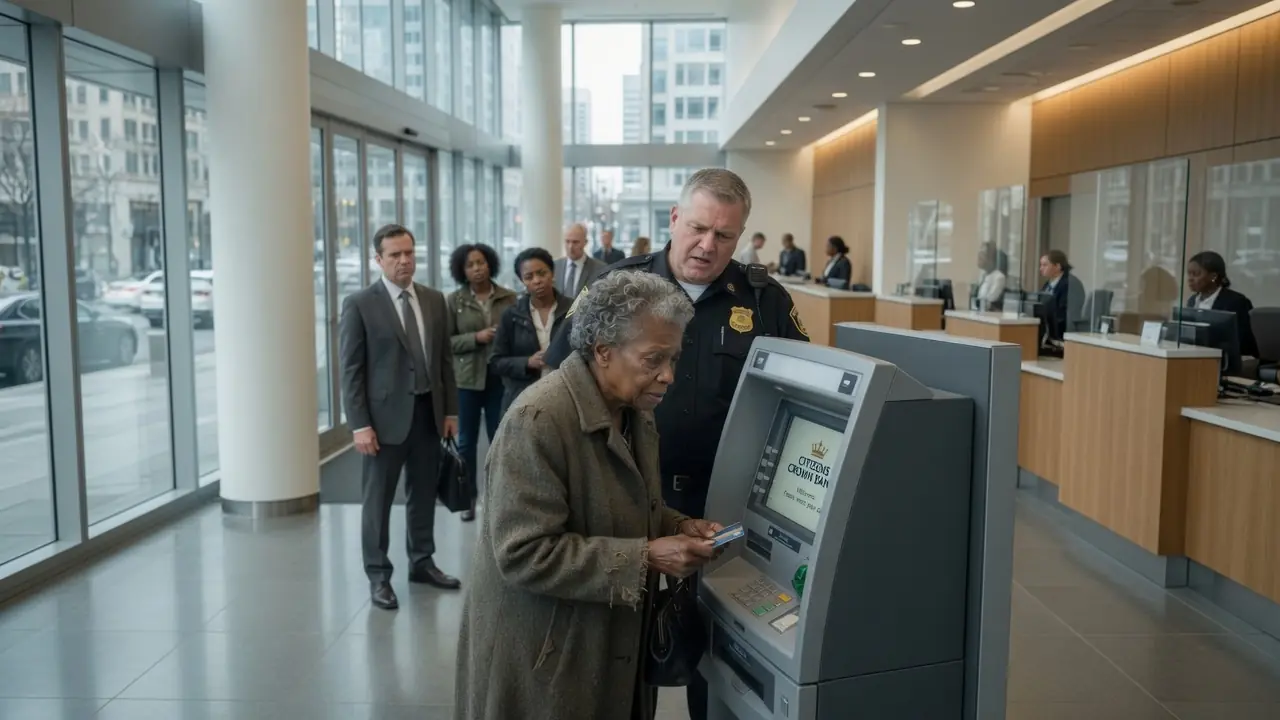
She was eighty-one years old, though she still stood straighter than most people half her age. Her Sunday hat was pale blue, pinned carefully over silver curls. Her coat was clean but old, the cuffs shiny from years of wear. She held a black handbag against her chest with one hand and a bank card in the other, gripping it as if it were something delicate and dangerous.
In front of her, the ATM screen glowed cold and bright.
PLEASE INSERT CARD.
Alma stared at the slot.
There were three different openings on the machine. One for receipts. One for cash. One for the card. The little arrow beside the card slot blinked green, but her eyes were not what they used to be, and her hands had begun trembling the moment she realized people were waiting.
She turned the card one way.
Then the other.
Behind her, someone clicked their tongue.
“Ma’am,” the gray-suited man said, “some of us have places to be.”
Alma looked back.
“I’m sorry, baby,” she said softly. “I’m just trying to get it right.”
He rolled his eyes.
The bank lobby was beautiful in the cold way rich places often are. White stone floors. Tall windows. Brass fixtures. A fountain near the entrance that made a gentle sound nobody actually listened to. Citizens Crown Bank sat in the middle of downtown Charlotte, occupying the first two floors of a glass tower where people wore tailored suits and spoke into wireless earpieces while walking too fast.
Alma had come by bus.
She had taken two transfers.
She had dressed carefully.
She had written her questions on a folded piece of paper and tucked it inside her handbag.
She had not come often since her husband died. He used to handle the machines, the screens, the passwords, the little slips of paper that came out with numbers on them. Alma had always preferred tellers. She liked looking a person in the face when money changed hands. But the teller line was closed for staff training, and the sign had pointed customers toward the ATM lobby.
So there she stood, with her card in her hand and six people waiting behind her.
She tried again.
The card went in halfway, then stopped.
She pulled it back quickly, afraid she had broken something.
Another sigh rose behind her.
This time louder.
Near the entrance stood a security guard named Curtis Blake.
He had watched the whole thing from beside the velvet rope. He was in his mid-forties, tall and heavyset, with a shaved head, a black uniform, and a badge that seemed to have given him a larger opinion of himself than the job required.
He glanced at the line.
Then at Alma.
Then at the card in her hand.
His mouth tightened in annoyance.
“Ma’am,” he called. “Step aside if you don’t know what you’re doing.”
Alma turned slowly.
“I’m trying,” she said.
“That’s the problem,” Curtis replied. “You’ve been trying for five minutes.”
A woman in a cream coat folded her arms.
The man in the gray suit checked his watch again.
Alma looked down at the card.
Her cheeks grew warm.
“I just need to withdraw some money,” she said. “My granddaughter’s birthday is tomorrow.”
Curtis walked toward her.
His shoes struck the marble with deliberate authority.
“This isn’t a classroom,” he said. “People got business to handle.”
“I understand that.”
“No, I don’t think you do.”
The line went quiet.
There are moments when a room senses something ugly coming and chooses, all together, not to stop it.
Alma felt that shift.
She had lived long enough to recognize it.
Curtis stopped beside her.
His eyes moved over her old coat, her worn handbag, her sensible shoes, her trembling fingers, her Black face beneath the blue hat.
Then he smiled.
“Do you even have money in that account?” he asked.
A few people shifted uncomfortably.
Nobody spoke.
Alma’s hand tightened around the card.
“That is my private business.”
Curtis laughed under his breath.
“Private business. Right.”
The gray-suited man behind her smirked.
Curtis lowered his voice, but not enough.
“Look, lady, if you wandered in here trying to check whether Social Security hit, use the branch on Tenth Street. They deal with this kind of thing all day.”
This kind of thing.
Alma looked at him.
Her face did not change much, but something in her eyes did.
A little light went out.
Then came back colder.
“I have an account here,” she said.
Curtis lifted one eyebrow.
“At Citizens Crown?”
“Yes.”
“With that card?”
“Yes.”
He held out his hand.
“Let me see it.”
Alma pulled the card closer to her chest.
“No.”
His expression hardened.
“You’re holding up customers.”
“I am a customer.”
The word seemed to irritate him.
“No, ma’am. Customers know how to use the bank.”
The woman in the cream coat looked away.
The man in the gray suit chuckled.
Curtis turned toward the line as if performing for them now.
“Some people come downtown and think every shiny building is a shelter.”
Alma inhaled sharply.
That one hurt.
Not because she had never heard worse.
She had.
She had heard worse in grocery stores, hospitals, offices, and the lobby of an investment firm where a receptionist once told her deliveries went around back. She had heard worse when she was young and Jim Crow signs were still fresh in memory. She had heard worse from men who thought age made her small and Blackness made her invisible.
But she had not expected to hear it here.
Not today.
Not in the bank where her husband’s name still sat on the old account documents.
Curtis pointed toward the entrance.
“Step away from the machine.”
Alma lifted her chin.
“I need my money.”
“And I need you to stop wasting everyone’s time.”
He reached toward the card.
Alma pulled back.
“Do not touch me.”
The room froze.
Curtis’s face changed.
People like him did not enjoy being told no in public, especially by someone they believed had no power.
“You want me to call the police?” he asked.
Alma stared at him.
“For trying to use my own bank card?”
“For causing a disturbance.”
There it was.
Disturbance.
A word people used when dignity made them uncomfortable.
Alma’s lips pressed together.
Behind her, the man in the gray suit muttered, “Just remove her already.”
Curtis heard it.
So did everyone.
That gave him courage.
Not the real kind.
The cheap kind borrowed from a crowd.
“Ma’am,” Curtis said, louder now, “you need to leave.”
Alma did not move.
Her hand trembled around the card, but her feet stayed planted.
Then a voice came from the back of the line.
“She doesn’t need to leave.”
Everyone turned.
The speaker was a man in his mid-thirties wearing a brown leather jacket and carrying a courier satchel across his shoulder. He had been standing near the lobby doors, quiet until now. His name was Daniel Mercer, though no one knew that yet. He was not dressed like the bankers inside the glass offices. No tie. No polished briefcase. Just jeans, boots, and a calm expression.
Curtis looked him over.
“This doesn’t concern you.”
Daniel stepped forward.
“It concerns everyone standing here pretending not to hear you.”
The gray-suited man scoffed.
Daniel ignored him and looked at Alma.
“Ma’am, would you like some help with the card?”
Alma blinked.
For the first time since she entered the lobby, someone had asked instead of ordered.
Her voice softened.
“Yes, baby. I would.”
Daniel approached slowly, keeping his hands visible.
“May I?”
She handed him the card.
Curtis stepped in.
“Sir, don’t interfere.”
Daniel looked at him.
“I’m helping a customer use the ATM.”
“She’s been told to leave.”
“By whom?”
“By me.”
Daniel nodded once.
“Are you the branch manager?”
Curtis’s jaw tightened.
“I’m security.”
“Then secure the lobby. Don’t humiliate an old woman.”
The words landed cleanly.
A young teller behind a glass partition looked up.
Curtis’s face darkened.
Daniel turned back to Alma before the guard could answer.
“This side up,” he said gently, showing her the card. “Chip goes in first. See the little picture on the machine? It matches.”
Alma leaned closer.
“Oh,” she whispered. “I couldn’t see that little thing.”
“It’s small,” Daniel said. “They don’t make these machines friendly.”
She gave a faint laugh.
It was the first sound of comfort she had made since entering the bank.
Daniel slid the card in.
The screen changed.
PLEASE ENTER PIN.
Alma looked at him, suddenly nervous.
“I can do that part.”
“Of course,” Daniel said, turning his face away. “I’ll look over here.”
He stepped aside and looked toward the fountain.
Alma entered her PIN slowly, covering the keypad with her other hand the way her husband had taught her.
The machine beeped.
Then the screen changed.
CHECKING.
SAVINGS.
INVESTMENT ACCOUNT.
BALANCE INQUIRY.
WITHDRAWAL.
Alma hesitated again.
Daniel kept his eyes away.
“What do I press if I want to see what’s in there?” she asked.
“Balance inquiry,” he said. “Then choose the account.”
Curtis laughed.
“Going to be a long wait for eight dollars.”
The gray-suited man laughed too.
This time, two people looked uncomfortable enough to shift their weight.
Still, no one told Curtis to stop.
Alma’s finger hovered over the screen.
Then she pressed INVESTMENT ACCOUNT by accident.
The machine took a moment.
Then the screen loaded.
For two seconds, nobody understood what they were seeing.
Then the lobby went silent.
Not quiet.
Silent.
Current Available Balance:
$18,742,509.63
The numbers glowed on the screen in bright white.
Eighteen million, seven hundred forty-two thousand, five hundred nine dollars and sixty-three cents.
Curtis stopped breathing.
The man in the gray suit leaned forward.
The woman in the cream coat lowered her phone.
The teller behind the glass stood up.
Daniel stared at the screen, then quickly looked away, as if the amount was too private to keep reading.
Alma squinted.
“Did I do something wrong?”
Daniel cleared his throat.
“No, ma’am.”
She leaned closer.
“My eyes aren’t what they used to be. What does that say?”
Nobody answered.
Curtis’s face had gone gray.
Daniel spoke gently.
“It says your investment account balance is a little over eighteen million dollars.”
Alma blinked.
“Oh.”
Just that.
Oh.
As if someone had told her the weather was warmer than expected.
The gray-suited man whispered, “Eighteen million?”
Alma finally turned and looked at the people behind her.
Every face had changed.
The annoyance was gone.
The judgment was gone.
In its place stood surprise, greed, embarrassment, and something that looked a little like fear.
Curtis stepped back.
“Ma’am,” he said quickly, “there must have been some confusion.”
Alma looked at him.
“No. There was not.”
The words were soft.
They carried anyway.
Curtis swallowed.
“I didn’t realize—”
“That I had money?”
He said nothing.
Alma turned fully toward him now.
The ATM screen still glowed behind her.
“You thought I was poor, slow, and lost,” she said. “You thought my old coat told you everything. You thought my Black face meant I had wandered into a place too fine for me.”
The lobby did not move.
Curtis’s mouth opened.
Closed.
Daniel said nothing.
He did not need to.
Alma continued.
“You were not confused. You were comfortable.”
That sentence did what shouting could not.
It made the room look at itself.
At that exact moment, a glass office door opened near the back of the branch.
A woman in a navy suit hurried out, followed by two bankers.
Her name was Evelyn Porter, branch manager.
She had been in a meeting when a teller quietly sent her a message.
Security issue in ATM lobby. Elderly client being removed. Possible account holder.
The second message had been shorter.
You need to come now.
Evelyn reached the ATM area and stopped when she saw Alma.
Then she saw the screen.
Her eyes widened.
“Mrs. Jefferson?”
Alma looked at her.
“Yes?”
Evelyn’s face drained.
“Mrs. Alma Jefferson?”
“Yes, baby. That’s me.”
Evelyn turned sharply toward Curtis.
“What happened?”
Curtis tried to speak.
Daniel answered instead.
“This guard mocked her, questioned whether she had money, threatened to remove her, and told her she should leave the bank because she didn’t know how to use the ATM.”
Curtis snapped, “That’s not exactly—”
Daniel looked at him.
“It is exactly.”
The young teller behind the glass spoke up.
“I heard it too.”
Everyone turned.
Her voice shook, but she continued.
“He asked if she even had money. Then he said people like her should use the branch on Tenth Street.”
Evelyn’s face tightened with horror.
Alma watched the teller for a moment.
Then gave her a small nod.
The teller looked near tears.
Evelyn turned back to Curtis.
“Step away from Mrs. Jefferson.”
Curtis obeyed.
Fast.
Now that he knew she mattered.
That was the part Alma noticed.
Now his posture had changed. Now his voice had softened. Now his hands were careful. Now he looked at her as if she might be fragile, powerful, dangerous, or all three.
Nothing about Alma had changed.
Only what he thought she was worth.
Evelyn turned to Alma.
“Mrs. Jefferson, I am deeply sorry. Please come into my office. We can handle anything you need privately.”
Alma looked toward the ATM.
“I only wanted two hundred dollars for my granddaughter’s birthday.”
Evelyn closed her eyes briefly, ashamed.
“Of course.”
Curtis said, “Mrs. Jefferson, I apologize. I didn’t know you were one of our private wealth clients.”
Alma faced him.
“There it is.”
He froze.
“You did not say, ‘I apologize because I disrespected you.’ You said, ‘I apologize because I did not know you were rich.’”
Curtis’s mouth trembled.
“The difference matters,” Alma said.
The gray-suited man looked down.
The woman in the cream coat tucked her phone into her purse with shaking fingers.
Evelyn took a breath.
“Curtis, surrender your badge and radio.”
His head snapped toward her.
“Ms. Porter—”
“Now.”
He stared at her.
“I’ve worked here four years.”
“And in four minutes, you showed me why that may have been four years too many.”
Curtis’s face hardened, then collapsed.
He removed his badge.
Then his radio.
He placed both on the small writing table beside the ATM slips.
The badge made a dull sound against the polished wood.
Alma looked at it.
A small metal thing.
Yet he had used it like a throne.
Evelyn turned to Daniel.
“Sir, thank you for helping Mrs. Jefferson.”
Daniel nodded.
“She shouldn’t have needed me.”
“No,” Evelyn said quietly. “She should not have.”
Evelyn personally helped Alma withdraw two hundred dollars.
Not from the investment account.
From checking.
The receipt printed.
Alma took it and folded it carefully into her purse.
The ATM returned her card.
This time, she removed it herself.
Then she turned toward Daniel.
“Thank you, baby.”
“You’re welcome.”
“What’s your name?”
“Daniel Mercer.”
She studied him.
“You work around here?”
“I deliver legal documents downtown.”
Alma nodded.
“Honest work.”
“Yes, ma’am.”
She opened her purse and removed one of the fresh hundred-dollar bills.
Daniel immediately shook his head.
“No, ma’am. I didn’t help you for that.”
“I know.”
She took his hand and folded the bill into it anyway.
“This is not payment. This is blessing. Learn the difference.”
He hesitated.
Then accepted it with both hands.
“Thank you, Mrs. Jefferson.”
Alma smiled.
Then she turned back to Evelyn.
“May I speak with you privately now?”
“Of course.”
But before they walked away, Alma looked back at the line.
At the people who had sighed.
Mocked.
Watched.
Stayed silent.
“I hope all of you remember something,” she said.
Nobody moved.
“The balance was not the moment I became worthy of respect.”
The room seemed to hold its breath.
“I was worthy before the card went in.”
Then she walked with Evelyn toward the glass office.
Daniel remained near the ATM, watching as Curtis was escorted toward the employee corridor by another guard. The man who had stood so tall minutes earlier now looked smaller than his own uniform.
The story should have ended there.
But it did not.
By that evening, a video had already spread online.
The woman in the cream coat had recorded the moment the balance appeared, but another person, a college student waiting near the fountain, had recorded from earlier. Curtis asking if Alma even had money. Curtis telling her to leave. Curtis suggesting she use another branch. Daniel stepping in. The card going into the machine. The number appearing on the screen.
The clip lasted two minutes and forty-six seconds.
It spread fast.
By midnight, millions had seen it.
Some people watched because of the shocking balance.
Others watched because of the humiliation.
The comments filled with anger.
Then with stories.
Black grandmothers followed in stores.
Elderly people mocked for not understanding machines.
Poor-looking customers ignored until wealth was discovered.
People wrote about banks, hospitals, airports, luxury shops, restaurants, car dealerships.
Different rooms.
Same wound.
The next morning, Citizens Crown Bank issued a public apology.
It was polished.
Careful.
Corporate.
Alma read it once at her kitchen table and shook her head.
Her granddaughter, Keisha, sat across from her with birthday balloons tied to the back of a chair.
“They said they’re reviewing procedures,” Keisha said.
Alma poured tea.
“Procedures did not humiliate me. A person did.”
Keisha looked at her grandmother with wide eyes.
“Are you okay?”
Alma smiled gently.
“I have been Black in America for eighty-one years. I am not okay because one bank said sorry.”
Keisha reached across the table and took her hand.
“I hate that they did that to you.”
“So do I,” Alma said.
Then she squeezed her granddaughter’s fingers.
“But hatred is too expensive to keep. We will spend our energy better.”
Three days later, Alma returned to Citizens Crown Bank.
This time, not by bus.
A black sedan picked her up.
She wore the same blue hat.
The same old coat.
On purpose.
Evelyn Porter met her at the door with two executives from regional headquarters.
They offered a conference room.
Coffee.
Water.
Privacy.
Alma accepted the chair but not the fuss.
Curtis Blake had been terminated. The bank had begun an internal investigation. Training would be updated. Public statements would be made.
Alma listened.
Then she opened her handbag and removed a folder.
“My late husband, Robert Jefferson, opened our first account with this bank in 1968,” she said. “He was a janitor at the courthouse. I was a seamstress. We saved twenty dollars at a time.”
The executives sat still.
“Later, Robert bought shares in small companies people told him he didn’t understand. He studied newspapers after work. He invested slowly. Carefully. He died before he saw what it became.”
Her voice softened.
“That money is not luck. It is labor that learned patience.”
Nobody spoke.
Alma pushed the folder forward.
“I had planned to move part of my estate into a charitable trust next year. Scholarships. Senior technology classes. Emergency rent for grandparents raising grandchildren.”
Evelyn’s eyes lifted.
“Senior technology classes?”
Alma smiled faintly.
“Yes. Because yesterday I could not use your ATM, and that made people think I was stupid.”
Her smile disappeared.
“I am not stupid. I am old. There is a difference.”
The regional president looked ashamed.
Alma continued.
“If Citizens Crown wants to repair this properly, you will help fund the Jefferson Digital Dignity Program. Free classes for seniors learning ATMs, online banking, phones, and fraud protection. Hosted in community centers, churches, libraries, and branches. No mocking. No rushing. No treating people like they are problems because the world changed faster than they did.”
Evelyn nodded quickly.
“I think that is an excellent idea.”
Alma looked at the executives.
“I was not finished.”
They straightened.
“You will also create a customer dignity policy that applies before anyone knows how much money is in the account. That means guards, tellers, managers, private wealth advisors, everyone.”
The regional president cleared his throat.
“That would require—”
“Work,” Alma said.
He closed his mouth.
“Yes.”
Alma nodded.
“Good. Then do some.”
Within six months, the Jefferson Digital Dignity Program opened in five cities.
Daniel Mercer attended the first session as a volunteer.
So did the young teller who had spoken up.
Alma stood in front of a classroom of seniors in a church basement, beside a projector showing a large picture of an ATM screen.
She wore her blue hat.
The same one.
A woman in the front row raised her hand.
“What if I hold up the line?”
Alma smiled.
“Then the line can learn patience.”
The room laughed.
But they all understood.
A man in the back asked, “What if I press the wrong button?”
“Then you press cancel and start again,” Alma said. “Machines forgive faster than people. That’s why people need training too.”
The program grew.
Banks called.
Libraries requested materials.
Churches hosted workshops.
Grandchildren brought grandparents.
Some came embarrassed.
Some came angry.
Some came only because Alma Jefferson was the woman from the video, the millionaire grandmother who had told a whole bank lobby that respect did not begin at the balance screen.
At the end of every class, Alma repeated the same sentence.
“You are not behind. You are learning.”
One year after the incident, Citizens Crown invited Alma to the downtown branch for a dedication.
The ATM lobby had changed.
A bench had been placed near the machines.
Clear instructions were posted in large print.
Staff were trained to offer assistance politely.
A small bronze plaque stood beside the machine where everything had happened.
It read:
Dignity is not determined by balance.
Alma looked at the plaque for a long time.
Daniel stood beside her.
So did Keisha.
Evelyn Porter approached quietly.
“Do you approve?” she asked.
Alma adjusted her hat.
“It is a good start.”
Evelyn smiled.
“I’ve learned that means a lot from you.”
“It does.”
A photographer asked Alma to stand near the ATM.
She did.
But before the picture was taken, she waved over a woman from the back of the room. The young teller, now promoted to customer care supervisor.
“You come stand here too,” Alma said.
The woman blinked.
“Me?”
“You used your voice when it shook. That counts.”
Then Alma called Daniel over as well.
“And you. You helped without making me feel small.”
The picture that ran in the newspaper the next day showed all three of them standing beneath the bronze plaque.
Not Curtis.
Not the executives.
Not the balance screen.
The people who mattered.
Years later, when Alma’s knees had grown weaker and Keisha had become a financial literacy teacher herself, people still recognized Alma sometimes in grocery stores or church events.
“Are you the ATM lady?” they would ask.
Alma would smile.
“I am Mrs. Jefferson.”
Then, if they looked properly embarrassed, she would pat their hand and forgive them a little.
She never moved all her money from Citizens Crown Bank.
People expected her to.
Some even urged her to.
But Alma had learned long ago that leaving a place was not always the strongest thing a person could do.
Sometimes staying and changing the rules took more nerve.
Still, she kept another account elsewhere.
“Wisdom,” she told Keisha, “does not require putting all your eggs back in the basket that dropped them.”
On her eighty-fifth birthday, Keisha brought her to one of the Digital Dignity classes as a surprise.
The room was full.
Seniors sat at folding tables with practice ATM cards, large-print instructions, and volunteers beside them.
At the front of the room, a new instructor repeated Alma’s sentence to a nervous man holding a card upside down.
“You are not behind. You are learning.”
Alma sat in the back and smiled.
Her blue hat rested in her lap now.
She ran one finger along the brim.
That day in the bank, Curtis Blake had looked at her and seen an old Black woman who did not belong near the machine.
He had seen a worn coat.
A bus ride.
Trembling hands.
Confusion.
He had not seen Robert Jefferson reading stock pages after midnight. He had not seen Alma sewing dresses until her fingers cramped. He had not seen decades of saving, investing, sacrifice, grief, patience, and faith.
He had not seen eighteen million dollars.
But more importantly, he had not seen her.
That was the real failure.
Not that he failed to recognize wealth.
That he failed to recognize humanity.
Alma watched the nervous man slide the practice card into the machine correctly.
The room applauded.
He laughed, embarrassed but proud.
Alma leaned toward Keisha.
“That sound,” she whispered.
“What sound?”
Alma nodded toward the classroom.
“People learning without shame.”
Keisha took her hand.
Outside, the city moved fast.
Screens changed.
Banks updated.
Machines grew newer.
People still rushed.
Lines still formed.
But in that room, time slowed down enough for dignity to enter first.
And that, Alma thought, was worth more than any number that had ever appeared on a screen.