“You got money, or did you just wander in here hoping somebody would feel sorry for you?”
The words cut through the afternoon quiet of Maple & Stone like a knife across white linen.
For a moment, nobody moved.
The coffee machine hissed softly behind the counter. A fork clicked once against a plate near the window. Outside, cars rolled along Peachtree Road under a pale Atlanta sun, ordinary life passing by as if nothing cruel had just been said inside a restaurant that charged sixteen dollars for soup.
The man standing at the register did not answer right away.
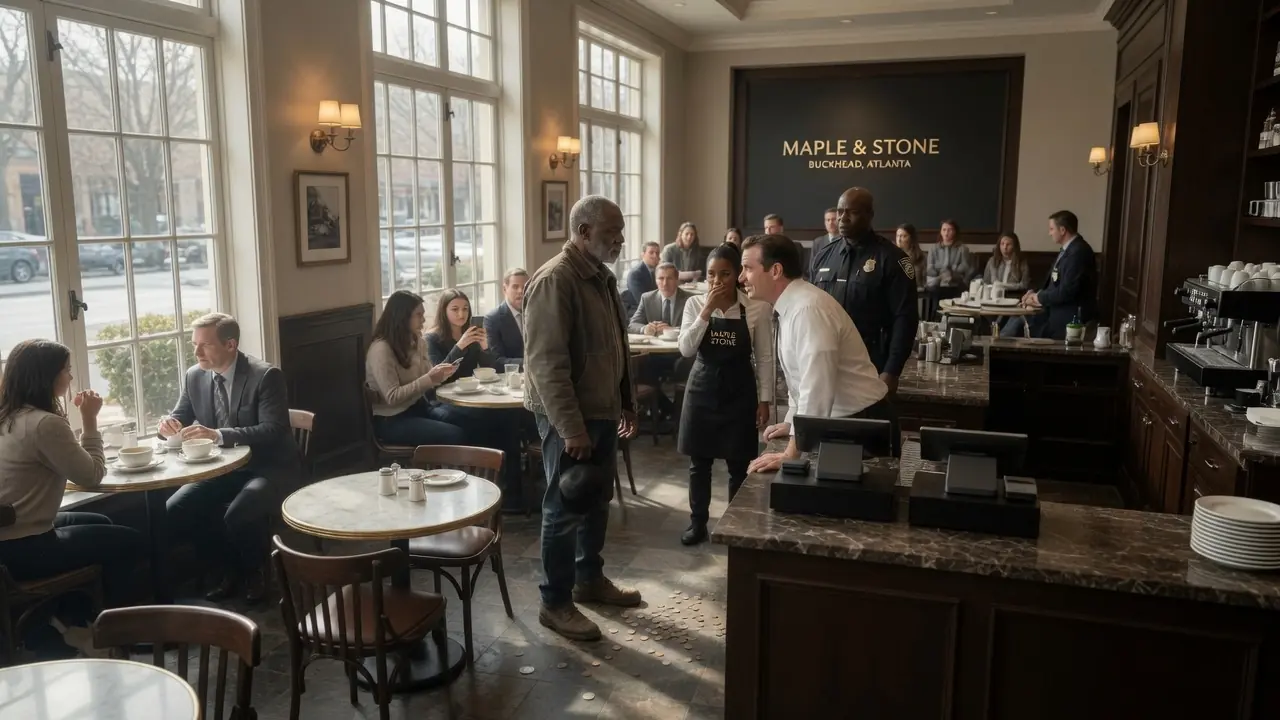
He was Black, somewhere in his late fifties, dressed in a faded brown canvas jacket, dark jeans, old work boots, and a plain black cap pulled low over his forehead. There was dust on one boot, the kind that came from construction sites or warehouse floors, not from sidewalks around Buckhead.
His name was Nathaniel Brooks.
But no one in that restaurant knew it yet.
He looked at the manager in the white shirt and crooked tie, then at the chalkboard menu behind him.
“Coffee,” Nathaniel said evenly. “And a slice of pecan pie. That’s all.”
The young cashier behind the counter, a woman named Alicia Monroe, had already rung it up. She was twenty-three, tired around the eyes, and too kind for the kind of place where kindness often got treated like weakness.
“That’ll be nine-fifty,” she said softly.
Nathaniel took a twenty-dollar bill from his wallet and laid it on the counter.
Alicia reached for it.
A hand came down over hers.
“I’ll handle this,” the manager said.
His name tag read Victor Harlan.
General Manager.
He was forty-six, white, narrow-eyed, and polished in the way men polish themselves when they want to look important without doing the work of becoming honorable. He had run Maple & Stone for seven years and treated those seven years like they gave him ownership over every table, every glass, every person who walked through the door.
Alicia pulled her hand back.
“Victor, he already ordered.”
“I said I’ll handle it.”
Her mouth closed.
Nathaniel watched that small surrender.
He noticed the way her shoulders dropped. The way her eyes went to the counter. The way the warmth in her face disappeared because one man had spoken and the room had rearranged itself around his temper.
That told him more than a report ever could.
Three hours earlier, Nathaniel Brooks had been sitting in a corner office on the sixteenth floor of a downtown Atlanta tower, looking over acquisition documents for twenty-eight restaurants.
Maple & Stone was one of them.
The deal had closed three days ago.
Forty-eight million dollars.
The biggest purchase of his career.
His assistant, Maribel, had stood in the doorway with a tablet in one hand and a worried look on her face.
“The announcement is scheduled for Friday,” she had said. “Marketing wants to do the press conference at the flagship location.”
Nathaniel had looked through the stack of inspection notes.
“Cancel my afternoon.”
Maribel blinked.
“Sir?”
“I’m going to Buckhead.”
“The flagship?”
“No,” he said. “Maple & Stone.”
She glanced at his suit hanging on the office door.
“Should I notify the regional director?”
Nathaniel took an old canvas jacket from the back of a chair.
“No. That would defeat the purpose.”
She had worked for him long enough to understand.
Nathaniel Brooks never walked into a new property with cameras, a tailored suit, and a line of executives waiting to clap. He went in quietly. No watch. No driver. No introduction. Sometimes in old boots. Sometimes in a mechanic’s jacket. Sometimes in the same ten-year-old pickup he had driven before he had enough money to buy whatever he wanted.
He wanted to see the truth.
Spreadsheets could tell him profit margins.
Reports could show food costs, lease terms, turnover rates, and customer reviews.
But none of them could tell him how a staff treated someone they believed had no power.
So that afternoon, Nathaniel parked his old Ford behind the restaurant, walked in through the front door, and ordered coffee and pie.
And now Victor Harlan held Nathaniel’s twenty-dollar bill between two fingers as if it smelled bad.
“Where’d you get this?”
Nathaniel looked at him.
“From my wallet.”
Victor lifted the bill toward the light.
“I asked where you got it.”
“A bank. Same as most folks.”
Victor did not smile.
He turned toward Alicia without taking his eyes off Nathaniel.
“Get me the counterfeit pen.”
Alicia froze.
“Victor, it’s just a twenty.”
“Pen.”
She opened a drawer and handed him the pen.
Victor dragged the marker slowly across the bill. The ink showed clean. No warning mark. No reason for suspicion.
Everyone near the counter already knew the bill was real.
Victor stared at it a moment longer, disappointed by the truth, then dropped it onto the counter.
“Can’t be too careful these days,” he said.
His eyes moved over Nathaniel’s jacket, boots, cap, hands, skin.
“We get all kinds wandering in.”
Nathaniel’s face did not change.
“My coffee and pie, please.”
Victor leaned against the register.
“That’s it? No attitude?”
“I ordered coffee and pie.”
“You people always start calm,” Victor said. “Then comes the scene.”
The words landed heavily.
A couple near the window stopped chewing.
A woman in a cashmere sweater glanced up, then quickly lowered her eyes. A man in a navy polo looked at Nathaniel, then at Victor, then back to his plate, choosing the cowardice of lunch.
Alicia’s hands tightened on the edge of the counter.
Nathaniel spoke quietly.
“What do you mean, you people?”
Victor smiled.
“You know exactly what I mean.”
Nathaniel did.
That was the point.
He had known it in hotel lobbies. In banks. In airports. In luxury stores where clerks followed him until he bought something expensive enough to embarrass them. He had known it as a boy in Savannah when a shop owner told him to empty his pockets before he had even touched a shelf.
He had known it before he became wealthy.
He had known it after.
Money changed the rooms he could enter.
It did not change what some people saw first.
“Can I have my change?” Nathaniel asked.
Victor punched open the register with unnecessary force.
The drawer sprang out.
He counted slowly, deliberately, as if every second was a lesson Nathaniel was supposed to learn.
The order came to nine-fifty.
Nathaniel had paid with twenty.
He should have received ten dollars and fifty cents.
Victor slid a five and two ones across the counter.
Seven dollars.
Nathaniel looked down.
“This is short.”
Victor shut the drawer.
“No, it isn’t.”
“I gave you twenty.”
“You got change.”
“I got seven dollars. I’m owed ten-fifty.”
Victor sighed loudly.
“Maybe you miscounted.”
Alicia whispered, “He’s right.”
Victor turned on her.
“What did you say?”
She swallowed.
“The change is short.”
He stepped closer to her.
“One more word and I write you up before your shift ends.”
Her face went pale.
Nathaniel looked at her.
He gave the smallest nod.
It’s all right.
It was not all right.
But he understood why she was afraid.
Victor turned back to Nathaniel.
“You’re holding up the line.”
There was no line.
Only three people pretending not to watch.
Nathaniel kept his voice level.
“I’d like the correct change.”
Victor’s face hardened.
“You calling me a thief?”
“I’m saying the math is wrong.”
Victor came around the counter and stepped into Nathaniel’s space.
The room seemed to shrink.
“You came into my restaurant dressed like that,” Victor said, voice low but loud enough to be heard, “and now you want to stand here and lecture me?”
Nathaniel looked at him.
“Your restaurant?”
Victor smiled.
“I run this floor.”
“That wasn’t my question.”
For the first time, Victor’s expression flickered.
Then anger filled the space where confidence had been.
“You’re lucky I served you at all.”
Alicia closed her eyes.
Victor continued.
“Plenty of places around here would have sent you back out the door before you touched the counter.”
Nathaniel said nothing.
That calm made Victor worse.
Men like Victor wanted anger. They needed it. Anger allowed them to point and say, See? I told you he was trouble.
Nathaniel did not give him that gift.
A security guard near the host stand shifted his weight.
His name was Calvin Reed. He was Black, mid-thirties, tall, and broad through the shoulders. He had watched the whole thing unfold with a tight jaw and eyes that moved between Victor and Nathaniel like he was measuring a line he did not want to cross but hated himself for standing behind.
Victor snapped his fingers.
“Calvin.”
Calvin walked over slowly.
“Keep an eye on this gentleman,” Victor said, putting poison into the word. “Make sure he doesn’t cause any disruptions.”
Calvin’s face tightened.
Nathaniel saw it.
Not agreement.
Conflict.
Victor slid a coffee cup across the counter so hard it sloshed over the rim.
“There’s your coffee.”
Alicia set a slice of pecan pie on a plate and pushed it toward Nathaniel gently, like an apology.
Nathaniel picked up the cup, took a sip, and set it down.
“What’s your full name?”
Victor blinked.
“What?”
“Your full name.”
Victor tapped his name tag.
“Victor Harlan. General manager. Seven years. And I’ll be here long after you walk out that door.”
Nathaniel looked at the name tag.
Then at Victor’s face.
“Seven years,” he said softly. “Good to know.”
He picked up his coffee and pie, walked to a small table near the back, and sat with his back to the wall.
For twelve minutes, Nathaniel ate slowly.
The pie was good.
Excellent, actually.
Buttery crust. Toasted pecans. The filling not too sweet. Whoever worked in the kitchen understood balance.
That mattered to him.
A restaurant was never just the person at the front.
Behind every cruel manager were cooks, dishwashers, servers, hosts, prep workers, and cleaners whose labor kept the place alive while someone else poisoned the air.
Victor watched him the entire time.
Not subtly.
Every few moments, he muttered something to Alicia or glanced toward Calvin.
Nathaniel finished his coffee, carried the cup and plate back to the counter, and set them down.
“Thank you,” he said to Alicia. “That was good.”
Alicia started to smile.
Victor stepped in.
“You’re not leaving yet.”
Nathaniel looked at him.
“I paid. I ate. I’m done.”
Victor tilted his head.
“I saw you sitting back there on your phone.”
“I was eating pie.”
“You were casing the place.”
The word hit the room like a thrown brick.
Casing.
A thief’s word.
A criminal’s word.
A word chosen carefully to turn a man eating dessert into a threat.
Nathaniel’s eyes sharpened.
“I was not casing anything.”
“Then you won’t mind emptying your pockets.”
Calvin looked up sharply.
“Victor—”
“I didn’t ask you,” Victor snapped. “Do your job.”
Calvin’s jaw worked once.
Nathaniel turned toward him.
“Do you believe I stole something?”
Calvin did not answer quickly enough.
That was answer enough.
Nathaniel slowly reached into his jacket.
Left pocket.
A folded document.
He set it on the counter.
Right pocket.
Keys.
He set them beside it.
Back pocket.
Wallet.
He placed it down too.
Victor snatched up the wallet first, opened it, and flipped through the cash inside. A few twenties. A fifty. A black business card tucked behind the ID sleeve.
Victor did not look at the card.
He was not searching for evidence.
He was exercising power.
Alicia watched with tears in her eyes.
Then Victor picked up the folded document.
“What’s this?”
“Private.”
“Not in my restaurant.”
He started to open it.
Nathaniel’s hand came down over the paper.
Firm.
Not violent.
“I said it’s private.”
The two men locked eyes.
The folded document was the acquisition summary for Maple & Stone and twenty-seven other restaurants. Nathaniel’s signature was at the bottom in blue ink.
Victor had no idea.
Not yet.
He let go first.
Then he smiled.
“Fine.”
He walked back to the register, opened the drawer, and pulled out the remaining change Nathaniel had been shorted.
Three quarters.
Two dimes.
A nickel.
A few pennies.
He held the coins in his fist and looked Nathaniel directly in the eye.
Then he threw them onto the floor.
The coins scattered across the dark tile.
A quarter spun beneath a chair.
A dime bounced against the baseboard.
A penny rolled near Nathaniel’s boot and stopped.
Victor pointed down.
“There’s your change,” he said. “Pick it up.”
No one breathed.
Then Victor said the word.
A racist word, ugly and old, meant to strip a Black man of his humanity.
“Pick it up, monkey.”
The room changed.
Alicia covered her mouth with both hands.
Calvin took one step back.
The woman in the cashmere sweater lifted her phone, then hesitated. A college student near the window did not hesitate. Her phone was already recording.
Nathaniel looked down at the coins.
He saw his own reflection in the polished tile, stretched and broken by the grout lines.
He looked at Victor’s shoes.
Polished.
Expensive.
Tapping impatiently.
He did not kneel.
He did not shout.
He looked up and said, “Who is your regional director?”
Victor laughed.
Actually laughed.
“You’re going to call corporate?”
“I asked for a name.”
Victor spread his arms.
“Elaine Porter. Regional director. Knock yourself out.”
Nathaniel took out his phone.
Unlocked it.
Tapped twice.
Held it to his ear.
The whole room watched.
The call connected.
Nathaniel spoke six words.
“Elaine, it’s Nathaniel. Maple & Stone. Now.”
He hung up.
Victor smirked.
“First-name basis with the regional director. Sure.”
He turned to Calvin.
“Get him out.”
Calvin did not move.
Victor’s smile faded.
“Calvin.”
Calvin’s eyes were on Nathaniel now.
He had heard the tone of that call.
No begging.
No complaint.
An order.
“Maybe we should wait,” Calvin said.
Victor stared at him.
“Wait for what?”
Calvin did not answer.
Victor turned back to Nathaniel.
“You’ve got thirty seconds to walk out or I’m calling the police.”
Nathaniel picked up his wallet.
Picked up his keys.
Left the folded paper on the counter.
Then he pulled out a chair and sat down.
“I’ll wait.”
Victor’s face reddened.
He opened his mouth.
Then headlights swept across the front windows.
A black SUV pulled sharply into the lot.
The engine cut.
A door slammed.
Heels struck the pavement fast.
Click.
Click.
Click.
The front door opened.
Elaine Porter entered like a woman arriving at the scene of a fire she had already smelled from miles away.
She was in her early fifties, sharp gray blazer, reading glasses pushed up on her head, expression controlled but pale.
Victor straightened.
“Elaine, thank God. I can explain—”
She walked right past him.
Did not slow.
Did not look at him.
Her eyes were fixed on the man in the old canvas jacket sitting at the table.
She stopped in front of Nathaniel.
Her face changed.
Not fear of danger.
Fear of failure.
“Mr. Brooks,” she said clearly. “I am so sorry. I came as fast as I could.”
Mr. Brooks.
The name moved across the restaurant like smoke under a door.
Victor’s hand, half raised from his attempted greeting, dropped to his side.
Alicia froze behind the counter.
Calvin stared at the floor.
The older man near the window slowly set down his fork.
Victor’s voice cracked.
“Mr. Brooks?”
Elaine turned toward him.
Her expression could have cut steel.
“Victor, this is Nathaniel Brooks, founder and CEO of Brooks Table Hospitality.”
She paused long enough for every person in the room to hear every word.
“He is the new owner of this restaurant and every restaurant in this group. The acquisition closed three days ago.”
The silence that followed was absolute.
Victor’s mouth opened.
Closed.
Opened again.
He looked at Nathaniel’s jacket.
The boots.
The cap on the table.
The man he had called a stray.
The man whose money he had checked like evidence.
The man he had told to kneel for coins.
“No,” Victor whispered. “That’s not—”
Nathaniel reached for the folded document on the counter.
The one Victor had tried to open.
He unfolded it slowly and laid it flat.
Brooks Table Hospitality letterhead.
Acquisition terms.
Asset transfers.
Property addresses.
Twenty-eight restaurants.
Forty-eight million dollars.
At the bottom, Nathaniel Brooks’s signature in blue ink.
“I closed on this location Tuesday,” Nathaniel said.
His voice was exactly the same as it had been all afternoon.
Quiet.
Level.
“I came here today to see how my people were being treated.”
He looked at the coins still scattered across the floor.
“Now I know.”
Victor’s face drained white.
Elaine stepped closer to him.
“Did you throw change at him?”
Victor looked around the room.
For the first time all day, he looked for help.
The same room that had given him silence now gave him nothing else.
The woman in cashmere looked down.
The man near the window stared at his plate.
The college student kept recording.
Alicia’s eyes were wet, but steady.
Calvin’s shoulders sagged.
“It was a misunderstanding,” Victor said.
Elaine’s voice did not move.
“Did you call him a racist slur and tell him to pick coins up off the floor?”
Victor swallowed.
“I didn’t know who he was.”
Nathaniel stood.
The chair barely whispered against the floor.
He walked toward Victor and stopped three feet away.
“That is the problem,” Nathaniel said. “You did not disrespect me because you knew who I was. You disrespected me because you thought I was nobody.”
Victor’s chin trembled.
Nathaniel continued.
“If you knew I owned this place, you would have smiled. You would have called me sir. You would have handed me the correct change. You would have asked if I wanted cream with my coffee.”
He paused.
“And then the next Black man in an old jacket would have gotten the coins on the floor.”
Victor stared at him.
“You’re not sorry for what you did,” Nathaniel said. “You’re sorry it was me.”
The words hung there.
Nobody moved.
Elaine took out her phone.
“Victor Harlan, you are suspended effective immediately pending termination review and legal investigation. Surrender your keys, access card, and manager credentials.”
“Suspended?” Victor’s voice cracked. “Elaine, come on. Seven years. I’ve run this floor for seven years.”
“Keys,” she said.
His hands shook as he reached into his pocket.
Front door.
Office.
Liquor cage.
Storage.
Register override.
He set the keys on the counter.
They landed with a dull clank.
Then his access card.
Then his name tag.
Victor Harlan.
General Manager.
Alicia watched that name tag hit the counter.
For a moment, something like relief crossed her face.
Elaine turned to Calvin.
“Escort him out.”
Calvin stepped forward.
Victor looked at him, searching for loyalty.
He found none.
“Let’s go,” Calvin said quietly.
Victor took two steps, then turned back.
“I gave seven years to this place. You’re throwing that away over a misunderstanding?”
Nathaniel bent slowly and picked up one coin from the floor.
A nickel.
He held it between his thumb and forefinger.
Then placed it beside Victor’s keys and name tag.
“You threw this at a man and told him to kneel,” Nathaniel said. “That is not a misunderstanding. That is a choice.”
Victor stared at the nickel.
Five cents.
Sitting beside the keys to a building he would never manage again.
Then he turned and walked out.
Calvin followed him to the door.
The glass swung open.
Afternoon light flooded the restaurant.
The door closed softly behind them.
No one spoke.
Nathaniel turned to Alicia.
“You spoke up.”
Her lip trembled.
“I should have done more.”
“You did something when almost everyone else did nothing,” he said. “Remember that.”
She nodded, tears slipping down her cheeks.
Then Nathaniel looked toward Calvin, who had returned and stood near the host stand with his hands clasped in front of him.
“Calvin.”
“Yes, sir.”
“You knew it was wrong.”
Calvin’s jaw tightened.
“Yes, sir.”
“And you still stepped forward.”
The words were not loud.
That made them heavier.
Calvin swallowed.
“I did.”
“An order you know is wrong does not become right because a man with a name tag gives it.”
Calvin’s eyes reddened.
“I know.”
“I’m not firing you today,” Nathaniel said. “But I need you to sit with that. I need you to remember what it felt like to walk toward a man you knew did not deserve it.”
Calvin nodded.
“Yes, sir.”
Nathaniel walked to the scattered coins.
Alicia started forward.
“Mr. Brooks, please, let me—”
“I’ve got it.”
He knelt slowly.
A fifty-eight-year-old man in old boots, gathering coins someone had thrown to humiliate him.
One by one.
Quarter.
Dime.
Nickel.
Penny.
The whole restaurant watched.
This time, nobody laughed.
When he had all of it, he walked to the counter and dropped every coin into the tip jar.
The coins rattled against the glass.
“These belong to the people who actually earned them,” he said.
The video hit the internet before Victor’s car left the parking lot.
A college student named Kendra Lewis had recorded nearly the whole thing. From Victor checking the twenty under the light, to the shorted change, to the coins scattering, to Elaine Porter walking past him and saying, “Mr. Brooks.”
Three minutes and nineteen seconds.
No filter.
No caption except five words.
This happened today in Buckhead.
By midnight, it had half a million views.
By morning, five million.
The hashtag came quickly.
#PickItUp
Then #DignityAtTheTable.
People posted their own stories beneath it.
Black customers accused of stealing.
Delivery drivers humiliated at side doors.
Families seated near kitchens while better tables sat empty.
Staff members told to stay quiet because “regulars spend money.”
Every story different.
Every story familiar.
The next day, an investigative reporter named Simone Grant began digging.
What she found proved that Victor Harlan was not one bad afternoon.
He was a pattern protected by silence.
Four complaints had been filed against him in the previous five years.
A Black mother accused of trying to skip out on a bill before dessert had even arrived.
A Black delivery driver forced to wait outside in the rain while white vendors used the front entrance.
A college student asked for two forms of payment verification after handing over a debit card.
A retired Black teacher told she could not sit at the bar without ordering a full meal, though three white customers sat there drinking coffee.
Every complaint had been marked resolved.
None had been properly investigated.
The district supervisor responsible for closing those complaints was a man named Harold Finch.
He and Victor had worked together for years.
Golf on Mondays.
Church fundraisers.
Shared holidays.
When complaints arrived, Harold buried them.
One internal email later recovered by Brooks Table Hospitality said only this:
Handled. Don’t worry about it.
Three words to erase a person’s dignity.
Nathaniel released a public statement the same afternoon Simone’s report aired.
What happened at Maple & Stone was not an isolated incident. It was the result of a system that allowed discrimination to hide behind management discretion, customer preference, and internal silence. That system ends now.
Victor Harlan was terminated for cause.
Harold Finch was removed from his position and later terminated after a review found he had closed multiple discrimination complaints without investigation.
The company reopened every past complaint filed under Harold’s region.
Settlements followed.
Apologies too.
Some accepted.
Some rejected.
Nathaniel understood both.
An apology did not become valuable simply because it arrived late with a company logo at the top.
Maple & Stone closed for two weeks.
When it reopened, there was new leadership, new training, and a brass plaque near the front entrance.
Every guest at this table deserves dignity. If you experience or witness anything less, call this number.
The number did not go to the manager.
It went to an independent review board.
Alicia Monroe became assistant manager.
Not because she cried on camera.
Not because the internet liked her.
Because when the room went quiet, she had found enough voice to say, “He’s right.”
Calvin remained employed.
He completed the first round of accountability training, then asked to speak at the next one.
He stood in front of thirty staff members and told the truth.
“I knew it was wrong,” he said. “I still moved. I don’t get to pretend that hesitation was courage.”
Nathaniel heard about it later.
He said nothing.
But he remembered.
Six weeks after the incident, Nathaniel drove his old Ford back to Maple & Stone.
Same jacket.
Same boots.
Same cap.
Late afternoon light cut through the windows in gold strips.
He stepped inside.
The bell above the door chimed.
A young host looked up and smiled.
“Welcome to Maple & Stone. Table for one?”
“Counter is fine.”
“Right this way, sir.”
No second look at his jacket.
No glance at the boots.
No tightening of the face.
Just a man being offered a seat.
Nathaniel sat at the counter.
Behind the espresso machine, Alicia Monroe looked up.
Her name tag now read:
Alicia Monroe.
Assistant Manager.
For a second, her face filled with surprise, warmth, and the ghost of a difficult memory.
“Mr. Brooks,” she said.
“Coffee and pecan pie?”
She smiled.
“I remember.”
She placed the cup down gently.
No slosh.
No slide.
A saucer.
A folded napkin.
Respect in ordinary motion.
“How’s the team?” Nathaniel asked.
“Better,” she said. “Not perfect. But better.”
“That’s honest.”
She nodded.
“The hotline had two calls this month. Both handled within a week. No burying.”
“Good.”
He ate the pie slowly.
Same buttery crust.
Same roasted pecans.
The kitchen had always known what it was doing.
The room felt different now.
Not perfect.
No room was.
But safer.
Safer mattered.
A couple with a stroller sat near the window. Two college students shared fries at a corner table. An older Black man in a work shirt read a newspaper with coffee and soup. Nobody watched him like he was an error in the scenery.
Nathaniel finished, laid a twenty on the counter, and stood.
“Keep the change.”
Alicia laughed softly.
The kind of laugh that carries relief.
Nathaniel tipped his cap and walked to the door.
Outside, he stopped beside the brass plaque and ran one thumb across the raised letters.
Every guest at this table deserves dignity.
He looked back through the window.
The tip jar still sat near the register.
Alicia had kept it.
Inside were coins, folded bills, and one old nickel taped to the bottom where nobody could take it out.
New hires always asked about it.
Alicia told them the story every time.
Not because she wanted to relive the humiliation.
But because some stories needed to stay near the register.
Near the money.
Near the place where power could go wrong if nobody remembered what it cost.
Nathaniel got into his old Ford and drove away beneath the Atlanta sun.
People later said Victor Harlan lost everything because he insulted the wrong man.
Nathaniel never liked that version.
It made the lesson too small.
Victor did not fall because Nathaniel Brooks was powerful.
He fell because, for seven years, he had used power against people he thought were not.
That afternoon, he simply chose a man who could make the truth impossible to bury.
And the coins he threw on the floor became heavier than he ever imagined.
Not because of their value.
Because of what they proved.
A nickel can weigh nothing in a palm.
Or it can weigh enough to bring down a kingdom built behind a manager’s name tag.