By the time the barn caught fire, Clara Bell had already been called too plain, too old, too worn-out, and too desperate to matter.
So when the flames climbed into the black Wyoming sky and the horses screamed inside the stable, nobody expected her to move first.
Men stood frozen in the snow.
Women clutched children against their skirts.
The ranch hands shouted over one another, but no one crossed the burning threshold.
Then Clara lifted her skirt clear of the mud, wrapped a wet shawl over her head, and ran straight into the fire.
That was the night Cedar Valley learned what Gideon Ward’s children had already begun to understand.
The woman nobody wanted was the one person they could not afford to lose.
Clara arrived at the Ward ranch three weeks earlier, seated on the back of a freight wagon with one suitcase, one patched coat, and a pair of gloves too thin for February.
The land around her was white and hard, rolling out beneath a pale sky that looked too tired to hold more snow. Fence posts leaned like old men. A frozen trough sat cracked beside the yard. The house itself crouched against the wind, gray boards weathered nearly silver, porch steps half-buried beneath drifts no one had cleared.
The driver spat into the snow and nodded toward the property.
“Ward place,” he said. “You sure this is where they sent you?”
Clara looked at the sagging porch, the torn screen door, the barn roof missing shingles, and the smoke rising weakly from a chimney that needed cleaning.
“This is the address.”
“Hard house for a woman alone.”
“I’ve worked hard houses before.”
The driver gave her a doubtful look, but she had heard that kind of silence all her life. It was the silence of men deciding a woman’s strength by her face, her age, her dress, her shape, her usefulness as an ornament.
Clara Bell was thirty-five years old. She was not delicate. She was not fashionable. Her hands were rough from work, her hair already threaded with early gray at the temples, and her face had the tired steadiness of someone who had survived more than she intended to discuss.
The agency in Cheyenne had told her the rancher needed a housekeeper for two months.
Cooking. Cleaning. Laundry. Children.
A widower.
Three young ones.
A household in decline.
They had not told her the house looked like grief had been left in charge.
Before she could knock, the front door opened.
Gideon Ward filled the doorway, tall and broad, one hand braced against the frame. He had dark hair badly in need of cutting, a short beard that looked more neglected than styled, and eyes the color of winter creek water.
He looked at Clara once.
Then he looked behind her, as if the real help might still be inside the wagon.
“You’re from the agency?”
“Yes. Clara Bell.”
His gaze returned to her.
She saw the disappointment arrive before he bothered hiding it.
“How old are you?”
“Thirty-five.”
His mouth tightened.
“They said they were sending someone strong.”
Clara let the insult settle without picking it up.
“I can work.”
“I didn’t ask if you could talk.”
“No, sir.”
That seemed to irritate him more than an argument would have.
Somewhere inside the house, a child coughed. It was a deep, dragging cough, too wet to ignore. Gideon’s jaw shifted, but he did not turn toward the sound.
“You’ll take the room off the pantry,” he said. “Meals at six, noon, and sundown. Laundry twice a week. Mending whenever it needs doing. My room is private. My late wife’s things are not to be touched. The children need order, not fussing.”
“I understand.”
“If you don’t last, tell me before you run. I don’t have time to chase replacements.”
Clara met his eyes.
“I don’t run without cause.”
He stared at her another moment, then stepped aside.
The smell of the house struck first.
Ash. Sickness. Unwashed bedding. Sour milk. Damp wool. Old food.
And beneath all of it, a stale heaviness Clara recognized from other homes where death had moved out but grief had stayed behind to occupy every room.
The parlor was dim though it was still afternoon. Curtains remained drawn. Dust lay over the furniture. A photograph on the mantel had been turned face down, but Clara saw the outline of a woman’s frame beneath the glass.
Gideon dropped her suitcase beside the kitchen doorway.
“Kitchen’s there. Children upstairs. Don’t expect gratitude.”
“I don’t work for gratitude.”
“No,” he said coldly. “You work for wages.”
Then he walked away, his boots striking the stairs with hard, tired force.
The wagon driver lingered in the doorway just long enough to shake his head.
“Good luck, Miss Bell.”
Clara looked around the dark front room.
Luck had rarely been assigned to her.
Work, however, she knew how to do.
She gave herself ten seconds.
Ten seconds to feel the loneliness of the house.
Ten seconds to hear the wagon roll away and understand there was no easy leaving.
Ten seconds to remember that she had been unwanted before and survived it.
Then she rolled up her sleeves.
The kitchen was a battlefield after everyone had already lost.
Dishes sat stacked in gray water. A skillet held grease gone rancid. Flour had spilled across a shelf and mice had tracked through it. A pot on the stove contained the remains of something that might once have been stew, now filmed over with white mold.
Clara opened the back door and let the freezing air cut through the stink.
She scrubbed the pot with sand until her fingers ached.
She swept mouse droppings from the corners, washed dishes, stacked them clean, and set water to boil. By the time the kitchen looked less like a warning and more like a room, the light had thinned outside the windows.
She found flour, salt, beans, coffee, and one hard end of bacon wrapped in cloth.
Enough.
Not much, but enough.
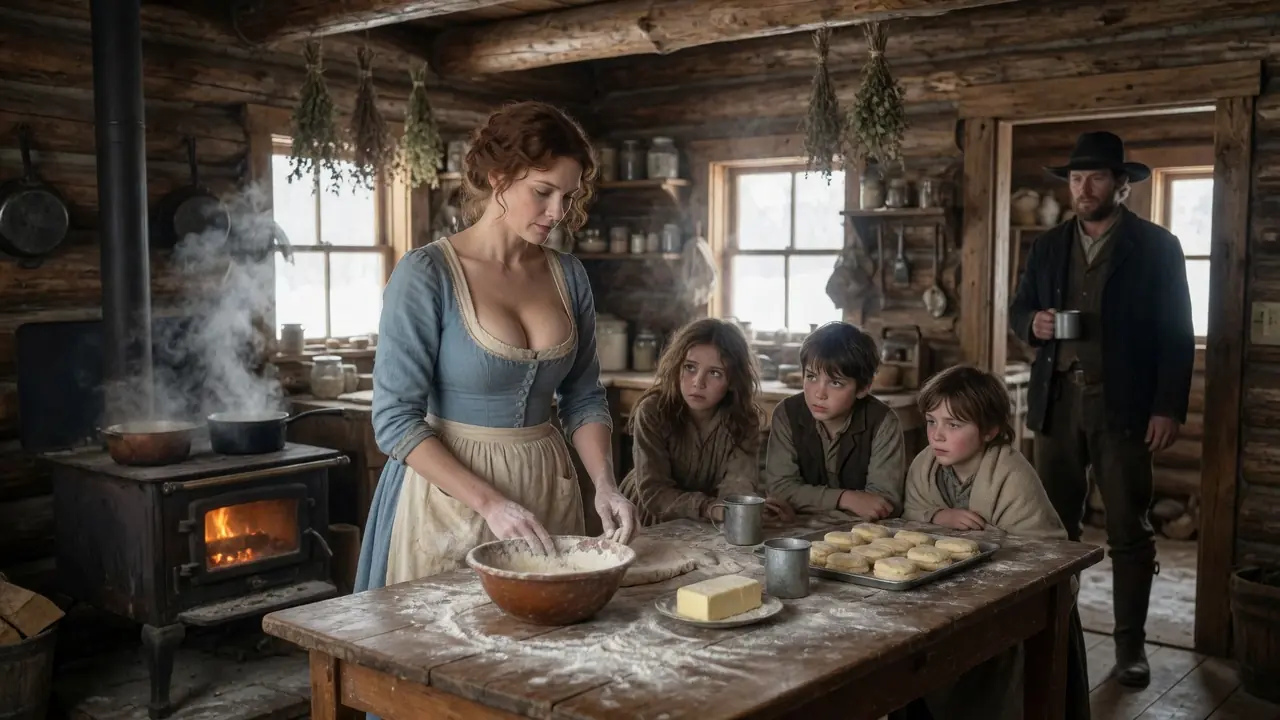
She made biscuits and beans and fried the bacon so thin every scrap counted. The smell climbed through the house better than any summons.
Small footsteps creaked above.
Clara did not call out.
Hungry children came slower when they were used to disappointment.
At last she went upstairs.
The first bedroom held two boys.
The older one stood beside the bed, stiff-backed and suspicious. He was nine or ten, thin as a rail, with his father’s gray eyes and the hard stare of a child who had been forced too early into watching for danger.
The younger boy lay beneath a dirty quilt, cheeks flushed, hair damp against his forehead.
Clara crossed the room and touched his brow.
Fever.
The older boy stepped forward.
“Don’t touch him.”
Clara withdrew her hand.
“What’s your name?”
“Silas.”
“And his?”
“Ben.”
“How long has Ben had that cough?”
Silas lifted his chin.
“He’s fine.”
“No, he isn’t.”
The boy’s eyes flashed.
“You don’t know anything.”
“I know fever when I feel it. I know a cough sitting deep in the chest. And I know children don’t get better lying in filthy bedding.”
Silas looked ready to hate her.
Clara did not blame him. Children who had already lost too much often defended what remained, even if what remained was harming them.
“There’s food downstairs,” she said gently. “Warm biscuits. Beans. Coffee for your father, milk if I can find any worth drinking.”
Silas’s expression shifted at the word warm.
Behind him, Ben stirred.
“Biscuits?”
Clara nodded.
“Fresh ones.”
The little boy’s cracked lips trembled.
Silas helped him sit, wrapping the quilt around his shoulders. Clara moved to the next room.
A girl sat by the window with a book open on her lap. She was perhaps eleven, with tangled brown hair and a dress hanging awkwardly on her narrow frame. The book was upside down.
Clara noticed.
The girl knew she noticed.
Neither mentioned it.
“Food is ready,” Clara said.
“I’m not hungry.”
“You don’t have to come down now. I’ll leave a plate for you near the stairs.”
“I said I’m not hungry.”
“I heard you.”
The girl finally looked at her.
“What’s your name?”
“Clara Bell.”
“No. I mean what did he hire you as?”
“Housekeeper.”
The girl’s mouth twisted.
“We had two before. One cried. One stole Mama’s brooch and left.”
“I don’t wear brooches.”
The girl did not smile, but something in her face changed.
“My name is Ruth.”
“I’ll remember.”
Clara went downstairs.
Gideon stood in the kitchen doorway, staring at the table as if it had insulted him.
“You cooked.”
“Yes.”
“I didn’t tell you to.”
“You hired me to keep house. Hungry children are part of a house.”
His eyes narrowed.
“You think you know this family after one hour?”
“No.”
“Then don’t act like you do.”
Clara set four plates on the table.
“I know a sick child needs clean bedding and medicine. I know the girl upstairs has not been eating enough. I know your older boy watches every doorway like he expects trouble. That is what I know.”
Gideon stepped closer.
“And what do you know about me?”
She should have lied.
A clever woman might have.
But Clara had grown tired of saving men from truths they had already earned.
“I know you are grieving,” she said. “And I know grief does not cook supper.”
His face went still.
For a second, she thought he might throw her out into the snow before the first meal was served.
Then Ben appeared on the stairs, wrapped in a quilt, leaning against Silas.
“Pa,” he whispered. “She made biscuits.”
Gideon turned.
His anger cracked just enough for pain to show through.
“Sit down, Ben.”
The boy obeyed.
He took one bite and closed his eyes.
“It’s hot,” he said, as if he had forgotten food could be.
Silas ate fast, trying not to look desperate. Gideon stood by the window with his back turned, shoulders stiff, one hand gripping the sill.
Clara made a plate and carried it upstairs.
Ruth’s door was closed.
Clara set the food on the floor.
“I’ll leave it here,” she said. “No one has to know whether you eat.”
An hour later, the plate was empty.
That night, Clara unpacked in the small room off the pantry.
It held a narrow cot, a washstand, and a window facing the barn. The walls smelled faintly of onions and cold plaster. It was not much, but it had a door.
In her suitcase she placed two work dresses, one Sunday dress, a brush, stockings, underthings, a sewing kit, and a small tin box wrapped in cloth.
She did not open the box.
Inside were letters from a man who had once promised to marry her until his family saw her and decided she was not the sort of woman who improved a man’s standing. There was also a tiny pair of knitted booties she had made before the child came too early and left too soon.
Clara touched the cloth once.
Then she slid the tin beneath the cot.
Upstairs, Ben coughed.
Outside, the barn door banged in the wind.
Clara lay awake in the dark and reminded herself this was temporary.
Two months.
Enough time to earn wages, mend a broken house, and leave before wanting anything foolish.
By the end of the first week, the house had begun to breathe again.
The floors were swept. The bedding was boiled clean. The kitchen smelled of bread instead of rot. Ben’s fever broke after three days of willow bark tea, hot compresses, and Clara sleeping in a chair beside him whenever his breathing grew rough.
Silas stayed suspicious, but he stopped guarding the pantry like a soldier.
Ruth said almost nothing, but each morning she appeared with her hair brushed as well as she could manage.
On the sixth evening, she came into the kitchen holding a comb.
“Can you braid?”
Clara looked up from mending Silas’s shirt.
“Yes.”
“Mama used to do it.”
The sentence was not an invitation. It was a test.
Clara pulled out a chair.
“Sit.”
Ruth sat, stiff as a fence post.
Clara worked carefully, easing tangles loose without yanking, separating the hair into three thick strands. The girl flinched at first, then slowly relaxed.
“My mama used to hum while she braided,” Ruth said.
“I don’t know many songs.”
“That’s all right.”
When Clara finished, Ruth touched the braid with both hands.
“It’s neat.”
“Yes.”
“Mama’s were neater.”
“I expect they were.”
Ruth looked at her then, eyes wet with a grief too large for her small face.
“You’re not trying to be her.”
“No.”
“Good.”
She ran upstairs before Clara could answer.
From the hallway, Gideon had been watching.
Clara saw him too late.
He looked away first.
The next morning, he came into the kitchen and closed the door quietly instead of letting it slam.
It was the first apology he gave her.
Not the last, but the first.
Cedar Valley noticed Clara before it accepted her.
At the general store, women paused conversations when she entered. Men looked at her and then past her, the way people do when they want someone to understand they have already been judged.
Mrs. Adeline Crowe was the worst of them.
She was elegant, sharp-eyed, and wealthy enough that even the storekeeper straightened when she walked in. Her husband owned the largest mercantile contracts in the valley. Her brother sat on the board of the local bank. Her opinion moved through Cedar Valley faster than weather.
She found Clara near the flour sacks one Saturday morning.
“You’re the woman at the Ward ranch.”
“I work there, yes.”
“How brave of you to say it plainly.”
Clara tied off a sack of sugar and turned.
“Was there something you needed, Mrs. Crowe?”
Adeline smiled.
It was a polished, bloodless thing.
“I only wondered how long you expected the arrangement to continue.”
“The agency contract is for two months.”
“How respectable. Contracts are useful things, aren’t they? They make certain situations appear cleaner than they are.”
The two women beside her laughed softly.
Clara lifted her parcels.
“I have work waiting.”
“I imagine you do. A widower, three motherless children, a neglected house. So many openings for a practical woman.”
Clara felt heat rise in her face.
She said nothing.
That was usually the safest way through women like Adeline.
But Adeline stepped closer.
“Lydia Ward was a friend of mine. A true lady. It is unpleasant seeing a stranger settle into her kitchen as if grief were an opportunity.”
Clara’s hands tightened around the flour sack.
“I’m not replacing anyone.”
“No,” Adeline said softly. “Of course not. Women like you rarely replace. You attach.”
Clara walked out before she answered with her hand.
The laughter followed her into the street.
That evening, Silas asked if people in town had been cruel.
Clara paused at the stove.
“Why do you ask?”
“Because they always are when someone new comes.”
He was peeling potatoes with the seriousness of a man performing surgery.
“They were cruel to Mama sometimes. Said she was too soft for ranch life. Said Pa should have married someone with land.”
Clara sat down across from him.
“People who have nothing useful to give often give opinions.”
Silas considered that.
“Mrs. Crowe told Pa after Mama died that he should send us east to Aunt Laurel.”
“What did your father say?”
Silas’s mouth twitched.
“He told her if she stepped on his porch again without being invited, he’d let the dogs decide whether she stayed.”
Clara almost laughed.
“He said that?”
“Pa was better then.”
The words landed quietly.
Clara looked toward the window, where Gideon stood outside repairing a fence rail in the fading light.
“He may be better again.”
Silas followed her gaze.
“Do you think so?”
“I think some people don’t die when they break. They just need help finding where to mend.”
The first true danger came through Ruth.
It happened near midnight, when Clara woke to the sound of retching upstairs.
She ran barefoot to the girl’s room and found Ruth doubled over a basin, trembling so hard the bed shook. Sweat shone on her forehead. Her lips were pale. Her eyes were unfocused.
Gideon appeared moments later, shirt untucked, panic cutting through his face.
“What is it?”
“Poison or fever,” Clara said. “Maybe both. Ruth, look at me. Did you eat anything unusual?”
Ruth tried to speak and gagged again.
Silas hovered in the doorway, white-faced.
“We were in the loft yesterday,” he said.
“What did you eat?”
“Nothing.”
Clara turned on him.
“Silas.”
His eyes filled.
“Berries. Behind the barn. Ruth said they looked like chokecherries.”
Clara’s stomach dropped.
“Show me.”
She followed him to the barn with a lantern. In the loft, behind a cracked crate, she found a handful of dark purple berries wrapped in cloth.
Not chokecherries.
Deadly enough if too many were eaten.
She ran back to the house.
Gideon was sitting on Ruth’s bed, holding her upright while she shook.
“Poison berries,” Clara said. “We have to make her bring up whatever remains, then bind what’s in her stomach.”
“How?”
“Salt water first. Charcoal after.”
His face tightened.
“You know how?”
“I know enough.”
The next hours were brutal.
Ruth cried and begged them to stop. Gideon held his daughter with tears running silently down his face while Clara forced salt water past the girl’s lips. Silas burned willow wood until it charred, then crushed it with trembling hands. Ben sat on the stairs clutching a blanket, too frightened to move.
By dawn, Ruth’s fever had lowered.
She lay exhausted, breathing evenly.
Gideon and Clara sat on opposite sides of the bed, hollow-eyed from fear and relief.
“Where did you learn that?” Gideon asked.
Clara looked at Ruth’s sleeping face.
“A girl in a logging camp ate nightshade when I was sixteen. No one knew what to do. She died before the doctor came.”
He absorbed that quietly.
“You were in a logging camp at sixteen?”
“I was in many places.”
“None good?”
“Some had good moments.”
“That isn’t what I asked.”
“No,” Clara said. “It isn’t.”
He did not press.
That was another kind of apology.
Later that morning, after Ruth woke and asked for water, Gideon walked Clara to the kitchen.
For once, he seemed unable to find the right words.
“You saved her.”
“I helped.”
“No.” His voice roughened. “You saved her.”
Clara looked away.
“Any mother would have done the same.”
“You’re not their mother.”
“I know.”
The words hurt more than she expected.
Gideon heard it.
His expression changed, but he said nothing.
That evening, Clara found a plate waiting in her small pantry room.
Not scraps.
Not leftovers.
A full portion of roast, potatoes, and two fresh biscuits covered with a cloth.
She sat on the cot and stared at it far too long before eating.
It was dangerous, she thought, how kindness could feel more frightening than cruelty.
Cruelty was familiar.
Kindness suggested something could be lost.
Adeline Crowe returned two days after Ruth recovered.
Clara was hanging sheets in the yard when the carriage rolled up. Adeline stepped down in a dark green dress far too fine for a ranch visit, her gloved hands folded delicately before her.
“I hear there was trouble with the girl.”
“Ruth is recovering.”
“How fortunate. Children are so fragile after losing a proper mother.”
Clara pinned another sheet and said nothing.
Adeline’s gaze moved over the clean yard, the smoke from the chimney, the repaired barn door.
“You have made yourself useful.”
“That is what I was hired to be.”
“Useful women often mistake usefulness for belonging.”
Clara turned then.
“Say what you came to say.”
Adeline’s eyes sharpened with pleasure.
“You should leave before people begin speaking more plainly.”
“They already speak plainly enough.”
“Then you understand. Gideon Ward is vulnerable. His children are grieving. A lonely woman of your age might easily confuse dependence with affection.”
The clothespin snapped in Clara’s hand.
Adeline stepped closer.
“You are wearing Lydia’s apron, feeding Lydia’s children, moving through Lydia’s rooms. Does it comfort you, Miss Bell, pretending a dead woman’s life is available for occupation?”
The slap cracked across the yard before Clara had time to decide.
Adeline staggered back, one hand to her cheek.
For one suspended second, even the wind seemed to stop.
Then Adeline’s face hardened with rage.
“You will regret that.”
Clara’s hand shook.
“I already do.”
But Adeline was climbing into her carriage.
“By tomorrow,” she said, “every decent person in Cedar Valley will know what you are.”
Clara stood in the yard until the carriage vanished.
Then she walked into the barn, sat behind the hay bales, and pressed both hands over her face.
This was how it ended.
The agency would hear of it. Gideon would send her away to avoid scandal. The children would think she had chosen to leave. Cedar Valley would nod and say it had known all along.
She was still there when Gideon found her near sundown.
“Adeline came by.”
Clara did not lift her head.
“I hit her.”
“So I heard.”
“She insulted me.”
“I assumed.”
“She said I was trying to steal Lydia’s place.”
Gideon was quiet.
Then he sat on the barn floor beside her.
“Adeline was never Lydia’s friend. She liked having Lydia nearby because Lydia made her feel generous.”
Clara looked at him.
“You aren’t angry?”
“Oh, I’m angry.”
“At me?”
“At the fact I didn’t hit her first.”
A laugh escaped Clara before she could stop it.
It sounded broken, but it was still laughter.
Gideon looked at her then, really looked, without suspicion or bitterness.
“You are not being dismissed.”
“You should dismiss me. She’ll make life miserable.”
“She has been making life miserable in this valley for years. At least now someone gave her a reason.”
“She’ll hurt your standing.”
“My standing did not feed my children.”
His voice turned low.
“You did.”
The words lodged somewhere beneath Clara’s ribs.
She had no defense against them.
Trouble came exactly as promised.
At first, it wore small faces.
The storekeeper claimed supplies were unavailable. The bank requested early payment on a minor loan Gideon had planned to settle in spring. Three families who had once traded labor with the Ward ranch suddenly became busy. Boys in town threw stones at Clara’s wagon and shouted that desperate women should know when to leave.
Then a hay shed burned.
Gideon found the door lock forced open and wagon tracks half-hidden in snow.
“Accident?” Clara asked, though she already knew.
“No.”
They fought the fire with buckets until the roof collapsed. Three months of feed went up in smoke. Gideon stood before the ruins, hands black with soot, face emptied of everything but fury.
“That hay was winter.”
“We’ll find more.”
“From whom? Adeline’s brother controls half the supply lines, and every rancher in the valley owes somebody money.”
That night, Gideon rode into town and returned with a split knuckle, a bruised cheek, and bad news.
No one would sell hay.
No one openly refused, but every answer sounded the same.
Sorry.
Short supply.
Bad season.
Nothing to spare.
Clara cleaned the blood from his hand in the kitchen.
“You hit someone.”
“Two someones.”
“Gideon.”
“They threw rocks at you.”
“Violence won’t solve this.”
“No,” he said. “But it made one of them apologize.”
She tried not to smile.
Failed.
The next morning, a wagon arrived loaded with hay.
The driver was an older rancher named Amos Reed, a blunt man with a white beard and a coat patched in six places.
Gideon stepped outside, wary.
“We didn’t order hay.”
“Good thing,” Amos said. “I didn’t ask.”
“How much?”
“Market rate. Pay when you can.”
Gideon stared at him.
“Why?”
Amos glanced toward Clara, who had come onto the porch.
“I heard Miss Bell struck Adeline Crowe.”
Clara stiffened.
Amos grinned.
“Been waiting fifteen years for someone to do that. Consider the hay my contribution to public morale.”
He handed Gideon a bill of sale and climbed back on the wagon before anyone could refuse.
When he left, Gideon looked at Clara.
“Seems you’re becoming popular.”
“With the wrong people.”
“Maybe the right ones were just quieter.”
But Adeline was not acting alone.
That truth arrived after four cattle died in the south pasture.
Foam at the mouth.
Glazed eyes.
Poison.
Gideon knelt in the snow beside the animals, one hand on the stiff neck of a cow he had raised from a calf.
Clara watched his face.
Not anger this time.
Despair.
“If this keeps happening,” he said, “I lose the ranch.”
Silas overheard.
That night, the boy came downstairs after bedtime.
“Is Mrs. Crowe doing this because of Miss Clara?”
Gideon looked at him for a long moment.
“We don’t have proof.”
“That isn’t no.”
Clara sat across from him.
“Listen to me, Silas. If someone hurts you to make another person run, the blame belongs to the person doing the hurting.”
The boy’s eyes burned.
“Then we make her stop.”
“We will try.”
“No,” Silas said. “We make her stop.”
The next clue came from a neighbor.
A rancher named Owen Fletcher rode in before dawn, his horse lathered from speed. He pulled Gideon aside, but Clara saw enough from the kitchen window to know the news was bad.
When Gideon returned, his face had changed.
“Owen says Adeline’s cousin works for Malcolm Voss.”
Clara frowned.
“The cattle baron?”
“Land speculator. Calls himself a cattle baron. Owns property across three territories.”
“And?”
“He’s been buying struggling ranches in Cedar Valley. Cheap. Every ranch had trouble before selling. Fires. Sick animals. Poisoned wells.”
“Like us.”
“Like us.”
Owen had heard of an abandoned freight depot north of the valley, old rail property no one used anymore. Men had been seen there at night. Wagons too.
Gideon planned to ride out alone.
Clara refused.
They argued in low voices until even the walls seemed tired of them.
“You are not coming,” he said.
“If you vanish, who tells anyone where to look?”
“If we both vanish, who protects the children?”
“Owen knows where we’re going. If we aren’t back by dawn, he comes.”
Gideon stared at her.
“You make a habit of not backing down.”
“I make a habit of surviving men who tell me what I can’t do.”
That ended the argument.
They rode out after midnight beneath a hard white moon.
The freight depot sat in a hollow between low hills, abandoned by appearance but not by fact. Fresh wheel tracks marked the snow. A new lock hung on the warehouse door.
Gideon broke it with a rock.
Inside, by lantern light, they found feed sacks, shipping crates, account ledgers, and a desk full of correspondence.
Clara searched the papers while Gideon examined the grain.
Then she found the letters.
Adeline’s handwriting.
Elegant. Controlled. Damning.
She wrote to Malcolm Voss about pressure points among valley ranchers, about which families had debts, which wives were ill, which barns were poorly guarded, which men might sell under sufficient distress.
The Ward ranch was named directly.
So was Clara.
The housekeeper is a useful disruption, one letter read. If she remains, Ward becomes emotionally irrational. Accelerate pressure.
Clara felt sick.
Gideon read over her shoulder, his jaw hardening line by line.
“This is enough,” he said. “This ends it.”
The warehouse door opened.
Three men entered with rifles.
Behind them came Malcolm Voss, dressed in a fine black coat, smiling like a man who had never feared consequences.
“Mr. Ward,” he said. “Miss Bell. How unfortunate.”
Gideon moved in front of Clara.
Voss glanced at the letters.
“I’ll take those.”
“No.”
Three rifles lifted.
Voss sighed.
“Please don’t confuse courage with leverage. You are trespassing. Armed. Stealing private documents. If violence occurs here, the story will not favor you.”
Clara’s fingers closed around the papers.
Voss smiled at her.
“You have caused a remarkable amount of inconvenience for a temporary woman.”
Gideon’s hand twitched toward his gun.
Clara whispered, “Don’t.”
He looked at her, furious and helpless.
Then he handed over the letters.
Voss accepted them.
“Wise. Now go home. Sell while I am still offering money. Refuse, and the misfortunes around your ranch will become less avoidable.”
They rode back near dawn with no papers and no proof.
Gideon was silent most of the way.
At the ranch, Owen Fletcher waited with a rifle across his lap.
“You found something?”
“Yes,” Gideon said. “Then lost it.”
Clara stepped down from her horse, stiff with cold and exhaustion.
“Not all of it.”
Both men looked at her.
“The feed sacks,” she said. “They were marked with Voss’s distributor. The poisoned grain from your cattle may match the feed stored there. Other ranches too.”
Gideon’s expression sharpened.
“If we collect samples from every ranch that lost stock—”
“And test them,” Clara said. “If they all contain the same poison and trace to the same supplier, we have a pattern.”
“Pattern isn’t a confession.”
“No,” she said. “But it is a beginning.”
For the first time since the warehouse, Gideon looked almost hopeful.
The next two weeks became a quiet war.
Owen collected samples from ranches that had lost cattle. Amos Reed carried them to a veterinarian two counties away. Clara made lists, dates, names, losses, suspected incidents. Gideon visited families in secret, asking them to stand together.
Some refused.
Fear had deep roots.
But others listened.
A burned barn here.
A poisoned well there.
Cattle dead after feed deliveries.
Loans called in after refusal to sell.
The pattern grew too large to dismiss.
Meanwhile, Adeline grew bolder.
She confronted Clara in town outside the cobbler’s shop while Ruth and Ben stood nearby.
“You could have ended this,” Adeline said softly. “You could have packed your little suitcase and spared them.”
Clara held Ben’s hand.
“No.”
Adeline’s smile faded.
“Excuse me?”
“No, I won’t leave because you demand it. No, I won’t let you frighten children to protect your pride. No, I won’t disappear so powerful people can keep stealing from those too tired to fight.”
Adeline’s face flushed.
“You are nothing.”
Clara stepped closer.
“I believed that once. You should have used it while it still worked.”
The town heard.
More importantly, the children heard.
That evening, Ruth hugged Clara without warning.
“You stayed,” the girl whispered.
“Yes.”
“Even after she told you to go.”
“Yes.”
Ruth pressed her face against Clara’s apron.
“Good.”
The proof arrived in a sealed report.
Arsenic.
Four ranches.
Same grain supplier.
Same chemical pattern.
Same timing before purchase offers from Malcolm Voss.
Gideon read the report twice. Owen read it once and swore. Amos Reed removed his hat and said, “Well, now we’ve got ourselves a war.”
They planned to expose Voss at the Red Hollow Livestock Auction, the largest gathering of ranchers, buyers, bankers, and officials in the territory.
Public.
Crowded.
Impossible to bury quietly.
They sent the children to stay with Owen’s wife two days before the auction.
Ben cried.
Ruth tried not to.
Silas refused to leave until Gideon knelt in front of him and said, “Protecting your brother and sister is not running. It’s the job I need you to do.”
The boy swallowed hard.
“Yes, sir.”
When the wagon carried them away, Clara stood beside Gideon in the empty yard and felt the house lose its heartbeat.
“If this goes badly,” he said that night, “there are papers in my desk.”
She turned.
“What papers?”
“I gave you legal interest in the ranch. Half held in trust with the children’s portion protected. If something happens to me, you stay. You decide what comes next.”
Clara stared at him.
“You had no right.”
“I know.”
“Gideon—”
“You earned more than wages. You earned a place.”
Her eyes burned.
“I don’t want land from a dead man.”
“Then I’ll try hard not to die.”
She almost laughed, but it broke into something else.
He stepped closer.
“You are not temporary, Clara.”
The words undid her more completely than any kiss could have.
But then he kissed her too, gently, as if asking permission from every scar she carried.
She kissed him back because the next day might ruin everything, and she was tired of saving love for safer weather.
The Red Hollow auction was crowded enough to hide fear and loud enough to bury threats.
Cattle bawled in the pens. Buyers shouted bids. Dust rose beneath hundreds of boots. Malcolm Voss stood near the front of the auction tent, calm and polished, surrounded by men who looked like money had taught them cruelty.
Adeline Crowe sat nearby in a blue dress, serene as church glass.
Gideon waited until the main bidding began.
Then he stood.
“I have a charge to bring before every rancher in this tent.”
The auctioneer objected.
Gideon ignored him.
He held up the veterinary report and spoke over the rising noise.
“My name is Gideon Ward of Cedar Valley. My cattle were poisoned. My hay shed was burned. My family was threatened. I believed it was personal until I learned I was one of many.”
Owen stood next.
“So was I.”
Amos Reed stood.
“So was my daughter’s family.”
One by one, others rose.
Nine families.
Nine voices.
Nine histories of damage preceding offers from Voss’s company.
Malcolm Voss smiled tightly.
“Hardship is not conspiracy, Mr. Ward.”
“No,” Gideon said. “But poisoned grain supplied through your distributor is.”
His lawyer began shouting about slander.
Clara stepped forward with her satchel.
“And letters written by Adeline Crowe to Malcolm Voss, naming which families to pressure, which debts to exploit, and which properties to sabotage, are harder to explain.”
Adeline stood.
“You have no letters.”
“No,” Clara said. “Your men took them.”
Voss’s smile returned.
“Then I wonder why you mentioned them.”
For a moment, the momentum faltered.
Then an older man stepped from the rear of the tent.
He carried a leather case and wore the plain black coat of a territorial judge.
“My office has copies.”
The tent went silent.
The man introduced himself as Judge Everett Hale.
“Two weeks ago, I received a packet containing duplicated correspondence, financial records, and witness statements related to High Plains Holdings and the coordinated seizure of ranch land throughout Cedar Valley.”
Voss’s face drained of color.
Adeline gripped the back of her chair.
Judge Hale opened the case.
“The handwriting has been authenticated. Payments have been traced. Three hired men have agreed to testify. Territorial marshals are present.”
Marshals stepped forward from the crowd.
People surged back.
Voss tried to speak, but no sound came.
Adeline slapped him before they took her.
It was petty, useless, and much too late.
Clara watched the woman who had tried so hard to make her invisible being led away in full view of the valley.
She felt no triumph.
Only exhaustion.
And relief so deep it hurt.
The trials came later.
So did restitution, reversed land sales, prison sentences, public apologies, and years of rebuilding.
But that afternoon, as the sun lowered over Red Hollow and the valley families gathered outside the auction tent, Gideon took Clara’s hand in front of everyone.
No one laughed.
No one whispered.
No one questioned whether she belonged at his side.
When the children came home the next day, Ben ran into Clara’s arms so hard she nearly fell. Ruth cried openly. Silas tried to be dignified until Gideon pulled him close, and then he cried too.
“It’s over?” Ben asked.
Gideon looked at Clara before answering.
“The worst of it.”
“Is Miss Clara staying?”
Clara held her breath.
Gideon smiled, small and tired and real.
“If she’ll have us.”
Ruth looked up.
“Will you?”
Clara looked at the children, the porch, the patched barn, the land they had almost lost, and the man who had finally stopped seeing her as a hired hand and started seeing her as home.
“Yes,” she said. “I’ll stay.”
The ranch did not become easy after that.
Real life rarely rewards courage with comfort.
They rebuilt the herd slowly. Repaired the barn one board at a time. Paid debts with work, patience, and the restitution that came months later. Cedar Valley changed too, not suddenly, not perfectly, but enough that people began asking different questions when misfortune struck.
Clara became the woman neighbors came to when someone was sick, when accounts did not balance, when a child needed watching, when pride had to be put aside and help requested plainly.
Some still called her difficult.
Gideon called her necessary.
Two years later, beneath a spring sky washed clean by rain, Clara Bell married Gideon Ward in the yard of the ranch she had once entered as temporary help.
Ruth braided wildflowers into Clara’s hair.
Ben carried the rings.
Silas stood beside his father, too tall now, too proud to cry until he did anyway.
Gideon’s voice shook only once, when he promised to honor the woman who had walked into his ruin and refused to let it remain one.
Clara did not promise to be easy.
She promised to stay.
That was more honest.
Years passed.
The children grew.
The ranch prospered modestly, which suited them better than wealth. Clara never became beautiful in the way cruel people had once demanded women be beautiful. She became weathered, respected, sharp-tongued, warm-handed, and loved beyond question.
Sometimes, in winter, she would stand outside the rebuilt barn and remember the night flames turned the sky orange.
People said that was when she proved herself.
Clara knew better.
She had proven herself long before anyone else noticed.
In the kitchen full of mold.
Beside Ben’s sickbed.
At Ruth’s tangled hair.
In the barn where she refused to be shamed into leaving.
At the auction where her voice shook but did not stop.
The fire only gave the valley a story it could understand.
The truth was quieter.
A woman nobody wanted had chosen not to disappear.
And by staying, she became the foundation of everything that survived.