The stranger had not been in Willow Creek more than twenty minutes when he said the sentence folks would still be repeating after the first snow.
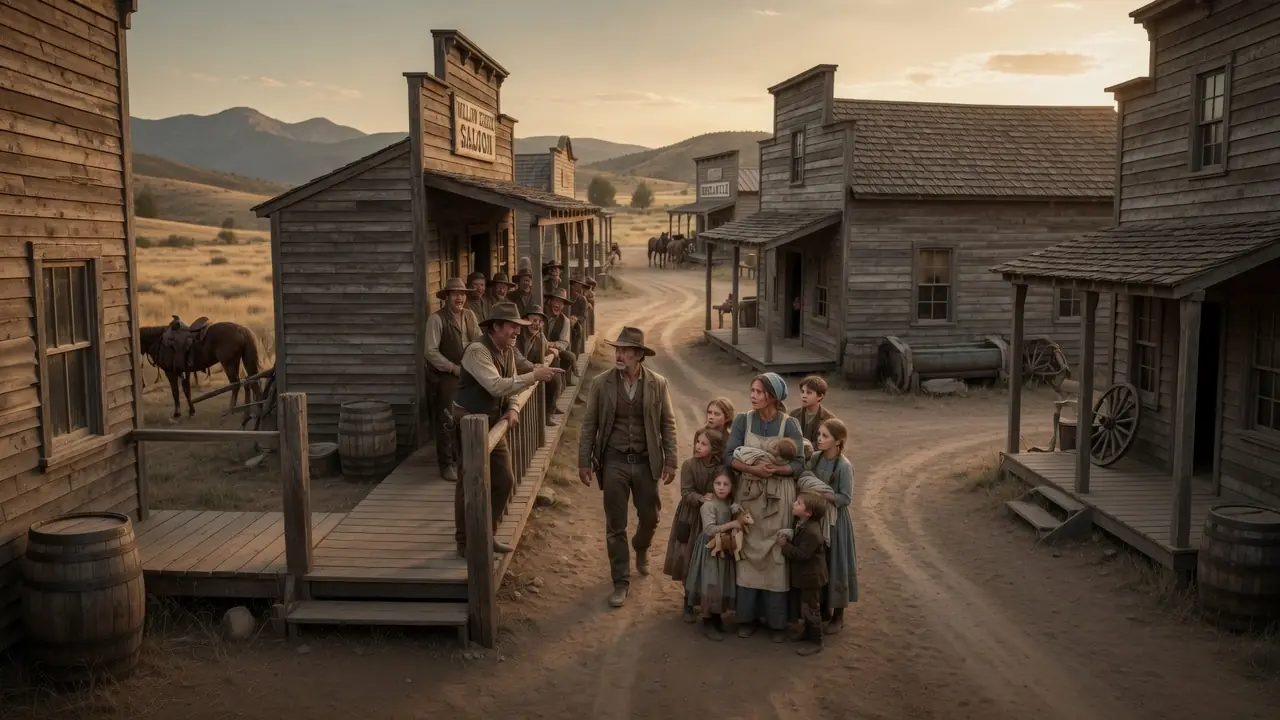
He stood in the middle of the rutted main street with three hundred miles of trail dust on his coat, a cowhand of about forty-two years, broad through the shoulders, lean through the waist, and gray at the temples before his time. His hat was sweat-stained, his boots worn down at the heel, and his face carried the tired patience of a man who had seen too much country and buried too many hopes along the way.
His name was Caleb Rourke, though no one had asked it yet.
He had stopped a boy outside the mercantile to ask where a man might find honest work and a hot supper. The boy, instead of answering directly, pointed across the square toward a sagging clapboard house at the edge of town.
Eight children were spilling from its doorway like marbles dropped from a torn pocket.
“That’s the Bell place,” the boy said.
There was something in the way he said Bell that told Caleb half the story before he heard a word of it.
“She’s got eight now,” the boy continued. “Took the last two off the orphan train when nobody else would. Folks say she’s poor as a winter field and twice as foolish.”
Caleb looked a long while at that house.
A girl of fifteen was hanging wash with a baby balanced on her hip. A small boy was chasing a hen around the yard with more determination than success. Another child sat beneath the porch steps, drawing circles in the dust with a stick. Near the fence, a woman in a faded blue dress knelt beside a broken rail, hammering a nail back into place with the careful anger of someone who had fixed the same problem too many times and would fix it again if she had to.
“And nobody wants them,” Caleb said.
It was not quite a question.
The boy shrugged.
“No, sir. Nobody wants a one of them.”
Caleb pushed his hat back from his brow.
When he spoke, he did not raise his voice. But the men leaning outside the saloon heard him, and so did the storekeeper standing in the mercantile doorway, and so did the woman in the faded blue dress, who had gone very still with the hammer in her hand.
“Then I’ll take them,” Caleb said. “I want them all.”
To understand why the town laughed, you have to understand Miriam Bell.
She was thirty-seven years old that spring and had been a widow for almost ten of those years. Her husband, Jonathan Bell, had been a horse breaker with kind hands and a stubborn streak. He had been thrown from a young stallion one cold morning and died before the doctor reached the ranch.
People said he died easy.
Miriam never cared much for that phrase.
Easy for whom?
What she did with her grief was this.
She filled the house.
It started with one boy.
A traveling family had passed through Willow Creek in a wagon with a cracked wheel and too many mouths to feed. When they left, they left a sick nine-year-old at the church steps with a blanket, a fever, and no name anyone could trust. The town fathers debated for two days over what should be done with him.
Miriam ended the debate by walking to the church, taking the boy’s hand, and bringing him home.
She named him Eli because she liked the sound of it and because the boy looked like he needed a short name that could be called quickly across a yard.
After Eli came the others.
One and two at a time over the years.
Children nobody wanted, which in that country was a longer list than polite people liked to admit.
There was Grace, fifteen now, who had come to Miriam at eleven with a stammer so bad the town mistook her for simple. Miriam had taught her to read aloud every night by lamplight until the stammer softened and the child discovered she had a mind sharper than most grown men in Willow Creek.
There was Ben, thirteen, quick-tempered and quicker to apologize if given time to cool.
There was Clara, eleven, who sang while sweeping, singing while cooking, singing even when there was not enough flour to make the biscuits rise properly.
There was Ruthie, eight, quiet as a shadow, who noticed everything and said almost nothing.
There was Henry, six, who feared thunder, darkness, strangers, and occasionally chickens.
And then there were the two smallest, Daisy and Jonah, both five years old, not kin to each other or anyone else in that house. They had been set off an orphan train the previous autumn because the family who promised to take them changed their minds on the platform after seeing how thin they were.
Miriam had been standing on that platform too.
She had not changed her mind.
Eight children.
One widow.
A leaning house.
A garden that fed them most months and betrayed them in dry weather.
A cow that gave milk when she was in the mood.
And a town that had decided, with the particular cruelty of comfortable people, that Miriam Bell was a fool who would drag those children into ruin with her.
So when a stranger stood in the square and said, “I want them all,” the men outside the saloon laughed.
They laughed because it was easier than asking why a passing cowhand had offered in one breath what the whole town had refused for nearly ten years.
Miriam did not laugh.
She rose slowly from beside the fence rail, wiped her hands on her apron, and looked across the yard at Caleb Rourke the way a woman looks at weather she cannot yet name.
He did not come to her that first day.
Miriam respected that.
Instead, Caleb took work at the Harlan Ranch east of town, breaking the rough string of horses nobody else would ride. He was good at it. Gentle-handed. Quiet. Unhurried. The kind of man a frightened animal studied first, then slowly decided to trust.
Word of that gentleness reached Miriam before he did.
In a town the size of Willow Creek, word always arrived before the person.
He came on a Sunday afternoon with his hat in his hands.
Miriam was standing near the wash line, folding patched shirts into a basket while Daisy and Jonah argued over a wooden horse with one missing leg.
“Ma’am,” Caleb said from the gate, “I expect what I said in the square sounded like a man who had too much sun and not enough sense.”
Miriam looked at him without smiling.
“It did.”
He nodded.
“I figured as much. I came to say it plain, without the town making a circus of it. I was sober when I said it, Mrs. Bell. And I meant every word.”
Behind Miriam, eight faces appeared in windows, doorways, and around porch posts.
Children had a way of appearing whenever adults thought they were being private.
“Men say a great many things, Mr. Rourke,” Miriam said. “Most of them are just listening to themselves talk.”
“Yes, ma’am. I’d think the same.”
He turned his hat in his hands.
“I had a family once. Wife named Sarah. Two little girls, Abigail and June. We lived down near the Nations. There was a sickness came through in the winter of ’84. Took all three of them inside a month.”
The yard became very quiet.
Even Ben, who hated silence almost as much as chores, did not speak.
“It did not take me,” Caleb continued. “I have spent six years since trying to understand why a man should be left behind like the last plate at a supper table after everyone else has gone.”
Miriam’s face changed slightly, but she said nothing.
Caleb looked toward the house, toward the children trying not to be seen.
“I rode into your town looking for supper and work. A boy pointed me toward a house full of children nobody wanted.”
He stopped, swallowed, and began again.
“And I thought, here I’ve been wanting somebody to want for six years, and could not find one soul who needed it. Then there was a whole houseful.”
Miriam did not answer right away.
She was not a woman who let her heart outrun her sense. Her sense had been kicked too many times by life to come running at the first kind word.
Finally, she said, “There’s wood that wants chopping.”
Caleb looked at her.
“And?”
“And the gate sticks. The porch step is loose. The cow pen needs mending.”
“Yes, ma’am.”
“You can stay for supper if you finish before sundown.”
The children exchanged looks behind her.
Caleb nodded solemnly.
“That is more than fair.”
It was, both of them understood, a great deal more than nothing.
He chopped the wood.
Then he fixed the gate.
Then the porch step.
Then the cow pen.
Then the broken fence rail Miriam had been working on when he first saw her.
He did not do it like a man showing off. He did it like a man who had finally found a use for his hands.
Supper was thin.
It was always thin.
Beans, cornbread, a little stew stretched farther than any stew had a right to be stretched. Caleb ate it like it was a feast and said so.
Jonah, who had been suspicious of him through most of the meal, fell asleep against his arm before the plates were cleared.
Caleb sat perfectly still so as not to wake him.
Miriam watched that.
She watched his shoulder slowly go stiff from holding the same position. She watched him ignore it. She watched Daisy lean against his other side without asking permission.
Something in Miriam’s chest, clenched tight for ten years, loosened the smallest amount.
That frightened her more than his kindness.
He came back the next Sunday.
And the one after that.
By the third Sunday, the children had stopped hiding behind curtains and started arguing over who got to walk with him to the Harlan Ranch road.
By the fifth, Grace had begun reading aloud without stumbling over every third word, because Caleb listened without impatience and never once finished a sentence for her.
By the seventh, Henry slept through a thunderstorm because Caleb had shown him how to count the seconds between lightning and thunder and told him the sky was only making noise, not coming inside.
And all the while, the town watched and waited for the stranger to do what strangers usually did.
Leave.
The man who tried to make that happen was named Silas Crane.
Silas held the note on Miriam’s land. He had bought it cheap from the bank two years earlier, betting she would fail. He had been waiting on that failure with the patience he mistook for intelligence.
Silas was not a violent man.
He was something quieter and more common.
He wore clean cuffs, spoke politely, and did harm with paper.
He came to Miriam in the eighth week with a folded document in his hand and told her, with great courtesy, that the note was due in full by first frost. He said he did not see how a woman in her circumstances could possibly pay it. He said perhaps it was time she stopped pretending. He said the children would be better off distributed through the county before winter.
He said it on the street where people could hear.
That was his mistake.
Caleb Rourke was crossing the square with a sack of flour on his shoulder when he heard it.
He set the flour down in the dust.
Then he walked over and stood beside Miriam.
He did not raise his hand.
He did not raise his voice.
He only looked at Silas Crane the way he looked at a green horse that had decided to be stubborn, patient and entirely unafraid.
“How much is the note?” Caleb asked.
Silas looked him over.
“That is family business.”
“It became town business when you said it loud enough for the barber to hear.”
A few people near the mercantile shifted.
Silas’s mouth tightened.
He named a figure meant to end the conversation.
Caleb nodded slowly.
“I’ve broke horses for six years and spent near nothing on account of having no one to spend it on.”
He reached inside his coat and drew out a worn leather wallet thick with the savings of a man who had been quietly saving for a family he did not yet have.
Miriam stared at him.
“Caleb—”
He looked at her once.
“Let me do this.”
She closed her mouth.
He counted the money into Silas Crane’s hand right there in the square.
Bill by bill.
Coin by coin.
The whole of Willow Creek watched in a silence so deep a person could hear the flour sack settle in the dust.
When he finished, Caleb folded the empty wallet and put it back inside his coat.
“Now it’s paid,” he said.
Silas stared at the money in his hand, then at Miriam, then at Caleb.
Caleb stepped closer.
“And these children are spoken for by me.”
A murmur moved through the square.
Then Caleb turned to Miriam.
For the first time since the day he rode into town, the steadiness left his voice and something younger, softer, more frightened took its place.
“If she’ll have me,” he said. “I haven’t rightly asked her yet, and I’d be obliged if the town would let me do it without an audience.”
Miriam’s eyes shone, but she did not cry.
Not there.
Not in front of Silas Crane.
Not in front of a town that had mistaken her endurance for foolishness.
She only lifted her chin.
“Mr. Rourke,” she said, “if you mean to ask me something important, you can do it after I put supper on. And not one minute before.”
The men outside the saloon laughed again then.
But this time, the laughter was different.
Quieter.
Almost ashamed.
She had him.
Not that afternoon.
Miriam Bell was not a woman to be hurried, and she made Caleb court her properly for the better part of two months, which he did with the patience that would have shamed a saint and impressed every difficult horse in Arizona.
But she had him.
And the town knew it.
A strange thing began to happen in Willow Creek that autumn.
The people who had refused those children for years discovered, to their discomfort, that they could no longer look at the Bell house and feel comfortable.
A stranger had ridden in with dust on his coat and grief in his pockets, and he had given everything without being asked twice.
There is no sermon in the world louder than that.
The Harlan women began leaving baskets at Miriam’s gate.
The mercantile owner, who had once made Grace wait at the back of the store while he served customers who arrived after her, began keeping peppermints behind the counter for the small ones.
The blacksmith fixed the hinges on Miriam’s barn door and claimed he had only done it because the squeaking offended him.
The church ladies sewed winter coats and pretended they had made too many by accident.
Silas Crane left the county before the first snow.
No one stopped him.
No one missed him.
Caleb and Miriam were married under the cottonwood where Jonathan Bell was buried.
Miriam chose the place herself.
When Clara asked if that was proper, Miriam smoothed her hair and said, “The dead are not jealous of the living. Your Mr. Bell was a kind man. He would have wanted the tree put to good use.”
The whole town came.
Every soul who had laughed in the square that first day.
Miriam let them come because she was not a woman who kept ledgers of old wrongs. She had buried too much to waste her short life carrying bitterness up a hill.
Caleb stood at the front of the gathering with Jonah asleep on his shoulder, Grace on one side, Eli on the other, and six more children pressed close around him as if someone might try to take him before the preacher finished.
The man who once felt like the last plate left on a table looked out at the people of Willow Creek and could not, for the life of him, find anything in his heart but gratitude.
When the preacher asked who gave the bride, Ben blurted, “We all do.”
The whole gathering laughed.
Miriam cried then.
Just once.
Quickly.
Then Caleb took her hand, and the children closed around them, and beneath that cottonwood the house that had been pitied became a family no one could deny.
He raised them all.
That is the plain end of it, and the best of it.
He raised Eli into a man who could fix anything with wood, wire, patience, and a curse muttered low enough not to offend Miriam.
He raised Grace until she married a schoolteacher and spent her life teaching reading to children in the same town that had once called her slow.
He raised Ben into a man who kept his quick temper for things that deserved anger and learned to forgive everything else before sundown.
He watched Clara stand at the front of the church and sing so sweetly that grown men stared at the floor to hide their tears.
He sat beside Ruthie through long evenings until she finally began telling stories that proved she had noticed more than anyone ever guessed.
He sat up nights with Henry until the boy outgrew his fear of darkness, and then he sat up a while longer just for the company.
He taught Daisy to ride before she could properly reach the stirrups and pretended not to notice when she stole sugar lumps for the horses.
He carried Jonah on his shoulders until Jonah grew too big for carrying and then carried him anyway when the boy fell asleep after barn dances.
People asked Caleb in his later years why he had done it.
Why a man with no obligation had stopped in a strange town and shouldered eight children the world had looked at and walked away from.
Caleb would think on the question awhile, the way he thought on everything.
Then he would say, “Because somebody had already done the hard part.”
And if they waited, he would explain.
“A woman in a faded blue dress stood on a train platform and refused to change her mind. All I did was want what she had already loved.”
Then he would look across the room at Miriam, gray-haired now and lovelier for every year she had survived, seated at the long table with children, grandchildren, noise, biscuits, arguments, babies, and laughter spilling everywhere.
A family nobody had wanted.
A family two ordinary people had simply decided to keep.
And Caleb Rourke, the stranger who once rode into Willow Creek asking only for work and supper, would smile like a man still surprised by his own good fortune.
“I’d take them all again,” he would say.
“Every single one. I’d do the whole of it.”