The hammer came down, and the room laughed.
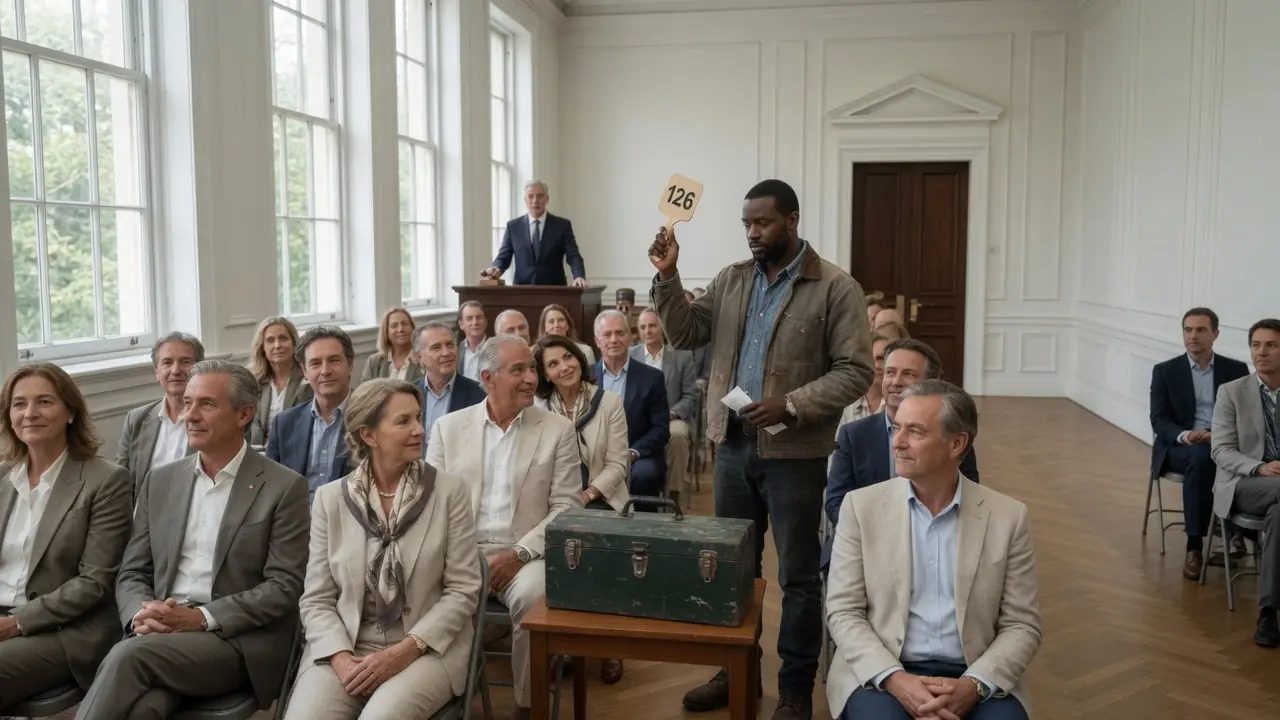
Not all of it. Not loud. But it was there, a ripple of quiet amusement that moved through the folding chairs, pearl necklaces, and pressed linen blazers like a current.
Joel Carter heard it. He was standing in the back of the Mercer Estate Auction House on a Tuesday afternoon with his number paddle still raised, his heart still hammering, and a room full of strangers deciding with their smiles that he had just made a very stupid mistake.
The lot was a battered metal toolbox, industrial dark green and old, the kind of thing that looked like it had been dragged through a century of hard use. The handle was taped with electrical tape, and one latch was bent.
The auctioneer had described it as a vintage mechanic’s chest, provenance unknown, sold as is, contents sealed. The opening bid had been thirty dollars.
Nobody had moved.
Then Joel raised his paddle at ninety, and the auctioneer, who had the practiced monotone of a man who had seen everything, blinked once before bringing the hammer down.
Ninety dollars.
The man to Joel’s left, older, tanned, with a Rolex that could have paid Joel’s mortgage, muttered something to his companion that Joel didn’t catch but understood completely.
Joel tucked the receipt into his jacket pocket and went to collect his toolbox.
He hadn’t planned to be at an auction that Tuesday. He had planned to be at work. He was a floor manager at a mid-sized fabrication plant on the east side of the city, a job that paid steadily, if not generously, a job he had kept for six years because it had health insurance and he had a daughter who needed it.
Amara was seven years old, and she had her mother’s cheekbones and her mother’s habit of tilting her head to one side when she was thinking hard about something, and absolutely none of her mother’s patience for nonsense.
Kezia had died two years ago. Ovarian cancer, diagnosed late, fought hard, the kind of story that doesn’t have a good ending no matter how many people pray or how many treatment plans get written on whiteboards in hospital corridors.
Joel had been there for all of it. And then he had been alone for all of what came after.
The casseroles that appeared on the porch for three weeks and then stopped. The sympathy that faded at exactly the speed that other people’s lives resumed. And the specific, private, daily weight of raising a seven-year-old girl who asked questions he didn’t always know how to answer.
“Why does Mama smell like flowers in my dreams but not when I’m awake?”
That was the one that had gotten him two months after the funeral, in the middle of packing Amara’s lunch. He had put down the peanut butter knife and breathed through his nose for ten seconds before he answered.
“Because your brain is smart,” he said. “It keeps the best parts.”
He’d found the auction listing by accident, a forwarded email from a coworker who collected vintage tools and thought Joel might be interested since Joel was the kind of man who fixed things with his hands when he could.
Joel had scrolled through the listings on his lunch break and almost closed the tab. Then he saw the toolbox.
There was something about it. He couldn’t have explained it to anyone. The photograph in the listing showed a battered green chest, heavy-looking, the kind of thing a working man carried his whole life.
It reminded him of something that felt, at forty-one years old and two years into grief, like it might still be findable.
He took a half day. He drove to the auction house. He bid ninety dollars on a sealed box nobody else wanted.
He drove home with it in the trunk, the latch rattling on every turn.
Amara was at the after-school program until 5:30. He had two hours.
He set the toolbox on the kitchen table and looked at it. Up close in the afternoon light coming through the window over the sink, it was heavier than it looked. He guessed forty pounds, maybe more.
The green paint was original, he thought, layered under decades of use. There was a faint stamp on the side near the bottom, partially obscured by grime, a manufacturer’s mark, a few letters he couldn’t fully make out.
He photographed it. He tried the latches. The good one opened. The bent one required a flathead and patience.
The lid lifted.
And then Joel stopped.
He had expected tools, old wrenches maybe, rusted sockets, the kind of thing you sorted through looking for the one piece worth keeping.
What he found instead was a second interior, a fitted wooden tray dark with age, custom-made and divided into specific compartments. And in those compartments, nestled in what appeared to be original felt lining, was a set of hand tools unlike anything he had seen outside a museum catalog.
Planes, chisels, a marking gauge, a brace with an ivory handle, all of it matching, all of it bearing the same mark, a small stamped emblem he recognized after three seconds of staring.
A crowned rose.
His grandfather had mentioned that mark once, just once. Joel had been twelve.
“There were craftsmen,” the old man had said, not to Joel specifically but to the garage in general, in the way he sometimes talked, “who made tools the way other men made furniture. Built to last three lifetimes. You’ll know them by the rose.”
Joel sat down heavily in the kitchen chair.
He sat there for a long time.
He was still sitting there when he heard the front door open and Amara’s backpack hit the floor with a particular thud that meant she had dropped it from shoulder height rather than setting it down, which he had told her fourteen times not to do.
“Daddy, I’m home,” she called, already heading for the kitchen.
She stopped in the doorway. She looked at the toolbox. She looked at her father’s face.
She tilted her head to the left, her mother’s gesture, precise and unchanged.
“What’s that?”
“A toolbox,” Joel said. “I bought it today.”
She walked over and looked inside, standing on her toes to see over the edge of the table. She was quiet for a moment, studying the tools the way she studied things she was deciding about.
“They’re pretty,” she said finally.
“Yeah,” Joel said. “They are.”
“Why do they look like that? Like old?”
“Because they’re old. Maybe very old.”
She reached out one finger toward the ivory handle of the brace, and he almost said, “Don’t touch.” Then he didn’t, because the look on her face was careful and reverent, and she barely made contact, just the tip of her finger.
Like she was checking whether something was real.
“Are they worth a lot?”
Joel looked at his daughter.
“I don’t know yet,” he said. “I’m going to find out.”
He spent the next two evenings researching. He was not a collector and had no background in antique tools, but he was methodical. It was what made him good at his job, the ability to move through information carefully and not jump to conclusions before the data supported them.
He identified the crowned rose mark within the first hour. It was the stamp of a Sheffield toolmaking firm that had operated from 1841 to 1923, known historically for producing high-grade cabinetmaking and joinery tools that were sold primarily to master craftsmen and exported to the United States and Canada during the late Victorian and Edwardian periods.
The specific style of the compartmented tray, the ivory brace handle, and the pattern of the plane bodies suggested the set was from approximately 1880 to 1900. He found a reference in an online archive of a tool collector’s society that described matched Sheffield sets in original trays as extraordinarily rare in complete condition and noted that the last documented complete set of this maker had sold at a specialist auction in 2021 for $38,000.
Joel read that sentence three times.
Then he closed the laptop and sat in the dark kitchen and listened to the house breathe.
In the morning, he called the one person he knew who might be able to tell him if he was reading this correctly, a man named Bernard Osei, who ran an antique furniture restoration business two towns over and had, over the years, become the person Joel called when something old needed to be understood.
Bernard was sixty-three, Ghanaian-born, meticulous, and constitutionally incapable of exaggerating.
“Send me photographs,” Bernard said. “Every piece, every mark, the tray, the felt, the box exterior, all of it.”
Joel sent forty-one photographs.
Bernard called back four hours later.
“Where did you get this?” he asked, and his voice had a quality Joel had never heard in it before, a kind of careful stillness, the voice of a man who was keeping himself from saying the first thing that came to mind.
“An estate auction Tuesday. I paid ninety dollars.”
A pause.
“Joel.”
“I know.”
“This is a complete Marples and Sons presentation set. Crown mark, second period, circa 1885 to 1892. The tray is original fitted mahogany. The brace handle is genuine elephant ivory, pre-ban, which means it is legal to sell with proper documentation.”
Bernard continued, “The plane blades have never been sharpened. Do you understand what I’m telling you? Never used. This was a presentation set, a gift, possibly a guild gift or a retirement gift for a master craftsman.”
“What’s it worth?” Joel asked.
His voice came out steadier than he felt.
“In this condition, complete, I would not let it go for less than sixty thousand dollars. At the right specialist auction with proper provenance established, it could reach eighty, perhaps more. There are collectors in the UK who have been looking for a second-period Marples presentation set for twenty years.”
Joel was standing in the break room at the plant. He had stepped out under the pretense of getting coffee. The coffee was untouched on the counter beside him.
“You’re sure?” he said.
“I’ve been doing this for thirty-five years,” Bernard said. “I’m sure. Joel, somebody at that auction house looked at a sealed box with a bent latch and saw junk. You looked at it and saw something worth stopping for. Those are not the same kind of eyes.”
He went back to the floor. He managed the afternoon shift. He picked Amara up from school at 3:15 because it was a Wednesday, and on Wednesdays he always picked her up himself.
She talked the entire drive home about a disagreement she’d had with her best friend over the rules of a game Joel had never heard of. He listened to every word. He asked the right questions.
He did not mention the toolbox.
That night after dinner, she found him at the kitchen table with the toolbox open again, going through the pieces one more time, checking each one against the photographs Bernard had sent him of reference examples.
She climbed into the chair beside him without asking.
“Can I look?” she said.
“Yeah, baby. Don’t touch the blades.”
She peered in. She was quiet for a while.
Amara’s silences were never empty. They were working silences, the kind that produced questions.
“Daddy,” she said.
“Yeah?”
“The man at the auction, the one who sold it to you.”
“The auctioneer.”
“Did he know it was special?”
Joel thought about the hammer coming down, the ripple of laughter, the Rolex to his left.
“No,” he said. “He didn’t.”
She considered this.
“That’s sad for him,” she said.
Joel looked at his daughter.
“Why sad?”
“Because it was right there,” she said simply, and went back to looking at the tools.
He had to look away. He looked at the window, at the dark glass, at his own reflection looking back at him.
He thought about Kezia. He thought about the things that are right there and the people who see them and the people who don’t, and the difference between those two kinds of people, and which kind he wanted his daughter to be.
She already was.
Bernard connected him with a specialist auction house, not a general estate house like the Mercer, but a firm that dealt specifically in antique tools and craftsmen’s equipment with an established international buyer base and a catalog that was taken seriously by collectors in the UK, Europe, and North America.
A specialist named Claire Ashworth flew out to examine the set in person, which she did on a Saturday morning in Joel’s kitchen while Amara was at a birthday party.
Claire Ashworth was fifty, direct, and said almost nothing that wasn’t necessary. She examined each piece with a loupe and a portable light. She measured the plane bodies with calipers.
She photographed the maker’s marks under magnification. She lifted the felt lining in the tray to examine the mahogany beneath.
Then she sat back and folded her hands on the table.
“Mr. Carter,” she said, “I want to be precise with you. A set of this completeness and condition, second-period Marples, original tray, ivory brace, unsharpened blades, has not come to public auction in at least fifteen years.”
She continued, “The last comparable example sold in 2009 at a specialist sale in Birmingham for forty-four thousand pounds. Accounting for market appreciation and the current strength of the American collector market, I would estimate a pre-sale range of seventy to ninety-five thousand dollars. If we generate the right interest, it is not impossible that it exceeds one hundred thousand.”
Joel’s hands were flat on the table. He was keeping them still deliberately.
“The box was sealed,” he said, “at the Mercer auction. Nobody knew what was inside.”
“That happens more often than people think,” Claire said. “Estate contents get cataloged quickly, often by people without specialist knowledge. A battered green box with a bent latch gets one line in the catalog and a thirty-dollar opening bid.”
She paused.
“You have good instincts, Mr. Carter.”
“My grandfather told me about the crowned rose mark when I was twelve,” Joel said. “I almost didn’t remember.”
Claire looked at him for a moment.
“Well,” she said, “he told the right person.”
The auction was scheduled for six weeks out. The intervening time had a strange quality.
Joel went to work, picked up Amara, made dinner, helped with homework, did the things that constituted a life. And underneath all of it, in a temperature-controlled case that Claire had arranged for the storage of the toolbox, something waited that had the power to change the geometry of what was possible.
He had not told Amara the full number. He didn’t want her carrying it around at school, turning it over in her mind, letting it change the way she moved through days that should still be ordinary.
She knew it was valuable. She knew it was being sold.
That was enough.
The night before the auction, she found him again at the kitchen table. The spot had become, over these weeks, a place of reckoning, a place where things got decided.
She was in her pajamas, the ones with the small yellow stars, and her hair was in two puffs because she’d done them herself and he hadn’t redone them because she’d been so proud.
She climbed up across from him.
“Is tomorrow the day?” she said.
“Tomorrow’s the day.”
She was quiet then.
“Are you scared?”
He thought about it.
“Not scared. Something else.”
“What something else?”
“Like standing at the edge of something and not knowing exactly how far down it goes.”
She tilted her head.
“Mama used to say that things arrive when they’re supposed to.”
He had told her that. He hadn’t realized she’d kept it.
“She did,” he said.
“Do you think she sent it?”
The kitchen was very quiet. The refrigerator hummed. Somewhere outside, a car passed.
“I think,” Joel said carefully, “that your great-great-grandfather maybe carried something like the toolbox his whole life. And I think somehow, in some way I can’t fully explain, it found its way to ours.”
Amara looked at the empty space on the table where the toolbox had been. Then she looked at her father.
“I’m glad you stopped for it,” she said.
He reached across the table and took her hand. She let him hold it, which she didn’t always anymore, which made him hold it a little tighter.
“Me, too, baby,” he said. “Me, too.”
The auction ran for four hours. Joel watched it on a live stream from his living room, Amara beside him on the couch in her yellow star pajamas because he had let her stay up, because this was the kind of night that was worth staying up for.
The toolbox lot came up sixty-three minutes in. The opening bid was $15,000.
Amara’s eyes went wide.
“Daddy.”
“Watch,” he said.
It moved fast, faster than he’d expected because Claire had been right about the interest. There were at least four serious bidders, two of them phoning in from overseas, their proxies visible as names on the livestream’s bidding panel.
It crossed $40,000 in under three minutes. It crossed $60,000, and two of the phone bidders dropped.
It crossed $75,000, and Joel’s leg was bouncing so hard Amara put her hand on his knee to stop it.
A gesture so precisely her mother’s that he almost couldn’t breathe.
The last two bidders held on past $80,000. Past $85,000.
The hammer came down at $91,000.
Joel sat absolutely still.
Amara turned to look at him. Her eyes were enormous.
“Daddy,” she whispered. “Daddy, that’s—”
“I know,” he said.
“Is that—”
“Yeah.”
She threw her arms around his neck. He held her.
He held her for a long time, longer than the moment required, longer than the livestream justified, because she smelled like the strawberry shampoo he bought in bulk, and she was warm and small and here.
And two years ago, he had learned with terrible precision how quickly the things you hold can be gone.
“We are okay,” he said into her hair.
It wasn’t quite for her.
“We’re going to be okay.”
She pulled back and looked at him with those cheekbones and that tilted head and those eyes that saw everything.
“We were already okay, Daddy,” she said.
He laughed. It came out ragged and real.
“Yeah,” he said. “We were.”
Three weeks later, Joel Carter walked back into the Mercer Estate Auction House. He didn’t have an appointment. He wasn’t there to bid.
He walked to the front desk and asked for the manager. And when the manager came out, a trim, efficient man named Hartwell whom Joel vaguely recognized from the auction floor, Joel shook his hand and said he had something to return.
He placed a folded piece of paper on the desk.
Hartwell unfolded it. It was a printout of the specialist auction’s result page, lot description, final hammer price, buyer’s premium line, $91,000 in plain black type.
“The green toolbox,” Joel said. “Lot 47. Your auction six weeks ago. Ninety-dollar sale.”
Hartwell looked at the paper for a long moment. His expression moved through several things.
“I see,” he said finally.
“I’m not here to make a point,” Joel said. “I’m here because I thought you should know. So that the next time a sealed box comes through with a bent latch, maybe somebody opens it before they write thirty dollars in the catalog.”
Hartwell nodded slowly. He looked like a man doing arithmetic.
“Thank you for coming in, Mr.—”
“Carter,” Joel said. “Joel Carter.”
He picked up the paper. He folded it back into his pocket.
“Have a good afternoon.”
He walked out into the afternoon, which was bright and cold and full of the particular clarity that follows a long period of uncertainty.
He had paid off Kezia’s remaining medical debt that morning, the last invoice, the one he’d been managing in small payments for two years, the one that felt like a monthly reminder of the worst year of his life.
He had put the rest in an account for Amara, a real account with a real number in it. The kind of number that meant she could choose her school and her city and her life without the particular constraint of a father who had done his best but not had enough.
He called Amara from the parking lot. She picked up on the second ring.
“Daddy, I’m in reading time,” she whispered.
“I know. I just wanted to hear your voice.”
A pause. He could hear her decide not to complain about the interruption.
“Hi, Daddy,” she said softer.
“Hi, baby.”
He leaned against the car. The afternoon felt enormous and still.
“I’ll pick you up at 3:15.”
“Are we getting the good ice cream or the regular ice cream?”
“What do you think?”
“The good ice cream,” she said with complete confidence, and hung up.
He stood there for a moment in the parking lot of an auction house that had once watched him walk out with a battered green box and quietly found that amusing.
He was forty-one years old. He had a job he was good at, a daughter who was better than he deserved, and a memory of a grandfather’s voice in a garage on a Saturday morning that had, across thirty years and through the worst detour of his life, found exactly the right moment to matter.
Things arrive when they’re supposed to.
He got in the car and drove toward 3:15.