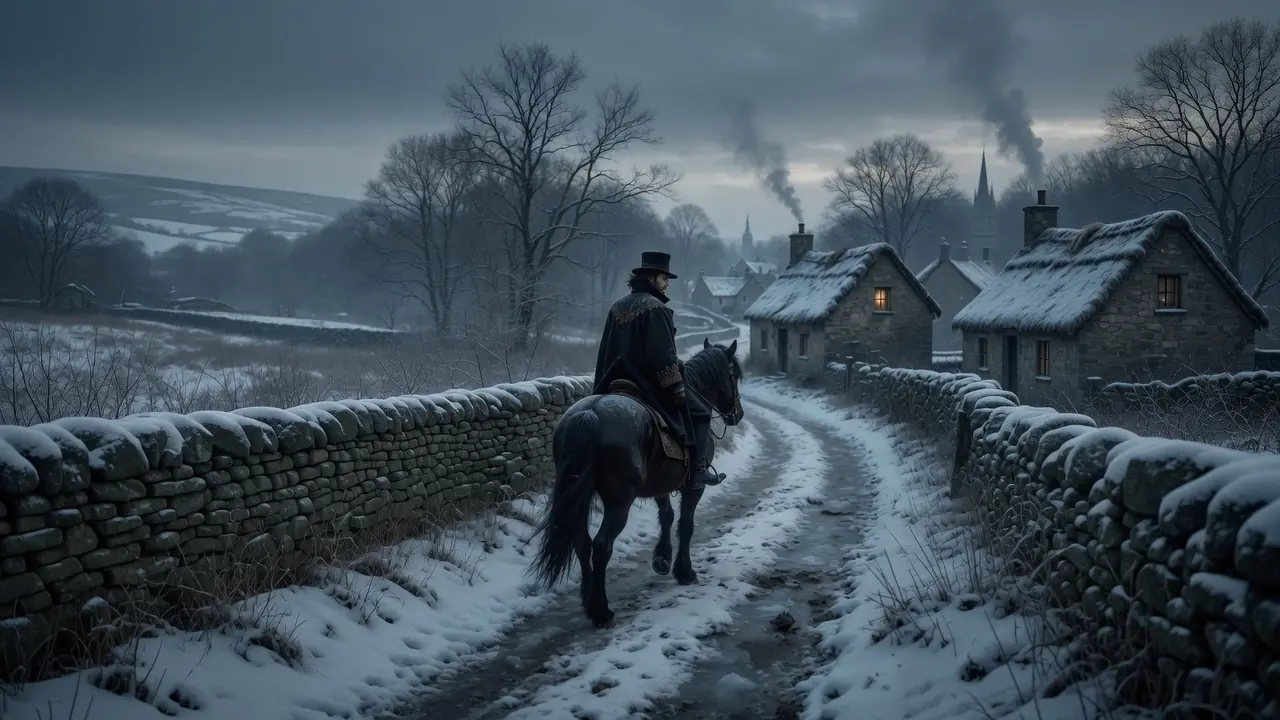
The news came up the frozen road on a carrier's cart, the way all news came to that part of the world in winter, late and secondhand and cold. And it found Diana Hail at the wash line behind the cottage with her hands raw in the wind. And it changed everything, though she did not let it show, because she had learned a long time ago that letting things show was a luxury for women who could afford to be looked at.
The carrier was a talkative man named Goff, who came through the village twice a week with parcels and gossip in equal measure. And he had a tale this morning that he had carried 40 miles and polished at every ale house on the way. And he told it to Diana over the low garden wall while his horse steamed in the lane.
There was a great lord, he said. A duke, no less, though Goff could not be brought to say which. And this duke had taken leave of his senses by all accounts, and was going up and down the country like a man bewitched, county after county, knocking at the doors of the gentry and the doors of the pawn brokers alike, and showing to everyone a little painted picture.
A lady's face done small on ivory, the kind of thing a gentleman wears in a locket or keeps in a drawer, and asking always the same question. Did anyone know her? Did anyone know the lady in the miniature? Would anyone tell him her name?
A face, said Goff, relishing it. Crossed three counties for a face, they say, and offering money to any soul that can put a name to it. Now there's a thing. Whole shires laughing about it. A duke chasing a picture about England in the snow like a boy chasing a hat in the wind.
What do you make of that, Mrs. Hail? Diana made nothing of it that she would say aloud. She wrung the shirt in her hands until the water ran white between her knuckles, and she said it was a strange world, and she hoped his horse would not take cold standing.
And Goff laughed and clucked the beast on, and the cart went away down the white lane. And Diana stood quite still at the wash line, with the wind cutting at her, and she knew with a certainty that sat in her stomach like a stone, exactly whose face was being carried up and down the country on a piece of ivory.
It was her own. She had sat for that miniature when she was 17 years old in her father's house, in the years when there had still been a father's house to sit in.
A traveling artist had come through, the kind who painted the squire's family and the parson's wife for a few guineas. And her father, who had loved her and been proud of her, and had not yet run his small fortune onto the rocks, had paid for her likeness to be taken.
A girl of 17, in a white muslin gown, with her hair dressed in the old way, and a rose in her hand that the painter had added for prettiness, because she had not been holding any rose. She remembered the sitting.
She remembered being told to hold still and think of something pleasant. And she had thought of the summer and the future, both of which had seemed at 17 to be made of the same bright stuff, and to be coming toward her without end.
She had not thought of the future as a thing that could fail. It had failed within 3 years. Her father, a gentle, hopeful, disastrous man, had put his money into a scheme a clever man had recommended, and the scheme had failed.
And then he had borrowed to recover, and the recovery had failed worse. And at the last there had been the visit from the men of business, and the slow, terrible inventory of the house, every chair and clock and spoon written down in a ledger and sold.
The miniature had gone with the rest. It had been listed among the effects, a lady's portrait on ivory in a gilt case, and it had been carried away with the silver and the books and the good chairs to be sold at the brokers in the market town.
And Diana had watched it go, and had thought even then in the wreck of everything, that there was a particular cruelty in selling a girl's own face out from under her, as though her very likeness were a debt to be settled.
Her father had not survived the ruin by a 12-month. And Diana, at 20, a gentleman's daughter with no fortune, no father, and no prospects, had done the sensible thing, the thing that quiet, ruined girls did, and married the first respectable man who offered.
Which was Mr. Hail the curate, a thin kind anxious man 15 years her senior who needed a wife to keep his poor house and could overlook her want of dowry because he had no great expectations himself.
She had not loved him. She had respected him which she had told herself was enough and which had very nearly been enough. And she had kept his house and darned his linen and sat by him through the long decline of his chest until the consumption took him.
And he had died apologizing to her the way he had lived apologizing to everyone. Sorry to leave her with nothing. Sorry to have been so little. And she had held his hand and told him he had been good, which was true, and had not told him she had never been happy, which was also true, because there is no kindness in handing a dying man a grief he can do nothing with.
So now she was Diana Hail, the Curate's widow, 7 and 20, and she lived in a rented cottage at the edge of a village in a county her father had never seen. And she kept herself by her needle, taking in the fine sewing that the farmer's wives could not do, and the gentry's wives would not.
And she taught three little girls their letters and their stitches two mornings a week for a few shillings. And she was poor and she was plain and she was proud.
And she was by every measure the world used, nobody at all. It was a small life, and she had made it a good one, in the way that only the proud and the poor know how to do by refusing to let it be a mean one.
The three little girls were the children of a farmer and a miller and a saddler. And they came to her cold kitchen two mornings a week, and she taught them their letters out of the one book she had kept through everything, her father's.
And she taught them their stitches. And she taught them without ever saying she was doing it, that a woman might have nothing and still have her own straight back, because she had learned that lesson in the hardest school, and thought it the only one worth passing on.
The mothers paid her in shillings when they had them, and in eggs and a twist of tea when they had not. And once the saddler's wife, meaning well, had left a basket of castoff clothes on the step, good clothes, kind clothes, and Diana had carried the basket two miles back to the woman's door, and thanked her with a face so quiet and so unanswerable that the charity was never offered again.
And the friendship, oddly, was the warmer for it, because the saddler's wife had understood that there was a thing in Diana Hail that could not be bought, even with kindness, and had respected it. She would take payment. She would not take pity.
The difference was the whole of what she had left, and she guarded it the way another woman might guard a jewel. And she was not ashamed of guarding it, for it was, she sometimes thought, the only jewel the ruin had not been able to sell out from under her.
The girl in the white muslin with the rose she had never held was gone. She had been gone for 10 years, and now a duke was carrying her ghost up and down England in the snow, asking everyone her name.
And Diana Hail stood at her wash line and felt something she had not felt in years, which was rage, clean and cold and bracing. Because she understood at once, before she understood anything else, that whatever this great bewitched lord thought he was hunting, it was not her.
It was the rose. It was the muslin. It was a dead girl's painted face. And she, the living woman, the one with the raw hands and the darned gown and the 10 hard years, was nothing to do with it at all, and never would be, and she would not be found, and she would not be claimed like a glove dropped in the road.
She took the washing in, and she did not say a word of it to anyone. And she resolved with the whole force of her stubborn pride that the Duke and his ivory might hunt the length of the kingdom, and they would never come to her door.
12 miles and one county away, at the cold great house called South Cross, the old woman, who had watched it all begin, sat by her fire, and turned the whole strange business over in her mind, and could not decide whether her great nephew had run mad, or had, after 35 frozen years, finally come to life.
Lady Bathsheba was 81 years old, and she had buried a husband, two brothers, a sister, and more of the next generations than she cared to count, and she had come to live at South Cross a decade past for no better reason than that she had nowhere warmer to be, and that the boy, as she still called the Duke of Ravensgate, though he was 4 and 30, had needed someone in that vast house who remembered him before he turned to stone.
She was sharp as a needle and twice as hard to thread, and she missed very little, and she had missed nothing of the change in her great nephew since the afternoon of the snow.
It had been the bitterest week of the winter. There had been a fair in the market town the day before, and the dealers and peddlers had come from three counties to it.
And one of them a man who bought and sold the small valuables of ruined families, the lockets and the snuff boxes and the painted miniatures of people whose grandchildren no longer wanted them had come along the South Cross Road in the dusk with his pack on a handcart, and the cart had gone into a drift and overturned, and the man had gathered up what he could in the failing night and gone on and had not noticed or had not troubled that one small thing had spilled into the snow and been left.
The Duke of Ravensgate had found it the next morning. He rode out early, as he always did, alone as he always rode, a tall, cold, solitary man on a tall, cold morning, and his eye had been caught by a gleam in the snow at the side of the road, a glint of gilt against the white, and he had got down, which a duke seldom does for a thing in a ditch, and picked it up, and brushed the snow from it, and found himself looking at her face.
Lady Bathsheba had seen him when he came in. She had been at her window, and she had watched him ride up the avenue at a pace that was not his usual pace, and she had seen, even at that distance, that he was holding something, and that he kept looking at it.
And when he came into the hall, she had gone out to him, and he had not heard her, and she had stood and watched her cold great nephew stand in his own hall in his wet boots, forgetting to give up his coat, looking down at a little painted face on ivory, as though it had spoken to him.
What have you there? she had asked, and he had started like a guilty boy, and had shown her almost unwillingly, and she had taken it to the light, and looked at it.
It was, she had to own, a lovely thing, a girl of about 17, fair, with a sweet grave mouth and clear eyes, and her hair done in a fashion 10 years out of date, holding a rose. The painter had been better than most.
There was a life in the face, a sense that the girl had been about to smile or to speak, a quality that made you want to know what she had been thinking. There was a name on the back, very small, but it had been half rubbed away by time and weather, and only the one word remained legible.
A surname, Cranidge, and below it, lost the rest. A pretty piece, Lady Bathsheba had said, handing it back.
Some ruined family's daughter by the date of the gown. The dealers carry hundreds of them. You may find the man at the fair and buy it honestly if it pleases you so.
I do not want to buy it, her great nephew had said. I want to know who she is.
And that Lady Bathsheba reflected now by her fire a fortnight and three counties later had been the beginning of the maddest and the most hopeful thing she had seen in 10 years.
For the boy had not let it go. He had gone to the fair and found the dealer, who remembered the lot, but not the face, hundreds passing through his hands, as he said.
But who could tell the Duke where he had bought that parcel of goods at a broker's two counties off, the residue of an old bankruptcy, and the Duke had gone there.
He had got into his carriage in the dead of winter and driven two counties to a pawn broker's back room to ask after the provenance of a thing he already held in his hand. And the broker had his ledgers, and the ledgers had the name Cranidge.
A gentleman's estate sold up a decade past. The family scattered or dead. And one daughter, the broker thought, married away somewhere. He knew not where. To a clergyman, he thought, in another county again. Three counties.
The boy had crossed three counties in the snow, knocking at the doors of brokers and parsons and the agents of old estates, piecing together from ledgers and parish registers and the long memories of country attorneys the trail of a ruined family and a married daughter.
And Lady Bathsheba had watched him go and come and go again, lit from within by something she had not seen in him since he was a child. And she did not know whether to be glad or afraid.
And she was, in the way of the very old, who love someone difficult, a great deal of both. He told her some of it on the evenings he came home more than he had told her of anything in years.
And she pieced the rest together from his man and from the state of his boots. The first county had given him the broker and the broker's ledger and the name Cranidge and a great deal of nothing else.
For the family was 10 years scattered, and the neighbors who remembered them remembered chiefly the manner of their fall, which is the thing neighbors always remember best. The second county had given him a churchyard with the father in it under a stone already going green and a half-sister of the dead man's, a sour old woman in a cold parlor who had received a duke without rising and told him with a satisfaction Lady Bathsheba could imagine all too well that the girl Diana had married a curate and gone away and that she neither knew nor cared to which benighted corner of the kingdom the connection having been in the old woman's phrase no longer worth the keeping once the money went.
The third county had been the hardest. A matter of curates, lists, and bishop's clerks, and the slow tracing of a poor clergyman named Hail from one wretched living to a worse one, and at last to a grave, and a widow left behind it, and a village, and a lane, and a cottage at the end of the lane.
The boy had done it all himself. He had not sent a man of business, which would have been the easy way and the cold way. He had gone in person, county after county, into back rooms and cold parlors and registry offices that smelled of damp paper, a duke asking after a nobody.
And he had borne the curiosity and the half-hidden laughter and the impertinent questions. And he had not once turned back.
And Lady Bathsheba, hearing it, had not known whether she was watching the most foolish thing a man of his rank had ever done, or the bravest, and had concluded in the end, that it was both, and that the two were perhaps not so different as the world supposed.
What she could not tell watching was what he imagined he would find at the end of it. She did not think he knew himself.
He had a face on ivory and a hunger he could not name, and he was following the one toward the other across the white winter country, like a man walking in his sleep toward a window.
And the old woman feared on his behalf the moment of waking, which she knew was coming, and which she could not spare him, for she knew what no one else knew, which was why the boy had frozen in the first place, and why a face on ivory could thaw him when no living woman had managed it in 15 years of trying.
He had been a warm child. That was the thing the world had forgotten and Lady Bathsheba had not. He had been the warmest, most open, most easily wounded of children, and the world had set about teaching him as the world does to such children, that warmth is a door left open in winter, and the cold comes in.
His mother had died when he was seven. And his father, a hard, correct man, had told the weeping boy that a duke's son did not cry and had sent him away to be made into something that did not cry, and it had taken years, but it had worked.
And when the boy had grown and had once, against all his training, let himself love a young woman in his early manhood openly and hopefully, she had used the love to raise her own value in the marriage market, and had thrown him over at the last for a richer coronet, laughing, and the world had seen it.
And the lesson his father began was finished by a girl he had trusted, that to want a living thing, a thing with a will of its own, a thing that could choose and could leave, was to hand it the knife and bare your throat.
So he had stopped. By degrees across his 20s, the Duke of Ravensgate had taught himself the one perfect safety, which was to want nothing that could refuse him.
He collected things, beautiful cold things, paintings and porcelain and horses, things that stayed where they were put and did not change their minds. He was courteous to women and warm to none.
He had let his heart, Lady Bathsheba thought, harden around itself like a pearl around a grain of grit, smooth and round and closed. And she had watched it happen and been powerless because grief and fear are not arguments and cannot be argued with.
And now he had fallen in love with a picture. She understood it, sitting by her fire better than he understood it himself.
Of course, it was a picture. A picture was the only thing such a man could safely love. The girl in the miniature could not refuse him. She could not throw him over for a richer man, could not laugh at him, could not leave.
She was 17 and sweet and silent forever, fixed in her white muslin with her painted rose, asking nothing, threatening nothing, perfectly safe. He had crossed three counties, not in spite of his fear, but because of it.
He had found at last the one beloved in all the world who could never break his heart because she was not alive to do it. And the whole force of the wanting he had dammed up for 15 years had broken loose toward the one object that could not hurt him.
You foolish boy, Lady Bathsheba said aloud to the fire. You have not fallen in love at all. You have found a way to want something without the risk of being wanted back.
And it will not do. It will not do you the least good in the world. For there is no one behind that face to love you. And a man cannot warm himself at a painted fire.
But she did not say this to him because the very old know that some things must be learned and cannot be told. She only watched and waited and hoped in her hard, fierce way that when he finally ran his ghost to ground, when he stood at last before the place where the girl in the ivory had gone, he would find there something he did not expect, something alive, something that could say no to him.
Because only that, she knew, only the shock of a living woman with a will of her own could finish what the snow had started and break the pearl and let the boy out.
He ran the ghost to ground on a gray afternoon at the very end of the winter at a cottage at the edge of a village in the third county. And what he found there was not the girl in the ivory.
Diana was at her sewing when the knock came. She had been expecting it in the way one expects a thing one has refused to believe in.
The rumor of the searching Duke had grown all month, and a fortnight since a country attorney had come asking after the Cranidge family, and gone away again, and she had known then that the trail was warm, and she had sat each evening with her needle and her dread, and told herself she did not care, and had not believed it.
So when the knock came, a firm knock, a gentleman's knock on her poor door in the failing light, she knew before she opened it, and she set down her work, and she smoothed her darned gown over her knees with hands she would not let shake, and she opened the door to the Duke of Ravensgate.
He was tall. That was the first thing. He filled the low doorway and had to stoop under the lintel. He had black hair and a hard, handsome, arrogant face gone strange with feeling, and dark eyes, brown as peat water, that fixed on her face the instant the door opened, with a hunger so naked that she nearly stepped back from it.
And then she watched in the space of 3 seconds the hunger fail. One second. Two. Three. She saw it go out of his eyes.
She saw him look at her face, the face he had crossed three counties for, and she saw it not match. She knew exactly what he was seeing, because she saw it herself every morning in her bit of glass.
A tired, plain woman of seven and 20, with a line between her brows that 10 hard years had put there, with chapped hands and a darned gown and gray beginning at her temples, a woman with none of the dewy 17-year-old softness of the painted girl, a woman the rose would have looked absurd in.
She watched the great lord's bewitchment break against the fact of her, and she felt under her rage a small contemptible stab of pure humiliation. The humiliation of being found wanting against a portrait of oneself, of being one's own disappointing future.
You are looking, she said before he could speak, because she would not stand there and be measured against a ghost in her own doorway, for a girl who does not exist.
I am sorry you have come so far. Good evening, Mrs. Hail. He got the name out as she began to close the door, and there was something in his voice, a kind of dismay that made her pause despite herself.
Forgive me. I have I have startled you and myself. I had not I did not expect... You did not expect me to have aged, Diana said.
No. The picture does not age. That is rather the point of pictures. She held the door half closed, a barrier between them, and looked at him steadily, and let him see that she was not afraid of him, and was not flattered by him, and was, if anything, angry.
I know what you have, your grace, for the whole country knows it. You have been carrying it about like a relic. It is a miniature of a girl named Cranidge, painted some years ago.
I was that girl. I am not that girl now. That girl had a father and a future and a white muslin gown, and she's been gone these 10 years, and you have crossed three counties in the snow to find her.
And I must tell you with great regret for your trouble that she is dead and that I, who wear her face like a worn out coat, am no kind of substitute, and have a great deal of sewing to finish before the light goes.
I wish you a safe journey home. And she closed the door. She closed it on a duke.
She stood with her back against it, her heart going hard, appalled at her own daring and fierce with a satisfaction she could not have explained, listening, and she heard him not move for a long moment on the other side of the door.
And then she heard him say through the wood in a low voice, not meant to carry but carrying, You are quite right. I beg your pardon.
And then she heard his boots go away down the path and the gate. And after a while a horse and he was gone.
And Diana Hail slid down with her back against her own door and sat on the cold floor and put her face in her raw hands and did not weep because weeping was a luxury, but came nearer to it than she had in years.
He came back 3 days later, and he came differently. She had not expected him to come back at all.
She had expected, if she had let herself expect anything, that he would go home to his great house and his collection, and forget the whole strange episode, the way the great forget the small, and that she would never see him again, which was what she wanted, she told herself.
And the telling rang as false as it always did. So when the knock came again, the same firm gentleman's knock on a clear cold morning with the first softness of the turning year in the air, she was unprepared for it, and she opened the door with her guard down.
And there he was, hat in hand this time, and he did not look at her with hunger, and he did not look at her with disappointment. He looked at her the way a man looks at a difficult passage he means to understand, with attention, and a kind of humility she had not thought a duke could own.
I have come to apologize properly, he said. And then I will go if you wish it and not trouble you again. May I?
She should have said no. She let him in. She told herself afterward that it was only the cold, that she could not leave even a duke standing on the step in the wind.
But the truth was that the difference in his face had caught her, the absence of the hunger, and she wanted, against all her resolve, to know what it meant.
She gave him the one good chair, and took the stool herself, and folded her hands, and waited, and the great cold house of her one room held its breath around them.
I have thought a great deal these three days, the Duke of Ravensgate said, about what you said to me at this door, and I have concluded that you were entirely right, and that I have made a fool of myself in a manner so complete that it has taken me 3 days merely to map the full size of it.
He turned his hat in his hands. He was not a man, she saw, who was used to saying such things, and the saying cost him, and he did it anyway, which she marked.
I found your likeness in the snow. I will not pretend it did not move me. It did more than I can well account for. But you have named the thing exactly.
I fell in love, if that is even the word, with a painting, with a girl of 17 who cannot speak and cannot change and cannot, I think this is the heart of it, cannot refuse me.
I crossed three counties chasing a face precisely because a face asks nothing of a man. And then I came to your door and a living woman opened it, a woman with a will and a temper and 10 years I know nothing of, a woman who shut a door in my face rightly.
And I found that I had no idea in the world what to do because the living woman was not in my plan at all. I had not come to meet a person. I had come to claim a picture.
It is when one says it plainly contemptible and I am ashamed of it. And I have come to tell you so and to give you this.
And he took the miniature out of his breast and held it out to her on his open palm. Diana looked at it.
There she was, 17 and dead, the white muslin, the rose she had never held, the future that had not come. She had not seen her own girl's face in 10 years. She did not take it.
Why are you giving it to me? she asked. Because it is yours, he said.
It was sold out from under you with everything else. I have learned the whole of it. The bankruptcy, your father, all of it, and a man's own face should not be carried about the country by strangers and pored over in alehouses.
It is yours. I had no right to it. I only had the luck to find it and I have used the luck badly and I am giving it back and then I will go.
He set it down on the table between them when she would not take it from his hand gently face up. I am sorry, Mrs. Hail for coming after you as though you were a thing to be found.
For looking at you that first day and letting you see me weigh you against a painting. That was the worst of it, the unforgivable part. And I have not been able to forget your face when you saw me do it.
You deserved to be looked at as yourself, and I did not. And I am sorry.
And Diana Hail, who had armed herself against a duke's arrogance and a duke's hunger and a duke's careless power, found that she had no armor at all against this, against a proud man humbling himself in her poor room, and naming the exact shape of the wound he had given her, and asking nothing in return.
And she felt the rage go out of her like water from a cracked jug. And something more dangerous come in to fill the space. And she was angry about that too, but differently.
Sit down, your grace, she heard herself say. You have come a long way to apologize. The least I can do is give you a cup of something hot before you ride back.
Though I warn you, it will be very poor tea, for I cannot afford the good kind, and I will not pretend to you that I can. Something moved at the corner of his hard mouth. Not a smile, the almost of one.
Poor tea, said the Duke of Ravensgate, would be very welcome. And he sat down.
And that was the beginning of the second thing, the real thing, the slow thing, which neither of them had planned, and neither of them could afterward say the hour of.
He came back after that, more than a man apologizing needs to come. He had no excuse for it, and he made none. And Diana asked for none, though she knew, and he knew she knew, that a duke does not ride 12 miles and back to drink poor tea in a curate widow's cottage for the sake of his conscience.
He came because the living woman had begun to be more to him than the painted girl had ever been, and the strangeness of that, the sheer reversal of it, kept him coming back to be sure of it.
For the girl in the ivory had been safe and silent and his. And the woman across the poor little table was none of those things, was sharp and sometimes cold and entirely her own, would contradict him flatly when he was wrong, and did not soften it, would let a silence stand when she had nothing to say rather than fill it to please him.
And the Duke, who had spent 15 years among people who agreed with him because he was a duke, found her like cold water on a fevered man. Shocking and necessary and impossible to do without.
He learned her, that turning spring, the way she had once been painted, slowly and with attention. But he learned the real thing and not the surface.
He learned that she had read more than he had, and better, that her ruined father had given her a gentleman's education, because he had loved her, and not known what else to give a daughter, and that she had kept it alive through 10 years of poverty, the way one keeps a coal alive under ash, banked and hidden, and never quite out.
He learned that she was proud in a way that had nothing to do with vanity, the hard, clean pride of a person who has been given every reason to feel small and has refused.
He learned the particular things, the catalog of her. The way she could not pass a child crying in the lane without stopping, the way she saved the worst of her three pupils for last, because the girl was slow and shamed, and Diana would not hurry her, the way she never complained of the cold, but kept her hands moving so he would not see them shake, the way she spoke of her dead husband with respect and never once with love and did not pretend otherwise to make herself look better.
He learned that she was braver than anyone he had ever known, the small unsung daily bravery of the poor and proud, and that it was worth more than all the beauty in his collection, and that he had nearly ridden past it, because it did not come in a gilt case.
And Diana, for her part, watched him and did not let herself trust him because she had one possession left in the world, which was her own clear sight, and she would not give it up for any man's company, however much she had begun, against every dictate of her sense, to want it.
She watched to see whether he was looking at her or at the ghost. She set him small tests he did not know were tests. She wore her plainest gown and her reddest hands and her flattest mood on purpose to see whether the bewitchment came back when she gave it nothing to feed on.
And it did not. He came on those days as steadily as on her better ones, and listened as closely, and she began by inches to let herself believe the thing she most feared to believe, which was that he had stopped seeing the painting, but she did not say so.
She had been a girl with a future once, and it had failed her, and she had learned not to count on a thing until it was in her hand and paid for.
There was an afternoon she remembered long after, a small afternoon, nothing in it, that told her more than all his fine speeches could have. He had come and found her vexed, which she had not troubled to hide, because the one good chair, the chair she always gave him, had at last given way at the joint, and she had no money to have it mended, and no skill to mend it herself, and a temper that day about the whole grinding smallness of being poor.
A duke, she had thought, would not even see such a thing, would step over the broken chair the way the great step over everything that costs less than a horse.
He did not step over it. He took off his coat in her poor room, and he asked for glue and twine, and she had a little of both. And he turned the chair up on its end, and set the joint, and bound it, and held it while it took, his fine hands at her mean little task for the better part of an hour.
And he talked while he did it, not of pictures, not of her face, but of a chair he had broken as a boy, and mended in secret for fear of his father, and the way the housekeeper had known and never told.
And Diana sat on her stool and watched a Duke of England glue her broken chair and tell her a true small thing about himself and felt the careful walls she had built against him give a little at their own joints quietly where she could not stop it.
You need not have done that, she said when it was done and the chair stood firm. I know it, he said, rolling down his sleeves.
That is rather why I wanted to. A man may give a great deal that costs him nothing. It is the small things, the things beneath him that tell the truth of him.
I have spent my life above the small things. I find I should like, late as it is, to learn them.
And he had looked at the mended chair, and not at her, and then at her, and not at the chair, and something had moved at the corner of his hard mouth, the almost of a smile.
And Diana had got up rather quickly to see to the kettle because there are moments a woman cannot let her face be looked at. And that was one.
It was on an evening near the end of that spring that he told her the truth of himself, the thing his great aunt knew and no one else.
And he told it to her alone in her poor room with the one candle burning. And she understood then that he had let her all the way in to the cold center and that no one else had been there.
You asked me once, he said, why a man would cross three counties for a picture. I told you it was because a picture asks nothing. That was true, but it was not the whole truth.
And I find I want to tell you the whole truth, though it does me no credit. He was quiet a moment, turning the cup in his hands, the way he turned his hat when the words were hard.
I was a warm child, Mrs. Hail. You would not think it to look at me. No one would, but I was. And the world took some trouble to teach me that warmth is dangerous.
And it taught me through the people I loved, one after another, until I had learned the lesson so well that I made a principle of it. I decided I would never again want anything that had the power to leave me.
So I wanted things instead of people. Things stay. And then I found your face in the snow and I thought here is the safest love in all the world.
A beautiful girl who cannot ever refuse me or leave me or laugh at me because she is not alive to do any of it. I crossed three counties not because I was brave enough to love, but because I was coward enough to want something that could not hurt me.
He looked up at her then and his peat dark eyes were not cold at all and they were not safe and he let her see that they were not.
And then you opened the door and you were alive and you shut it in my face and you could refuse me and you did and I should by every law of my own nature have fled from you and gone back to my safe painted girl forever.
And instead I find I cannot stay away. I find that the very thing I built my whole life to avoid, a woman with a will of her own who might say no to me, is the only thing I have wanted in 15 years badly enough to risk the no.
You have undone the entire work of my life, Mrs. Hail, simply by being real. And I do not know whether to thank you for it or to be terrified.
And the truth is that I am both in equal measure all the time. And Diana Hail sat very still in the candle light with her heart breaking quietly open because she heard the cost of what he had said.
And she knew what it was to have built a whole life around never ever wanting what could be lost, having built one herself. And she understood that he had just handed her the knife and bared his throat, the very thing he had sworn never to do, and that he had done it knowing she could use it.
I will not hurt you, she said low. I do not have it in me to hurt anyone who has shown me his throat.
But I will tell you what I am afraid of, your grace, since you have been honest. And it is only fair.
I am afraid that you have talked yourself out of loving a picture and into loving a brave poor woman who is having a hard life, and that the second is only the first in a kinder coat.
I am afraid you are in love with my courage the way you were in love with my face from the outside as a fine thing to admire. I have been admired from the outside before.
It is not the same as being known and it does not last and I am too old and too poor to spend what little I have left on the difference between them.
So I will not give you an answer to a question you have not asked. But I will tell you that the asking when it comes must be to the woman, the whole woman, the tired and the cold and the sometimes bitter and the often afraid and not to the brave one or the painted one or any other flattering thing.
To me or not at all. To you, he said. Or not at all. Yes. I understand it.
And she thought that night, lying awake, that perhaps he did, and perhaps she might, after all, have a future a second time.
She had forgotten how much hope hurt. She had forgotten that it was a kind of opening of an old wound, that to want again is to remember every way wanting has failed.
She lay in the dark and let herself hope anyway, a little carefully the way she had once banked a fire. And she did not know that the thing that would test her hope to its root was already on its way to her county in a fine carriage with a fine, cruel, beautiful purpose.
Lady Cosima came to the county because she had decided some time ago that she was to be the Duchess of Ravensgate, and she was not a woman who let her decisions be interfered with by the facts.
She was the daughter of a Marquess and she was 4 and 20 and she was by the common verdict of three London seasons the most beautiful unmarried woman in England and she had been raised from the cradle to be exactly that and nothing else.
A surface so perfect that no one had ever thought to ask whether there was anything behind it, least of all Cosima herself, who had learned very young that her beauty was her whole value, and had organized her entire being around the keeping and the spending of it.
She had expected to have the Duke of Ravensgate years ago. Their families had half arranged it. She was the obvious match, the dazzling match, the match the whole world expected.
And his cold reluctance had been, she had always assumed, mere male perversity that would yield in the end to her face, because everything yielded to her face in the end.
And then the absurd story had reached her in London, the story the whole town was laughing over. The great cold Duke of Ravensgate gone mad over a pawned miniature, crossing three counties in the snow after a nobody.
And Cosima had not laughed. Cosima had felt for the first time in her gilded life a cold finger of fear because she understood with the sharp instinct of a woman whose whole capital is her face that a man chasing a face across England was a man primed to fall and that if he fell it might not be to her.
So she had ordered her carriage and come to the country to the neighborhood of South Cross on a long visit to a complacent cousin to see for herself and to put a stop to it.
What she found when she had made her quiet inquiries was almost reassuring. The woman was a curate widow, a penniless seamstress of seven and 20, plain, worn, living in a hired cottage.
It was, Cosima thought, hardly a rival at all. It was barely a person. And yet the Duke went there 12 miles and back again and again all the spring.
Her inquiries told her too, and the fear did not go away. And so she did what such women do when they are frightened, which is to find the weak place and press on it until something breaks.
She found the weak place easily because it was the same as her own, though she would never have admitted the likeness. The weak place was the picture.
She arranged to meet the widow as if by chance in the market town on a day she knew the Duke was elsewhere. She came upon Diana at the linen drapers, where Diana was matching thread, and she was all sweetness.
Lady Cosima, all gracious, wondering condescension, a great beauty in a great pelisse, stooping to notice a little dim seamstress. And she introduced herself, and she watched the widow understand who she was, and she admired with exquisite cruelty how well the poor creature held her countenance.
I have so wanted to meet you, Cosima said, smiling, her voice pitched to carry just to the two of them, and no further, for you are quite the most talked of woman in three counties, did you know?
The face from the snow. How it must amuse you to have set a duke chasing about the country after a little painting of yourself. Such a romantic tale. Everyone says so.
She let the smile sharpen by a degree. I do hope, my dear, that you are not so unworldly as to mistake it for anything but what it is.
You will not mind my speaking plainly. I am older in these matters than you, though not, I think, in years. A man like Ravensgate does not love a woman like you.
It is not unkindness in me to say it. It is only the truth, and I would think it a greater unkindness to let you go on in a dream.
He fell in love with a picture. A pretty lie on ivory, a girl of 17 who never has to grow tired or grow old or grow poor.
And you, forgive me, you are the worn thing the picture was traced from, 10 years on, and the moment the novelty of the resemblance wears thin. And it will, my dear, these things always do.
He will look up and see what the rest of us see, a faded little widow in a darned gown, and he will wonder, as men do, what on earth he was about.
You are not a woman to him. You never were. You are a curiosity that happens to share a face with something he admired.
I tell you this as a kindness. Do not stake your heart on being the answer to a riddle. When he has solved it, he will set it down.
It was beautifully done. It was the cruelest thing that had ever been said to Diana Hail, and it was cruel precisely because it was not a lie.
It was the exact shape of her own deepest fear, lifted out of her own heart, and held up to the light by a beautiful stranger.
And Diana stood at the linen draper's counter with her thread in her hand, and felt the careful banked fire of her hope go cold and gray, because she had said this very thing to herself in the dark, in different words, and hearing it in another woman's mouth made it true in a way she could not argue with.
She did not give Lady Cosima the satisfaction of seeing it land. She had a lifetime of practice at not letting things show, and she used all of it.
She said in a voice that did not shake that she was obliged to her ladyship for her concern and that she was less unworldly than her lady feared and that she matched her own thread and minded her own affairs and would continue to do both.
And she paid for her thread and walked out of the shop with her head up. And she got all the way home, two miles in the cold, before she let herself feel it.
And then she sat down at her cold hearth in her darned gown, and she felt the whole of it. And the worst part, the part that broke her, was that she could not prove the beautiful woman wrong.
She could not see inside the Duke. She could not know, could never know for certain whether he had truly come to love the woman, or whether he was still under everything, in love with the riddle of the face, and would set her down when it was solved.
And she could not stake the last of herself on a thing she could not know. So she made the hardest of her decisions, the one that cost the most.
And she made it out of pride and out of fear and out of the deep refusal that had kept her alive through 10 hard years. The refusal to be any man's curiosity, any man's painted girl, any man's pretty riddle.
She wrote to the Duke that night a short, cold letter, and she told him that she had thought better of his visits, that she was a poor woman with a reputation to keep, and he, a great man, whose attentions could only end in her harm, that whatever had passed between them in the kindness of a long winter was at an end, that she begged he would not come again and would do her the honor of believing that she meant it.
She did not tell him about Lady Cosima. She would not give that woman the power of being named. She only closed the door in writing this time as she had once closed it in oak, and she sent the letter by the carrier in the morning.
And then she sat down to her sewing with hands that would not quite work and told herself she had done the only sensible thing and did not believe it and went on sewing anyway because the work did not care whether her heart was broken and the rent was due regardless.
The Duke read her letter at South Cross, and his great aunt, watching him read it, saw the warmth she had so longed to see in him, turn in an instant to a grief so plain and so total that it frightened her, and she understood that the boy had got all the way out of his shell at last, all the way into the open where things can wound you, and had been wounded at once terribly, and that this was the hinge of everything.
That he would either close again now forever, harder than before, or he would do the one thing he had never in his life done, which was to fight for a living person who might still refuse him.
For a day and a night he said nothing, and Lady Bathsheba feared the shell. And then on the second morning he came to her where she sat and his face was not closed.
It was set and white and alive. And he said she thinks I love the picture. Someone has told her I love the picture and she believes it because she has feared it all along.
I heard it under everything she ever said to me. And the unbearable thing, aunt, is that I gave her every reason to believe it.
I came after her like a man after a painting. I let her see me weigh her against it that first day. I have spent the spring trying to undo that one moment, and I have not undone it.
And now a cleverer enemy has used it to drive her off. And she has gone and she will not come back for the asking because she cannot know.
She cannot see inside me. She has nothing to go on but my word. And my word began with a lie about a face.
He drew a breath. I have to show her, not tell her. Show her in a way she cannot doubt that it is the woman and not the painting.
And I have to do it where she and everyone else can see it, so that there is no shadow left for that beautiful viper to whisper into. Do you understand me?
I understand you, said Lady Bathsheba, and her old eyes were bright. You mean to make a public fool of yourself for love in front of the whole county at your time of life and with your dignity?
It is the first entirely sensible thing you have proposed in 15 years. What do you need of me?
Get her to the assembly, he said. The county assembly, a fortnight hence, the great one.
She will not come for me. She has forbidden me her door, but she might come for you. An old woman's whim, a kindness.
You will think of a way. Only get her into the room. I will do the rest, and I will do it so that there is nothing left to doubt, or I will have lost her, and it will be no more than I deserve.
The county assembly was held in the long rooms above the chief inn of the market town, and it was the great event of the season in that quiet part of the world.
And everyone came to it, the gentry and the half gentry, and the prosperous trades people in their best. And that year there came two who set the whole room whispering, the Duke of Ravensgate, who never came to such things, and came now, and on the arm of his ancient great aunt, a thin, plain widow in a made-over gown, whom half the room knew for the face from the snow, and the other half soon would.
Lady Bathsheba had got her there. She had driven to the cottage herself, the formidable old woman, and had refused to be refused.
She had said she was old and lonely, and wished for the company of a sensible woman at a tedious evening, and that Diana would not deny an old woman so small a thing.
And she had said more quietly, with her sharp eyes steady on Diana's face, that there were things a person should see for herself before she shut a door for good, and that she, Bathsheba, had lived 81 years, and never yet known the truth come of running away from a room, and would Diana not, for her own sake, come and see?
And Diana, who could not in the end be unkind to a brave old woman, and who was, beneath all her resolution, dying to see his face one more time, even as she dreaded it, had put on her one made-over gown, and come.
She knew it for a mistake, the moment she entered the room, for there, at the bright heart of it, surrounded, admired, luminous, was Lady Cosima, the most beautiful woman in England, in a gown that cost more than Diana would earn in 5 years.
And beside her, the empty space where everyone clearly expected the Duke to stand, the dazzling expected match, the living ideal. And Diana looked at her, the perfect surface, the girl with the future that had not failed, and looked down at her own darned gloves, and understood that she had been brought here to be humiliated, and turned to go.
And the Duke of Ravensgate crossed the room. He crossed it past Lady Cosima, who turned to him with her practiced radiant smile, and he did not stop.
He crossed it through the whispering crowd, who fell back and went silent, the way a crowd goes silent when it senses something it did not pay for.
He crossed the whole long room to where a plain widow stood in a made-over gown with her hand on the door and he stopped in front of her and he took something out of his breast and he held it up in the candle light where the whole room could see it.
The little painted face on ivory. The girl of 17 with the rose. Most of you have heard, said the Duke of Ravensgate in a clear, carrying voice, not to Diana, not yet, but to the room, the amusing tale of how I crossed three counties this winter, chasing a picture.
It is quite true. I found this in the snow and I lost my head over it and I behaved like a fool and I have been laughed at the length of the kingdom and I deserved every laugh.
He turned the miniature in his fingers looking at it and then he looked up at the room at Lady Cosima bright and still at the center of it.
I will tell you what I have learned since because some of you have been at pains to spread the first half of the story and ought to have the second.
I learned that a painting is the safest thing a coward can love because it cannot refuse him. I have been a coward for 15 years.
I loved this picture because the girl in it could never look at me and find me wanting, never argue, never grow tired of me, never leave.
And then I found the living woman whose face this is. And she did all of those things on the very first day and every day since.
And I discovered to my complete astonishment that I would rather be refused by her than accepted by anyone else in England.
The room was utterly silent. Diana stood frozen with her hand on the door and she could not breathe.
This said the Duke and he held up the miniature one more moment. Is a pretty lie.
It is a girl of 17 who never had to grow tired or poor or brave. Who never sat up three nights with a dying man she did not love because it was right.
Who never kept her courage alive under 10 years of cold. Who never once in her painted life had to choose to be kind when the world had given her every reason to be hard.
It is a face. It is nothing. I would not cross the road for it now.
And he turned and he set the miniature down on the nearest table, face down, and left it there and turned his back on it on the painted girl on the safe, dead beautiful lie, and faced the living woman by the door.
I crossed three counties for a face. I would cross 30 for the woman. And I have known her three months. And I know the difference now between a face and a woman, as I know the difference between a painting and a fire.
And a man cannot warm himself at a painting. And I have been cold a very long time.
And then he said to her alone, though the whole room heard it, I am not asking the girl in the snow. She is not here. She has been gone 10 years.
I never met her and I do not want her. I am asking you, Mrs. Hail, the tired one and the poor one and the proud one and the one who shut the door in my face twice and was right both times.
I am asking the woman who is real. Will you have a reformed coward who took three counties and one whole winter to learn the only thing worth knowing?
That the living thing is worth more than the perfect one. Every time always. Will you have me?
One second. 2 seconds. 3. Diana Hail stood with her hand on the door and the whole bright, cruel, admiring room watching, and she looked at the painted face lying forgotten and face down on the table, the girl she had been, the riddle, the lie, set aside as nothing.
And she looked at the living man who had turned his back on it in front of all the world to face the worn real woman she actually was.
And she found at the bottom of all her fear the one thing she had needed and had not been able to get any other way, which was proof. Not his word, his act.
He had taken the picture, the thing he was accused of loving, the thing she most feared he loved, and he had set it down and turned away from it in front of everyone and named the real things, the dying man and the cold years and the daily courage.
The things only someone who had truly seen her could know, and she understood that he saw her, the woman, not the face.
And the banked fire, which she had let go gray, came up again all at once, and warmed her to the bone.
Ellis, she said, his name. She had never used it. She said it now in the silent room, and she watched him close his eyes when she said it, the way a man closes his eyes coming in out of the cold.
You are a great fool and you have made a spectacle of us both and half this room will dine on it for a month. She let go of the door.
Yes, I will have you. Not the Duke. I do not care to for the Duke. The coward who learned better. Him I will have and gladly and for the rest of my life.
And you may put that in three counties worth of gossip and welcome.
And the Duke of Ravensgate crossed the last of the distance between them and took both her chapped and reddened hands in his there in front of the whole county and did not kiss them and did not make a show.
He only held them and bent his head over them. The proud cold man brought all the way home and the room let out its breath.
And somewhere a single pair of hands began to clap. And then the whole room was clapping awkwardly, helplessly, the way people clap when they have watched something true happen in front of them, and do not know what else to do with it.
Lady Cosima did not clap. She stood at the bright center of the room she had ruled, the most beautiful woman in England, and she watched a duke turn his back on a perfect painted face to choose a plain real woman.
And she understood with the sharp instinct that was the truest thing about her, exactly what she was watching, and exactly why it was unbearable.
For she was the painted face. She was the perfect surface that had never grown tired or poor or brave. The lovely lie that asked nothing and was nothing underneath.
And she had just watched the whole point of her existence set down face down on a table and called not worth crossing the road for.
She had been raised to be admired and had never once been known. And she saw now in a flash that lit up the whole empty length of her gilded life, that she never would be, that there was nothing in her to know, that they had all made her into a picture, and the picture was all there was, and that the worn widow in the made-over gown had a thing Lady Cosima would never have, would die without, had never even been allowed to grow.
It was not satisfying to anyone who saw her face in that moment. And Diana, who alone in the room was looking at her with pity instead of triumph, saw it clearest of all, the beautiful woman discovering at 4 and 20, that she was the lie and not the fire.
And Diana felt for her a sorrow she could not have explained to anyone. The sorrow of one woman watching another learn too late and in public the thing that should have been taught her gently and in private long ago, that a person is meant to be more than a face.
Lady Cosima left the assembly within the half hour and left the county within the week and made a brilliant cold match within the year to a man who wanted exactly what she was, a perfect surface and never asked for more.
And they were, by all accounts, as content as two beautiful pictures hung side by side. And if there was a grief at the bottom of it that no one ever saw, she had had long practice at not letting things show.
And she did not let it show, and perhaps in time she even forgot it was there. It was the saddest victory Diana ever heard of, and she never told anyone that she prayed for the woman who had tried to break her.
But she did on the bad days when she remembered the look on that beautiful face in the moment the painting went face down on the table.
They were married quietly in the spring in the small church where Diana had once been a curate's wife, and it was a quiet wedding by a duke's measure, which is to say there were only a hundred people who wished there had been a thousand.
And Diana wore a gown that was new but plain, because she would not be made over into a grand thing for the occasion, having spent her whole life refusing to be made into things.
And the Duke of Ravensgate, who could have draped her in the contents of his collection, understood this about her and did not try, which was, she thought, the truest wedding gift he could have given, the gift of being wanted exactly as she was.
There was a cost, and Diana would not have trusted a happiness that came without one. The years were gone that the ruin and the first marriage had taken.
The girl of 17 with the future ahead of her was not given back and would not be ever. And on certain evenings Diana felt the ghost of her, the life she might have had if her father's money had held.
And she let herself feel it. And then she let it go, because the life she might have had would not have brought her here to this man, to this fire.
And she found she would not trade the hard road for the smooth one, if the smooth one led anywhere but here. Her father had not lived to see her safe.
Mr. Hail had not lived to be thanked properly for his thin kind decency. Lady Cosima had gone down into her gilded loneliness and could not be saved from it.
The world did not give back what it took. But it had given Diana this at the long last and by the strangest road, and she found it was enough to make a life from, and she made one.
As for the miniature, the little painted girl in the snow who had begun it all, it was never spoken of much again, which was as it should be.
The Duke had meant to give it back to Diana, but she had not wanted it. She had no wish to keep her own dead girlhood on the mantle, staring out at her the riddle her husband had solved, and set down.
So in the end it went into a drawer and then it was lost again somewhere in the great house in the way that small things are lost. And neither of them looked for it and neither of them missed it.
And that was the proof, the final quiet proof that the painting had become exactly what it ought to be, which was nothing at all beside the living woman by the fire.
The news still traveled up the frozen roads in winter, the way it always had on the carrier's cart, late and secondhand and cold.
And one winter the news that traveled was that the strange cold Duke of Ravensgate, who had once crossed three counties chasing a face, had married the very woman, and that against all the laughing predictions, they were happy.
And the people who heard it shook their heads over the wonder of it, a duke and a curate's widow, and said, You never could tell. And went on their way.
But there was no longer a face being carried up and down the country in the snow, no longer a name being asked of strangers, no longer a man hunting a painted ghost across the shires of England.
For the man had found at the end of the hunt not the face he went looking for, but the woman he had not known to want. And he had set the face down and kept the woman, and learned at last the only thing the whole long cold search had been for, which was that you cannot love a picture, however perfect, and that the real thing, however worn, however plain, however late in coming, is the only thing in the world worth crossing even one county to keep.