No woman lasted a full day in the cabin of Silas Ward.
That was what people said down in Cedar Hollow, where the road ended at the foot of the Montana mountains and gossip traveled faster than a horse could climb the ridge.
They said the Ward boys were wild as wolves. They said Silas had let grief rot the manners right out of them. They said the cabin was cursed, though most folks lowered their voices before saying it, as if the mountain itself might hear.
Maybe they were not entirely wrong.
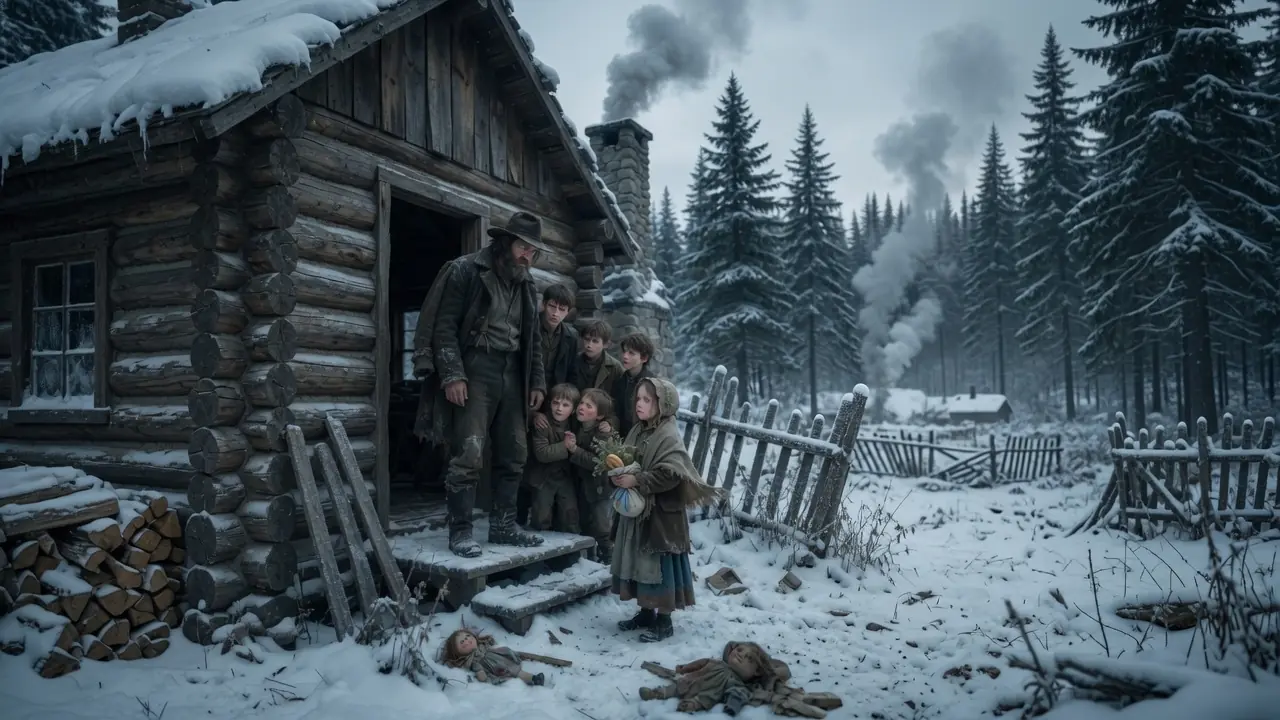
The Ward cabin stood deep in a snowy hollow, half hidden by cedar trees and dark pines. It was wide, rough, and strong, built by a man who expected winter to fight him every year and had decided to fight back with logs, stone, and stubbornness.
Inside, there was never quiet.
Boots thundered across the floorboards. A chair crashed over near the stove. Someone shouted. Someone else laughed. A tin plate flew across the room and struck the wall with a sharp clang.
“He threw the stew!”
“I did not!”
“You did!”
“You put salt in my boots!”
Silas Ward stood in the middle of it all with his jaw clenched so tight it looked carved from rock.
He was tall, broad-shouldered, and quiet in the dangerous way storms are quiet before they break. His beard was dark, his hands rough, his face worn down by wind, work, and two years of sorrow. The lines around his eyes had not come from age alone. Grief had done most of the cutting.
He slammed one hand onto the table.
“Enough.”
The word cracked through the cabin like thunder.
For one blessed second, everything stopped.
Then someone giggled.
Then something broke.
Silas closed his eyes and dragged one hand down his face.
He had raised cattle through bad winters. He had broken horses that would have killed a softer man. He had survived blizzards, hunger, and a broken leg miles from town.
But nothing had prepared him for raising five motherless boys.
There was Grant, the oldest at sixteen, already too proud and too angry, trying to stand where his mother had once stood and failing at it every day. There was Owen, fourteen, all fists and fire, ready to fight anything that looked too closely at his hurt. There was Levi, twelve, quiet enough to seem harmless until trouble needed a shadow.
Then came the twins, Finn and Toby, nine years old and born with the particular gift of turning chores into disasters.
They were not bad boys.
They were lost boys.
Ever since their mother, Clara Ward, died two winters earlier, the whole cabin had changed. Her laughter no longer moved through the rooms. Her songs no longer softened the nights. Her hands no longer brushed flour from the table or fever from a child’s forehead.
When Clara went into the ground, peace seemed to go with her.
The boys grew sharp without her gentleness. Silas tried discipline. He tried chores. He tried silence. But the harder he pressed, the farther they drifted.
A pot boiled over on the stove, hissing into the fire.
Silas lunged for it and cursed under his breath when steam burned his hand.
“Can’t you boys do one thing right?”
Grant’s face hardened.
“We ain’t her, Pa. We can’t.”
The words struck Silas like a hammer to the chest.
He turned away before his sons could see what they had done to him.
“Outside,” he muttered. “All of you.”
The door slammed behind them, and for the first time all morning, the cabin was still.
Silas sank into a chair and stared at the worn patch of floor near the stove, the place Clara used to stand while cooking. He could almost hear her voice again, soft and steady.
Silas, they’re just boys. They need love, not fear.
But what did he know of love anymore?
Every woman who had come to help had left.
Miss Helen from the schoolhouse lasted three days before declaring the Ward boys impossible. Mrs. Pritchard, a widow from town, left before sunset, swearing the cabin was fit only for bears. Even the preacher’s sister gave up after one morning and said, “The Lord Himself would need extra patience for that family.”
No one stayed.
No one could.
Silas looked through the frost-clouded window toward the trees.
The wind howled across the valley, carrying snow and sorrow down the mountain.
“Maybe they’re right,” he whispered. “Maybe this place is cursed.”
On the mantel sat a faded photograph of Clara with the boys, taken in a summer that felt like another lifetime. They were all smiling then. No hard eyes. No broken plates. No silence so heavy it made breathing difficult.
Silas reached for the frame and touched Clara’s face with his thumb.
“I don’t know what to do without you,” he said softly. “They need their ma, not me.”
Silas heard them and let his head fall back against the chair.
He did not know that just beyond the ridge, a tiny figure was already making her way up the mountain path.
A little girl with no horse, no guardian, and no proper plan.
A little girl who would soon bring back what the Ward family thought they had lost forever.
The morning after the storm, the mountains went quiet.
Snow lay thick across the trail, shining under a pale sun. The wind had spent itself in the night, leaving behind only the creak of old trees and the soft crunch of small boots moving through powder.
The girl was no more than nine.
Her name was Annie Rose Bell.
Her boots were too large. Her coat was too thin. A patched shawl fluttered around her shoulders like a tired flag. In both hands, she carried a small bundle wrapped in cloth.
Inside were a loaf of bread she had baked herself two days earlier and a handful of wildflowers, wilted from the cold but still tied with a blue ribbon.
Annie had no map.
Only a memory of what she had heard in town.
Those Ward boys are wild as mountain wolves.
No woman can last up there.
Silas Ward ain’t got a heart left since his wife died.
Ain’t nobody foolish enough to go help that family.
Annie had stood quietly near the general store counter while grown women spoke as if lonely people were weather and not human beings.
Then she had thought, Maybe they just need someone to be kind to them.
Now she was climbing toward the very cabin grown women had fled.
Her legs ached. Her lips trembled from cold. But her eyes still held light.
She hummed softly to herself as she walked, an old tune her mother used to sing when nights were frightening and the world felt too large.
When the cabin finally appeared through the trees, Annie stopped.
It looked almost like a beast crouched in the snow: huge, rough, dark, and quiet from the outside. Smoke curled from the chimney in lazy gray spirals. The yard was littered with broken toys, boot prints, a leaning fence, and a wagon wheel half buried in drifted snow.
Annie took one breath.
Then another.
“You can do it, Annie Rose,” she whispered. “They’re just people. People who forgot how to smile.”
She walked up to the door and knocked.
The sound was so small the wind nearly swallowed it.
She knocked again, harder.
Inside, voices shouted. Something thudded. Someone laughed. Then the door swung open so fast Annie nearly stepped backward.
Silas Ward filled the doorway.
He was taller than she had imagined, broader too, with frost in his beard and tired suspicion in his eyes.
“What in the world?”
Then he looked down.
His irritation shifted into confusion.
“Girl, are you lost?”
Annie shook her head and clutched her bundle tighter.
“No, sir. I came to help.”
Silas stared at her.
“Help?”
He glanced past her, expecting to see a wagon, a family, someone responsible.
There was only snow.
“You came up here alone?”
“Yes, sir.”
“Why?”
“I heard your boys don’t smile anymore,” Annie said softly. “I thought maybe I could fix that.”
Behind Silas, five faces crowded into view.
Grant frowned. Owen snorted. Levi stared. Finn and Toby pushed each other aside to get a better look.
“You?” Owen said. “You’re gonna fix us?”
Finn giggled. “She’s smaller than Toby.”
Toby puffed out his chest. “I ain’t that small.”
The boys laughed.
Annie only smiled.
A soft, patient smile.
“That’s all right,” she said. “My brothers used to laugh too. They said I couldn’t lift a bucket. But I can lift a heart if someone lets me.”
For a moment, nobody spoke.
Snow drifted around the porch like feathers.
Silas rubbed the back of his neck.
“Listen, girl, we don’t need—”
From inside, the kettle began to whistle.
Sharp.
Lonely.
Somehow that sound stopped him.
He looked back at his boys, then at Annie’s small flushed face and bright, determined eyes.
There was something in her expression he had not seen in his home for a long time.
Gentleness.
“Fine,” he muttered, stepping aside. “Come in until the wind settles. Then I’ll take you back to town.”
Annie nodded politely and crossed the threshold as if entering a church.
The cabin was warm, smoky, and wild with clutter.
Dishes stacked near the basin. Socks hung from the mantel. Tools lay scattered beside the hearth. A broken chair leaned against one wall, waiting for someone to remember it.
Annie did not wrinkle her nose.
She did not flinch.
She looked around and whispered, “It’s cozy.”
The boys blinked.
No one had called their home that in two years.
Within minutes, Annie had removed her shawl, cleared a corner of the table, and unwrapped the bread.
“I brought this,” she said shyly. “It’s not much. But bread’s better when it’s shared.”
The boys eyed it as if it might bite.
Silas leaned against the wall with his arms crossed, pretending not to care.
But he watched her.
Who was this little thing who did not fear them? Who walked into their storm like sunlight through a cracked door?
Outside, the wind began to rise again.
But inside the Ward cabin, for the first time in a long while, there was a small piece of peace.
Fragile.
Uncertain.
Barely there.
But enough to make Silas wonder if maybe the child had not come by accident.
The next morning, pale light slipped through the cracks in the cabin walls and striped the floorboards.
The boys were already awake, stomping, bickering, and arguing over breakfast. Silas stood by the stove stirring thin porridge with the patience of a man who had seen too many mornings begin this way.
But this morning was different.
At the table sat Annie Rose Bell, sleeves rolled up, hair brushed neatly, trying to set out bowls that did not match and spoons that looked like they had been carved by an angry bear.
Silas kept glancing at her from the corner of his eye.
She looked too small for the room. Too fragile for the noise. Out of place in a house built for rough hands, heavy boots, and grief that did not know how to sit quietly.
He did not understand why she had not already run.
When the boys started bickering again, Annie did not raise her voice. She only hummed the same tune she had carried up the mountain.
Low.
Gentle.
Like wind moving through pine needles.
One by one, the boys quieted.
Toby looked at her.
“What’s that song?”
Annie smiled.
“My mama used to sing it when we were scared. It means everything’s going to be all right.”
Silas felt something twist under his ribs.
When we were scared.
He had not thought much about fear in years. He thought about food, wood, weather, cattle, fences, and keeping boys alive long enough to become men.
But fear?
He had not allowed himself that word.
Listening to Annie’s small, calm voice, he realized his sons had been frightened all this time. Frightened behind their noise. Frightened behind broken plates and slammed doors. Frightened behind laughter too loud to be joy.
After breakfast, the boys decided to test her.
Finn slipped a frog into her boot. Owen dumped flour in her hair when she was not looking. Levi took her shawl and hung it from the rafters just to see if she would cry.
Silas saw most of it.
He did not stop them.
Part of him wanted to know whether this strange little girl was truly made of the kindness she carried.
When Annie found the frog, she did not scream.
She laughed softly, carried it outside in both hands, and set it near the stream.
“You don’t belong in boots, little one.”
When Owen poured flour over her head, she brushed it from her eyelashes and smiled.
“Now I look like a snow angel.”
And when Levi pointed to her shawl hanging above, Annie did not get angry.
She climbed onto a chair, stood on tiptoe, and reached as high as she could. When she failed, she only laughed.
“Guess it’s resting up there. Everything gets tired sometimes.”
The boys did not know what to do with that.
No shouting.
No anger.
No tears.
Only gentleness.
They had forgotten how to fight something that did not fight back.
Later that day, Owen slipped while hauling firewood and scraped his knee on the frozen ground. He tried to hide the blood, embarrassed, but Annie saw it and hurried over.
Without a word, she tore a strip from the hem of her faded blue dress and wrapped it carefully around his knee.
“There,” she said. “That’ll hold.”
Owen stared at her.
“You tore your dress.”
“It’s only cloth,” Annie said. “You’re not.”
Silas watched from the doorway, arms crossed, feeling warmth creep into a place in his chest he thought winter had sealed shut.
Not since Clara, he thought.
That evening, as the fire burned low, Annie hummed again.
The boys gathered around her.
One by one, they joined in.
Not well.
Not in tune.
But real.
When the song ended, the cabin held a quiet that did not come from fear or exhaustion.
It came from peace.
Silas finally spoke.
“You planning to stay long, girl?”
Annie looked up from the firelight, her eyes bright with reflected gold.
“I’ll stay until you smile, Mr. Ward.”
The boys laughed.
Silas did not.
Not right away.
He only stared at the tiny girl who had walked into his wrecked home and brought something stronger than discipline.
Kindness.
It was not loud.
It did not command.
But it had made five wild boys sit still beside a fire.
And it had made a hardened man remember what warmth felt like.
Outside, snow drifted quietly over the roof.
Inside the Ward cabin, once full of shouting and sorrow, something began to feel like home.
Winter deepened in the Montana mountains.
The days grew shorter, the nights longer, and the cold carried a sharpness that could hollow out a man’s heart. But inside the Ward cabin, something had begun to thaw.
The mornings still came noisy, but not always angry. Laughter began to mix with the shouting. Boots still thudded across the floor, but fewer plates flew. The boys still fought, but now, sometimes, one of them apologized before Silas had to order it.
Annie had been with them nearly two weeks, and already her presence had threaded itself through their lives like stitching through torn cloth.
One morning, Silas stepped outside to chop wood and paused when he heard laughter.
Not the rough, wild laughter that usually meant someone was about to get hurt.
This was softer.
Genuine.
He leaned the axe against the porch rail and looked through the frosted window.
Inside, Annie sat cross-legged near the fire with all five boys gathered around her. She had found an old box of books, covered in dust and long forgotten. The same books Clara used to read from before she died.
Annie turned the brittle pages carefully.
“This one,” she said, holding up a faded green book, “is about a boy who thought he was too wild to be loved.”
The boys leaned closer.
Even Owen, who usually rolled his eyes at anything gentle, listened.
“But someone showed him he wasn’t,” Annie continued.
Her voice filled the room with something that had been missing for years.
Tenderness.
When she finished, she handed the book to Grant.
“You can read the next part tomorrow. If you want.”
Grant looked down quickly.
“I don’t read too good.”
“Then we’ll learn together,” Annie said. “That’s what families do.”
Silas froze outside the window.
Family.
The word struck harder than the cold.
That night after supper, Annie found him sitting alone on the porch.
She stepped outside quietly, wrapping her shawl around her shoulders.
“You don’t talk much, Mr. Ward.”
Silas looked down at her.
“Ain’t much to say.”
Annie tilted her head.
“You don’t have to talk much to be kind.”
He frowned.
He had no answer for that.
The wind moved through the pines. Annie looked toward the stars.
“Your boys love you,” she said. “They just don’t know how to show it yet.”
Silas’s jaw tightened.
“My mama used to say when people act mean, it’s usually because they’re hurting inside.”
“Your mama sounds like she knew things.”
“She did,” Annie whispered. “She used to say kindness is like firewood. The more you give, the warmer everybody gets.”
Silas swallowed hard.
That simple sentence lodged deep inside him.
Clara had once said nearly the same thing.
Inside the cabin, the boys started arguing again, but this time it was only about who got to sit closest to the fire. Their voices were not cruel. They were just young and alive.
Annie turned toward the door.
“I think I’ll make them cocoa,” she said. “Would you like some too?”
Silas shook his head as he watched her go inside.
She was just a child.
Poor.
Small.
Fragile.
And somehow she was teaching his sons more than any preacher, schoolteacher, or caretaker ever had.
Later that evening, Silas found himself sitting beside the boys while Annie read aloud again.
Her voice was steady and sweet, like a thread pulling them back toward one another.
When she reached the end, Toby leaned against her arm.
“Another?”
Annie tucked the blanket around his shoulders.
“Tomorrow night. Good stories take time.”
Silas felt his throat tighten.
He looked around the room.
His boys were still. Content. Listening. Clara’s old books were open again. The firelight warmed their faces. The cabin no longer felt like a place waiting to collapse under grief.
It felt alive.
That was when Silas understood.
Annie had not only brought kindness.
She had brought hope.
The same kind Clara used to carry in her eyes.
And though he did not say it aloud, for the first time in years, Silas silently thanked God for sending a small lost girl up the mountain.
The mountain had a way of reminding people who was in charge.
One day, the sun would glint on the snow like diamonds. The next, the wind would come roaring down from the peaks, wild and merciless, tearing through the trees as if it meant to take the whole world apart.
That evening, as dusk crept through the pines, Silas felt a storm coming in his bones.
He stood on the porch and looked toward the valley. The horizon had turned dark and bruised. Clouds rolled fast over the ridge. The air felt too heavy, the way it did before bad weather.
Inside, Annie and the boys were laughing.
They were playing a game she had taught them, something with a button hidden in small hands while everyone guessed who held it. Their laughter slipped through the cracks around the door, bright and rare.
Silas smiled faintly.
Then the wind shifted.
“Get the shutters closed,” he called. “Storm’s coming.”
Within an hour, the mountain began to howl.
Trees moaned. Snow whipped across the clearing. The temperature dropped fast enough to make the cabin walls creak.
By nightfall, it was a full blizzard.
The Ward cabin shuddered beneath the assault. The boys huddled near the fire while Silas bolted the door and checked the roof beams.
“Keep that fire fed,” he ordered. “And don’t move from that hearth.”
Annie sat near the boys, trying to look calm, though her heart beat hard in her chest. She had never seen a storm like this. Wind screamed through cracks in the walls. Snow forced its way inside in fine white dust.
Then a crash split the room.
One of the back windows burst inward.
Glass scattered across the floor. Snow and wind poured into the cabin. The fire sputtered beneath the sudden cold.
“Pa!” Grant shouted. “The window!”
Silas turned just as Annie leapt to her feet.
“Stay back!” he barked.
But she was already moving.
She grabbed an old quilt from the cot and pressed it against the broken window frame. Wind slammed into her small body, nearly knocking her off her feet. Snow stung her face. Her hands shook as she fought to hold the quilt in place.
Silas lunged forward and caught her by the arm before she fell.
“You foolish girl!” he shouted over the storm. “You’ll freeze!”
Annie looked up at him, lips trembling.
“It’s the boys’ room,” she said. “They’ll be cold.”
Silas stared at her.
This tiny child, shaking in the snow, thinking first of his sons.
Something inside him broke wide open.
He pulled her back and wrapped his coat around her.
“You’re braver than most grown folk I’ve known,” he muttered, voice rough.
Together, they worked through the night.
Silas and the older boys nailed boards across the broken window and stuffed rags into cracks. Annie tended the fire, feeding it carefully with the last dry pieces of wood. When the flames began to fade, she reached for one of the old torn books.
Silas stopped.
Annie looked at the brittle pages in her hands.
“Stories can wait,” she whispered, placing them into the fire. “Warmth can’t.”
By midnight, the storm’s fury was deafening.
The roof groaned. One rafter cracked. Silas ordered the boys to move the table and gather close to the hearth.
He kept Annie near him with a blanket around her shoulders.
She looked up through sleepy eyes.
“It’s loud,” she murmured.
“Yes.”
“But it sounds like the sky is singing.”
Silas blinked.
“Singing?”
Annie nodded faintly.
“Maybe God’s reminding us He’s still here.”
And somehow, in that battered cabin, while the mountain tried to tear them loose from the earth, Silas believed her.
Hours passed before the wind finally weakened.
By dawn, the cabin was bruised but standing. Snow piled halfway up the door. Icicles hung from the roof like daggers. The hearth glowed orange with the last embers.
The boys slept in a pile near the fire.
Annie slept between them, one hand still clutching a scorched piece of quilt.
Silas sat awake, watching them.
His sons.
The girl.
The firelight.
For the first time since Clara died, the cabin did not feel empty.
He bowed his head and whispered into the quiet, “Thank you for sending her.”
Outside, the storm had passed.
Sunlight broke over the mountain, and a thin, steady thread of smoke rose from the Ward chimney.
Not the sign of a lonely man’s shelter anymore.
The sign of a family that had survived the night together.
Spring came slowly down the mountain.
Snowdrifts turned into muddy streams. Pine sap scented the air. The cabin, once a place of shouting and sorrow, now hummed with gentle life.
Annie had been there for months.
Every morning, she helped Finn and Toby feed the chickens. She taught Levi to spell his name in the dirt outside. She showed Owen how to mend torn shirts with crooked stitches. Grant, stubborn, quiet Grant, had begun reading beside her in the evenings, sounding out words one at a time.
And Silas Ward listened more.
Shouted less.
The cabin felt alive again.
There was laughter now. Pages turning. Brooms sweeping. Annie’s soft humming. The small ordinary music of a home returning to itself.
It was as if Clara’s warmth had come back to them, carried in the slight frame of a child who refused to stop caring.
But peace on the mountain was never left alone for long.
One morning, while Silas split logs near the barn, he saw a rider climbing the trail.
Visitors were rare. Uninvited ones rarer still.
Silas set the axe down and watched as the man approached, a leather satchel hanging at his side.
“Silas Ward?” the rider called.
“That’s me.”
“Letter from town.”
“From who?”
The rider handed it over.
“County orphan office.”
Then he tipped his hat and turned back down the trail before Silas could ask anything more.
Inside, Annie and the boys were setting breakfast on the table when Silas entered with the envelope in his hand.
The moment Annie saw his face, she knew something was wrong.
He did not speak at first. He only turned the letter over in his rough fingers, then tore it open.
His eyes moved slowly across the page.
With each line, his shoulders seemed to sink.
“What is it, Pa?” Grant asked.
Silas’s voice came low and tight.
“They’re looking for her.”
Annie froze.
“For me?”
Silas nodded.
“Says you ran off from the orphan house in Cedar Creek nearly five months ago. They want you brought back.”
The room went silent.
Only the fire spoke, crackling softly in the stove.
Finn’s eyes widened.
“They can’t take her.”
“She belongs here,” Toby cried, clutching Annie’s sleeve.
Owen slammed one fist onto the table.
“They don’t know her.”
Annie stood small and trembling, twisting her fingers in her skirt.
“I didn’t mean to run,” she whispered. “I only wanted to help. I thought maybe…”
Her voice broke.
“Maybe someone needed me.”
Silas crouched before her.
His weathered face softened.
“Listen to me, little one. You did not do wrong by coming here. You gave us back more than we thought we’d ever have.”
Tears filled her eyes.
“Then why do I have to go?”
Silas opened his mouth.
No answer came.
He stared at the letter again.
Neat black ink.
Rules.
Orders.
Words written by people who had never set foot on this mountain and did not know what Annie Rose Bell had done to a grieving home.
That night, the cabin was quiet.
No games.
No laughter.
No stories.
Annie sat by the fire holding one of Clara’s old books against her chest. The boys were too sad to speak. Even the flames seemed dimmer.
Silas sat in his chair with the letter crumpled in his fist.
After a long silence, Annie looked up.
“You don’t have to worry, Mr. Ward. I’ll go back tomorrow. They’ll take me in again.”
Silas shook his head slowly.
“Ain’t that simple.”
Annie smiled through tears.
“You already gave me what I needed.”
“What’s that?”
“A home.”
Her voice cracked on the word.
Silas felt his heart twist, a feeling he had thought buried with Clara.
He wanted to tell Annie she could stay. He wanted to promise no one would take her. But the law was the law, and Silas was a mountain man who knew how to fight weather, wolves, hunger, and grief.
He had never learned how to fight papers.
When the fire burned down to embers and the boys slept near Annie, Silas whispered into the stillness, “You’re not leaving, Annie Rose. Not if I can help it.”
He did not know how.
But by sunrise, he intended to find a way.
Dawn broke over the mountain in pale gold.
Mist curled between the pines, and the cabin sat too quiet.
Annie’s small satchel was already packed by the door. She had not slept. Neither had Silas. The boys moved around with red eyes, trying to hide what they had been crying over in the dark.
Grant spoke first.
“Pa, you ain’t really gonna let them take her, are you?”
Silas stared out the window.
“We don’t own people, son.”
“She’s family,” Owen said, his voice breaking. “She made us a family again.”
Silas did not answer.
He reached for his hat, tucked the letter into his coat, and stepped outside.
The door closed behind him with a sound heavy enough to feel like an ending.
He saddled his horse, then glanced once toward the cabin window.
Annie watched him with wide, tearful eyes.
“Stay here with the boys,” he said softly. “I’ll be back before sundown.”
Then he rode down the mountain.
The trail to town was long and rough, slick with melting snow and edged with stubborn ice. As Silas rode, his thoughts turned over themselves.
He remembered the first day Annie appeared at his door, small as a sparrow and twice as determined.
He remembered the boys going quiet under her song.
He remembered Owen staring at the strip torn from her dress.
He remembered the night of the blizzard, Annie pressing a quilt to the broken window because she was worried his sons would be cold.
Silas had buried one wife.
He had thought he had buried the best of himself with her.
Somehow, that tiny girl had dug up the part of him that still believed in goodness.
He would not let the world take her simply because the world had written itself a rule.
By midday, he reached Cedar Creek.
People stared when the mountain man dismounted. His coat was dusty. His beard was windblown. His boots left mud across the boardwalk.
He walked straight to a small wooden building marked County Orphan Office.
Inside, a woman in a stiff gray dress looked up from behind a desk.
“Can I help you, sir?”
Silas dropped the crumpled letter onto her papers.
“You sent this?”
She adjusted her spectacles.
“Yes. Regarding the runaway girl, Annie Rose Bell. You found her, then?”
Silas’s voice was rough but steady.
“She found me.”
The woman blinked.
“I beg your pardon?”
“She’s been living with me and my boys. Feeding them. Teaching them. Keeping them from tearing each other apart. That child’s got more heart than half the grown people in this town.”
The woman folded her hands.
“Mr. Ward, the law is the law. Annie Rose is a ward of the county. She cannot simply live with strangers.”
Silas leaned forward, eyes burning with quiet fire.
“She ain’t a stranger to us.”
“Even so—”
“I’m not asking to steal her,” Silas said. “I’m asking what papers I need. Guardianship. Adoption. Whatever word you people use when a child has already come home and the law needs to catch up.”
The woman hesitated.
“That is a long process.”
“Then start it.”
For a long moment, the only sound was the ticking office clock.
Then a voice came from the doorway.
“I can witness.”
Silas turned.
Sheriff Amos Reed leaned against the frame, hat tipped back, arms crossed, a faint smile hidden beneath his mustache.
“About time that little girl had a proper roof over her.”
The woman sighed, opened a cabinet, and pulled out a file.
“You’ll need to sign here, Mr. Ward.”
Silas took the pen.
His hand, which could hold an axe steady through sleet, shook slightly as he wrote his name.
When Silas rode back up the mountain that evening, the boys were waiting at the fence.
Their faces were full of fear and hope.
Annie sat on the porch steps, her small hands clutching the edge of her skirt.
Silas swung down from the saddle and walked toward her.
For a moment, he could not speak.
Then he knelt in front of her, the same way he had the night before.
“Well,” he said, voice thick, “seems I had some papers signed.”
Annie blinked.
“Papers?”
He smiled softly.
“Since you’re a Ward now, if you’ll have the name.”
Her eyes went wide.
“You mean I can stay?”
Silas nodded.
“If you’re willing.”
She threw herself into his arms, sobbing against his shoulder.
The boys whooped and hollered. Finn and Toby ran circles around the yard. Owen shouted loud enough to frighten the chickens. Grant turned away quickly, wiping his eyes before anyone could tease him.
Even the old hound barked as if he understood.
Silas held Annie tight.
“You turned this place into a home, little one,” he murmured. “Guess it’s only right you stay in it.”
That night, laughter filled the Ward cabin louder than any storm.
Annie sat by the fire with Clara’s old book open in her lap. The boys leaned close, all elbows and knees and softened faces, listening as she read.
Silas sat in his chair and watched them.
A smile, small but real, touched his mouth.
The mountain outside was quiet.
The fire burned steady.
For the first time in years, the Ward family felt whole.
And in the warm glow of the hearth, Annie Rose looked around at the wild boys, the tired mountain man, the battered cabin, the old books, the patched blankets, and the life that had somehow opened its door to her.
Then she whispered, almost to herself,
“Home.”