She wakes in darkness and doesn't recognize the ceiling. The room smells wrong, expensive, like smoke and cedar and something else. Something that makes her body relax before her mind catches up. The mattress is too soft, the silence too heavy, the warmth too complete. She doesn't know where she is, but she feels safe. She shouldn't, but she does. She falls back asleep.
When the Duke enters his chamber and finds a servant girl in his bed, the response should be immediate. Dismissal, scandal, ruin. She's a lady's maid. And nobody in a world built on reputation. She has no right to be there. But he doesn't ring for the butler. He doesn't wake her. He stops and watches. The rise and fall of her breathing. The way her fingers grip his coverlet as if clinging to warmth for the first time. The tired crease between her brows even in sleep. And something shifts. Something he doesn't have a name for. Something that has nothing to do with logic or duty or the 12 years he has spent being untouchable.
By morning the whispers will start and the coldest man in England will discover there are some things even a duke cannot control. The candles in the east corridor had burned low. Not all of them, just the ones that lined the servant passageway between the scullery and the upper chambers.
A thin stonewalled corridor that smelled of tallow smoke and old wood and the particular cold that only found its way into houses built before anyone thought to consider comfort. It was the kind of cold that settled in the bones, the kind that no number of aprons or wool stockings could entirely chase away.
Laurel Bowman walked quickly, her head bent, her breath rising in small, pale clouds before her face. She was 22 years old, and already exhausted in the way that much older women were exhausted, not from one long day, but from a hundred days, stacked one upon the other, without pause, without sleep, without anyone asking if she was managing.
She had thin wrists that disappeared into her gloves, a tired line between her brows that had no business sitting on a face so young, and eyes the color of wet earth after rain, dark and soft and careful. She was careful about everything.
She carried her candle at shoulder height, holding it steady against the draft that crept beneath the doors, and she moved the way she always moved inside Blackthornne House, silently, efficiently, as though the walls themselves might report her if she paused too long in one place. Blackthornne House did not encourage stillness.
It was one of the great ducal estates of England. A sprawling greystoned manor set upon a hill above the village of Crestwick in Darbasha, surrounded by iron gates and bare winter trees, and a reputation that kept strangers at a distance. The house had 14 fireplaces, two libraries, a portrait gallery that felt like being watched, and a staff of 43.
The ceilings were high enough to make a person feel small, even without trying. The floors were cold marble in winter and cold marble in summer, because the stone remembered nothing of warmth. And at the top of it all, in reputation, in silence, in the particular manner he had of making every room feel smaller when he entered it, was Duke Fabian Wells, the Duke of Blackthornne, 34 years old, unmarried, known across every drawing room in England as the coldest man in the peerage.
Not cruel, precisely, not unkind in any way that could be pointed to directly, simply unreachable, as though he had constructed a careful wall around himself made of composure and quiet authority, and the absolute certainty that no one was permitted to cross it. The servants called him the ice duke, but never where he could hear it.
Laurel had worked in this house for three years. In those three years, she had spoken directly to the Duke perhaps six times. She had curtsied to him perhaps 40. She had learned to read the small warning signs that told her when he was moving through the house, the particular sound of his footsteps on marble, the way the footman straightened without being told, and she had learned to simply not be where he was. It was safer that way. Most things were safer when you were invisible.
She turned left at the end of the east corridor, then right at the top of the servant's stair, then right again, and stopped. The corridor stretched before her, and it was entirely unfamiliar. She lifted her candle higher. The flame bent in the draft.
The wallpaper here was different, darker, a deep burgundy damask with a pattern she did not recognize. And the carpet beneath her feet was heavier and more richly colored than the faded runners in the servant passages she knew. Doors lined both sides, thick dark oak doors with brass handles that gleamed even in low light.
There were no housemaids closets here, no linen cupboards, no narrow alcoves stacked with cleaning supplies. She had made a wrong turn somewhere. This was not entirely surprising. Blackthornne House was enormous in the way that only very old houses could be enormous, built in pieces over centuries by different architects with different ideas, added to and altered and extended until the floor plans no longer made simple sense.
Even long-serving staff sometimes found themselves on the wrong floor, in the wrong wing, blinking in the particular embarrassment of the sincerely lost. But Laurel knew with a sinking feeling that this was worse than a simple wrong turn, because the wallpaper, the doors, the quality of the silence, all of it was telling her something she did not want to hear.
She was in the west wing, the forbidden west wing. Lady Evangeline Cross had sent her here, not directly, of course. Lady Evangeline did nothing directly. She had smiled her thin smile over her evening tea and said in the lightest possible voice that there was a household ledger somewhere in the upper rooms of the West Wing left there weeks ago by the estate secretary and that she would simply be so grateful if someone could retrieve it before Lord Victor returned in the morning and required it for his review of the estate accounts.
She had said it as though it were nothing, a small request, easily accomplished, and Laurel, who had already been awake for 16 hours, and whose hands were trembling with cold, had curtsied and said, "Yes, my lady." And taken the single candle Lady Evangeline had pressed into her hands. One candle, no map, no escort, and gone.
Because that was what you did. You said yes and you went and you did not ask questions and you found what was needed and returned and you did not show that your feet ached or that your eyes burned or that you had not eaten properly since noon. She kept walking.
The corridor curved gently to the left and she followed it. Her candle casting yellow light across the dark wallpaper. The portraits of past Wellses watching her from their frames with the impassive faces of people who had never needed to fetch anything for anyone. She tried three doors and found them locked or empty or containing furniture she did not recognize in the uncertain light. No ledger.
She tried a fourth door which opened easily and stepped inside. The room was large. She could feel the largeness of it even before her candle found the edges. A particular quality of space that she associated with rooms that knew they were grand that had never needed to apologize for their dimensions.
There was a fireplace against one wall. Its fire burned to a low orange glow, and the warmth of it reached her immediately, enveloping her like something she had almost forgotten was possible. She stood still for a moment, just a moment, just to breathe.
The warmth was extraordinary. She had not realized quite how cold she was until it touched her, and now her whole body seemed to lean toward the hearth like a plant leaning toward light. She took one step closer, then another. The smell of the room reached her then. Smoke, old cedarwood. Something faintly resinous, like pine trees after rain, and beneath it, quieter, warmer.
Sandalwood, she thought, and something else she could not name. Something that belonged entirely to this room, and to no other room she had ever entered. It was not the smell of a room that had been closed. It was the smell of a room that was lived in.
She turned, lifting her candle. The bed was enormous. It stood against the far wall, dressed in dark velvet the color of deep water, with carved posts at each corner, and curtains drawn halfway back on one side. The sheets visible at the turned edge were white and impossibly fine, the kind of linen that whispered when you moved against it. The pillows were stacked three deep.
Laurel stood very still. A terrible understanding was spreading through her. This was not a guest room. Guest rooms did not smell like this. Guest rooms were kept cold. The fires banked. The furniture sheeted. Guest rooms smelled of lemon polish and closed air. Guest rooms did not have a half burned candle on the writing desk, a book left open and face down on the bedside table, a coat draped over the armchair by the fire as though the owner had simply stepped out for a moment and would return directly.
She should leave. She knew she should leave. Her entire body was informing her in clear and urgent terms that she should back out of this room immediately, close the door, find her way back to the east wing, and pretend she had never been here at all.
Her legs did not cooperate because the warmth was extraordinary because she hadn't slept properly in 4 days and her eyes were burning and the fever that had been threatening at the back of her throat all week had arrived now without ceremony, flushing her skin and making the edges of the room swim slightly. Because the bed was there and the fire was there and her legs had been carrying her for 16 hours and they had simply reached the end of what they were willing to do.
She sat on the edge of the bed just for a moment, she told herself, just until the dizziness passed. She would rest her eyes for a moment and then she would stand up and she would leave and she would find the ledger and she would return to Lady Evangeline's rooms and she would smile and curtsy and hand it over and everything would be perfectly fine.
The sheets were warm, the pillow was soft. The fire spoke softly to itself in the grate. Laurel Bowman closed her eyes and she slept. Outside the winter sky was pressing down on Blackthornne House, heavy and dark and full of snow that had not yet decided to fall.
In the entrance hall below, a carriage had arrived. Duke Fabian Wells descended the carriage steps with the particular controlled stillness of a man who had learned long ago that the fastest way to silence a room was simply to walk into it. He was tall, taller than most of the men he spent his evenings with. And his face, though not unkind in its basic arrangement, had an economy to it that people often confused for coldness.
He did not waste expressions. He did not perform comfort he did not feel. He looked at things directly and said what he meant without the decorative softening that other people seemed to require. This had made him many acquaintances and very few friends. He handed his gloves to Reeves, his butler, and did not wait to be asked about the evening.
The Cross party? Reeves said carefully. We'll not be dining here again this week, Fabian said and walked up the stairs. It had been a long evening.
Lord Victor Cross was a man who believed that political pressure applied with sufficient social charm could accomplish what honest conversation could not. He had spent three hours applying it. Lady Evangeline, his sister, had spent the same three hours demonstrating that she understood the terms of the arrangement they were proposing, and found them quite reasonable, as though the matter were already settled, and Fabian's agreement simply a formality awaiting completion.
The arrangement was a marriage. Evangeline Cross to the Duke of Blackthornne, a union that would unite the Cross political connections with the Wells estate and satisfy several pressing questions about inheritance and alliance that the aristocratic world considered urgently important. Fabian considered none of it his business.
He had listened. He had said nothing that could be called agreement. He had returned to Blackthornne House with the particular headache that came from spending too long in rooms where other people were trying to arrange his life. He walked the upper corridor to his chamber. He did not summon a valet.
He preferred silence at the end of long evenings, preferred the ritual of a quiet room and a dying fire, and the particular relief of a space that belonged to no one but himself. He opened the door. The fire was lower than he'd left it. The room was warmer than the corridor, and the smell of it settled around him immediately. Familiar, known, his.
He stepped inside and reached to close the door behind him, and then he stopped. There was someone in his bed. He stood completely still. In his years as the Duke of Blackthornne, nothing had prepared him for this particular moment. The appropriate response was perfectly clear.
Ring for Reeves, have the intruder removed, demand an explanation, and deal with whatever consequences followed with the composed efficiency that was his acknowledged reputation. He did not ring for Reeves. He moved closer silently until he could see clearly in the low fire light.
A young woman, a maid. He could tell from her dress, from the apron still tied around her waist, from the small cap that had slipped sideways in her sleep. She was curled slightly on her side, one hand pressed beneath her cheek, the other loosely holding the edge of the coverlet as though she had reached for it in her sleep, and found it. And not let go.
She was deeply, thoroughly, completely asleep. Not the light sleep of someone who knew they were in the wrong place and might surface at a footstep. This was the sleep of a person who had reached the absolute outer limit of what their body could sustain and had simply stopped regardless of where they were, regardless of what the consequences might be.
Her breathing was slow and even. The tired crease between her brows had softened in sleep, and her face had gone still in a way that made her look very young and very defenseless. Fabian Wells stood in the doorway of his own bed chamber and looked at a sleeping housemaid.
He should have been furious. He was not. There was something in the way she was holding the coverlet. That small tight grip, the fingers curled like a child's around the edge of the velvet that stopped whatever appropriate response he might have assembled. There was something in the stillness of her face, the absolute unguarded quality of it that was unlike anything he encountered in his daily life.
In his world, everyone performed something. Composure, deference, interest, affection. Everything was arranged and presented for effect. This woman was not performing anything. She was simply there, simply sleeping entirely, helplessly herself.
He stood by the fire for a long time. The clock on the mantle marked the quarter hour, then the half hour. At some point, without precisely deciding to, Fabian Wells moved to the armchair across the room, settled into it, and watched the fire burn lower, and did not wake her. Outside, the first snow of winter began to fall.
Mrs. Caldwell, the housekeeper, was the first to know something was wrong. She had risen early, as she always did, to check that the morning fires were laid, and the kitchen was in order, and she had passed through the upper corridor on her way to the linen room, when she noticed the light beneath the Duke's door. Not unusual in itself, but the light was moving slightly in the way of a single candle, rather than the bright steadiness of a room properly lit for morning.
She paused then, because she had been housekeeper at Blackthornne House for 21 years, and she knew the particular weight of a silence that was not simply empty. She listened. She heard nothing alarming, only the low sound of a fire, and beneath it something so quiet she almost missed it. The slow, even rhythm of someone breathing in sleep.
Mrs. Caldwell did not knock. She turned and walked very deliberately back the way she had come. But the whispers, in a house of 43 staff, had a way of finding purchase. By the time the breakfast fires were laid, and the morning staff had assembled in the kitchen, something had shifted in the air of Blackthornne House. Not quite a rumor yet, but the seed of one, small and dark and growing.
Dawn came gray and cold to Blackthornne House. It arrived through tall windows and heavy velvet drapes, pressing its thin light into every corner, indifferent to who was ready and who was not. The house creaked and settled around it as old stone houses do, and the fires burned lower in their grates, waiting for the morning staff.
Laurel woke slowly. The first thing she felt was warmth. Not the usual cold cloth of a cot blanket in a servant's room. Not the tired heaviness of the pillow she shared with Millie from the kitchen who always migrated toward the center in the night. This was something deeper and more thorough.
The warmth of a room that had held a fire through the night, of sheets that had been laundered with something that smelled faintly of dried lavender, of a mattress that gave beneath her in a way that suggested it had been constructed with some actual consideration for the person who would sleep in it. She lay still, eyes closed, in the particular suspended state between sleep and waking, when the mind is soft and permeable, and the body has not yet remembered all the things it is carrying.
She felt safe, genuinely, completely, bewilderingly safe. She could not remember the last time she had felt this way. Then she opened her eyes. The ceiling above her was deeply coffered. Its dark wood carved in a repeating pattern of leaves and small geometric shapes. And it was impossibly, wrongly, horrifyingly not the ceiling of the servant's dormitory.
The room came into focus all at once. Velvet curtains, heavy oak furniture, the massive carved posts of the bed she was lying in, a fire in a stone fireplace that was twice the size of anything in the servants' quarters, burning quietly in the morning light, a writing desk with a brass inkwell, a tall wardrobe, a coat draped over an armchair, an armchair that was not empty.
Laurel's entire body went cold. She threw back the covers. She moved without grace, without the careful quiet that usually governed her every action in this house, because grace had no place in what was happening. She swung her legs off the bed and stood, and immediately her vision blurred, and her knees threatened to fold beneath her, because the fever that had chased her all the previous evening had arrived fully overnight, and was now making its presence absolutely clear.
She gripped the bedpost. She steadied herself. She turned and found the Duke of Blackthornne watching her from the armchair by the fire. He was awake. He had been awake. She understood this with a certainty that was worse in some ways than anything else because it meant he had been sitting there in that chair fully awake and had not removed her, had not summoned anyone, had not done any of the things that should naturally follow from finding a servant girl asleep in his bed.
He was still dressed from the previous evening. Dark coat, white cravat slightly undone at the throat, boots still on his feet. He had not slept. He looked, not angry, not amused, which would have been worse. He looked the way he always looked, composed, contained, giving nothing away, except that he was watching her with an attention that was not at all impersonal.
Laurel's knees found a way to function despite everything, and she went down onto them, and the stone floor was cold through her dress, and she pressed her hands flat against her thighs to stop them from shaking. Your grace! Her voice came out as a whisper. She cleared her throat. Your grace, I beg your pardon. I beg your forgiveness. I didn't know. I lost my way in the corridor, and I I only meant to sit for a moment. I didn't know whose room it was. I promise you, I would never have.
Miss Bowman. His voice was quiet. Low, not loud at all, and yet it stopped her with the precision of something much sharper. She looked up and immediately looked down again because looking at him directly felt like the most foolish thing she could do. How long? He said, has it been since someone allowed you to rest properly?
The question landed in the room and stayed there taking up space. Laurel had prepared herself for many responses. She had prepared for quiet, controlled anger. She had prepared for the cool announcement of her immediate dismissal. She had prepared for the summons of Mrs. Caldwell, for the catalog of her transgressions, for the particular shame of being marched out of a room she should never have entered.
She had prepared herself in the deepest part of her for the worst. She had not prepared for this. I She stopped. The question sat before her, very simple, and she found she could not answer it. Not because she did not understand it, but because the answer, if spoken aloud, would say something about her life here that she did not know how to say without it sounding like complaint. And complaint was not something she could afford. Not now, not in this room. Not to this man.
Stand up, Fabian said. Not unkindly, simply. She rose. Her hands were still trembling, and she pressed them against her apron. He was looking at her with a careful, assessing quality. Not the look of a man examining a servant for infractions, but the look of a man who was seeing something he had not previously noticed, and was troubled by the fact that he had not noticed it sooner.
He saw the shadows beneath her eyes, deep and bruised. He saw the way the apron at her waist had been retied twice, the strings fraying from repeated use. He saw that her gloves were mended at both index fingers, the repair neat and competent, but unmistakable. He saw the slight weight she shifted onto her right foot as though her left ached.
He said nothing for a moment. Then you were sent into the West Wing last night. It was not a question. Yes, your grace. Lady Evangeline Cross asked me to retrieve. Who sent you alone? He said, through an unlit corridor at that hour. Lady Evangeline, your grace. Something moved through his expression. Not quite anger, something quieter and colder than anger.
There is no ledger in the West Wing, he said. Laurel blinked. The estate accounts are kept in the study on the ground floor, Fabian continued. They have always been kept there. I reviewed them myself last week. He paused. There was nothing to retrieve.
The understanding of this settled over Laurel slowly, the way cold water fills a low place in the ground. Lady Evangeline had sent her on an errand that did not exist through a forbidden wing alone at night with one candle. She should have been caught. She should have been dismissed. She had in fact been caught, only not in the way Lady Evangeline had intended, because the person who found her was not Mrs. Caldwell or a footman, but the Duke himself. And the Duke had inexplicably, impossibly done nothing.
You will not report to Lady Evangeline's rooms today, Fabian said. His voice had the quality of a door being closed, quiet, and final. You will go to your room. You will sleep. Mrs. Caldwell will be informed. Laurel stared at him. Your grace, she said carefully. With respect my duties. Will wait, he said.
She stood very still, trying to understand what was happening. In 3 years at Blackthornne House, she had never been given a day of rest that wasn't a Sunday, and Sundays were only partial rest, because the fires still needed laying, and the breakfast things still needed clearing, and there was always something.
Do you understand me, Miss Bowman? Yes, your grace, she said. And then, because she was genuinely uncertain, and it seemed important to be, Are you? Will I be dismissed? He looked at her for a moment. Just looked with that careful, contained attention. No, he said. You will not be dismissed. He stood. He moved to the door and opened it, and she understood she was meant to leave.
She curtsied, a small, careful, still trembling curtsy, and walked to the door. She paused. Thank you, she said very quietly, to the floor beside his feet. Your grace, Fabian Wells said nothing, but when Laurel had gone, and the door had closed behind her, he stood by the mantle for a long time, looking at the fire. He had been awake all night. He should have been tired. He was not tired.
Lady Evangeline Cross came down to breakfast at 9, dressed in a gown the pale gold of winter sunlight, her hair arranged with the kind of precision that suggested she had been planning this particular morning for several days. She expected Fabian at the breakfast table. He was not there.
She sat, smoothed her napkin across her lap, and accepted a cup of tea from the footman, and did not permit herself to look at the door more than twice. She was not accustomed to being kept waiting. Evangeline Cross had been many things in her 26 years. A celebrated beauty, her brother Victor's most valuable political asset, a woman of considerable intelligence, who had learned very young that in a world that did not give women direct power. The most effective kind was the kind that operated through other people.
She had cultivated it carefully. She smiled in the right rooms and said the right things to the right people, and managed situations from a distance, with a precision that only occasionally required anything as blunt as cruelty. Sending Laurel Bowman into the forbidden West Wing had not been cruelty, she told herself. It had been practical.
The girl had been in the way, not in any overt, demonstrable way, but in the quiet, instinctive way that Evangeline recognized as a form of competition, even if no one else in the house had noticed it yet. She had seen the Duke glance at Laurel twice in the East drawing room. Twice, which was twice more than he glanced at most people. It needed to stop before it became anything.
The plan had been elegant. Laurel sent on a false errand, found in the wrong wing at the wrong hour, dismissed for trespassing or worse. Neat, clean, untraceable. What had actually happened was something she was still, even now, working to understand.
Because the girl had not been dismissed, the girl was apparently resting on the Duke's orders. And the Duke, who had not been to breakfast, was moving somewhere through the upper floors of this house in a manner that suggested he had entirely different things on his mind than the engagement Evangeline and her brother had spent three months carefully positioning. She set her teacup down. Across the table, her brother Victor looked up from his newspaper. He was a broad, well-built man of 35 with the kind of handsome face that suggested authority without quite achieving intelligence and a particular way of holding himself that reminded you he was accustomed to being listened to.
Trouble, he said. Evangeline smiled thin and bright. None whatsoever, she said, but her eyes were on the door. Upstairs in the small room she shared with Millie. Laurel lay on her narrow cot and stared at the ceiling and didn't sleep. She tried. She closed her eyes and told herself she had been given permission, which was extraordinary, and she should use it. She told herself that the fever would not improve if she persisted in lying here, tense as a bow string, running through every possible interpretation of what had just happened. It did not work.
Her mind was very busy. She thought about the question he had asked her. How long has it been since someone allowed you to rest properly? She thought about how simply he had said it, without pity, without emphasis, just a question, direct and honest, as though it were the most natural thing to ask.
No one had ever asked her anything like that. Mrs. Caldwell was not unkind, but she was a woman of systems and schedules, and within those systems, Laurel was a resource, capable, reliable, not to be wasted. The other maids were friendly enough, but their friendship was the friendship of people in the same boat, which left little room for the sort of question that actually required an answer.
Lady Evangeline treated her like furniture, useful furniture, but furniture nonetheless to be moved as needed without consultation. The Duke had asked her. It was such a small thing, the smallest possible thing, and it had nearly undone her completely. She pressed the back of her hand against her forehead, felt the warmth of the fever still there, and closed her eyes.
She thought, against all better judgment, about sandalwood and winter rain. She thought about the way the fire had looked in that room, low and golden, and the silence, which had been so different from the usual silence of this house, not the silence of a space being held empty, but the silence of a space that was inhabited and at rest. She thought, "I felt safe in there." And then she thought, "Do not think about that." And then she slept.
The whispers began, as whispers always do, before anyone had fully decided to start them. By the time the midday meal was cleared from the servants' hall, the essential facts had arranged themselves into a shape that everyone understood, even if no one had the whole picture. Something had happened in the West Wing. Miss Bowman had been found somewhere she shouldn't have been. The Duke had been involved. The Duke had not been angry.
That last part was the one that people kept returning to. He covered her, said Ellen, the parlor maid, to Rebecca from the laundry, in the narrow gap between the linen cupboard and the servant's stair. She said it in the low, significant voice of someone delivering news she knows to be momentous, with his own coat. Apparently, Maggie saw it when she came in at dawn to lay the fire.
Maggie says a lot of things, Rebecca said, but her voice was uncertain. She saw the coat. She saw a coat. She saw his coat, Ellen said. She knows his coat. The distinction seemed to settle something. Poor girl, Rebecca said finally, though whether she meant poor Laurel for the trouble that would follow, or poor Laurel for the trouble that had already arrived, was not entirely clear.
Mrs. Caldwell, who heard more than she appeared to from her office at the end of the servant's hall, said nothing, and observed everything. She had been a housekeeper for 21 years and a housemaid for 10 years before that. And she had learned early that in a great house the spaces between people were as important as the people themselves and sometimes more revealing.
She watched Fabian Wells move through his house that morning with the quiet attention of a woman who was paid to notice things. And what she noticed was this. He was different. Not dramatically different. He was still composed, still contained, still the man whose measured calm had been the governing principle of Blackthornne House for 12 years. But there was something displaced in him, some small gear that had been moved from its usual position, and she felt it every time he paused at a window that looked over the kitchen garden, or asked without apparent reason what time the serving staff took their afternoon tea.
He was paying attention to the rhythms of the house. He had not done that before. Laurel emerged from her room on the second day, against Mrs. Caldwell's quiet suggestion that she might rest another morning because the alternative was lying there listening to her own thoughts and she had already spent enough time doing that.
She went back to work. There was always work. The corridor fires needed banking at midday. The upper rooms needed airing. Lady Evangeline's suite required the constant cycle of straightening and refreshing that a woman of her particular standards demanded. Laurel moved through it all with her customary quiet efficiency, keeping her head down, speaking only when necessary, willing herself to be invisible.
She was not invisible. She felt it immediately, the subtle recalibration of attention whenever she moved through a room where other staff were present. Not unkind, most of it, but aware. Some of it was genuine sympathy. Cook pressed an extra roll into her hands when she came through the kitchen and told her she looked peaky. Millie asked if she was all right no fewer than four times. The footman Thomas had taken to opening doors for her with a slightly overdone courtesy that suggested he was compensating for something.
Other attention was less warm. She caught Helena, one of the upper maids, watching her from the far end of the picture gallery with an expression she recognized, the particular flat assessment of a woman calculating whether another woman is a threat. She caught Evangeline Cross's eyes over a tea tray, and the smile that Evangeline gave her was the kind of smile that had nothing of warmth in it, thin and bright and measuring.
She kept her head down and worked. She was in the east passage on the third afternoon, polishing the brass candle holders that lined the wall at regular intervals when she heard footsteps behind her. She knew those footsteps. She had learned to know them. She pressed herself slightly closer to the wall, the way she always did when the Duke was near, and kept her eyes on the candle holder in her hands and waited for the footsteps to pass.
They did not pass. They stopped. She felt the quality of the air change the way it always did when he was in a room. A slight heightening of attention that she was powerless to prevent. Miss Bowman. She set down the candle holder and turned. She curtsied. He was looking at her with that same careful attention she had noticed before. Not the impersonal survey of a man assessing household staff, but something more specific, something that was very much about her in particular.
The West Wing assignment, he said. Who else gave you similar tasks this week? She hesitated. I require an honest answer, he said quietly. This was the difficulty. An honest answer meant naming Lady Evangeline Cross, who was a guest of significant standing and the woman his household expected him to marry.
An honest answer meant describing in plain language the series of unreasonable tasks the pre-dawn errands, the heavy tray carrying through the upper floors, the late night summons for trivial things that had been steadily accumulating over the three weeks since Lady Evangeline had arrived at Blackthornne House. Lady Evangeline, your grace, she said, but she means nothing by it. I'm sure she has particular preferences and you are defending her. Fabian said, not accusingly, simply observing.
I'm Laurel stopped. I don't want to cause trouble your grace. You are not the one causing trouble, he said. He held her gaze for a moment longer, and she found to her considerable consternation that she could not look away. There was something in his eyes that was not the cold distance she had always associated with him, something she could not immediately name, intent, perhaps, or care of a very particular and focused kind. He nodded once and walked on.
Laurel turned back to the candle holders and stood very still for a moment before she picked one up again. Her hands were trembling, and not from fever. The dinner that evening was the kind that Lady Evangeline Cross orchestrated with all the skill of a general managing a campaign.
She had invited through Victor's authority as the Duke's temporary political associate a small gathering, Sir Wallace Foster, who moved in the same parliamentary circles as Victor, his wife Francis, and a younger cousin of the Cross family, Eugene, who was handsome in a vacant way, and had been brought, Laurel suspected, to fill the space and make the gathering feel like a natural social event rather than a pressure campaign.
Laurel served. She moved between the table and the sideboard, filling glasses when they needed filling, carrying plates with the practiced steadiness of a woman who had done this 10,000 times and would do it 10,000 more. She kept her eyes down and her expression neutral and thought about nothing. This worked until Lord Victor Cross spilled his wine.
He knocked it, not hard. The glass simply tipped, the red wine spreading in a bloom across the white tablecloth and reaching the edge of the table just as Laurel was directly behind him. She stepped back, but not quite quickly enough, and a single dark drop landed on the cuff of her glove. She moved immediately to the sideboard to retrieve the linen cloth kept there for exactly this situation.
She was quick, efficient, utterly without drama. Lord Victor Cross was not without drama. Good God, girl, he said in the carrying voice of a man who had never learned the difference between a conversation and a performance. Can you not manage to stand in a room without creating an incident?
The table went quiet. Victor, his sister said lightly, as though she were mildly amused. I'm quite serious, Evangeline. One would think in a house of this standing, the staff might be trained to the fault is mine. Every head at the table turned.
Fabian Wells was looking at Lord Victor Cross with an expression that was entirely still and entirely, unmistakably clear. He had not raised his voice. He would never raise his voice. He did not need to. I knocked your glass. He said, the fault is mine. This was not true. Every person at the table knew it was not true.
Victor Cross certainly knew it was not true, but there was not a single person at that table who was going to say so. The silence held for a beat, and then conversation resumed. Not naturally, but with the careful deliberateness of people filling a space that would otherwise become dangerous. Victor Cross went back to his wine. Francis Foster asked Evangeline about the spring social season. Eugene said something about horses.
Laurel stood at the sideboard, cloth in hand, and did not look at the Duke. But she felt something settle in the room around her, like a coat laid over her shoulders, like something she had not known she was missing until it arrived. Protection, quiet, certain, undeniable.
That night, Lady Evangeline stood at the window of her suite, her reflection watching her from the dark glass. And said very quietly to herself words that were not fit for polite company. She had miscalculated. She was not accustomed to miscalculating, and the experience was unpleasant.
She had assumed, she had been entirely certain, that the girl was a trivial distraction, a fleeting curiosity, the kind that even the coldest men sometimes entertained for a moment, before practical necessity reasserted itself. She had assumed that a well-dressed woman of the right name, and the right connections, present, and consistent, and perfectly positioned, would hold the advantage over a servant girl with red mended gloves.
She had not assumed the Duke would lie at his own dinner table to protect the girl's dignity. She turned from the window. Outside the door, just barely audible, she could hear the sound of the house settling into night, the soft, distant percussion of a kitchen being closed, the footsteps of the night footman on his round.
She thought about Laurel Bowman's face in the east corridor that afternoon. The way she had held the candleholder steady and careful. The way she had answered the Duke's questions with that quiet, unguarded honesty that was either very brave or very foolish. Evangeline Cross was a clever woman. She recognized that what she was feeling was not indignation at the girl's presumptuousness.
It was something closer to fear. She went to her dressing table and sat down, and in the mirror she arranged her face into its most practiced calm. She said very softly to her reflection, A servant girl can disappear very easily. She did not mean it, not precisely.
She was not that kind of woman, or at least she told herself she was not. But she let the words sit there for a moment, trying their weight. The winter deepened over the following two weeks, pressing down on Blackthornne House with the gray, determined weight of a season that had decided to mean business. Snow fell, melted, fell again.
The wind found every crack in the old stone, and made itself known in every corridor. The fires worked constantly, and still the marble floors breathed cold upward through wool stockings and leather boots alike. The village below the hill was frosted over by 6 in the morning, and barely thawed by noon, and the roads that connected Blackthornne House to the rest of the county became uncertain things, passable if you were confident, and foolhardy if you were not.
Laurel was not supposed to be working in the outer gardens. The outer garden gates had been designated by Mrs. Caldwell's careful household management as the responsibility of the male garden staff during winter. But one of the young undergardeners had left suddenly to attend to a family illness, and his duties had simply migrated the way unclaimed work always migrated in a large household to whoever was nearest and most reliable.
Laurel was nearest and most reliable. She spent three days in the freezing outer garden, tying back the climbing rose canes along the south wall before the worst of the frost could break them. And on the third afternoon she developed the kind of deep rattling cough that meant the fever that she had been refusing to fully acknowledge had finally decided to stop waiting for her permission and arrive in earnest.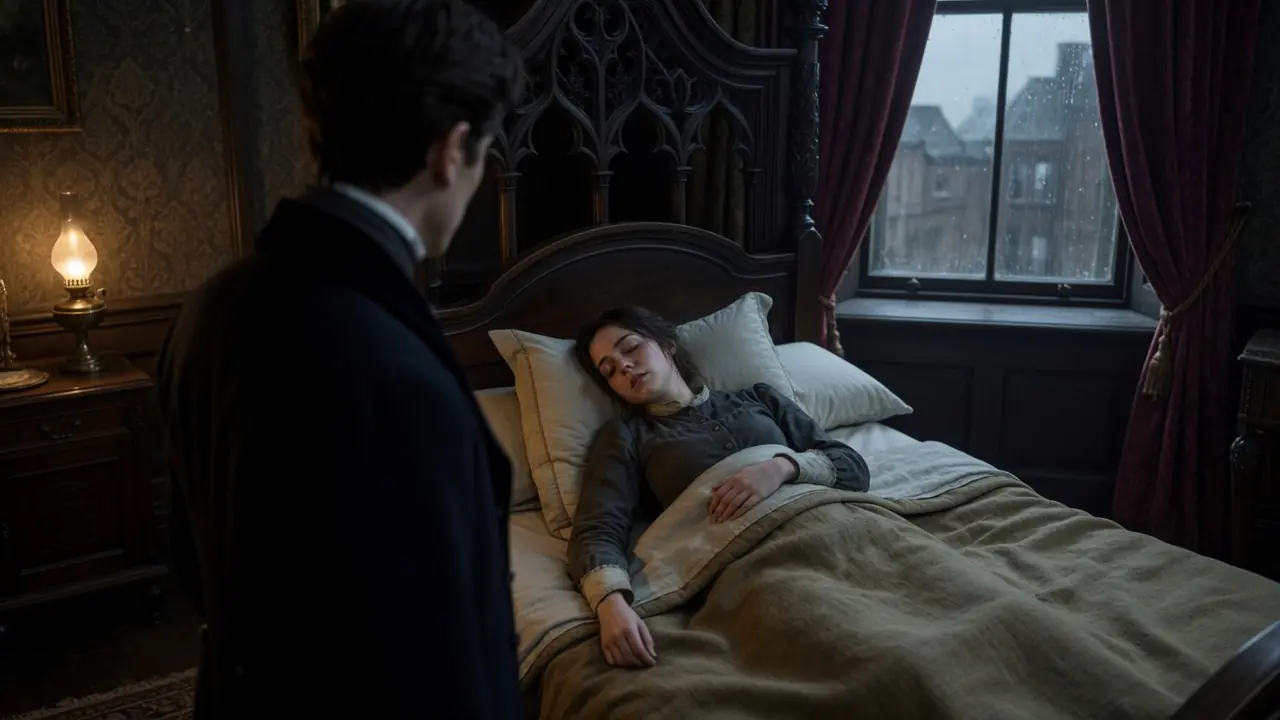
She finished the work. She brought herself inside, took off her wet outer things, put on dry ones, and went back to her other duties because there were always other duties, and they did not stop requiring doing simply because she felt as though the floor was tilting.
She was in the corridor outside the upstairs parlor carrying a cold scuttle that was heavier than it should have been because it had been left too full by a staff member who had not been the one who needed to carry it when the scuttle slipped. She caught it. She did not drop it, but the catch cost her, and she stood for a moment in the corridor, gripping the handle with both hands, and let out a long, slow breath through her teeth, and the cough that followed was the kind that came from very deep in the chest.
Set that down, she turned. Fabian was standing 10 ft away in the corridor, and she had not heard him coming, and the look on his face was one she had not seen before. Not composed, not contained, not the measured calm that was his habitual expression. He was looking at her the way a person looks when they have seen something they shouldn't have had to see, when the evidence of a failure that is not their fault has made itself undeniable.
Your grace, she said straightening. I'm perfectly set it down, Miss Bowman. He said, now she set it down. He crossed the corridor to her in three steps and did something she had never expected in her life. He put one hand beneath her arm, steady and certain, and guided her toward the window seat at the end of the passage, where the padded bench sat in the alcove overlooking the winter garden.
She sat, because she had no other choice without making a scene, and because she had to be honest with herself, her legs were very glad of it. He crouched down to look at her face, which meant they were at the same height, which was an entirely unexpected intimacy, and she could not look anywhere except at his face, which was close and grave, and looking at her with an expression that she did not have words for.
How long have you been working outside? he said. 3 days, your grace. The canes needed in this weather. It needed to be done, your grace. The frosts. Who assigned you to it? She stopped because the honest answer was that no one had assigned her. She had simply been there and it had needed doing. This was the ordinary arithmetic of her life, and she did not know how to explain it to a duke who lived in a world where things were assigned and delegated and organized, where no task fell on anyone simply by proximity.
He read the hesitation correctly. He stood. His face had gone to something quiet and controlled and very, very cold, but not at her. She understood this clearly. The cold was not for her. Come, he said. He led her, and she let him, because she was genuinely unsteady, and the floor was still doing its disconcerting tilt to the small room at the end of the east corridor that was used for the upper housemaid's afternoon breaks.
It was warmer than the corridor, and had a proper fire and a decent chair. He settled her into it. He went to the door and said something to a footman in a low voice that she could not hear. 10 minutes later, Mrs. Caldwell appeared with a tea tray. The housekeeper looked at Laurel with an expression that mixed professional assessment with something that was almost, though not quite, maternal.
Fever, she said in the tone of someone confirming what they have suspected for several days. I'm fine, Laurel said. You are not fine, Mrs. Caldwell said in the tone of someone who was done pretending otherwise. You have been not fine for at least a week, and have been extremely unreasonable about it. I had duties. Your duties, Mrs. Caldwell said, settling the tea tray with a precision that brooked no argument. Will be there when you are well. The canes will not be less tied if you recover fully before returning to them.
She poured tea with the decisiveness of a woman who had been managing difficult people for 21 years. The Duke has asked that you rest. You will rest. Laurel accepted the tea because she was too tired to argue and because the tea was very hot and the room was very warm and she was, if she was honest, very glad to simply sit still for a moment.
Mrs. Caldwell, she said when the housekeeper moved to go. Yes. Does he do this often? Asked after the staff. Mrs. Caldwell paused at the door. She was a woman who chose her words carefully, who understood the weight of things said and things left unsaid in the complex ecosystem of a great house.
No, she said after a moment. He does not. And then she went. Fabian found the undergardener's work roster that evening. He read it quietly in his study, the fire burning high beside him, a glass of brandy untouched on the desk. He read the names and the tasks and the dates. And when he had finished reading it, he sat for a while, looking at nothing in particular.
He thought about thin wrists and mended gloves and a cold scuttle too heavy to carry at the end of a long day. He thought about three days in the freezing garden, working without complaint, without being asked. He thought about the fever in her eyes, and the set of her jaw, and the way she had said, I'm perfectly fine, in the voice of a person who had learned that saying otherwise did not help.
He thought about the West Wing and Lady Evangeline's smile and the ledger that had never existed. And he felt something he was not accustomed to feeling. Not anger exactly, though anger was in it somewhere. Something sharper. Something that had to do with the particular failure of a man who ran a household of 43 people and had somehow somehow allowed one of them to disappear into a pattern of overwork and small cruelties for 3 years without ever noticing.
He had been very busy being unreachable. He had been very focused on maintaining the distance that kept everyone at a comfortable remove and allowed the world to run smoothly without demanding anything of him that he was not prepared to give. He had not noticed Laurel Bowman until she fell asleep in his bed.
He picked up the brandy glass and then set it down again. He went to the window and looked out at the frozen garden, barely visible in the winter dark, the snowcovered rose canes along the south wall, just distinguishable against the gray stone. She had tied those canes in this cold, because it needed doing, and she was the nearest and most reliable person, and no one had thought to ask whether that was a reasonable thing to ask of her.
He stood at the window for a long time. He thought, She is not safe here. And then he thought something else, something quieter and more complicated, something he did not immediately examine closely, because it was the kind of thought that once examined demands something of you, he thought. I do not want her to leave.
The days that followed had a different quality than any that had come before. Laurel rested because Mrs. Caldwell was absolutely immovable on the subject, and because the fever had made the decision somewhat inevitable. She slept for 15 hours in the first day, and woke feeling as though she had returned from somewhere very far away.
She drank the broth that appeared at her door, carried by Millie, who reported with barely contained excitement that the Duke had spoken to the cook directly about it. He spoke to Cook, Millie said for perhaps the fourth time, sitting on the edge of her cot with her eyes very wide. I heard you the first time, Laurel said about the broth.
He described what broth he wanted and cook made it. That is a very ordinary thing. Laurel said he has never described what he wanted to cook in his life. Millie said he sends notes. He doesn't go in person. Laurel looked at the broth. It was very good broth as it happened, the kind that meant someone had paid attention to it. She did not say anything.
On the third day, well enough to be sitting up and restless, she was allowed to the window seat wrapped in a blanket, where she could see the south garden and the rose canes she had tied and the gray winter sky pressing low over the bare trees. She was sitting there watching a sparrow argue with the frozen ground when the knock came at the door. Not Millie's knock, which was brisk and practical. Not Mrs. Caldwell's, which was a single sharp wrap. This was a quiet knock measured, and she would have known it anywhere.
Come in, she said, and immediately thought. You should not have said that. You should have said one moment while you arranged yourself into something appropriate. Fabian entered. He was not in full dress, no coat, no formal cravat, simply a dark waistcoat over a white shirt. And this informality was somehow more startling than anything formal he might have worn.
He looked at her by the window in her blanket with her hair in a loose plait because no one had told her to be dressed for company and he did not look away or retreat. Better, he said. An assessment, not a question. Much better. Thank you, your grace. He brought the chair from the writing table and set it near the window seat, which was the most extraordinary thing she had ever witnessed a duke, and sat in it without preamble. She watched him with wide eyes.
I have some questions, he said. I would like honest answers. Yes, your grace. How long has Lady Evangeline been assigning you duties outside your role? Laurel considered several ways to soften the answer and found under the directness of his gaze that none of them felt possible. Since she arrived, she said about 3 weeks. He nodded. What other tasks?
She told him. She kept her voice even and factual, as she would report to Mrs. Caldwell, listing rather than complaining. The late night summons for trivial things, the early morning errands, the heavy work that should have gone to the male staff, the particular quality of Lady Evangeline's requests, never direct commands, always phrased as gentle preferences, so that refusing them would have required making a case that the guest was being unreasonable, and no servant could make that case without risking far more than the task itself.
He listened without interrupting. When she finished, there was a silence that sat between them, comfortable in a way silences usually were not between people of their respective positions. I should have known, he said eventually quietly. You couldn't have known your grace. My household, he said, my responsibility.
The words were simple, and he meant them in a way that was slightly devastating, because they were the words of someone who was used to owning their failures without looking away from them. She looked at him. She had been careful not to look at him too directly, because looking at him too directly made her aware of things she could not afford to be aware of.
But sitting here by the window in the gray winter light, with the distance between them that usually lived in every interaction somehow not present, she looked at him. He was tired. She could see it now. Not the deep bone tired exhaustion she knew in herself, but a different kind. The tiredness of a man who had been carrying something heavy and alone for a very long time.
It lived in the set of his shoulders, in the slight tension around his eyes, in the way he held himself with a precision that was so habitual she suspected he was no longer aware of it. Your grace, she said, and then stopped because she was not sure what she intended to say after that. He looked at her with those careful, attentive eyes. Nothing, she said. I'm sorry.
He almost smiled. It was not quite a smile, more the ghost of one, the suggestion of warmth at the edge of something that had been cold for a long time. Get well, Miss Bowman, he said. He stood, returned the chair to its place, with the same quiet precision with which everything he did was accomplished, and went to the door. Your grace, she said. He stopped. Thank you, she said, for the broth.
He stood for a moment with his back to her. You are welcome, he said, and walked out, and she heard his footsteps going away down the corridor, and she turned back to the window and the sparrow and the gray winter sky, and pressed both hands flat against her burning cheeks.
Downstairs in the morning room, Lady Evangeline Cross sat with very straight posture and explained to her brother in precise terms that the situation had moved beyond what she had anticipated. He is interested in her, she said. Victor looked up from his newspaper. She's a maid. Yes, Evangeline said. She is. That is hardly Victor. Her voice was flat and entirely serious.
He went to her room. Victor put the newspaper down. They sat together in the morning room and thought about the various implications of this, and neither of them liked any of the implications. Victor said, We cannot allow this to derail three months of careful work. Evangeline said, We are not going to allow it.
She was thinking behind the composed planes of her face about all the ways she still had available to her. She was thinking about influence and patience and the long game which was always in the end the game she was best at. But she was also thinking with a honesty she allowed herself only in private about the look on Fabian Wells's face when he had corrected Victor at dinner.
She had known Fabian Wells for years. She had been in society long enough to know his reputation, his history, the particular emotional geography of a man who had made a virtue of distance. She had never seen him look at anyone the way he had looked at that door after Laurel Bowman walked out of the dining room. She had refused the engagement.
In the privacy of her own thoughts, Evangeline knew the Duke had already chosen. He simply had not said it yet. The formal refusal came on a Tuesday. Victor Cross delivered it himself, which was unusual. Refusals of this kind were normally handled through letters, through solicitors, through the careful machinery of polite diplomatic distance that allowed both parties to pretend the matter had been one of timing and circumstance rather than preference.
The fact that Victor came to the study in person unannounced at 11 in the morning was a form of pressure in itself. Fabian received him behind his desk. Victor was a man who preferred large rooms and large gestures, and he filled the study doorway with the deliberate broadness of someone who had learned early that taking up physical space was a form of authority.
He settled into the chair across the desk with the confidence of someone who believed the conversation was going to go his way. The engagement, Victor said. I'd like to discuss it directly. There is no engagement, Fabian said. Victor smiled, the smile of a man who was translating what he was hearing into something more manageable.
There was an understanding, a mutual. There was not, Fabian said. I made no agreement and stated no intention. I listened to a proposal and did not refuse it in that moment, which was a courtesy, not a commitment. Victor's smile did not quite disappear, but it changed character.
Fabian, reasonably, you must see that this alliance would serve you well. The political connections alone. I am not interested in those connections at this time. And in 3 years time, when the parliamentary shifts that are coming have reshaped who holds influence in which circles, when the alliances that seem unnecessary now have become Victor, Fabian said quietly. I have given you my answer.
The smile vanished entirely. Victor Cross was not a stupid man, and he had the intelligence to understand when a line had been drawn clearly enough that proceeding past it would cost him something he could not afford to lose. He stood. He straightened his coat. He allowed himself one long, level look at the man across the desk, and in that look there was an assessment and a recalibration.
And beneath both, the cold beginning of something that was not yet anger, but was related to it. I see, he said. Good morning, Victor, Fabian said. The door closed.
The aristocratic world was a small one, and news moved through it with remarkable speed for something that operated almost entirely through whisper and implication. By the end of the week, it was known in every relevant drawing room in Darbasha that the Duke of Blackthornne had declined the Cross alliance.
The reasons given in public were vague and procedural. The Duke had other matters on his mind. The Duke's advisers had questions about the terms. The Duke was not ready to commit to anything at this time. But in private, between people who paid attention to the details, a different story was assembling itself.
Something had changed at Blackthornne House. There was a girl. These things did not stay secret. They never did. Not entirely. Not in a world where the staff of one house moved between houses and carried news with them. Where the connections between families were dense enough that someone always knew someone who had heard something.
The particular rumor that assembled itself was imprecise. It was always imprecise at first, but the shape of it was clear. The Duke of Blackthornne, the coldest man in the peerage, had become interested in a servant girl, and he had declined an advantageous engagement, and these two facts were connected.
The response was social and swift. Lady Francis Foster, wife of Sir Wallace, called on Evangeline Cross and sat with her in the morning room and spoke with careful circumspection about the importance of protecting the dignity of all parties involved when unfortunate attachments developed.
Lady Helena Ashby, whose family had known the Wellses for two generations, wrote a letter to Fabian, expressing in the warmest possible terms her hope that he was well, and her certainty that he would make all the right decisions in the end. Two of Victor's parliamentary associates, passing through Darbasha on their way north, made visits to Blackthornne House, and left after brief, uncomfortable meetings.
All of this was in its various forms pressure. Pressure directed not at Fabian precisely. No one with sense directed pressure directly at the Duke of Blackthornne, but at the situation, at the possibility of it, at the servant girl, who had become, suddenly, and against all expectation, a source of social anxiety to people who had never previously known she existed.
Laurel was aware of all of it. She could not not be aware of it. The change in the atmosphere of the house was palpable, a tightening, a watching, a quality of expectation that made every room she entered feel slightly more charged than it had been before. Helena gave her looks of measured pity that were somehow worse than hostility.
Thomas, the footman, who had been opening doors for her with his overdone courtesy, had stopped. Other staff had recalibrated again, more carefully this time, toward the neutral weariness of people who were waiting to see which way a situation would fall before they committed to a position.
She moved through all of it quietly, and carried her work, and said nothing, and thought constantly. She thought about what it would mean for him. She was not naive. She understood the architecture of the world she lived in with a clarity that people who had never been at the bottom of it sometimes lacked.
She knew what an attachment, even a rumored attachment, between a duke and a servant girl meant for the Duke's reputation, his political standing, his relationships with every family who had been hoping to connect themselves to the Wells name. She knew what it meant for the people who depended on the estate's stability, the tenants and the staff and the households connected to it.
She thought he should not have spoken to me in that corridor. He should not have defended me at dinner. He should not have come to my room. And then she thought. But he did. And then she thought something she did not let herself complete.
She made the decision on a Thursday evening. She had been watching a scene from the corridor outside the upper parlor that she had not intended to watch. She had been passing. She had heard voices and something in the quality of the voices had made her pause.
Victor Cross and a woman she recognized as Lady Francis Foster and the low careful tones of a conversation that was not meant to be overheard. The girl is the problem. Victor was saying, Remove the girl and the situation resolves. Lady Francis, with a kind of reasonable warmth that was more chilling than outright hostility. Surely it can be handled quietly, a position in another household, somewhere northern, arranged through that assumes she'll go quietly, Victor said. My sister is less confident of that than she was.
A pause. Then it needs to be more direct, Lady Francis said, and the warmth in her voice was still there, which was the most terrible thing about it. These situations are best resolved before they become permanent.
Laurel stood in the corridor. She stood very still for a long time until the voices moved to another subject and she could breathe again. She walked back to her room. She sat on her cot. She thought very clearly, You need to go.
Not because she wanted to, not because the thought of leaving was anything other than a gray, hollow thing, but because she could see with cold clarity what she had been refusing to see, that staying was not simply difficult. Staying was actively damaging to him, to the estate, to the careful, complex machinery of a Duke's life that her presence was now working against.
He had been kind to her. He had been more than kind. He had changed something in himself because of her. And she was not foolish enough to pretend she did not know what that meant. Even if she could not say it, even if it was impossible, even if the distance between a duke and a lady's maid was not simply social, but structural, built into the very bones of the world they lived in.
She could not repay his kindness by letting him be destroyed for it. She found her small bag under the cot and began to pack it. She was very quiet about it. She took only what was hers, a change of dress, her personal things, the small coin purse she had been adding to for months against some unnamed future need.
She took the letter from her mother, kept in the pocket of her winter coat. She left the good wool gloves that Mrs. Caldwell had given her because they belonged to the house. She wrote a short note for Millie thanking her and left it on the pillow. She did not write a note for anyone else.
She put on her coat and picked up her bag and went downstairs and moved through the sleeping house toward the servant's gate. It was 4:00 in the morning. The snow had started again, soft and steady, falling without drama, covering everything.
She reached the gate. She put her hand on the latch and she heard his voice. Miss Bowman. She turned slowly. He was standing in the servant's passage behind her, a single lantern in his hand, and the light of it caught the snow that was falling softly between them. He was in his coat, fully dressed, as though he had not been to bed at all. His face was very still.
Your grace, she said. Her voice was steady. She was proud of how steady it was, given that her heart was doing something rather chaotic, and the lantern light was making his face look like something out of one of the paintings in the gallery upstairs. All shadow and gold.
You were leaving, he said. Yes, without telling anyone. There is a note for Millie. He was quiet for a moment, just looking at her across the 10 ft of stone passage and falling snow. I see, he said, and then come inside. Your grace, she held her bag tighter. I think it's better that I come inside, Laurel.
It was the first time he had used her given name. She had not expected it, and it did something to her that she was not prepared for, something that dismantled the careful, reasonable architecture of her plan with a precision that was quite unfair. She came inside.
He led her to the small sitting room off the east corridor. Not the grand formal rooms, not his study, but this small, quiet, firelit space that smelled of old books and wood smoke, and the particular accumulated comfort of a room that was simply over time used.
He set the lantern on the table and built up the fire without summoning anyone, doing it himself with a quiet efficiency that she found as startling now as she had found everything else he did, outside the narrow range of what she expected from him. She sat on the edge of the chair closest to the fire, her bag in her lap, her coat still on, because keeping it on felt like keeping the possibility of leaving alive.
He sat across from her. He did not speak immediately. He looked at the fire for a moment, and she looked at the fire, and the silence between them was full of all the things that had been accumulating for weeks. Every look in a corridor, every conversation that had gone longer than its ostensible subject required, every moment of quiet understanding that had no name.
Tell me, he said, why you were at that gate? You know why, she said. He looked at her. I would like to hear it from you. She pressed her hands flat against the top of the bag. She thought about the careful, reasonable arguments she had assembled, about his reputation and his political standing, and the people who depended on the estate's stability. And she tried to present them as simply and clearly as she had worked them out in her room an hour ago.
When she finished, the fire said something quiet to itself in the grate. You were protecting me, Fabian said. I was being practical, she said. What is possible and what is not possible is Laurel. She stopped. He was leaning forward slightly, his elbows on his knees, his eyes on hers, and the lantern light between them was very warm.
You fell asleep in my bed by accident, he said. She blinked. You were lost and exhausted and ill, and you found a warm room and you slept. He said it plainly, without embarrassment, as though he was simply establishing a fact. That was an accident. Yes, she said carefully. What happened to me afterward, he said, was not an accident.
The sitting room was very quiet. I stood in that room and watched you sleep, he said, and I felt something I hadn't felt in longer than I can account for. Not He paused, choosing words with the care of someone who did not usually have to search for them. Not what you might expect a man to feel. Not what Victor Cross would assume if he knew, or what society would infer.
Something simpler and more complicated than any of that. Laurel held very still. I saw someone exhausted, he said. Someone who had been running on nothing for too long, for people who did not consider whether they were asking too much. And something in that. The way you were holding the sheet, the crease you get between your brows even when you're asleep. He stopped. It broke something, he said quietly. In me, something I had been keeping very carefully closed for a very long time.
She looked at him. She looked at him fully for the first time without the habitual careful management of her own gaze, and she saw everything she had seen by the window on the gray winter afternoon. The tiredness, the isolation, the man behind the composure. Your grace, she said. Fabian, he said, here in this room. She let out a slow breath. Fabian.
She had not said his name before. The word sat in her mouth with an extraordinary unfamiliarity and also she could not help it, a rightness. I have been watching you, he said since that morning. I have been rearranging things and adjusting schedules and defending you at dinner tables and coming to check on you when you were ill. And I have been telling myself that all of this was simply the behavior of a responsible employer who had discovered an injustice in his household.
He looked at the fire. I stopped believing that some time ago. You could lose everything, she said. Everything you have built, every alliance, every political I know, he said. Then you understand why I was at that gate. I understand that you were trying to make a decision about my life, he said, not unkindly on my behalf. Without asking me.
She opened her mouth and closed it. I have spent my entire life, he said, having decisions made on my behalf by my father, by my advisers, by Victor Cross and his sister and every other family in England, who has looked at the Wells estate and seen an opportunity. I have accommodated all of it because I understood the stakes, and I was willing to pay the cost. He looked at her. I am not willing to pay this one, he said. This particular cost. I have decided.
That the snow was still falling outside the small window. She could see it in the darkness beyond the glass, soft and steady and silent. She thought about safe. She thought about the night she had stumbled into his room, exhausted and feverish and lost, and the way the smell of it had reached her, sandalwood and winter rain, and the way her body had simply let go of everything it had been holding for the first time in years because something in that room had told her she was not in danger.
She thought that was him. That feeling was him. I was safe because it was his room. I felt safe, she said. Her voice was barely above a whisper. In your room before I knew whose room it was. I felt I have not felt that way in I don't know how long I have not felt that way.
Something happened in his face. Something behind the composure. A shift, a giving, a small fracture in the wall. You were safe, he said, and it was the simplest thing and the most absolute thing she had ever heard. The bag in her lap had loosened. She was not holding it the same way.
She looked at his hands. He had long, steady hands, the kind that belonged to a man who did things with care. She had noticed that about him, the precision with which he did small things, the way he had rebuilt the fire without making a performance of it.
What happens now, she said that, he said, depends on whether you will trust me. He was asking her. She understood this. He was actually asking, not telling, not managing, not directing her toward an outcome he had already decided on. He was asking whether she would choose this, whatever this was, whatever shape it might take.
She thought of everything practical. She thought of Evangeline Cross's thin smile and Victor Cross's voice through the parlor door and Lady Francis Foster's warmth that was not warmth. She thought of the real difficulty of what he was suggesting, the weight of it, the ways it could go wrong.
She thought, I have been practical my whole life. I have been careful and invisible and practical, and it has kept me safe the way a cage keeps you safe. She looked at him. Tell me what you intend, she said plainly.
I intend to remove you from Lady Evangeline's authority immediately, he said. I intend to make clear to Victor Cross that his influence in this house has reached its limit. I intend to announce in front of everyone who requires a public announcement that you are under my protection as my ward, as my companion, in whatever capacity society requires a name for in order to leave you alone.
He paused, And I intend to take whatever time is needed to do this correctly, without rushing either of us. She thought about that. Ward, she said. For now, he said, until we can be honest about more.
The fire spoke again in the grate. Outside the snow fell, the lantern burned steadily between them. All right, she said. He looked at her for a moment, and what she saw in his face then was something she had never expected to see there. Relief, pure and unguarded, and real.
He stood. He crossed to the small table against the wall and picked up a folded blanket and brought it to her because she was still in her coat and the room was still cold. And this small, completely unassuming gesture, a blanket offered without comment made her feel more seen than all the grand gestures she had spent her whole life watching other people receive.
She took it. He sat back down and they sat together in the small room while the snow fell beyond the window. And outside the world was asleep. And inside this room at 4:00 in the morning, something that had been growing in the dark for weeks came quietly into the light.
He did not touch her. He did not need to. He simply stayed. That was the thing she would remember. Not a declaration, not a dramatic gesture, not the kind of moment that plays well in the telling, just two people by a fire in the cold before dawn staying.
She fell asleep in the chair before the fire had burned down, the blanket around her shoulders, her bag on the floor beside her, and her hand resting open in her lap, not clutching anything, not holding on against the fear of losing it. Simply open, simply resting, he watched her sleep.
He had done this before. He had done exactly this, and it had changed him, and he felt the echo of it now, the recognition of something returning that he had only just found the first time. He thought about walls and costs and the long careful architecture of a life built against feeling.
And he thought about thin wrists and mended gloves, and a question asked simply in a corridor that had done more than all the years of careful management. How long has it been since someone allowed you to rest? He thought. I will not ask that question again. He thought, I will make it so she does not need to be asked.
Outside the snow had covered everything in white, and Blackthornne House was very still, and the Duke of Blackthornne sat in a small sitting room, watching the fire burn low, and for the first time in longer than he could accurately account for, he was not thinking about the cost of anything at all.
The morning broke clear. After days of gray sky and driving snow, the sun arrived over Blackthornne House with the particular bright authority of winter sunlight that has had its say, the kind that illuminates everything harshly and honestly, that makes no allowances and casts no flattering shadows.
It came through the tall windows of the dining room and fell across the breakfast table in long exact rectangles and it was already in the room already illuminating things when the household began to assemble. Lord Victor Cross came down at 8. He was dressed with his habitual precision, a man who understood that how you appeared was a kind of argument and who never surrendered that argument in the morning regardless of what the night had held.
He greeted the footman by name, which he always did because he understood the politics of small courtesies, and he sat at the breakfast table and unfolded his newspaper and accepted his coffee, and was, to all observable appearances, perfectly calm. He was not perfectly calm. He had been awake since 5, running through the various configurations of what he knew and what he suspected, and what he intended to do about both. And he had arrived at the breakfast table with a plan.
Plans were what Victor Cross did best. The plan required Fabian to be present and required the situation with the maid to be addressed directly without the elaborate indirection that Fabian was so skilled at using to delay conclusions he had already reached. Lady Evangeline came down at 8. She wore pale gray, which she had chosen because it was the color of composure, and she sat across the table from her brother, and poured her own tea with a steady hand.
Sir Wallace Foster came down shortly after with his wife Francis, both of them inhabiting the carefully neutral expressions of people who were present for a situation they had not created, but intended to observe to its conclusion. Eugene the Cross cousin came down last and immediately requested kippers which the footman provided with the professional absence of opinion that was the highest achievement of good service.
Fabian arrived at 9. He was not alone. This was the detail that changed everything. He was never accompanied at breakfast. He was a man of solitary mornings and the whole household understood this and arranged itself accordingly. But he came through the breakfast room door, and Laurel was behind him, not in the position of a servant, not carrying anything, not walking a half step back with her eyes down, but simply present, walking into the room as though she had as much right to be there as anyone else, which under his quiet authority she did.
She was in a clean dress, and her hair was neat, and her expression was the careful, steady kind that belonged to someone who had decided to be afraid only after there was something actually worth being afraid of. The breakfast room absorbed this. Victor Cross lowered his newspaper. Lady Evangeline sat down her teacup with a small, precise click. Sir Wallace and Lady Francis exchanged a look of the practiced sort that long marriages develop. The look that says, I see it, and I see you seeing it, and we will discuss this later at considerable length. Eugene ate his kippers.
Fabian took his place at the head of the table. He indicated a chair, not a servant's position, not a corner, but a chair at the table, three places down from himself. And Laurel sat in it. And the footman, because the footman was a professional, and because the Duke had indicated clearly that this was the arrangement, brought her a cup and filled it.
Victor Cross said, Fabian, a word, I think, before you may say it here, Fabian said. The room went very still. Victor had been intending a private word, a quiet, reasonable, man-to-man conversation, in which the problem was defined, and the solution presented, and the matter closed before it became a scene. He had not been intending a scene. Scenes were inefficient.
This is not the time or the setting for Victor, Fabian said quietly, with the particular quality of a man who has made a decision and is no longer available for negotiation. Say it here or do not say it, a pause, the kind that required a choice. Victor set down his newspaper. He looked at Fabian across the white tablecloth, and then he looked briefly at Laurel, and his expression was not unkind exactly, but it had all the warmth of a financial document.
I must insist, he said, that you consider the gravity of the situation you are creating, for the estate, for your standing, for every alliance and relationship you have. I have considered it, Fabian said. The girl, Miss Bowman, Fabian said, is no longer under Lady Evangeline's authority. She is under mine. She will remain at Blackthornne House under my personal protection, and she will be treated by every person in this room and in this household accordingly.
The sentences were short. They were not unkind. They were perfectly clear. Victor Cross drew breath. Fabian, I am trying to speak to you as a man who has your best interests. You are trying to speak to me, Fabian said. As a man who has his own best interests and has been mistaking them for mine for some time. He reached for his coffee. I recognize the distinction. I am grateful for what you intend by it, but my answer stands.
Evangeline Cross had not spoken. She sat in her pale gray dress with her teacup in her hand, and she was looking at her brother, and then at Fabian, and then slowly, with an expression that was complex and careful, and harder to read than anything else in the room. At Laurel.
Laurel met her eyes. She was not sure what she expected. The thin measuring smile, some cold signal of threat or contempt. What she got was something else. Evangeline Cross looking at her with an expression that was not warm but was honest and in which there was beneath the calculation something that resembled recognition.
The look of one woman who understood the situation completely acknowledging another. It lasted only a moment. Then Evangeline looked away and lifted her teacup. Victor, she said very quietly. Her brother looked at her. Let it be, she said. Victor Cross sat with his newspaper and his coffee, and whatever argument he had assembled, he put it down. Not with grace. He was not a graceful man when things went against him, but he put it down. The room breathed.
Conversation resumed slowly in the cautious way of people recalibrating after a shift in the landscape. Francis Foster asked someone about the weather. Eugene expressed a second opinion about the kippers. The footman refilled cups without comment. Fabian turned to Laurel. He said nothing. He did not need to. He simply looked at her with that quiet, attentive directness. And what was in his eyes was plain, clear, entirely unhidden.
She looked back at him across the table, across the white cloth and the morning coffee and the long complicated weight of everything that had led to this moment. She looked at the Duke of Blackthornne, and she did not look away.
Something had happened at that table. Something small in the visible world and enormous in every world below it. The room had witnessed it and would remember it and carry it forward into every drawing room conversation and letter and whispered exchange for months to come. The Duke had chosen publicly in the brightest possible light in front of exactly the people who needed to see it, without apology, without evasion, without the careful distance that had been his protection for as long as anyone had known him. He had chosen, and there was no mistaking what he had chosen.
The Cross party departed that afternoon. Victor did it quietly with the contained efficiency of a man who intended to take his dissatisfaction somewhere it could be expressed without audience. Evangeline oversaw the packing of trunks with her usual precision and said goodbye to Mrs. Caldwell with her usual courtesy and paused for a single moment in the entrance hall. She looked up at the portrait that hung above the mantle, a former Duke of Blackthornne, three generations back, painted with the particular arrogance of a man who had never questioned his right to stand in the center of any room.
She looked at it for a moment. Then she looked at the door that led to the east corridor. And through that door, somewhere in the depths of the house, at the life that was assembling itself in ways she hadn't managed, she put on her gloves, she left.
The house settled into itself after they had gone. The particular shift in atmosphere that follows the departure of people who have been creating tension for too long, a lightening, an expansion, a taking of breath by rooms that have been holding themselves slightly rigid, moved through Blackthornne House quietly.
Mrs. Caldwell reorganized three duty rosters and said nothing about any of it. The staff, who had been recalibrating for weeks, finished their recalibration, and arrived at a new understanding of how things stood, which spread through the house in the steady, wordless way that new understandings spread through places where people pay attention to each other.
Millie cried a little when she saw Laurel's bag returned to its place under the cot, which she denied, and then said at length that she had always known something was not right about Lady Evangeline, and then ate three biscuits from the kitchen in rapid succession.
Laurel worked. She worked because she was not a woman who could simply stop working, and because the work was hers, and she was good at it, and because doing it well was one of the ways she knew herself. She went back to her duties with the particular quality of presence that comes from having been close to leaving and choosing to stay, everything slightly brighter, slightly more felt, slightly more itself.
But the duties were different now. They were different because the people around her were different, which was to say they treated her differently, which was to say the invisible architecture of her days. Who asked what of her? How, with what consideration had shifted in ways that were small and material and real.
The cold scuttles were no longer left over full. The late night summons didn't come. Mrs. Caldwell arranged things with the particular care of a woman who had been waiting for permission to arrange them differently.
On the third evening after the Cross party left, Fabian asked her to walk with him, not in the public rooms, not in the formal garden, in the kitchen garden at the back of the house, which was not grand and not formal, and smelled of frozen earth and old stone, and was, she realized, as they walked, the part of the house he came to when he was most himself.
The snow had melted to patches on the ground, and the winter plants in their beds were still and waiting, and the air was cold and clear and smelled of nothing in particular except the cold itself. He walked beside her. Are you well? he asked. Not a formal inquiry. The real question. Yes, she said. Genuinely, he nodded.
They walked in silence for a moment, their breath making small clouds. A bird moved in the bare hedge. The kitchen garden wall stood warm and stonecolored in the last of the afternoon light. I have been thinking, he said, about what comes next. So have I, she said. I imagine we have arrived at different conclusions.
She looked at him sideways. He was looking forward at the stone path. Perhaps, she said, tell me yours first. He almost smiled, the not quite smile she had come to watch for. The ghost of warmth at the edge of a face that had learned to hold itself still.
My conclusions, he said, involve time, patience, doing things in the right order, at the right pace, without being rushed by anyone else's timeline. He glanced at her. And your conclusions that I should find a way to be useful, she said, that does not require me to make myself small.
He stopped walking. She stopped beside him. He turned to look at her, and in the clear, cold, unsparing winter light, with no fire between them, and no lantern to create flattering shadows. She saw his face as clearly as she had ever seen it. Saw the tiredness and the care and the person he was when he was not performing composure for rooms full of people who wanted things from him.
You have never been small, he said, not once in any room you have stood in. She could not speak for a moment. You have been treated as though you were. He said that is a different thing and it ends now.
The kitchen garden was very still. The stone walls held the cold and the quiet in equal measure. Somewhere in the house behind them a fire crackled, and the evening was beginning in the ways that evenings began, candles lit, meals considered, the gradual gathering of warmth against the night.
Laurel looked at Fabian Wells. She thought about a warm room and a smell of sandalwood and winter rain and a feeling she had not expected and could not explain. Safe. She thought about a question asked in darkness. How long has it been since someone allowed you to rest?
She thought about all the ways the world she lived in told both of them in its various clear and coded ways that what was growing between them should not be allowed to grow. She thought I have been careful my whole life. She thought some things are worth the risk of being careless.
She looked at him. All right, she said. We do it your way in order. At the right pace. He looked at her for a long moment. Then he did something she had not seen him do. He offered her his arm. Not the formal gesture of a host conducting a guest through his estate. Something simpler and more real. A man standing beside a woman in a winter garden offering to walk back to the house together.
She took it. They walked back through the kitchen garden, through the old stone gate, and into the light of Blackthornne House, and the house received them with the quiet, ordinary welcome of a place that had adjusted itself to the truth of what was happening, and had decided, in its old and patient way, to approve.
That night, Laurel stood for a moment outside the door of the east passage, where the candle holders lined the wall she had polished weeks ago, and she felt the house around her, its size, its cold marble, its many fires, its staff of 43, the weight of its history, and the weight of all that had shifted in it over the past weeks.
She felt for the first time that she was part of it, not furniture, not a resource, useful and invisible and easily replaced. Part of it in the way that people are part of the places that have seen them most truly, that have held the real shape of them when they could not hold it themselves.
She walked down the corridor. The candles were burning steadily, all of them in a row. Upstairs in his study, Fabian Wells was sitting at his desk and not reading the letter in front of him. He was looking at the fire, and he was thinking with the particular quiet of a man who has set down something very heavy, and is still understanding what his hands feel like without it. About the shape of a future that was not yet visible, but was for the first time in a long time. Possible.
He thought about a woman who had fallen asleep in his bed by accident and changed him on purpose, or perhaps not on purpose. Perhaps simply by being herself, by being tired and honest and unexpectedly brave, by feeling safe in his room before she knew it was his room, by asking nothing of him while somehow asking everything.
He thought, the coldest man in England, he thought, Not anymore. He leaned back in his chair. Outside the study window, the winter night was very clear, the stars hard and bright above Blackthornne House, the snow on the grounds lit faintly from within by its own whiteness. The estate lay quiet in all directions, fields and walls, and the sleeping village below the hill, and beyond it the dark country stretching away into England.
The fire spoke softly in the grate. He sat for a while, doing nothing in particular, simply being in the room and aware of it, aware of the house around him, aware of the 43 people within its walls, and the one among them who had arrived in his life sideways by accident through a wrong corridor on a winter night and had simply once to stayed. He thought. I'm not afraid of anything at all. He thought that is what she has done.
The candle on his desk burned low and steady, and the fire gave its last before settling to embers, and Fabian Wells sat in the gathering quiet of Blackthornne House, and felt for the first time in longer than he could measure that the rooms around him were not empty. They were full, full of warmth and fire light and the ordinary particular life of people who were in all their ways simply there.
Full of the presence of one woman who had not meant to find him, but had found him anyway, and he had not looked away. He had not from the very first moment been able to look away. And in the end, in the long, patient, cleareyed, winterlit end, that was the only thing that had mattered. He should have looked away. He had not. She had felt safe, and that was what had changed everything.
She Accidentally Fell Asleep On The Cold Duke's Bed — By Morning, He Was No Longer the Same Man
She Accidentally Fell Asleep On The Cold Duke's Bed — By Morning, He Was No Longer the Same Man
Theme:
Font Size:
24px