Clara Whitcomb stood at the front of the little church in Fairvale with her hands folded over her mother’s mended wedding dress and the whole town watching her try not to fall apart.
She stood there for forty minutes past the hour.
Forty minutes while the preacher shifted from one foot to the other. Forty minutes while the organist pretended to adjust her sheet music. Forty minutes while women whispered behind gloved hands and men stared at the floor because there are some humiliations so public that even decent people become cowards before them.
Then the note came.
A boy no older than twelve walked up the aisle with his hat crushed in both hands and placed a folded paper into Clara’s palm. She knew before she opened it. Every woman in that church knew. Every man did too.
Still, she unfolded it.
Five lines.
That was all it took to end a year of promises.
Elias Granger would not be marrying her that day. Nor any day after. He had thought better of the arrangement. He wished her well. He hoped she would understand.
He did not even sign it with affection.
That was the part Fairvale would remember longest.
Not that he had left her. Men had done cowardly things before and would again. But Elias had not come to say it with his own mouth. He had let Clara dress, walk, stand, and wait in front of the whole town. Then he sent a child with a note as if she were a parcel returned to the wrong address.
By supper, everyone knew why.
Elias had found a better offer in Mill Creek: the banker’s daughter, with a dowry large enough to make his conscience quiet. Rather than face the woman he had courted, praised, and promised to wed, he let Clara Whitcomb’s shame become a public spectacle.
She stood there with the note in her hand while the church stared.
Then she did the only thing left to her that had any dignity in it.
She folded the note small.
Lifted her chin.
Turned around.
And walked back down the aisle alone.
She passed pitying faces, curious faces, pleased faces, and faces that would retell the story before the dust settled on her hem. She did not hurry. She did not cry. She did not look at anyone long enough to give them the satisfaction of seeing where the wound landed.
She walked out the church doors and into the afternoon.
Then she kept walking.
The cruelest part was not the jilting.
It was that Clara had nowhere to go afterward.
Her father had been a beekeeper, a soft-spoken man who kept hives behind their cottage and sold honey in jars tied with brown paper. He had taught Clara everything: how to read a hive by sound, how to calm bees with patience instead of smoke, how to tell a weak queen from a failing season, how to move slowly when fear urged haste.
When he died the winter before, his debts took almost everything.
The cottage.
The wagon.
Even the little copper extractor he had polished every spring.
Clara was twenty-four, orphaned, nearly penniless, and left with no family willing to take her in without reminding her every day what a burden looked like at the table.
Elias Granger’s proposal had not been love alone. It had been ground beneath her feet.
A marriage.
A place.
A future.
She had pinned too much to it because there had been nothing else to pin hope to.
Now he had pulled that ground away in front of everyone.
She had no father. No cottage. No bees. No position. And now, through no fault of her own, she had a public ruin attached to her name.
That was how small towns did their arithmetic.
A woman left at the altar somehow shared the shame of the man who left her.
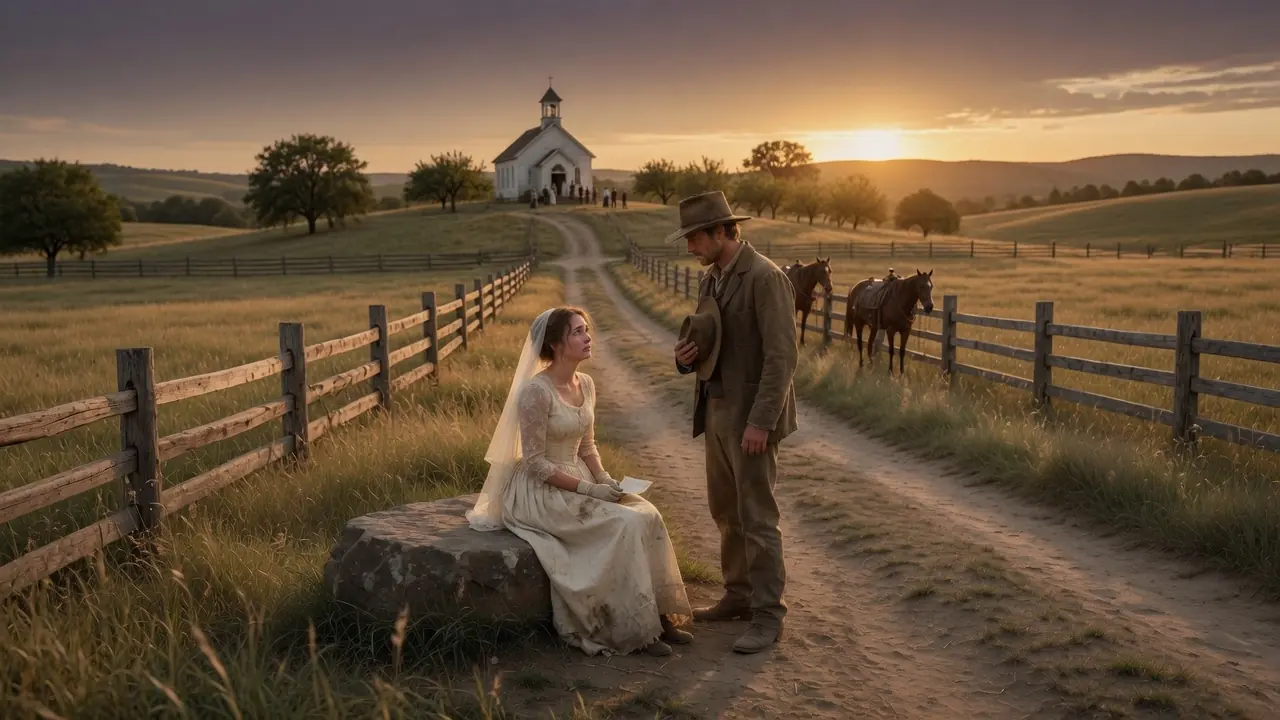
Clara walked past the last house in Fairvale and beyond the bend where the road began to slope toward the orchard country. There, beside a split-rail fence, she sat down on a flat stone in her wedding dress.
She had simply run out of places.
The sun had dropped low enough to turn the road gold. Dust clung to the hem of her gown. Her veil had come loose on one side. She had not cried in the church, and she refused to begin now where any passerby might see.
So she sat there dry-eyed, emptied, and still.
She did not know what she was waiting for.
Caleb Rowan found her there.
He was a rancher and orchardman, thirty-five or thereabouts, with a place north of Fairvale where the land rose gently toward the hills. He was unmarried, quiet, and plain-spoken in a way some mistook for coldness until they needed the truth and found him already holding it.
He had been at the wedding.
Not because he was a friend of Elias Granger. He was not. Caleb had known Clara’s father. For years, he had bought jars of old Mr. Whitcomb’s dark honey and admired the gentle way Clara handled bees when she was still young enough to braid ribbon into her hair.
He had watched the scene from a back pew with anger moving slowly through him.
He saw Clara walk out.
He gave her time.
Then he went after her because a man who had watched that kind of cruelty and simply gone home would have had to live with himself after.
He found her on the stone beside the road in her wedding dress, looking like a person who had reached the very end of her own life and found nothing waiting.
Caleb did not make a speech.
He stopped a respectful distance away, removed his hat, and held it against his chest.
“Miss Whitcomb,” he said, “it is no business of mine, and I will leave if you ask me to. But evening is coming on, and I cannot ride past a woman sitting alone by the road in her wedding dress without asking one thing.”
Clara looked up.
He asked it gently.
“Do you have anywhere to go?”
She stared at him for a moment.
A polite lie rose out of habit, then died before reaching her mouth. She was too tired for pride and too far past shame to pretend.
“No,” she said.
The word was flat.
Final.
“I haven’t. My father is dead. The bees are sold. The cottage is gone. No respectable house in Fairvale will take me now without making me feel the cost of it. Elias was…”
She stopped.
Caleb did not fill the silence.
Clara looked toward the road.
“He was the last place I had. Now I have nowhere, Mr. Rowan. I have been sitting here trying to decide what a person does when all her places are gone.”
Caleb studied her for a long moment.
Then he said the words that changed everything.
“Now you do.”
Clara blinked.
He spoke quickly after that, not hurried, but plain, before she could refuse him out of pride.
“I have an orchard my father planted. Apples mostly, a few peach trees toward the south fence. It has not borne a decent crop in six years, and no one has been able to tell me why. The trees bloom, then fail. Year after year.”
He looked toward the hills, then back at her.
“I knew your father. I knew his bees. I watched you with those hives when you were a girl, and I have never seen anyone handle bees the way you did. I have meant to bring hives to my orchard for years but never knew how to begin.”
Clara said nothing.
Caleb shifted his hat in his hands.
“So this is not charity, and I would thank you not to insult either of us by calling it that. It is an offer of work. Come to my place. Keep bees there. Build the hives back up. Set them through the orchard. I can give you a room with a lock, a wage, and honest work that belongs to you.”
He paused.
“You said you had nowhere to go. Now you do. If you want it, there is an orchard north of Fairvale that needs you more than this town deserves to keep you.”
Clara looked at him.
The sky had softened behind his shoulder. He did not look like a rescuer from a story. He looked like a tired man in a brown coat offering facts as if facts could become mercy when arranged correctly.
“I will not press you,” Caleb said. “The offer stands whether you answer now or next week.”
Then he put his hat back on and waited.
Clara Whitcomb had risen that morning to become Elias Granger’s wife. By evening, she stood from a roadside stone and went to become Caleb Rowan’s beekeeper.
Because the alternative was darkness and ditch grass.
And because something in the steady way he had said Now you do had reached the part of her that had already lain down and told it to stand.
That first night in the room with the lock, Clara did not sleep for a long time.
Not from fear.
From strangeness.
The room was small, but clean. There was a narrow bed, a washstand, a hooked rug near the door, and a window facing the orchard. On the table sat a lamp and a folded towel. The key lay on the inside of the door where Caleb had placed it without comment.
A door she could shut.
That alone felt almost too large to understand.
Two nights earlier, Clara had gone to bed a bride-to-be. That morning, she had become a jilted woman. Now she lay beneath a plain quilt as a hired beekeeper with a wage and work waiting at dawn.
To her own surprise, the last of the three felt most like solid ground.
She did not heal quickly.
But the bees began doing what people could not.
Caleb had not exaggerated her gift. Among bees, Clara became a different creature. Not the humiliated bride. Not the orphan with no place. Not the girl people whispered about after church.
Among the hives, she was sure.
Calm.
Unhurried.
Unafraid.
She found two failing skeps from a farmer who had given up on them and bought them with part of her first wages. She nursed them back carefully, fed them when weather turned poor, split the strongest colony, and built the hives up through the summer. When the time was right, she set them beneath the old trees in Caleb Rowan’s barren orchard.
The next spring, the orchard changed.
Branches that had looked tired for years foamed into bloom. White petals opened across the rows like a second snowfall. From dawn until dusk, Clara’s bees moved through them, humming over every blossom, touching what had gone untouched for too long.
That autumn, the trees bore so heavily that Caleb had to prop the limbs.
The first true crop in six years.
Apples filled baskets, barrels, and wagons. The peach trees along the south fence bent under fruit warm as sunset. Customers came from Fairvale, Mill Creek, and farther still.
The orchard had not been dying.
It had been lonely for bees.
Clara understood that more deeply than anyone.
She knew what it was to go barren for lack of the right small daily attention. She had been treated as though her life had failed because no one had tended it properly, no one had seen what could still bloom if given the right work, the right place, the right patience.
The orchard bloomed.
And, slowly, so did she.
The stiff dignity she had worn out of the church eased into something stronger. Not softness exactly. Something steadier. Something rooted.
She had once pinned her worth to whether Elias Granger would marry her. Frame by frame, hive by hive, blossom by blossom, she learned her worth had never belonged in his hands.
It had been in her own all along.
Caleb needed her gift and said so plainly. He paid her fairly. He asked her judgment about the trees as though her opinion weighed more than his own.
In matters of bees, it did.
A woman thrown away in public does not easily believe she is worth keeping. But it is difficult to keep disbelieving when both hands are full of work only you can do, and a quiet man across the orchard treats your knowledge like weather he had better respect.
The honey came too.
Dark orchard honey, rich and deep, with a taste that made customers stop talking after the first spoonful. It sold faster than Clara could jar it. Between fruit and honey, Caleb’s place did better than it had in a decade.
He was too honest to pretend he did not know who had done it.
One evening, beneath the propped apple limbs, Caleb told her why the orchard mattered beyond money.
“My father planted every tree the year I was born,” he said. “He thought there would be a house full of children running under them. Thought there would be pies cooling in the windows and baskets sent to neighbors every harvest.”
He looked at the trees in the gold light.
“That never happened. He died, my mother followed, and I kept the orchard more from love than sense. A green monument to a dead man’s hopes.”
Clara told him then about her father and the bees. About the gentle humming years of her girlhood. About the debt that took everything. About the way the empty place where the hives had stood hurt worse than the cottage being sold.
They discovered, quietly, that each of them had been keeping a dead parent’s dream.
His orchard.
Her bees.
Set together, the two abandoned dreams had become one living thing that fed them both.
Neither said aloud what that seemed to mean.
But after that, Caleb took to leaving the first jar of each batch of honey on her windowsill without a word. Clara took to saving him the best apple from the propped trees.
The place healed by inches.
So did they.
Of course, Fairvale had opinions.
Mrs. Bellamy drove out one afternoon in a gray buggy, carrying disapproval like a basket she hoped to unload. She found Clara among the hives, lifting a frame heavy with comb.
“My dear,” Mrs. Bellamy began, “people are speaking.”
Clara did not hurry.
“People often do.”
“A jilted young woman living on a bachelor’s place is not a small matter. You must think of appearances. After what happened with Mr. Granger, surely you cannot afford more talk.”
Clara lifted the frame, inspected it, then set it gently back.
“Mrs. Bellamy,” she said, “I stood in front of the whole town in my mother’s wedding dress and was cast off by a coward with a note. Since then, Fairvale has been clucking over how it looked, as if I had done the jilting myself.”
She closed the hive slowly.
“So I have learned what the town’s concern for appearances is worth. Exactly nothing. Mr. Rowan gave me work, a room with a lock, fair wages, and my bees back when this town gave me pity and gossip. I know which I prefer.”
Mrs. Bellamy drew herself up.
Clara nodded toward the hive.
“Mind your sleeve. That colony is cross in the afternoon, and I believe they can tell who means well.”
Mrs. Bellamy left rather quickly.
The bees saw her out.
The turning point came at the first great harvest.
Caleb had been working beside Clara in the orchard every evening, hauling baskets, propping limbs, and pretending not to notice how often he looked toward her when she was not watching.
One evening, the trees stood heavy around them, gold light caught in the leaves, bees moving homeward in a soft dark stream.
Caleb picked an apple and turned it in his hand.
“For six years,” he said, “I looked at these trees and thought they were dying. Thought there was nothing to do but keep them standing until they gave up. Turns out they only needed what they had lost put back.”
He did not look at her.
“I think about that a good deal lately.”
Clara stood very still.
Caleb cleared his throat.
“I was content enough alone. Same way the orchard was content enough barren, which is to say not at all. Only used to it.”
His thumb moved over the apple’s skin.
“Then you came and set something humming under everything. Now I find I cannot go back to how it was.”
He shook his head faintly.
“I am saying this poorly.”
“Yes,” Clara said softly. “A little.”
That almost made him smile.
“I am a poor hand at it. But you did not only fix my orchard, Clara.”
She looked at the apple.
Not at him.
Then she took it from his hand and bit into it.
The sound was small and bright in the evening air.
Juice touched her lip. She wiped it away with her thumb.
Caleb looked at her then, and she looked back.
Neither said anything more.
The bees went home around them in the last light.
The unsaid thing ripened.
That suited them both.
Elias Granger returned the next year.
His banker’s daughter had not married him after all. The dowry had come with conditions Elias did not have the character to meet, and the match had fallen apart before winter.
He had spent a sour year watching the woman he had discarded become something he had not expected: a respected beekeeper, the reason Rowan Orchard had become famous, a woman spoken of not with pity now but with admiration.
Worst of all, she was happy.
Elias could not bear that.
So he came to Caleb Rowan’s place at harvest time, when half the county had gathered to buy fruit and honey. He chose his moment carefully, which was exactly his mistake.
Clara stood behind the honey table, sleeves rolled neatly, hands steady, hair pinned beneath a plain hat. Jars of dark orchard honey glowed in rows before her.
Elias approached with the old smile he had once believed could open any door.
“Clara,” he said loudly enough for nearby customers to hear. “I have been a fool.”
Conversation thinned around them.
He went on, gaining confidence from his own performance.
“I never stopped thinking of you. I came to make things right. You belong with a man of prospects, not buried out here among trees and bees.”
He held out his hand.
Before the watching county.
As if he were mercy arriving late.
Clara looked at his hand.
Then at him.
She did not take it.
“Elias,” she said, clear enough for everyone to hear, “you left me standing in a church in my wedding dress and sent a child with a note because you had not the spine to face me yourself.”
His smile faltered.
“You traded me for a dowry that would not have you. Now you have heard I am doing well, and you cannot stand that I landed softer than you meant me to.”
A hush settled over the tables.
Clara placed both hands flat beside the jars.
“You did not come because you want me. You never truly wanted me. You came because you cannot bear that the woman you threw away did not remain where she fell.”
Elias’s face reddened.
“Clara—”
“You asked by note to be rid of me,” she continued. “I have been grateful for it every day since. Being jilted by you was the best thing that ever happened to me. It brought me to a man who found me on a stone beside the road and asked whether I had anywhere to go, and meant the question.”
The crowd was utterly still.
“You have no claim on me, Elias Granger. You signed it away with a note and a frightened boy.”
She nodded toward the road.
“There it is. I suggest you take it before my bees take an interest in you. They are particular about who stands near the honey, and they can smell rot.”
For the first time in Fairvale’s memory, the laughter was not at Clara.
It was at Elias.
He had come to perform a triumph and instead received his own public dismissal before the whole county.
He went red.
Then pale.
Then climbed onto his horse and left.
He was rarely spoken of afterward except as a warning.
Caleb had come up quietly behind Clara midway through it all. He stood at her shoulder without speaking, letting her fight her own battle because he had learned she could.
When Elias was gone, Caleb said, “You did not need me for that at all.”
“No,” Clara said.
Then she looked at him.
“But I was glad you were there. There is a difference.”
Caleb nodded slowly.
Clara touched the edge of a honey jar.
“I spent too much of my life needing someone to stand between me and the next bad thing. It is a finer feeling to stand for myself and simply be glad of good company at my back.”
That evening, Caleb asked her to marry him under the apple trees.
Properly.
He had washed his hands, though honey still clung beneath one thumbnail. Clara noticed and loved him for it before he had said a word.
“I asked you once if you had anywhere to go,” he said. “You said no, and I told you, ‘Now you do.’ At the time, I meant a room, a wage, and your bees back. That was all I had the right to offer a woman I had just watched be hurt in front of a town.”
Clara listened.
“I have spent a year wanting to offer the rest,” he continued, “and not daring. I did not want you thinking it had been the bargain all along. It never was.”
He took her hands, sticky with honey as they were.
“But today, you faced Elias Granger with your eyes open and your feet under you. You chose this place without needing it as a last refuge. So now I can ask, and you can answer freely.”
His voice roughened.
“I do not want only a beekeeper for my orchard, Clara. I want you for my life. Marry me. Not because you have nowhere to go. You could keep bees anywhere in this county now, and they would line up to have you.”
He looked up at the loaded branches.
“Marry me because there is an orchard here that is yours, and a man who has been yours since about the day he found you on that stone by the road. I would like ‘now you do’ to be permanent, and to mean home, not merely shelter.”
He almost smiled.
“And because you bit my apple under these trees and never gave it back. I have been hoping since then it meant what I thought it meant.”
Clara Whitcomb, who had once stood at an altar and been handed a note, looked at the plain orchardman asking plainly beneath the trees her bees had saved.
The answer was easy.
“I stood up to be married once,” she said, “and a coward sent a boy. Then a decent man rode out and found me on a rock and asked if I had anywhere to go. He gave me bees, a door that locked, honest wages, and a year to remember I was worth something before he ever asked for anything in return.”
Her eyes filled, though she did not cry.
“You want to know what the bitten apple meant, Caleb Rowan?”
He held still.
“It meant yes. It has meant yes since harvest.”
His breath caught.
“Ask me properly, then,” she said. “And hear it.”
So he asked her properly.
And beneath the heavy apple trees, with bees returning home around them, Clara said yes.
They married that autumn.
Clara Rowan kept the bees and made the orchard famous in three counties. The dark honey sold in neat brown-paper jars. The fruit grew heavy year after year. People came for apples, peaches, wax, and advice. They left speaking of the woman who could calm a hive with her bare hands and read an orchard like scripture.
She trained every motherless or castaway girl the county sent her way in the gentle art of hives.
Because she had not forgotten what it was to have a gift and no place to use it.
She and Caleb raised a house full of children beneath the apple trees.
When the children were old enough, Clara told them the story of the wedding that did not happen, the stone by the road, and the man who asked the right question.
She did not tell it as a tragedy.
She told it as the truest piece of luck in her life.
“The worst day I ever stood through,” she would say, “turned out to be the road to the best one.”
And that was the story of Clara Whitcomb, the bride left waiting at the altar with nowhere on earth to go, who sat on a roadside stone in her mother’s mended wedding dress and answered honestly when a plain orchardman asked if she had anywhere to go.
She said no.
And Caleb Rowan said, “Now you do.”
In the end, she found her bees, her worth, and a home from which she was never once turned away.