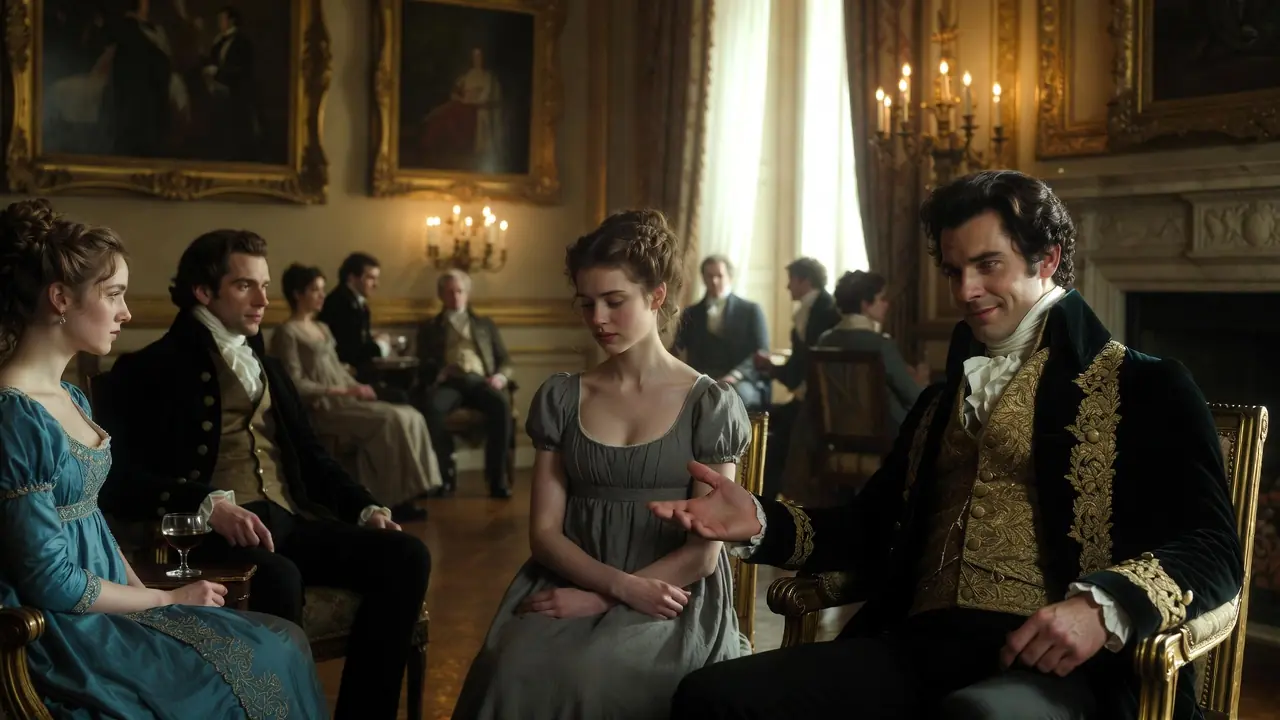
The drawing room at Hartstone Court was the kind of room that had been built to make people feel small, and it was very good at its work. It was a long room, and a cold one despite the fires, with a ceiling painted by an Italian nobody could now quite name, and a row of windows that looked out over a park so manicured it seemed to have been combed rather than grown.
The candles were many, and the conversation was low, and the whole gathering had the particular glittering hush of a country house party in its second week, when the guests have exhausted their best stories and begun, out of boredom, to sharpen their knives on one another.
And at the center of it, in the best chair, with the best light falling on the best profile in three counties, sat Alexander Raven Hall, Earl of Raven Hall, who was bored.
You will meet a great many cold men in the stories I tell you, and I want you to understand that this one was cold in a particular way. Not the heat of the moment coldness of a man who has been wounded and lashes out, but the cultivated, deliberate, room temperature coldness of a man who has decided that warmth is a weakness he cannot afford.
He was clever. He was clever the way a blade is sharp, which is to say that the cleverness existed primarily to cut. And he had spent some 15 years cutting, elegantly and in several languages, anyone who came near enough to matter, which was a thing he arranged very carefully so that no one ever did.
And on this particular evening, in the cold long drawing room at Hartstone, he had turned the edge of himself toward the least important person in the room. Her name was Miss Juliet Aldridge, and she was a companion.
I will tell you everything about her presently, where she came from and what she carried, and why she had learned to sit so very still in the corners of rooms. But for now, you need only know what the Earl of Ravenhall knew, which was almost nothing, and what he assumed, which was a great deal.
He saw a woman of perhaps six and twenty in a gray gown, two seasons out of fashion, seated near her employer, the loud and rather vulgar Lady Carbury, with her hands folded and her eyes down, and the unmistakable air of a woman who had been brought to the party to fetch shawls and turn music pages and otherwise be furniture.
He saw, in short, a nobody. And because he was bored, and because boredom in a certain kind of man curdles into cruelty the way milk curdles in heat, he decided to amuse himself with her.
He did not address her. That was beneath him. Instead, he leaned toward the lady on his right, a fashionable, feather-headed creature named Mrs. Fanshawe, who collected the Earl's cruelties the way other women collected fans.
And he said, in French, in a voice pitched just loud enough to carry to the corner where Miss Aldridge sat, "Regardez la petite dame de compagnie. Tant d'efforts pour paraître bien née. C'est presque touchant."
Now, I owe you a translation, because not all of us were finished at the kind of school that teaches a girl to be insulted in three languages, and there is no shame in that. Indeed, it is rather the point of this entire story.
What the Earl said, in his cool and faultless drawing-room French, was this: "Look at the little companion. So much effort to appear well born. It is almost touching."
He said it certain, perfectly, serenely certain that the gray woman in the corner could not understand a word of it, because that was the cruelty of it, you see. That was the elegance.
A man could say a vicious thing in French in an English drawing-room, and the only people who understood were the people sophisticated enough to be in on the joke, and the victim sat there in her ignorance while the clever people laughed behind their teeth.
He had done it a hundred times. It had never once failed. Mrs. Fanshawe gave the small smothered laugh that was expected of her.
And Miss Juliet Aldridge lifted her head. She lifted it slowly and she looked at the Earl of Raven Hall directly, which companions did not do, which nobodies did not do.
And when she spoke, her French was not the careful schoolroom French of an Englishwoman who has learned the language from books and a governess. It was the other kind. It was the kind you only get from living inside a language, from dreaming in it, from being scolded and comforted and taught your sums in it as a child.
It poured out of her like water finding its level. "Vous avez raison, monsieur," she said. "C'est touchant. Mais permettez-moi de vous corriger. Ce n'est pas la dame de compagnie qui fait tant d'efforts ce soir."
The room did not yet understand, but the Earl of Raven Hall understood because the Earl of Raven Hall spoke excellent French.
And then, before he could close his mouth, which had come slightly open, she continued. And she changed languages the way a musician changes from one instrument to another without breaking the phrase into Italian.
She gave him a line of Dante. I will not make you suffer the whole of it, but I will tell you that it was from the mouth of Ulysses deep in the Inferno and that it said in its old and rolling Tuscan that men were not made to live like brutes, but to follow virtue and knowledge. Per seguir virtute e canoscenza.
And that she delivered it looking directly at a man who had just used the whole of his expensive education to be cruel to a woman he believed could not fight back. Which meant that the line was not a recitation at all. It was a diagnosis.
And then, because apparently two languages were insufficient to the size of the point she intended to make, she finished in Latin. Three words, only three.
An old proverb, the kind a girl learns at the knee of a father who teaches Latin for his bread. And she said them quietly, almost gently, the way you deliver the last and lightest tap that brings the whole wall down. Fronti nulla fides.
Place no trust in the face. Never judge by appearances. And then Miss Juliet Aldridge folded her hands again and lowered her eyes again and went back to being furniture, leaving the Earl of Raven Hall, the cleverest and coldest man in three counties, sitting in the best chair in the best light, comprehensively and multilingually destroyed in front of the entire room.
Now, come back with me to the beginning. Not to the drawing room, we shall return there soon enough, and we shall see what a man like the Earl of Raven Hall does when he has, for the first time in his cold life, met someone he cannot cut.
But first, I must take you back 3 weeks and rather more to a woman who had learned a long time ago exactly how much it cost to let a room see what she was, and who had decided that very evening that she was tired of paying it.
To understand Juliet Aldridge, you must understand her father, because she was made out of him the way a key is made out of a lock. The Reverend Mr. Aldridge, for he had taken orders, though he never kept a living, the church having been a way to a fellowship rather than a calling of the soul, was a scholar of the old, impractical, magnificent kind.
He read six languages and spoke four, and could quote the whole of Horace and a great deal of Dante and the better part of the Greek tragedians, and he had precisely no idea how to keep money in his pocket, which is a combination that produces a very particular kind of childhood.
Juliet's mother had died when she was small, and after that her father had done the thing that scandalized his relations and shaped his daughter. He had taken her with him.
Where another man would have left a motherless girl with an aunt and gone alone to his scholarship, Mr. Aldridge could not bear to. And so Juliet had been raised in the train of a man who followed learning across Europe like other men follow the hunt.
They had lived a year in Geneva, where she learned her French was wrong and then learned it right. 2 years in Florence, where a landlady with a tongue like a whip taught her Italian by the simple method of never speaking anything else.
A long cold winter in Heidelberg, a spring in Rome that she remembered all her life as the happiest of her existence. Her father in the mornings among the ruins with his notebook, and Juliet beside him, 8 years old and 9 and 10, learning to read inscriptions off the broken stones before she could properly read a novel.
He taught her everything. That was the thing. He did not believe, as nearly every man of his age believed, that a girl's mind was a smaller and weaker vessel that would crack under the weight of real learning.
He poured it all in, the Latin and the Greek, the philosophy and the mathematics, the four living languages and the two dead ones, not because he had any plan for it, not because he imagined the world would ever let her use it, but because he loved her, and it was the only thing he had to give.
And because, he told her once, in Rome, on the steps of a temple older than England, "A mind is a mind, Juliet. God did not make a smaller kind for daughters. He only made a smaller world for them to use it in. That is the world's fault, and not his, and not yours."
She was 19 when he died. He died as he had lived, which is to say with a great deal of learning and no money at all.
And Juliet discovered, in the cold weeks afterward, exactly how small the world her father had warned her about truly was. She had six languages and a mind like a blade, and not one thing the world would pay a woman for.
She could not take a fellowship. She could not take a chair. She could not so much as publish under her own name without scandal. The whole of that magnificent, impractical, lovingly given education was worth, on the open market, precisely what any other genteel and penniless young woman's accomplishments were worth, which was to say, it qualified her to be a governess or a companion and nothing else in the world.
She had been a companion for 4 years now. She was 6 and 20, and she had learned, slowly and at a cost I want you to feel, because it is the whole hinge of this story, that the surest way to be miserable in her position was to let it show what she was.
Because here is the thing about a brilliant woman in a dependent place. Her brilliance does not earn her gratitude. It earns her resentment.
The first lady she had served had dismissed her for correcting a point of history at a dinner table. Not unkindly, not to show off, only because the point was wrong and Juliet had not yet learned to let wrong things stand.
The lady had not been able to bear it, a paid companion who knew more than her guests. Juliet had gone without a character and had spent two frightened months before Lady Carbury took her on.
And from that day, she had folded her gifts away like out of season clothing and learned to sit in corners with her eyes down and her Latin silent. Lady Carbury suited her in the way that an ill-fitting shoe suits a woman who can afford no other.
She was loud and vain and not unkind so much as incapable of imagining that her companion had an interior life at all, which was restful in its own way because a woman who does not believe you have a mind will never resent you for using it.
Juliet fetched the shawls and turned the music pages and read aloud the novels Lady Carbury liked and the letters Lady Carbury's eyes had grown too weak to manage.
And she kept the whole roaring library of herself locked in a back room of her own soul and she told herself she had made her peace with it. She had not made her peace with it.
You do not make peace with the silencing of the one thing you love. You only make a kind of treaty, and treaties can be broken. And Juliet's was about to break in the cold drawing room at Hartstone Court, though she did not yet know it, on the September morning when Lady Carbury's carriage turned up the long drive, and Juliet looked out at the great cold house, and felt the way you feel weather coming, that something was waiting for her there.
The house party at Hartstone was the annual production of Sir Geoffrey and Lady Marwood, who were rich and dull and aspired, with the doomed persistence of the rich and dull, to be thought brilliant, and who had achieved this year the great coup of their social lives, which was to secure, as the jewel of their gathering, the Earl of Ravenhall.
You must understand what the Earl was in the world of these people to understand why his coming mattered. He was not merely an Earl, though he was that, with a title old enough to make the Marwood's baronetcy look like something purchased that morning.
He was the fashion. He was the man whose good opinion made a hostess's season, and whose contempt could unmake it. The man whose wit was repeated in drawing rooms he had left an hour before. The man whom every mother with a marriageable daughter regarded with the mingled hope and terror you might feel toward a beautiful and possibly man-eating horse.
He was unmarried, which made him the greatest prize in England, and he was cold, which made him the greatest challenge, and he had spent 15 years declining, with exquisite politeness, to be either caught or warmed.
And there was, at Hartstone that autumn, a young woman who had been brought expressly to catch him. Her name was Miss Penelope Marwood, and she was Sir Geoffrey's niece, and she was everything Juliet was not, which is to say she was 19 and golden-haired and possessed of a fortune of 40,000 pounds and accomplished in exactly the way the world wished its young women to be accomplished, which is to say she could play three airs on the pianoforte and paint a tolerable watercolor and speak the kind of French that consists of about 40 memorized phrases deployed with great confidence and no understanding whatsoever.
I want to be fair to Penelope Marwood because she will not be the villain of this story and she does not deserve to be. She was only a young woman who had been raised to be ornamental and had succeeded and who had been told her whole life that catching a man like Ravenhall was the summit of a woman's achievement and who therefore set about the catching with the determined, slightly desperate energy of a girl who has never been allowed to want anything for herself and has poured the whole of that damned-up wanting into the one ambition the world permits her.
The whole party, by its second week, had arranged itself around this hunt. The Earl was the quarry, Penelope was the huntress, and everyone else was either beating the covert or laying odds.
And in the midst of all of it, fetching shawls and turning pages and saying nothing was Lady Carbury's companion who watched the entire production with the particular clear eye of a woman who has been excluded from the dance long enough to see exactly how the dance is done.
Juliet saw, for instance, that the Earl of Ravenhall did not want Penelope Marwood in the slightest and was too well-bred and too bored to say so. She saw that he endured the girl's attentions the way a tall man endures a low doorway with a permanent, weary stoop of the spirit.
She saw that he was unhappy, which surprised her because she had assumed coldness and unhappiness were different things and was beginning to understand that they were very often the same thing wearing different coats.
And she saw, because she could not help seeing, it being the one subject on which she was the greatest living authority in that house, that his much-praised brilliance was, underneath the polish, a kind of fear.
She watched him do it, night after night. She watched him use his wit the way a nervous man fingers a weapon, never quite at rest, always ready, cutting at the first sign that anyone might come close enough to know him.
She watched him deploy his French and his Latin and his lethal glittering cleverness, and she understood, with the recognition of one armored creature spying another, exactly what the armor was for.
He was not cold because he had nothing inside. He was cold because there was a great deal inside, and he had decided, somewhere, somehow, that letting any of it out was the most dangerous thing a man could do.
She knew the feeling. She had a back room in her own soul where she kept the whole roaring library of herself, and she had learned to keep its door shut. And here was a man who had done the same thing with a whole house and called it a personality.
She might have left it there. She had a treaty, remember? She had a hard-won peace built on the daily silencing of herself, and the wise thing, the safe thing, the thing 4 years of dependence had trained into her bones, was to keep her eyes down and her Latin locked away and let the clever cold earl be cruel in French to whomever he pleased.
And then he was cruel in French to her. I have already shown you the moment, but I want to take you back into it now that you know what stood behind it, because it was not, you understand, a small thing. It only looked like a small thing.
It looked like a bored man amusing himself at a companion's expense. Tant d'efforts pour paraître bien né. So much effort to appear well-born. Almost touching. The kind of casual cruelty that happens in such rooms a dozen times an evening and is forgotten by morning.
But here is what the Earl of Ravenhall did not know as he leaned toward Mrs. Fanshawe and pitched his elegant little knife toward the corner. He did not know that the woman in gray had been raised on the steps of Roman temples by a father who taught her that her mind was as good as any man's and the only smallness was the world's.
He did not know that she had spent four years swallowing her own brilliance to keep a roof over her head and that the swallowing had been slowly poisoning her the way swallowed things do.
He did not know that she had arrived at Hartstone with a feeling like weather coming and that she had watched him for 2 weeks and recognized him and that something in her, some long compressed spring, some treaty stretched past its breaking, had been waiting without her quite admitting it for an excuse.
He gave her the excuse in French certain she would not understand. And she looked up.
You have heard what she said. You have heard the French that turned his insult back on him and the Dante that diagnosed him, men were not made to live like brutes but to follow virtue and knowledge, and the three small words of Latin that brought the wall down. Fronti nulla fides. Place no trust in the face.
What I want you to see now is the room. Because the cruelty of an insult in French depends entirely on the audience being in on it and the moment Juliet answered, the audience changed sides.
The two or three people in that drawing room who actually spoke French, and they were the people whose opinion mattered, the genuinely cultivated ones the Earl most wished to impress, understood in an instant precisely what had happened.
They understood that the Earl had insulted the companion in a language he assumed she could not speak. That the companion had answered him in better French than his own. That she had then gone on to thrash him in Italian and Latin for good measure.
And that the cleverest man in three counties had just been comprehensively out-thought, out-spoken, and out-classed by a woman in a two-season gown whom he had dismissed 30 seconds earlier as furniture.
And they did the thing that such people always, finally do when they watch the mighty fall. They were delighted.
Oh, they hid it. They were far too well-bred to laugh aloud, but Juliet, who had spent four years reading rooms because reading rooms was how a dependent woman survived them, saw the delight move across the cultivated faces like wind across a wheat field, the suppressed smiles, the carefully lowered eyes, the one elderly gentleman by the fire, a retired diplomat named Lord Ashby, who had spent 30 years in the courts of Europe and knew good French when he heard it, who looked at Juliet Aldridge with an expression of pure, unguarded, twinkling joy.
And the Earl of Ravenhall sat in the best chair in the best light. And felt the room turn against him, and did the most surprising thing of the entire evening. He laughed.
Not the cold laugh, not the cruel one, a real laugh, short, astonished, helpless, surprised out of him the way the truth is surprised out of all of us when we least expect it.
He laughed, and he looked at the woman in gray with an expression that no one in that room had ever seen on the Earl of Ravenhall's face. An expression that Lady Marwood would later describe to her sister in tones of deep confusion as almost human.
And he said, in English, so that the whole room could hear him concede, "I beg your pardon, miss." He did not know her name. Of course, he did not know her name. He had never troubled to learn it.
"Aldridge," said Juliet, "Miss Aldridge." "Miss Aldridge." He inclined his head, and it was not the small, mocking bow of a man being clever. It was the real thing, the bow one swordsman gives another across the floor, the acknowledgement of a touch.
"I appear to have brought a penknife to a duel. My French, it seems, is very good for an Englishman." He had taken her own unspoken weapon, "for an Englishman," and turned it on himself before she could.
It was the first generous thing she had ever seen him do, and it was generous in his own coin, which was wit, and she understood that he had just paid her the highest compliment he knew how to give, which was to treat her as an equal worth losing to.
"Your French is excellent, my lord," she said. "I only object to the use you put it to." "Yes," said the Earl of Ravenhall, and the laughter went out of his face and left something quieter and more serious behind it.
"So increasingly do I." And that was the beginning of it, though neither of them knew it yet, and Lady Carbury, beside her companion, was opening and closing her mouth like a landed fish, and somewhere across the room a golden-haired girl named Penelope Marwood was watching the man she had been brought to catch look at a companion in a gray gown the way he had never once looked at her, and was beginning, with a sinking heart she did not deserve, to understand that the hunt was over and that she had never really been in it at all.
The Earl of Ravenhall did not sleep that night, which was unusual, the Earl of Ravenhall being a man who had long ago disciplined his very dreams into good behavior. He lay awake in the best guest chamber at Hartstone and conducted the kind of merciless self-examination that clever people inflict on themselves at 3:00 in the morning.
And the conclusion he reached was deeply unwelcome. The conclusion was this, that he had been bested fairly and completely in the one arena where he had believed himself unbeatable. That the person who had bested him was a penniless companion he had been too arrogant even to look at.
And that the dominant emotion he felt about it was not, as it ought to have been, humiliation. It was relief.
He turned that over for a long time in the dark because it made no sense. And the Earl of Ravenhall did not care for things that made no sense.
Why should a man feel relief at being defeated? And slowly, in the small hours, he found his way to the answer. And it was an answer that frightened him more than any defeat could have.
He felt relief because for 15 years he had been the cleverest person in every room he entered. And he had been so unutterably bone-achingly lonely in that cleverness that some part of him had begun to wonder whether there existed anywhere in the world a single mind that could meet his own.
And tonight, in a cold drawing room, in three languages, that mind had looked up out of a gray gown and met it. And the loneliness had cracked just slightly, like ice in the first thaw.
He found her in the library the next morning. He had gone there himself for refuge. It was the one room at Hartstone the rest of the party reliably avoided. Books being to the Marwood set rather like religion, a thing one approved of in principle and shunned in practice.
And he had not expected to find it occupied. But there she was, in the window seat, in the gray gown, with a book open in her lap, and the September light falling across her face.
And she was so deep in the reading that she did not hear him come in. And for a moment, the Earl of Ravenhall did a thing he had not done in 15 years. He simply looked at someone without calculating what he might gain or lose by it.
She was not beautiful by the standards the world used for women like Penelope Marwood. She was something rarer and more dangerous, which was interesting. A face that did nothing when at rest, and became, when it was thinking, the most alive thing in any room.
She was thinking now. He could see it. Whatever she was reading had her entirely, and her lips moved very slightly, and she reached up once to push a strand of hair from her eyes without looking away from the page, and the Earl of Ravenhall stood in the doorway of the Hartstone library, and felt the ice crack a little further.
"It is rude," she said, without looking up, "to watch a person read. It is ruder still to insult them in French. I find I am working through my rudenesses in order of magnitude."
He came into the room. "What are you reading?" She turned the book so he could see the spine. It was Greek.
"Of course it is," said the Earl. "Naturally, it is Greek. Why would it be anything as pedestrian as English?" He sat down, not too near. He was not a fool. In the chair across from the window seat.
"May I ask you something, Miss Aldridge?" "You may ask. I make no promises as to answering." "How does a lady's companion come to read Sophocles in the original in a window seat at 8:00 in the morning?"
And Juliet looked at him and made a decision. She had spent 4 years keeping the door of herself shut, you remember. She had a treaty.
And the wise thing, the safe thing, was to deflect, to say something modest and self-deprecating and forgettable, to fold herself small again and let the Earl lose interest and go away. That was what survival looked like. She knew it the way she knew her own name.
But she was tired. She had been tired for 4 years. And there was something in the way the cold, clever Earl of Ravenhall had said, "Naturally, it is Greek." Something that was not mockery at all, but a kind of wonder, the wonder of a man who has found, against all hope, another creature of his own strange species, that made her open the door instead.
"My father taught me," she said. "He was a scholar. He had no money and no sense, and the finest mind I have ever known. And he believed, which was eccentric of him and cost us both a great deal, that a daughter's mind was worth furnishing as well as a son's.
So he furnished mine. He gave me six languages and the classics and a head full of things the world will never permit me to use. And then he died and left me with all of it and no way on earth to spend it."
She closed the Sophocles. "So I read Greek in window seats at 8:00 in the morning, my lord, before Lady wakes and requires her shawl. It is the only hour of the day the library is mine."
The Earl of Ravenhall was quiet for a moment. "That," he said at last, "is the saddest and the most enraging thing I have heard in some years."
"It is neither, particularly. It is only ordinary. There are a great many women like me, my lord. Minds furnished by fond fathers and then locked in dependence. Brilliance going to waste in a thousand back parlors all over England. You have simply never noticed us because we have learned that being noticed costs more than it pays."
She looked at him steadily. "I broke that rule last night. I am not yet certain it was wise." "It was magnificent," said the Earl with a force that surprised them both.
And then because he was who he was and because 15 years of armor does not fall off in a single morning he retreated at once into the safety of cleverness. But it was a different cleverness now, a warmer one, a cleverness offered as a gift rather than swung as a blade.
He picked up a book from the table beside him and quoted a line in Latin and raised an eyebrow in challenge. And Juliet answered the line and capped it with another. And he answered that.
And within 10 minutes the two of them were deep in the kind of conversation that neither had had in years and that Juliet had despaired of ever having again. The conversation of two people who do not have to explain their references, who can build sentence by sentence on a shared foundation of everything ever written, who can fence and laugh and reach together towards something neither could reach alone.
It was the happiest hour Juliet Aldridge had spent since Rome. And when Lady Carbury's bell rang at last from the floor above and Juliet rose to go and fetch the shawl and turn back into furniture the Earl of Ravenhall stood too and stopped her at the door and said a thing that frightened him even as he said it because it was true and because true things were the things he had spent his whole life not saying.
"Miss Aldridge, I have been the cleverest man in every room I have entered for as long as I can remember and I have never been so glad to be wrong about that as I was last night. And so glad to keep being wrong about it as I have been this morning."
He paused. "I should like to be wrong about it a great deal more if you would permit it." "That depends, my lord," said Juliet, "on whether you can learn to use your cleverness for something other than keeping people at a distance, because that is what you do with it.
I have watched you all fortnight. You are not cold, my lord. You are barricaded and you have mistaken the one for the other and it has made you the loneliest man at this entire party.
I will fence with you gladly, but I will not help you build the wall higher. I have spent four years behind a wall of my own and I came out from behind it last night and I find I would rather not go back."
And she went to fetch the shawl. And the Earl of Ravenhall stood in the library holding a book of Latin verse, looking at the door she had closed behind her and understood that he had just been seen.
Truly seen. All the way down past the title and the wit and the famous coldness to the frightened, walled-up, lonely man at the center of it. And that being seen, which he had spent 15 years arranging never to permit, did not feel like the catastrophe he had always assumed it would.
It felt like the window seat. It felt like the morning light. It felt, God help him, like relief.
I will not pretend to you that it was simple after that because it was not. And the not simpleness is the part of the story I most want you to have because it is the part that is true to life. A man does not unbuild a 15-year wall in a fortnight.
The Earl of Ravenhall came to the library every morning after that. It became their hour. The one hour of the day that belonged to neither Lady Carbury nor Penelope Marwood nor the watching, whispering party.
The hour when the door of the library closed and two barricaded people let each other a little further in, and in those mornings he was wonderful, warm and funny, and so quick that keeping pace with him was the great joy of Juliet's days.
But out of those mornings, in the drawing room, at dinner, in the long afternoons when the whole party was watching, he was, again and again, the old Earl, cold, clever, cutting, reaching for the weapon the moment anyone came near.
And it hurt her more each time because now she knew what was underneath, and watching him barricade himself in public after he had let her in each private morning felt like watching a friend choose, over and over, to drown within sight of the shore.
It came to a head over Penelope. The girl had not given up, or rather, her aunt had not permitted her to give up, Lady Marwood having staked the entire social capital of the house party on the production of an engagement and being unwilling to see 40,000 pounds and a coronet slip away over what she could not help regarding as a passing whim.
And so the pressure on the Earl had mounted all through the third week until one evening at dinner, Lady Marwood, with the heavy-handedness of a woman who has run out of subtlety, maneuvered the conversation toward the subject of Penelope's accomplishments and invited the girl to favor the company with her French.
It was cruel, though Lady Marwood did not mean it so, cruel to Penelope, who was made to perform, and crueler still in what came next because Penelope, nervous and over-managed, deployed her 40 memorized phrases and made in the middle of them a small grammatical error, the kind of error anyone makes, the kind that means nothing, and the Earl of Ravenhall, cornered and irritated and reaching as he always reached for the weapon, corrected her in French, drily, wittily, in a way that made the cultivated half of the table smile, and left poor Penelope Marwood scarlet and stricken, 19 years old and humiliated in front of the very company she had been groomed her whole life to impress, by the very man she had been ordered to win.
It was exactly the thing he had done to Juliet 3 weeks before. The elegant cruelty, the knife in French. The only difference was that this time the victim could not fight back.
Penelope had no three languages, no dead scholar father, no roaring library locked in her soul. She had 40 phrases and a broken heart, and the Earl of Ravenhall had just sharpened himself on her in front of everyone, and the cultivated half of the table was smiling.
And Juliet Aldridge put down her fork. "What a curious thing wit is," she said into the smiling silence, and her voice carried the way it had carried the first night, low and clear and absolutely certain.
"It is the only weapon I know of that wounds the person wielding it more deeply than the person it strikes. Miss Marwood will recover from a small mistake in French by morning, my lord, but a man who can find nothing better to do with one of the finest minds in England than make a frightened girl cry at dinner. That is a wound that does not heal because he carries it inside himself, and he carries it everywhere, and it is killing him by inches, and the worst of it is that he knows."
The table had gone utterly silent. "You spoke to me of magnitude, my lord, that morning in the library," Juliet went on, and only the Earl understood that she was no longer performing for the table at all, that she was speaking to him alone in front of everyone, the way he had once insulted her alone in front of everyone, and that this was not revenge, but its exact opposite.
"You said you were working through your rudenesses in order of magnitude. Here is the greatest of them, and I will name it for you, since you cannot seem to name it for yourself. The greatest rudeness of your life, my lord, is the one you commit against yourself every single day. Every time you choose the wall over the window, you are better than this.
I have seen that you are better than this, and it is unbearable to watch you keep choosing not to be." And she rose, and she curtsied to Lady Marwood, and she said, "Forgive me. I have spoken out of my place." And she left the dining room.
And behind her, she left a silence so complete that the candles seemed to burn louder in it, and a golden-haired girl looking at the strange gray companion with the dawning astonished gratitude of someone who has just been defended by the last person on earth she expected, and an Earl of Ravenhall sitting very still at the center of the wreckage of himself, having been told the truth at last in front of everyone by the only person who had ever loved him enough to say it.
Though she did not yet know that she loved him, and he did not yet know it either, they were both, you understand, rather slow about the things that mattered most, being so very quick about everything else. It is a common failing in clever people. I have noticed it again and again from this side of the fire.
Now I must bring on a new player, because every story of a man learning to lay down his armor must, sooner or later, produce the person who first taught him to put it on.
And in the case of the Earl of Ravenhall, that person arrived at Hartstone Court two days after the dinner in a black traveling carriage in the formidable shape of his mother.
The Dowager Countess of Ravenhall was a magnificent and terrible old woman, and I want to give her her due because she was not a villain, either. She was a casualty who had become a recruiter, which is a sadder and more common thing.
She had been married young to the Earl's father, who had been the original of the type, cold, brilliant, cruel, a man who valued nothing but excellence and despised nothing so much as feeling.
He had frozen her over the course of a long marriage the way a hard winter freezes a pond from the surface down until the warmth was all locked away somewhere at the bottom where it could no longer do anyone any good.
And then he had set about doing the same to his son, and the Dowager, frozen herself, had helped him because the frozen so often do. She had taught Alexander that warmth was weakness and that the only safety lay in being untouchable, and she had taught him so thoroughly and at such cost to them both that she had genuinely come to believe she had done him a kindness.
She arrived to find her son in disarray, and she did not like it. She had heard things, you see. The world of these people ran on letters, and the news of Hartstone, the Earl out of countenance, the Earl haunting the library, the Earl publicly rebuked by a companion, and more alarming still, appearing to enjoy it, had reached the Dowager Countess in town and brought her north in 3 days at the kind of speed that, in a woman of her age and dignity, signaled genuine alarm.
She had come to put a stop to whatever was happening, and it took her, on the first evening, approximately 1 hour in the drawing room to identify the cause.
She watched her son. She watched where his eyes went, and his eyes went again and again helplessly to the corner where a gray companion sat with her hands folded. And the Dowager Countess of Ravenhall, who had spent 50 years reading rooms with a skill that made even Juliet's look amateur, understood the entire situation in a single glance and set about with the cold efficiency of a general to destroy it.
She did it the family way. She did it in French. She waited until the company was gathered, until the audience was good, and then she turned to Juliet, addressing her directly, which was itself a calculated insult.
A great lady stooping to notice a companion only in order to crush her. And she said, in French, as faultless and as cold as her son's had ever been, "I am told you speak several languages, Mademoiselle. How useful. A woman in your position must have many talents to make herself indispensable."
And she let the pause before indispensable do its work. The pause that turned the word into something filthy. That suggested, without quite saying, that a penniless companion who made herself fascinating to an unmarried Earl was a fortune hunter, a schemer, a woman selling the only thing such women had to sell.
It was vicious. It was masterful. It was the whole cold genius of the Ravenhall family distilled into a single sentence.
And it was designed to make Juliet Aldridge flush and stammer and shrink. And to remind the entire room exactly what she was and exactly what she could never be.
And here, my dear listeners, is where the story turns. Because Juliet Aldridge looked at the terrible old woman and she did not flush and she did not stammer and she did not reach as the old Juliet, the four years silenced Juliet, might still have reached for the safety of three devastating languages.
She had learned something in three weeks at Hartstone. She had learned it watching the man this woman had frozen. She had learned that the cleverest answer is not always the truest one. And that there are some walls that cannot be out-fenced, only refused.
So she did not fence. "Madam," she said in plain and quiet English so that the whole room could understand her and no one could hide behind the language.
"I speak several languages, yes. My father gave them to me and you are right that they have made me, in a manner of speaking, indispensable, though not, I think, in the manner you intend to suggest."
She did not look away from the dowager's eyes. "They have made me indispensable to myself. They are the company I keep when I am lonely, which in my position is often. They are my father's voice still speaking years after his death. They are the one thing the world has not been able to take from me though it has taken nearly everything else.
I do not use them to make myself anything to anyone, madam. I use them to remain someone to myself. That is all they have ever been for."
The room was silent. "You meant to shame me just now," Juliet went on gently, almost kindly, "in French, before this company, certain it would wound me. Your son did precisely the same thing in this very room three weeks ago. I will tell you what I told him.
It is a remarkable family talent you have, the use of brilliance as a blade, but I have come to believe it is the saddest talent in the world because every cut it makes turns inward in the end. You are a frozen woman, madam. I am sorry for it.
I think you were frozen by someone long ago, the way you have tried to freeze your son. But I will not be frightened by it, and I will not be shamed by it, and I will not, whatever it costs me, help either of you build the wall any higher."
And then a chair scraped back. It was the Earl of Ravenhall. He had risen from his seat, and the whole room turned to him.
His mother turned to him, and for a moment, the old habit was visible in his face, the 15-year reflex to retreat, to stay safe, to say something cold and clever and uncommitted, and let the moment pass.
He did not take it. He crossed the room to where Juliet stood, before the whole company, before his terrible frozen mother, and he stopped at her side, which was an answer in itself, the plainest answer a man can give, and he turned to the Dowager Countess, and he spoke.
"Mother," he said, "you taught me French. You taught me a great many things, Latin and Greek, and the use of all of them as weapons, and the great central lesson of this family, which is that to be safe, one must be untouchable, and that warmth is the one unforgivable weakness."
His voice was steady and very clear. "I believed it for 35 years. I have been the cleverest and the coldest and the most untouchable man in every room in England, and I have been so lonely, mother, for so long that I had stopped being able to feel it, until a woman in a gray gown insulted me back in three languages, and cracked the ice, and let in enough light for me to see what we have done to ourselves. What you did, because it was done to you. What I have been doing ever since."
He paused. "I am not going to do it any longer. I am laying it down. Here, tonight, in front of everyone. Which is the only way a thing like this can be laid down. In the open. Where one cannot take it back.
Miss Aldridge is correct about the family talent. It is the saddest in the world. And I would rather be touchable and warm, and occasionally a fool, than spend one more year as the cleverest frozen man in England.
I would rather, mother, be happy. A word I do not believe I have ever once heard spoken in our house, and which I intend to spend the rest of my life learning the meaning of."
And he turned from his mother, and he took Juliet Aldridge's hand, the companion's hand, the nobody's hand, in front of the entire watching party, and he raised it, and he said, in French, but warm French now, French as a gift and not a blade, the first warm French perhaps ever spoken in the cold history of the Ravenhall family, "Voulez-vous m'apprendre, mademoiselle, comment être heureux?"
Will you teach me, mademoiselle, how to be happy? And Juliet Aldridge, who had spoken three languages to a man certain she would understand none of them, who had read Greek in window seats at 8:00 in the morning, and kept the roaring library of herself locked behind a four-year wall, looked at the Earl of Ravenhall standing in the open at last, with his armor laid down at her feet, and answered him in the only language which was the plain and undefended truth.
"Yes," she said, "I will. Though I warn you, my lord, I am only learning it myself."
They were married in the spring, which gave the gossips a winter to talk, and the dowager countess a winter to come, by slow and frozen degrees, partway round.
For she did come partway round in the end, which I am glad to tell you, because thaws are real things, and even very old ice can melt at the edges if it is left long enough in the warmth. And the dowager had not had warmth near her in 50 years, and found, to her own astonishment, that she had missed it.
It was not a fashionable match, and the world said so at length. An earl of his rank and fortune marrying a penniless companion, the world found it eccentric and faintly scandalous, and exactly the sort of thing that happens when a clever man is allowed to read too much.
But the world, as the world generally is, was wrong about the nature of the thing. It saw a great man stooping. It did not see what had actually occurred, which was two barricaded people, each lonely behind a wall of their own particular making, who had found in one another the one mind in England that could meet their own, and who had done the bravest thing either had ever done, which was to lay the walls down and let themselves be known.
Penelope Marwood, I am pleased to report, recovered entirely, and rather better than entirely. Freed from the dreadful labor of catching an earl who never wanted her, she discovered, over the following year, that there were a great many things she had never been permitted to want for herself, and she set about wanting some of them, and married, two seasons later, a cheerful and unbrilliant young squire who adored her and never once corrected her French, and was happier than she had ever imagined being allowed to be.
She and the new Countess of Ravenhall became, in time, genuine friends, which surprised everyone and which need not have, the bond between two women who have each escaped the same cage being one of the strongest there is.
And the earl and his countess? They read Greek together in the mornings. That is the truest thing I can tell you about their marriage, and the thing I most want you to carry away from it.
He had a great library at Ravenhall, a real one, the kind Juliet's father would have wept to see, and they made it theirs, the way she had once made a window seat hers for a single stolen hour a day, except that now the whole long magnificent room was hers every hour of every morning with the light coming in golden and a man across the table who built sentence by sentence on the same foundation of everything ever written, who fenced and laughed and reached with her toward the things neither could reach alone.
He never used his cleverness as a weapon again. I will not tell you he lost the edge of it. A mind like that does not dull, and she would not have wanted it to, but he turned it, all of it, away from the wall and toward the window, away from keeping people out and toward letting one person in.
And she, for the first time since Rome, unlocked the door of herself and left it open. And the roaring library she had kept hidden for four lonely years came out into the morning light at last and was not resented and was not feared and was loved.
Was loved, in fact, precisely and especially for being exactly what it was. He had spoken French to insult her, certain she would not understand. She had answered in three languages and he had spent the rest of his life grateful that she had.
And that, my dear listeners, is where I leave them. In the morning light of the Ravenhall library, two clever lonely people who laid their armor down, reading the old words to one another the way you read to someone you have decided to keep, which is not to show off what you know, but to share what you love and to be known all the way down and to find at the last that being known is not the catastrophe the frightened heart imagines, but the only thing that was ever going to thaw it.