He told her to disappear at her own engagement ball where Gray leave off her mother's pearls. Don't be looked at. She did everything he asked, and the room still went silent when she walked in.
A duke terrified of losing a second wife the way he lost his first. A bride who refused to make herself small for his fear. What happens on that cold terrace changes everything.
Nor Hall, Shropshire, October 1817. 3 days before her wedding, Miss Henrietta was told by the man she loved to make herself small.
He did not say it cruelly. He said it the way a man asks for rain to stop, as though the asking might actually work. If only he phrased it carefully enough, if only he wanted it badly enough.
He stood in the doorway of the small sitting room at Norath, set aside for her use during the final days of the house party. His hands clasped behind his back, the posture of a soldier delivering orders he had given himself and did not entirely trust.
Mrs. Aldis, Hattie's widowed aunt, and the woman charged with chaperoning her through these last unmarried days, sat at the far end of the room with her needle work, near enough to satisfy propriety, and far enough to grant the conversation the appearance of privacy.
It was not Hattie's dressing room. That would have been unthinkable, and both of them knew it. Hattie had spent the past four nights under her aunt's roof at the Daer cottage half a mile from Norath's gates, exactly as a bride 3 days from her wedding ought.
She would walk back across the park that evening, only to dress for the ball under Mrs. Aldis's watchful eye, not Theo's. But he had written over that afternoon on some excuse about confirming the seating arrangement, and had found her here instead.
She was going over her aunt's correction to the guest list, with a furrowed business-like attention that he found, against his better judgment, entirely too charming to interrupt with anything sensible.
Wear the gray, he said instead, because sensible had apparently left him sometime in the last quarter hour. And leave off the pearls your mother gave you.
Tonight of all nights, I should like you to go unremarked. Hattie set down her pen slowly, the way one sets down something that might otherwise be thrown.
Unremarked, she repeated, testing the word as though it might taste different the second time. There will be talk enough when we marry.
40 guests under my mother's roof tonight, half of them strangers to you, all of them with nothing better to occupy a fortnight than the new Duchess of Norath and whatever they decide to make of her.
I'd rather not add fuel before the match is even settled in law. It was, she would think, later, a very reasonable sentence, delivered by a man who did not believe a single word of it himself.
You make it sound as though I intend to set the curtains alight. I didn't mean... I know precisely what you meant, Theo.
She glanced once toward her aunt, who had not looked up from her needle work, but whose needle had gone very still, the particular stillness of a chaperone listening with great interest while pretending not to.
Hattie lowered her voice all the same. You meant that you would like the room to look at someone else tonight. You are simply too well-mannered to say so plainly.
He did not deny it. That more than anything was what told her she had read him correctly.
To understand why a duke would ask such a thing of the woman he was 3 days from marrying, one had to understand what the Duke of Norath had already lost, and how thoroughly the losing had reshaped him.
Theodore Callaway, sixth Duke of Norath, had buried one wife already. He had been 5 and 20 when he married Margaret, the daughter of a Viscount with estates bordering his own in Herefordshire.
He was 8 and 20 when illness took her, after 3 years of a marriage that had been, by the unremarkable standards of their world, a contented one.
Not a great passion, but a comfortable partnership, built on familiarity and shared expectation, rather than the kind of consuming feeling he had not known existed until Hattie.
He had been in London for a fortnight on estate business. He could no longer, three years on, even fully recall the importance of when word reached him that the fever had turned.
He had returned to North Hall to find his wife no longer able to recognize his face, and 3 days later he had stood at the edge of a grave in the family plot, wondering what precisely he had been doing in London that had seemed at the time more urgent than being here.
He had observed the full year of mourning that propriety and his own genuine grief both demanded. No society, no calls, no consideration of remarriage.
The great house kept dim and quiet through that first long winter. It was not until the 18th month, when the strictest obligations of black had given way to half mourning, and the cautious resumption of ordinary social life, that his mother had first mentioned gently and without any real expectation of being heeded, that the Reverend Vane's younger daughter had grown into a remarkably sensible young woman.
A call upon the parsonage might do him good. He had gone more to please his mother than from any real interest, and had stayed considerably longer than the call required.
He had returned the following week, and the week after that, until even he could no longer pretend the visits were about anything but Hattie herself.
It was by the strict reckoning of society, a courtship begun with proper decency observed, past the year of deep mourning, conducted with his mother's full knowledge and gradual encouragement, never once compromising the forms.
Even as the feeling beneath them grew faster than either of them had expected. That it had grown at all toward a Parson's daughter, with no fortune to speak of, and connections that extended no further than a respectable country parish, was its own small scandal in certain drawing rooms.
The Dowager Duchess had fielded more than one pointed remark from old friends, who wondered aloud why a duke could not have looked higher.
But the Dowager had known Hattie's late mother as a girl, had loved her, in fact, with the particular fierce loyalty of women who had once been girls together, and watched the world separate them by marriage into different stations.
She had made her own feelings on the match known early and finally to anyone who cared to question it. My son will marry where he has found happiness, she had said more than once, and I have buried one daughter-in-law already.
It made it possible, which Theo had learned in the 3 years since Margaret's death was not always the same thing as easy, and was nonetheless worth having.
He did not intend under any circumstance he could control to lose a second thing he loved in front of a room full of people who would talk about it for a decade.
He had not said this to Hattie. He had not said it to anyone, not even Francis, who knew him better than any living person, and still only guessed at the shape of the thing rather than its precise dimensions.
It lived in him the way an old injury lives in a knee. Quiet on ordinary days, and then without warning, impossible to ignore the moment the weather changed.
Tonight the weather was a house party of 40 guests gathered to celebrate a match his own mother had insisted upon marking properly, and the arrival, an hour passed, of a Mr. Sebastian Leighton.
A friend of a neighboring family, down from London for the autumn, with an easy laugh and the unbothered good looks of a man who had never once in his life had to wonder whether a room was paying him attention.
Theo had watched Leighton's carriage come up the long drive from the window of his study, and felt something tighten in his chest that he refused, even in the privacy of his own skull, to name jealousy.
He preferred to call it caution. Caution was a duke's prerogative. Jealousy was something else, something smaller, more grasping, the kind of feeling he associated with men who could not trust their own wives.
He did not wish to be that sort of man, even as he recognized somewhere beneath the refusal that he already was.
You're glowering at a man who hasn't yet removed his hat, said his sister from the doorway of the study. Lady Francis Callaway was 4 and 20, unmarried by choice rather than misfortune.
She possessed of the particular fearlessness of a woman who has decided early in life that she will not be managed by anyone, least of all her own brother.
She came to stand beside him at the window, considerably shorter than he was, and considerably less convinced of his self-command.
I am not glowering. You are doing the thing with your jaw. I haven't a jaw thing, Francis.
You have had it since you were 11 years old, and father told you the new tutor would be teaching you Latin, whether you liked it or not. It's a very specific clench.
I could draw it for you if you'd like documentation. He did not rise to this.
He rarely did with Francis. Rising only encouraged her, and she required no encouragement to begin with.
It's a ball, she said more gently now, watching the carriage disgorge its single passenger onto the gravel below. People will dance.
Hattie will dance because she is a sensible young woman attending a ball thrown in her own honor and dancing is what one does at balls.
The world will not end because Sebastian Leighton has a pleasant laugh and knows the steps to a quadrille. I didn't say it would end.
You're thinking it might. He said nothing to that which was between siblings raised in the same difficult house under the same exacting father its own kind of confession.
Hattie wore the gray. She told herself, dressing for the evening in her aunt's small guest chamber with Susan, her own maid sent ahead from the parsonage for the occasion, working pins into hair styled plainer than she preferred, that it was a small thing.
A color, a cut of fabric, nothing that touched who she actually was beneath it, and that a woman who loved a man could surely grant him one evening of feeling safe in his own house.
She left off her mother's pearls, the single piece of real jewelry she owned, set carefully back into their box rather than around her throat.
She had Susan part her hair simply with no feathers, no ornament beyond what plainness allowed. She kept the earrings.
They were a small thing, too, by any reasonable measure. Garnet drops unfashionable even a decade passed, set in old gold gone slightly soft at the edges from handling.
They had been her mother's, the only jewelry her mother had owned before fever took her when Hattie was 12, and Hattie had worn them on every important day of her life since her confirmation.
Her sister's wedding, the morning Theo had first called formally upon her father's house, with an offer that had startled them all. She did not think Theo's instruction had been meant to include the earrings specifically.
She did not ask him to clarify, because asking would have meant admitting that the instruction had landed at all, had found purchase somewhere in her, and some stubborn part of her did not want him to see precisely how much it had cost her to agree.
She looked in the glass when Susan had finished. Gray silk dove plain cut high and unremarkable at the throat.
Hair without a single pin of decoration. A face that had never once in four and 20 years managed to look as ordinary as she currently wished with her whole determined heart that it would.
It did not work. She knew it would not work the moment the Norath carriage delivered her to the great front steps, and she descended into the hall, feeling the assembled household's attention catch upon her like cloth snagging on a nail.
Not loudly, not vulgarly, but with the particular weight of a dozen footmen and a hovering housekeeper, deciding almost in unison that the new duchess to be was not at all what gray wool had been designed to suggest.
Theo met her at the foot of the great staircase, as propriety and his own eagerness both demanded. He had been waiting, in fact, for the better part of 20 minutes, a fact Francis had already remarked upon twice.
His gaze went over Hattie with the careful, comprehensive attention of a man inspecting a defense he had personally ordered built, the gray, the plain hair, the obedience of the whole composed effect, and something in his shoulders eased fractionally before his eyes reached her ears and stopped there.
You kept them, he said. They were my mother's. I know whose they were.
He did not ask her to remove them. He only looked at the garnets a moment longer than the matter strictly warranted.
The way a man looks at a door he has decided against his own better judgment not to close after all. You look well, he said, which was not at all what either of them meant by it, and they both knew it.
You told me to look unremarkable. I did. He offered his arm with the stiff formality he fell back on whenever a feeling threatened to outrun his composure.
I find I am no longer entirely certain that was within the realm of what's possible. It was the closest he came before the ball properly began to telling her the whole truth of what frightened him.
The ballroom at North Hall had not been lit so brightly in 2 years. Hattie noticed this the moment they crossed the threshold.
Noticed the careful, practiced way the housekeeper, Mrs. Pell avoided her eye when she remarked upon the unusual number of candles, noticed that even light in this house seemed to carry old weather along with it, the way a room remembers a fever long after the patient has gone.
She did not ask about the first duchess. She had asked once early in their courtship, walking the long gallery at North on a wet afternoon, with rain streaking the tall windows and Mrs. Aldis trailing at a discrete distance behind them.
Theo had answered with three correct, careful sentences. Margaret was a kind woman. We were married 3 years. She is buried in the family plot beyond the chapel.
And then changed the subject so completely, so immediately that Hattie had understood the door had not merely been closed, but locked, with the key set somewhere she was not yet permitted to look.
She had not tried the door again. She told herself this restraint was patience, the proper deference of a woman who understood that grief kept its own calendar.
Some nights lying awake in her father's parsonage in the weeks before the wedding, she had suspected it was something closer to cowardice instead, a fear that if she pushed too hard against that locked door, she might find something on the other side that made her question whether she was marrying a man who had room left in him for a second love at all.
The dancing began promptly at 9. Theo led her out first, as was both proper and evidently urgently wanted by him, and for the length of one dance she had him entirely to herself.
His hand light and certain at her waist, his eyes not once straying from her face to survey the room the way they so often did. Something almost boyish breaking through the careful ducal composure he wore, like a second coat fitted by an excellent tailor.
You dance as though you're counting, he said midway through the figure. I am counting.
I learned the steps in a parlor in Shropshire with my sister calling out the count wrong on purpose to see if she could make me trip in front of the curate. It doesn't show whatever counting you're doing.
That is rather the point of counting silently your grace. He laughed at that, a real laugh short and startled out of him, the kind of sound that drew a glance or two from the nearest dancers.
And for a moment the ballroom, the 40 watching guests, his mother's calculating eye from the wall, all of it fell away to the size of two people who liked each other a very great deal, and had for one dance been permitted to forget that anyone else existed.
Then the music ended. Hattie curtsied, Theo bowed, and it was the Dowager Duchess herself moving with the easy authority of a hostess managing her own ballroom, who brought Mr. Sebastian Leighton forward to make the proper introductions.
A small formality, but a necessary one, and one the dowager performed with evident pleasure, having taken a liking to the young man's easy manners over dinner the evening before.
Miss Vane, may I present Mr. Sebastian Leighton, newly returned from Florence, and staying with the Whitmores through the month. Mr. Leighton, Miss Vane, who is to be married to my son in 3 days time, as I am sure half the county has already informed you.
Her very great pleasure, Miss Vane. Leighton bowed with the unhurried confidence of a man who had never once in his life had to consider whether he was welcome.
I wonder if I might beg the next dance now that I have been properly introduced and can no longer be accused of presuming. Hattie glanced briefly at Theo.
A small instinctive checking, the kind a woman gives the man she's about to marry when another man asks for her hand on a dance floor in front of 40 witnesses.
Theo's face gave nothing away. It was, she would think later, the most carefully composed expression she had seen him wear all evening, which was itself a kind of answer.
I should be glad to, Mr. Leighton, she said, because propriety left her little real choice, and because some small contrary part of her, the part that had spent the last hour trying very hard to be gray and plain and unremarkable for a man who had asked it of her without quite explaining why, wanted just once to dance, without calculating what it cost anyone watching.
Theo could not refuse on her behalf. Propriety did not permit it, and pride would not have permitted him to want to, even had propriety allowed.
He stood at the edge of the floor with a glass of claret he had no intention of drinking and watched Sebastian Leighton turn his almost wife through the figures of a quadrille with the unbothered easy charm of a man who had never once worried whether the room was watching him do it.
It was not the dancing itself that troubled him. Hattie danced with Leighton precisely as she had danced with Theo not a quarter hour before.
Competent, unshowy, faintly self-amused at her own counting. It was the way Leighton bent his head to murmur something low as they crossed in the figure, and the way Hattie laughed at it openly, her head tipping back, candle light catching warm in the garnet drops at her ears.
He's harmless, said Francis, materializing at his elbow with the unerring instinct of a sister, who has spent her whole life observing her brother make the same mistake in slightly different rooms.
I didn't say he wasn't. You're doing the jaw thing, Francis. I beg you.
I'm merely observing the documented phenomenon. She watched the dance a moment longer in companionable silence, then added quieter in the tone she reserved for things that actually mattered beneath the teasing.
She kept the earrings, you know, after you asked her not to be noticed tonight. I noticed that she kept them.
Did you notice why? He did not answer. He was watching Hattie's face across the candle lit distance of the room, watching the unguarded, easy pleasure of a woman enjoying a perfectly innocent dance that cost her, as far as he could tell, absolutely nothing.
Feeling with the particular ignoble shame of a man who knows full well he is being unreasonable, and finds himself unable to stop regardless, that he wanted that unguarded ease to belong to him alone.
Not shared with a room, not shared with Leighton's easy laugh and easier compliments. His privately the way Margaret's last clear smile had belonged to a fever and a fortnight in London he could never get back.
It isn't about Leighton, Francis said more gently now, reading something in his face that he had not intended to show her. Is it?
I don't know what you mean. I think you know precisely what I mean, and I think it frightens you considerably more than one young man from London with excellent calves and no real designs on your fiancée.
The dance ended. Leighton bowed over Hattie's hand with practiced grace, said something that made her smile once more, and escorted her toward the long refreshment table set against the eastern wall, toward Theo, in fact, since the table stood nearest where he had positioned himself like a sentry, for the better part of two dances.
Nor Leighton inclined his head, easy and entirely unbothered by whatever atmosphere he might have been walking into. Your bride dances rather better than she's willing to admit to.
She told me twice during the figure that she was certain to misstep. She undersells most things, Theo said.
It came out flatter harder than he had intended, and he heard it land that way even as the words left him. Hattie glanced at him sidelong, a quick assessing look, the kind she gave whenever she was deciding in the moment whether a thing was worth addressing aloud, or better allowed to pass for the sake of the room.
She let it pass for now. Mr. Leighton was telling me about Florence, she said instead, smooth as anything.
He's only just returned. He says the light there is unlike anything in England. How fortunate for him, Theo.
Just his name quiet, the smallest possible correction, but a correction nonetheless, and one that several nearby guests were close enough to register, if not quite to understand.
Leighton, to his considerable credit, seemed to sense the sudden change in temperature, and made his excuses with the smooth, practiced instinct of a man who had navigated a hundred such drawing rooms without ever once causing real and lasting harm to anyone in them.
He bowed again, wished them both a pleasant evening, and moved off toward the card room, entirely unaware, as he went, that he had just become, for one quietly disastrous quarter hour the fault line running through a marriage that had not yet officially begun.
You were short with him, Hattie said the moment he'd gone. I was civil.
You were civil the way a closing door is civil. She studied her betrothed with the careful, unhurried attention she gave most things that troubled her.
What is the matter, Theo? And do not tell me nothing, because I have watched your jaw do something alarming for the better part of an hour, and I'm quite tired of pretending I haven't noticed.
Nothing is the matter. You asked me to wear gray tonight. Her voice did not rise, but it did not soften either.
You asked me to leave my mother's pearls in their box, as though plain wool might somehow render me invisible to a room full of people who have spent 2 years waiting to see who I am.
And now you are watching me across a ballroom as though I have done something wrong by dancing one perfectly ordinary quadrille with a perfectly harmless man who is, I might add, a properly introduced guest at your own house party.
You haven't done anything wrong. Then why, she said very quietly, do you look at me as though I have?
He did not answer that. Across the room, his mother, the Dowager Duchess, had begun watching them both with the particular focused attention of a woman calculating precisely how a public quarrel between her son and his bride might read to 40 assembled guests by morning.
Theo, recognizing the look for what it was, offered Hattie his arm instead of his honesty. Walk with me, he said.
The terrace. Francis, would you join us? The doors stand open to the ballroom, and I find I should like a witness to whatever I'm about to say, so that I cannot later pretend I didn't say it.
It was, Hattie would think afterward, a small and telling thing that he thought, even in the grip of whatever was driving him toward honesty, to ask his sister along, to keep the proprieties intact, even as he opened the one door he had kept locked for 2 years.
Francis followed without comment, settling near the terrace doors within clear sight of the ballroom, and well within earshot, close enough to satisfy every requirement of decency, far enough to grant the conversation the shape of privacy, if not the whole of it.
The terrace ran the full eastern length of North Hall, stone balustrades pale under a thin October moon, lit only by the spill of candle light through the tall glass doors Francis had left standing open behind them.
It was the kind of cold that made breath visible and conversation honest. The sort of night no one chooses to linger in unless something genuinely needs saying, and both Theo and Hattie understood, stepping out into air sharp enough to sting that something did.
I am not angry with you, Theo said once they had moved a few steps beyond the doors, far enough for lowered voices, near enough that Francis, watching the dance floor with elaborate pointed disinterest, could have called them back inside in an instant had propriety demanded it.
I want you to understand that before anything else. I didn't think you were angry.
Hattie wrapped her arms against the cold, watching his face rather than the dark garden beyond the balustrade. I thought you were frightened.
I should like to know of what precisely, because I find I am tired of guessing. He was quiet long enough that she thought with a small sinking feeling that he might retreat again, the way he had retreated in the long gallery, the one time she'd asked directly about his first wife, and watched the door shut in real time mid-sentence behind his eyes.
But he didn't retreat. Not tonight. Margaret died in this house, he said, three springs ago.
A fever no one thought serious until it was. That is the cruelty of fevers I have since learned that they announce themselves as nothing at all until they are everything.
I was in London for a fortnight on estate business I could not now if my life depended upon it tell you the substance of by the time word reached me and I returned she no longer he stopped began again more carefully the words coming slower as though each one cost him something specific.
She no longer knew my face by the end. I have spent 3 years telling myself that if I had simply been here instead of attending to something that mattered a great deal less than I believed it did at the time, the ending might have gone differently.
Theo, her voice had gone soft. I know intellectually that my presence would not have changed the fever.
I'm not entirely a fool, whatever else I have made myself look tonight. But knowing a thing and feeling it are different countries, Hattie and I have lived in the second one for a long while now, with no particular hope of crossing back.
He looked at her fully then, and the composure he wore so habitually, the careful ducal stillness that rarely cracked even under his sister's relentless teasing, had a fracture in it she had never once seen before, in a year of courtship, and 3 days from a wedding.
And then I met you and I found myself afraid of an entirely new species of losing. Not illness this time, just a ballroom, a man with an easy laugh and no real designs on you at all.
The simple, ordinary, inevitable way the world will notice you and want you for the rest of your life, and the unbearable thought of being the second man a room looks at instead of the first.
Hattie absorbed this in silence, the cold making the garnets at her ears feel sharp and present against her skin. An honest weight she was suddenly fiercely glad she had kept.
So you ask me to be unremarkable tonight, she said slowly, working it through aloud. Because you cannot survive the thought of losing me, and you have convinced yourself somewhere beneath all your good sense that if no one looks at me, then no one can ever take me from you.
That is a very unflattering way of putting an entirely reasonable fear. It is an accurate way of putting an unreasonable one.
She said it gently. She meant it gently, but she said it and did not take it back. Theo, I wore the gray tonight.
I left my mother's pearls in their box. I had Susan pin my hair as plain as a school room miss.
I tried all evening to be exactly as small as you asked of me, because I love you and because some part of me believed it might ease whatever was sitting in your chest if I simply did as you asked without making you explain yourself.
And it did not work. Not because I failed at being plain. I promise you I tried my very hardest to fail beautifully at being plain.
But because I was never, not for one moment, going to manage it. And I think you knew that before you ever asked.
I think you asked anyway. I knew it. Then what precisely was the asking for?
He did not answer at once. When he finally did, his voice had lost every trace of the careful Duke's register he had carried through the ballroom, through the introductions, through a year of correct and creditable courtship.
It was for me, he said, so that I might feel for the space of one evening that I had done something, anything at all, to exert some control over an outcome I cannot in any real and lasting sense control.
You will be looked at, Hattie. You will be looked at in every room you ever enter for the remainder of your life by men with easy laughs and men with none at all, and there is nothing gray wool or plain hair or my own ridiculous and ungenerous instructions can do to prevent it.
I knew that walking down to meet you at the bottom of the stairs tonight. I asked you regardless, because the asking made me feel less afraid, and I confess I did not stop until just this moment, watching your face in this cold, to consider how the asking might have made you feel instead.
Small, Hattie said quietly, the word costing her something to say plainly. It made me feel small, Theo.
And then when the smallness didn't work, when I walked down those stairs in gray wool and plain hair, and the entire room still turned to look, it made me feel as though I had somehow failed you at the one single thing you had asked of me on the very eve of our marriage.
You have not failed me. You have never once in one year failed me at anything.
His hands had come up, not quite touching her, hovering at the air near her shoulders, as though he did not yet trust himself to close the distance, and find it welcomed, mindful even now of Francis watching from the doorway, and the proprieties that still governed exactly how far this moment was permitted to go before the wedding made it otherwise.
I have been failing you all evening by asking you to disappear in order to soothe the fear that has nothing whatsoever to do with anything you have done or could ever do to deserve it.
The silence that followed held differently than the silences that had come before it on that terrace. Less brittle, less like a held breath, more like the particular quiet that settles after a true thing has finally been said aloud and found against all expectation survivable.
I am not Margaret, Hattie said at last, choosing the name deliberately, watching to see if he flinched from it.
He did not. I will not vanish from you in a fortnight you happen to spend in London on business you cannot later recall the importance of.
I am not made of the same luck good or terrible that took her from you and I cannot promise you otherwise because no one living can promise such a thing to anyone else but I need you to know that I understand your fear Theo and that I do not think one degree less of you for carrying it.
What I cannot do, what I will not do, not even for love of you, not even 3 days before our wedding is marry a man who requires me to be invisible in order to feel safe in his own house.
I would very much rather you be afraid beside me in the open air where I can see it and help carry some part of the weight than have you ask me again and again for the rest of our lives to dim myself so that you might manage the fear alone in the dark.
Then I am afraid, Theo said, and I am telling you so plainly in the open air with my own sister standing close enough to hear every word of it, exactly as you have just asked of me.
I am afraid every single time you leave a room that you will not return to me whole. I am afraid that loving you as much as I evidently do is a debt the world will eventually find some cruel way to collect.
And I am asking you now not to be smaller, not ever again to be smaller on my account, but to marry a man who is frightened and trying regardless because the only alternative I can see is a lifetime of asking you to disappear.
And I find standing here with you in the cold that I cannot bear that thought even slightly more than I can bear the other. That Hattie said something breaking open and warm in her voice is a very considerably better thing to ask for.
He took her hand, then only her hand, gloved fingers closing around gloved fingers, the single liberty the moment, and the watching doorway allowed him, and pressed it once briefly to his chest, where she could feel his heart going entirely too fast for a man who had spent the evening so carefully composed.
It was not the grand gesture a less careful man might have made. It was instead exactly the kind of small honest thing she had begun to understand he was capable of once the fear had somewhere safe to go beside silence.
3 days, he said. I find I cannot wait a single hour longer than I must.
3 days, Hattie agreed, and from the doorway just audible over the distant music, Francis let out a long theatrical breath of relief that made them both, despite everything, begin to laugh.
They did not return to the ballroom at once. Francis, true to the unspoken bargain of her presence, allowed them a few minutes more at the balustrade before clearing her throat with the particular meaningful cough she had perfected over four and 20 years of chaperoning her own conscience as much as anyone else's.
I should think, she said, that two people who have just settled something rather important might wish to come back inside before my mother decides to investigate the matter herself.
She has already looked toward these doors three times. I have been counting. Of course, Theo offered Hattie his arm with the stiff formal correctness of a man recovering his composure in real time, though the look he gave her as she took it was not stiff at all.
Francis, thank you. Don't thank me.
I should have charged a fee for the service, standing out here in the cold, pretending not to listen to my own brother make a declaration. I shall expect a very fine wedding gift by way of recompense.
Francis will have noticed we're gone, Theo had said earlier, with the air of a man delaying an inevitable return to scrutiny. But of course, Francis had not merely noticed.
She had arranged the entire proper shape of it, and Hattie found herself grateful in a way she had not expected to be, for a sister-in-law who understood exactly how much honesty a moment required, and exactly how much chaperonage it still owed the world.
Francis notices everything, Hattie said as they crossed back toward the bright doors. She told me before the ball even began that I oughtn't trouble myself trying to be invisible.
I didn't listen to her. My sister, Theo said with feeling, is generally right about a great deal, which I find considerably more irritating than I let on.
You let on quite a lot actually. Do I? The jaw, Hattie said, daring, in the privacy of the few remaining steps before the candle light reclaimed them, to touch briefly, properly brief, no more than a fingertips worth of contact through her glove, the very place at his jaw that Francis had spent the evening cataloging right here.
It does something quite specific when you're cross and trying not to show it. I shall have to learn to control it better.
Please don't. I find I should like to always know exactly what you're feeling rather than have you manage it into something smoother for my benefit.
When they did return, the ball had not paused for their absence. Leighton was at the card table, deep in a hand of whist with two of the neighboring squires, and looking entirely unbothered by whatever atmosphere he might have walked through earlier.
The Dowager Duchess was still in close conversation with a visiting countess near the long windows, though her eyes found her son and his betrothed the instant they crossed back through the terrace doors, and something in her face, relief perhaps, or simple maternal satisfaction, eased visibly before she returned her attention to the countess, as though she had never looked away at all.
The candles burned the same steady gold they had an hour before, but something in the room had shifted regardless.
The particular unmistakable shift that happens when two people walk back into a space standing differently than when they left it, and a room full of practiced observers notices, even without quite being able to name what it has noticed.
Lady Francis found them first by the refreshment table, having slipped ahead through a side door with the easy familiarity of a woman who had grown up running tame through this house.
Well, she said. There it is. There's what precisely.
The thing you've been doing with your jaw for the better part of a month, ever since Mr. Leighton's visit was first mentioned at dinner, it's gone.
She turned her attention to Hattie next, taking in the gray dress, the plain hair, the garnet earrings, with a small, deeply satisfied nod as though she had personally engineered the entire outcome from a distance.
Good. Keep the garnets by all means. They suit you considerably better than disappearing ever did, and I include in that assessment the whole sorry business of the gray wool, which I noticed did not work in the slightest.
I had every intention of keeping the earrings regardless of what came of the dress, Hattie said. I only wasn't certain anyone would have noticed one way or the other if I'd left them off as well.
My dear girl, Francis said it without unkindness, but without softening it either. Everyone noticed from the very first step you took into this hall tonight.
That was rather the entire trouble, wasn't it? And I suspect my brother has only just this past quarter hour managed to say so aloud, with me standing about as an unwilling witness to the whole production.
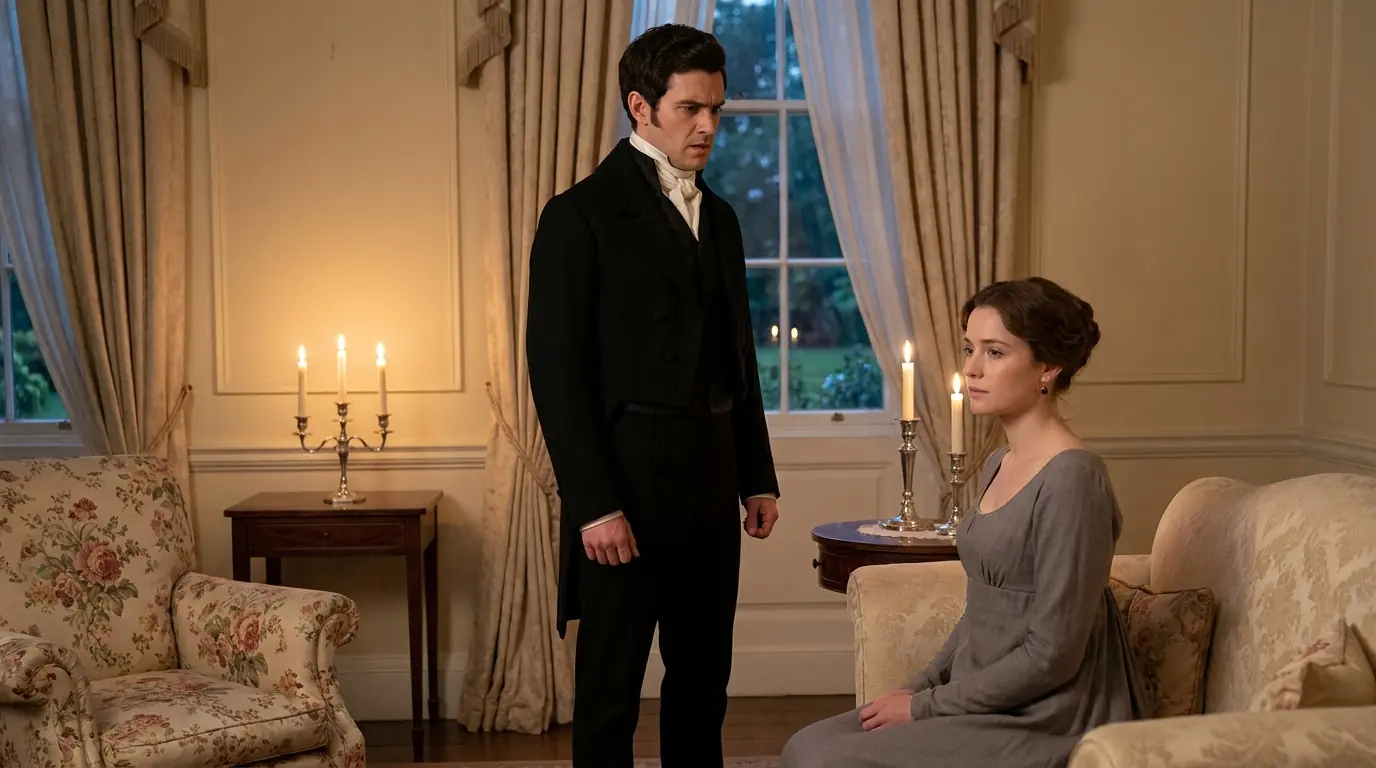
Hattie glanced at Theo. He did not deny it. It was near midnight, the dancing winding toward its natural close, the older guests already beginning to gather shawls and call for carriages, when the Dowager Duchess approached them both with the particular deliberate look of a woman who has been saving a remark for the better part of an evening and intends now to deliver it properly.
I had wondered, she said, settling beside them with the unhurried authority of a woman who had run this house for 30 years before handing its keys to her son, whether gray was perhaps your color, Miss Vane.
I confess I had my doubts the moment I saw the gown laid out this afternoon at your aunt's cottage. Your maid mentioned the choice to my own woman, who of course mentioned it to me, because nothing in this county remains private for longer than an hour.
But I held my tongue on the theory that a mother ought not interfere in every small decision her son makes regarding his own household. Mother.
Theo's voice carried the particular weariness of a man who suspected exactly where this was headed and could see no graceful way to redirect it.
I am not scolding either of you, the dowager said placidly. I am only observing, as a woman who has attended a great many balls in her time, that you asked Miss Vane to wear a dress specifically designed to be forgotten the moment it left the room, and she has instead spent the entire evening being the singular thing every guest under this roof cannot stop discussing.
I should call that an experiment that failed rather admirably on the whole. It was not precisely an experiment, Theo said.
Wasn't it? The dowager turned to him directly, and whatever brittle society manner she had worn through the receiving line earlier in the evening fell away, leaving something plainer and more direct beneath it.
The voice, Hattie suspected, of a mother speaking to her son rather than a duchess managing a room. Your father did precisely the same thing to me once, you know, very early in our own engagement.
Tried to keep me quiet and unremarked at a hunt ball, because Lord Oldwin had been paying me a degree more attention than your father found comfortable.
It did not, in the end, soothe his jealousy in the slightest. It very nearly ended our engagement altogether, and would have, I think, had my own mother not intervened on my behalf, rather more bluntly than I am intervening on yours tonight.
What ended the jealousy then, if not the asking? He stopped asking me to be smaller and started simply standing beside me instead wherever I happened to be in a room so that there was nothing left for him to fear watching from a distance.
She patted his arm once briefly, the gesture small but unmistakably final, the closing of a subject she had no intention of revisiting.
Five and 20 years we had together before he died, Theodore, and he spent perhaps the first three of them standing guard, and the remaining two and 20 simply standing beside me.
I should very much like you to manage the arithmetic rather faster than your father did.
She moved off toward the card room without waiting for a reply, leaving her son and his almost wife standing rather quietly together near the refreshment table, both turning the remark over in the particular silence that follows a piece of advice, arriving at exactly the moment it was needed, and not one moment before.
Is it true? Hattie asked once the dowager had gone. About your father?
I never knew the particulars until just now. He died when I was 19. I told you that.
I think early on. I knew he and my mother had married for more than simple convenience, but I had always assumed the affection came easily to them from the start.
I did not know there had been a Lordwin or a hunt ball or any of it. It seems a great many families have a version of tonight buried somewhere in their history and simply don't speak of it afterward.
Perhaps that's the mistake, Theo said slowly, working the thought through as he said it, not speaking of it afterward, letting it become a thing that happened once privately and was never properly resolved.
Only outlived the way one outlives a bad winter, without ever actually addressing the draft in the wall that caused it.
He looked at her, and there was something lighter in his face now than she had seen there all evening, the fracture from the terrace not gone, but settled into something he seemed willing, finally, to carry in the open rather than alone.
I should like ours to be different. I should like to be a man who says the frightened thing aloud on a cold terrace with my own sister listening if necessary, rather than a man who simply asks his wife to wear gray for 5 and 20 years and calls it managed.
That Hattie said, echoing herself from the terrace without quite meaning to, is a very considerably better plan.
They danced once more before the evening's end. Not a quadrille this time, but a slower turn that allowed for conversation, and Theo did not once glance toward the card room, toward Leighton, toward any door or window or face in the crowded ballroom besides the one directly in front of him.
You're not watching the room, Hattie observed. I am watching you.
It had not occurred to me until this evening that the two activities might be entirely different things, and that I had been doing only the first, under the mistaken impression it was the second.
And which do you prefer? This one decidedly, though I confess it requires a degree more honesty than the watching ever did.
Watching I could do from a distance, telling myself I was being prudent. This requires actually looking at you and admitting what I find there in front of whoever happens to be looking back.
Welcome, Hattie said, smiling against the proper distance the dance still required between them. To the rest of your life, Theo.
I'm afraid it's rather a lot of that. I find I don't mind it nearly so much as I expected to.
When the carriage came at half midnight to return her to her aunt's cottage, three more nights under that roof before the wedding, three more nights of propriety observed to the letter, as both of them had always known it must be.
Theo handed her up himself and held her hand a moment longer than the courtesy strictly required and said nothing at all because there was nothing left that evening that needed saying aloud.
The wedding took place 3 days later at the small stone church in the parish where Hattie had grown up. A deliberate choice made jointly over the Dowager Duchess's gentle initial suggestion that a match of this consequence ought properly to be solemnized at Norath's own chapel with its better acoustics and its tidier approach for carriages.
Hattie had wanted instead the church where she had been christened, where her own mother lay buried not 40 yards from the door, where her father had preached every Sunday for 6 and 20 years, and would now, with hands that trembled slightly through the opening lines, marry his younger daughter to a duke.
The dowager had yielded the point with surprising grace, once Hattie had explained her reasons plainly. I should like to be married in the place that knew me before any of this, before the title, before the gowns, before anyone in the county had occasion to wonder whether I deserved any of it.
And had gone so far as to say, with the particular dry warmth Hattie was coming to recognize as the family's truest register of affection, that she found she liked her future daughter-in-law rather better for the asking.
It was a small affair by the standards of a dukedom, perhaps 60 guests where North Hall might have managed 300, but it suited the morning, gray-skied and mild, the kind of October day that smelled of wet leaves and wood smoke, and felt, despite the cold, entirely without menace.
Hattie spent her last unmarried night, as propriety demanded, beneath her father's own roof at the parsonage, her aunt and her sister Mary fussing over the wedding dress laid out across the bed in the small chamber that had been hers since girlhood.
She wore her mother's pearls. She had taken them from their box herself, three mornings after the ball, without asking Susan to fetch them, and without waiting to be told it was permitted.
She fastened the clasp at her own throat in front of the glass on her wedding morning, watching her own hands do it, and felt none of the strange secondhand shame she had carried wearing the gray, only the plain settled rightness of a woman putting on something that had always belonged to her, in full view of anyone who cared to look.
She wore the garnet earrings as well, of course. She had never once, in the days since the ball, seriously considered leaving them off, not even for the wedding morning, not even with Mary fussing over whether they suited the finer dress in quite the way they'd suited the gray.
They suited everything as far as Hattie was concerned, because they were hers, and she had stopped somewhere on that cold terrace three nights before, with Francis standing watch at the doorway, asking permission to be exactly what she was.
Theo watched her walk the short aisle of the country church with an expression his sister would later describe with great fondness and considerably more volume than the occasion strictly called for as thoroughly undignified for a duke.
He did not attempt to compose it into something smoother. He had decided somewhere in the cold air of that terrace that there was very little practical use left in pretending he felt less than he plainly did.
And a man who has spent two years schooling his face into careful blankness finds once he has finally stopped that he has very little appetite left for resuming the habit.
You're not wearing gray, he murmured when she reached him at the rail. I considered it for old times sake.
Mary thought I'd lost my senses entirely when I suggested it just to see your face. Don't ever wear gray again on my account, Hattie.
I believe I've had quite enough of gray to last the remainder of my natural life. I wasn't planning to, she said, and there was real laughter underneath it, the kind that made her father, glancing up from his prayer book at the wrong moment, lose his place entirely, and have to find it again with the congregation watching.
The vows themselves were ordinary and ancient, and in their plainness, entirely sufficient to the weight of what was being promised.
Hattie's father read them in the voice she had known her whole life, the voice that had married half the parish and buried the other half and somehow still found for his own daughter, a tremor he could not quite manage to smooth away.
When the moment came for Theo to kiss his bride in front of God and her father, and a church full of Shropshire neighbors, who had watched Hattie grow from a solemn, gangly child into the woman now standing at the rail in her mother's pearls.
He did not hesitate, did not perform restraint for the benefit of an audience that had already three nights before at a ball 40 miles distant, witnessed the very worst of his fear, and the considerably better turn of his correction.
He kissed her the way he had wanted to on the terrace, and had not quite been permitted to, openly, without calculation, a man no longer attempting to manage an outcome he had finally properly learned to simply live inside of instead.
The church predictably erupted into the particular warm disorder of a country wedding. Mary weeping happily into a handkerchief two sizes too small for the job.
Francis applauding outright in a manner the Dowager Duchess would later term rather more enthusiasm than the Archbishop himself would strictly sanction and Hattie's father abandoning his prayer book entirely to embrace his new son-in-law with the unrestrained relief of a man who has against considerable odds involving a dukedom and 40 curious guests and one near disastrous evening of gray wool watched his daughter marry a man who genuinely deserved her.
The wedding breakfast, held back at North under a sky that had finally cleared to a thin, watery autumn sun, was a considerably grander affair than the ceremony itself.
The Dowager Duchess had, after all, insisted on managing at least one portion of the proceedings according to proper consequence, but Hattie found, moving through the receiving line, with her new husband's hand steady at her elbow, that she minded the scrutiny of it not at all.
You're being looked at rather a great deal today, Theo murmured as a fourth countess in succession pressed her hand and exclaimed over the pearls. I had noticed.
Does it trouble you? Not in the slightest, Hattie smiled at him genuinely, with none of the careful management of a week before.
I find I quite like being looked at, Theo, provided the man beside me isn't trying to manage the looking on my behalf.
It's rather freeing, actually, once you stop fighting it. I shall try to remember that the next time my jaw begins doing the thing Francis has apparently been cataloging since I was 11.
I shall remind you if you forget loudly and possibly in front of guests. I would expect nothing less from my wife.
It was the first time he had said the word aloud wife. And something in his voice when he said it, some quiet, settled wonder he made no attempt to hide, told Hattie everything she needed to know about how thoroughly the terrace had changed him in the small space of one cold half hour a week before.
They settled quickly into the particular rhythm of married life at Norath Hall. Quickly, that is, by the standards of a household used to running on the careful, grief-shaped routines of the two years prior, and considerably faster than either of them privately had expected.
The first real test came not 3 weeks into the marriage at a dinner the Dowager Duchess hosted for the neighboring families.
A smaller, quieter affair than the ball, but a test nonetheless, because Sebastian Leighton, still visiting the Whitmores through the close of autumn, was among the dozen guests seated at the long table.
Hattie watched Theo's face when Leighton's name was read off the seating arrangement that morning, watched for the particular tightening at the jaw that Francis had documented so thoroughly, and saw instead something closer to resignation settling into mild, deliberate amusement.
You're not going to glower, she said. It was not quite a question.
I am attempting not to. It requires more active effort than I anticipated, if I'm honest.
But I find the effort considerably more bearable than the alternative. And what is the alternative precisely?
Casting you to wear gray to my own mother's dinner table presumably, and watching that fail exactly as thoroughly as it failed the first time?
He said it lightly, but there was real self-awareness underneath the lightness, the particular wry honesty of a man who has examined his own worst habit closely enough to find it faintly ridiculous now, even as he still felt the pull of it.
I have decided instead to simply sit beside you, as my mother suggested, and trust that you have given me no particular reason to doubt you and considerable reason to trust you.
That, Hattie said, is an excellent decision, and I am very proud of you for arriving at it without my having to drag you there by the collar.
He did sit beside her that evening, and when Leighton, entirely without malice, as ever, simply being his easy, charming self, made some passing remark midway through the second course that drew a genuine laugh from Hattie.
Theo found his hand seeking hers beneath the table instead of his attention seeking the door, and discovered, to his own mild surprise, that the dread he had braced for simply did not arrive.
There was only Hattie's hand in his, warm and present, and the ordinary survivable noise of a dinner party proceeding exactly as dinner parties were meant to.
You did very well, Hattie told him afterward once the guests had gone and they stood together in the cooling quiet of the front hall, their own front hall now, in their own house, a fact that still occasionally struck Hattie with a small private wonder when she least expected it.
I had an excellent teacher. You had a terrace and a great deal of cold air, as I recall, and very little choice in the matter once I'd said my peace with your own sister listening to every word.
I had you, Theo said simply, which I am coming to understand was the entire point all along.
The earrings made one more notable appearance that first winter, in a manner that became, in time something of a private joke between them.
Hattie had misplaced them, set them down absently on her dressing table after an evening call to a neighboring family, then forgotten where in the small domestic chaos of a household still learning its new mistress's habits, and spent the better part of an anxious morning searching, with Susan's help, through every drawer and box in her dressing room.
Theo found her finally sitting rather forlornly on the edge of the bed with her jewelry box emptied entirely onto the counterpane, looking for all the world as though she had lost something considerably more valuable than two small pieces of old gold and garnet.
They were my mother's, she said before he could ask, her voice thick in a way that told him this was not, in fact, about the earrings alone.
It is foolish, I know, to weep over a thing one can simply replace, but I cannot replace her. And the earrings are the closest I have left to...
They're not foolish. He sat beside her on the bed, not touching the scattered jewelry, only her.
Where did you wear them last? The Hartley's dinner. 3 days passed.
I took them off before bed and meant to put them straight back in the box. And then Susan called me down to see about the linens, and I simply...
Then they're likely still in the dressing room at the Hartleys, or somewhere between there and here in your reticule, and we shall send word this morning, and have the answer within the hour.
He said it with the calm, practical certainty of a man solving a manageable problem, and something in the steadiness of it seemed to settle her more than the words alone accounted for.
The earrings were indeed found within the hour, tangled in the lining of the reticule Hattie had carried that evening, exactly where they had slipped during the carriage ride home.
But what Hattie remembered afterward more than the relief of finding them was the particular quality of Theo's calm in that moment.
No flicker of the old anxious watchfulness, no instinct to manage the loss by managing her, only the steady, unfrightened practicality of a man who had learned finally to meet a small crisis without dressing it up as a large one.
You didn't panic, she said that evening, turning the recovered earrings over in her palm by the fire. Should I have?
The old Theo might have. The Theo from the ball would have found some way to make it about disappearing. Yours or mine or both?
The old Theo, he said, settling beside her with his arm, finding its now familiar place around her shoulders, had not yet learned that fear, shared aloud, shrinks considerably faster than fear managed alone in silence.
I find the lesson has rather stuck now that I've properly learned it.
Their first child, a daughter, was born the following autumn. A difficult labor by the standards of the time, long enough that Theo spent the better part of two days pacing the length of the gallery with a composure that fooled absolutely no one, least of all Francis, who sat with him through most of it, and reported afterward that she had never seen her brother's jaw do quite so much continuous work in her life.
But the child came healthy and loud and entirely unbothered by the considerable anxiety her arrival had caused.
And Hattie, exhausted and triumphant in the great curtained bed where another woman had once, four springs before any of this began, slipped away from this same house in a fever no one had caught in time.
Found Theo's face when he was finally permitted into the room to be the single clearest thing she had ever seen on him.
No fear in it at all, only a kind of plain, undefended wonder he made no attempt whatsoever to hide.
They named her Margaret, after Theo's first wife, at his own insistence, and over Theo's initial startled protest.
Are you certain? he had asked more than once in the weeks of her confinement when the question of names first arose.
It seems an unusual choice, Hattie, given everything. It seems the only choice given everything, Hattie had answered.
She was a part of your life before me, Theo, and I have no wish to pretend otherwise, or to raise our daughter, believing her father's history began the day he met her mother.
Margaret deserves to be remembered as something other than a fear you carried. Let our daughter carry her name forward as something gentler instead, a kindness rather than a wound.
It was, Theo told his sister privately some weeks later, the single moment in a year of courtship and marriage, when he had understood completely and without any remaining doubt the full measure of the woman he had married.
The years that followed brought two more children, a son christened Robert after Hattie's father, and a second daughter, considerably more reserved than her elder sister, who took after her father's quiet watchfulness without mercifully inheriting much of what had once driven it.
Lady Francis liked to point out at every possible opportunity, and with great evident satisfaction, that this was a remarkably poor outcome for a man who had once tried to render his bride invisible at a country ball.
Three children, she observed, were not generally the harvest of successful invisibility.
The eldest daughter, young Margaret, was given her grandmother's garnet earrings on her 16th birthday.
Hattie's mother's earrings passed now to a third generation with explicit instruction from her own mother that she was never under any circumstance whatsoever to dim herself for the comfort of a frightened man, though she might if she ever found one worth the considerable trouble of loving.
Teach him to stand beside her instead of standing guard over her. Is that what you did with Papa? young Margaret asked, turning the garnets over in her palm with the same careful attention her mother had once given them in front of a different glass a different lifetime ago.
That is precisely what I did with your papa, Hattie said. It took one cold terrace, your aunt Francis standing guard at the doorway, pretending not to listen, a great deal of plain speaking, and your grandmother's considerable interference to manage it.
I should hope it takes you considerably less time and considerably less cold, but I make no promises on either front.
Love rarely arrives tidily, whatever the poets claim.
Theo never did entirely lose the old watchfulness. Some habits once worn deep enough into a man's character, do not vanish so much as they soften, change their shape, learn to serve a gentler purpose than the one that first carved them.
Some evenings at balls of their own hosting now years into the marriage, Hattie would catch him glancing toward whatever room she currently occupied, with a faint familiar tightness gathering at his jaw, the old instinct, still present, still occasionally stirred by an unfamiliar face, paying her some particular attention across a crowded floor, but he no longer asked her to disappear.
He simply crossed the room, found her hand without any particular ceremony, and stood beside her instead, present rather than managing, watchful rather than watching from a distance, exactly as his mother had promised him, on a cold October night years before, that it would turn out to be considerably less exhausting for them both in the long run.
And every year, without fail, on the anniversary of that first house party ball, Hattie wore the gray dress once more.
Not because Theo asked it of her, not anymore, not ever again after that single disastrous evening, but because she liked now and then the small private pleasure of reminding him exactly how thoroughly, how completely, and how permanently it had failed.