The train had been gone for four hours.
Maeve O’Rourke stood alone on the platform at Hartwell with her carpetbag at her feet and her hat pinned tight against a wind that smelled of dust, creosote, and faraway rain. The platform was narrow, wooden, and weathered almost white by sun and years of boots. Beyond it, Hartwell’s main street stretched in both directions beneath the fading May light.
There was the general store with its striped awning, the telegraph office with a cracked front window, and the saloon with its batwing doors standing open as though the building had grown tired of keeping secrets inside. A boardwalk ran the length of the street, but no one stood on it now except a boy leading a tired mare toward the livery.
Maeve had counted her money twice on the train.
Fourteen dollars and sixty cents.
Enough for a room at the boarding house, perhaps two nights if she did not eat much. Enough for one proper meal if the boarding house refused to take her without payment up front. The woman who had driven the wagon from the station had already explained that Mrs. Barlow ran a tight house. No credit. No exceptions. Not even for a girl newly arrived from the East with an Irish name and no family in the territory.
The town already knew why she was there.
Word traveled faster than trains in places like Hartwell. A woman arriving alone on the afternoon car, wearing a dress too thin for the territory and carrying everything she owned in one small bag, was a story people could read without opening the book.
The woman at the general store had asked questions without quite asking them.
Was Maeve headed somewhere?
Did she have kin nearby?
Was she connected to anyone named Whitaker up on the North Ridge?
Maeve had answered carefully.
She had come to cook for a rancher. She had a letter of reference from her previous household. She was expected.
She did not mention that the household had dissolved three weeks before she arrived. She did not say the mistress had died of fever and the sons had sent her wages with a note explaining the position was no longer available. She did not say the letter had arrived too late, after she had already sold her trunk, paid the agency fee, and bought the ticket west.
She had simply come.
The wind lifted again, and she pressed one hand flat against her skirt to keep it from billowing. The sun was dropping toward the ridge west of town. In another hour, darkness would settle. The station master’s office was locked, and a sign on the door said the next eastbound would arrive at ten in the morning.
Maeve picked up her bag and walked to the end of the platform.
From there, she could see the road that led north out of town, winding through scrubland toward the foothills.
Forty miles, the woman at the store had said.
Maybe someone at the general store would let her wait inside. Maybe Mrs. Barlow would extend a night’s mercy if Maeve offered to wash dishes. Or maybe she would stand on that platform until morning and walk north at dawn, trusting that the man named Whitaker still remembered the letter he had written and the cook he had asked for.
She set her bag down again.
She waited.
A buggy came from the east.
That meant it had come from the main road, and that whoever was driving had seen her from a distance and turned down the station road anyway. Maeve noticed this. She also noticed the horse was a good one: a bay mare with clean hooves, a neat mane, and the calm manner of an animal owned by someone who paid attention.
The buggy stopped at the end of the platform.
The man driving it sat for a moment without getting down.
He looked at her the way men look at things they are not yet sure about. Not rudely. Not hungrily. More like he was deciding whether she was a problem, a responsibility, or the answer to one.
He was perhaps thirty-six.
Brown coat worn at the elbows. Hat pulled low. No softness in the line of his mouth, but no cruelty either. His hands were broad, roughened, and marked by work that had nothing ornamental about it. Maeve knew hands like that. Her father had built furniture through Irish winters, and a man who worked with his hands carried the evidence even when he was still.
“You’re waiting for someone,” he said.
Not a question.
“I am.”
“Eastbound doesn’t come until morning.”
His gaze moved to her carpetbag.
It was the small one, her good one, sitting flat on the platform where she had placed it. The larger trunk was gone, sold before she left, along with the bed frame, the sewing machine, and the photographs still in their frames. She had kept only what she could carry and what could sit in her lap for two days of train travel.
He would not know any of that.
He would see only a woman alone at dusk with one bag and no clear place to go.
“Whitaker,” he said.
Something shifted in her chest.
Relief, perhaps.
Or caution.
“Yes,” she answered. “He sent for a cook.”
“He did.”
The man glanced toward the road.
“He’s not coming down tonight. His mare threw a shoe this afternoon near Harding’s place, and he walked three miles back after dark.”
Maeve held herself still.
The man continued, “You can wait here if you want. Or you can come with me. I’ve got a room. It’s not much, but there’s a stove and coffee on it. You can wait there until morning.”
She studied his face.
There was nothing in it inviting trust. No smile. No practiced warmth. No attempt to soften the offer with charm. Just a man who had found a woman standing alone and had done the hard arithmetic of what that meant.
He was not offering romance.
He was offering shelter.
That was different.
“People will know,” she said.
“They already know,” he replied. “You’ve been on the platform more than an hour. Mrs. Gill saw you from the dry goods window. By now, she’s told her husband, her sister, and anyone who came in for sugar.”
He picked up the reins.
“Half the town knows already. The rest will know by supper.”
Maeve looked toward the darkening road.
“It doesn’t have to mean anything,” he added. “It’s a room and a stove. Nothing more.”
She thought about the hour before dawn. She thought about walking north with no water, no map, and no knowledge of the scrubland or the things that moved through it after dark. She thought about Whitaker’s letter, the careful lines about what he needed, what he could pay, and what he could offer in return.
She picked up her bag and walked to the buggy.
The wheel was higher than she expected. She held the side rail and climbed up without asking for help. The man watched, then went around to the other side and climbed up beside her. The seat was narrow enough that their sleeves touched.
Maeve moved her shoulder two inches to the left.
He did not comment.
He took the reins, clicked softly to the mare, and they turned north past the general store, past the boarding house where Mrs. Barlow was likely setting out supper, past the last lamp burning in the last window.
The road opened ahead into darkening country.
The first stars were appearing above the ridge.
The man did not speak again until they reached a small house at the edge of town, set back from the road with a lean-to on one side and a woodpile stacked neatly against the wall.
“Inside,” he said. “I’ll bring the bag.”
The house had two rooms.
The front room held a stove, a table, two chairs, and a shelf lined with tin cups. A curtain separated the back room, where Maeve could see a bed made with a wool blanket and a washstand with a chipped basin. The floorboards had been swept clean. The walls were bare except for a hardware-store calendar turned to July, though it was May.
He brought her bag inside and set it near the table.
“Bathhouse is around back,” he said. “Lantern’s on the hook. Water’s in the rain barrel. I’ll bring a towel.”
Maeve stood with her bag at her feet and looked at the room.
He removed his hat and hung it on a nail by the door.
“I’ll sleep in the barn,” he said.
She looked past the curtain toward the bed. The pillow was plain cotton, folded once. The blanket had been mended at one corner with dark thread.
“There’s room,” she said. “I’ll take the floor.”
“The floor’s got nothing on it. The bed does.”
He pulled a second blanket from beneath the bed and shook it out.
“You need sleep. You’ve come a long way.”
She did not argue.
She was tired in the way that went past muscle and bone. The kind of tired that had settled over weeks of not knowing where she would be when the sun went down. She sat on the edge of the mattress. The frame creaked. The pillow smelled faintly of soap and cedar.
The man stood in the doorway with his hat in his hands.
“Breakfast at six,” he said. “I’ll have coffee on.”
Then he left.
She heard his boots on the porch, then on packed dirt outside. After a while, the barn door creaked shut.
Maeve unpacked only what she needed: a clean chemise, her brush, and the small leather purse she kept hidden beneath folded linen. She found a cup on the shelf and went around back for water. The lantern made a small circle of yellow light around her. Above the roofline, the stars were brighter than they had ever been in Meridian.
The air smelled of hay, wet dust, and cold earth.
She went back inside and lay down without undressing.
The mattress was thin.
The blanket was warm.
She lay still and listened to the house settle around her, the small sighs and creaks of a place that had been lived in rather than merely occupied. Somewhere outside, a chicken shifted. The wind pressed gently against the window glass.
She thought about the letter she had answered. About the words that had seemed solid enough to hold. She thought about the man who had written them and how different he seemed now than she had imagined.
Not older.
Not younger.
Less like a question and more like a wall.
A wall with a door in it, perhaps.
She did not yet know if he had opened it or if she was only standing before it, imagining the hinge.
She closed her eyes.
In the barn, Eamon Whitaker sat on an overturned crate and listened to the house.
The creak of the mattress when she sat.
The floorboard near the stove that would need shimming before winter.
The silence that told him she had finally lain down.
He did not light a lamp.
He sat in the dark and thought about the letter he had sent and how he had not truly expected anyone to answer. He thought about the woman who had climbed into the buggy without asking for help, who had moved her shoulder two inches away from him, who now slept in his bed in a house that had never held anyone but him.
He sat with that for a long while.
Then he lay back on the hay and closed his eyes.
Maeve woke to rain.
For a moment, she did not remember where she was. The light was wrong. The quilt was heavier than the one she had known at the boarding house, and it smelled of cedar and something else. Something male and unfamiliar, not unpleasant, only new.
She lay still and listened.
Rain on the roof.
A house breathing.
A floorboard near the door creaking under careful weight.
She sat up.
Eamon stood in the doorway with two cups in his hands. He looked as if he had been awake for hours. His shirt was damp at the shoulders.
He set one cup on the table near the bed and the other on the chair closest to the door. Then he sat down with his own cup between both hands, though he did not drink.
“There’s oatmeal,” he said. “I’ll start the fire.”
She watched him move to the stove. Watched the efficient way he checked the kindling and the damper. He was not hurrying. He was not performing consideration. He was simply doing what needed to be done, and Maeve understood this was likely how he had lived for years.
Not lonely, exactly.
Loneliness was wanting.
This was only the shape of things.
The oatmeal was plain. She ate it with a little sugar from the canister and did not ask for salt, though she found some later in a smaller tin near the stove. He ate standing up. When he finished, he wiped his bowl with a cloth and set it in the basin.
“Chickens are in the coop out back,” he said. “Let them out when you’re ready. I’ll be in the north field until midday.”
She nodded.
He nodded back, put on his coat, and went out.
For a long time after he left, Maeve sat at the table and listened to the rain.
Through the window she could see the yard, a muddle of chicken coop, woodpile, and a wagon half-covered by a tarp. The garden had gone to seed. Someone had either let things slide or had never had the time to put them right.
She washed both bowls.
Then she found a broom and swept the floor.
Near the washstand, she found a cracked mirror and looked at herself properly for the first time since arriving. Dark hair pinned back. Face thinner than it had been two years ago. Eyes still her own, though she sometimes wondered how.
She did not look like someone who belonged in a house like this.
She did not look like anyone in particular.
She wiped dust from the mirror’s edge and went outside to let out the chickens.
The coop smelled of wet straw. The hens moved around her ankles without fear. She scattered grain from a tin bucket and watched them peck at the ground. The rain softened to a steady mist, and for a while she thought of nothing in particular.
That was a kind of rest.
By noon, the rain had faded into a fine gray veil. Maeve walked the fence line on the south side, counting posts. Four were loose. The wire sagged in places and had rusted thin in others. She marked the worst sections in her mind and kept walking.
The barn was long and low, set back from the house. Its doors hung crooked on their hinges. Inside, the air was thick with the smell of old hay and horse sweat. A single mare stood in the nearest stall, watching her with the patience of an animal that had seen much and judged little.
Maeve took a handful of oats from a barrel near the door and held out her palm flat, the way her father had taught her before she could read.
The mare’s lips brushed her skin, dry and warm.
Maeve did not go into the other stalls. She did not know what was expected of her here, and it seemed wiser to ask than assume.
When she returned to the house, the porch boards were dark with rain. She sat on the step and watched mist moving across the yard. A hen with missing feathers settled near the woodpile, tucked against the wall out of the wind.
She could hear the mare shifting in the barn. A board creaked somewhere. The house held itself together with small ordinary sounds.
She thought about Eamon sitting six feet away from her that morning, his hands around the coffee cup, his gaze fixed slightly past her left shoulder. She thought about the way he had said “until you’re sorted,” though he had not used those exact words. The meaning had been there all the same.
She was not sorted.
Not close.
She had eleven dollars in a leather purse, a dress that needed washing, and no clear idea where she would go when whatever this was ended.
But the rain was soft. The mare had eaten from her hand. And when she had swept the floor, there had been something in the motion of it. The straight line of the broom. The dust gathering at the edge.
It had felt almost like a decision.
She went inside and built a fire in the stove.
She found flour in a tin canister, salt in a smaller one, and a jar of lard that was still good. She mixed biscuit dough without measuring, the way her mother had taught her, working the heel of her hand into it until it came together smooth. She set it to rest beneath a cloth and stood at the window with her arms crossed, watching the yard.
Eamon returned just before dark.
She heard the horse before she saw him: the slow clop of hooves on wet earth, the creak of the saddle, the soft snort at the barn. He stopped there first. A long pause. The barn door opened. The mare greeted him. Then came the quiet sounds of a man unsaddling after a wet day.
Maeve put the biscuits in the oven.
She set two plates on the table.
Then she stood back and looked at the room without moving anything more.
The fire was low. Rain tapped at the glass. She realized she was holding her hands in front of her, fingers laced together, and made herself stop.
The door opened.
Eamon shook rain from his hat, hung it on the nail, and looked first at the table, then at her.
He said nothing.
He took off his coat and hung it behind the door. She watched the economy of the motion. No wasted movement. Then he crossed the room and sat across from her.
The table was small enough that their knees might have touched had either of them leaned forward.
The biscuits were still warm. She had sliced them open and put butter inside the way her father used to before a long day. The beans came from a small tin, reheated with onion and salt. Not much, but she had thought about it.
Eamon looked at the plate.
Then he picked up his fork and ate.
He did not comment on the food. He did not praise the biscuits or ask what she had done to the beans. He finished one biscuit and took the second without asking.
Maeve ate slowly, cutting hers into small pieces.
The fire settled. Rain hissed gently against the window.
After a while, Eamon said, “Got the posts set.”
She looked up.
“North fence,” he added. “Three of them. Ground’s soft from the rain, but they’ll hold.”
She nodded.
She did not ask why he was telling her. She understood. He was telling her because he did not know what else to say. Because this was his house and she sat at his table, and he wanted her to know the day had been spent usefully.
He had left.
He had worked.
He had come back.
“There’s another post close to the barn,” he said. “Needs replacing. I’ll do that tomorrow if the rain holds.”
“All right,” she said.
He took another bite of biscuit, chewed, swallowed.
“You can have the bedroom,” he said. “I’ll take the cot in the front room.”
Maeve set her fork down.
“The front room’s cold.”
“I’ve slept in worse.”
She looked at him.
He looked back.
He did not elaborate.
She understood this too. Offering the bedroom was not about his comfort. It was about what was decent for her. And he would not be easily moved on it.
“The bed’s big enough,” she said.
He went very still.
Not shocked, exactly. More like a man who had heard something he was not sure he was allowed to hear and needed it repeated before he could react.
Maeve picked up her fork again.
“I am not saying anything improper. I am saying the bed is big enough, the front room is cold, and there’s no sense in either of us being uncomfortable when a perfectly practical solution is already there.”
A long pause followed.
The rain tapped at the window.
The fire ticked.
“Ma’am,” he said, then stopped.
She waited.
“I appreciate the practicality,” he said slowly, choosing each word before releasing it, “but I can manage the cot.”
“I’m sure you can.”
He looked relieved for a fraction of a second.
Then she added, “But I don’t sleep well knowing someone is cold. So either you take the bed, or I don’t sleep, and then I am useless around here tomorrow. Which means we both lose.”
Eamon looked at her for a long time.
Something moved across his face.
Not quite a smile.
Perhaps the memory of one.
He looked down at his plate, ate the last bite of biscuit, and said nothing else.
Maeve carried both plates to the basin. She washed them, set them upside down on the shelf, dried her hands, and turned around.
Eamon stood in the doorway of the front room with his blanket rolled under one arm and his boots already off.
He was looking at her like a man who had been told something important and was still deciding what it meant.
She did not look away.
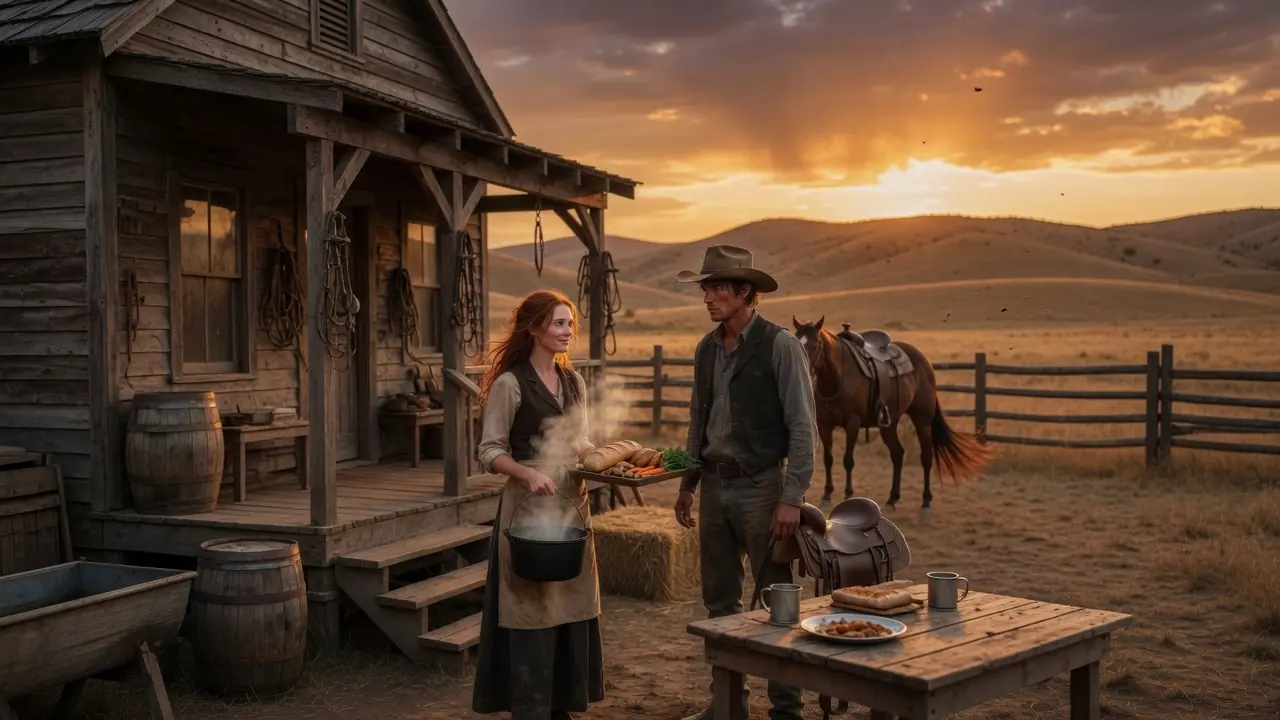
She had decided long ago she would not be the one to look away first.
“You need to sleep in an actual bed,” she said. “Not for my sake. For yours.”
His brows pulled slightly.
“You’ve been riding and working for days with nothing to show for it but saddle sores and an empty pocket. The cot is for men who have earned a rest and won’t admit they need one. You haven’t earned the right to be foolish yet.”
She said it plainly, as she might have said the kettle needed water or the woodpile was running low.
Eamon stood with the blanket under his arm, and something in his posture shifted.
Not surrender.
Recognition.
The particular stillness of a man outmaneuvered by logic he could not argue against.
“The bed’s yours,” he said. “For tonight.”
“Tonight,” she replied, “and however long it takes you to stop looking like you might disappear out the door before dawn.”
He opened his mouth.
Closed it.
That was answer enough.
She showed him where the linens were kept in the chest. Her mother’s pressed lavender still clung faintly to one folded sheet from a life Maeve did not talk about. She pointed to the lamp by the bedside and told him to leave the curtain open in case the fire needed tending in the night.
She did not say, I will be in the next room.
She did not say, I am not afraid of you.
But she thought he understood.
He nodded once and set his boots near the door with the laces tucked inside, the way a man does when he expects to leave early and quietly.
Maeve closed her own door, but not all the way.
Just a crack.
She did not examine why.
The wind came up around midnight, and Maeve woke to the sound of it working at the eaves. The house smelled of wood smoke and rosemary. She lay still, listening for some sign of him: a chair scraping, a floorboard shifting, a breath carried through the crack of the door.
There was nothing.
Either he slept, or he lay awake in the dark the way she sometimes did, thinking about distances.
She thought of a photograph she had once seen in a doctor’s office in St. Louis. A man on horseback in front of a house that was not hers. She had stood before it too long, and the woman at the counter had not asked what she was looking at.
Women who stand too long before photographs are usually looking for someone who is not coming back through the door.
In the morning, sunlight entered through the east window.
Maeve heard Eamon before she saw him.
The particular sound of a man trying to be quiet in someone else’s kitchen.
The clink of the pot.
The small scrape of a spoon against the inside of a cup.
She rose and dressed. When she stepped out, he stood at the stove with his back to her, and he had made coffee.
Two cups sat on the table, side by side, close enough that their steam mingled.
He did not turn when she entered.
She understood that too.
There are mornings when the face is not ready to carry what the voice has not yet admitted.
A man who knows this is worth knowing.
Maeve sat at the table.
The coffee was dark, stronger than she would have made it. She wrapped both hands around the cup and said nothing.
Eventually, he turned.
There was an egg in a bowl on the counter and a biscuit on a plate that she had not seen him make. He looked at her, then at the food, then back at her.
The look said what he would not say.
I didn’t know what you like, so I made what I know.
She ate the egg and half the biscuit.
He drank his coffee standing, which she took to mean he was not yet comfortable sitting across from her in the morning. That was all right. Comfort accumulated. Maeve had learned patience with accumulation.
The child came down at half past seven, and the whole shape of the morning changed.
His name was Thomas, though Eamon called him Tom.
He was small, solemn, and narrow-shouldered, with hair that had been cut too quickly and eyes that watched everything before deciding what to trust. He came into the room barefoot, paused at the doorway, and looked from Maeve to Eamon without speaking.
Eamon went back to the stove.
He made another egg, and this time he sliced bread first, laying it in the pan beside the egg the way a man does when he has learned to cook for more than himself.
Tom sat at the table.
He looked at Maeve across from him.
He did not speak, but he did not not speak either.
There was a difference, and the difference mattered.
The silence of a child still deciding is not the same as the silence of a child who has already decided to stay quiet.
Maeve had seen that distinction before, in a boarding house in Council Bluffs, where a woman watched her son eat without speaking for three days. On the fourth morning, the boy asked the woman’s name.
Eamon poured Tom a glass of milk.
There was a spot of egg on the child’s chin. Eamon wiped it away with his thumb without asking permission, and Tom let him.
Maeve finished her coffee. The cup was warm in her hands, and she held it longer than she needed to because the kitchen was quiet, the light was good, and she was beginning to understand that some mornings were not like other mornings.
The thing to do with such mornings was to stay inside them as long as possible.
Eamon washed the plates.
Maeve watched him do it.
The way he held the chipped edge of one plate so the crack would not widen. The way he set each dish in the rack instead of stacking them carelessly. Small things. The kind that tell you what a man believes about the world, which is to say what he believes about other people.
Tom went outside.
Maeve heard the screen door catch and the particular sound of a child who had been given permission to go somewhere and knew exactly where that somewhere was.
Eamon dried his hands and hung the towel back on its hook.
“I’ll be back by dark,” he said.
She nodded.
He put on his hat and did not look at her again before going out the door.
The kitchen settled after him.
Maeve carried her second cup of coffee to the window and stood looking out at nothing in particular. The line where the yard ended and the country began. The dust already rising faintly on the eastern road. The child somewhere outside, speaking to the dog in the low, serious voice children use when they believe animals understand them better than adults do.
The cup was still warm when she set it in the basin.
The day moved slowly, and she was grateful for it.
She swept the floor again and noticed where the broom had worn a path in the dirt near the stove. Tom came in once for water, once for a biscuit, and a third time for nothing at all. He simply stood in the doorway watching her.
She let him.
When he went back out, she found a sewing kit in the drawer by the window. She did not open it. She set it on the table, looked at it a moment, then put it back.
There were things in this house that belonged to whoever had lived here before.
She would learn them in time.
The way she was learning the sound of the screen door when it caught. The way light fell across the floor at three o’clock. The particular quiet that settled over the house when Eamon was not in it.
Toward evening, she stood by the window and watched the road.
The road was empty.
She had stopped expecting anything from it.
The light changed first, turning orange at the edges before pulling back like a tide. A hawk crossed the open sky soundlessly and lifted toward the ridge. The dog barked once and then stopped. Somewhere beyond the barn, a rooster announced something no one had asked to hear.
Maeve stepped away from the glass.
On the table, the bread she had baked that morning cooled beneath a cloth.
Two slices waited for supper.
She had not known whether Eamon would come in from the field for a meal she had made, but she had set them out anyway. It was the kind of small presumption she was allowing herself now.
Small plans.
Two plates.
Two cups.
The understanding that a table was not a threshold.
The screen door opened.
She turned first toward the window, where the last light still held, then toward the sound of boots on the porch.
She was already beginning to know that rhythm without trying.
Eamon stood in the doorway with his hat in his hand.
He looked at her looking at him.
Neither spoke.
The distance between the doorway and where she stood was perhaps six steps.
He took none of them.
He stood with the light behind him, hat low against his thigh, and what was in his face was neither question nor answer. It was simply the open fact of a man who had come in from the field and found something he had not known he was looking for.
Maeve crossed the room.
Not to him.
To the table where the bread waited and the two cups sat side by side.
The cloth beneath them was blue.
The one she never used.
The one she had folded and put away four years ago in a house she no longer thought of as hers.
She had taken it out that morning without deciding to.
Behind her, she heard him set his hat on the hook by the door.
She heard him wash his hands at the basin.
The water sounded loud in the quiet kitchen.
When he came to the table, he stood beside her chair instead of across from it. The warmth of him was there at her shoulder, like a question whose answer she had already known for longer than she wished to admit.
He pulled out her chair.
The scrape of wood against floorboards was small.
Plain.
Almost nothing.
And yet, in that house on the edge of Hartwell, with rain still caught in the earth and bread cooling beneath a blue cloth, it felt like the beginning of everything.