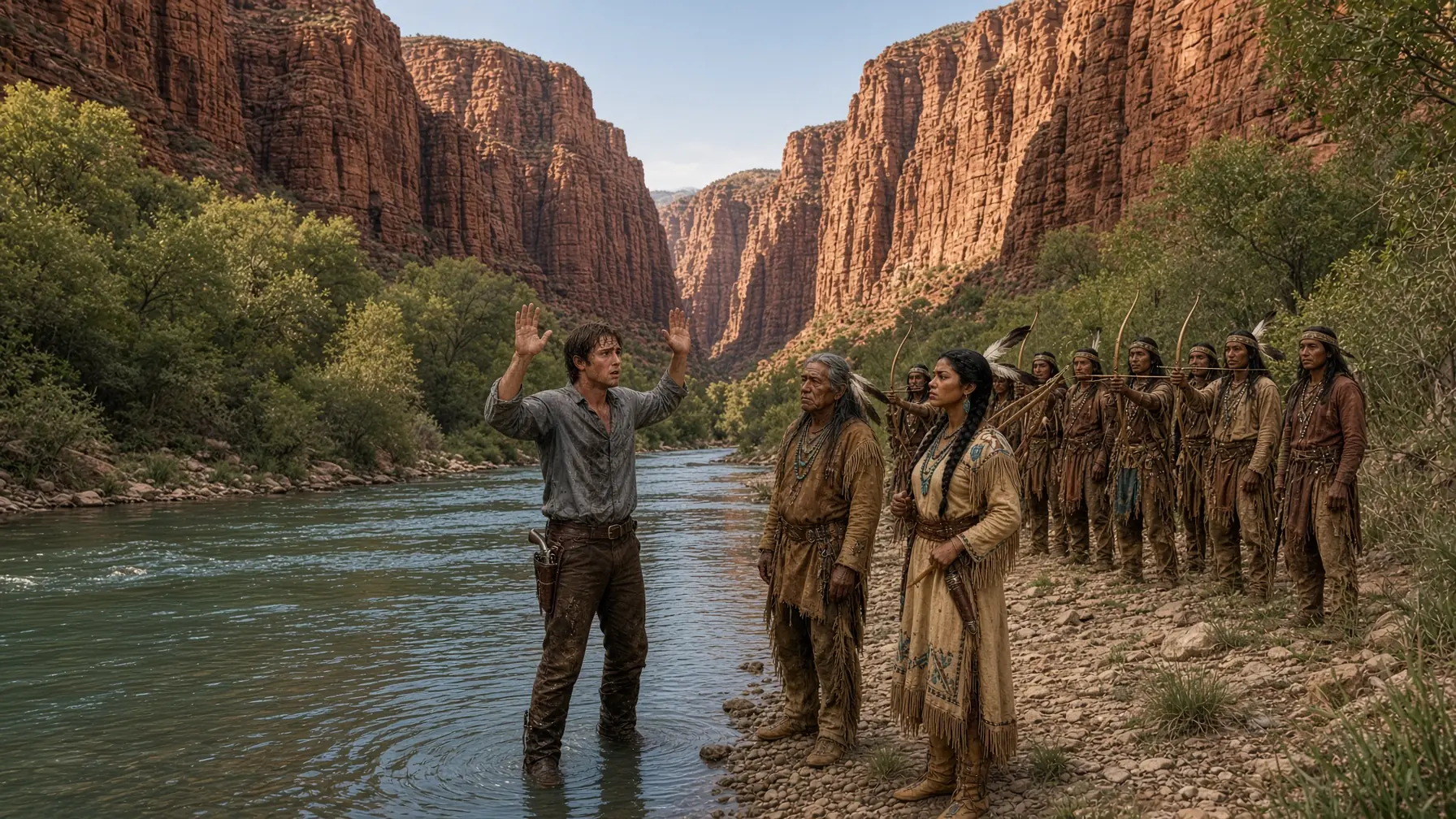
Eli Mercer had been lost in the Arizona Territory for two days when he found the river. By then his canteen was dry, his lips had split from heat, and the old map he bought in Santa Fe had become little more than an expensive piece of paper covered in roads that did not exist. His horse, a chestnut gelding named Jasper, was tired enough to stumble on level ground. So when the animal suddenly raised his head and pulled toward a narrow break between the red cliffs, Eli let him choose the direction.
The water appeared like something the desert had been hiding on purpose. A clear ribbon wound between sandstone walls, shaded by cottonwoods and willow brush so green they looked impossible against the copper-colored earth. Eli stared at it for several seconds before dismounting because after enough hours without water, a man stopped trusting beautiful things. Jasper did not share his doubt and nearly dragged the reins from Eli’s hand trying to reach the bank.
“All right,” Eli muttered. “If it kills us, at least we die hydrated.”
He knelt at the edge and drank carefully at first. The water was cold, clean, and sweeter than anything he could remember tasting. After filling the canteen and letting Jasper drink, Eli removed his hat, boots, gun belt, and dusty shirt, then stepped into the river.
He had spent seven days riding west from Texas toward California. Every mile had left something on him—dust in his hair, salt on his skin, soreness in his shoulders, and the constant fear that he had mistaken leaving home for having a destination. The water reached his waist, and for the first time since crossing into Arizona, Eli felt his body relax. He closed his eyes and lowered himself beneath the surface.
For several seconds, there was nothing except water.
Then he heard a bowstring tighten.
Eli opened his eyes.
Men stood among the rocks on both sides of the river. He counted eight immediately, then twelve, then realized more were appearing from behind brush and stone until nearly twenty warriors formed a wide semicircle around the water. Every bow was drawn.
Eli raised both hands slowly.
“I’m leaving,” he said in Spanish. “I didn’t know this belonged to anyone.”
Nobody moved.
“I only needed water.”
Still nothing.
The strange part was their faces. Eli had expected anger, but what he saw looked closer to disbelief. Two younger men glanced at each other as though they were trying very hard not to laugh.
A sharp whistle came from above.
The bows remained raised while an older man descended from the rocks. His hair was streaked with gray, several eagle feathers were tied behind one ear, and the lines across his face belonged to someone who had spent more years solving other people’s problems than creating his own. He stopped at the riverbank and studied Eli.
“Come out,” he said in Spanish.
Eli obeyed.
The older man looked at his abandoned boots, gun belt, and hat, then at the dripping cowboy standing in the shallows.
“You choose unusual places to bathe.”
Eli glanced toward the arrows.
“I’m beginning to understand that.”
A few warriors smiled.
The older man did not.
“Do you know this river?”
“No.”
“Do you know these lands?”
“Apparently not very well.”
That earned another quiet laugh from somewhere behind him.
The older man folded his arms.
“My name is Tahoma. I lead the Red Mesa people.”
Eli nodded cautiously. “Eli Mercer. Texas.”
“I know what Texas looks like.”
Eli decided silence might improve his situation.
Tahoma pointed toward the river.
“This water is called Moon Promise.”
Eli waited.
“Two hundred years ago, according to our elders, a medicine woman said the man who entered this water without invitation, without greed, and without knowing what it meant would one day join the chief’s family.”
Eli blinked.
“I’m sorry?”
Tahoma did not smile.
“The river has been guarded for generations.”
Eli looked behind him at the water.
Then back at the chief.
“So I committed some kind of sacred offense.”
“That would be simpler.”
Eli frowned.
Tahoma continued.
“You may have fulfilled a marriage tradition.”
For several seconds, Eli honestly believed dehydration had finally reached his brain.
Then a woman’s voice cut across the riverbank.
“He did nothing of the kind.”
The warriors shifted aside.
A young woman stepped through them.
She looked about twenty-three, tall and straight-backed, with long black hair woven into a single braid decorated with turquoise beads. A hunting knife rested at her belt, and a short bow hung across one shoulder. Her expression suggested Eli had personally arranged this entire disaster just to inconvenience her.
Tahoma turned.
“Yara.”
“Father.”
She looked directly at Eli.
“That man doesn’t even know where he is.”
Eli raised one hand.
“On that point, we completely agree.”
Yara ignored him.
“You cannot expect me to marry someone because he got lost and decided to wash himself in the wrong water.”
“The elders will decide what the tradition requires.”
“I already know what I require.”
Tahoma’s jaw tightened.
“Yara.”
“No.”
She stepped closer to Eli.
Water still ran from his hair.
His trousers were soaked.
One sock was missing because the river had stolen it.
Yara looked him up and down.
“This is fate?”
Eli sighed.
“Believe me, ma’am, this is not how I imagined introducing myself to my future wife either.”
Her eyes narrowed.
“Do not call me that.”
“Gladly.”
Tahoma pinched the bridge of his nose.
The warriors were openly amused now.
Yara pointed toward Eli’s horse.
“He should leave.”
Eli nodded enthusiastically.
“Best idea I’ve heard all morning.”
Tahoma turned sharply.
“Nobody leaves until the council meets.”
Both Eli and Yara stared at him.
The chief continued.
“You will come to our settlement. Tomorrow the elders will decide what the river means.”
Eli picked up his boots.
“And if the elders decide it means nothing?”
“Then you continue west.”
“And if they decide otherwise?”
Tahoma looked toward his daughter.
“Then both of you will have decisions to make.”
Yara’s face hardened.
“The decision is already made.”
Tahoma looked tired rather than angry.
“So you have told me for fifteen years.”
That silenced her.
Eli did not understand the history between them, but he understood enough to put his boots on quickly.
The journey to Red Mesa took nearly two hours.
The settlement sat inside a hidden valley surrounded by high sandstone walls. From above it would have looked like empty desert, but once Eli passed through a narrow canyon, the land opened into cottonwood shade, cultivated plots, horse corrals, shelters, cooking fires, and dozens of families moving through the afternoon. Children stopped playing when the riders entered.
People stared.
Eli heard whispers.
“The river man.”
“Moon Promise.”
“He actually entered?”
His shoulders tightened.
“I’m guessing news travels quickly here.”
Yara rode ahead of him.
“Everybody saw the warriors return with a wet cowboy.”
“Fair point.”
She did not look back.
At the center of the settlement stood a large circular gathering area marked by flat stones. Tahoma dismounted and raised one hand. Conversations stopped almost immediately.
“My people,” he said, “this man entered Moon Promise today.”
A murmur moved through the crowd.
“He did not know what the river was. He did not know our tradition. He was thirsty and lost.”
Someone laughed quietly.
Tahoma continued.
“The elders witnessed it from the ridge. My warriors witnessed it. Tomorrow at sunrise, the council will decide what is required.”
Eli dismounted awkwardly.
A little boy stepped forward and looked up at him.
“You really bathed in it?”
Eli glanced around.
“Yes.”
The boy grinned.
“Without permission?”
“Yes.”
“That was stupid.”
Eli nodded.
“I’ve been hearing that a lot today.”
The boy laughed until his mother pulled him away.
Tahoma led Eli toward a small shelter near the western edge of the settlement. Inside were blankets, a sleeping roll, pottery, and enough room for one person to sleep comfortably. Compared with the rocky ground Eli had used for most of the week, it looked luxurious.
“You’ll stay here tonight.”
Eli set down his bag.
“Am I a guest or prisoner?”
Tahoma considered.
“A guest who should not try to leave.”
“That sounds suspiciously like the second one.”
Tahoma almost smiled.
“The desert at night is less forgiving than my warriors.”
Eli sat.
“Chief, I need you to understand something.”
“I understand more than you think.”
“I’m headed to California.”
Tahoma waited.
“I heard ranchers around Los Angeles are paying good money for men who can break difficult horses. I don’t have family left in Texas, so I figured I’d try somewhere new.”
“And marriage was not included.”
“Not exactly.”
Tahoma nodded.
“Yara has spent most of her life saying the same.”
That surprised Eli.
“So why keep this tradition?”
Tahoma looked toward the entrance.
“Because communities remember fear longer than individuals do.”
Eli waited.
“Twenty-one years ago, a drought nearly destroyed us. The elders believed we had abandoned too many old promises.”
“You believe that?”
Tahoma paused.
“I believe people need reasons to survive difficult years.”
That was not the answer Eli expected.
The chief stood.
“Rest.”
He left.
Eli ate venison stew that evening and eventually wandered toward the edge of the valley. The sunset turned the cliffs deep orange and violet. He found Yara sitting alone on a broad stone above the corrals.
He nearly turned around.
Then she spoke.
“If you came to apologize again, don’t.”
Eli stopped.
“I was going to ask if I could sit.”
She shrugged.
“It is a large rock.”
He sat several feet away.
For a while, neither spoke.
Finally Yara said, “Twenty-three years.”
“What?”
“That is how long people have discussed my marriage before discussing anything else about me.”
Eli looked at her.
“I learned to track before most boys my age could saddle a horse. I can shoot better than half my father’s warriors. I know every water source between this valley and Red Rock.”
She picked up a pebble.
“I negotiate horse trades. I organize winter stores. I lead scouting parties.”
Then she threw the pebble into the dust.
“And still every elder eventually asks when the river will choose a husband.”
Eli understood something then.
This was not simply an inconvenience for her.
It had been a shadow over her entire life.
“I’m sorry.”
Yara looked at him.
“For what?”
“For walking into the river.”
That earned the smallest smile.