By the time I saw the red car, I had twenty-one hours left to save eighty acres of soybeans.
That was the number running through my head.
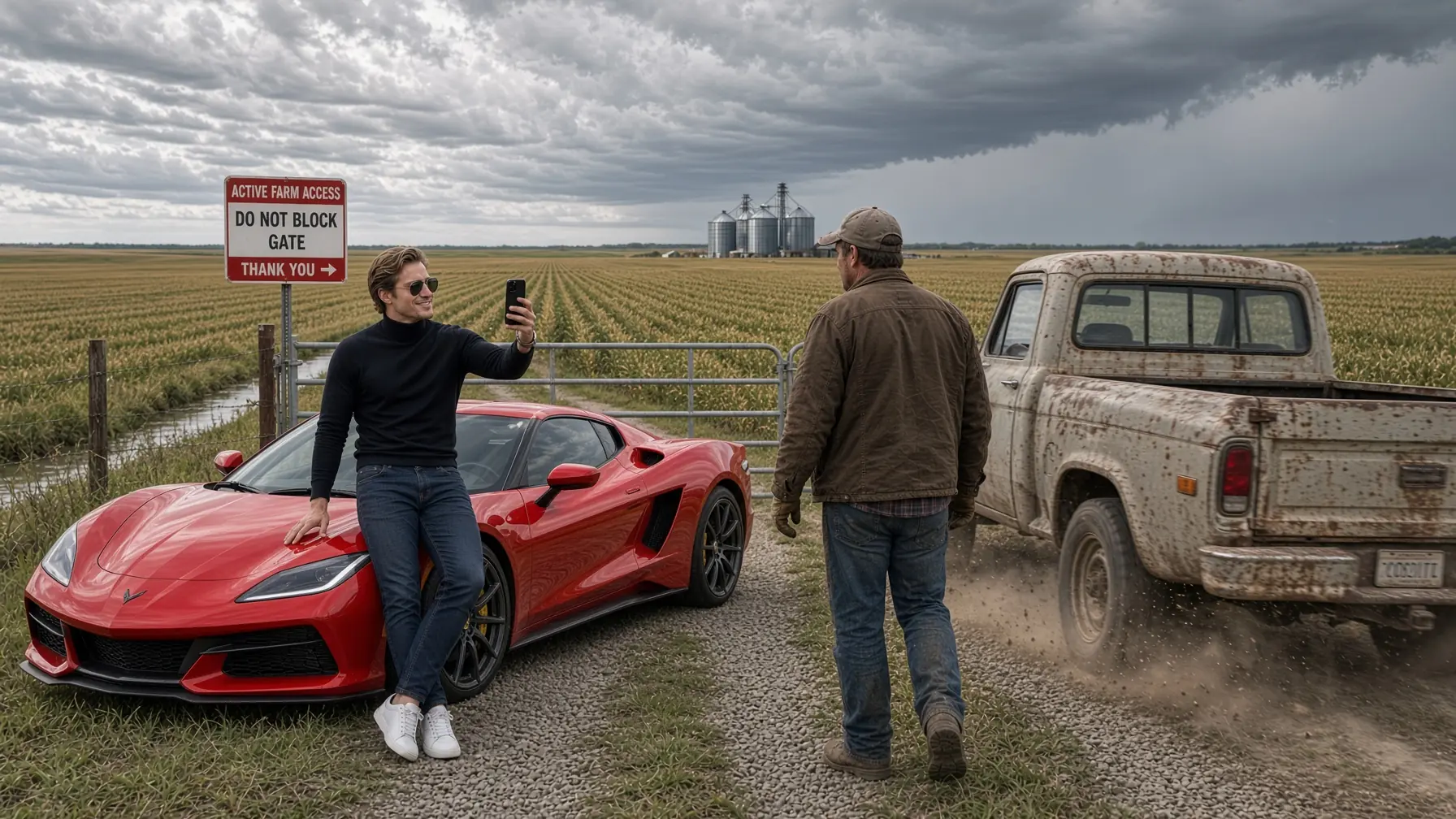
Not the price of the car.
Not the weather.
Not even the man standing in my field taking photographs of himself.
Twenty-one hours.
That was roughly how long the forecast gave us before a cold October storm crossed central Iowa and dumped somewhere between three and four inches of freezing rain over the county.
If you’ve never farmed, that might sound inconvenient.
If you have, you already know what it meant.
The beans were ready.
Too ready.
A hard soaking at that stage could make pods split, knock beans onto the ground, delay harvest for days, and leave what remained vulnerable to mold and rot. On that particular eighty-acre field, I had somewhere around eighty thousand dollars hanging off brittle brown stems.
And the only entrance wide enough for my combine was blocked by a red Italian sports car.
I stopped my pickup in the road and stared.
The south gate was impossible to miss.
The opening itself was almost thirty feet wide because our combine needed room to swing in from the county road. Beside it stood a reflective metal sign nearly as tall as my chest:
ACTIVE AGRICULTURAL ACCESS
DO NOT BLOCK GATE
HEAVY EQUIPMENT
VEHICLES SUBJECT TO TOW
I had even painted KEEP CLEAR across the gate itself.
The car was parked directly in front of both.
Not nearby.
Not partly blocking it.
Across it.
A low red machine with black wheels, a pointed nose, and enough polished carbon fiber to make me nervous just looking at it.
I didn’t know the exact model.
I knew one thing.
It cost more than my first house.
Then I noticed the owner.
He was twenty yards inside my soybean field.
The man had climbed over the gate instead of opening it and was now trampling a narrow path between the outer rows.
He wore white driving shoes.
White.
In October.
On a farm.
That should tell you almost everything you need to know.
His jeans looked custom-made. Black turtleneck. Aviator sunglasses even though the sun was already dropping low enough to turn the field gold.
He was holding his phone sideways, crouching, standing, moving three feet, crouching again.
At first I genuinely thought something was wrong.
Maybe the car had broken down.
Maybe he was waiting for help.
Then he walked back toward it, checked the photograph on his screen, looked annoyed, and returned farther into my beans for another angle.
He was doing a photo shoot.
I shut off the pickup.
My name is Jack Whitaker. I was forty-seven years old that fall, third generation on our farm, and by late October I was functioning on enough caffeine to qualify as agricultural equipment.
Harvest had been brutal.
A wet spring had delayed planting.
Then August turned dry.
Equipment prices were up.
Diesel was up.
Our grain dryer had needed a repair that cost more than my daughter’s first year of college.
And now the entire season depended on getting the last acres out before that storm.
I stepped out of the truck.
“Hey!”
The man lifted one finger without turning around.
Wait.
That was the first warning.
I walked to the gate.
“Sir!”
Click.
Another photograph.
“I need you to move that car.”
He finally sighed.
Not the sigh of someone surprised to find out he was blocking a working farm.
The sigh of a man whose waiter had interrupted an important conversation.
He turned.
Up close, he looked maybe thirty-five. Hair styled perfectly. Expensive watch. Skin that suggested he spent more time in boutique gyms than direct sunlight.
He walked toward me slowly.
“Relax, chief.”
Chief.
I knew immediately this was going to be a long afternoon.
“You’re blocking the only machinery entrance to this field.”
He looked at the gate.
Then his car.
Then back at me.
“So?”
“So I have a combine coming through here.”
“How long?”
“Soon.”
He smiled.
“Perfect. I need maybe fifteen minutes.”
“No. I need you to move now.”
His smile disappeared.
Behind him, my beans moved softly in the wind.
I pointed toward the western horizon.
“You see those clouds?”
He looked.
“Sure.”
“Storm comes tomorrow. I have eighty acres to cut before it gets here.”
“Okay.”
“This is the only gate.”
“Okay.”
“My combine is twenty feet wide. It needs the shoulder to make the turn.”
“Okay.”
Every okay came flatter than the last.
I tried once more.
“If you move fifty yards down the road, you can take all the pictures you want without blocking us.”
He laughed.
“The composition doesn’t work down there.”
I stared at him.
“The what?”
“The composition.”
He pointed toward the field.
“I need the road curve, the car, and the sunset behind the crops. That’s the shot.”
I remember looking at his perfect white shoes.
Then at my boots.
Mine were covered in grease because I had spent the morning replacing a bearing on a grain auger.
“I don’t care about the shot.”
He smiled again.
“You probably should. I’ve got almost four hundred thousand followers.”
That explained nothing and everything.
“I’m asking you nicely.”
“And I’m telling you I’ll move when I’m done.”
He started turning away.
I said:
“This is private property.”
He looked back.
“I’m standing in a field.”
“My field.”
“It’s not like I’m stealing anything.”
“You’re blocking a posted farm access.”
He spread his hands.
“Buddy, do you know what this car costs?”
“No.”
“More than four hundred thousand dollars.”
“Congratulations.”
“I’m not pulling it into some muddy ditch because you’re in a hurry.”
“I didn’t ask you to pull it into a ditch.”
“You want me on the shoulder.”
“The shoulder farther down is gravel.”
He looked at my pickup.
Then at my shirt.