“Sir, you look very hungry. Please take this hamburger. It is fresh and warm.”
The words came gently, carried by a quiet sincerity that felt rare in a place like this. The young waitress stood just outside the restaurant entrance, holding a tray with a neatly wrapped burger. Steam rose softly from the paper, curling into the cool air of the late afternoon. The old man standing in front of her looked at the food, then at her, as if unsure whether this moment was real or something that would disappear if he reached for it too quickly. His coat was worn, sleeves frayed, shoes dusted with the weight of long roads. But his eyes held something steady, something thoughtful.
“You don’t have to do this,” he said slowly, his voice rough but calm.
“I know,” she replied, her tone warm and unwavering. “But I want to.”
He studied her face, searching for hesitation, for judgment, for anything that might make this feel like a mistake. But there was none.
“Thank you,” he said at last, accepting the burger carefully, almost respectfully, as if it were something far more valuable than food.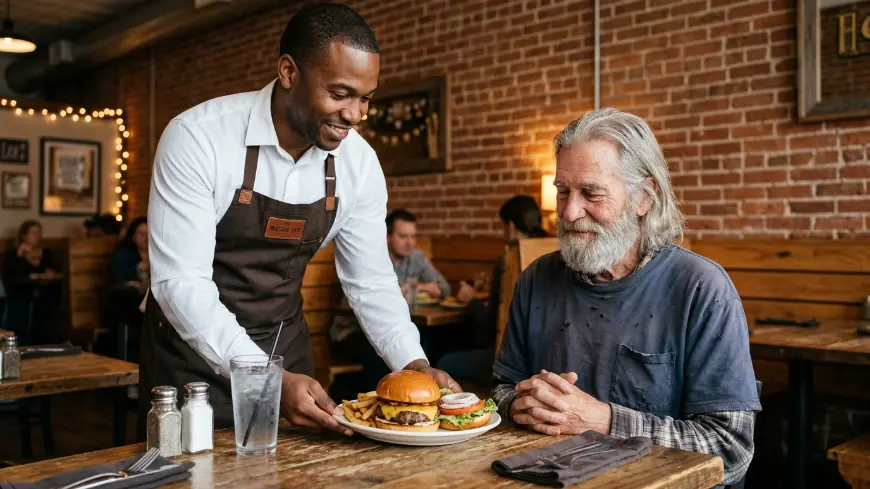
“Welcome, sir. Please come in and take a seat.”
A few minutes later, she guided him inside. The restaurant was modest but clean, filled with the comforting smell of grilled meat and fresh bread. Conversations flowed quietly between tables, the soft clink of utensils blending into the background. As they entered, a few customers glanced over, their eyes lingering just a little longer than necessary before returning to their meals.
“Are you sure it’s okay for me to sit here?” the old man asked, pausing near the table.
“Of course,” she said. “You’re a guest, just like everyone else.”
He slowly sat down, his movements careful, deliberate. She placed a proper plate in front of him now, replacing the wrapped burger with a full meal—fries, water, and a clean napkin.
“Here is your meal, sir.”
He looked at it, then back at her, something softening in his expression.
“I hope you enjoy it.”
“Then today is a good day,” she said.
He gave a faint smile and picked up the burger, taking his first bite slowly, as if savoring more than just the taste.
“What is this ridiculous situation?”
The sharp voice shattered the calm like glass. The door swung open, and a well-dressed woman stepped inside, her heels striking the floor with controlled precision. Her eyes scanned the room quickly before locking onto the old man.
“Why is this homeless old man sitting here?” she demanded, her tone filled with disbelief and irritation.
The restaurant fell silent.
The old man lowered his gaze slightly, setting the burger down.
“Get out of my restaurant immediately, you filthy beggar,” she snapped.
The waitress stepped forward instinctively.
“Ma’am, please—”
“And you,” the woman cut her off, turning sharply, “you dared to serve him?”
The waitress held her ground.
“He was hungry,” she said.
“That is not your concern,” the woman replied coldly. “This place has standards.”
“So does being human,” the waitress answered.
A few customers shifted uncomfortably in their seats.
“You are fired right now,” the woman said without hesitation.
The words landed heavily, echoing through the room.
“For helping someone?” the waitress asked, her voice steady but quiet.
“For disobeying authority,” the woman replied. “Pack your things and leave.”
The old man pushed his chair back slowly.
“I will go,” he said. “There is no need for this.”
“No,” the waitress said firmly. “You stay.”
“Stay?” the woman laughed sharply. “You think you have any say here?”
The tension thickened, pressing into the silence that followed. A few customers exchanged glances, unsure whether to intervene or remain spectators.
Then, unexpectedly, the old man straightened.
“Young lady, do you know who you are speaking to?” he asked, his voice calm but carrying a quiet authority that hadn’t been there before.
The woman frowned.
“Excuse me?” she replied.
“Who gave you the right to treat people like this in my restaurant?” he continued.
“My restaurant?” she scoffed. “This is absurd.”
The old man reached into his coat slowly and pulled out a worn leather wallet. From it, he removed a card and handed it to her.
She glanced at it casually at first—then froze.
Her expression shifted.
“This… this isn’t possible,” she whispered.
The card bore his name. Adam. The registered owner of the establishment.
The silence that followed felt heavier than anything before it.
“You… you’re…” she stammered.
“Yes,” he said simply.
The waitress stood still, her eyes moving between them, trying to process what was happening.
“I wanted to see how this place was being run,” Adam continued. “Not through reports. Not through managers. But through real moments. Real choices.”
The woman’s confidence collapsed.
“I didn’t know,” she said quickly. “If I had known—”
“That’s exactly the problem,” Adam interrupted gently.
The words were calm, but they carried weight.
“You saw a man in worn clothes,” he continued. “And that was enough for you to decide his worth.”
“I was protecting the restaurant,” she insisted, though her voice had lost its edge.
“No,” Adam said. “You were protecting your image of it.”
The room remained completely still.
He turned to the waitress.
“What is your name?” he asked.
“Emma,” she said softly.
“Emma,” he repeated. “Why did you help me?”
She hesitated.
“Because you needed help,” she said. “That’s all.”
“And you didn’t think about what might happen to you?”
“I did,” she admitted. “I just didn’t think that mattered as much.”
Adam studied her for a moment.
“Good,” he said quietly.
He turned back to the woman.
“You are fired. Leave this place immediately.”
Her eyes widened.
“Sir, please, I—”
“This is not a discussion,” he said calmly.
She stood frozen for a moment, then turned and walked out, her steps no longer confident, but uncertain and hurried.
The door closed behind her.
Silence lingered, but it felt different now.
Not tense.
Reflective.
Adam looked at Emma again.
“From today, you will be the new manager,” he said.
The words seemed to echo.
“Me?” she asked.
“Yes.”
“I don’t have experience,” she said.
“You have something better,” Adam replied. “You have judgment.”
She looked around the restaurant—the customers, the staff, the place she had only ever known from one position.
“I don’t know if I’m ready,” she said honestly.
“You were ready the moment you chose kindness over fear,” Adam said.
She took a slow breath.
“Thank you, sir,” she said. “I will not disappoint you.”
“I know,” he replied.
He sat back down at the table and picked up the burger again.
“Now,” he added with a faint smile, “may I finally enjoy my meal?”
A quiet ripple of laughter moved through the room, breaking the tension.
The restaurant slowly returned to life, but something had changed.
Conversations felt softer. Movements more thoughtful. Eyes less quick to judge.
Over the next few days, Emma stepped into her new role carefully. She didn’t try to change everything at once. Instead, she listened. She observed. She paid attention to the small things—the way customers were greeted, the way staff spoke to each other, the moments where kindness could exist but often didn’t.
“Good morning,” she said one day, addressing the team before opening.
“Good morning,” a few voices replied, uncertain.
“I don’t expect perfection,” she continued. “But I do expect respect. For every person who walks through that door.”
A server raised his hand slightly.
“Even if they… don’t look like they belong here?” he asked.
Emma met his eyes.
“Especially then,” she said.
The change wasn’t instant. Some resisted. Some didn’t understand. But slowly, the atmosphere shifted.
One evening, a man in worn clothes stepped inside, hesitating near the door.
A few heads turned.
Emma noticed.
She walked toward him.
“Sir, you look tired. Please, come in and have something warm to eat.”
The man looked surprised.
“I don’t have money,” he said.
“That’s okay,” she replied.
“Are you sure?” he asked.
“I’m sure.”
He stepped inside slowly.
At the counter, one of the staff members watched, then glanced at Emma.
She gave a small nod.
No words were needed.
And somewhere, far from that restaurant, Adam sat in a quiet office, listening as Peter updated him.
“She’s changing the place,” Peter said.
Adam smiled faintly.
“I thought she would,” he replied.
“She didn’t keep the change to herself,” Peter added. “She’s helping others.”
Adam leaned back slightly.
“That’s how you know it was real,” he said.
Because in the end, it wasn’t about the hamburger.
It wasn’t about the job.
It wasn’t even about who he was.
It was about a simple choice made in a quiet moment.
To see a person.
Before seeing everything else.