A man sat quietly in a small café on a rainy afternoon, the kind of place where time seemed to slow down just enough for people to breathe between responsibilities. The windows were slightly fogged from the warmth inside, and outside, the rain tapped gently against the glass in a steady rhythm. His name was Daniel Harper, a man in his early fifties, dressed in a dark coat, his posture calm but thoughtful. He had chosen a table by the window, not because he wanted to be seen, but because he preferred to observe. Life had taught him to notice things others overlooked, though he hadn’t always listened to what those observations meant.
He glanced at his watch briefly, then set it down on the table, deciding not to rush the moment. The café was moderately busy—students with laptops, a couple quietly talking over coffee, a man reading a newspaper. Everything felt ordinary. Predictable. Safe.
Then the door opened.
A gust of cold air entered with it, followed by a woman who seemed to carry the weight of many years on her shoulders. She was elderly, perhaps in her late seventies, though hardship had aged her beyond that. Her clothes were worn, layered unevenly, patched in places that told a story of long-term struggle rather than temporary misfortune. Her shoes were thin, barely protecting her from the cold pavement outside. Her hands trembled slightly as she held the door open for a moment longer than necessary, as if gathering the strength to step fully inside.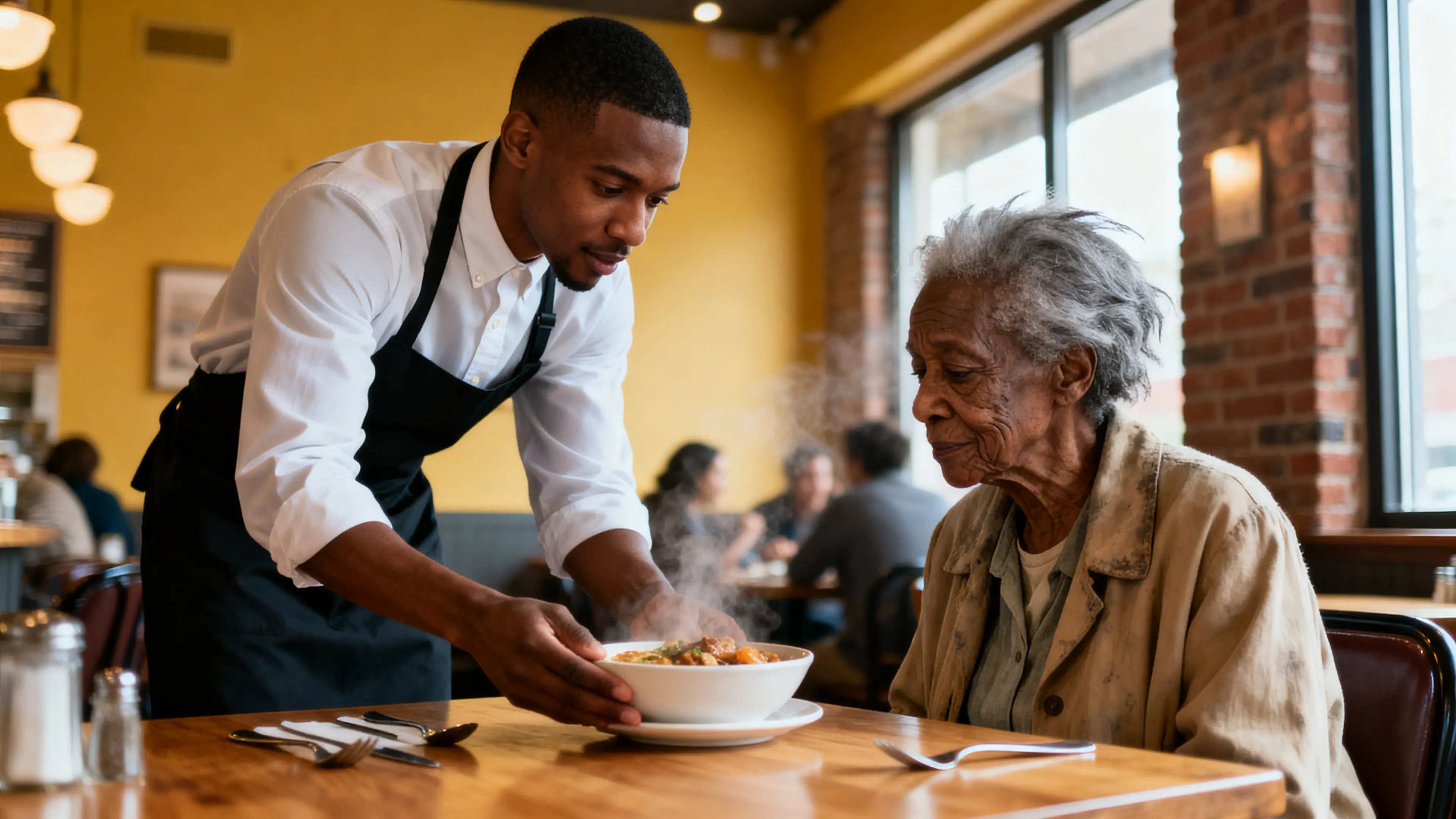
Conversations in the café softened for a brief second—not out of concern, but out of awareness. Then, just as quickly, people returned to their own worlds.
The woman looked around slowly, her eyes searching not for attention, but for permission. She spotted an empty table in the corner and walked toward it, each step measured, careful. She sat down gently, almost apologetically, as if she were borrowing space she didn’t believe she deserved.
Daniel watched her.
Not with judgment. Not with pity. Just with attention.
A few seconds passed before a waiter approached Daniel’s table. His name was Michael Carter, a young man in his late twenties. His uniform was simple, his movements efficient, but there was something else about him—something calm, something grounded. He leaned slightly closer to Daniel, lowering his voice.
“Sir,” he said politely, “would you mind if I serve her first? She looks very tired.”
Daniel followed his gaze, then nodded without hesitation.
Michael gave a small nod of appreciation and walked toward the woman.
He approached her the same way he approached every customer—with respect, with patience, without assumption.
“Ma’am,” he said gently, “what would you like to eat today?”
The woman looked up, startled. For a moment, it seemed like she didn’t understand the question. Then her lips parted slightly.
“Anything warm,” she said softly. “If… if that’s okay.”
Michael nodded.
“It is,” he said simply. “I’ll take care of it.”
He didn’t ask for payment. He didn’t ask how she would afford it. He simply turned and went to the kitchen.
Daniel leaned back slightly in his chair, watching everything unfold. Something about the interaction felt different from what he was used to seeing. There was no hesitation in Michael’s actions. No calculation. Just a quiet certainty.
A few minutes later, Michael returned with a tray. On it was a bowl of hot soup, a plate of bread, and a cup of tea. He placed each item carefully in front of the woman, making sure everything was within easy reach.
“Please be careful, it’s hot,” he said softly.
The woman stared at the food for a moment, her eyes reflecting something close to disbelief. Then she nodded.
“Thank you,” she whispered.
She picked up the spoon slowly and began to eat. Each movement was deliberate, almost cautious, as if she were afraid the meal might disappear if she moved too quickly. She took small bites, pausing between them, savoring each one. It wasn’t just hunger—it was relief.
Daniel felt something shift inside him as he watched. It wasn’t dramatic, not something he could name immediately. But it was there.
Time passed quietly. The café continued its rhythm, but Daniel’s focus stayed on the corner table.
When the woman finished eating, she sat for a moment, her hands resting on the table. Then she reached into her coat pocket and pulled out a small piece of paper. It was folded several times, worn from being handled often. She unfolded it carefully, smoothing it out with trembling fingers, then held it out as Michael approached.
“Here,” she said softly. “For the food.”
Michael took the paper gently, without inspecting it.
“Thank you,” he replied.
There was no hesitation. No correction. No rejection.
The woman nodded, a faint sense of dignity returning to her posture, then slowly stood up. She adjusted her coat, gave a small glance around the room, and walked back toward the door. No one stopped her. No one spoke. She left the same way she had entered—quietly, without drawing attention.
For a moment, the café returned to normal.
But Daniel couldn’t let it go.
When Michael returned to his table, Daniel spoke.
“That wasn’t real money,” he said calmly. “You knew that, didn’t you?”
Michael smiled slightly, not surprised by the question.
“Yes, sir,” he replied.
Daniel studied him.
“Then why accept it?”
Michael placed his hands lightly in front of him, thinking for a moment before answering.
“She believes it is,” he said quietly. “And sometimes, that matters more than what it actually is.”
Daniel frowned slightly, not fully satisfied.
“How long has this been happening?”
Michael’s answer was immediate.
“Almost three years.”
Daniel leaned back, surprised.
“Three years?”
Michael nodded.
“She comes here almost every day. Around the same time.”
Daniel shook his head slightly.
“And your boss allows this?”
Michael gave a small, calm smile.
“He knows,” he said. “He deducts the cost from my salary.”
Daniel’s expression hardened slightly.
“And you’re okay with that?”
Michael shrugged gently.
“I just work extra hours,” he said. “It balances out.”
Daniel looked at him more closely now.
“Why?”
Michael’s answer came without hesitation.
“Because helping her gives me peace.”
There was no performance in his voice. No attempt to impress. Just truth.
Daniel sat there in silence. For years, he had built his life around logic, efficiency, measurable outcomes. Everything had a cost, a benefit, a reason. But this—this didn’t fit into any of those categories.
For three years, this man had quietly sacrificed part of his income, part of his time, for someone who could never repay him. No recognition. No reward. Just consistency.
Daniel looked down at the table, then back up.
“Do you ever get tired of it?”
Michael shook his head.
“No,” he said. “Because I don’t see it as a burden.”
Daniel exhaled slowly, processing.
When his meal finally arrived, he ate in silence. Not because the food demanded it, but because his thoughts did. Every bite felt secondary to what he had just witnessed.
When he finished, he sat there for a moment longer, then reached into his coat and placed a small bag on the table.
“This is for you,” he said.
Michael looked confused.
“Sir, I can’t accept—”
Daniel raised a hand gently.
“Please.”
There was something in his tone that made refusal feel unnecessary.
Michael hesitated, then picked up the bag. It was heavier than expected. He opened it slightly—and froze.
Inside was a large amount of cash.
His hands trembled as he looked back up.
“Sir… this is too much.”
Daniel smiled, but it was different now. Softer. Real.
“Consider it a reward,” he said. “Not just for today, but for the last three years.”
Michael’s eyes filled with tears.
“I don’t know what to say.”
Daniel shook his head.
“You don’t need to say anything.”
Michael swallowed, trying to steady himself.
“Thank you.”
Daniel stood up slowly, putting on his coat.
“Just promise me one thing,” he said.
Michael nodded.
“What is it?”
“Don’t stop,” Daniel replied.
Michael held the bag tightly, as if it were something far more valuable than what it contained.
“I won’t.”
Daniel gave a small nod and walked toward the door.
Outside, the rain had softened, almost stopping. The streetlights reflected off the wet pavement, creating a quiet glow.
He paused for a moment before stepping out, looking back once—not at the café itself, but at what had happened inside.
Because sometimes, the most powerful lessons don’t come from success or wealth.
They come from quiet acts of kindness that no one else notices.
And sometimes, those acts don’t just change one life.
They change the person who finally learns to see them.