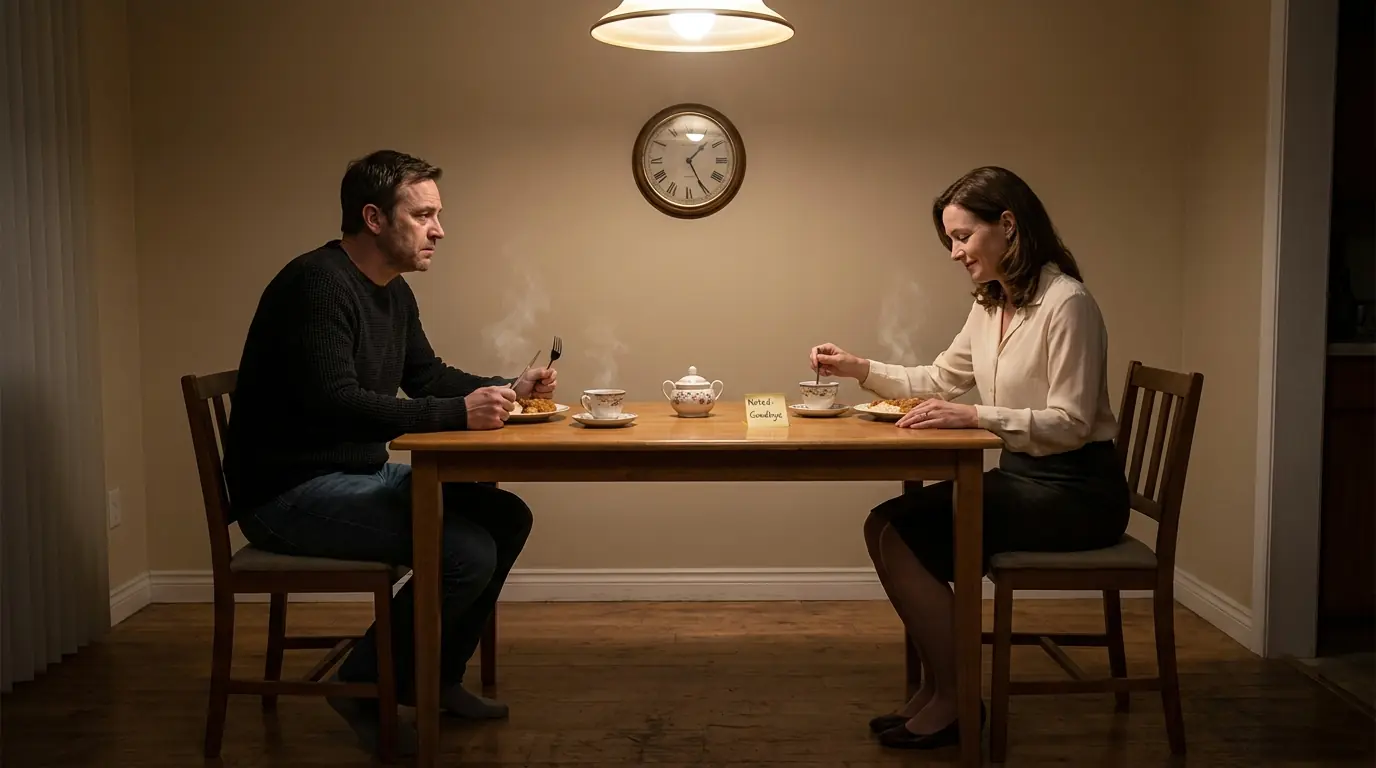
The spoon clinked gently against the porcelain again and again and again. It was the only sound in the room, aside from the slow, rhythmic ticking of the old wall clock she insisted we keep because it was charming.
I watched her hands circle the cup like she was hypnotizing herself, or maybe stalling. I don’t know. What I do know is that it was 7:42 p.m. on a Thursday night.
I hadn’t even taken a bite of my food yet. It was still steaming. She hadn’t touched hers either.
“I want to tell you something,” she said, still stirring, still not looking at me.
That sentence. I swear, if I could delete one sentence from existence, it would be that one. Not “I don’t love you anymore.” Not “It’s not you, it’s me.”
Just that quiet, unassuming sentence, because nothing good has ever followed it.
I remember my first thought wasn’t fear or panic. It was exhaustion, like I was about to be handed another responsibility I didn’t ask for.
She finally looked up. No tears, no guilt, just a strange kind of relief, as if she had just finished a difficult workout and wanted me to clap.
“I’ve been seeing someone,” she said softly.
Not a single nerve in my face moved. I just sat there blinking, gripping my fork like it might run away if I let go.
“It’s not serious,” she added quickly. “It’s just something I needed to feel alive again, you know, to spark things. I still love us.”
And there it was, the sentence that buried our entire marriage under a pile of carefully chosen words and emotionally detached logic.
She reached across the table, trying to take my hand like we were in a therapy session. I pulled back. Not dramatically, just enough.
“You cheated on me,” I said.
I didn’t raise my voice. I didn’t even sound like me. I sounded like someone watching a car accident from inside another car.
“It’s not cheating if—” she started.
I stood up.
My chair didn’t even screech. It just sighed like it was tired, too. I didn’t yell. I didn’t break anything.
I walked over to the cabinet, opened it, pulled out a sticky note, and wrote two words.
Noted: Goodbye.
I left it next to her teacup and walked out of the house barefoot because I couldn’t stand the thought of putting on shoes in that moment.
The kicker? She didn’t follow me.
But what came after that night? That was where things got really insane, because her spark lit a fire I don’t think she ever expected.
I didn’t go far that night. Just down the street, past the empty bus stop, past the closed bookstore, past Mrs. Langley’s house with the sagging porch where her wind chimes never shut up.
I ended up sitting on the cold concrete bench in front of the old hardware store, barefoot, staring at a vending machine that hadn’t worked since 2019.
I should have felt rage or betrayal or heartbreak, but honestly, I just felt stupid, like I had missed every obvious sign. And now the universe was laughing behind my back.
She didn’t even try to deny it. No dramatic confessions. No begging, just the truth delivered with the same tone she used to remind me to take out the trash.
Hey babe, just so you know, I’ve been sleeping with someone else. Please pass the salt.
At some point that night, I texted my brother Calvin. We’re not close. He lives an hour away and usually only messages me when he needs help moving something heavy.
But I figured if anyone could keep a secret, it was the guy who barely remembered my birthday.
Me: Lorna cheated. Left dinner like a zombie. Need to crash somewhere.
He called immediately. He didn’t even text back. Just called.
“Dude, what the hell?”
I told him everything. The tea, the confession, the spark. He kept saying “Jesus” every few minutes like it was the only word left in his vocabulary.
Then he offered to drive down and pick me up. I told him not to. I didn’t want to leave. Not yet. Not before I figured out what kind of disaster I was actually standing in.
When I got back to the house two hours later, the lights were off. Her salad was still on the table, completely untouched.
My sticky note was gone.
I walked to the bedroom, half expecting her to be asleep like nothing had happened, but she wasn’t there. Her side of the bed was cold.
Her toothbrush was still in the bathroom. Her robe was still hanging on the hook. But her keys were gone.
And so was the cheap little heart-shaped pendant I gave her two Christmases ago when I couldn’t afford anything better.
I didn’t sleep. I just sat on the floor in the hallway like a ghost, replaying everything in my head.
And that was when something strange clicked in my brain. Something I hadn’t even considered until that moment.
If she had been seeing someone to feel alive again, like she said, how long had she been feeling dead?
And worse, what else was she lying about?
So I did something I’m not proud of. At 3:17 a.m., I picked up her old laptop from the kitchen drawer, the one she swore she didn’t use anymore because everything was on the cloud now.
And I opened it.
That was when the second wave of betrayal hit, because buried in her browser tabs were hotel bookings.
Not one, not two. Eleven, spread out over the last four months. All different names, all different cities, all paid for in cash, all booked from this very laptop.
She hadn’t just been trying to spark something. She had been living a whole other life.
A life she had hidden behind passwords, fake receipts, and a convincing smile.
The worst part was that one of the hotel stays was booked the same weekend I was in the hospital getting tests done for chest pain.
She had texted me, “Love you. Be strong,” while checking into a place three hours away under the name Laura P.
And still, I stayed silent.
I closed the laptop, walked back into the living room, sat down on the same chair she always complained was too lumpy, and waited.
Because now I wasn’t just heartbroken. I was planning something I never thought I was capable of.
By the time morning came, I had memorized every hotel address, every fake name she had used.
I even mapped the distances from our house to each location like I was conducting some kind of investigation, which I guess I was.
The whiny little voice in my head kept asking me, “What are you even looking for, Curtis? Proof she’s worse than you thought? Isn’t the cheating enough?”
But it wasn’t about more proof. It was about understanding how long I had been living next to a stranger, sharing toothpaste with someone who was already gone.
She walked through the door at 7:43 a.m. sharp, like she timed it.
Her hair was still neat. Her shoes were dry. No smudged makeup.
She carried a to-go coffee cup from some trendy place in Midtown she once said was too overpriced for what it was.
I didn’t say anything. I just sat at the dining table, arms crossed. The laptop was open in front of me, screen still glowing, browser history wide open.
She froze for a second when she saw it, a flicker barely visible, then moved into a fake yawn like she hadn’t just come back from a night of betrayal.
“I know where you were,” I replied, quiet and flat.
She blinked. “What?”
“The Arless Hotel,” I said. “Room 608. Same one you stayed in on August 12th. And September 3rd. And October 19th.”
I watched her soul leave her body for just a moment.
“You went through my stuff?” she asked, her voice suddenly sharp.
That did it. That actually did it.
She had the audacity to be offended.
“No,” I said, standing up. “I went through my stuff. This marriage. My life. I’m just taking inventory like you did when you decided hotel rooms were more exciting than your husband.”
She tried to cry. I swear she actually tried. One of those short gasps with no tears behind it, the kind you practice in mirrors when you’re thirteen and trying to win a fight with your parents.
“You don’t understand,” she said. “You’re always here. You never change. It’s like you just stopped evolving, Curtis. I needed something unpredictable, something that made me feel like I still mattered.”
“Unpredictable,” I repeated. “Like, say, being caught?”
She sat down like she had been slapped. But I wasn’t done. Not even close.
I reached into the drawer behind me, pulled out a folder, the one with every screenshot I had taken from her laptop.
I placed it in front of her like I was serving a meal.
“Don’t worry,” I said. “I made backups in case you get dramatic and try to delete everything. I may be boring, but I’m not stupid.”
She looked at me then, really looked. And for the first time since this whole mess started, she looked genuinely afraid.
Not of me, but of losing control.
“You’re not going to tell anyone, are you?” she whispered.
That sentence cracked something inside me like I had been holding back a dam and she had just taken a sledgehammer to it.
“No, Lorna,” I said. “I’m not going to tell anyone.”
Then I grabbed my jacket, opened the front door, and left her sitting there, coffee in hand, folder full of her own secrets, wondering what the hell was about to happen next.
Because the truth was, I wasn’t going to tell anyone.
I was going to show them.
I didn’t go to work that day. I didn’t call in either. I just drove nowhere in particular until I ended up parked in front of the high-rise where Lorna’s company had their headquarters.
Fifteenth floor, sleek glass building, the kind of place where everyone wears sneakers that cost more than my entire wardrobe.
I sat in the car for an hour, gripping the folder in my lap. The one with all the printed screenshots, booking confirmations, and her disgusting little notes she wrote to herself on her phone.
Bring candles. He likes those.
I had found that one while digging through her backup files.
She brought candles for him. She never even bought birthday cards for me.
I wasn’t there to make a scene. I wasn’t going to walk in and blow up her job, even though my blood begged me to.
No, I had something better.
Lorna had a boss, a guy named Steven Golderman. I had met him once at their holiday mixer. He wore a velvet blazer and introduced himself like he was hosting a game show.
But more importantly, I remembered something else.
His wife’s name was Laurel.
I found Laurel’s contact on social media in under five minutes. I didn’t even have to scroll. Her profile banner was a photo of her and Steven at the office gala.
The same gala Lorna told me she skipped because she was exhausted from work.
That night, I had cooked dinner and waited up for her while she was apparently making memories with another woman’s husband.
So I did it.
I sent a message. Not a rant, not an insult, just four images. No caption, no explanation.
Screenshots of Lorna’s calendar synced with Steven’s. Hotel receipts with both their names. And the note about the candles.
Then I turned off my phone completely, pulled the battery, and tossed it in the glove box like it was radioactive.
I just wanted peace for a few hours. Time to exist without vibrating from the inside.
When I got home later, the house was too quiet. Her car was gone. The dining table had been cleared.
The folder I left her was still there, unopened, of course.
I sat on the couch and waited for the sky to darken.
And just after nine, I heard the garage door open.
She walked in like nothing had happened, tossed her bag onto the kitchen counter, and started talking from the hallway like we were still married.
“I stopped by the co-op to grab that weird almond milk you like,” she said. “They were out, so I—”
“You should sit down,” I interrupted.
She froze.
“What now?” she asked.
Her voice changed. Flat, guarded.
I looked up at her, dead center in the eyes.
“Steven’s wife knows.”
Everything drained from her face. Color, words, even breath.
She leaned on the counter like her knees might give out.
“You didn’t,” she whispered.
“I didn’t ruin your life, Lorna,” I said calmly. “You just spent too long pretending there wasn’t a fire behind you. I simply opened a window.”
She sat down slowly, like she was trying not to wake a sleeping animal.
“You don’t know what you’ve done,” she said.
“Oh, I do,” I replied. “I finally gave the truth a voice.”
Her phone rang. She didn’t pick it up. It rang again and again.
I didn’t even have to check. I knew it was him.
Then she said the thing that truly stunned me.
“I need you to protect me.”
I almost laughed. But it wasn’t funny.
“From what?” I asked. “Your own reflection?”
She didn’t answer. She just stared into the dark hallway behind me like it had something waiting for her.
And in that moment, for the first time since all this started, I realized she was afraid.
Not of me, not of consequences, but of being alone.
That night was the first time I saw her as human. Not in a soft romantic way, not like I saw her soul or rediscovered some old tenderness.
No, I mean it was the first time I saw her stripped of the act. No performance, no rehearsed lines, no curated emotions.
Just a woman sitting at the edge of a life she had set on fire, realizing there was no one left to blame when the smoke finally hit her eyes.
She barely spoke after I told her. She just sat on the carpet in her work blouse and kicked off her heels like they were choking her.
Her phone was buzzing every three minutes. She kept flipping it over like the screen itself burned.
And I just watched.
I sat in my chair like a guest in someone else’s movie, trying to decide whether I was the villain or the idiot.
Maybe both.
Eventually, after what felt like an hour, she asked, “What do you want from me, Curtis?”
I leaned forward.
“Nothing.”
She blinked like she didn’t understand.
“No second chances, no closure, no last-minute speech. I just want out. And I want you to feel every inch of this for as long as it takes.”
“You’re not leaving me,” she said like it was fact, like I hadn’t already checked out emotionally two days ago. “Curtis, you’re not like this. You’re a forgiver. You’re—”
“I was,” I cut in. “You turned me into something else.”
Her mouth opened like she had a comeback, maybe something practiced in the mirror, something dramatic and teary. But nothing came out.
Instead, she got up and walked upstairs without another word.
The next morning, she was gone before I woke up. She had taken her laptop, a duffel bag, and most of her clothes.
But she left the wedding ring on my nightstand. Not in a box, not on a note, just placed neatly, face up, like it was daring me to react.
I didn’t touch it.
Later that day, Laurel messaged me back.
Just five words.
I had a feeling. Thank you.
That was it. No drama, no threats, no lawsuits, just quiet acknowledgment from a stranger I had never met.
A woman whose life had also been rerouted by the same fire.
But the fallout, oh, it came fast.
By 3:00 p.m., Lorna’s work profile disappeared from her company’s website. Someone I didn’t know sent me a screenshot from an anonymous office Slack thread.
People whispering about how two married executives got exposed in the same hour.
I didn’t confirm or deny anything. I didn’t need to. The truth had already started doing its job.
Around five, my brother Calvin showed up unannounced with a six-pack and a pizza like it was a funeral.
He didn’t even say hi, just tossed me a slice and muttered, “So, I’m guessing couple’s therapy is off the table.”
That was the first time I laughed in days.
We didn’t talk much, just sat in silence, watching some dumb show neither of us cared about. It was the most peace I had had since that night at the diner.
But even as the calm settled in, I knew this wasn’t over because Lorna may have lost everything, her affair, her job, her carefully constructed illusion.
But I knew her too well.
She wasn’t done yet.
And when she came back, it wouldn’t be for forgiveness.
It took exactly three days for her to try and rewrite the story. Three days of silence. Three days of peace I didn’t trust.
Three days without hearing her keys in the door or her voice echoing off the hallway tiles.
And then Saturday morning, I heard the knock. Not a doorbell, not a text, an actual knock.
Sharp, rhythmic, confident, like she was still the lead actress in a show I had quit watching.
I opened the door slowly, and there she was.
Lorna.
No makeup, sunglasses perched on her head, holding a box of pastries from that overpriced cafe downtown like she thought a croissant could repair betrayal.
“I figured you hadn’t eaten,” she said, voice soft, eyes scanning me for an opening.
Any opening.
“I’m not hungry,” I answered.
She stood there for a moment, unsure, then stepped in anyway.
Of course she did.
She placed the box on the counter, turned toward me, and folded her arms like she was preparing for a board meeting.
“I’ve been thinking,” she began, and I could already feel the speech brewing. “I’ve had a rough couple of days. I lost everything. My job, my reputation. I know you’re hurting, but I’m hurting, too. I was confused, Curtis. That man, Steven, he wasn’t who I thought he was. I was stupid and I’m sorry. I just—”
“No,” I interrupted. “You’re not sorry. You’re exposed.”
That shut her up.
I walked past her, opened the fridge, and grabbed a bottle of water just to give my hand something to do.
“You didn’t come back here to apologize. You came back because your safety net is gone, and I’m the last one who might still pick up the pieces.”
Her jaw tightened. Her arms dropped.
“I didn’t cheat to destroy us,” she said.
And it was almost laughable.
“Then why didn’t you stop?”
Silence.
“Was it the first hotel that made you feel alive?” I asked. “Or was it the sixth? Was it when you realized he’d never leave his wife? Or was it when you looked in the mirror and didn’t recognize who you had become?”
I didn’t yell. I didn’t cry. I just stood there letting the words land exactly where they needed to.
She finally sat down on the bar stool, defeated, but not broken.
Not yet.
“I miss us,” she whispered. “I miss the man who used to bring me coffee in bed. I miss how safe it felt to come home. You always made me feel like I was enough.”
I almost laughed.
The irony was choking.
“I made you feel like enough, but you made me feel invisible.”
Her eyes darted away.
Then she said the line she probably practiced in the car a dozen times.
“I don’t want to give up on us, Curtis. I want to fix this.”
Fix this.
Like our marriage was a clogged drain or a leaky faucet. A quick trip to the hardware store and all would be forgiven.
“You’re not here to fix the marriage,” I said. “You’re here to fix your story, to make sure when people ask what happened, you can say we tried. So it doesn’t look like you were the only one who gave up.”
She didn’t deny it.
She didn’t even blink.
And that told me everything. She still didn’t get it.
And the worst part was that she never would.
I didn’t ask her to leave. I didn’t have to.
After our conversation crashed and burned right there in the kitchen, Lorna sat in silence for what felt like ten full minutes, staring at the pastry box like it might suddenly open and offer her a new identity.
I think she expected a breakdown from me, some dramatic weepy forgiveness or maybe a shouting match.
She wanted reaction because reaction meant power, but I gave her none.
Instead, I went upstairs, grabbed the one small suitcase I had left from my college days, and came back down.
No ceremony, no announcement. Just started folding shirts off the back of the couch and packing them in.
She finally broke the silence.
“What are you doing?”
“I think you know exactly what I’m doing.”
“You’re just walking out?”
Her voice cracked, then genuinely cracked for the first time after everything we had been through.
“You’re confusing history with healing, Lorna.”
She stood, came closer, almost reached for my hand.
“This isn’t you, Curtis. You don’t just walk away. You talk. You process. You always said relationships take work.”
“Yeah,” I said, zipping the suitcase. “But this wasn’t a relationship anymore. It was a hiding place for you. A waiting room until something more exciting walked in.”
She looked like I had hit her, but I didn’t stop.
I walked into the bedroom, grabbed my laptop, my passport, a small fireproof box with important documents.
The things I never thought I would need quickly, but now suddenly did.
When I came back into the kitchen, she was holding the ring I left on the nightstand, clutching it like it was fragile.
“We can still fix this,” she whispered. “If we just step back and slow down. Maybe counseling. Please, Curtis.”
I looked at her. Not the woman I married. Not even the woman who hurt me.
Just a person, flawed, scared, cornered.
Not because she had lost me, but because she was realizing I had finally stopped orbiting around her.
And that terrified her.
“You killed the version of me that would have tried,” I said.
And then I left.
I didn’t slam the door. Didn’t throw my ring. Didn’t post some dramatic status online.
I just left quietly because that was what finally got to her.
Not the shouting, not the exposure, not the evidence.
It was the silence, the absence, the clean, hollow space where I used to be.
Later that night, I stayed at a cheap rental about thirty minutes outside the city. No decorations, just four walls, a worn-out bed, and peace.
I turned my phone back on for the first time in two days.
Twenty-three missed calls, twelve voicemails, all from her.
The last one just said, “Please call me. Just talk to me. I’m scared.”
I didn’t listen to the rest. I just hit delete, because the truth was, I wasn’t scared anymore.
I was free.
It has been seven months since I left that house. Seven months since I walked out with a suitcase and a broken heart I didn’t think would ever stop bleeding.
But here’s the thing no one tells you.
Heartbreak is not a death sentence. It just feels like one until you wake up one morning and realize the world kept spinning and somehow you’re still standing.
At first, it was messy. I stayed on Calvin’s couch for two weeks while he pretended not to notice me crying into his dog’s fur at night.
I ate gas station food. I stared at walls. I replayed her voice in my head like it was a broken record I couldn’t eject.
But something shifted when I started rebuilding my routine.
I got my own apartment. Small, a little drafty, but mine.
I started biking again, something I hadn’t done in years. I stopped drinking the brand of coffee she liked and went back to the bitter roast I used to buy before we met.
I even signed up for one of those cheesy cooking classes just to remind myself I was allowed to enjoy life again.
And yeah, I burned risotto the first night, but no one laughed.
We all clapped.
And that was where I met Leah.
No, this isn’t a fairy-tale ending where I say she saved me. She didn’t.
I saved myself.
But Leah, she noticed the scars and didn’t flinch. She saw a guy who still double-checked locked doors and carried silence like a backpack.
And instead of walking away, she asked, “Do you want to talk about it, or do you just want company?”
Sometimes we talked. Sometimes we didn’t.
And that was enough.
Last week, I bumped into Lorna. It was at a grocery store, of all places.
She looked thinner, paler. She was wearing sunglasses inside, and I knew it wasn’t just to hide from the fluorescent lights.
She saw me before I saw her. I expected her to turn around, but she didn’t.
She walked up slowly, holding a basket with nothing in it.
“Hey,” she said softly.
I nodded. “Hey.”
She didn’t ask how I was. She could see how I was.
I wasn’t carrying pain anymore. I wasn’t haunted.
I was wearing a hoodie, holding a shopping list, and buying dinner for someone who actually cared when I smiled.
“I heard about you and someone new,” she added, hesitating. “That’s good.”
I nodded again. “Yeah, it is.”
There was a long silence.
Then she said the one thing I didn’t expect.
“I never thought you’d be the one to walk away.”
I shrugged. “Neither did I, but I’m glad I did.”
She didn’t cry. She didn’t fight.
She just nodded and walked off, her empty basket swinging at her side.
And in that moment, I realized something.
She didn’t miss me. She missed the man who would have let her come back.
But he doesn’t live here anymore.
I do.
And finally, after everything, I’m okay.
The bartender blinked at me like I had just handed him a live grenade.
I didn’t blame him.
Who gives someone a wedding ring in the middle of a Friday night rush and tells them, “Give it to her when she comes back in with a guy in the blue blazer”?
I didn’t even wait for his answer.
I just turned, walked out, and let the door shut behind me like a coffin lid.
My hands were still shaking, not from sadness, but from the adrenaline of finally doing something after six months of pretending I didn’t know.
She told me she was meeting friends from college. I knew she was meeting him.
I just didn’t think she would be that bold.
Bringing him to our spot, the bar where we once slow danced on a dare from the DJ, the one where she cried into her wine glass the night I proposed because she said no one had ever made her feel so safe.
I stood outside for ten minutes watching them.
Through the window, I could see her tossing her hair, laughing like she didn’t have a husband with our anniversary circled in red on the calendar at home.
And then she reached for the guy’s hand. Just a little touch.
Just enough to know it wasn’t the first time.
So yeah, I took my ring off, walked back in, and slipped it on the polished bar top like it was a tip for betrayal.
I didn’t scream. I didn’t confront. I didn’t cause a scene.
I just made sure she would know the moment she walked up for her next overpriced cocktail that I saw everything.
And then I left.
I drove around the city in silence, phone buzzing nonstop in the passenger seat. Her name lit up again and again.
No voicemails, just texts.
Where did you go?
Is this a joke?
Ellis, please pick up.
We can explain.
We.
She used “we.”
That was when I pulled over, laughed like a crazy person, and finally let the numbness turn into something worse.
Something sharp.
Something final.
Because I hadn’t told her yet. Not about the camera in the dash of her car, or the backup copies on my cloud, or the lawyer I already paid a retainer to.
All I did was leave a ring.
And by the time she got home, the house wouldn’t even look the same.
By the time I got back to my apartment, no, not our apartment anymore, it was 2:16 a.m., and my phone had exploded with a gallery of desperation.
Thirty-three texts, seven missed calls, two voicemails I refused to open.
And yet all I could do was sit on the edge of the unpacked couch, staring at that stupid little gold band still imprinted on my finger like a scar that hadn’t figured out it was allowed to fade now.
The first message she sent was laughable.
Ellis, I swear it wasn’t what it looked like.
Not what it looked like.
Really?
She was practically leaning into the guy like they were posing for a wedding portrait. Her fingers brushed his chest like it was hers to touch, and his hand didn’t flinch.
It settled comfortably, like they had been doing this for weeks, months, and maybe they had.
The second message stung worse.
You were never around, Ellis. You were always in your head, always somewhere else.
Classic.
The “you made me cheat” defense. Straight from the cheater’s handbook.
Suddenly, my quiet love, my introverted loyalty, my trying-to-be-enough nature, all of that became the villain in her story.
But I wasn’t the one lying about late nights. I wasn’t the one who shut off location sharing the moment she parked.
I wasn’t the one who kept our marriage photo turned face down on her office desk like it was something to be ashamed of.
No, I was the idiot who bought her roses every seventh of the month just because we got married on the seventh.
I was the guy who installed that stupid shelf in the bathroom, even though I knew she would never use it, just because she said it was a vibe.
So when she tried calling again, I didn’t answer.
I just stared at the screen, let it ring until her name faded, and finally got up to do what I should have done months ago.
I walked over to my laptop and opened the folder titled “Just in case.”
Inside were copies of everything. Screenshots of the late-night messages that popped up on the Apple Watch she forgot to unpair from my iPad.
Photos from the private investigator’s report.
Yeah, I hired one because I needed to be sure.
The timestamped footage from her dashboard camera, the one she didn’t even realize recorded audio when the car was running.
There it was, clear as day. Her voice giggling, telling Devon, “He still thinks I’m at that conference with Laurie.”
Devon’s voice was low and smug.
“You sure he’s not following us?”
And then her whisper.
“Ellis, please. He wouldn’t know what to do if he caught me.”
She was right.
I didn’t know what to do, so I did nothing for weeks.
I smiled when she came home. I kissed her forehead. I even helped her zip up her dress before her work gala, fully aware she was probably going to meet him again.
I let her live in the illusion that I was clueless until tonight.
Until the ring.
Until the moment I saw her reaction through the bar’s window when Mao, bless that old bartender, handed her the band without a word.
Her face dropped like she had been hit in the chest.
Devon turned confused. She didn’t say anything, just clutched the ring in her palm like holding it might reverse what she already destroyed.
But it won’t.
And neither will the tears.
I know she’s crying right now as she sits in the back of some cab reading my silence.
I won’t text her back. I won’t go back to that apartment.
And when the sun comes up, the next message she gets will be from my lawyer.
When I finally built up the nerve to return to the apartment to collect the rest of my things, I expected it to feel empty.
I expected the air to be cold, the space to echo without her in it, maybe a faint scent of her perfume lingering in the sheets I hadn’t touched in weeks.
What I didn’t expect was to find her already there, sitting in the kitchen in silence, wearing one of my old college sweatshirts like she hadn’t just ripped our marriage to shreds in public.
She didn’t say anything at first. She just stared at me like she was waiting for me to explode, to scream, to demand an apology she could twist into a misunderstanding.
I didn’t give her that.
I walked right past her and into the bedroom, ignoring the quiet sound of her breath catching in her throat.
My side of the closet was untouched, exactly as I had left it. Half-packed suitcases, folded shirts, a hoodie with a broken zipper I hadn’t been able to throw away.
But it was the other side, her side, that stopped me cold.
It wasn’t empty.
No, it was worse.
It was full, overfull with new clothes, men’s clothes, cologne I didn’t wear, a shaving kit that wasn’t mine.
And tucked behind her row of boots was a gym bag, navy and tan.
The same one I had seen in the trunk of Devon’s car in one of the photos from the private investigator.
I didn’t say anything. I didn’t touch it.
I just stood there absorbing it, my pulse slowing down in that weird way it does when your brain stops registering betrayal as pain and starts treating it like data.
Behind me, she finally spoke.
“Ellis, please just let me explain.”
Her voice was raw, like she hadn’t slept, like maybe she was finally feeling something.
But I wasn’t ready to hear her twisted version of the truth.
Not yet.
Maybe not ever.
So I turned, walked past her again, and headed for the drawer in the entry table where I kept all the house keys.
Hers was gone. Only mine remained.
She had his things in my home, but not her own key.
That told me more than any voicemail ever could.
“I wasn’t planning for it to go this way,” she said suddenly, following me into the living room. “It wasn’t supposed to be him. It wasn’t supposed to be like this.”
I laughed. I actually laughed.
Not because it was funny.
God, it wasn’t funny.
But because I couldn’t believe how well she had rehearsed her lines, like this was some soap opera and I had just walked in at the climax, conveniently forgetting the buildup.
She stepped closer. Her eyes were glassy, her hands trembling.
“I made a mistake,” she whispered.
I nodded.
“Yeah,” I said. “You left your mistake’s gym bag in my closet.”
She froze for the first time.
She didn’t have a retort, no witty deflection, no fake tears, just a flicker of shame crossing her face.
So brief I almost missed it.
I grabbed the duffel bag, didn’t open it, didn’t care what was inside, and carried it to the hallway.
I dropped it right outside the door.
“You can take the rest when I’m gone,” I said. “Or he can. Either way, this place won’t belong to either of you.”
“Ellis, I still love you,” she said.
That stopped me.
Not because I believed her, but because it was so predictable, like the final move in a game she assumed I didn’t know how to play.
But I did. I learned her rules the hard way.
I stepped out, closed the door behind me, and heard her cry for the first time in months.
Loud, raw, uncontrolled.
I didn’t feel victorious.
I felt done.
And in that moment, done felt like freedom.
Three days passed. I didn’t respond to her texts. I didn’t return to the apartment.
I stayed at a short-term rental across town, one of those cold staged condos they use in real estate listings.
No memories, no smells, just silence, empty drawers, and takeout containers I didn’t have the energy to throw away.
I thought I was moving on. I thought by not answering her calls, I was building a wall she couldn’t climb.
Then her boss called me.
It was a number I didn’t recognize, so I almost let it go to voicemail. But something told me to answer, and the voice on the other end was not what I expected.
“Ellis, this is Margot. I’m Roxanne’s department director.”
I froze.
The name alone punched a hole through my ribs. I had met her once. Older, sharp as broken glass, the kind of woman who knew when people were lying even before they opened their mouths.
“I’m not sure if I should be calling you,” she continued. “But something has come up that you probably deserve to know.”
There was a pause like she was weighing every word.
“Roxanne was put on administrative leave this morning. There is an internal issue we’re investigating. Her work phone is with HR now, and some of the messages we found, well, they raise serious concerns.”
“What kind of concerns?” I asked, my voice already tighter than I meant it to be.
“She has been using company resources, a lot of them, to cover up her relationship with Devon. Hotel bookings charged to the client travel fund. Multiple instances of falsified meetings and, Ellis…”
Margot sighed.
“She listed you as a business partner to justify some of the expense reports.”
My blood ran cold.
She used my name.
Apparently, while I was trying to stay out of her way, she was still dragging me through the mud behind my back.
I had never signed anything. I wasn’t even involved with her company. But there I was, attached to fraudulent charges, potentially under investigation because my wife couldn’t keep her hands off her coworker.
“I’m telling you this off the record,” Margot said, “because I’ve seen this happen before, and it never ends well when people stay quiet out of embarrassment.”
I thanked her. I don’t even remember hanging up.
I just sat there on the edge of the rental’s too-white bed, staring at my phone like it might catch fire.
It wasn’t just emotional anymore.
It was legal.
Financial.
And for the first time, I realized something darker.
Roxanne wasn’t sorry she hurt me. She was sorry she got caught.
And now, with the walls closing in, she was probably looking for someone else to blame.
Someone like the husband she painted as checked out and emotionally absent.
But I had something she didn’t know I still had.
The evidence. All of it. The audio, the texts, the receipts, the fact that she used her company card to book a beachfront hotel while claiming to be at a charity event.
And the guy who handed her champagne in the mirror selfie she took, Devon, wearing the same blue blazer from that night at the bar.
I wasn’t angry anymore. I wasn’t even hurt.
I was calculating.
I backed up everything to a hard drive and made an appointment with the attorney I had retained weeks ago.
Not for divorce papers. Those were already in motion.
But to prepare a separate file in case this turned into a courtroom disaster.
And just as I zipped up the evidence folder and was ready to leave, my phone buzzed again.
It was her.
We need to talk. Please, something happened.
I didn’t respond because whatever had happened, I had a feeling she wasn’t ready for what was about to happen next.
It was barely 7:00 a.m. when I heard the knock.
Not a normal knock. This was frantic, desperate, repetitive, the kind of knocking that says someone’s life is falling apart on the other side of the door.
I already knew who it was. I don’t know how, but I did.
I didn’t move right away. I sat on the arm of the couch in my rental, holding a half-empty mug of lukewarm coffee, staring at the door like opening it would mean going backward.
Another knock.
Then her voice.
“Ellis, please. It’s me. I didn’t know where else to go. Please just talk to me.”
I stood slowly, not out of pity, not because I missed her, but because I needed to see her face when I told her I wasn’t coming back.
When I opened the door, I barely recognized her.
Her hair was messy, her eyeliner smudged, and she was wearing the same coat she had on during that night at the bar. Her eyes were puffy, red-rimmed.
She wasn’t wearing makeup the way she normally did.
No mask to hide behind.
Just raw, exposed panic.
“I lost everything,” she said, stepping inside without waiting for me to invite her. “Ellis, they fired me. Margot fired me. Devon, he ghosted me the second it went public. His wife filed for divorce, and now she’s dragging me into her lawsuit. My name’s in reports. I’m getting calls from lawyers. I don’t know what to do.”
She collapsed onto the floor like her legs gave out, not even making it to the couch.
She looked up at me, trembling.
“I never meant to hurt you,” she whispered. “I was stupid. I thought I was in control. I thought I could fix everything before it spun out. But I was wrong, Ellis. I was so wrong. And now, now you’re the only person who has ever known me who hasn’t turned their back.”
I leaned against the wall, arms crossed, trying not to let her words slide into my bloodstream like they used to.
I had to remember this wasn’t love.
This was a performance.
She wasn’t crying for me. She was crying because she got caught, because the safety net she destroyed was the only one willing to forgive her.
She kept going.
“I can’t breathe. I can’t sleep. I keep looking at your ring and thinking I ruined the only good thing I ever had. Devon was a fantasy, Ellis. He made me feel exciting, but he never made me feel safe. He never held my hand during my anxiety attacks. He didn’t take care of me when I got sick last winter. He didn’t see me like you did.”
I crouched down next to her, not close. Just enough to make sure she saw my eyes when I said what I needed to.
“You’re right,” I said. “He didn’t see you like I did, because I saw everything. The good, the flaws, the fear, and I stayed. I stayed through the disinterest, through the lies, through the nights you said you were working late and came home smelling like a perfume you didn’t wear. I saw it all, Roxanne. I just kept hoping you would see me again.”
She reached for my hand.
I didn’t let her touch it.
“I can fix this,” she said quickly. “Let me fix it. Let me fight for us.”
I stood up.
“You already fought,” I said coldly. “You fought to keep your lie alive. You fought to make me feel small while you lived two lives. Now it’s my turn.”
She blinked.
“Your turn to what?”
“To move on,” I said. “To choose myself. Finally. To stop being the backup plan to your disaster.”
The room went silent.
She didn’t cry this time. She just sat there, mouth slightly open, as if she couldn’t believe I had stopped playing the part of the soft, forgiving husband.
“I’ll have my attorney reach out,” I said, walking to the door and holding it open.
She didn’t leave right away.
She looked around the room like she was trying to memorize it, like she was already nostalgic for something she would never have again.
Then she stood, picked up her purse with shaking hands, and walked out without saying another word.
And I closed the door.
Not gently, not with regret.
I closed it the way you close a book that is done lying to you.
Two weeks went by. The silence between us finally settled into something that didn’t ache.
I didn’t block her number, but I stopped reading her messages. I turned off notifications.
I stopped waiting for her to change and started focusing on myself, on reclaiming the parts of me I didn’t even realize I had given up.
It was strange how quickly peace replaced chaos when I no longer had to guess who I was sleeping next to.
I was packing up the last of my things from storage when it happened.
The knock.
Not on my apartment door this time, but on the glass wall of the law office where I was finalizing divorce paperwork.
I had been sitting in the conference room with my attorney, Evelyn, reviewing the final draft when I saw a blurred figure appear behind the frosted glass.
I knew that silhouette.
I knew the hesitation in her posture.
It was Roxanne.
Evelyn looked up, startled.
“Did you invite her?”
“No,” I said immediately, standing.
I opened the door, blocking the entry.
Roxanne’s face was flushed, her eyes wide with something between panic and confusion.
“I’m sorry. I didn’t know where else to go,” she said breathlessly. “I found something. I wasn’t trying to. I swear, Ellis, I wasn’t trying to spy, but I was cleaning out the hall closet, and I—”
I narrowed my eyes.
“What did you find?”
She hesitated, then pulled out a manila folder.
My heart dropped.
I knew exactly what it was. It wasn’t hers to find. It wasn’t meant to be found.
Not by her.
She held it up like it was a bomb she was diffusing.
“You were going to expose everything?” she asked, her voice trembling. “To my board? To the corporate compliance officer?”
Evelyn stood up now, her expression unreadable.
“You need to leave, Miss Grayson.”
Roxanne didn’t move. She looked at me again like I had just become a stranger.
And maybe I had.
Maybe I wasn’t the soft-spoken husband she thought she could shatter and then stitch back together when it suited her.
“I wasn’t going to send it,” I said quietly. “Not unless you tried to drag me down with you.”
Tears welled in her eyes.
“Ellis, this would ruin me.”
I raised my eyebrows.
“And what exactly were you planning to do when you listed me as a fake business partner to justify those company charges? Because I have the emails. You CCed my name, Roxanne. You forged signatures. You crossed the line. You dragged me into it.”
“I panicked,” she whispered. “Everything was falling apart.”
“No,” I interrupted. “Everything was already broken. You just didn’t want to admit it.”
Evelyn stepped forward.
“You violated the restraining boundaries noted in the separation draft. I’m advising Mr. Carver not to engage.”
Roxanne looked stunned.
“Ellis, please. If you send that folder, I lose my career. I lose everything.”
“You already did,” I said. “You just didn’t feel it yet.”
She tried to say something, but the words died in her throat.
I took the folder from her gently, slid it back into my case, and stepped aside, gesturing toward the door.
She walked out without another word, her heels clicking down the marble hallway like a slow countdown to the collapse of the life she had built on lies.
When the door shut again, Evelyn looked at me and nodded.
“Smart move, keeping leverage.”
“I didn’t want to use it,” I said, staring at the folder. “But I knew one day I might need to protect myself from the person I trusted most.”
The silence in the room wasn’t cold anymore.
It felt like armor.
Because for the first time in this entire mess, I wasn’t the one being blindsided.
I thought that would be the last of her. After the confrontation at the law office, after the folder, after everything, I assumed she would crawl back into the shadows of the mess she created and let me fade from her story.
But I underestimated something.
The one card she hadn’t played yet.
The past.
It started with a letter. Not a text, not an email, a physical letter left at my doorstep, handwritten in her looping, dramatic cursive I hadn’t seen in years.
No return address, just my name on the front like it still meant something to her.
I shouldn’t have opened it. I knew that.
But curiosity is a terrible disease.
Inside were three pages, front and back, drenched in nostalgia. She wrote about our early days, about the little apartment with the leaky sink we used to joke would flood us out.
She wrote about the road trip to Arizona where we slept in the car because I forgot to book a motel.
She mentioned the scar on my wrist she once kissed when I told her the story behind it.
Things no one else would remember.
Details that had no business making my chest hurt again.
And at the end, she wrote, “You once told me you didn’t believe in soulmates. I think I do now because losing you feels like losing a limb. I’m not asking for forgiveness. I’m just asking that if there’s a version of us somewhere in another life, you remember me kindly.”
I should have laughed or thrown it away, but I didn’t.
I folded it carefully, placed it in my desk drawer, and stared at the wall for what felt like an hour.
She was trying to rewrite the ending, trying to make herself the tragic figure, the woman who lost something beautiful because she was broken.
But no, that wasn’t what happened.
She didn’t lose me because she was broken. She lost me because she knew she was breaking us and kept swinging the hammer.
Anyway, the next morning, I made a decision. I emailed Margot, told her I had documents she might want to see, not to ruin Roxanne, but to protect myself.
I drew a clear line.
I wasn’t vengeful. I just wasn’t going to let her bury me in the rubble of her poor decisions.
Margot responded within an hour, thanking me, telling me HR was moving forward with their own review and that my name had already been cleared internally. They had verified enough on their own.
My evidence would simply reinforce it.
That night, I slept better than I had in months.
But of course, that was when she showed up again.
This time, it wasn’t to cry or plead or beg.
She was standing in the lobby of my building when I came back from the gym, hair clean, clothes pressed, expression calm.
Too calm.
“You win,” she said simply, stepping closer. “You burned it all down. Congratulations.”
I shook my head.
“You think this is about winning?”
She smiled. Not the warm kind, the weaponized kind.
“I always knew you would do something like this if I pushed you far enough. The sad thing is, it actually makes me respect you a little.”
And then she did the one thing that proved she wasn’t there for closure.
She reached into her bag and pulled out a flash drive.
“I thought you might want to see the other side of the story,” she said. “Not because I think you’ll forgive me, just because you always needed every detail.”
She handed it to me and walked out before I could respond.
I held it in my hand for a long time.
I still haven’t plugged it in, because for the first time in our entire marriage, I finally understood something.
Not knowing might be the only peace I ever get.
And maybe, just maybe, I was ready to stop chasing closure and start choosing freedom.
I never opened the flash drive.
Not because I wasn’t tempted. I was. For hours, it sat on the corner of my desk like a dare.
I thought about plugging it in more times than I’ll admit. I thought about whether it was a last confession, a manipulation, a recording, or just one final twist in the plot she had written behind my back.
But in the end, I realized it didn’t matter.
I had enough answers.
I had the answer.
She had chosen someone else repeatedly. And when that fell apart, she chose herself, her reputation, her career, her image.
I was never her first choice, just the safety net.
And I was done being the net.
Instead of opening her file, I opened a new one.
A blank document.
A resume.
It sounds small, but for the first time in years, I let myself imagine a future that wasn’t built around her schedule or her dreams.
I applied for remote positions across the country. I sold what little furniture I hadn’t already shoved into storage.
And within a week, I got an offer from a software firm in Denver.
I took it.
The move was quiet. No announcement, no post, just boxes, a rented van, and a road that didn’t lead back to the apartment we used to share.
Roxanne texted once more when she heard through mutual friends that I had left the state.
You disappeared again.
That time, I didn’t even open it.
Because I didn’t disappear.
I chose myself.
Denver was colder than I expected. It snowed the second night I arrived, and I had to dig my boots out of a box in the dark.
But when I stepped outside that next morning and saw the mountains lit up in orange sunlight, something in me shifted.
It was subtle, like breathing without realizing you had been holding your breath for months.
I got a small apartment near a park. Nothing fancy, just mine.
I set up my desk by the window and started working again. Real work, focused work.
No distractions. No checking texts between meetings. No wondering if she was lying again.
Then one Saturday, I took a walk downtown and ducked into a little bookstore cafe just to get out of the wind.
I ordered a coffee, sat down by the window, and started reading a novel I hadn’t touched in years.
It felt pointless at first, like trying to jump into a river that had already passed.
But five pages in, someone tapped my table.
“Excuse me, is this seat taken?”
She was wearing glasses, a thick scarf, and the kind of smile that didn’t ask for anything, just offered warmth.
“No,” I said. “Please.”
We talked for three hours.
Her name was Marlene. She loved weird documentaries and used to volunteer at a wildlife rescue center.
She hated liars, loved spicy food, and said the biggest mistake of her twenties was giving her time to someone who thought she was just a placeholder.
I smiled, and for the first time, it wasn’t a mask.
Roxanne’s memory didn’t disappear. It didn’t vanish into some locked box I never opened again.
No, it stayed like a scar.
But scars don’t hurt forever. Eventually, they’re just reminders that you survived something you thought might kill you.
I never needed revenge. I never needed to destroy her.
I just needed to walk away and mean it.
And I did.