England, 1813.
The golden light of autumn filtered through the tall windows of Greystone Manor, casting long shadows across the polished marble floor.
Flora Ashford, Duchess of Westmere, stood alone in the grand entrance hall, her fingers tracing the intricate patterns on a letter that had just arrived.
Seven years had passed since she had accepted her fate as the wife of a man whose heart belonged to another.
Seven years of solitude within the walls of a marriage that existed only on paper.
“Your Grace?” the butler announced with practiced formality. “His Grace, the Duke, has returned from London.”
Flora quickly composed herself, smoothing the front of her pale blue gown.
“Thank you, Bennett. I shall greet him.”
The heavy oak doors swung open, revealing the imposing figure of Henry Ashford, Duke of Westmere.
At thirty-five, he remained one of the most sought-after gentlemen in England, tall, broad-shouldered, with piercing gray eyes that rarely softened.
His dark hair showed the first hints of silver at the temples, a testament to the burden he carried.
“Your Grace,” Flora curtsied, the practiced smile firmly in place. “I trust your journey was pleasant.”
Henry barely glanced at her, handing his hat and gloves to the waiting footman.
“As well as can be expected. I have correspondence to attend to. I shall take dinner in my study.”
Without waiting for her response, he strode past her, his boots echoing against the marble floor.
The familiar scent of sandalwood and leather lingered in his wake, the closest Flora ever came to her husband’s presence.
A maid approached cautiously.
“Your Grace, shall I have a tray prepared for you as well?”
“No, Eleanor. I shall dine in the small sitting room.”
Flora maintained her composure until Henry disappeared up the grand staircase.
Only then did she allow her shoulders to drop, the mask of the perfect duchess momentarily slipping.
Lady Constance Harrington, Flora’s closest confidant and companion, emerged from the drawing room.
At forty, with kind eyes and a sensible nature, she had been Flora’s anchor in the turbulent waters of aristocratic life.
“He returns like a storm cloud,” Constance observed quietly. “Did he at least inquire after your health?”
Flora shook her head, a sad smile crossing her features.
“He never does. I believe he has forgotten how to form the question.”
“Seven years is a long time to maintain such coldness,” Constance remarked, linking her arm through Flora’s. “One might think ice flows through his veins instead of blood.”
“It was not always so,” Flora replied, guiding them toward the sitting room. “There was a time when Henry Ashford was known for his warmth and generosity.”
“Before she betrayed him,” Constance finished. “Before Eleanor Rutherford left him standing at the altar and disappeared with his cousin.”
The memory of that scandal still echoed through London society.
Henry, devastated and humiliated, had retreated from society for months.
When he emerged, he announced his engagement to Flora Hathaway, the quiet daughter of the Earl of Clarendon.
A business arrangement, nothing more.
His title for her dowry, with no expectations of love or affection.
“You deserve more than this half-life, Flora,” Constance said as they settled by the fire. “To be a duchess in name, but a stranger to your husband.”
“I knew what I was accepting,” Flora replied, though the words felt hollow after so many years. “Father’s debts would have ruined us. This marriage saved my family from disgrace.”
“At the cost of your happiness.”
Flora gazed into the dancing flames.
“There are worse fates than living in comfort and security.”
“There are better ones than watching your husband chase ghosts,” Constance countered. “The servants whisper, Flora. They say he still has men searching for her. For Eleanor, after all these years.”
Flora’s heart constricted.
She had long suspected as much, but hearing it confirmed reopened wounds she thought had scarred over.
“What he does with his time and fortune is his affair.”
“And what of your affair? Your life? These are your prime years spent waiting for acknowledgment from a man too blind to see the treasure before him.”
Before Flora could respond, Bennett appeared at the doorway.
“Your Grace, a message has arrived from Lady Hartswood. She requests your presence at tomorrow’s dinner party.”
Flora nodded.
“Please send our acceptance.”
After the butler departed, she turned back to Constance.
“Another evening of pitying glances and whispered speculation.”
“The ton has little else to occupy their minds,” Constance sighed. “Though I dare say Lady Hartswood’s gatherings are more bearable than most.”
Flora rose, moving to the window that overlooked the estate’s grounds.
The gardens stretched toward the distant hills, beautiful, but somehow as empty as her marriage.
“Sometimes I wonder if I shall ever know what it means to be truly seen, Constance. To be wanted.”
“To be loved,” Constance finished softly.
“How foolish that sounds coming from a woman of twenty-six.” Flora laughed without humor. “Like a schoolgirl’s fantasy.”
“There is nothing foolish about wanting what every heart desires,” Constance replied. “Even duchesses deserve love.”
As twilight descended over Greystone Manor, Flora watched the first stars appear in the darkening sky.
Somewhere in the vast house, her husband sat alone, perhaps staring at reports of another false sighting, another dead end in his search for a woman who had chosen to disappear rather than become his wife.
While she, who had chosen to be his wife, disappeared a little more each day, even though she remained exactly where he had left her.
Upstairs in his private study, Henry Ashford stared at the latest report from his investigator, Mr. Nathaniel Price.
Another dead end.
Another false hope extinguished.
“Seven years,” he muttered, crumpling the paper in his fist. “Seven years chasing shadows.”
He moved to the fireplace and tossed the report into the flames, watching as it blackened and curled into ash.
The fire illuminated a face hardened by disappointment and bitterness, a far cry from the hopeful young man he had once been.
His gaze fell upon the small portrait on his desk, not of Eleanor, as many assumed, but of his mother.
The late Duchess had been dead fifteen years, but her words still echoed in his mind.
A man is measured not by the injuries he suffers, but by how he heals from them.
He had not healed.
He had merely buried his wounds beneath work, duty, and the relentless pursuit of a woman who had made her choice clear on what should have been their wedding day.
A soft knock interrupted his thoughts.
“Enter,” he called, his voice rougher than intended.
His valet, Phillips, stepped inside with a glass of brandy on a silver tray.
“Your evening drink, Your Grace, and might I remind you of Lady Hartswood’s dinner party tomorrow evening?”
Henry frowned.
“Must I attend? The shipping contracts—”
“The Duchess has already accepted on your behalf,” Phillips replied, setting down the brandy. “And if I might be so bold, Your Grace, it would not do to let her attend alone again. The gossips are already too busy with their speculations.”
Henry’s frown deepened.
He rarely considered how his actions, or lack thereof, affected his wife’s position in society.
Flora was so capable, so composed, that he sometimes forgot she navigated the treacherous waters of the ton largely without his support.
“Very well,” he conceded. “Have my evening clothes prepared.”
As Phillips turned to leave, Henry found himself asking, “How is the Duchess today?”
The valet paused, surprise briefly crossing his features.
“She seems well, Your Grace, though perhaps a little pale. Lady Harrington keeps her company as always.”
Henry nodded, dismissing him with a wave.
When the door closed, he moved to the window, from which he could see the soft glow from the small sitting room where he knew Flora would be.
So close, yet separated by more than walls and corridors.
He lifted the brandy to his lips, the amber liquid burning a path down his throat.
Tomorrow, he would accompany his wife to Lady Hartswood’s dinner party.
It was the least he could do, a small courtesy to the woman who had fulfilled her part of their bargain with grace and dignity.
Perhaps it was time to set aside his search for Eleanor Rutherford.
Perhaps it was time to acknowledge that some ghosts should be allowed to rest, that some wounds would never heal because he kept tearing them open.
Perhaps it was time to look at the woman who had stood by his side for seven years, expecting nothing and receiving even less.
But old habits died hard, and Henry Ashford had grown accustomed to the cold comfort of his resentment.
It was familiar territory, unlike the uncharted waters of a real marriage, waters he had never learned to navigate.
Lady Hartswood’s ballroom glittered with candlelight, the crystal chandeliers casting prismatic rainbows across silk gowns and polished silver.
Heads turned as the Duke and Duchess of Westmere made their rare appearance together, whispers following in their wake like ripples in a pond.
The Duchess looks well, considering.
Seven years and not even a hint of an heir.
They say he still searches for her, the Rutherford woman.
Flora kept her chin high, her smile serene, though each whispered comment struck like a tiny arrow.
Henry’s arm was rigid beneath her gloved hand, his expression an impenetrable mask of aristocratic indifference.
To anyone watching, they appeared the perfect noble couple, handsome, wealthy, powerful.
Only Flora felt the chasm between them, wide as an ocean.
“Your Grace! How delightful to see you both!”
Lady Hartswood, a plump woman with shrewd eyes, greeted them effusively.
“It has been an age since you graced my humble gatherings. Your Grace,” she added, addressing Henry directly.
“Business keeps me occupied, Lady Hartswood,” Henry replied with practiced courtesy. “Though your invitations are always appreciated.”
“Business, always business with men,” Lady Hartswood tutted, then leaned closer to Flora. “My dear, you must insist on more of your husband’s time. A duchess should not be seen alone so often.”
Flora’s smile never wavered.
“His Grace’s enterprises support many families throughout England. I would be selfish indeed to demand more of his attention.”
Henry glanced at her, something unreadable flickering in his gray eyes.
“Well said, my dear,” Lady Hartswood nodded. “Though I dare say England’s economy might survive if the Duke attended a few more social gatherings. Do circulate, both of you. Lord Brighton is most anxious to discuss shipping routes with you, Your Grace.”
As they moved through the crowded ballroom, Flora felt Henry’s hand settle at the small of her back, a gesture so unexpected that she nearly stumbled.
“You defend my absence admirably,” he said quietly. “Though Lady Hartswood is not entirely wrong.”
“It is not my place to criticize your choices, Your Grace,” Flora replied, her gaze fixed ahead.
“Is that not a wife’s prerogative?” A hint of wry humor colored his tone.
Flora finally looked up at him, surprised.
“I believe you made it clear from the beginning that ours was not to be that kind of marriage.”
Something darkened in his expression.
“Indeed.”
Before he could say more, they were interrupted by the Earl of Montrose, an elderly gentleman with a fondness for political discourse.
“Westmere, just the man I wanted to see. What do you make of this business with the American trade embargos?”
Henry excused himself, leaving Flora standing alone at the edge of the ballroom.
Within moments, Constance appeared at her side.
“I saw you enter with the Duke,” Constance observed. “I nearly swooned from shock.”
Flora smiled despite herself.
“Phillips must have reminded him of his social obligations.”
“Or perhaps he finally realized he has the most elegant wife in London,” Constance suggested, handing Flora a glass of champagne. “You look beautiful tonight, my dear. That shade of green brings out the gold in your eyes.”
“Thank you.”
Flora sipped the sparkling wine.
“Though I doubt Henry noticed.”
“Do not be so certain.” Constance nodded subtly toward the far side of the room, where Henry stood with the Earl and several other gentlemen. “He has glanced in your direction no less than three times since leaving your side.”
“Probably ensuring I am not embarrassing him,” Flora dismissed, though her heart quickened at the thought.
“Lady Clarendon approaches,” Constance warned under her breath. “Brace yourself.”
Flora turned to see her mother, the Countess of Clarendon, sweeping toward them in a gown of deep burgundy.
At forty-eight, Lady Clarendon remained a striking woman, though years of social climbing had etched permanent lines of calculation around her eyes.
“Flora, darling,” the countess air-kissed both her daughter’s cheeks. “What a pleasant surprise to see the Duke in attendance. Perhaps you have finally taken my advice.”
“Good evening, Mother,” Flora replied evenly.
“What advice would that be?”
“To make yourself more indispensable to your husband.” Lady Clarendon’s gaze traveled meaningfully down to Flora’s midsection. “A duchess without an heir is in a precarious position, my dear. Seven years is a long time to leave such matters unattended.”
Heat flooded Flora’s cheeks.
“Mother, please.”
“Lady Clarendon,” Constance interjected smoothly. “Have you seen Lady Hartswood’s new Sèvres porcelain? I believe she acquired it directly from France despite the embargo. Most impressive.”
The countess was not so easily diverted.
“I only have your best interests at heart, Flora. The ton talks, and your situation grows more peculiar with each passing season.”
She lowered her voice.
“There are rumors that the Duke still pines for that Rutherford girl, that he keeps investigators on retainer, searching for her. Is this true?”
Flora felt as though the room had suddenly grown airless.
“I do not monitor my husband’s affairs, Mother.”
“Perhaps you should,” the countess replied tartly. “Before they become common knowledge and make you an object of even greater pity.”
“Lady Clarendon,” Lord Hartswood’s booming voice saved Flora from having to respond. “You must settle a wager for us. Was it in ’97 or ’98 that the Prince Regent caused that scandalous scene at your summer ball?”
As her mother was drawn away, Flora exhaled slowly, her hands trembling slightly around her champagne glass.
“Your mother remains as tactful as ever,” Constance observed dryly.
“She means well,” Flora defended weakly.
“She means for you to secure your position by any means necessary,” Constance corrected. “As if you had not already sacrificed enough.”
The orchestra began a waltz, and couples moved to the center of the ballroom.
Flora watched them with a mixture of envy and resignation.
Husbands and wives, lovers and friends, moving in perfect harmony to the music.
“Your Grace.”
A deep voice spoke beside her, and Flora turned to find Henry offering his hand.
“Would you honor me with this dance?”
Stunned, Flora stared at his outstretched hand as though it might vanish.
In seven years of marriage, they had never once danced together.
“I... yes, of course.”
She finally managed, placing her hand in his.
He led her to the dance floor, one hand settling at her waist while the other clasped hers.
The touch of his fingers against her back burned through the silk of her gown.
“You seem surprised,” he observed as they began to move with the music.
“We have never danced together before,” she replied, her voice barely audible over the orchestra.
“An oversight I am now correcting.”
Flora searched his face for some explanation for this sudden change, but his expression revealed nothing.
“May I ask why now?”
Henry guided her through a turn, his movements unexpectedly graceful for a man who spent most of his time behind a desk.
“I overheard your mother’s comments.”
Flora’s step faltered slightly.
“Ah. So this is pity.”
His hold on her tightened almost imperceptibly.
“No, this is courtesy. You have endured much on my behalf, Flora. A dance seems the least I can offer.”
They continued in silence for several measures, their bodies moving in perfect coordination despite the distance between their hearts.
Flora was acutely aware of every place their bodies connected, his hand at her back, his palm against hers, the occasional brush of his legs against her skirts as they turned.
“You dance well,” he said finally. “I should not be surprised. You excel at all the social graces.”
“I had an excellent governess,” Flora replied. “And plenty of practice attending events alone.”
Henry’s jaw tightened.
“Another oversight on my part.”
“You have your reasons for avoiding society.”
“Yes,” he conceded, “though perhaps they have not been good ones.”
Before Flora could respond, a commotion at the ballroom entrance drew everyone’s attention.
A latecomer had arrived, a woman with striking blonde hair and a crimson gown that pushed the boundaries of propriety with its daring neckline.
Henry’s steps faltered, his body suddenly rigid against Flora’s.
The woman’s laugh rang out across the ballroom, a sound both musical and calculated to draw attention.
As the crowd parted, she turned, her gaze sweeping the room until it landed directly on the Duke and Duchess of Westmere.
Flora felt Henry’s sharp intake of breath, his hand tightening painfully around hers.
“Impossible,” he whispered, his face draining of color.
And in that moment, Flora knew with terrible certainty exactly who had just entered Lady Hartswood’s ballroom.
Eleanor Rutherford, the woman who had abandoned Henry at the altar, the ghost he had chased for seven years, had returned to London society.
Whispers exploded throughout the ballroom like gunfire.
Flora felt Henry’s arm grow rigid beneath her hand, his breathing shallow as he stared at the woman who had shattered his heart seven years ago.
“Henry,” Flora spoke quietly, urgently. “Perhaps we should—”
“She’s here,” he said, his voice hollow with disbelief. “After all this time.”
Eleanor Rutherford, now Lady Eleanor Stanfield according to the whispers racing around them, made her way through the crowd with practiced grace.
She had aged well, her golden beauty matured but undiminished, her confidence seemingly untouched by the scandal she had left in her wake.
Lady Hartswood hurried toward the newcomer, clearly torn between social obligation and the delicious prospect of drama unfolding in her ballroom.
“Lady Stanfield, what an unexpected pleasure.”
“Lady Hartswood.” Eleanor curtsied elegantly. “I hope you’ll forgive my intrusion. My husband and I have only just returned to England, and we were so eager to reconnect with old friends.”
Her gaze drifted meaningfully toward Henry as she spoke the word friends.
Flora felt, rather than saw, the tremor that passed through her husband’s body.
She squeezed his arm gently, an instinctive gesture of support that surprised them both.
“We should leave,” she murmured. “This is neither the time nor place for—”
“Run away?” Henry’s voice had hardened. “And give her the satisfaction?”
“Give yourself the dignity,” Flora countered softly.
For a moment, he seemed to consider her words.
Then Eleanor began moving directly toward them, and whatever moment of connection Flora had felt with her husband vanished as his attention fixed entirely on the approaching woman.
“Henry,” Eleanor greeted him, her voice like honey poured over broken glass. “How wonderful to see you after all this time.”
Henry’s face might have been carved from stone.
“Lady Stanfield,” he acknowledged coldly. “A surprise indeed.”
Eleanor’s smile faltered slightly at his tone before her gaze shifted to Flora.
“And this must be your wife, the Duchess of Westmere.”
“Flora Ashford,” Flora introduced herself, straightening to her full height, which still left her several inches shorter than Eleanor’s statuesque figure. “A pleasure to make your acquaintance, Lady Stanfield.”
Eleanor’s assessment was swift and dismissive, taking in Flora’s more modest beauty, her simpler gown, her quieter presence.
“Charmed, I’m sure.”
She turned back to Henry.
“I had heard you married soon after our misunderstanding.”
“Misunderstanding?” Henry’s voice was dangerously quiet. “Is that what you call it?”
Eleanor had the grace to look momentarily discomforted.
“Perhaps this is not the venue for such discussions.”
Her gaze swept the ballroom, where dozens of eyes watched their exchange with barely disguised fascination.
“I would welcome the opportunity to speak privately, to explain.”
“There is nothing to explain,” Henry cut her off. “Seven years ago, you made your choice perfectly clear.”
“People change, Henry,” Eleanor said, lowering her voice. “Circumstances change.”
“My husband, is he here?” Henry interrupted, his gaze scanning the crowd. “Your cousin, the man you chose over me.”
A shadow crossed Eleanor’s perfect features.
“Richard passed away six months ago. Fever. I have returned to England a widow.”
The silence that followed her announcement hummed with unspoken implications.
Flora felt the floor shifting beneath her feet, as though the carefully constructed world she had built around her marriage was beginning to crumble.
“I am sorry for your loss,” she said when Henry remained silent, the words automatic, a duchess’s training overriding personal feelings.
Eleanor acknowledged the condolence with a slight nod.
“Thank you, Your Grace. It has been a difficult adjustment.”
Her eyes returned to Henry.
“One realizes in grief the true value of connections abandoned.”
Before Henry could respond, the orchestra began another waltz.
Eleanor’s perfect lips curved into a smile that held both invitation and challenge.
“For old times’ sake, Henry. One dance to show there are no hard feelings.”
Flora felt Henry’s hesitation like a physical pain.
Seven years of marriage, and he had danced with her only once, moments ago.
Yet here was Eleanor, returned from the dead like Lazarus, asking for the same courtesy and causing him to waver.
“I believe my husband and I were about to depart,” Flora said, summoning every ounce of dignity she possessed. “The hour grows late.”
Henry looked down at her, something like surprise in his expression, as though he had forgotten she was there.
“Yes,” he said finally. “We were leaving. Another time, perhaps, Lady Stanfield.”
Eleanor’s smile dimmed, but she recovered quickly.
“Of course. I shall be in London for the season. We will have ample opportunity to renew our acquaintance.”
As they turned to leave, she added, “I am staying at Grosvenor Square. My late husband’s family keeps a house there, should you wish to call.”
Flora felt Henry’s step falter, though he did not look back.
With as much composure as she could muster, she guided him through the crowd, accepted their cloaks from the footmen, and stepped into the cool night air.
Their carriage waited at the end of the gravel drive.
Henry helped her in mechanically, his movements distracted, his mind clearly elsewhere.
As the carriage pulled away from Lady Hartswood’s illuminated mansion, silence stretched between them, thick with unspoken fears and questions.
Through the window, Flora watched the stars, bright and cold in the autumn sky, wondering if this was how it felt to lose something she had never truly possessed.
“She’s back,” Henry finally said, his voice flat.
Flora nodded, not trusting herself to speak.
“A widow,” he continued, almost to himself. “After all this time.”
“Yes,” Flora managed. “Quite convenient.”
Henry’s gaze snapped to her face, his expression suddenly alert.
“What do you mean?”
Flora clasped her hands tightly in her lap.
“Nothing. It is not my place to speculate on Lady Stanfield’s motivations.”
“But you have an opinion.”
“Everyone will have an opinion, Your Grace. I doubt mine matters more than most.”
Henry leaned forward, his eyes intent upon her face.
“I would hear it nonetheless.”
Flora took a steadying breath.
“Very well. I think it peculiar that, having abandoned you for your cousin, having made no contact for seven years despite your—”
She hesitated.
“Your efforts to locate her, she should reappear in London society immediately following her husband’s death, making a spectacle of your past connection.”
“You think she has designs?” Henry stated flatly.
“I think a widow with a tarnished reputation might look favorably upon reconnection with a duke,” Flora replied carefully. “Particularly one whose fortune has only increased in her absence.”
Henry sat back, his expression unreadable in the dim carriage light.
“You believe she aims to entrap me again?”
“I believe she aims to secure her future,” Flora corrected. “Whether that includes you would depend on what other prospects she finds available.”
A bitter laugh escaped him.
“How pragmatic you are, Flora. Always seeing the practical angle.”
“A necessary skill for a duchess in name only,” she replied quietly.
Henry fell silent at that, turning to stare out the window as London’s streets passed by.
When he spoke again, his voice held a weariness that surprised her.
“Seven years,” he said. “Seven years searching, wondering, imagining explanations, and now she simply returns as though stepping back onto a stage she temporarily exited.”
“What will you do?” Flora asked, dreading the answer but needing to know.
Henry’s gaze remained fixed on the passing shadows.
“I don’t know.”
It was perhaps the most honest thing he had ever said to her.
Three days passed following Lady Hartswood’s dinner party.
Three days in which Henry retreated further into his study, emerging only for meals that he barely touched.
Flora maintained the household routines, received callers, and pretended not to notice the letter delivered by messenger from Grosvenor Square, a letter her husband quickly pocketed, his face carefully blank.
On the morning of the fourth day, Flora sat in the morning room with Constance, reviewing correspondence when Bennett entered with the day’s post and newspapers.
“The latest scandal sheets have arrived, Your Grace,” he announced with careful neutrality, though Flora detected a note of concern in the old butler’s voice.
“Thank you, Bennett,” she replied, reaching for the stack.
The moment he departed, Constance leaned forward.
“Well, what are they saying?”
Flora’s hands trembled slightly as she unfolded the first paper, her eyes scanning until she found what she feared.
“Society sensation, the return of the runaway bride,” she read aloud. “Lady Eleanor Stanfield, née Rutherford, whose dramatic flight from the altar seven years ago left the Duke of Westmere bereft, has returned to London a widow. Observers at Lady Hartswood’s gathering noted a tense reunion between the former lovers, with the current Duchess of Westmere looking on.”
She continued, her voice tightening.
“One wonders what the Duke makes of this unexpected development, particularly given the widely known circumstances of his hasty marriage to the daughter of the nearly bankrupt Earl of Clarendon mere months after Lady Rutherford’s departure.”
Flora set the paper down, her cheeks burning.
“Vultures,” Constance spat. “They twist the knife with such elegant phrasing.”
“It is no more than I expected,” Flora said, though the words stung nonetheless. “Hasty marriage, nearly bankrupt earl. They might as well have written convenient financial arrangement.”
“Your marriage has been a model of propriety,” Constance insisted. “Whatever its origins, you have been a credit to the Westmere name.”
“A name that will die with Henry if we continue as we have,” Flora replied softly. “Another fact the ton has not failed to notice.”
Before Constance could respond, the door opened again.
This time it was Mrs. Hughes, the housekeeper, appearing unusually flustered.
“Your Grace, forgive the intrusion,” she said, curtsying quickly. “There is a situation that requires your attention.”
Flora set aside the newspapers.
“What is it, Mrs. Hughes?”
“A young woman has arrived claiming to be—”
The housekeeper hesitated, glancing at Constance.
“Lady Harrington has my complete confidence,” Flora assured her. “Please continue.”
Mrs. Hughes lowered her voice despite the closed door.
“She claims to be the late Mr. Richard Stanfield’s sister, Your Grace. Miss Victoria Stanfield.”
Flora felt her heart sink.
More connections to Eleanor’s past, to Henry’s past.
“What does she want?”
“She refuses to say, Your Grace. Only that she must speak with the Duke on an urgent matter concerning her late brother and Lady Stanfield.”
Constance and Flora exchanged meaningful glances.
“The Duke is not at home,” Flora said. “He departed early for his club.”
“So I informed her, Your Grace, but she insists the matter cannot wait. She appears most distressed.”
Flora considered her options.
Protocol dictated that she should send the young woman away, instruct her to call when the Duke was available.
Yet curiosity, and perhaps something more protective, stirred within her.
“Show her to the blue drawing room,” Flora decided. “I shall speak with her myself.”
“Flora,” Constance cautioned. “Is that wise?”
“Probably not,” Flora admitted, rising from her chair. “But I find I am tired of being the last to know what transpires in my own household.”
Mrs. Hughes curtsied.
“Very good, Your Grace.”
Five minutes later, Flora entered the blue drawing room to find a young woman pacing anxiously by the window.
Miss Victoria Stanfield was perhaps twenty years of age, with dark hair and eyes that contrasted sharply with her brother’s widow’s golden beauty.
She wore a simple traveling dress of navy blue, its quality good but not ostentatious, and her hands clutched a worn leather portfolio.
“Miss Stanfield,” Flora greeted her. “I am Flora Ashford, Duchess of Westmere.”
The young woman curtsied deeply.
“Your Grace, forgive this intrusion. I was hoping to speak with the Duke.”
“My husband is not at home,” Flora replied, gesturing for her visitor to be seated. “But I understand you have an urgent matter to discuss regarding your late brother and Lady Stanfield.”
Victoria hesitated, conflict evident in her expression.
“It is a delicate matter, Your Grace. Perhaps I should return when the Duke is available.”
“Miss Stanfield,” Flora said evenly, taking a seat across from her. “If this matter concerns Lady Eleanor Stanfield, then I believe it may well affect my household and my marriage. I would prefer to hear it directly rather than filtered through society gossip.”
The young woman studied Flora’s face as though measuring her character.
Whatever she saw there seemed to satisfy her, for she nodded slowly.
“You’re right, Your Grace. This does concern your marriage, though not in the way you might imagine.”
She took a deep breath.
“I’ve come to warn the Duke. My sister-in-law is not what she appears to be.”
“Few of us are,” Flora observed quietly.
“But few have orchestrated the level of deception that Eleanor has,” Victoria countered, her voice gaining strength. “My brother’s death was no accident, Your Grace. I believe Eleanor poisoned him.”
The accusation hung in the air between them, monstrous and almost unbelievable.
“That is a very serious allegation,” Flora said carefully. “Do you have evidence?”
Victoria opened the portfolio she carried.
“Richard began suspecting something was amiss months before his death. He grew ill gradually. Weakness, stomach pains, confusion. The doctors diagnosed a wasting disease, but Richard did not believe it.”
She withdrew several folded letters.
“He wrote to me in secret, documenting his symptoms and his suspicions.”
She handed the letters to Flora, who scanned them with increasing alarm.
Richard Stanfield’s handwriting grew progressively more unsteady through the correspondence, his thoughts more disjointed, but the central suspicion remained clear.
He believed his wife was slowly killing him.
“In his final letter,” Victoria continued, “he asked me to retrieve his journal from their home in Italy should anything happen to him. I arrived too late for the funeral. Eleanor had him buried with unseemly haste, but I managed to find this.”
She produced a small leather-bound book.
“It details not only his suspicions about Eleanor, but also something I believe will interest the Duke greatly. The true story of why she abandoned him seven years ago.”
Flora’s hands trembled slightly as she accepted the journal.
“Why bring this to us? Surely the authorities would—”
“Do what?” Victoria interrupted bitterly. “The word of a spinster against a beautiful widow of good family? I have no proof that would satisfy a magistrate. The body is buried. No examination was performed. But I know my brother, Your Grace.”
Her eyes filled with tears.
“And I know what I saw in Italy. Eleanor administering medicine that only seemed to worsen his condition. Eleanor meeting secretly with a man I later discovered was a chemist known for creating undetectable poisons.”
“And now she has returned to London,” Flora murmured. “To Henry.”
“Yes.” Victoria nodded grimly. “With my brother’s fortune secured, and the scandal of her first jilting faded, she seeks to reclaim what she once rejected. I fear the Duke may be in danger if he renews his connection with her.”
Flora rose, moving to the window that overlooked the garden.
Outside, the autumn roses still bloomed, their beauty belying the frost that would soon claim them.
“Why did she leave him, Miss Stanfield? After all this time, I find I would like to know.”
Victoria’s expression hardened.
“Money, Your Grace. Simply that. My brother was heir to our uncle’s shipping fortune, a fortune that would only be his if he married before his thirtieth birthday, a stipulation in our uncle’s will.”
Victoria continued.
“Eleanor discovered this mere days before her wedding to the Duke. She also learned that my brother stood to inherit significantly more than the Duke’s fortune was worth at that time.”
“So she abandoned Henry at the altar to marry your brother instead,” Flora concluded, the pieces finally falling into place. “For financial gain.”
“Precisely,” Victoria confirmed. “Richard was besotted with her, had been since they first met. When she suddenly appeared at his doorstep the night before her wedding, claiming she couldn’t go through with marrying the Duke because she had always loved Richard, he believed her. They eloped that very night.”
Flora shook her head, disgust mingling with a strange sense of relief.
All these years, Henry had imagined some great passion, some profound connection that had drawn Eleanor away.
To learn it was mere avarice seemed almost anticlimactic.
“And now that your brother’s fortune is hers,” Flora began.
“She seeks to add the Duke’s to it as well,” Victoria finished. “The Westmere estates are far more valuable now than they were seven years ago. Your husband’s business acumen is well known.”
“But surely she cannot expect Henry to divorce me,” Flora said, though uncertainty colored her words.
Victoria’s gaze was sympathetic but direct.
“Forgive me, Your Grace, but the ton whispers about the nature of your marriage. The separate bedchambers, the lack of an heir. Eleanor would know these rumors, too.”
Heat flooded Flora’s cheeks.
“The private arrangements of my marriage are not society’s concern.”
“I agree entirely,” Victoria said quickly. “I mention it only to illustrate that Eleanor would see it as a vulnerability to exploit. She is extraordinarily calculating.”
Flora looked down at the journal in her hands.
“May I show this to my husband?”
“That is why I brought it,” Victoria replied. “But I must warn you, some of the contents are disturbing and deeply personal.”
“I understand.”
Flora moved to the bell pull. When the footman appeared, she instructed, “Please ask Mrs. Hughes to prepare a guest chamber for Miss Stanfield. She will be staying with us for a few days.”
Victoria’s eyes widened.
“Your Grace, I couldn’t possibly impose.”
“It is not an imposition, but a precaution,” Flora replied firmly. “If what you say about Lady Stanfield is true, it would be unsafe for you to stay elsewhere in London. She might learn of your presence and your suspicions.”
Understanding dawned in Victoria’s expression.
“You are very kind, Your Grace.”
“Not kind,” Flora corrected. “Practical. Now you must be tired from your journey. Rest, and we shall speak again when the Duke returns.”
After seeing Victoria settled, Flora retreated to her private sitting room with Richard Stanfield’s journal.
For hours she read, her horror growing with each page.
The journal documented not only Richard’s gradual poisoning, but also Eleanor’s numerous infidelities, her extravagant spending of the Stanfield fortune, and her occasional references to the fool duke she had left behind.
The most damning entries were those from Richard’s final months.
His handwriting grew increasingly unsteady, his thoughts disjointed, yet his suspicions remained clear.
March 15th, 1813.
The pain grows worse. E brings tea each night, insisting it will help. I noticed the symptoms worsen after I drink it. Today I only pretended to sip, emptying it into the potted plant when she left. My head was clearer this evening.
March 28th, 1813.
Confronted E about the medicine. She wept. Claimed I was becoming paranoid. Perhaps I am. But I saw her meeting with that chemist again yesterday. What business has my wife with such a man?
April 10th, 1813.
Weaker today. Cannot hold the pen steady. Have written to Victoria. If something happens, she must know the truth about E, about the fortune, about everything.
By the time she heard Henry’s carriage in the drive that evening, Flora’s hands were steady and her mind clear.
The truth, however ugly, was preferable to the ghost that had haunted her marriage for seven years.
She found Henry in his study, a glass of brandy in his hand, his gaze fixed on the fire.
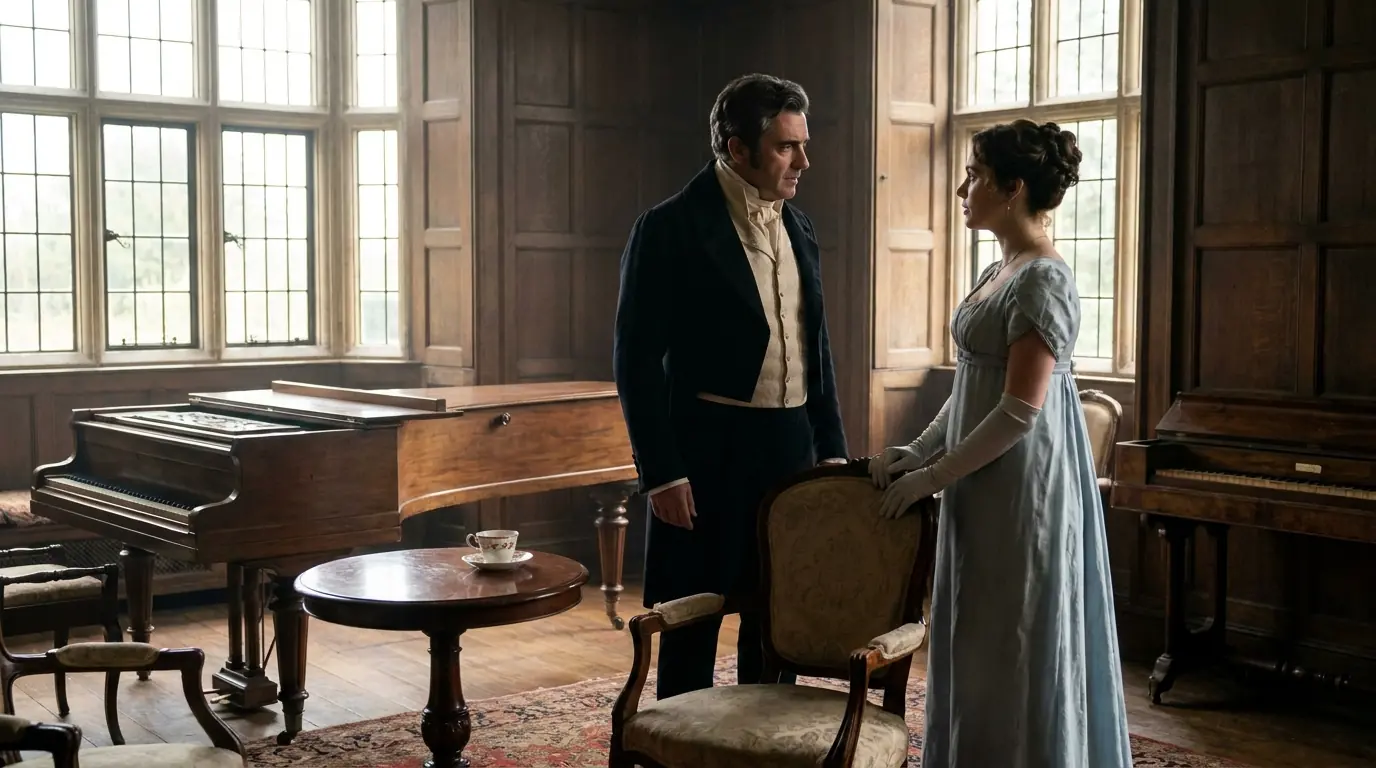
“I need to speak with you,” she said from the doorway, not waiting for an invitation to enter.
Henry looked up, surprise evident in his expression.
Flora rarely sought him out, respecting the boundaries he had established from the beginning of their marriage.
“What is it?” he asked, setting down his glass.
Flora crossed the room and placed Richard Stanfield’s journal on the desk before him.
“We received a visitor today. Miss Victoria Stanfield, Richard’s sister.”
Henry stiffened.
“What did she want?”
“To warn you,” Flora replied evenly.
“About Eleanor?”
A muscle tightened in Henry’s jaw.
“I don’t need warnings about Eleanor. I know exactly what she is.”
“Do you?” Flora challenged gently. “Read the journal, Henry. Then tell me if you still believe that.”
She turned to leave, but his voice stopped her.
“Did you read it?”
Flora paused at the door.
“Yes.”
“And what did you learn about the woman I almost married?”
“That you had a fortunate escape,” Flora answered, meeting his gaze directly. “And that she has returned to finish what she started seven years ago. Only this time her methods may be more final.”
She left him then, closing the door softly behind her.
Whatever Henry discovered in those pages, whatever decisions he made in the coming days, Flora knew that their marriage had reached a turning point.
The comfortable distance they had maintained for seven years could no longer protect either of them from the truths they had avoided.
Long after midnight, Flora stood at her bedroom window, watching the moonlight cast silver patterns on the garden below.
She had dismissed her lady’s maid hours ago but found sleep elusive, her mind too full of the day’s revelations.
A soft knock at her door startled her from her thoughts.
“Yes,” she called, reaching for her dressing gown.
The door opened to reveal Henry, still fully dressed, the journal clutched in his hand.
His face was haggard, his eyes haunted.
“May I come in?” he asked, his voice rough.
Flora nodded, belting her dressing gown more securely.
“Of course.”
He entered, closing the door behind him.
For a moment, he simply stood there, taking in the feminine touches of her bedchamber, a room he had never entered in seven years of marriage.
“I read it,” he said finally, holding up the journal. “All of it.”
“I see.”
Flora remained by the window, uncertain what to say.
Henry moved to the small sitting area near the fireplace, sinking into a chair as though his legs could no longer support him.
“I’ve been such a fool.”
“No,” Flora said softly. “You were betrayed by someone you loved. There is no shame in that.”
He laughed bitterly.
“Isn’t there? Seven years, Flora. Seven years chasing a phantom, searching for answers. While all along—”
He shook his head.
“She left me for money. Simple avarice.”
“People have done worse for less,” Flora offered, moving to sit across from him.
“I received a letter from her,” Henry confessed abruptly. “The day after the Hartswood dinner. She asked to meet to explain everything. I nearly went.”
Flora’s heart constricted.
“What stopped you?”
“You,” he answered, surprising her. “What you said in the carriage that night about her timing being convenient. It made me hesitate. And then Victoria arrived with this.”
He tossed the journal onto the small table between them as though it was something unclean.
“What will you do now?” Flora asked, the question that had hovered between them for days.
Henry looked up, truly seeing her perhaps for the first time.
“Protect what is mine. If what Richard suspected is true, Eleanor is dangerous. She poisoned her husband for his fortune. She might well attempt the same with me.”
“She would have to get close to you first,” Flora pointed out.
“Yes,” Henry agreed. “Which is why we must present a united front. No more separate appearances at social events. No more rumors of a marriage in name only.”
Flora felt her pulse quicken.
“What exactly are you proposing, Henry?”
He leaned forward, his gaze intent.
“A real marriage, Flora. Or at least the appearance of one. Enough to convince Eleanor and the ton that there is no vulnerability for her to exploit.”
“I see,” Flora said carefully, ignoring the sharp disappointment that lanced through her.
Of course, it was strategy, not sentiment, that brought him to her door.
“And how long would this performance last?”
“Until the danger has passed,” Henry replied, his expression unreadable. “Until Eleanor realizes her schemes will not succeed and leaves London.”
“And if she does not leave?”
“Then we maintain the charade,” Henry said simply. “It shouldn’t be difficult. You’ve played the perfect duchess for seven years already.”
“Yes,” Flora agreed, her voice steady despite the ache in her chest. “I have some experience with pretense.”
Henry stood, crossing to her.
“This isn’t fair to you. I know. You agreed to a marriage of convenience, not this.”
“I agreed to be your wife,” Flora corrected him gently. “In whatever capacity you required.”
Something flickered in his eyes.
Regret perhaps, or realization.
“I haven’t been a husband to you in any real sense of the word.”
“No,” she acknowledged. “You haven’t.”
They stood in silence for a moment, the moonlight casting both their faces in silver and shadow.
“Tomorrow,” Henry said finally, “I’ll have my things moved to the connecting suite.”
He gestured to the door that had remained locked since their wedding day, the door that led to what should have been the Duke’s chambers.
“We’ll begin appearing together at social functions, dining together, riding together in the park.”
“As you wish,” Flora agreed, keeping her tone neutral.
Henry hesitated, then reached out to touch her cheek, a gesture so unexpected that Flora nearly flinched.
“Thank you,” he said softly, “for showing me the truth. For being steadfast all these years.”
Before she could respond, he withdrew his hand and moved toward the door.
“Good night, Flora.”
“Good night, Henry,” she whispered as the door closed behind him.
Alone again, Flora pressed her fingers to her cheek where his touch still lingered, wondering if it was possible to both gain and lose everything in the same moment.
The next morning dawned cold and clear, the first true frost of autumn painting the garden in crystalline white.
Flora watched from the breakfast room window as servants hurried across the lawn, breath clouding in the chill air.
The frost seemed fitting, beautiful but temporary, like the new arrangement with her husband.
“You’re up early,” Henry’s voice came from the doorway.
Flora turned, surprised to find him already dressed for the day.
In all their years of marriage, they had rarely broken their fast together, each preferring the solitude of their private quarters in the morning hours.
“I often am,” she replied. “Though we have not often kept the same schedule.”
Henry entered, accepting a cup of coffee from the waiting footman.
“Another oversight to be corrected.”
His words were light, but something in his tone caught Flora’s attention.
She studied him as he took a seat at the table, noting the shadows beneath his eyes, the tension in his shoulders.
“Did you sleep well?” she asked, resuming her own place.
“Hardly at all,” he admitted. “The contents of that journal, I found them disturbing.”
“As did I,” Flora agreed, spreading a small amount of marmalade on her toast. “Have you decided what to do about Lady Stanfield?”
Henry’s expression hardened.
“I’ve instructed Bennett to refuse her at the door should she call, and I’ve sent word to my solicitor to begin investigating Richard Stanfield’s death. If there is evidence of foul play, it should be brought to light.”
“And Miss Victoria? Will you speak with her today?”
“Yes.” Henry nodded. “I have questions about her brother’s final days, details that might help build a case, should one be necessary.”
They ate in silence for several minutes, the quiet broken only by the clink of silverware against china and the occasional rustle of Henry’s newspaper.
It was strange, Flora thought, how intimate a simple breakfast could feel after years of careful distance.
“I received an invitation from Lady Somerset this morning,” she said finally. “A musical evening tomorrow. We should attend together to begin our new arrangement.”
Henry looked up from his paper.
“Yes, that would be suitable.”
He hesitated, then added, “You play the pianoforte beautifully. Perhaps you might be persuaded to perform.”
Flora nearly dropped her teacup.
“You’ve heard me play?”
“When?” A faint flush colored Henry’s cheeks. “You often play in the music room in the evenings. Sometimes when I work late in my study, I hear you through the walls.”
“Oh,” Flora said softly, strangely moved by the thought of Henry listening to her music, a private connection she had never suspected.
“Yes, I could play something if you wish.”
“I would,” he said simply, returning to his paper.
Flora finished her breakfast in contemplative silence, wondering what other small threads might have connected them over the years without her knowledge.
As she rose to leave, Henry spoke again.
“There will be talk, you know, about the sudden change in our public behavior.”
“There is always talk,” Flora replied with a small smile. “Let them speculate. It matters only what we know to be true.”
Henry regarded her thoughtfully.
“And what is true, Flora, about us?”
The question caught her off guard, direct and searching in a way Henry had never been with her before.
“That we are husband and wife,” she answered carefully. “That we have built a life, however unconventional, that has suited our purposes for seven years, and that now circumstances require adjustment.”
“A diplomatic answer,” Henry observed, rising as well. “Worthy of a duchess.”
“The only answer I have to give,” Flora replied, meeting his gaze steadily.
Something unreadable flickered in his eyes.
“For now, perhaps. But I find myself curious about what lies beneath the diplomatic duchess. The woman I’ve lived alongside for seven years but never truly known.”
Before Flora could respond, Bennett appeared at the doorway.
“Your Grace, Mr. Price has arrived. He says he has urgent information regarding the matter you discussed yesterday.”
“Nathaniel Price, my investigator,” Henry explained to Flora. “Show him to my study, Bennett. I’ll be there directly.”
As the butler withdrew, Henry turned back to Flora.
“Would you join us? This concerns you as well now.”
Surprised by the invitation, Flora nodded.
“Of course.”
Together, they walked to Henry’s study, a room Flora had rarely entered during their marriage.
It was distinctly masculine, with dark leather furniture, oak-paneled walls, and shelves lined with leather-bound volumes.
A large desk dominated one end, while a comfortable seating area surrounded the fireplace at the other.
Nathaniel Price stood as they entered, bowing to them both.
He was a slight, unassuming man with sharp eyes that missed nothing, precisely the qualities that made him an excellent investigator.
“Your Grace,” he greeted Henry, then turned to Flora. “Your Grace, a pleasure to see you again.”
“You have information, Price?” Henry asked, gesturing for them both to be seated.
“Indeed, Your Grace, and most concerning.”
Price withdrew a notebook from his coat pocket.
“As instructed, I began inquiries into Lady Stanfield’s activities since her return to London. She arrived three weeks ago, taking a house in Grosvenor Square that belongs to her late husband’s family. She brought with her a personal maid, a French cook, and a manservant, all hired in Italy.”
“Nothing unusual in that,” Henry observed.
“No, Your Grace. What is unusual is that she made contact with a certain apothecary in Covent Garden within two days of her arrival. A man named Simmons, known in certain circles for preparing specialized compounds.”
Flora exchanged a glance with Henry.
“Poisons?” she asked quietly.
Price nodded.
“Among other things. Nothing that could be proven illegal, but his clientele tends toward the desperate or the dangerous.”
“Has she visited him again?” Henry asked.
“Twice more, Your Grace. Most recently yesterday afternoon.”
Price consulted his notes.
“She also made inquiries about your habits, Your Grace, your club, your preferred riding paths in the park, your business associations. She seems particularly interested in when you might be alone.”
A chill ran through Flora.
“She means to approach him when I’m not present.”
“So it would appear, Your Grace,” Price agreed. “There’s more. Lady Stanfield has been making discreet inquiries about annulments and divorces among the peerage, specifically cases where marriages were dissolved due to lack of consummation.”
Flora felt heat rush to her face, even as her stomach knotted with dread.
So Eleanor’s plan was becoming clear.
Isolate Henry, perhaps poison him slowly as she had Richard Stanfield, while simultaneously investigating ways to invalidate his marriage.
Henry’s expression had darkened to something dangerous.
“She plans comprehensively.”
“She does, Your Grace,” Price confirmed. “There is one more thing. Lady Stanfield has arranged to attend Lady Somerset’s musical evening tomorrow night.”
“As have we,” Flora said, her voice steadier than she felt. “It seems the confrontation will come sooner rather than later.”
“So it would seem,” Henry agreed, turning back to Price. “Continue your surveillance of Lady Stanfield. I want to know everywhere she goes, everyone she meets, and see what else you can discover about Richard Stanfield’s death. His sister believes he was poisoned. Find out if there’s evidence to support the claim.”
“Yes, Your Grace.”
Price rose, bowing again.
“I’ll report again tomorrow morning.”
After the investigator had left, Henry remained silent, staring into the fire.
Flora watched him, noting the tight set of his jaw, the way his fingers drummed restlessly on the arm of his chair.
“She won’t succeed,” Flora said quietly.
Henry looked up, his gaze sharp.
“How can you be so certain?”
“Because we know what she intends,” Flora replied simply. “And because she underestimates me.”
A ghost of a smile touched Henry’s lips.
“I believe I may have made the same mistake.”
“It’s not an uncommon one,” Flora said, rising from her chair. “Men often do.”
Before she reached the door, Henry spoke again.
“Flora.”
She turned, waiting.
“I’m sorry,” he said, the words seeming to cost him considerable effort. “For seven years, I’ve been chasing a ghost while ignoring the woman before me. I’ve been less than the husband you deserved.”
The apology, unexpected and sincere, caught Flora off guard.
“We both entered this marriage with open eyes, Henry. You never promised me more than you gave.”
“Perhaps that was the failing,” he replied softly. “Perhaps I should have.”
Not knowing how to respond to this new reflective Henry, Flora simply nodded and left the study, her thoughts in turmoil.
Lady Somerset’s musical evening was one of the most anticipated events of the autumn season.
Her townhouse in Berkeley Square boasted a magnificent music room with exceptional acoustics, and she prided herself on presenting only the finest musicians and accomplished amateurs to her guests.
Flora felt every eye upon them as she and Henry entered the already crowded room.
She wore a gown of deep crimson silk, more vibrant than her usual subdued palette, with Henry’s grandmother’s rubies at her throat and ears.
Henry, resplendent in black evening wear, kept his hand at the small of her back, a gesture that raised eyebrows among those accustomed to the polite distance the Duke and Duchess typically maintained in public.
“My dears,” Lady Somerset hurried forward, her face alight with curiosity poorly disguised as welcome. “How delightful to see you both, and looking so well, I must say.”
“You’re too kind, Lady Somerset,” Flora replied warmly. “We’ve been looking forward to this evening. Your musical gatherings are always exceptional.”
“Indeed they are,” Henry agreed, his hand remaining possessively at Flora’s waist. “I understand my wife has agreed to favor us with a performance tonight.”
Lady Somerset’s eyes widened slightly.
“Has she indeed? How wonderful. We shall place you after Miss Harrington’s violin sonata, Your Grace.”
As their hostess moved away to greet other guests, Flora felt a ripple move through the crowd.
Following the direction of the murmurs, she saw Eleanor Stanfield making her entrance.
The widow wore a striking gown of midnight blue that displayed her golden beauty to perfection, her hair arranged in an elaborate style studded with sapphires.
Her gaze swept the room until it found Henry, and a smile of calculated warmth curved her lips.
She began moving in their direction, only to falter slightly when she noticed Flora at Henry’s side, his arm now around her waist.
“She’s surprised to see us together,” Flora murmured.
“Good,” Henry replied quietly. “Let her wonder.”
Eleanor recovered quickly, approaching them with practiced grace.
“Your Grace,” she curtsied to Henry, then turned to Flora. “Your Grace, how lovely to see you both.”
“Lady Stanfield,” Henry acknowledged coolly. “I wasn’t aware you had an interest in music.”
“There are many things about me you’ve yet to learn, Henry,” Eleanor replied, her voice dropping to an intimate tone. “Or perhaps relearn.”
Flora felt Henry’s arm tighten around her waist.
“I doubt that very much, Lady Stanfield. Some lessons, once learned, need no repetition.”
Eleanor’s smile faltered slightly.
“You seem different, Henry. Not the man I remember.”
“Seven years changes a person,” Henry replied evenly. “As does marriage to the right woman.”
The pointed emphasis on his words was not lost on Eleanor, whose gaze flickered to Flora, reassessing.
“Indeed,” she said smoothly. “Speaking of changes, I’ve only recently returned to London and find myself quite without escort for Lady Hartswood’s masquerade ball next week. Perhaps you might recommend a suitable companion.”
The transparent attempt to separate Henry from Flora might have been amusing if it were not so brazen.
“I’m afraid I cannot help you there,” Henry replied. “I’ll be escorting my wife, of course.”
Eleanor’s smile turned brittle.
“Of course. How thoughtless of me to suggest otherwise.”
Before she could say more, the first performer was announced, and guests began moving toward the seats arranged before the pianoforte.
Henry guided Flora to a place near the front, ensuring Eleanor could not join them.
“That was direct,” Flora whispered as they sat. “Perhaps too direct. We don’t want to alarm her.”
“Let her be alarmed,” Henry replied, his voice hard. “I want her to know that whatever game she’s playing, she will not find me an easy mark.”
The music began, a skilled tenor performing a Schubert lied.
Flora tried to concentrate, but her nerves were too alert, too aware of Eleanor watching them from across the room, and of Henry beside her, his thigh occasionally brushing against hers in a way that sent inexplicable shivers through her body.
When it came time for her to perform, Flora moved to the pianoforte with outward calm, though her heart raced.
She had selected a Beethoven sonata, one that began softly but built to passionate intensity, a piece she had often played alone in the music room at Greystone Manor, never knowing Henry listened.
As her fingers touched the keys, the room faded away.
There was only the music flowing through her, expressing all she could not say in words, the loneliness of seven years, the yearning for connection, the growing spark of something new and fragile between her and the man she had married but never truly known.
When the final notes died away, there was a moment of silence before the applause began.
Flora looked up to find Henry watching her, his expression unguarded for once, filled with something that looked almost like wonder.
As she returned to her seat, he took her hand, bringing it to his lips in a gesture that sent a ripple of whispers through the assembled guests.
“That was beautiful,” he murmured. “Like hearing it for the first time, seeing you play.”
For the remainder of the evening, Henry kept Flora close, his attention entirely focused on her.
They conversed, they laughed, they shared private observations, a performance of marital intimacy so convincing that Flora herself sometimes forgot it was merely for show.
Eleanor watched them with increasing frustration, her attempts to draw Henry’s attention repeatedly thwarted.
By the time they took their leave, the widow’s beautiful face had settled into lines of calculation and displeasure.
In the carriage ride home, Flora finally relaxed against the cushions, the tension of the evening catching up with her.
“Do you think we convinced her?”
“I’m not certain,” Henry replied thoughtfully. “Eleanor is shrewd. She may suspect a stratagem.”
“Then we must be more convincing,” Flora said decisively.
Henry studied her in the dim carriage light.
“You played beautifully tonight. I’ve never heard that piece performed with such feeling.”
“Thank you,” Flora replied, strangely shy under his regard. “It helped to know you were listening.”
“I’ve always listened, Flora,” Henry said quietly. “Even when you didn’t know it.”
The words hung between them, laden with meaning that extended beyond music.
As Greystone Manor came into view, Flora wondered what other changes this strange new chapter of their marriage might bring.
The following week brought a flurry of social engagements, each one an opportunity to present their united front to society and to Eleanor.
They attended dinner parties, the theater, afternoon rides in the park.
Everywhere they went, Henry remained attentive, solicitous, his hand often at Flora’s elbow or the small of her back, his eyes frequently seeking hers across crowded rooms.
The ton noticed, of course.
Whispers followed them, speculations about what had caused this sudden change in the famously distant Duke and Duchess of Westmere.
Some suggested a baby might be expected at last. Others hinted at a renewed marriage contract with more favorable terms for the Duchess.
A few even wondered if the Duke had finally transferred his affections from the ghost of Eleanor Rutherford to the wife who had waited patiently for seven years.
Flora tried not to listen to the gossip, tried not to let her heart be swayed by gestures she knew were calculated for public consumption.
Yet it became increasingly difficult to maintain her emotional distance as days passed, and the boundaries between performance and reality began to blur.
Henry now breakfasted with her each morning. They dined together each evening.
He sought her opinions on business matters, listened to her play the pianoforte in the evenings, and walked with her in the gardens when weather permitted.
Most significantly, he had moved his personal items to the connecting suite, though the door between their chambers remained closed each night.
It was a convincing charade of marital harmony, so convincing that sometimes, in unguarded moments, Flora found herself forgetting it was not real.
One morning, ten days after their confrontation with Eleanor at Lady Somerset’s musical evening, Flora sat at her dressing table while her maid arranged her hair for a riding excursion with Henry.
A knock sounded at her door, and to her surprise, Henry himself entered, already dressed in his riding clothes.
“Your Grace,” her maid bobbed a curtsy, surprised by the Duke’s unusual appearance in his wife’s private chambers.
“Leave us, please, Jane,” Henry requested. “I need to speak with the Duchess privately.”
When the maid had gone, Henry crossed to Flora, his expression grave.
“Price has brought news. It seems Eleanor has accelerated her plans.”
Flora’s hand stilled in the act of fastening a pearl earring.
“What has she done?”
“She’s been spreading rumors,” Henry replied, his jaw tight with anger, “suggesting that our marriage was never consummated, that you remain as much a maiden as the day we wed.”
Heat rushed to Flora’s cheeks.
“That’s outrageous.”
“It’s calculated,” Henry countered. “She’s laying groundwork for the suggestion that our marriage could be easily annulled, should I wish to be free of it.”
Flora rose from her dressing table, moving to the window to hide the hurt that flashed across her face.
“I see. And what do you wish to do about these rumors?”
She heard Henry move behind her, felt his presence close at her back.
“There is only one way to definitively quash such speculation,” he said quietly.
Flora turned, finding him much closer than she had expected, his gray eyes intent upon her face.
“Which is?”
“To make it abundantly clear that you are my wife in every sense of the word,” Henry replied, his voice dropping lower. “To ensure that no one, including Eleanor, can doubt the nature of our relationship.”
Flora’s heart began to beat faster.
“And how do we accomplish that?”
“We must share a bedchamber,” Henry said simply. “Not just for appearances, the servants talk, but in truth.”
The implication hung in the air between them, charged with seven years of distance and the strange new intimacy that had been growing over the past fortnight.
“You wish to consummate our marriage,” Flora stated, needing to hear the words plainly spoken. “After seven years.”
“Yes.”
Henry took a step closer.
“If you are willing.”
Flora searched his face, looking for signs that this was merely another strategic move, another piece in the game against Eleanor.
What she saw instead confused her.
Desire certainly, but also uncertainty and something that looked almost like tenderness.
“Why now, Henry?” she asked softly. “Is it only because of Eleanor’s rumors?”
He hesitated, then shook his head.
“No. Not only that.”
“Then what?”
Henry ran a hand through his hair, a gesture of frustration she had rarely seen from him.
“I don’t know how to explain it, Flora. These past weeks, seeing you differently, being with you differently. It’s as though a fog has lifted.”
He paused, struggling visibly with words that did not come easily to him.
“I find myself thinking of you at odd moments, wanting to hear your opinions, wondering what might make you smile.”
He continued softly.
“The truth is, I’ve been a fool. For seven years, I’ve been living with a remarkable woman and never bothered to truly know her. And now that I’ve begun to see you, really see you, I find I want more.”
Flora’s breath caught in her throat.
“More?”
“More of you,” Henry said simply. “More than this careful performance we’ve constructed, more than separate lives lived under the same roof.”
He reached out, his fingers tracing the curve of her cheek with a gentleness that made her tremble.
“I want a real marriage, Flora. Not just in name, not just for show.”
“Because of Eleanor’s schemes,” she whispered, needing to be certain.
“Because of you,” he replied. “Eleanor’s return may have opened my eyes, but what I see now has nothing to do with her and everything to do with the woman who has stood beside me with grace and dignity for seven years, asking nothing in return.”
Flora closed her eyes, overwhelmed by words she had never expected to hear from her husband’s lips.
“I cannot promise my heart. Not yet,” Henry continued softly. “That would be a lie. But I can promise to try to be the husband you deserve, to build something real between us, if you’ll give me the chance.”
When she opened her eyes, he was watching her with an expression she had never seen before, vulnerable, hopeful, uncertain.
“Yes,” she said simply. “I will give you that chance.”
Relief washed over his features, followed by something darker, more intense.
Slowly, giving her time to withdraw if she wished, he leaned down and pressed his lips to hers, their first kiss in seven years of marriage.
It was gentle at first, exploratory, but quickly deepened as suppressed desire flared between them.
Flora’s hands came up to clutch at his shoulders as his arms wrapped around her waist, drawing her against the solid warmth of his body.
When they finally broke apart, both breathing heavily, Henry rested his forehead against hers.
“Perhaps we should postpone our riding excursion,” he suggested, his voice rough with want.
Flora smiled, a new confidence unfurling within her.
“I believe that would be wise, Your Grace.”
He captured her lips again, more urgently this time, and Flora surrendered to the knowledge that whatever had begun between them, whether born of strategy or genuine feeling, had irrevocably changed the nature of their marriage.
For better or for worse, the winter of their discontent was finally beginning to thaw.
Hours later, as afternoon shadows lengthened across the bedchamber, Flora lay in the circle of Henry’s arms, her head pillowed on his chest, listening to the steady rhythm of his heartbeat.
The intimacy they had shared had been both strange and familiar, the awkwardness of new lovers tempered by the deep knowledge of two people who had orbited each other’s lives for seven years.
Henry’s fingers traced idle patterns on her bare shoulder, his touch reverent in a way she had never imagined possible.
“I should have done this years ago,” he murmured, pressing a kiss to her temple.
Flora smiled against his skin.
“You weren’t ready then.”
“No,” he agreed. “I was too lost in bitterness, too focused on what I’d lost to see what stood before me.”
“And now?” she asked, raising her head to meet his gaze.
Henry tucked a strand of auburn hair behind her ear, his expression thoughtful.
“Now I find myself wondering how many other treasures I’ve overlooked through my own blindness.”
The tenderness in his voice brought a lump to Flora’s throat.
She had guarded her heart for so long, convinced that Henry would never see beyond the convenient arrangement of their marriage.
To have him look at her now with such warmth, such consideration, was almost more than she could bear.
“We should dress for dinner,” she said, reluctant to break the spell, yet wary of allowing hope too much rein.
Henry caught her hand as she moved to rise.
“Flora.”
She turned back to him, questioning.
“I meant what I said earlier,” he told her earnestly, “about building something real between us. This wasn’t just—”
He gestured to the rumpled bedding.
“Physical need.”
“I know,” she assured him, though a small part of her still feared the transience of this new connection.
“Do you?”
He sat up, drawing her back to him.
“Because I need you to understand. Whatever began as strategy has become something else entirely, something I never expected, but now find I cannot imagine losing.”
Flora searched his face, finding only sincerity in his gray eyes.
“Then we shall not lose it,” she promised. “We shall build on it day by day.”
His answering smile warmed her to her core.
“Starting now,” Henry agreed, pressing a kiss to her palm. “Though I fear we must first address the threat that looms over us.”
Flora nodded, sobering at the reminder of Eleanor’s schemes.
“What is our next move?”
“Price continues to gather evidence about Richard Stanfield’s death,” Henry replied, reluctantly releasing her hand. “Until we have enough to confront Eleanor directly, or take our suspicions to the authorities, we must remain vigilant.”
“The Hartswood masquerade is tomorrow night,” Flora reminded him as she rose, pulling on her dressing gown. “Eleanor will certainly be there.”
“As will we,” Henry affirmed, watching as she moved to the bell pull to summon her maid. “Together.”
The word held new meaning now, charged with the intimacy they had shared.
As Flora met his gaze across the room, she allowed herself, for the first time in seven years, to hope that the future might hold more than the cold politeness that had defined their past.
Lady Hartswood’s annual masquerade ball was the most anticipated event of the autumn season.
Her ballroom had been transformed into a fantastical woodland scene, with silk flowers climbing the walls and paper birds suspended from the ceiling on invisible threads.
Hundreds of candles cast a golden glow over guests in elaborate costumes and jeweled masks, creating an atmosphere of enchantment and possibility.
Flora entered on Henry’s arm, wearing a gown of silver-blue silk that shimmered like moonlight on water.
Her mask, adorned with pearls and tiny silver stars, concealed the upper half of her face, leaving only her lips and chin exposed.
Beside her, Henry cut an imposing figure in black evening wear, his mask a simple domino of dark velvet that did little to disguise his identity.
Few men possessed his height and bearing.
“You look beautiful,” he murmured as they paused at the entrance to the ballroom, his gaze warm with appreciation. “Like a winter goddess.”
Flora smiled, still unaccustomed to such open admiration from her husband.
“And you make a very handsome shadow, Your Grace.”
His answering smile sent a flutter through her stomach, a reaction she was beginning to associate with this new, attentive version of Henry.
The past twenty-four hours had brought changes she scarcely dared believe, each moment of genuine connection reinforcing the fragile hope that what had begun as strategy might truly evolve into something lasting.
“Shall we dance?” Henry asked, guiding her toward the center of the ballroom, where couples were already moving to the music.
“With pleasure,” Flora replied, allowing him to draw her into his arms.
As they joined the waltz, Flora caught glimpses of curious eyes behind masks, watching the Duke and Duchess of Westmere dance with unprecedented closeness.
Even through the festive chaos, their sudden intimacy had not gone unnoticed.
“We have an audience,” she murmured.
“Let them watch,” Henry replied, his hand pressing more firmly against the small of her back. “I find I no longer care what the ton thinks of us.”
“No?”
Flora raised an eyebrow behind her mask.
“And what of Eleanor? I haven’t spotted her yet.”
“She’ll be here.” Henry’s expression darkened momentarily. “But she too shall witness what everyone else sees. That the Duke of Westmere is entirely captivated by his wife.”
The words sent warmth cascading through Flora’s chest.
“Is he indeed?” she asked, her voice light, though her heart pounded.
Henry’s gaze softened as it held hers.
“More than he ever thought possible.”
They danced in silence for several measures, each lost in private thoughts.
Flora allowed herself to savor the sensation of being held in her husband’s arms, their bodies moving in perfect harmony, as though they had been dancing together for years rather than days.
As the music ended, Henry reluctantly released her.
“I should greet Lord Hartswood,” he said. “He mentioned wanting to discuss the West Indies shipping routes.”
“Of course,” Flora nodded. “I believe I see Lady Clarendon by the refreshment table. I should pay my respects to my mother.”
“I’ll find you shortly,” Henry promised, his fingers lingering on hers before he moved away through the crowd.
Flora watched him go, still marveling at the transformation in their relationship.
Then, squaring her shoulders, she turned toward the refreshment table, where her mother was holding court among a circle of admirers.
Lady Clarendon’s eyes widened slightly as Flora approached, though her social smile never faltered.
“My dear daughter,” she greeted, air-kissing Flora’s cheeks. “What a charming costume. Silver becomes you.”
“Thank you, Mother,” Flora replied, accepting a glass of champagne from a passing footman. “You look well.”
The countess, dressed as a Roman empress in purple silk and a gold laurel wreath, preened slightly at the compliment.
“One does what one can with advancing years,” she said modestly, though her expression suggested she considered herself to have triumphed magnificently over time’s ravages.
As the other guests drifted away, Lady Clarendon leaned closer, her voice dropping.
“I’ve been hearing the most interesting rumors, Flora, about you and the Duke.”
“Have you indeed?”
Flora kept her tone neutral, though she couldn’t suppress a small smile.
“They say you’ve become closer,” her mother continued, shrewd eyes studying Flora’s face. “That the Duke hardly leaves your side these days. That he looks at you as though seeing you for the first time.”
“Perhaps he is,” Flora replied simply.
Lady Clarendon’s painted brows rose higher.
“My dear, has something changed after all this time?”
Before Flora could respond, a ripple of whispers spread through the ballroom, drawing their attention.
Eleanor Stanfield had arrived, and her entrance was nothing short of spectacular.
Dressed as Cleopatra, she wore a gown of shimmering gold that clung to her statuesque figure, her blonde hair elaborately arranged and intertwined with gold serpents.
Her mask, shaped like the wings of a golden falcon, highlighted her striking blue eyes.
Even among the lavishly costumed guests, she commanded attention, her beauty heightened by the dramatic costume.
“The widow makes her move,” Lady Clarendon observed dryly. “Rather obvious, isn’t it?”
“Eleanor Stanfield has never favored subtlety,” Flora replied, watching as the blonde woman scanned the ballroom, clearly searching for someone.
Her mother’s gaze sharpened.
“You know her.”
“We’ve been introduced,” Flora said carefully. “She was at Lady Somerset’s musical evening.”
Understanding dawned in Lady Clarendon’s eyes.
“So that is the wind that changes your weather, is it? Competition has finally roused the Duke from his indifference.”
“Mother,” Flora admonished gently. “It is more complicated than that.”
“I’m sure it is, dear.” The countess patted her hand patronizingly. “Men often are. But whatever the cause, I’m pleased to see the change. A duchess without an heir is in a precarious position, as I’ve always said.”
Flora felt heat rise to her cheeks at the implication.
“If you’ll excuse me, Mother, I should find Henry.”
As she turned to leave, Lady Clarendon caught her arm.
“Be careful, Flora,” she warned, her expression unusually serious. “That woman didn’t earn the nickname the Golden Viper for nothing. She destroyed the Duke once before.”
Surprised by the genuine concern in her mother’s voice, Flora nodded.
“I know, Mother. But Henry is not the same man he was seven years ago.”
“Let us hope not,” the countess replied. “For both your sakes.”
Flora moved through the crowd, searching for Henry while keeping one eye on Eleanor, who had begun working her way through the ballroom with calculated grace.
The widow’s path seemed random, but Flora noted she was gradually moving toward the corner where Henry stood in conversation with Lord Hartswood and several other gentlemen.
Before Flora could reach her husband, she felt a light touch on her arm.
Turning, she found Miss Victoria Stanfield, dressed simply as a shepherdess in pale blue, her dark eyes anxious behind her modest mask.
“Your Grace,” Victoria curtsied. “Forgive the interruption, but I must speak with you urgently.”
“What is it, Miss Stanfield?” Flora asked, drawing her toward a quieter alcove.
“She’s here,” Victoria said, her voice trembling slightly. “And she’s seen me. I didn’t think she would recognize me in costume, but—”
“Eleanor knows you’re in London?” Flora asked, alarmed.
Victoria nodded.
“She was watching when I arrived. The way she looked at me, Your Grace. I fear she suspects I’ve spoken to the Duke about Richard’s death.”
Flora glanced across the ballroom.
Eleanor had nearly reached Henry’s group, her golden gown gleaming in the candlelight.
“Stay close to me,” she instructed Victoria. “We’ll join my husband immediately.”
Together, they moved through the crowded room, Flora’s heart racing as she saw Eleanor reach Henry’s side.
Even from a distance, she could see the widow’s practiced smile, the way she placed her hand on Henry’s arm as she spoke.
By the time Flora and Victoria reached them, Eleanor was saying, “Such a delightful surprise to find you here, Henry. I had begun to think you were avoiding me.”
“Not at all, Lady Stanfield,” Henry replied coolly, his gaze shifting to Flora as she approached, relief evident in his expression. “Merely occupied with matters of greater importance.”
Eleanor turned, her smile faltering slightly as she saw Flora.
“Your Grace, what a charming costume. Silver suits you, though perhaps not as well as gold would have.”
“I find silver has its own quiet strength,” Flora replied evenly. “Less ostentatious, perhaps, but more enduring.”
Eleanor’s eyes narrowed behind her mask as she registered the subtle rebuke.
Then her gaze shifted to Victoria, and her smile turned predatory.
“And who is your little shepherdess friend? She seems familiar somehow.”
Victoria visibly tensed, but Flora placed a reassuring hand on her arm.
“I believe you know Miss Stanfield quite well, Lady Stanfield. Your late husband’s sister has been our guest these past weeks.”
A flash of genuine shock crossed Eleanor’s face before she recovered her composure.
“Victoria, how unexpected. I had no idea you were in London.”
“I arrived shortly after you did, sister,” Victoria replied, her voice steadier than Flora had expected. “Though under different circumstances.”
“Indeed,” Eleanor’s tone was dangerously sweet. “And what circumstances would those be?”
“I believe this is neither the time nor place for such discussions,” Henry interjected firmly. “Miss Stanfield is under our protection, Lady Stanfield. I would advise you to remember that.”
Eleanor’s gaze moved between them, calculation evident in her blue eyes.
“How touching. The Duke and Duchess of Westmere, champions of orphaned spinsters.”
Her attention fixed on Henry.
“Though I wonder what your true interest might be, Henry. Victoria was always rather plain for your tastes.”
The deliberate cruelty of the remark hung in the air.
Before either Henry or Flora could respond, Victoria stepped forward, her chin raised defiantly.
“My brother kept a journal, Eleanor,” she said quietly. “I found it after his death.”
All color drained from Eleanor’s perfect face.
For a moment her mask slipped, revealing naked fear beneath the practiced confidence.
“I don’t know what you mean,” she managed, though her voice had lost its melodic quality.
“I think you do,” Henry said, his tone implacable. “Richard documented his suspicions quite thoroughly, about his illness, about your meetings with the chemist, about your sudden interest in his will.”
Eleanor’s gaze darted around the ballroom as though seeking escape.
“This is absurd,” she hissed. “You cannot possibly believe—”
“We have the journal,” Flora interrupted calmly. “And Mr. Price has been investigating your activities since your return to London, including your visits to a certain apothecary in Covent Garden.”
“Seeking headache powder,” Eleanor protested, though her hands trembled visibly. “This is slander, nothing more. I loved Richard. I nursed him through his illness. I mourned him.”
“You murdered him,” Victoria stated flatly. “And you would have done the same to the Duke given the opportunity.”
Eleanor’s beautiful face contorted with fury.
“You have no proof. None that would stand in any court.”
“Perhaps not yet,” Henry acknowledged. “But we have enough to destroy your reputation in society. Enough to ensure that no gentleman of standing would consider aligning himself with you. Enough to make your position in London untenable.”
For a long moment, Eleanor stood frozen, her gaze moving between them as she calculated her options.
Then abruptly, her demeanor changed, softening into the vulnerable beauty that had once captivated Henry.
“Henry,” she said, her voice breaking slightly, “surely you don’t believe these absurd accusations, after what we meant to each other. After all this time.”
Flora felt a flicker of anxiety as Eleanor turned the full force of her charm on Henry.
For seven years, this woman had held his heart captive.
Would he waver now, faced with her apparent distress?
But Henry’s expression remained unmoved, his gray eyes cold as he regarded the woman who had once been his fiancée.
“What we meant to each other,” he repeated. “You left me at the altar for my cousin and his fortune. You made me a laughingstock before all of society, and now you return, a widow under suspicious circumstances, making discreet inquiries about annulments and divorce laws.”
He shook his head, a look of wonder crossing his features.
“For seven years, I searched for you, wondering what had gone wrong, what I might have done differently. What a fool I was.”
Eleanor’s facade cracked further, desperation replacing calculation in her eyes.
“It wasn’t like that, Henry. I was young, confused.”
“You were calculating,” Henry corrected flatly. “Just as you are now. The only difference is that this time I can see you clearly.”
He turned to Flora, his expression softening as he took her hand.
“Thanks to my wife.”
The simple gesture and the warmth in his voice as he acknowledged Flora seemed to affect Eleanor more than any accusation.
Her gaze moved between them, finally registering the genuine connection that had formed where once there had been only polite distance.
“So it’s true,” she said quietly. “The rumors. You finally decided to make her your wife in more than name.”
“I’ve finally recognized what has been before me all along,” Henry replied. “A woman of grace, intelligence, and loyalty. Everything you pretended to be, but never were.”
Eleanor’s mask of beauty slipped entirely then, revealing the cold calculation beneath.
“How touching,” she sneered. “The Duke finally notices his convenient little wife. I wonder how long that will last once the novelty wears off.”
“You have until tomorrow morning to leave London,” Henry said, ignoring her barb. “Return to Italy or wherever else you choose, but do not remain in England. If you do, I will ensure that Richard’s journal and Mr. Price’s findings reach the proper authorities, regardless of whether they constitute legal proof.”
Eleanor glared at him, all pretense abandoned.
“You wouldn’t dare. It would cause a scandal that would touch you, too.”
“I would dare much more to protect my wife and my name,” Henry replied evenly. “The question is whether you wish to test that resolve.”
For a long moment, the four of them stood in silence, the festivities continuing around them, oblivious to the drama unfolding in their midst.
Then Eleanor straightened, her chin lifting in defiance.
“Very well,” she said coldly. “I shall depart London tomorrow. But don’t imagine this is the end, Henry. You’ve made a powerful enemy tonight.”
“I’ve recognized a threat that has lingered too long,” he countered. “Goodbye, Eleanor. I trust we shall not meet again.”
Without another word, Eleanor turned and swept away through the crowd, her golden gown glittering under the chandeliers as she disappeared from view.
Victoria let out a shaky breath.
“Do you think she’ll actually leave?”
“She has little choice,” Henry replied. “Her schemes depended on secrecy and the advantage of surprise. Now that we know her intentions, she has lost both.”
Flora squeezed his hand, relief washing through her.
“It’s over then.”
Henry brought her fingers to his lips.
“This chapter, yes. But I find I’m rather looking forward to the next.”
The promise in his eyes made Flora’s heart soar with possibilities she had long ago ceased to imagine.
Dawn was breaking over London when Henry entered Flora’s bedchamber, already dressed for the day despite the early hour.
She sat up, blinking sleep from her eyes, her auburn hair tumbling loose around her shoulders.
“Henry, what is it?”
“Price just arrived with news,” he said, sitting on the edge of the bed. “Eleanor left London at first light, taking only her lady’s maid and a single trunk. She boarded the Dover packet.”
“Returning to the continent,” Flora murmured. “So it truly is over.”
“Yes,” Henry confirmed, taking her hand. “Victoria is safe. We are safe. And Eleanor Stanfield will find it very difficult to reestablish herself in any society where the Westmere name carries influence.”
Flora searched his face, looking for signs of regret or lingering attachment.
Instead, she found only relief and something warmer, more intimate.
“How do you feel?” she asked softly. “Knowing she’s gone for good this time.”
Henry considered the question, his thumb tracing circles on her palm.
“Liberated,” he said finally. “As though a weight I’ve carried for seven years has finally been lifted. Not just because she’s gone, but because I no longer care.”
He leaned closer, his free hand coming up to cup her cheek.
“The space she once occupied in my thoughts has been filled by someone far more deserving.”
Flora’s breath caught at the tenderness in his touch, the sincerity in his gray eyes.
“Henry—”
“I know we began this as a strategy against Eleanor’s schemes,” he continued, “but somewhere along the way it became real for me. More real than anything I’ve felt in seven years.”
He hesitated, then pressed on.
“I cannot promise you the innocent heart of the man I was before Eleanor’s betrayal. That man is gone. But I can offer you the heart I have now, older, perhaps wiser, and entirely yours, if you want it.”
Tears pricked at Flora’s eyes as the words she had never expected to hear fell from her husband’s lips.
“Are you saying you love me, Henry?”
A smile curved his mouth.
“I believe I am, Flora Ashford, though I’m making rather a mess of it.”
Joy bubbled up within her, bright and effervescent as champagne.
“On the contrary,” she whispered, drawing him closer. “I think you’re doing splendidly.”
His kiss was gentle at first, a question and a promise combined, before deepening into something more urgent, more passionate.
When they finally broke apart, both breathless, Henry rested his forehead against hers.
“Seven years,” he murmured. “Seven years I wasted chasing ghosts when what I truly needed was here all along.”
“Not wasted,” Flora corrected softly. “Perhaps we both needed those years. You to heal, me to grow stronger. Perhaps we weren’t ready for each other until now.”
Henry pulled back to look at her, wonder in his expression.
“How did you become so wise, my duchess?”
“I had time to observe,” she replied with a smile. “Seven years of watching and waiting tends to clarify one’s perspective.”
He gathered her close, his arms strong and secure around her.
“No more watching and waiting, Flora. From now on, we live, truly live together.”
As the first rays of sunlight streamed through the windows, painting the room in golden hues, Flora surrendered to the joy of being at last not just a duchess in name, but a woman truly and deeply loved by the man she had chosen seven years before.
The winter was over.
Spring had finally come to Greystone Manor.