The applause thundered through the opera house like a wave crashing against shore, jolting Rosalind from sleep with the disorienting violence of someone waking in an unfamiliar place.
Her neck ached. Her cheek felt warm against something firm and expensive-smelling: wool and cedar and something darker she couldn’t name.
She opened her eyes.
She was leaning against a man’s shoulder, a stranger’s shoulder.
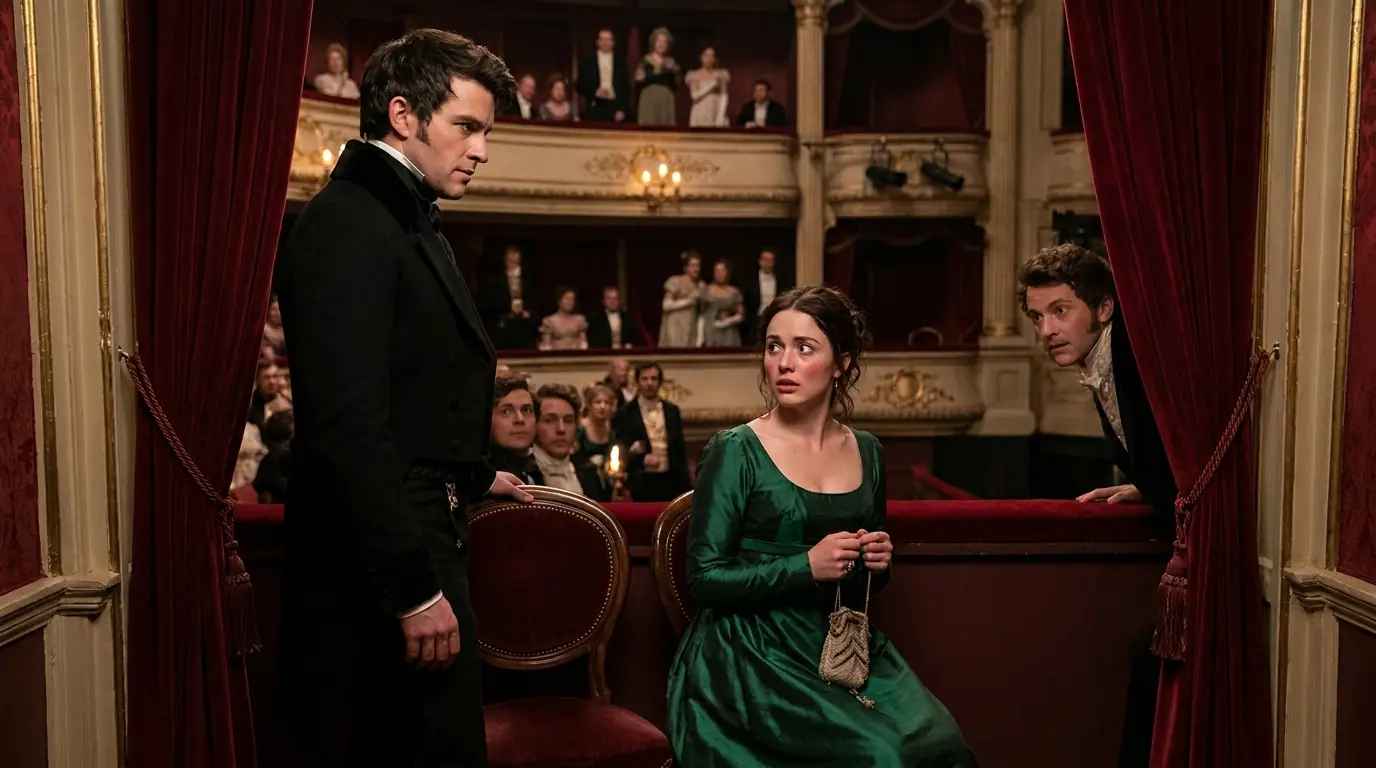
Heat flooded her face as she jerked upright, her borrowed silk gloves catching on the velvet of the theater seat.
The stranger beside her didn’t move immediately, his posture rigid and controlled in a way that suggested he had been aware of her presence for quite some time.
Around them, the audience rose in a rustle of fine fabric and polite conversation, but Rosalind could feel eyes turning toward their box, curious, amused, scandalized.
“I—”
Her voice came out rough.
She cleared her throat, mortification burning through her chest.
“I’m so terribly sorry. I didn’t mean to.”
The man finally turned to look at her.
He was younger than she had expected, perhaps thirty-three or thirty-four, with dark hair swept back from a face that would have been handsome if not for the cold assessment in his blue eyes.
There was something aristocratic in the sharp line of his jaw, the way he held himself with the unconscious authority of someone accustomed to being obeyed.
“Didn’t mean to what?” he asked, his voice low and precise. “Fall asleep during one of the season’s most anticipated performances, or use a complete stranger as your pillow?”
Rosalind’s hands twisted in her lap.
The emerald dress Felix Grimley had loaned her suddenly felt too tight, too obvious, too much like the costume it was.
“Both? Neither. I—where is Mr. Grimley?”
The stranger’s eyebrow lifted fractionally.
“The gentleman who abandoned you here? I haven’t the faintest idea.”
He stood with fluid grace, offering his hand.
“But I’m afraid you’ve created rather an interesting situation, miss.”
She stared at his outstretched hand, her mind racing.
Felix had promised this would be simple.
Sit quietly, watch the opera, cause no trouble.
He had even provided the dress, the gloves, the small beaded reticule that matched perfectly.
Jonathan had sworn it was harmless.
His friend just needed someone presentable for an evening, and Rosalind would finally get to experience the opera she had dreamed of for years.
No one had mentioned anything about being abandoned in a box with a stranger who looked at her like she was a particularly interesting problem to solve.
“I should go,” she said, not taking his hand. “I apologize again for the intrusion.”
“Too late for that, I’m afraid.”
His voice carried a note of dark amusement.
“Do you see them?”
Against her better judgment, Rosalind followed his gaze.
Several people in the boxes across from them were watching with barely concealed interest, fans fluttering, heads bent together in whispered conversation.
A woman in diamonds raised an opera glass directly toward them.
“They’ve been watching for the past forty minutes,” the stranger continued conversationally. “Watching you sleep against my shoulder with what I can only describe as rapt fascination. The Countess of Davenport has already sent her daughter to discover your identity. She’ll be here any moment.”
Panic clawed at Rosalind’s throat.
“I don’t understand. Why didn’t you wake me?”
His smile was razor sharp.
“Because, my dear, you’ve just solved a problem I’ve been trying to navigate for weeks.”
He leaned closer, his voice dropping to a murmur only she could hear.
“And now you’re going to help me with it.”
Before she could respond, the curtain to their box swept aside.
A young woman in pale pink entered first, her blonde curls perfectly arranged, her smile bright and predatory.
Behind her came an older woman dripping in sapphires, and behind them, Rosalind’s stomach dropped.
Three more society matrons, all watching her with the focused attention of cats cornering a mouse.
“Your Grace,” the woman in pink said, her voice sugary. “I didn’t realize you’d brought a guest this evening. How delightful.”
Your Grace.
The title crashed through Rosalind’s awareness like cold water.
She had been sleeping on a duke’s shoulder.
A duke.
She was going to kill Jonathan.
She was going to kill Felix Grimley.
She was going to die of mortification right here in the Royal Opera House and save them the trouble.
The Duke, because apparently that was what he was, straightened to his full height with the ease of someone who commanded rooms simply by existing in them.
“Lady Cecilia, Mrs. Hartford, ladies.”
His hand moved to the small of Rosalind’s back, the touch proprietary and warm through the silk of her dress.
“May I introduce Miss Rosalind Thorne, a dear friend of my sister’s?”
The lie was smooth, practiced, utterly convincing.
Rosalind’s mind screamed at her to correct him, to explain the misunderstanding, to find Felix, and escape this nightmare before it spiraled further out of control.
Instead, she heard herself say, “It’s a pleasure to make your acquaintance.”
The words came out steadier than she felt, shaped by years of her mother’s careful instruction in manners and deportment.
Just because they were not wealthy did not mean they were ignorant of how to behave.
Her parents had sacrificed everything to ensure both their children knew how to speak, how to move, how to exist in spaces above their station.
She had never imagined she would need those lessons quite like this.
“Thorne,” Lady Cecilia repeated, her eyes narrowing slightly. “I don’t believe I’m familiar with the family.”
“My sister met Miss Thorne at the lending library in Cheltenham,” the Duke said, his tone suggesting the conversation was concluded. “They’ve been corresponding ever since. Beatrice insisted I bring her to the opera tonight.”
Another lie effortlessly deployed.
“How charming,” one of the older matrons said, though her expression suggested she found it anything but. “Did you enjoy the performance, Miss Thorne?”
The question was loaded with judgment.
Everyone in this box knew she had been asleep for at least half of it.
Rosalind lifted her chin.
“The second act was sublime. Though I confess the journey to London was rather taxing. I’m afraid the fatigue caught up with me during the quieter moments.”
It was not quite an apology and was not quite a defense.
The Duke’s hand pressed slightly more firmly against her back.
Approval or warning, she could not tell.
“Of course,” Lady Cecilia said, her smile sharp. “Travel can be so exhausting. Though I must say, Your Grace, I didn’t realize you’d be bringing a guest when we discussed attending together.”
The emphasis on together was deliberate, possessive.
“Plans change,” the Duke said mildly. “I’m sure you understand, Lady Cecilia.”
The temperature in the box dropped several degrees.
Rosalind could feel the undercurrents swirling around them: jealousy, calculation, social maneuvering so complex she could barely track it.
This Lady Cecilia clearly believed she had some claim on the Duke’s attention, and Rosalind’s presence had disrupted whatever careful arrangement existed between them.
“Well,” Mrs. Hartford said brightly, breaking the tension, “I’m sure we’ll be seeing much more of you, Miss Thorne. Will you be attending the Peyton ball?”
Rosalind opened her mouth, but the Duke answered first.
“Miss Thorne will be staying at Carrington House for the remainder of the season, as my sister’s guest, naturally. I’m certain she’ll attend all the usual events.”
The world tilted sideways.
Carrington House.
The remainder of the season.
All the usual events.
“How wonderful,” Lady Cecilia said, her voice brittle as glass. “I look forward to becoming better acquainted.”
She swept from the box, the other women following like ladies-in-waiting departing after their queen.
Only when the curtain fell back into place did Rosalind allow herself to breathe.
“What,” she said slowly, turning to face the Duke, “just happened?”
His expression was unreadable.
“You fell asleep on my shoulder during the opera. Surely you remember that part.”
“Don’t be glib. You just told those women I’ll be staying at your house. You said I’m friends with your sister. You—”
She broke off, shaking her head.
“I don’t even know your name.”
“Sebastian Blackwell, Duke of Carrington.”
He said it as if she should have known, as if everyone in London knew.
“And yes, I told them you’ll be staying at Carrington House because that is precisely what you’re going to do.”
“I most certainly am not.”
“Did Mr. Grimley not explain the arrangement?”
Rosalind stared at him.
“What arrangement? He said he needed someone to accompany him to the opera. That’s all. He said I should sit quietly and not speak to anyone, and—”
The pieces clicked together with sickening clarity.
“He was supposed to be here in this box with me.”
“He was,” Sebastian agreed. “I hired him to find me someone suitable for a very specific purpose. Someone who could play the role of a potential match for the season, someone intelligent enough to navigate society, but unknown enough to disappear when the charade was no longer necessary.”
The cold calculation in his voice made her stomach turn.
“I’m not playing any role. I don’t know what arrangement you made with Felix Grimley, but I never agreed to—”
“And yet here you are in borrowed finery, sitting in a duke’s private box, having just spent forty minutes asleep on said duke’s shoulder in full view of half the ton.”
He stepped closer, his voice dropping to something almost gentle.
“Tell me, Miss Thorne, when you leave this opera house tonight, where exactly will you go? Back to whatever modest situation Felix pulled you from? Back to your brother, who is likely in debt to half the tradesmen in London?”
She wanted to slap him.
“How dare you?”
“I dare because I’m offering you an opportunity.”
His eyes held hers, intense and unwavering.
“My grandmother expects me to marry immediately. She’s been throwing eligible women at me since my father’s death six months ago, and Lady Cecilia is her current favorite. A perfectly suitable match. Wealthy, connected, biddable, everything a duke’s wife should be.”
“Then marry her.”
“I don’t want to marry her. I don’t want to marry anyone.”
The words came out flat, final.
“But my grandmother won’t relent, and Lady Cecilia is under the impression we have an understanding. Tonight, you gave me an alternative.”
The curtain rustled, and a new voice entered the conversation, bright, feminine, delighted.
“Sebastian, you absolute genius. Is this her?”
A young woman burst into the box with the energy of a summer storm.
She was perhaps nineteen or twenty, dark-haired like her brother, but with a warmth in her brown eyes that he completely lacked.
She grabbed both of Rosalind’s hands before anyone could make introductions.
“I’m Beatrice. You must be the mysterious sleeping beauty everyone’s talking about. This is brilliant. This is absolutely brilliant.”
“Beatrice,” Sebastian said warningly.
“Oh, don’t Beatrice me in that tone. You’ve been moping around for months about Grandmother’s matchmaking schemes, and now you found a perfect solution.”
She turned back to Rosalind, squeezing her hands.
“You will help him, won’t you? Please say yes. It’ll be such fun.”
“I haven’t even explained.”
“Don’t listen to him. He’s terrible at explaining things.”
Beatrice drew a breath and continued eagerly.
“Here’s what you need to know. Our grandmother is relentless. She’s decided Sebastian needs a wife, and she won’t stop until he has one. He doesn’t want to marry yet. He’s still grieving Father, though he’d never admit it. But Grandmother doesn’t care. She’s invited Lady Cecilia to everything. Arranged private dinners, basically announced their engagement without technically announcing it. It’s unbearable.”
Rosalind’s head was spinning.
“I don’t see how I—”
“You sleep on his shoulder in front of everyone,” Beatrice said, as if it were the most obvious thing in the world. “You create a scandal, or at least the suggestion of one. Now he can claim he’s courting you instead. Grandmother will be furious, but she can’t force him to marry Cecilia if he’s publicly pursuing someone else. And by the end of the season, you can simply—”
She waved her hand vaguely.
“Decide you don’t suit. Go your separate ways. No harm done.”
“Except to my reputation,” Rosalind said quietly.
The room fell silent.
Sebastian and Beatrice exchanged a look, the kind of wordless communication only siblings could achieve.
When Sebastian spoke again, his voice had lost some of its calculated edge.
“Your reputation will be intact. I give you my word. You’ll be presented as my sister’s guest, a friend of the family. When we end the association, it will be portrayed as a mutual decision handled with discretion. No scandal will touch you.”
“And if your grandmother investigates? If Lady Cecilia decides to look into my background?”
“Let them look,” Beatrice said fiercely. “You’re the daughter of a respectable family who’s fallen on hard times. It happens. It’s not scandalous. It’s sympathetic. And if anyone dares to speak ill of you, they’ll answer to me.”
Rosalind wanted to laugh at the absurdity of it all.
This morning, she had been helping her mother with the marketing, calculating whether they could afford new boots before winter.
Now, she was standing in an opera box with a duke and his sister, discussing fake courtships and society scandals like it was the most natural thing in the world.
“Where is Felix Grimley?” she asked.
Sebastian’s jaw tightened.
“Gone. He disappeared shortly after the performance began. I assume he saw an opportunity to—”
“To make more money elsewhere,” Rosalind finished bitterly.
That was Felix’s way.
Jonathan’s friend was always chasing the next scheme, the better deal, the quicker profit.
She should have known better than to trust him.
“He’ll be dealt with,” Sebastian said, an edge of steel in his voice that suggested Felix would very much regret abandoning her.
“No.”
Rosalind pulled her hands free from Beatrice’s grip, squaring her shoulders.
“I’ll deal with him myself. He’s my brother’s friend, and this is my decision to make.”
Sebastian studied her for a long moment, something like approval flickering in his eyes.
“What is your decision, then? Will you accept my offer?”
She should say no.
Every rational part of her mind screamed that this was madness, dangerous, improper, destined to end in disaster.
She did not belong in this world of dukes and balls and society matrons.
She was a merchant’s daughter whose father had lost his business to bad investments and worse luck.
Her brother was a dreamer who chased schemes with men like Felix Grimley.
Her mother took in mending to help make ends meet.
But when would she ever get another chance like this?
To live in a duke’s house, to attend balls and parties, to wear beautiful dresses and be treated, even temporarily, like she belonged.
To experience just once what life could be like without constantly calculating pennies and making do with last year’s ribbons.
“Three conditions,” she heard herself say.
Sebastian’s eyebrow rose.
“You’re negotiating with me.”
“You need me as much as I need this opportunity. That makes us equals, Your Grace. At least in this.”
Beatrice made a delighted sound.
Sebastian’s expression remained neutral, but something shifted in his eyes.
Interest perhaps, or respect.
“Name your conditions.”
“First, I want my family informed properly. Not by Felix Grimley. I want a letter delivered to my mother explaining that I’ve accepted a position as Lady Beatrice’s companion for the season. Nothing about courtships or schemes, just a respectable reason for my absence.”
“Done.”
“Second, when this ends, I want references, letters of introduction that will help me secure a position as a governess or companion. I won’t go back to where I was before.”
Sebastian hesitated.
“That’s more difficult. References for a fake courtship?”
“Not from you,” Rosalind interrupted. “From Lady Beatrice, from any society connection she can provide. You said yourself I’ll be presented as her friend. Friends help each other find positions.”
Beatrice nodded eagerly.
“I’ll do better than that. I’ll introduce you to everyone I know. By the end of the season, you’ll have your pick of offers.”
“And your third condition?” Sebastian asked.
Rosalind met his eyes directly.
“The moment you actually decide to marry, whether it’s Lady Cecilia or someone else, this ends immediately. I won’t be used as a shield while you conduct a real courtship on the side. I may be poor, Your Grace, but I’m not a fool, and I won’t be made to look like one.”
The silence stretched between them, sharp with tension.
Then Sebastian extended his hand.
“You have my word. All three conditions. Do we have an agreement?”
Rosalind looked at his outstretched hand, elegant, powerful, completely foreign to her world.
Then she looked at Beatrice, practically vibrating with excitement.
Finally, she looked down at herself, at the borrowed dress and borrowed gloves and the borrowed life she was about to step into.
She took his hand.
“We have an agreement.”
His grip was warm and firm, sealing a bargain that would change everything.
She just did not know yet how much.
The carriage ride to Carrington House was a study in contrasts.
Beatrice chatted enthusiastically about all the events they would attend, the people Rosalind would meet, the dresses they would need to commission.
Sebastian sat in silence, his gaze fixed on the darkened streets of London, his expression unreadable.
Rosalind watched them both, trying to understand what she had agreed to.
“You’ll need everything,” Beatrice was saying. “Morning dresses, afternoon dresses, evening gowns. At least three ball gowns. No, four. Five. We have the Peyton ball, the Harford musical, the—”
“Beatrice,” Sebastian said quietly. “Perhaps give Miss Thorne a moment to breathe.”
“She can breathe while we plan.”
But Beatrice softened, squeezing Rosalind’s hand.
“I’m sorry. I’m just so excited. This house has been unbearably gloomy since Father died. Grandmother’s constant lectures about duty and marriage. Sebastian brooding in his study. This will be fun, I promise.”
Rosalind was not sure fun was the word she would use, but she appreciated the girl’s enthusiasm.
When they arrived at Carrington House, her breath caught.
The building was massive, a cream-colored facade with columns and windows that seemed to glow from within.
Servants appeared instantly, opening carriage doors, offering hands, moving with practiced efficiency.
“The green guest suite,” Sebastian told the housekeeper, a severe-looking woman in black. “Have it prepared for Miss Thorne. She’ll require a lady’s maid as well.”
“Of course, Your Grace.”
The housekeeper’s eyes flicked to Rosalind with curiosity, but no judgment.
Inside, the house was even more intimidating.
Marble floors, soaring ceilings, portraits of stern-faced Blackwell ancestors watching from the walls.
Rosalind felt like a fraud with every step, certain someone would realize she did not belong and throw her out into the street.
“Your grandmother,” she said suddenly. “When will I meet her?”
Sebastian’s expression darkened.
“Tomorrow. She’ll have heard about tonight. By then, she’ll want to assess the situation.”
“Assess me, you mean?”
“Yes.”
At least he was honest.
A young maid appeared, curtsying.
“If you’ll follow me, miss, I’ll show you to your rooms.”
Rosalind turned back to Sebastian and Beatrice, suddenly uncertain.
“I thank you for this opportunity.”
Sebastian nodded, his face giving nothing away.
But Beatrice pulled her into an impulsive embrace.
“It’s going to be wonderful,” she whispered. “You’ll see.”
The green guest suite was larger than Rosalind’s entire house.
She stood in the center of the bedroom, turning slowly to take it all in: the four-poster bed with its silk hangings, the writing desk by the window, the wardrobe that could fit ten of her dresses with room to spare, the attached sitting room with its own fireplace.
This was where she would live for the next several months while pretending to be courted by a duke.
The absurdity of it hit her all at once, and she had to sit down on the edge of the bed before her legs gave out.
What had she done?
A soft knock at the door interrupted her spiraling thoughts.
“Miss, I’m Alice. I’ve been assigned as your lady’s maid.”
The girl who entered was perhaps a year or two younger than Rosalind, with red hair tucked under a cap and friendly brown eyes.
She carried a tray with tea and biscuits.
“I thought you might be hungry,” Alice said shyly. “It’s late, and I didn’t know if you’d eaten.”
Rosalind’s throat tightened with unexpected emotion.
“That’s very kind. Thank you.”
As Alice set about laying out nightclothes and preparing the room, Rosalind sipped the tea and tried to organize her chaotic thoughts.
Tomorrow, she would face the Dowager Duchess.
Tomorrow, she would have to continue this charade in daylight.
Tomorrow, she would have to be someone she was not.
But tonight, in this beautiful room with its soft sheets and warm fire, she could simply exist.
When Alice finally departed with a cheerful “Sleep well, miss,” Rosalind changed into the borrowed nightgown and climbed into bed.
The mattress was softer than anything she had ever felt.
The pillows smelled of lavender.
She should have been terrified.
Instead, she felt strangely calm.
Maybe Beatrice was right.
Maybe this would be fun.
Or maybe, a small voice whispered in her mind, it would be something else entirely.
Morning arrived with pale sunlight and the quiet efficiency of servants she did not hear, but whose work was evident everywhere.
Fresh flowers in the vase, a dress laid out for her, water already steaming in the basin.
Alice helped her dress in a morning gown of soft yellow muslin that fit surprisingly well.
“Lady Beatrice had it sent up from the modiste this morning,” Alice explained at Rosalind’s questioning look. “She said you’d need something proper to wear while we wait for your wardrobe to arrive.”
“My wardrobe?”
“Oh yes, miss. Lady Beatrice has already sent word to Madame Dubois. You’re to have a fitting this afternoon.”
Rosalind’s head spun.
Less than twelve hours, and already her life had been reorganized without her input.
Breakfast was served in a sunny morning room where Beatrice held court with boundless energy, rattling off plans while pushing pastries onto Rosalind’s plate.
Sebastian was absent.
“He always breakfasts early,” Beatrice explained. “Then locks himself in his study with estate business. He’s been even worse since Father died, burying himself in work instead of properly grieving. It drives Grandmother mad.”
“And where is your grandmother?”
“Still asleep. She never rises before ten, which gives us plenty of time to prepare you.”
“Prepare me for what?”
Beatrice grinned.
“For war.”
The Dowager Duchess of Carrington descended the main staircase at precisely ten o’clock like a general surveying a battlefield.
She was not what Rosalind expected: tall, silver-haired, with the same blue eyes as her grandson, but sharper, more assessing.
She wore black for morning, but made it look regal rather than somber.
Her posture was so perfect it made Rosalind’s back ache in sympathy.
“So,” the Dowager said, her voice carrying across the entrance hall. “This is the young woman who fell asleep on my grandson’s shoulder.”
Rosalind curtsied, grateful for years of her mother’s instruction.
“Your Grace, I apologize for the unconventional introduction.”
“Unconventional?”
The Dowager’s lips quirked.
“That’s certainly one word for it.”
She circled Rosalind slowly, examining her like a horse at auction.
“You have good posture. Tolerable looks. Your dress is well made, but last season’s style, and those are not your pearls.”
Rosalind felt her face heat.
“No, Your Grace. They belong to Lady Beatrice.”
“At least you’re honest.”
The Dowager stopped in front of her.
“My granddaughter tells me you’re a friend from Cheltenham, that you met at a lending library.”
“That’s the story we’ve agreed upon, Your Grace.”
Surprise flickered across the Dowager’s face.
“You admit it’s a fabrication.”
“Would you prefer I lie to you?”
Silence fell like a blade.
Beatrice made a strangled sound.
From somewhere behind Rosalind, she heard Sebastian’s voice, low and warning.
“Miss Thorne.”
But the Dowager threw back her head and laughed.
“I like you,” she declared. “You have spine. Foolish spine perhaps, but spine nonetheless.”
Her eyes narrowed.
“My grandson hired you to disrupt my plans for Lady Cecilia. Don’t bother denying it. I’ve already extracted the truth from poor Mr. Grimley, who is currently regretting every decision that led him to my morning room.”
Rosalind’s stomach dropped.
“I—”
“I don’t care about the scheme,” the Dowager interrupted. “Sebastian is as stubborn as his father was. If he doesn’t want to marry Lady Cecilia, he won’t, no matter how many dinners I arrange. What I do care about is whether you understand what you’ve walked into.”
She gestured for Rosalind to follow her into a private sitting room.
Sebastian moved to join them, but his grandmother held up one imperious hand.
“Alone.”
When the door closed, leaving them in silence, the Dowager settled into a chair and pointed to another.
“Sit, and tell me who you really are.”
There was no point in lying now.
Rosalind sat, folding her hands in her lap, and told the truth.
She spoke of her father’s failed business, her mother’s quiet strength, Jonathan’s endless schemes, the life of careful economy and hard work that had shaped her, the education her parents had sacrificed to provide, and the dreams she had to set aside when the money ran out.
The Dowager listened without interruption, her expression unreadable.
When Rosalind finally finished, silence hung between them like smoke.
“You’re poor,” the Dowager said flatly. “Gently bred, but poor. No connections, no fortune, no prospects beyond whatever position you might secure as a governess.”
“Yes, Your Grace.”
“And my grandson offered you a fantasy. A few months of luxury in exchange for playacting as his potential bride.”
“That’s an accurate summary.”
The Dowager leaned forward.
“Let me tell you what will happen, Miss Thorne. You’ll spend the next few months at balls and parties, wearing beautiful dresses and dancing with lords. Sebastian will be attentive in public and distant in private because that’s who he is. Controlled, careful, emotionally unavailable. You’ll start to believe the fantasy. You’ll start to hope that maybe somehow it could be real.”
Rosalind’s chest tightened, but she kept her voice steady.
“I’m not naive enough to confuse performance with reality.”
“Everyone is that naive when the performance is good enough.”
The Dowager stood, moving to the window.
“My concern is not for you, girl. You’ll survive. You’re clever and adaptable, and Beatrice will ensure you land on your feet. My concern is for Sebastian.”
That was not what Rosalind expected.
“Your Grace?”
“My son died six months ago.”
The Dowager’s voice held no emotion, but her knuckles were white where they gripped the window frame.
“A sudden illness. Sebastian was in Scotland on estate business. He didn’t make it back in time to say goodbye. He’s been somewhere else ever since, performing his duties, managing the estates, attending Parliament. But not here. Not really here.”
Rosalind did not know what to say.
“I want him to marry,” the Dowager continued. “Not because it’s his duty, though it is. Not because he needs an heir, though he does. I want him to marry because I want him to live again, to feel something beyond duty and grief.”
“Lady Cecilia is suitable, yes, but she’s also vapid and self-absorbed. She’d bore him within a month.”
“Then why push the match?”
“Because he won’t choose for himself. He’ll bury himself in account books and estate improvements until he’s forty and alone, and then wonder why life feels empty.”
The Dowager turned, her gaze sharp.
“You, Miss Thorne, are a disruption, an unknown variable. You might bore him just as thoroughly as Lady Cecilia would, or you might surprise me.”
Rosalind stood, meeting the older woman’s eyes.
“I’m not trying to trap your grandson into marriage, Your Grace. This is a business arrangement, nothing more.”
“We’ll see.”
The Dowager moved toward the door, then paused.
“One more thing. If you hurt him, if you manipulate him, or try to exploit his grief, I will destroy you. I don’t care how sympathetic your circumstances are. Do we understand each other?”
“Perfectly, Your Grace.”
The Dowager nodded and swept from the room, leaving Rosalind alone with her racing heart and the unsettling realization that she had just been given both a warning and a benediction.
She was still standing there, trying to process the conversation, when Beatrice burst in.
“She likes you.”
Beatrice grabbed her hands, spinning her in an excited circle.
“I can tell. She only threatens people she respects. This is perfect.”
Rosalind was not sure perfect was the right word, but she let Beatrice pull her toward the door, chattering about dress fittings and afternoon calls.
Behind them, through the window, she could see Sebastian in the garden.
He stood very still, hands clasped behind his back, staring at nothing.
Performing his duties, the Dowager had said, but not really here.
Rosalind wondered suddenly what it would take to make him present, to crack through that controlled facade and find the man underneath.
Then she pushed the thought away.
This was temporary, a performance.
Nothing more.
She repeated it like a prayer as Beatrice dragged her toward the waiting carriage.
Nothing more.
The modiste’s shop was a revelation of silk and velvet, lace and ribbon, colors Rosalind had only dreamed of wearing.
Madame Dubois moved around her with pins and measuring tape, creating dresses from nothing but air and expertise.
“The emerald will bring out your eyes,” she murmured in accented English. “And the cream with gold embroidery for the Peyton ball. Classic, elegant, unforgettable.”
Beatrice approved everything with lavish enthusiasm, adding shawls and gloves and delicate slippers until Rosalind’s head spun.
“This is too much,” she protested weakly.
“Nonsense. You’re Sebastian’s—”
Beatrice caught herself, glancing at the modiste.
“You’re my dear friend. Only the best.”
When they finally returned to Carrington House, Rosalind’s feet ached, and her mind was full of fashion plates and social calendars.
She wanted nothing more than to collapse in her beautiful room and sleep for a week.
Instead, she found Sebastian waiting in the library.
“Miss Thorne,” he said formally. “May I have a word?”
Beatrice made an encouraging gesture and disappeared with suspicious speed.
Rosalind entered the library, hyperaware of the door closing behind her.
The room was lined floor to ceiling with books, a fire crackling in the hearth, leather chairs positioned for reading.
It smelled of paper and wood and faintly of cedar.
Sebastian stood with his back to the fire, his expression carefully neutral.
“I wanted to thank you,” he said, “for handling my grandmother with such grace this morning. I understand she was direct.”
“She threatened to destroy me if I hurt you.”
His lips quirked, not quite a smile.
“That sounds like her.”
“She loves you very much.”
“She loved my father more. I’m simply the remaining heir.”
He said it without bitterness, as if stating a fact.
“But yes, she loves me in her way.”
Rosalind moved toward the shelves, letting her fingers trail along the spines.
“How did he die? Your father?”
“Pneumonia. Very sudden. He was never particularly strong, but we thought—”
Sebastian stopped, his jaw tightening.
“We thought he had years left.”
“I’m sorry.”
“Are you?” The question was sharp. “Or is that simply what one says?”
Rosalind turned to face him.
“My father lost everything he had built over thirty years in a single bad investment. He came home one evening and told us we’d have to sell the house, let go of the servants, move to smaller lodgings. He stood in our parlor and apologized for failing us, and I watched something break inside him. He has never been the same. So yes, Your Grace, I understand loss, and I’m genuinely sorry for yours.”
The silence between them felt different now, less confrontational, more honest.
“I didn’t mean to snap,” Sebastian said finally.
“Yes, you did. But I understand.”
She returned to examining the books.
“This is a beautiful collection.”
“My father’s passion. He could spend hours in here, lost in philosophy or poetry or military history.”
Sebastian moved to stand beside her, pulling down a volume bound in green leather.
“This was his favorite. Don Quixote. He used to say idealism was a form of madness, but a necessary one.”
Rosalind took the book, opening it carefully.
The pages were well worn, notes written in the margins in a careful hand.
“You can borrow it,” Sebastian said. “Any of them. Beatrice rarely reads, and Grandmother prefers religious texts. The books are mostly lonely these days.”
It was the kindest thing he had said to her.
“Thank you. I’d like that.”
They stood there for a moment, not quite comfortable, but not quite awkward either, until Beatrice’s voice echoed from the hallway.
“Sebastian, Rosalind, dinner is ready.”
The spell, whatever it had been, broke.
Sebastian offered his arm with practiced formality.
“Shall we?”
She took it, aware of the strength beneath his sleeve, the careful distance he maintained.
This was going to be complicated.
The Peyton ball was five days away.
Five days of dress fittings and dancing lessons with a terrifying French instructor who kept shouting, “Non, non, you must feel the music.”
Five days of Beatrice coaching her on who was who in society, which families were allied, which old dowagers must be flattered, which young lords were fortune hunters.
Five days of Sebastian being absent.
He appeared at meals, perfectly polite and perfectly distant.
He acknowledged her with formal courtesy when they passed in hallways.
He made no attempt at private conversation.
It was exactly what she had expected, and it should not have bothered her.
But it did.
“He’s always like this,” Beatrice said on the fourth day, catching Rosalind watching Sebastian leave yet another room she had just entered. “Ever since Father died. Present, but not present.”
“Your grandmother said something similar.”
“Did she?” Beatrice looked intrigued. “What else did she say?”
“That she wants him to live again.”
Beatrice’s expression softened.
“We all do, but he won’t let us in. He just works endlessly, as if stopping would mean facing something he’s not ready to face.”
Rosalind thought of her own father, who had retreated into silence after his business failed.
Different losses, same response.
Withdraw, protect, survive.
“Maybe he just needs time.”
“Maybe,” Beatrice said doubtfully. “Or maybe he needs someone who will refuse to let him withdraw.”
That evening, Rosalind found herself in the library again, drawn by the promise of books and quiet.
She was surprised to find Sebastian there, papers spread across a desk, a ledger open before him.
“I can leave,” she said, already backing toward the door.
“Stay.”
He did not look up from his work.
“I’m just finishing these accounts.”
So she settled into one of the leather chairs with Don Quixote and tried to focus on the words, but she kept stealing glances at him.
The way his brow furrowed when he found a discrepancy, the precise way he dipped his pen, the slight slump of his shoulders that suggested exhaustion.
“You’re staring,” he said without looking up.
“I’m observing.”
“Is there a difference?”
“Staring is rude. Observing is educational.”
That earned her an actual glance, something that might have been amusement in his eyes.
“And what have you learned?”
“That you work too hard. That you carry tension in your shoulders. That you’re avoiding something by burying yourself in ledgers.”
His jaw tightened.
“You presume much, Miss Thorne.”
“You hired me to be your fake interest in courtship. That requires a certain level of presumption.”
He set down his pen with deliberate care.
“Did Beatrice send you in here to lecture me?”
“No one sent me. I came to read. You’re the one interrogating me about observations.”
For a moment, she thought he would dismiss her, return to his ledgers with cold finality.
Instead, he leaned back in his chair, studying her with those unsettling blue eyes.
“Tell me about your family,” he said. “Beyond what you told my grandmother. I should know the details if we’re to be convincing.”
It was practical, strategic, not personal at all.
So why did it feel like an invitation?
“My mother is kind and strong,” Rosalind began slowly. “She never complains, even when she’s taking in mending at midnight to afford Jonathan’s debts. My father was brilliant once. Everyone said so. He built a successful trade business from nothing. But one bad partner, one dishonest deal, and it all collapsed. He blames himself.”
“And your brother?”
“Jonathan means well. He just believes in shortcuts, in luck, in the idea that success is one clever scheme away. He’s chased fortune with Felix Grimley for three years now. Nothing has worked yet.”
Sebastian’s expression was unreadable.
“Does it anger you that he keeps trying and failing while you sacrifice?”
She considered.
“Sometimes. But mostly I just want him to be happy, to find something real to build, not another fantasy to chase.”
“And what do you want for yourself?”
The question caught her off guard.
No one ever asked what she wanted.
It was always what the family needed, what they could afford, how they could manage.
“I want—”
She paused, searching for honesty.
“I want not to be afraid anymore. Of poverty, of losing what little we have, of watching my parents grow old without comfort. I want stability, security, a life where I can choose instead of simply surviving.”
Something shifted in Sebastian’s expression, recognition perhaps, or understanding.
“That’s why you agreed to this,” he said. “Not for adventure or luxury, but for a chance at something better.”
“Yes. And when it ends, when I return to my life, I’ll have references, connections, skills that might open doors that were closed before. Your grandmother promised I’d land on my feet, and I intend to make sure she’s right.”
He studied her for a long moment, then returned his attention to the ledgers, but the dismissal felt less cold this time.
“The ball is in two days,” he said. “We should discuss expectations.”
“Such as?”
“You’ll be introduced as Beatrice’s friend. I’ll ask you to dance the first waltz and the supper dance. We’ll be seen in conversation throughout the evening, enough to suggest interest, but not so much as to be scandalous.”
“What about Lady Cecilia?”
His hand tightened on his pen.
“She’ll be there with my grandmother’s encouragement. Undoubtedly, you’ll likely face questions, possibly rudeness.”
“I can handle rudeness.”
“Can you?”
He looked up sharply.
“This isn’t a theoretical exercise, Miss Thorne. Society can be cruel, especially to those it perceives as overreaching. You’ll be judged on every word, every gesture. One misstep and you’ll be torn apart.”
“Then I won’t misstep.”
“Such confidence.”
“Such necessity,” she countered. “I can’t afford doubt, Your Grace. I agreed to this arrangement, and I’ll see it through, whatever that requires.”
He watched her for a moment longer, then nodded slowly.
“Very well. We’ll leave for the ball at eight. Wear the cream gown with gold embroidery.”
“Madame Dubois said the same thing.”
“Madame Dubois has excellent taste.”
He returned to his ledgers, effectively ending the conversation.
But as Rosalind left the library, she carried with her the strange warmth of his attention, the curious weight of his questions about what she wanted.
Two days until the ball.
Two days until everything changed.
The cream gown fit perfectly, molding to her figure before falling in elegant folds to the floor.
Alice had arranged her dark hair in an intricate style, weaving through it a ribbon that matched the gold embroidery.
Small pearls, real ones this time, borrowed from Beatrice, adorned her ears and throat.
She looked like someone else, someone who belonged.
“You’re stunning,” Beatrice breathed, appearing in her doorway in pale blue silk. “Sebastian is going to forget how to speak.”
“Sebastian is going to perform his role, as will I,” Rosalind corrected, but her heart fluttered traitorously.
They met him in the entrance hall, where he waited in formal evening wear that made him look even more intimidating than usual.
His gaze swept over her once quickly before settling somewhere over her left shoulder.
“You look appropriate,” he said.
Beatrice kicked his shin.
“Ow. What I mean to say is the gown is well chosen. You’ll do credit to the family.”
It was possibly the worst compliment Rosalind had ever received, and Beatrice looked ready to kick him again, but the carriage was waiting.
The Dowager descended last, resplendent in black silk and sapphires.
She examined Rosalind with one sweeping glance.
“You’ll do,” she pronounced, which seemed to be high praise from her.
The Peyton ball was everything Rosalind had imagined and more: a grand house ablaze with lights, music spilling from open doors, lords and ladies in jewels that could feed families for years.
She felt her courage waver as they entered, suddenly aware of how many eyes tracked their arrival.
“Steady,” Sebastian murmured, his hand at the small of her back. “Remember, you belong here tonight.”
She did not, but she lifted her chin and smiled as if she did.
Introductions blurred together.
Lady this, Lord that, the Earl of somewhere.
Beatrice stayed close, whispering helpful context.
“That’s the Marchioness of Hartford. Terrifying but fair. Those are the Sinclair twins. Harmless flirts. Avoid Lord Pembrey. He smells of mothballs and talks only of his hunting dogs.”
And then, inevitably, Lady Cecilia appeared.
She was even more beautiful than Rosalind remembered, her blonde hair gleaming in the candlelight, her rose silk gown cut in the absolute height of fashion.
She moved through the crowd with the confidence of someone who had never doubted her place.
“Your Grace,” she said, curtsying to Sebastian with practiced grace. “How wonderful to see you. And Miss Thorne, wasn’t it?”
The pause before her name was deliberate.
“Lady Cecilia,” Rosalind replied with equal politeness. “What a lovely gown. Rose is certainly your color.”
“How kind. I had it made in Paris. One must maintain standards.”
Her smile was sharp.
“I don’t believe I caught where you said your family estates are located.”
“I didn’t say.”
Rosalind kept her tone pleasant.
“My family maintains a residence in the north. Quite modest compared to this grandeur.”
“How charming.”
Lady Cecilia turned to Sebastian, dismissing Rosalind entirely.
“I hope you’ll save me a dance, Your Grace, for old times’ sake.”
“I’m afraid my card is rather full this evening,” Sebastian said coolly.
It was a lie.
The ball had barely begun, but delivered with such conviction that Lady Cecilia’s smile froze.
“Of course. Perhaps later.”
She glided away, and Rosalind released a breath she had not realized she had been holding.
“Well done,” Sebastian murmured. “You didn’t flinch.”
“Should I have?”
“Most people do. She has that effect.”
The orchestra began a waltz, and Sebastian offered his hand.
“I believe this is ours.”
Rosalind had practiced with the French instructor.
But this was different.
This was real.
His hand at her waist, her palm pressed to his, the eyes of hundreds watching as they took the floor.
“Don’t think,” Sebastian said quietly as they began to move. “Just follow.”
She tried.
But it was hard not to think when he was this close, when she could feel the warmth of his hand through her glove, when he smelled of cedar and something darker that made her dizzy.
“You’re counting steps,” he observed.
“The instructor said—”
“Forget the instructor. Feel the music.”
She almost laughed at the irony.
The most controlled man she had ever met, telling her to feel instead of think.
But she tried.
She let the music guide her instead of counting.
She let herself trust his lead, and something shifted.
They moved together with surprising grace, turning and sweeping across the floor.
She caught Beatrice watching with delight, the Dowager with narrow assessment, Lady Cecilia with barely concealed fury.
“Everyone is staring,” she whispered.
“Let them.”
His hand tightened slightly at her waist.
“You’re doing perfectly.”
The waltz ended too soon.
He released her with careful correctness, bowing over her hand.
“Thank you for the dance, Miss Thorne.”
“The pleasure was mine, Your Grace.”
They were performing, playing their roles.
So why did it feel real?
The rest of the evening passed in a whirl of dances and conversation.
Beatrice introduced her to friendly young ladies who asked about Cheltenham with genuine curiosity.
Several lords requested dances, which Sebastian approved with slight nods.
The Dowager held court in a corner, watching everything with hawk-like attention.
And Sebastian stayed near.
Not obviously, not in a way that would seem improper, but he was always within view, always aware of where she was and who she was speaking to.
When Lord Pembrey did approach, smelling exactly as Beatrice had warned, Sebastian materialized with a smooth excuse about needing to introduce Rosalind to someone.
“Thank you,” she murmured as he guided her away.
“He’s harmless but tiresome. You would have been trapped for twenty minutes hearing about his hounds.”
During the supper dance, he was more relaxed.
Or perhaps she was imagining it.
They spoke of books, of his father’s collection, of her favorite poets.
“Byron or Wordsworth?” he asked.
“Both, but for different moods. Byron when I’m feeling dramatic. Wordsworth when I need peace.”
“And tonight, which mood?”
She considered.
“Tonight, I feel like I’m living in someone else’s story.”
His expression grew serious.
“Does that bother you?”
“I’m not sure yet.”
They were interrupted by the Dowager, who appeared with Lady Cecilia in tow like a general with a reluctant soldier.
“Sebastian, you must dance with Cecilia. It would be rude to neglect her entirely.”
Rosalind started to step back to release him to his obligation, but his hand tightened on hers.
“I appreciate your concern, Grandmother, but as I told Lady Cecilia earlier, my card is full.”
“Surely you can make room.”
“I’m afraid not.”
His voice was pleasant, but final.
“If you’ll excuse us, I promised to show Miss Thorne the gardens.”
He led Rosalind away before either woman could respond, through French doors onto a terrace overlooking shadowed gardens.
The night air was cool against Rosalind’s flushed skin, a welcome relief from the stuffy ballroom.
Music drifted through the open doors, but out here it was muted, dreamlike.
“I apologize,” Sebastian said, releasing her hand. “That was presumptuous.”
“You don’t actually need to see the gardens.”
“No, but I’m grateful for the escape.”
Rosalind moved to the stone balustrade, looking out over the manicured lawns.
“Your grandmother is relentless.”
“She believes she knows what’s best for me, for the family, for the title. Individual happiness is secondary to duty.”
“Do you believe that?”
He was quiet for a long moment.
“I used to think duty was enough, that if I performed my role correctly, managed the estates well, married appropriately, that would constitute a successful life. My father thought differently. He married for love. Chose my mother despite my grandmother’s objections. They were happy.”
“Were?”
“She died when Beatrice was born. He never remarried. Grandmother considered it a wasteful devotion. All those years alone when he could have secured another alliance.”
Sebastian’s voice was carefully neutral, but she heard the anger underneath.
“She doesn’t understand that some things can’t be replaced. Some losses leave permanent marks.”
Rosalind turned to face him.
“You’re angry with her.”
“I’m angry with death.”
The words came out harsh, unguarded.
“For taking my mother before I could know her. For taking my father before I could—”
He stopped, jaw clenching.
“This is inappropriate conversation for a ball.”
“We’re alone. You’re allowed to be inappropriate.”
“Am I?”
His laugh was bitter.
“I’m the Duke of Carrington. I’m never allowed to be anything but appropriate.”
“That sounds exhausting.”
“It is.”
They stood in silence, the night wrapping around them like silk.
Rosalind knew she should return to the ballroom, knew this moment was too intimate, too real, but she could not make herself move.
“Thank you,” Sebastian said finally. “For tonight. For playing your role so well.”
“It has been easier than I expected.”
“Easier to lie, you mean?”
“Easier to breathe.”
He met her eyes, and something in his expression made her breath catch.
“You make it easier to breathe.”
Before she could respond, before she could even process what that meant, voices drifted from the doorway.
They stepped apart instinctively, putting proper distance between them, as Lady Cecilia emerged with two other young women.
“Oh,” Cecilia said, her eyes narrowing. “I didn’t realize the gardens were occupied. How fortunate that I found you, Your Grace. The Dowager is asking for you.”
It was a lie.
Rosalind could see it in the calculated gleam of Cecilia’s eyes, but Sebastian could not refuse without being openly rude.
“Of course.”
He bowed to Rosalind.
“Miss Thorne, thank you for the evening air.”
“Your Grace.”
He left, and Rosalind was alone with three women who looked at her like predators assessing prey.
“You’re very bold,” one of them said, a brunette in yellow silk, “monopolizing the Duke’s attention so thoroughly.”
“I wasn’t aware conversation constituted monopoly,” Rosalind replied evenly.
“Conversation?” Cecilia’s smile was sharp. “Is that what you call it? How fascinating. Most young ladies would be more careful about their reputations.”
“Most young ladies,” Rosalind said, letting steel enter her voice, “would be more careful about revealing their jealousy quite so obviously.”
The brunette gasped.
Cecilia’s face flushed.
“You forget yourself, Miss Thorne. You’re a guest here, a temporary guest, while I am a permanent fixture of this society. When the Duke tires of his little diversion, you’ll return to whatever provincial obscurity you emerged from. I’ll still be here.”
“Then you have nothing to worry about.”
Rosalind moved past them toward the door.
“If you’ll excuse me, I should return to the ball.”
She walked away with her head high, but her hands were shaking.
Cecilia was right.
This was temporary.
A performance that would end, leaving Rosalind exactly where she had started, while Cecilia and women like her remained in their gilded world.
She found Beatrice near the refreshment table and grabbed her arm.
“I need to leave,” she whispered. “Please, I need to leave now.”
Beatrice took one look at her face and nodded.
“I’ll tell Sebastian you’re unwell. Come on.”
They slipped away through a side entrance, avoiding the main crowds.
In the carriage, Beatrice did not press for explanations, just held her hand while Rosalind tried to steady her breathing.
“She’s wrong, you know,” Beatrice said finally. “Cecilia, whatever she said to you, she’s wrong.”
“Is she?” Rosalind’s voice cracked. “I am temporary. This is all borrowed. The dress, the pearls, the life. In a few months, it ends, and I go back to being nobody.”
“You’re not nobody. You’re extraordinary. Anyone with eyes can see it.”
But Rosalind turned to the window, watching the dark streets pass, and wondered if Beatrice was simply being kind, or if she was simply being naive.
She avoided Sebastian for the next three days.
It was not difficult.
He seemed to be avoiding her, too, burying himself in estate business and parliamentary duties.
They crossed paths at meals, exchanged polite pleasantries, and retreated to separate corners of the house.
The Dowager watched them with narrowed eyes, but said nothing.
Beatrice tried to coax Rosalind into conversation, into explanations, but she deflected with practiced ease.
On the fourth day, Felix Grimley appeared.
He was shown into the morning room where Rosalind was attempting to read, though she had been staring at the same page for twenty minutes.
“Miss Thorne,” he said, bowing with exaggerated courtesy. “You look well. Prosperity agrees with you.”
She closed her book slowly.
“Mr. Grimley. I wondered when you’d show your face.”
“Ah, you’re angry. Understandable.”
He settled into a chair uninvited.
“In my defense, an unexpected opportunity arose at the opera.”
“You abandoned me.”
“I left you in capable hands.”
His smile was unrepentant.
“The Duke’s hands, as it turned out. Things worked rather well, didn’t they?”
Rosalind wanted to throw her book at him.
“You had no right to make decisions about my life without consulting me.”
“Your brother seemed to think—”
“Jonathan isn’t here. I am. And I want to know exactly what arrangement you made with the Duke.”
Felix’s expression grew more serious.
“He needed someone presentable, someone who could play a role for the season without expecting permanence. I thought of you. Educated, lovely, in need of opportunity. It seemed perfect.”
“Perfect for whom?”
“You. Jonathan.”
“How much did my brother profit from this scheme?”
“Not as much as you’re profiting now.”
Felix gestured around the elegant room.
“Look at where you are, Miss Thorne. Look at what you’re wearing. In three months, you’ll have connections that could secure you a position in any great house in England.”
He was not wrong.
But that did not make it right.
“I need you to deliver something to my mother,” she said. “A letter. And this time, actually deliver it. Don’t get distracted by better opportunities.”
“Harsh.”
But he took the sealed letter she offered.
“Anything else?”
“Yes. Stay away from Jonathan. Whatever schemes you’re cooking up now, leave him out of them. He means well, but you bring out his worst impulses.”
Felix studied her for a moment, then laughed.
“You know, I almost believe you could order me around and make it stick. The Duke’s influence is rubbing off on you.”
“Get out, Mr. Grimley.”
He left still laughing, and Rosalind sagged back into her chair.
She had barely recovered when Sebastian appeared in the doorway.
“I saw Grimley leaving. Did he upset you?”
“No more than usual.”
She set her book aside.
“He delivered my letter to my family. Or claims he will.”
Sebastian entered the room, and she noticed he carried a small wrapped package.
“I wanted to give you this as an apology for the other night.”
She unwrapped it carefully to find a leather-bound volume, a collection of Byron’s poetry, beautifully illustrated.
“It’s from my father’s collection,” Sebastian said. “But he would have wanted it to be read, not simply preserved. And you said Byron suited your dramatic moods.”
Rosalind’s throat tightened.
“I can’t accept this. It’s too valuable.”
“It’s a gift. Accept it.”
She traced the gold lettering on the spine, overwhelmed by the gesture.
“Why?”
“Because Lady Cecilia upset you. Because I brought you into this situation. Because—”
He stopped, seeming uncertain.
“Because I wanted to.”
They looked at each other across the morning room, and Rosalind felt something shift between them.
Something dangerous and inevitable.
“Thank you,” she whispered.
He nodded and left quickly, as if staying would be a mistake.
Rosalind held the book to her chest and tried to remember this was temporary.
A performance, nothing real.
But her heart was not listening.
The Harford musical was less intimidating than the Peyton ball, but no less strategic.
Smaller gathering, more intimate conversations, greater opportunity for observation and judgment.
Rosalind wore a dress of soft green silk that Madame Dubois promised brought out the warmth in her complexion.
Beatrice pronounced her perfect.
The Dowager gave one of her approving nods that meant acceptable.
Sebastian said nothing, but his eyes lingered on her in the carriage, and she felt the weight of his attention like a physical touch.
The musical itself was elegant, performances of Mozart and Handel, followed by refreshments and conversation in the Harfords’ drawing room.
Rosalind found herself swept into a group of young ladies who seemed genuinely friendly, asking about her friendship with Beatrice, her impressions of London, her thoughts on the season.
She was beginning to relax when she heard her name mentioned from a nearby cluster of older women.
“Thorne, yes. The one the Duke is supposedly courting.”
“Supposedly being the operative word. No family to speak of, no fortune, no connections.”
“Mark my words, this is a passing fancy.”
“The Dowager must be beside herself.”
“The Dowager is practical. She’ll let him have his fun, then steer him back to someone suitable. Lady Cecilia is still the favorite.”
Rosalind’s face burned.
She glanced around, hoping no one had noticed her overhearing, and found Sebastian watching her from across the room.
His expression was unreadable, but he excused himself from his conversation and crossed to her.
“Walk with me,” he said quietly.
He led her to a small conservatory off the main drawing room.
Glass walls and potted palms, the scent of earth and growing things.
They were visible from the drawing room, but afforded some privacy.
“You heard them,” Sebastian said.
It was not a question.
“Yes.”
“I’m sorry. Society can be cruel.”
“They’re not being cruel. They’re being honest.”
Rosalind wrapped her arms around herself.
“This is temporary. You’ve said so. I’ve said so. They’re simply stating facts.”
“Facts can still wound.”
She laughed without humor.
“Do you know what the worst part is? I was starting to forget. Starting to believe that maybe this could be real, that maybe I could belong here.”
“Rosalind, don’t—”
She held up a hand.
“Don’t make this harder. We have an arrangement, a business transaction. In a few more weeks, the season will end. I’ll return home with my references and connections, and you’ll be free to marry whoever your grandmother chooses. That’s the plan.”
“And if I don’t want that plan?”
The words hung between them like a challenge.
Rosalind’s heart hammered against her ribs.
“What are you saying?”
“I don’t know.”
He ran a hand through his hair, destroying its careful styling.
“I don’t know what I’m saying. This was supposed to be simple, a temporary arrangement to buy me time. But nothing about this feels simple anymore.”
“Sebastian—”
“You make me want to be present,” he continued, his voice rough. “Not performing duty, not managing responsibilities, but actually here. Actually living. I didn’t expect that. I didn’t want it. And now, now I’m terrified.”
The admission seemed torn from him.
“Because wanting something means it can be taken away. And I’ve lost enough.”
Rosalind understood then, truly understood.
This was not about duty or arrangements.
It was about fear.
The same fear that had kept her father silent after his business failed.
The same fear that made her mother work until midnight rather than accept help.
The fear that loving something meant giving it power to destroy you.
“I’m scared, too,” she whispered. “Because this ends. We both know it ends. You’re a duke and I’m nobody. And fairy tales don’t happen to girls like me.”
“Who decides that?”
Sebastian stepped closer, his voice urgent.
“Who decides what’s possible and what isn’t? Society? My grandmother? People who’ve never felt what I feel when you’re near?”
“What do you feel?”
He cupped her face in his hands, his touch gentle despite the intensity in his eyes.
“I feel alive. I feel like I’ve been drowning and suddenly remembered how to breathe. I feel like you’re the only real thing in my carefully constructed life.”
Rosalind’s breath caught.
This was dangerous.
This was breaking the rules they had established.
But she could not pull away.
“This is madness,” she said.
“My father’s favorite book says idealism is a form of madness, but a necessary one.”
Then he kissed her.
It was not the chaste kiss he had given her at the ball for show, quick and proper and performative.
This was real: his mouth on hers, gentle but insistent, tasting of wine and want.
Her hands found his lapels, clinging to him as the world tilted and reformed around this moment.
When they finally parted, pulses racing, reality came crashing back.
They were in a conservatory at a musical, visible through glass walls to anyone who cared to look.
The Duke of Carrington and his temporary arrangement, kissing like they meant it.
Because Rosalind realized, with dawning horror and hope, they did mean it.
“We need to talk,” Sebastian said. “Really talk about what we want it to be.”
“Sebastian, we can’t just—”
“Tomorrow. Come to the library after breakfast. We’ll discuss this properly.”
Before she could respond, Beatrice burst into the conservatory, her face flushed with excitement or alarm.
Rosalind could not tell which.
“There you are. Everyone’s asking for you, Sebastian. And Rosalind, that dreadful Lady Peyton wants to introduce you to her nephew. I told her you were indisposed, but she’s insistent.”
They followed Beatrice back to the drawing room, and Rosalind tried to compose herself.
Her lips still tingled.
Her heart still raced.
Everything had changed in the space of one kiss, and everyone was watching.
She barely slept that night, alternating between reliving the kiss and imagining disaster scenarios.
By the time dawn broke, she had talked herself in and out of hope a dozen times.
The library meeting never happened because at breakfast, the Dowager made an announcement that changed everything.
“Sebastian, I’ve arranged a gathering for tomorrow evening. Just family and a few close friends. Lady Cecilia and her mother will attend, along with the Pembrey family and several others. It’s time we formalized your intentions.”
Sebastian’s fork clattered against his plate.
“I beg your pardon?”
“Your intentions regarding marriage. You’ve been distracted this season, but now we must be practical. Lady Cecilia remains the most suitable option, and her family expects clarity.”
“I have made no promises to Lady Cecilia.”
“But you’ve given her reason to hope. The decent thing would be to formalize the courtship or release her to pursue other options. Since you clearly aren’t interested in releasing her—”
“I am releasing her.”
Sebastian’s voice was cold.
“I have no intention of marrying Lady Cecilia.”
The Dowager’s eyes narrowed.
“Because of Miss Thorne?”
Silence fell over the breakfast table like snow.
Beatrice looked between them with wide eyes.
Rosalind wanted to sink through the floor.
“Because I don’t love her,” Sebastian said. “I don’t even particularly like her. She’s exactly what you want: suitable, connected, appropriate. But she makes me feel nothing.”
“Love is a luxury,” the Dowager said sharply. “Duty is what matters.”
“Father didn’t think so. He married for love.”
“And look where it left him. Alone for twenty years after your mother died. Is that what you want? That kind of pain?”
“Maybe pain is better than numbness.”
Sebastian stood abruptly.
“Cancel your gathering, Grandmother. I won’t be attending.”
He strode from the room, leaving devastation in his wake.
The Dowager turned to Rosalind, her expression like ice.
“This is your doing.”
“I didn’t ask for his affection, Your Grace.”
“Didn’t you? A pretty face, a sympathetic ear, playing the role of someone different from all the empty-headed girls chasing his title. How convenient that you appeared exactly when he was most vulnerable.”
“That’s not fair,” Beatrice began, but the Dowager silenced her with a look.
“You’re a governess’s daughter playing dress-up,” the Dowager continued, her voice cutting. “You have no fortune, no family, no real place in his world. What do you think happens if he actually marries you? How long before he resents the sacrifice? Before he sees what he’s given up for a moment of infatuation?”
Each word landed like a blow because each word echoed Rosalind’s own fears.
“You’re right,” she said quietly. “I don’t belong here. I never did.”
She left the room with as much dignity as she could muster, climbed the stairs to her borrowed room, and began to pack.
Alice found her twenty minutes later, folding dresses with shaking hands.
“Miss, what are you doing?”
“I’m leaving.”
“But does His Grace know?”
“His Grace doesn’t need to know. This arrangement was always temporary. I’m simply ending it ahead of schedule.”
“Miss, I don’t think—”
“Please, Alice. Just help me pack and ask someone to arrange a carriage. I’ll be gone by noon.”
Alice looked torn, but obeyed.
Within an hour, Rosalind’s borrowed life was packed into two small cases.
She left the beautiful dresses, all except the green silk she had worn to the musical, which she could not bear to part with.
She left the pearls, the gloves, the accessories.
She kept only the Byron that Sebastian had given her and one dress that Madame Dubois had already been paid for.
She wrote two letters, one to Beatrice thanking her for everything and one to Sebastian.
The second letter took six attempts.
What did you say to a duke you had almost let yourself love?
Your Grace,
I’m returning home. This arrangement has run its course, and I think we both know it’s time to end before anyone gets hurt beyond repair.
Thank you for your kindness and generosity. I’ll treasure the memories of these weeks.
Please don’t try to find me. Let this be a clean break.
Yours in gratitude,
Rosalind Thorne.
She sealed it and left both letters on her writing desk.
The carriage was ready at noon as requested.
Rosalind took one last look at the beautiful green guest suite, the elegant hallways, the life she had briefly inhabited.
Then she climbed into the carriage and left Carrington House behind.
Home felt smaller than she remembered.
The modest rooms, the worn furniture, the smell of bread baking and laundry soap.
It should have felt comforting.
Instead, it felt like a cage she had briefly escaped, only to be locked back inside.
Her mother embraced her tearfully, asking a dozen questions.
Jonathan looked guilty and relieved in equal measure.
Her father simply nodded, as if he had expected this return all along.
“It was always going to end,” he said quietly. “Best it ended before you got hurt.”
But she was already hurt.
That was the problem.
For three days, she tried to settle back into her old life.
She helped with the mending, visited the market, read to her father in the evenings.
She tried not to think about Sebastian, about the kiss in the conservatory, about the way he had looked at her like she was something precious.
On the fourth day, Felix Grimley appeared at the door.
“Miss Thorne, you’re a difficult woman to track down.”
“I don’t want to see you, Mr. Grimley.”
“Too bad. His Grace sent me.”
Felix pushed past her into the small parlor.
“He wants you to come back to London.”
Rosalind’s heart lurched.
“No.”
“He was quite insistent. Said to tell you he’s called off his grandmother’s gathering, told Lady Cecilia personally that he has no interest in a match. Created quite the scandal, actually.”
“That has nothing to do with me.”
“Doesn’t it?”
Felix studied her with unexpected shrewdness.
“He’s also threatening to fire me if I don’t bring you back, which I’d normally ignore, except he’s the only client I have right now who pays on time and doesn’t ask me to do anything actually illegal. So, I’m afraid I’m going to have to be persistent.”
“The answer is no.”
“Rosalind.”
Her mother appeared in the doorway, wiping her hands on her apron.
“Perhaps you should hear what Mr. Grimley has to say.”
“Mother.”
“I saw your face when you came home, darling. I saw what you’ve been like these past days. If this duke makes you happy—”
“He doesn’t make me happy. He makes me confused and scared and angry.”
Rosalind’s voice cracked.
“He makes me want things I can’t have, and that’s worse than anything.”
Her mother crossed the room and took her hands.
“When your father lost everything, I wanted to run, to take you children and disappear rather than face the shame. But running doesn’t make the wanting go away. It just makes you wonder what might have been.”
“This is different.”
“Is it? Or are you just too frightened to find out?”
Rosalind pulled her hands free.
“It doesn’t matter what I want. His grandmother made it clear. I’m not suitable. I’m nobody.”
“His grandmother,” Felix interjected, “isn’t the one asking you to come back. He is. Quite desperately, I might add. He’s been like a caged animal since you left.”
“Then he’ll recover. Dukes always do.”
But even as she said it, she thought of Sebastian’s face when he talked about his father, about loss, about being afraid to want things.
She thought of the library conversations, the careful way he had handed her Byron, the kiss that had felt like falling and flying simultaneously.
“Just come back for one conversation,” Felix pleaded. “Hear what he has to say. If you still want to leave after that, I’ll drive you home myself. No more schemes, no more tricks. I promise.”
Rosalind looked at her mother, who nodded encouragingly, at her father, who looked resigned, at Jonathan, who looked hopeful.
“One conversation,” she said finally. “And then I’m done.”
Felix grinned.
“Excellent. I’ve got a carriage waiting outside. We can leave immediately.”
“Now?”
“The man is desperate, Miss Thorne. I don’t think he’ll last another day.”
Against her better judgment, against every rational thought, Rosalind gathered her cloak and followed Felix to the waiting carriage.
She was either about to make the best decision of her life or confirm her worst fears.
She supposed she would find out soon enough.
Carrington House looked exactly the same, but somehow different through the lens of absence.
The servants greeted her with surprised smiles.
Alice nearly cried when she saw her.
“He’s been impossible, miss. Absolutely impossible. Locked in his study for days.”
“Where’s Lady Beatrice?”
“With her grandmother, trying to calm her down. There’s been quite the row.”
Of course there had.
Felix deposited her in the entrance hall and disappeared with suspicious speed.
Rosalind stood there clutching her reticule, wondering if she should wait or flee or march straight to Sebastian’s study and demand answers.
The decision was made for her when Beatrice appeared at the top of the stairs.
“Rosalind.”
She flew down the steps and embraced her fiercely.
“Finally. He’s been utterly wretched. I’ve never seen him like this.”
“Beatrice, I can’t. I don’t know what I’m doing here.”
“You’re here because he loves you, you fool.”
Beatrice grabbed her shoulders.
“And you love him. Anyone with eyes can see it.”
“Love isn’t enough. Your grandmother—”
“Grandmother can be managed. She’s stubborn and difficult, but she’s not cruel. And she wants Sebastian happy, even if she has a terrible way of showing it.”
“She said I was playing dress-up, that I have no place in his world.”
“Then make a place.”
Beatrice’s eyes were fierce.
“Fight for him. Fight for this, because I’ve watched him these past days, and he’s half alive without you. Don’t let fear steal this from both of you.”
Before Rosalind could respond, Sebastian himself appeared in the hallway leading from his study.
He looked terrible.
Hair disheveled, jacket missing, exhaustion in every line of his face.
“Rosalind.”
Her name was a prayer.
“You came.”
Beatrice squeezed her hand once, then slipped away, leaving them alone.
“Felix said you wanted to talk,” Rosalind said, her voice steadier than she felt.
“I want to do more than talk, but yes, we need to talk. Come with me.”
He led her to the library, their space, the room where she had first seen him vulnerable.
The fire was lit.
Books were scattered across surfaces as if he had been pulling them down, searching for something.
“I’m sorry,” he said once the door closed. “For my grandmother, for the situation, for not being clearer about what I wanted before you left.”
“What do you want?”
The question came out barely above a whisper.
Sebastian crossed to her, taking her hands in his.
“I want you to stay. Not as an arrangement or a performance or a temporary solution. I want you to stay because you want to, because this is real. Because I—”
He took a shaky breath.
“Because I love you.”
The world stopped.
“You can’t,” Rosalind said reflexively. “We’ve known each other less than a month. This is infatuation or gratitude or—”
“It’s love.”
His grip on her hands tightened.
“I’ve spent my entire life being told what to feel, how to behave, what duty requires. But this, this is the first thing I’ve felt that’s entirely my own. And I’m tired of pretending it doesn’t matter.”
“Your grandmother will never accept me. Society will never accept me. You’ll lose—”
“I’ll lose nothing that matters. Yes, there will be scandal. Yes, my grandmother will be furious. Yes, some doors may close. But what I gain, you, this, the possibility of actual happiness, that’s worth more than any number of society approvals.”
Rosalind’s eyes filled with tears.
“I’m scared.”
“So am I.”
He pulled her closer, resting his forehead against hers.
“I’m terrified. But I’m more terrified of living the rest of my life wondering what might have been if I’d been brave enough to choose. And if it doesn’t work, if we try and fail, then we fail together. But Rosalind, I don’t want to fail by never trying.”
She thought of her mother’s words.
Running does not make the wanting go away.
She thought of all the years ahead, wondering what if.
She thought of Sebastian’s kiss, his laughter, the way he looked at her like she was extraordinary.
“I love you, too,” she whispered. “I’ve been trying not to, but I do.”
He kissed her then, soft and sweet and full of promise.
When they broke apart, he was smiling, really smiling, the first genuine joy she had seen in him.
“There’s something else we need to discuss,” he said. “My grandmother. She needs to hear this from you.”
Rosalind’s stomach dropped.
“Now?”
“Now. She’s in her sitting room, and if we’re doing this, if we’re truly doing this, we do it properly.”
He was right.
But that did not make it less terrifying.
They found the Dowager exactly where Sebastian predicted, sitting by her window with embroidery she was not working on.
She looked up when they entered, her expression unreadable.
“So,” she said. “The prodigal returns.”
“Grandmother,” Sebastian began, but Rosalind stepped forward.
“Your Grace, may I speak?”
The Dowager’s eyebrow rose.
“By all means.”
Rosalind gathered her courage.
“You’re right. I’m not what you wanted for your grandson. I have no fortune, no title, no grand connections. My father lost everything he built. My brother chases schemes with men like Felix Grimley, and I spent most of my life counting pennies and making do. By every measure society uses, I’m completely unsuitable.”
The Dowager’s expression did not change.
“But I love him,” Rosalind continued, her voice growing stronger. “Not his title or his wealth or his position. I love the man who retreats to his library when the world gets too heavy. The man who gave me Byron because it suited my dramatic moods. The man who has been drowning in grief and duty but still finds moments to be kind. I love him, and if you give me the chance, I will spend the rest of my life making sure he knows he is worth loving.”
Silence stretched between them, sharp as a knife.
Then the Dowager set aside her embroidery.
“You remind me of his mother. She spoke to me much the same way all those years ago. Just as bold, just as foolish, just as absolutely certain.”
“And you opposed that match, too,” Sebastian said quietly.
“I did, and I was wrong.”
The Dowager looked at her grandson, something softening in her severe features.
“Your father was happy. Truly happy. Losing your mother broke something in him, but he never once regretted marrying her. He told me that himself near the end. He said the pain of loss was worth the joy of love.”
She stood, crossing to where they stood hand in hand.
“I don’t approve,” she said firmly. “I think this is reckless and foolish and will cause more scandal than I care to contemplate. Miss Thorne, you will be scrutinized mercilessly. People will say terrible things. Some doors will close permanently.”
“I understand, Your Grace.”
“But I won’t stand in your way. If this is what you both want, truly want, I’ll support it publicly, even though I reserve the right to say I told you so if it all goes horribly wrong.”
Sebastian released Rosalind’s hand to embrace his grandmother.
“Thank you.”
“Don’t thank me yet. We have a great deal of work to do if we’re going to manage this properly. Miss Thorne needs a proper sponsor, better references, and we’ll need to craft the narrative carefully. The romantic rescue angle might work, the Duke saving the impoverished gentlewoman. Or perhaps we emphasize her education and accomplishment.”
She continued planning, and Rosalind caught Beatrice peeking through the doorway, grinning triumphantly.
This was not a fairy-tale ending.
There would still be challenges, still be people who disapproved, still be moments of doubt.
But as Sebastian took her hand again, squeezing gently, Rosalind felt something she had not felt in years.
Hope.
The Sinclair ball was the social event of the season, and everyone was waiting to see what the Duke of Carrington would do.
Rosalind stood at the top of the grand staircase in a gown of deep sapphire silk that the Dowager herself had commissioned from Madame Dubois.
“If you’re going to be talked about,” she had said tartly, “you might as well look magnificent while they do it.”
Below, the ballroom glittered with candles and jewels, the cream of London society gathered to whisper and speculate.
“Ready?” Sebastian murmured beside her.
“No, but I’m doing it anyway.”
He smiled and offered his arm.
Together, they descended the stairs.
The whispers started immediately, a susurrus of scandal and speculation.
Rosalind saw Lady Cecilia standing with her mother, her expression sour.
She saw the matrons who dismissed her as a passing fancy.
She saw Felix Grimley lurking near the refreshments with Jonathan, both of them watching with unconcealed interest.
Sebastian led her directly to the center of the ballroom.
The music had already begun, but he waited for the current dance to end.
Then he turned to her, his voice carrying across the sudden silence.
“Miss Rosalind Thorne, would you do me the honor of this dance?”
It was a simple question, but in the weighted quiet of the ballroom, it was a declaration.
She placed her hand in his.
“The honor is mine, Your Grace.”
They took the floor alone, a breach of etiquette that made the whispers explode into frantic murmurs, but Sebastian did not seem to notice.
He pulled her into the first position of a waltz, his hand warm at her waist.
“Everyone is staring,” she said.
“Let them. They’ll talk regardless. We might as well give them something worth discussing.”
The music swelled, and they began to move.
This time, Rosalind did not count steps or worry about form.
She simply followed his lead, trusting him completely.
As they turned across the floor, other couples gradually joined, but Rosalind barely noticed.
She was aware only of Sebastian, the warmth of his hand, the intensity of his gaze, the way he held her like she was precious.
“I spoke to your father yesterday,” he said quietly.
Her eyes widened.
“What?”
“I went to your home and formally asked his permission to court you properly. He said, and I quote, ‘If she’s fool enough to want you, I won’t stand in her way.’ I think he likes me.”
Rosalind laughed, tears pricking her eyes.
“That’s his version of approval.”
“I also settled Jonathan’s debts quietly through Felix. Your brother thinks he won at gambling, but the games were rather dramatically fixed in his favor.”
“Sebastian, you can’t—”
“I can, and I did. Your family situation is no longer precarious. You’re not accepting me out of desperation or obligation. If you choose me, it’s only because you want to.”
The music soared toward its conclusion.
Around them, the ball continued, but in their small orbit, time seemed suspended.
“I do want you,” Rosalind said, desperately, terrifyingly, completely.
“Then when this dance ends, I’m going to ask you something, and I need you to answer honestly.”
“What question?”
The waltz concluded.
They stood in the center of the ballroom, surrounded by hundreds of watching eyes.
Sebastian stepped back and, to Rosalind’s shock, dropped to one knee.
The ballroom erupted in gasps.
“Rosalind Thorne,” he said, his voice steady and sure, “you fell asleep on my shoulder at the opera and changed my entire life. You made me want to be present instead of merely existing. You made me brave enough to choose happiness over expectation. You make me believe that love is worth the risk of loss. Will you marry me?”
The world held its breath.
Rosalind looked down at the man kneeling before her.
The duke who had given up his carefully controlled life for the possibility of something real.
The man who had driven to her modest home to ask her father’s permission.
The man who had fixed Jonathan’s debts just to ensure her choice was free.
“Yes,” she said, her voice clear and strong. “A thousand times, yes.”
He stood and kissed her right there in the middle of the Sinclair ballroom in front of everyone.
It was scandalous and perfect and absolutely inappropriate.
The crowd’s response was mixed.
Some applause, some shocked silence, some angry whispers.
But Rosalind did not care.
When they finally broke apart, she saw the Dowager standing at the edge of the ballroom.
The older woman’s expression was complicated: disapproval and resignation and perhaps the tiniest bit of approval.
She nodded once, just once, but it was enough.
Epilogue.
Six months later, Rosalind stood in the Carrington House library, now officially hers as much as it had been Sebastian’s father’s.
She was cataloging the collection properly, a project the Dowager had suggested with surprising support, when she came across a letter tucked into the Byron that Sebastian had given her all those months ago.
It was in his father’s handwriting, addressed to Sebastian but never sent.
My dear son,
If you’re reading this, I’ve already gone. I’m sorry for that. Sorry for the burden I’ve left you. Sorry for the grief I know you’ll carry.
But I want you to know your mother was worth it. Every moment of joy, every moment of loss. Love is not a burden or a weakness. It’s the only thing that makes duty bearable.
Don’t make the mistake of choosing safety over happiness. Don’t let the fear of loss keep you from living. Find someone who makes you brave and hold on to them with everything you have.
The title, the estates, the responsibilities, they’ll still be there tomorrow. But love, love demands you be present. Love demands courage.
Be brave, my son.
Your loving father.
Rosalind’s eyes filled with tears.
She was still standing there, reading and rereading the letter, when Sebastian found her.
“What’s this?” he asked, then saw what she held.
His face went pale.
“I found it just now. I think he wanted you to read it.”
Sebastian took the letter with shaking hands, reading it slowly.
When he finished, he sank into one of the leather chairs, gripping the paper like a lifeline.
“He knew,” he said hoarsely. “Somehow, he knew what I’d need to hear.”
Rosalind knelt beside his chair, taking his free hand.
“He knew you, that’s all. He knew his son would need permission to choose happiness.”
“I miss him.”
“I know.”
They sat together in the quiet library, surrounded by books and memories and the ghosts of love that had come before.
Eventually, Sebastian pulled her up into his lap, holding her close.
“Thank you.”
“For what?”
“For falling asleep on my shoulder. For being brave enough to stay. For teaching me that love isn’t a weakness.”
Rosalind smiled, nestling against his chest.
“You’re welcome, though technically, I think you’re the one who taught me. Before you, I thought safety was the same as security, that surviving was enough. And now, now I know that living requires risk, and love is the best risk of all.”
Outside the library windows, London continued its endless dance of society and scandal.
But inside, in their sanctuary of books and firelight, the Duke of Carrington and his unsuitable duchess were perfectly, completely content.
The whispers about their marriage never fully stopped.
Society remained divided on whether the match was romantic or ridiculous.
The Dowager continued to make pointed comments about proper behavior, though she also ensured that anyone who openly insulted Rosalind found themselves mysteriously excluded from the best events.
Jonathan eventually found legitimate work as Sebastian’s informal investigator, using his street smarts and connections to manage delicate matters quietly.
Felix Grimley became the family’s official consultant for situations requiring discretion and creativity, though Sebastian kept him on a very short leash.
And every year, on the anniversary of their engagement, Sebastian and Rosalind attended the opera.
They sat in the same box where it had all begun.
And every year, without fail, Rosalind let herself drift to sleep against his shoulder while the music played.
It was their tradition, their reminder, their proof that sometimes the best things in life begin with an accident.