London, 1809.
Spring brought with it the familiar flutter of anticipation that marked the beginning of another social season. For most young ladies, it was a time of excitement, new gowns, dance cards to be filled, and the possibility of a fortuitous match.
For Miss Adeline Hartwell, it marked the beginning of her sixth season of quiet humiliation.
The ballroom of Lancaster House glittered with candlelight reflecting off crystal chandeliers and the jewels adorning London’s elite. Adeline sat with practiced poise in the corner, her dove-gray gown a deliberate choice that blended into the pale wallpaper behind her.
Her hands were folded neatly in her lap, her slender fingers occasionally smoothing the fabric of her modest dress, one carefully altered from last season to appear fresh enough for scrutiny.
“Miss Hartwell, would you care for some refreshment?” asked Mrs. Fairchild, a kindly matron who had taken pity on Adeline over the years.
“No, thank you,” Adeline replied with a small smile that did not reach her hazel eyes. “I am quite comfortable.”
Comfort was a lie she had perfected.
The daughter of Baron Hartwell, whose estate had fallen into disrepair and whose coffers had been emptied by poor investments and mounting debts, Adeline had become the embodiment of social invisibility.
At twenty-three, she was considered firmly on the shelf, a fate sealed not by a lack of beauty, for she possessed a quiet loveliness, but by her father’s financial ruin and the absence of a dowry.
Across the room, Adeline’s younger sister, Charlotte, giggled with a group of debutantes, somehow managing to maintain social connections despite their family’s diminished circumstances.
Charlotte possessed a vivacity that Adeline had never cultivated, an ability to charm without the benefit of fortune.
“She’s with the Peyton girl again,” observed their mother, Lady Hartwell, who had briefly appeared at Adeline’s side with a cup of punch she would not drink. “At least one of my daughters might secure a decent match.”
Adeline nodded, acknowledging the familiar sting of her mother’s pragmatism.
“Charlotte has always been clever with her friendships.”
“You could learn from her example,” Lady Hartwell said with a sigh before drifting away to engage with a former acquaintance who had not yet cut their connection entirely.
The orchestra began a new set, and couples formed lines across the polished floor. Adeline watched, her expression carefully neutral.
Five seasons of watching, of sitting against walls in various ballrooms across London, had taught her to mask the longing that still stubbornly resided within her heart.
It was then that the crowd seemed to part like the sea before Moses, and a murmur rippled through the assembly. Adeline glanced up to see the cause of the disturbance and felt her breath catch in her throat.
Francis Aldridge, the Duke of Ravencourt, had entered the ballroom.
Tall and imposing, dressed impeccably in black evening attire that contrasted sharply with his crisp white cravat, the Duke moved through the crowd with the confidence of a man who needed no one’s approval.
At thirty-two, he was at the height of his power and influence, feared in business circles for his ruthless acumen, whispered about in drawing rooms for his scandalous liaisons, and universally acknowledged as the most eligible yet unattainable bachelor in England.
They called him the Shadow Duke, not only for his preference for dark attire, but for the way he could destroy a man’s fortune or a woman’s reputation with nothing more than a whispered word in the right ear.
His presence at a social event was rare enough to cause a sensation, and every unmarried lady, and many married ones, followed his movements with barely concealed interest.
Adeline observed him with detached curiosity. Men like the Duke of Ravencourt existed in a different world than hers, one of power, privilege, and possibility. Their paths would never cross.
Until they did.
The Duke’s penetrating gaze swept the room, seemingly in search of someone. Adeline thought nothing of it until she realized, with a jolt of disbelief, that his eyes had settled on her.
She blinked, certain she was mistaken, but when she looked again, he was moving purposefully in her direction, cutting through the crowd with determination.
Adeline glanced behind her, convinced he must be approaching someone else, but there was only the wall and a potted palm.
When she turned back, he stood before her, tall and imposing, his features sharp and aristocratic, his eyes the color of a winter storm.
“Miss Hartwell, I presume?”
His voice was deep, cultured, with the confidence of a man who rarely had his wishes denied.
Adeline rose on unsteady legs, executing a perfect curtsy despite her shock.
“Your Grace, you have me at a disadvantage.”
A smile that did not reach his eyes curved his lips.
“I make it my business to know everyone worth knowing in London society, Miss Hartwell.”
The statement was so patently false, she was decidedly not worth knowing by society’s standards, that Adeline nearly laughed. Instead, she raised a skeptical eyebrow.
“Then your intelligence gatherers have led you astray, Your Grace.”
Something flickered in his eyes, surprise perhaps, at her candor. Around them, the ballroom had grown quieter, with nearby conversations faltering as people strained to overhear their exchange.
“On the contrary,” he replied, his voice lowering to a timbre that seemed to vibrate through her very bones. “I believe they have led me precisely where I needed to be.”
The orchestra began the opening notes of a waltz, a dance still considered daringly intimate despite its growing acceptance. The Duke extended his gloved hand to her, his gaze never leaving hers.
“Dance with me.”
It wasn’t a question, but a command, softly delivered, yet unmistakable in its authority. Adeline knew she should refuse.
Dancing with the Duke of Ravencourt would invite speculation, gossip, and inevitable disappointment when nothing came of it. She had spent five years cultivating invisibility as a shield against society’s cruelty.
One dance could shatter that protection.
Yet her hand moved of its own accord, settling into his palm like a bird coming to rest.
“Yes.”
As he led her onto the floor, every eye in the ballroom followed them. Lady Fairchild nearly spilled her punch. Charlotte’s mouth hung open in an unladylike gape.
And Lady Cecilia Beaumont, the season’s reigning diamond, with her golden curls and substantial dowry, watched with narrowed eyes as the Duke, whom everyone believed would eventually offer for her, instead took the hand of the invisible Miss Hartwell.
“Everyone is staring,” Adeline murmured as the Duke’s hands settled at her waist with surprising gentleness.
“Let them,” he replied simply, before sweeping her into the waltz with practiced ease.
Dancing with the Duke of Ravencourt was like being caught in the eye of a storm, a moment of perfect suspended calm while chaos swirled around them.
He moved with fluid grace that belied his imposing stature, guiding her through the steps as if they had danced together a hundred times before.
“You dance well, Miss Hartwell,” he observed, his expression inscrutable.
“The benefit of five seasons of observation, Your Grace,” she replied. “One has ample time to study technique when not participating.”
Again, that flicker in his eyes.
“You speak quite frankly.”
“A habit my mother despairs of correcting.”
Adeline found herself relaxing slightly, the rhythm of the dance grounding her.
“May I ask why you’ve chosen to dance with me this evening? Surely there are more advantageous partners available to you.”
The Duke’s grip tightened almost imperceptibly on her waist.
“I find that advantage is a relative concept, Miss Hartwell. What appears disadvantageous to some may be precisely what others seek.”
“And what do you seek, Your Grace?”
His gaze intensified, seeming to look beyond her carefully composed exterior to something deeper.
“A woman who understands the value of directness. A woman without illusions.”
The waltz ended before Adeline could formulate a response. The Duke escorted her back to her corner, bowed formally over her hand, and instead of departing, leaned closer.
“I would speak with you further, Miss Hartwell. Perhaps you might join me on the terrace in ten minutes’ time.”
It was improper, scandalously so. Yet Adeline found herself nodding before she could consider the wisdom of such a meeting.
The Duke straightened, gave her a look that seemed to contain a warning, and strode away, leaving whispers and speculation in his wake.
Ten minutes later, having slipped away from the ballroom with a whispered excuse to Mrs. Fairchild, Adeline stood on the moonlit terrace, her shawl pulled tightly around her shoulders against the spring night’s chill.
“Miss Hartwell,” the Duke’s voice came from the shadows before he emerged, his tall figure silhouetted against the light from the ballroom windows.
“Your Grace.” Adeline’s voice was steady despite the impropriety of their meeting. “I confess I’m curious about what matter could be so urgent as to require a clandestine conversation.”
“I require a wife,” he stated without preamble.
Adeline blinked, certain she had misheard.
“I beg your pardon.”
“I require a wife,” he repeated, moving closer, his features now visible in the moonlight. “And I believe you would suit my purposes admirably.”
“Your purposes?” Adeline echoed, her mind struggling to make sense of his words.
“My brother and his wife died six months ago, a boating accident on Lake Geneva.” His voice remained even, though something in his eyes suggested a deeper pain. “They left behind a daughter, my niece Eleanor. She is five years old and currently in the care of my sister-in-law’s parents.”
“I’m very sorry for your loss, Your Grace, but I fail to see—”
“The Winstons, my late sister-in-law’s parents, have petitioned for permanent guardianship of Eleanor. They claim that my bachelor status and reputation make me an unsuitable guardian for a young girl.”
Understanding began to dawn.
“Precisely.”
He nodded approvingly, as if she were a pupil who had grasped a difficult concept.
“The court hearing is in two months. I need to present a stable, respectable household before then.”
“But surely someone of your standing could have any number of suitable brides. Lady Cecilia Beaumont, for instance, has made her interest quite clear.”
The Duke’s expression hardened.
“I have no interest in Lady Cecilia or any woman who seeks the title of Duchess above all else. What I need, Miss Hartwell, is a practical arrangement with a woman who harbors no romantic illusions about marriage to me.”
“And you believe I fit that description because—”
“Because you have observed society from its margins for years. You understand its hypocrisies and cruelties. You speak directly when others would simper and flatter.”
He added with brutal honesty, “Your family’s financial situation is dire enough that a practical arrangement would be welcome.”
Adeline felt heat rise to her cheeks, not from maidenly embarrassment, but from a flash of indignation.
“You’ve investigated my family’s finances.”
“I investigate everything that concerns me, Miss Hartwell.”
“And what exactly would this practical arrangement entail?”
“Marriage, of course. You would become the Duchess of Ravencourt, mistress of Greymore Estate in Yorkshire, and stepmother to Eleanor. Your father’s debts would be settled, and a generous allowance arranged for your parents and sister.”
He paused.
“In return, you would provide the respectability I need to secure guardianship of my niece.”
“And after the guardianship is secured, what then?”
The Duke’s gaze was steady.
“We would continue our arrangement. You would have your own suite of rooms at Greymore. Your obligations would be social in nature, hosting necessary gatherings, appearing at my side when required. Beyond that, your time would be your own.”
“A marriage in name only, then.”
Something flashed in his eyes too quickly to interpret.
“Unless mutually agreed otherwise.”
Adeline turned away, moving to the stone balustrade of the terrace. The garden beyond lay in shadows, much like the future the Duke was proposing.
A duchess in title only, married to a man who sought her for her practicality rather than any deeper connection. It should have been offensive.
Yet, wasn’t it more honest than the false flattery and empty promises that characterized so many marriages of her acquaintance?
And what were her alternatives?
Another five seasons of sitting against walls, watching Charlotte marry while she herself became the spinster aunt, dependent on the charity of others.
“You need not answer immediately,” the Duke said, breaking the silence. “I will call upon you tomorrow at two. We can discuss the terms more thoroughly.”
Then Adeline turned back to face him.
“And if I refuse?”
For the first time, uncertainty crossed his features.
“Then I shall have to seek another solution.”
“Another practical bride, you mean?”
“Yes.” The admission was candid. “Though I suspect I would be hard-pressed to find one who intrigues me as you do, Miss Hartwell.”
Before she could respond to this unexpected statement, the terrace doors opened, spilling light and the sound of music into their private conversation. The Duke stepped away from her with practiced ease.
“Consider my proposal,” he said quietly. “Until tomorrow, Miss Hartwell.”
With a formal bow, he departed, leaving Adeline alone with the night air and a decision that would alter the course of her life forever.
Greymore Estate loomed against the Yorkshire sky like something from a fevered dream, Gothic spires reaching toward the clouds, windows like watchful eyes, and stone walls darkened by centuries of Yorkshire rain.
As the ducal carriage approached through an avenue of ancient oaks, Adeline felt a shiver that had nothing to do with the autumn chill.
“It’s rather imposing, isn’t it?” she murmured, more to herself than to her new husband seated across from her.
The Duke of Ravencourt, Francis, as she was still becoming accustomed to calling him, glanced up from the correspondence he had been reading.
“Greymore has stood for over four centuries. It was built to withstand both the elements and enemies.”
“Does Your Grace have many enemies?”
The question slipped out before she could reconsider it. His lips quirked in what might have been amusement.
“Every man of consequence has enemies, Duchess. And please, when we are alone, I would prefer you use my given name. We agreed upon that.”
“Francis,” she amended, the name still foreign on her tongue, despite having been married to him for a fortnight.
Their wedding had been a quiet affair at St. George’s in London, with only her immediate family and a handful of his associates in attendance. The absence of society at such a significant union had caused nearly as much gossip as the hasty nature of their engagement.
The carriage rattled over the stone bridge that crossed a swift-flowing river before beginning the final ascent to the house. Adeline straightened her traveling coat, suddenly conscious of her appearance.
She would soon be meeting the staff of Greymore as their new mistress, a role she had never been trained for, having been raised with modest expectations in a household that had been reducing its servants yearly.
“There is no need for anxiety,” Francis said, observing her with those penetrating gray eyes. “Mrs. Hughes, the housekeeper, has been informed of our arrival and will have prepared everything to your comfort.”
“I’m not anxious,” Adeline replied, lifting her chin. “Merely contemplative.”
A ghost of a smile crossed his face.
“Of course. My mistake.”
The carriage came to a stop before the imposing entrance of Greymore. Footmen appeared as if by magic, opening the carriage door and lowering the steps.
Francis descended first, then turned to offer his hand to Adeline. As she placed her gloved fingers in his, she was struck again by the contradictions of their situation.
They were legally bound and yet strangers. She wore his ring and bore his title, and yet knew almost nothing of the man beyond the carefully worded agreement they had signed in her father’s study two days after his proposal.
The staff was assembled in two neat lines in the grand entrance hall, a sea of black and white uniforms beneath the vaulted ceiling and ancestral portraits.
Mrs. Hughes, a dignified woman of middle years, stepped forward with a curtsy.
“Your Grace, welcome home. And may I be the first to welcome Her Grace, the Duchess, to Greymore.”
“Thank you, Mrs. Hughes,” Francis replied with the easy authority of one accustomed to command. “I trust all is in order.”
“Yes, Your Grace. The Duchess’s rooms have been prepared according to your instructions, and dinner will be served at seven.”
Adeline smiled warmly at the housekeeper.
“Thank you, Mrs. Hughes. I look forward to becoming acquainted with you and all the staff.”
If the housekeeper was surprised by such friendliness from a duchess, she concealed it well.
“It would be my pleasure to conduct you on a tour of the house tomorrow morning, Your Grace, after you’ve had time to rest from your journey.”
“That would be most helpful.”
Francis placed a proprietary hand at the small of Adeline’s back, a gesture that sent an unexpected warmth through her despite the formality of their arrangement.
“Mrs. Hughes will show you to your rooms now. I have some business matters to attend to in my study, but I shall join you for dinner.”
With that, he was gone, striding away down a corridor with the confidence of a man who had never questioned his place in the world.
Adeline watched him go, struck by the realization that this imposing house and this enigmatic man were now the center of her existence.
Mrs. Hughes led her up a grand staircase, past portraits of stern-faced Aldridges, who seemed to judge her with painted eyes.
“The family wing is in the east section of the house, Your Grace. His Grace has had the Duchess’s suite entirely refurbished for your arrival.”
“That was thoughtful of him,” Adeline replied, though she wondered if it had been thoughtfulness or simply another detail in his meticulous planning.
The Duchess’s suite proved to be a revelation, a sitting room in soft blues and creams that opened into a bedchamber of understated elegance. Beyond that lay a dressing room and a private bathing chamber with modern plumbing, a luxury Adeline had not experienced in her father’s increasingly shabby home.
“His Grace selected the furnishings himself,” Mrs. Hughes informed her with a note of approval. “Most unusual, but he was most specific about certain details.”
Adeline ran her fingers over the spines of books arranged on a small shelf, novels and poetry collections, including several of her favorites.
Had Francis chosen these, or had it been the work of an efficient secretary given instructions to furnish a lady’s room?
“Your lady’s maid, Miss Wilson, will attend you shortly,” Mrs. Hughes continued. “Is there anything else you require in the meantime, Your Grace?”
“No, thank you. This is all quite overwhelming.”
Once alone, Adeline moved to the window, which offered a view of the estate’s grounds, formal gardens giving way to wilder parkland, and beyond that, the rolling moors stretching to the horizon.
It was beautiful in its stark way, so different from the manicured gardens of London townhouses or the gentle countryside of Hampshire, where she had been raised.
A soft knock at the door announced the arrival of Miss Wilson, a young woman with clever eyes and capable hands, who helped Adeline change from her traveling costume into a more comfortable afternoon dress.
Throughout the process, Adeline attempted to establish a rapport with her new maid, finding her responsive but carefully reserved, no doubt uncertain of her new mistress’s temperament.
After Miss Wilson departed, promising to return to help her dress for dinner, Adeline decided to explore her new domain.
The agreement she had signed had made it clear that she would have authority as mistress of Greymore, a responsibility she intended to take seriously, regardless of the unusual nature of her marriage.
The family wing contained several unused bedchambers, a small morning room, and a music room with a pianoforte that appeared well maintained despite Francis’s bachelor status.
Adeline ran her fingers over the keys, producing a soft, resonant chord that seemed to hang in the air of the silent house.
“You play?”
She turned with a start to find Francis standing in the doorway, his tall frame filling the space.
“A little,” she admitted. “Though not with any great skill.”
“You must feel free to use the instrument whenever you wish.”
He entered the room, his footsteps silent on the thick carpet.
“This was my mother’s favorite room. She was an accomplished pianist.”
It was the first personal detail he had shared with her.
“She has passed, then?”
“When I was sixteen. My father followed three years later.”
“I’m sorry.”
The words felt inadequate but sincere. Francis shrugged, a barely perceptible movement of his broad shoulders.
“It was many years ago.”
Silence fell between them. Neither comfortable nor uncomfortable, simply a space unfilled. Adeline sought to bridge it.
“When will your niece join us at Greymore? Eleanor?”
Something in his expression softened at the mention of the child.
“Not for several weeks yet. The court proceedings are progressing, but there are formalities to be observed. The Winstons have agreed to allow her to visit next week, however, so that she might become acquainted with you.”
“I look forward to meeting her.”
Francis studied her face as if searching for insincerity. Finding none, he nodded.
“I believe you will find her a delightful child, though somewhat reserved. She has suffered much change in her young life.”
“Children are often more resilient than we give them credit for,” Adeline offered. “With patience and consistency, I’m sure she will adjust to her new circumstances.”
“You speak as if from experience.”
Adeline smiled faintly.
“My sister Charlotte is seven years my junior. After our circumstances changed, she struggled to understand why certain luxuries were no longer available to us. Children feel such losses keenly, even when they cannot articulate their confusion.”
Francis’s gaze remained on her, thoughtful and assessing.
“You have an unusual perspective, Adeline.”
“A benefit of being invisible in society, Your Grace.” She corrected herself. “Francis. One observes a great deal when not the subject of attention oneself.”
“Yet you are not invisible now,” he pointed out. “As Duchess of Ravencourt, you will find yourself the object of intense scrutiny.”
“A daunting prospect,” she admitted. “Though I suspect most of society will be watching for signs of regret on your part rather than missteps on mine.”
To her surprise, he laughed, a deep, genuine sound that transformed his austere features into something approaching handsomeness.
“You continue to speak with refreshing candor. It is most unusual in my experience.”
“I hope it is not disagreeable to you.”
“On the contrary.”
His expression grew serious once more.
“Our arrangement may be unconventional, Adeline, but I would not have you fear speaking your mind to me, particularly in matters concerning Eleanor’s welfare or the management of this household.”
“Thank you.”
She found herself genuinely touched by this concession.
“I shall endeavor not to abuse the privilege.”
A clock somewhere in the house chimed the hour, breaking the moment of connection between them. Francis straightened, resuming his customary formality.
“I should return to my correspondence. Dinner is at seven, as Mrs. Hughes informed you. Until then, feel free to continue exploring your new home.”
With a bow that managed to be both courteous and distant, he left her alone in the music room.
The first fortnight at Greymore established patterns that would define Adeline’s new life. Her days were filled with learning the intricacies of managing a great house, consulting with Mrs. Hughes and the butler, Mr. Simmons, about menus and household schedules, and gradually winning the trust of staff who had grown accustomed to serving a bachelor duke with little interest in domestic matters.
Francis remained an enigma, unfailingly courteous but distant, joining her for dinner each evening, where they engaged in carefully neutral conversation about estate matters or London gossip.
He never sought her company beyond these formal interactions, disappearing into his study or riding out across the moors for hours at a time.
Adeline found herself oddly disappointed by this strict adherence to the terms of their agreement. Though she had entered the marriage with no romantic expectations, some small, foolish part of her had hoped for companionship at least.
The anticipated visit from Eleanor was a welcome diversion from these unsettling thoughts.
The child arrived on a crisp autumn morning, accompanied by a stern-faced woman introduced as Mrs. Winston, her maternal grandmother.
Eleanor Aldridge was a solemn child, with her uncle’s gray eyes and dark hair arranged in neat ringlets beneath a blue bonnet.
She curtsied with perfect form when introduced to Adeline, but said nothing, watching her new aunt with wary assessment.
“Eleanor has been most properly raised,” Mrs. Winston informed Adeline with a pointed emphasis that suggested she doubted the same could be said of the new duchess. “She excels at her piano lessons and French studies, and her needlework is exceptional for a child of five.”
“How impressive,” Adeline replied warmly, kneeling to Eleanor’s level, despite Mrs. Winston’s visible disapproval of such informality.
“I hope you’ll play for me while you’re visiting, Eleanor. The music room here has a lovely pianoforte.”
The child glanced up at her grandmother as if seeking permission to respond directly. At Mrs. Winston’s curt nod, she murmured, “Yes, Aunt Adeline,” in a voice so soft it was barely audible.
Francis, who had been observing the interaction with uncharacteristic tension in his bearing, stepped forward.
“Perhaps you would like to show Eleanor the gardens, Adeline. I believe Mrs. Hughes has arranged for tea to be served in the conservatory afterward.”
Understanding his intent to separate the child from her grandmother’s oppressive influence, Adeline nodded.
“What a splendid idea. Would you like to see the rose garden, Eleanor? I believe there are still a few late blooms despite the season.”
Mrs. Winston began to object, but Francis cut her off with practiced authority.
“I’m sure you must be fatigued from your journey, Mrs. Winston. Jenkins will show you to the blue guest room, where you can rest before dinner.”
The woman’s lips thinned in displeasure, but even she dared not contradict a duke in his own home.
With a reminder to Eleanor to mind her posture and not soil her dress, she allowed herself to be escorted away by the impassive butler.
Once Mrs. Winston was out of sight, Francis knelt beside his niece, his expression softening in a way Adeline had never witnessed before.
“Hello, little one.”
The transformation in the child was immediate and heartbreaking. Her formal posture crumbled as she flung herself into her uncle’s arms.
“Uncle Francis, I’ve missed you terribly.”
He held her close, one large hand cradling the back of her head with surprising tenderness.
“And I’ve missed you, Ellie. Have you been well?”
The nickname and the obvious affection between them caught Adeline by surprise. This was a side of Francis she had not glimpsed in their brief marriage: warm, gentle, almost vulnerable in his obvious love for his brother’s child.
Eleanor pulled back, her small face suddenly serious.
“Grandmother says I cannot come to live with you because you are a bachelor, and bachelors cannot raise little girls properly. But now you have a duchess, so I can stay, can’t I?”
Francis glanced up at Adeline, a silent communication passing between them that acknowledged the truth of their arrangement.
“That is my hope, yes. And speaking of my duchess, I believe it’s time you became better acquainted with her. She has been looking forward to meeting you.”
Eleanor turned her solemn gaze to Adeline, assessing her with a child’s direct curiosity.
“Are you a real duchess?”
Adeline smiled, charmed by the question.
“I am indeed, though it’s still quite new to me. Perhaps we could learn about being a duchess together.”
The child considered this proposal with surprising seriousness before nodding.
“I would like that. Grandmother says duchesses must always be dignified, but you don’t look very dignified when you kneel on the floor.”
A surprised laugh escaped Adeline.
“You’re quite right. Most unduchess-like of me. Shall we attempt to be dignified together in the garden, or would you prefer to be undignified and perhaps find some interesting insects among the roses?”
Eleanor’s eyes widened at this scandalous suggestion.
“Grandmother says ladies never touch insects.”
“Does she indeed?”
Adeline rose and offered her hand to the child.
“Well, I find that grandmothers, while very wise in many matters, occasionally have curious ideas about what ladies may or may not do. For instance, my grandmother was convinced that ladies should never eat apples in public, which I always found most puzzling.”
A giggle escaped Eleanor, a sound so unexpected and delightful that it brought an answering smile to Francis’s face.
He stood watching the pair with an expression Adeline couldn’t quite interpret.
“I believe I shall leave you ladies to your garden exploration,” he said, his usual formality returning. “Eleanor, mind the Duchess, and remember that dinner is at six, not seven, while you are visiting.”
As he turned to leave, Eleanor called after him, “Will you read to me tonight, Uncle Francis? The story about the knight and the dragon?”
Something flickered across his features, pain perhaps, or memory.
“Of course, little one. Just as your father used to do.”
Once he had gone, Adeline led Eleanor into the garden, where the child gradually shed her formal demeanor, revealing a curious mind and a sweet disposition beneath the rigid training imposed by her grandmother.
By the time they reached the conservatory for tea, Eleanor was chattering about her favorite flowers and asking Adeline if they might search for interesting stones on the moors the following day.
“And my papa used to collect stones,” she confided as they sat among the potted palms, Eleanor’s feet swinging beneath her chair. “He had a special box for the prettiest ones.”
“Did he?” Adeline poured milk into Eleanor’s tea, noting how the child’s face lit up at the mention of her father. “What happened to his collection?”
Eleanor’s expression clouded.
“Grandmother said it was cluttering the house and had it put away. She said it wasn’t proper for Papa’s things to be left about making everyone sad.”
Adeline reached across the table to gently cover the child’s small hand with her own.
“Sometimes adults say such things because they themselves are very sad and don’t know how to manage their feelings. But it’s important to remember the people we’ve lost, even if remembering makes us a little sad sometimes.”
“Uncle Francis has Papa’s watch,” Eleanor said, brightening slightly. “He let me hold it once and showed me the inscription inside that Grandpa gave him.”
“That was kind of your uncle.”
Eleanor nodded solemnly.
“Uncle Francis is very kind, even though Grandmother says he is dangerous and improper. I don’t think he’s dangerous at all, except perhaps to spiders. He removed one from my room once and wouldn’t tell me if he had killed it or set it free.”
Adeline bit back a smile at this assessment.
“I believe your grandmother and many others may not understand your uncle very well.”
“Do you understand him?”
The question was posed with a child’s directness. Adeline considered her answer carefully.
“Not entirely, but I hope to, given time.”
“Papa said Uncle Francis has a heart bigger than the whole of Yorkshire, but hides it better than a fox hides its den.”
The insight, delivered in a child’s voice but clearly the words of Francis’s brother, struck Adeline deeply.
She looked across the conservatory to where the man in question had appeared in the doorway, watching them with that inscrutable expression he so often wore.
Had she, like society, misjudged the Duke of Ravencourt? Was there more to the man than the cold, calculating figure who had proposed their practical arrangement?
The question lingered in her mind as Francis approached to join them for tea, his manner warming perceptibly as Eleanor recounted their garden adventures with animated enthusiasm.
For the first time since their marriage, Adeline found herself truly curious about the man she had wed, not as the Shadow Duke of society’s gossip, but as the uncle who read dragon stories and removed spiders from little girls’ rooms, the man who, according to his brother, possessed a heart larger than Yorkshire itself.
October gave way to November, bringing with it the biting wind and gray skies for which Yorkshire was notorious.
Within the stone walls of Greymore, Adeline had settled into her role as Duchess with growing confidence, earning the respect of the staff and gradually making the imposing house feel more like a home.
Eleanor’s visit had concluded with promises of her return for Christmas, a prospect that brought genuine pleasure to Adeline, who had developed a deep affection for the solemn little girl with her keen observations and hidden spark of mischief.
The court proceedings regarding her guardianship continued, with Francis making regular trips to London to consult with his solicitors. Each return brought cautious optimism. Their marriage had indeed strengthened his case considerably.
It was after one such return, as Adeline sat in the small morning room she had claimed as her private sanctuary, that a footman arrived with a silver salver bearing a visiting card.
“Lady Cecilia Beaumont, Your Grace,” he announced. “She asks if you are receiving callers this afternoon.”
Adeline concealed her surprise behind a calm smile.
“Yes, of course. Please show her ladyship to the blue drawing room and ask Mrs. Hughes to arrange for tea.”
As the footman departed, Adeline moved to the mirror above the fireplace, adjusting her hair and smoothing the skirts of her russet day dress.
Lady Cecilia’s arrival was unexpected, and given the woman’s known interest in Francis before his sudden marriage, potentially awkward.
The blue drawing room, with its elegant furnishings and views of the frosted gardens, provided a formal setting for their meeting.
Adeline entered to find Lady Cecilia examining a porcelain figurine with critical interest.
“Lady Cecilia, what an unexpected pleasure.”
Adeline’s voice was warm despite her wariness.
Cecilia turned, setting down the figurine with deliberate care. She was as beautiful as Adeline remembered, golden-haired, blue-eyed, with the kind of perfect features that seemed almost mathematically designed to appeal.
Her traveling costume was the height of fashion, the deep green velvet flattering to her complexion.
“Duchess.”
Lady Cecilia curtsied with perfect form, her smile not quite reaching her eyes.
“How kind of you to receive me without notice. I was visiting cousins in the area and thought it only proper to pay my respects to Greymore’s new mistress.”
“How thoughtful,” Adeline replied, gesturing toward the settee. “Please make yourself comfortable. Tea will arrive shortly.”
They settled into the elegant furniture, the silence between them charged with unspoken tension.
Cecilia’s gaze wandered the room, taking in the details of Adeline’s domain with barely concealed assessment.
“You’ve made changes to the drawing room,” she observed. “I recall the curtains being blue brocade when I last visited.”
The implication that she had been a guest at Greymore before was not lost on Adeline.
“Yes, I found some lovely gold silk in the attics that brightens the room considerably during our darker Yorkshire days.”
“How resourceful.” The word carried a hint of condescension. “Although I would have thought a duke’s bride might prefer to order new furnishings rather than rummaging through attics.”
Adeline smiled pleasantly.
“I find there’s something satisfying in discovering hidden treasures already within one’s home. The silk is of exceptional quality, far superior to what one might find in shops today.”
The arrival of tea provided a welcome interruption. As Adeline poured, she noted the calculating look in Cecilia’s eyes.
This was no casual social call.
“I must confess,” Cecilia said, accepting her cup. “All of London was quite astonished by your marriage. The Duke of Ravencourt’s interest in you seemed to materialize rather abruptly.”
“Love often strikes unexpectedly,” Adeline replied smoothly, the practiced lie coming easily after weeks of similar insinuations from the local gentry.
Cecilia’s laugh was like crystal breaking.
“Love, my dear Duchess? Surely we need not pretend with one another. We both know what brought about this sudden union.”
Adeline maintained her composure.
“Do we?”
“A child,” Cecilia stated with quiet triumph. “Or rather, the guardianship of one. His Grace required a wife to secure his claim to his niece, and you, with your family’s financial difficulties, required security. A most convenient arrangement for you both.”
The accuracy of Cecilia’s assessment was unsettling, but Adeline refused to show it.
“You seem remarkably well informed about the private affairs of both my family and my husband.”
“London thrives on information, Duchess, and I make it my business to be well informed.”
Cecilia set down her cup with deliberate precision.
“Particularly about matters concerning Francis.”
The familiar use of the Duke’s name was a calculated provocation. Adeline met it with calm dignity.
“And why, may I ask, does my husband remain such a subject of interest to you, Lady Cecilia? Surely your attention would be better directed toward your own matrimonial prospects.”
“My interest is simple.”
Cecilia leaned forward slightly, her voice lowering.
“Francis and I have an understanding, one that predates your hasty marriage, an understanding that remains unaltered by his temporary need for a convenient bride.”
A chill that had nothing to do with Yorkshire’s November weather settled in Adeline’s chest.
“I believe you overestimate the nature of any previous connection with my husband.”
“Do I?” Cecilia’s smile was sharp as a blade. “Has he told you about our time together in Vienna last spring? Or perhaps mentioned our correspondence over the summer? No, I thought not. Francis keeps his private affairs quite private.”
The possibility that Francis maintained some relationship with Cecilia was both plausible and painful for reasons Adeline did not wish to examine.
Their marriage contract had specified fidelity in public but made no claims on private behavior once Eleanor’s guardianship was secured.
“My husband’s past associations are precisely that, past,” Adeline replied, her voice steady despite her inner turmoil. “As his wife, I concern myself with our present and future.”
“How admirably pragmatic.” Cecilia’s tone dripped with false admiration. “Though I wonder if you’ll maintain such composure when Francis resumes his customary habits. Men of his position often find that a wife serves certain social functions, while other companions fulfill different needs.”
Before Adeline could formulate a response to this blatant insult, the drawing room door opened to reveal Francis himself, his tall figure imposing in riding attire, his expression darkening as he took in the tableau before him.
“Lady Cecilia,” he acknowledged, his voice cold. “I was unaware we were expecting visitors.”
Cecilia rose, her demeanor transforming instantly to one of warm welcome.
“Francis, how fortuitous. I was just becoming acquainted with your bride.”
“Indeed.”
His gaze shifted to Adeline, a question in his eyes that she couldn’t fully interpret.
“I trust my wife has been showing you every hospitality.”
“The Duchess has been most gracious,” Cecilia replied with a smile that held secret meaning. “We’ve been having such an illuminating conversation.”
“I’m certain you have.”
Francis moved to stand beside Adeline’s chair, his hand coming to rest on her shoulder in a gesture that might have appeared affectionate to an observer, but felt possessive in its pressure.
“Unfortunately, I must interrupt. The Duchess and I have a prior engagement this afternoon.”
Cecilia’s perfect features registered momentary surprise before smoothing into practiced poise.
“How disappointing. I had hoped we might speak privately, Francis, about the matter we discussed in London last month.”
“Any business between us can be conducted through my solicitors, Lady Cecilia.”
His tone was final, brooking no argument.
“Jenkins will see you out. I wish you a safe journey back to your cousins.”
The dismissal was unmistakable. Cecilia gathered her gloves with deliberate slowness.
“Of course. Another time, perhaps.”
She turned to Adeline with a smile that held no warmth.
“Duchess, thank you for the tea. I do hope we’ll meet again soon, perhaps in London for the Christmas season. I understand Greymore can be terribly isolated in winter.”
After she had departed, the silence in the drawing room grew thick with unspoken questions.
Francis’s hand remained on Adeline’s shoulder, a weight she could not interpret as either supportive or constraining.
“I apologize for the intrusion,” he said finally, moving away to stand by the window. “Lady Cecilia has a habit of appearing where she is not invited.”
“She seems quite familiar with Greymore,” Adeline observed carefully. “And with you.”
Francis’s back stiffened.
“We have moved in the same social circles for years. Her father, the Earl of Harrington, was an associate of my father’s.”
“She spoke of Vienna and of correspondence between you.”
He turned, his expression guarded.
“Did she indeed? And did you believe her insinuations?”
Adeline met his gaze directly.
“I don’t know what to believe, Francis. Our arrangement has always been clear regarding its purpose, but not its boundaries.”
For a long moment, he studied her face as if searching for something hidden there.
Then he sighed, a sound so weary it seemed to carry the weight of years.
“Lady Cecilia harbors certain expectations regarding her future that I have never encouraged. Whatever she implied about our relationship is a fiction of her own creation.”
“She believes she will still become the Duchess of Ravencourt.”
A harsh laugh escaped him.
“A title that is already occupied, as she has been clearly informed.”
“For now,” Adeline said softly. “Our agreement specified that once Eleanor’s guardianship is secured, you would be free to—”
“I am aware of the terms,” he interrupted, his voice sharp. “As apparently is half of London society.”
He ran a hand through his dark hair, a rare gesture of frustration.
“Lady Cecilia’s visit was a calculated attempt to sow discord. I would ask that you not allow her manipulations to succeed.”
“Of course,” Adeline replied, rising from her chair with as much dignity as she could muster. “If you’ll excuse me. I have household matters to attend to.”
Francis caught her arm as she moved to pass him.
“Adeline.”
The sound of her name on his lips, spoken with unusual gentleness, halted her retreat.
“Whatever Lady Cecilia implied about my past or future intentions, I assure you that I hold our arrangement in the highest regard. You have my respect and my loyalty.”
Their eyes met, and for a moment, something unspoken passed between them, a current of understanding that transcended the careful terms of their marriage contract.
Then Adeline nodded, breaking the connection.
“Thank you for the reassurance, Your Grace.”
She felt his gaze on her back as she left the drawing room, her mind a tumult of confused emotions.
She had entered this marriage with clear-eyed pragmatism, expecting nothing beyond the security it offered her family and the respectability it provided Francis in his quest for Eleanor.
That arrangement had seemed straightforward in the abstract.
Living it, however, was proving far more complicated.
The days following Lady Cecilia’s visit brought a subtle shift in the dynamics between Adeline and Francis.
Where he had previously maintained a polite distance, he now sought her company with greater frequency, joining her for morning walks in the frost-covered gardens, requesting her presence in his study to discuss estate matters, and lingering over dinner conversations that extended far beyond their usual polite exchanges.
Whether this change stemmed from genuine desire for her company or from concern about Cecilia’s influence, Adeline could not determine.
Either way, she found herself cautiously welcoming the opportunity to know her husband better.
“I’ve been reviewing the household accounts,” she mentioned one evening as they sat before the fire in his study, she with her embroidery, he with a ledger open on his lap. “Mrs. Hughes has been most helpful in explaining the systems in place.”
Francis glanced up, his expression interested rather than dismissive as it might once have been.
“Have you found them satisfactory?”
“Largely, yes. Though I’ve noticed the village school receives a rather modest allowance. I wondered if it might be increased to allow for additional books and perhaps a second teacher. The current arrangement has one poor woman attempting to educate nearly forty children of various ages.”
His eyebrows rose slightly.
“You’ve visited the village school?”
“Several times,” she admitted. “I’ve been accompanying Dr. Bennett on his rounds to the tenant families. It seemed a practical way to become acquainted with the estate’s people.”
“Most duchesses would consider such duties beneath their dignity.”
Adeline’s needle moved steadily through the linen.
“I am not most duchesses, as you were well aware when you proposed our arrangement.”
To her surprise, a smile curved his lips, a genuine expression that softened the austere planes of his face.
“Indeed, I was. It is one of the qualities that recommended you to me.”
The compliment, unexpected and sincere, brought a flush to Adeline’s cheeks.
“You have no objection to the increased school allowance, then?”
“None whatsoever. In fact—”
He hesitated, then continued with unusual openness.
“My brother had proposed a similar improvement before his death. George always had a keen interest in education.”
“You miss him very much, don’t you?” Adeline asked softly.
Francis’s gaze returned to the ledger, though she suspected he no longer saw the figures written there.
“George was different from me. More open, more trusting.”
A shadow crossed his features.
“Perhaps if he had been less so, he might still be alive.”
The statement hung in the air between them, laden with implication. Adeline set aside her embroidery.
“You don’t believe the boating accident was truly an accident.”
His eyes, when they met hers, held a bleakness that caught at her heart.
“I believe my brother was encouraged to invest in a shipping venture by men who knew the enterprise was doomed to fail. When he discovered their deception, he and Catherine traveled to confront them. The boating accident occurred the day before that planned confrontation.”
“Heavens,” Adeline breathed. “Have you proof of this?”
“Nothing that would stand in a court of law, but I have been gathering evidence.”
His expression hardened.
“Those responsible will face justice one way or another.”
The vehemence in his tone revealed a depth of feeling Francis rarely displayed. Adeline understood suddenly that the cool, controlled facade he presented to the world concealed currents of powerful emotion, grief, loyalty, and a fierce sense of justice that drove him in ways society never glimpsed.
“Is that why you’ve cultivated your reputation as the Shadow Duke?” she asked. “To pursue this investigation without raising suspicion?”
Francis regarded her with new interest, as if seeing her more clearly.
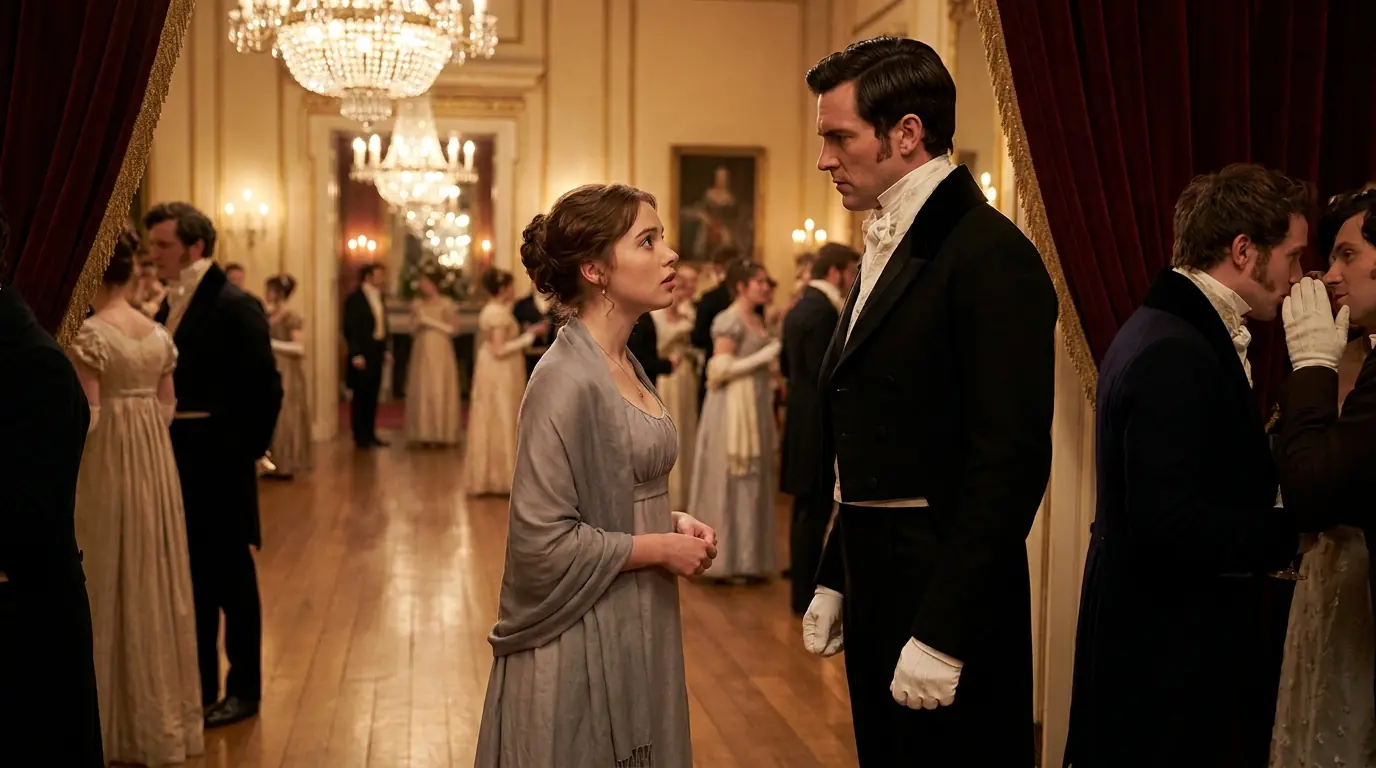
“Partly, yes. The reputation serves multiple purposes. People are careless around those they underestimate or fear. They reveal things they might otherwise conceal.”
“And Lady Cecilia? Does she play some role in this investigation?”
His expression shuttered.
“Lady Cecilia’s father was among the investors in the venture that ruined my brother. Whether he was complicit in the deception or merely another victim remains unclear.”
Understanding dawned.
“So your connection to her was strategic rather than personal.”
“Initially, yes.”
He closed the ledger, setting it aside.
“Though I severed that connection entirely upon our marriage. Whatever Lady Cecilia implied to you was wishful thinking on her part.”
Relief washed through Adeline, stronger than she had anticipated.
“Thank you for explaining. I confess her visit left me unsettled.”
Francis rose from his chair, moving to stand before the fire. The flames cast his profile in sharp relief against the shadows of the room.
“Our arrangement has asked much of you, Adeline. You’ve left your family and friends to live in this isolated house with a man society considers dangerous and unpredictable. You’ve taken on responsibility for a child not your own, and you’ve done so with more grace than I had any right to expect.”
The honesty in his voice touched something deep within her.
“The arrangement has benefited me as well, Francis. My family’s security is assured, and I—”
She hesitated, searching for words that would not reveal too much of her changing feelings.
“I have found purpose here at Greymore that I never had in London ballrooms.”
He turned to face her, his expression softened by the firelight.
“Nevertheless, I am in your debt, a fact I do not acknowledge lightly.”
“There is no debt between us,” she replied. “Only the terms of our agreement.”
“Terms which I fear may have seemed cold and restrictive in retrospect.”
He took a step toward her chair.
“Perhaps those terms might benefit from reconsideration.”
Adeline’s heart quickened at his words and the intent in his eyes.
“What sort of reconsideration did you have in mind?”
Before he could answer, a sharp knock at the study door interrupted the moment.
Mr. Simmons entered, his usual impassive expression troubled.
“Your Grace, forgive the intrusion, but a messenger has arrived from London with urgent news. The hearing regarding Miss Eleanor has been moved forward. Your presence is required in London immediately.”
Francis straightened, all trace of vulnerability vanishing behind the mask of the Duke.
“When?”
“The day after tomorrow, Your Grace. The messenger says Lord and Lady Winston have petitioned for an immediate decision, claiming that the child’s welfare is at stake.”
“Have the carriage prepared. I’ll leave within the hour.”
Francis turned to Adeline.
“This is the Winstons’ final attempt to undermine our claim. They know their position weakens with each passing day that Eleanor is settled in our care.”
“What can I do?” Adeline asked, rising to her feet.
Francis considered for a moment, his mind clearly working through multiple contingencies.
“Come with me to London. Your presence will strengthen our case, and Eleanor will be comforted having both of us there.”
“Of course. I’ll have Miss Wilson pack immediately.”
As they prepared for the journey, Adeline reflected on how seamlessly they had shifted from their intimate conversation to a unified front against this external threat.
Whatever was developing between them, this cautious warming, this tentative trust, would have to wait.
Eleanor’s future came first, as it should.
The journey to London was long and arduous, made more difficult by heavy rains that turned the roads to mud and slowed their progress considerably.
By the time they reached the Duke’s London residence in Grosvenor Square, both were exhausted and anxious about the hearing scheduled for the following morning.
Eleanor was already there, having been brought from the Winstons’ home by a court-appointed chaperone.
The child flew into Francis’s arms the moment he entered the drawing room, her small face alight with joy despite the uncertainty surrounding her future.
“Uncle Francis, Aunt Adeline, I knew you would come.”
Francis lifted her high, his severe expression melting into genuine warmth.
“Of course we came, little one. Nothing could have kept us away.”
Eleanor’s gaze moved anxiously between them.
“Grandmother says the judge might make me stay with them forever. She says you’re not suitable guardians because—”
She hesitated, clearly repeating words she didn’t fully understand.
“Because your marriage is a sham and you don’t truly care for each other.”
Adeline exchanged a quick glance with Francis, seeing her own alarm reflected in his eyes. The Winstons were playing a dangerous game, involving a child in adult manipulations.
Kneeling beside Eleanor, Adeline took the little girl’s hand in hers.
“Eleanor, sometimes adults say unkind things when they’re afraid of losing someone they love. Your grandmother loves you very much and is frightened of changes. But you mustn’t worry about what she says about us.”
“But is it true?” Eleanor’s gray eyes, so like her uncle’s, searched Adeline’s face. “Grandmother says you only married Uncle Francis because he paid your family’s debts.”
Francis crouched beside them, his large hand gentle on Eleanor’s shoulder.
“Eleanor, listen to me. What exists between adults is often complicated and not easily explained to children. But I can promise you this. Your aunt Adeline and I have the deepest respect for one another, and we both love you dearly.”
He paused.
“Our home at Greymore is waiting for you, and we very much want you to live there with us.”
The child’s expression remained troubled.
“But do you love each other? Mama and Papa loved each other. They were always laughing and holding hands, even when they thought I wasn’t looking.”
Adeline felt Francis tense beside her, clearly struggling for an answer that would reassure Eleanor without being an outright lie.
Before he could respond, Adeline reached for his hand, twining her fingers with his in a gesture that felt both foreign and strangely right.
“Love comes in many forms, Eleanor,” she said softly, “and it often grows over time, like a garden that becomes more beautiful with each passing season. Your uncle and I may not have had the same beginning as your parents, but that doesn’t mean our story is any less true.”
Francis’s fingers tightened around hers, a silent acknowledgement of her careful words.
To Eleanor, he added, “Your aunt Adeline is very wise, little one. Now, why don’t you show her the new doll the court chaperone brought you while I speak with Mr. Hargrove about tomorrow’s hearing?”
Once Eleanor had been settled for the night, with promises from both of them to be there when she woke, Francis and Adeline met with the solicitor in the Duke’s study.
Mr. Hargrove, a sharp-eyed man with graying whiskers, laid out the situation with blunt clarity.
“The Winstons are claiming that your marriage is a contrivance designed solely to influence the court,” he explained. “They’ve presented affidavits from several London acquaintances testifying to Your Grace’s bachelor habits and sudden, unexpected interest in Miss Hartwell.”
“That’s preposterous,” Francis growled, pacing before the fire. “My personal history is irrelevant to my ability to provide a stable home for Eleanor.”
“On the contrary, Your Grace, it is highly relevant in the eyes of the court. A child, particularly a female child, requires moral guidance and stability. The Winstons are positioning themselves as the conventional, respectable option.”
“And us as what?” Adeline asked, indignation coloring her voice. “Immoral and disreputable?”
Hargrove’s expression was sympathetic but frank.
“They are suggesting that Your Grace married hastily and for convenience, that the union lacks the foundation necessary for a stable household, and that it is likely to dissolve once its immediate purpose is served.”
Francis stopped his pacing, turning to face them with cold fury in his eyes.
“They dare question my commitment to my brother’s child.”
“Not directly, Your Grace. Rather, they question whether your household, with a marriage they characterize as one of convenience rather than affection, provides the emotional security Eleanor requires.”
“This is ridiculous,” Adeline protested. “Countless aristocratic marriages begin as arrangements of convenience and develop into perfectly stable households.”
“Indeed, Your Grace,” Hargrove agreed, “and that is precisely the argument we shall make. However—”
He hesitated, clearly uncomfortable with what he needed to say next.
“The court will be observing you both closely tomorrow. Any hint of distance or formality between you will be noted and may influence the judge’s decision.”
Understanding dawned.
“You’re suggesting we present ourselves as a love match,” Francis stated flatly.
“I am suggesting, Your Grace, that you present yourselves as a united couple with genuine affection and commitment to one another. The court does not expect grand passion, but it does expect the kind of bond that will provide Eleanor with security and an example of proper marital relations.”
After the solicitor departed, silence fell between them, heavy with implications.
Adeline stood by the window, watching the rain streak the glass, a reflection of her own turbulent thoughts.
“This complicates matters,” Francis said finally, pouring himself a glass of brandy from the decanter on his desk.
“It changes nothing,” Adeline replied, turning to face him. “We agreed to present ourselves as a conventional marriage to the world. Tomorrow simply requires a more convincing performance.”
Francis studied her over the rim of his glass.
“You’re remarkably pragmatic about all this.”
“Did you expect hysterics?”
A small smile curved her lips.
“I understood the nature of our arrangement from the beginning, Francis. Tomorrow we shall simply emphasize certain aspects of it more prominently than others.”
He set down his glass, crossing the room to stand before her. In the dim lamplight, his face held shadows and warmth in equal measure.
“You continue to surprise me, Adeline Hartwell.”
“Adeline Aldridge,” she corrected gently. “A name I accepted with full understanding of its obligations and privileges.”
His hand rose, hesitating momentarily before brushing a loose strand of hair back from her face, a gesture of intimacy they had never before shared.
“Tomorrow, then, we present ourselves as a couple drawn together by genuine regard rather than practical considerations.”
“It needn’t be entirely pretense,” she found herself saying, her voice softer than intended. “I have developed a genuine regard for you, Francis. Whatever brought us together initially, these months at Greymore have shown me a man of principle and depth that society never sees.”
Surprise flickered in his eyes, followed by something warmer.
“And I have discovered that the quiet wallflower of London ballrooms possesses more courage and character than most who command the spotlight.”
His hand lingered near her face, his voice lowering.
“Perhaps Hargrove is right. Perhaps what began as convenience has become something more substantial.”
The moment hung between them, charged with possibility.
Then, with careful deliberation, Francis leaned forward and pressed his lips to hers. A kiss so gentle it might have been imagined, yet so profound it seemed to alter the very air around them.
When he drew back, his eyes searched hers, questioning.
Adeline answered by reaching up to touch his face, her fingers tracing the strong line of his jaw.
“For Eleanor,” she whispered, though they both recognized the words as only partially true.
“For Eleanor,” he agreed, before drawing her into a more thorough embrace, one that acknowledged the growing truth neither had yet fully admitted: that their practical arrangement had sparked an entirely impractical emotion.
The courtroom was imposing, oak paneling, high ceilings, and the weight of centuries of legal precedent creating an atmosphere of solemn authority.
Adeline sat beside Francis in the front row, her gloved hand resting in his, their shoulders nearly touching in a tableau of marital unity.
Across the aisle, Lord and Lady Winston observed them with barely concealed hostility.
Eleanor sat with the court chaperone in a small anteroom, to be brought in only if the judge required her testimony. Francis had been adamant that the child be spared as much of the proceedings as possible, a position the court had mercifully respected.
Judge Blackwood, a stern-faced man whose reputation for fairness was matched only by his intolerance for deception, reviewed the documents before him with methodical care.
The silence in the courtroom stretched taut as a bowstring as they awaited his attention.
“This case,” he began finally, his voice resonating with practiced authority, “concerns the guardianship of Miss Eleanor Aldridge, orphaned daughter of Lord George Aldridge and Lady Catherine Aldridge, née Winston. Both maternal and paternal relations petition for custody, each claiming to offer the most suitable home for the child.”
He peered over his spectacles at both parties.
“I have reviewed the affidavits and petitions submitted by both sides. Lord and Lady Winston claim primary consideration based on their biological relationship to the child’s mother and their established household. His Grace, the Duke of Ravencourt, and Her Grace, the Duchess, claim consideration based on the Duke’s position as the child’s paternal uncle and his brother’s appointed guardian in the event of his death.”
The proceedings continued with presentations from both sides’ solicitors.
Mr. Hargrove presented their case with eloquence, emphasizing Francis’s legal right as named guardian, his financial resources, and the stable home he and Adeline had established at Greymore.
The Winstons’ solicitor countered with insinuations about Francis’s character and the hasty nature of his marriage, stopping just short of openly calling it a sham.
As the arguments continued, Francis’s hand tightened around Adeline’s, his knuckles white with tension. She stroked her thumb across the back of his hand in a small gesture of reassurance, feeling his grip relax slightly in response.
“Your Grace,” Judge Blackwood addressed Francis directly. “These allegations regarding the nature of your marriage are troubling. While it is not this court’s place to evaluate the personal feelings between husband and wife, the stability of your union directly impacts Miss Eleanor’s welfare.”
He paused.
“How do you respond to the suggestion that your marriage was arranged hastily and solely for the purpose of this guardianship petition?”
Francis rose, his bearing every inch the Duke.
“My lord, I acknowledge that my courtship of the former Miss Hartwell was brief by conventional standards. However, I reject entirely the implication that our union lacks substance or commitment.”
He glanced down at Adeline, his expression softening visibly.
“I had observed Miss Hartwell for several seasons and found in her qualities I admired: dignity, intelligence, and quiet strength of character. When my brother’s death placed me in the position of seeking guardianship for Eleanor, I recognized that the time had come to establish my own household.”
He continued steadily.
“I chose a wife not merely for appearance’s sake, but as a genuine life partner with whom I could provide Eleanor the stable, loving home she deserves.”
The judge’s expression remained skeptical.
“Yet you had shown no previous inclination toward marriage despite being of an age where most men of your station have long since established families.”
“I had not found the right woman,” Francis replied simply. “In Adeline, I recognized someone who would complement my strengths and compensate for my weaknesses. Someone who could bring warmth to Greymore and guidance to Eleanor that I alone could not provide.”
“And you, Your Grace?”
The judge turned his attention to Adeline.
“What drew you to accept the Duke’s proposal after five seasons without forming an attachment?”
Adeline rose beside Francis, her hand still clasped in his.
“My lord, I had indeed spent several seasons without forming an attachment, but not for lack of opportunity.”
She smiled slightly.
“Rather, I found myself unwilling to accept proposals based solely on practical considerations without the foundation of mutual respect and shared values.”
She turned to look at Francis, finding it surprisingly easy to infuse her voice with genuine warmth.
“In His Grace, I discovered a man of principle and depth behind the facade society observes. A man devoted to his family and determined to honor his brother’s memory by raising Eleanor with the love and guidance she deserves.”
Her voice remained steady.
“Our courtship may have been unconventional, but our commitment to creating a stable, loving home for Eleanor and for each other is entirely genuine.”
Something shifted in Judge Blackwood’s expression, a softening around the eyes, a slight relaxation of his stern mouth.
“I see. And how has the child responded to your household? I understand she has visited Greymore on several occasions.”
Francis nodded.
“Eleanor has flourished during her visits, my lord. She and Her Grace have developed a particularly close bond, sharing interests in music and nature that have helped Eleanor begin to process her grief in healthy ways.”
“The child is simply being polite,” Lady Winston interjected, unable to contain herself. “She has been raised to show proper respect to her elders, regardless of her true feelings.”
Judge Blackwood frowned at the interruption.
“Lady Winston, you will have your opportunity to speak. Until then, I must ask you to remain silent.”
The hearing continued with testimony from the court-appointed observer, who had supervised Eleanor’s visits to both households.
Her assessment favored the Duke and Duchess, noting Eleanor’s increased animation and apparent comfort in their company compared to the formal, restrictive atmosphere of the Winston household.
Finally, Judge Blackwood called for Eleanor herself to be brought in.
The child entered, looking small and vulnerable in her black mourning dress, her dark curls neatly arranged beneath a matching ribbon. She curtsied to the judge with perfect form, her solemn face a mask of careful politeness.
“Miss Eleanor,” the judge began, his tone gentler than it had been throughout the proceedings. “I have just a few questions for you, and I want you to answer them honestly. There are no wrong answers. Do you understand?”
“Yes, sir,” Eleanor replied, her voice barely audible in the large room.
“You have spent time in both your grandparents’ home and at Greymore with your uncle and his wife. Can you tell me how you feel about each place?”
Eleanor glanced nervously at her grandmother, then at Francis and Adeline.
“Grandmother and Grandfather Winston have a very nice house in London. It has pretty furniture and a garden with roses.”
“And how do you feel when you are there?” the judge prompted.
The child hesitated, clearly struggling between honesty and the desire to please.
“I try to be very good there,” she said finally. “Grandmother says little girls should be seen and not heard, so I practice sitting still and speaking only when spoken to.”
“I see. And at Greymore?”
Eleanor’s face transformed, a genuine smile replacing her careful composure.
“Greymore is wonderful. Uncle Francis lets me ride my pony, and Aunt Adeline reads stories with me in all the different voices. We collect interesting stones on the moors, and I’m learning to play the pianoforte in the music room.”
She grew brighter with each word.
“And last time, we built a fort in the library using cushions and blankets, and Uncle Francis pretended to be a dragon trying to capture the princess.”
A ripple of surprised laughter ran through the courtroom at this image of the austere Duke of Ravencourt engaged in imaginative play.
Adeline felt Francis stiffen beside her, but when she glanced at him, his expression held only tender affection as he regarded his niece.
“That sounds enjoyable indeed,” Judge Blackwood said, a hint of a smile touching his lips. “One final question, Miss Eleanor. If you could choose where to live, where would that be?”
Eleanor’s smile faded, her small face growing serious once more.
“I would live at Greymore with Uncle Francis and Aunt Adeline,” she said without hesitation. “But I would visit Grandmother and Grandfather sometimes too, if they wouldn’t be too angry with me for choosing.”
Lady Winston made a small sound of distress, quickly stifled behind her handkerchief. Lord Winston placed a restraining hand on his wife’s arm, his expression grim but resigned.
Judge Blackwood nodded, thanking Eleanor and instructing the chaperone to return her to the anteroom.
Once the child had departed, he surveyed the courtroom thoughtfully.
“Having reviewed all evidence and testimony, I am prepared to render my decision.”
He straightened in his chair, his voice resuming its formal cadence.
“It is the finding of this court that primary guardianship of Miss Eleanor Aldridge shall be granted to His Grace, Francis Aldridge, Duke of Ravencourt, and Her Grace, Adeline Aldridge, Duchess of Ravencourt, in accordance with the expressed wishes of the late Lord George Aldridge.”
A wave of relief washed through Adeline, so powerful she might have swayed had Francis not steadied her with a strong arm around her waist.
“However,” the judge continued, raising a hand to silence the murmurs that had broken out, “this court recognizes the importance of maintaining connections with both maternal and paternal relations. Therefore, Lord and Lady Winston shall be granted visitation rights to be exercised at Greymore or at their London residence for a period not to exceed one week per quarter, unless all parties agree to alternative arrangements.”
The judgment was fair, fairer than either side had expected, given the acrimony that had developed between them.
As the court adjourned, Adeline watched Lord Winston approach Francis with visible effort at dignity.
“Your Grace, I... we...” he began, clearly struggling for words. “We only wanted what was best for our granddaughter.”
Francis regarded him steadily.
“As did I, Lord Winston. Perhaps we can agree that Eleanor’s welfare transcends our personal differences.”
“Indeed.”
Winston hesitated, then continued with palpable difficulty.
“My wife, her grief over Catherine’s death has made her less reasonable than she might otherwise be. In time, I hope we may establish a more amicable relationship for Eleanor’s sake.”
“That would be my preference as well,” Francis replied, his tone measured, but not unkind.
As the Winstons departed, Adeline squeezed Francis’s arm in silent approval of his restraint.
They had won, not just legally, but morally, by demonstrating the grace and composure that would make them suitable guardians for Eleanor.
“Shall we tell her?” Adeline asked softly.
Francis’s smile was one of genuine joy, an expression she had rarely seen from him.
“Yes. Together.”
When they entered the anteroom, Eleanor looked up from the book the chaperone had been reading to her, her eyes wide with apprehension.
“Is it over? Did the judge decide?”
Francis knelt before her, taking her small hands in his.
“Yes, little one. The judge has decided that you will come to live with us at Greymore, as your father wished.”
Eleanor’s face lit with pure joy.
“Truly? Forever?”
“Forever,” Adeline confirmed, kneeling beside Francis. “You’ll have your own room, just as we discussed. The one with the window seat overlooking the rose garden.”
“And can I bring my books and my collection of pressed flowers?”
“Every last one,” Francis promised. “And anything else you wish to have with you.”
Eleanor threw her arms around both of them, her small body trembling with emotion.
“I knew the judge would understand. I told him the truth, just as you said I should.”
“You were very brave,” Francis said, his voice thick with feeling. “Your father would have been proud.”
They returned to Grosvenor Square, the three of them sharing the carriage in a bubble of quiet happiness.
Eleanor chatted excitedly about her plans for her new life at Greymore, the pony she would ride, the lessons she would have, the exploration of the moors when spring came.
Adeline and Francis exchanged glances over her head, their shared joy in the child’s happiness creating a warm current of connection between them.
It was late afternoon when a message arrived from Lord and Lady Winston, requesting permission to see Eleanor before they departed London the following day.
Francis, in a gesture of goodwill, suggested they invite the elder couple to dine that evening.
“Are you certain?” Adeline asked quietly as they stood together in his study. “It may be rather strained.”
“Undoubtedly,” he agreed. “But for Eleanor’s sake, we must establish civil relations with the Winstons. She should not be made to feel she must choose between her maternal and paternal families.”
His consideration for Eleanor’s emotional well-being, even at the cost of his own comfort, touched Adeline deeply.
“You’re right, of course. I’ll speak with Mrs. Daniels about dinner arrangements.”
The dinner was indeed strained, with Lady Winston maintaining a rigid formality that barely concealed her disappointment at the court’s decision.
Lord Winston, however, made visible efforts at conciliation, engaging Francis in conversation about estate management and inquiring politely about Adeline’s impressions of Yorkshire.
Eleanor, dressed in her best frock and on her most exemplary behavior, watched the adults with obvious relief as the meal progressed without open hostility.
When Adeline suggested that she might show her grandparents the drawing she had made that afternoon, the child eagerly retrieved it from the morning room.
“It’s Greymore,” she explained proudly, presenting the childish but recognizable sketch. “See, that’s Uncle Francis and Aunt Adeline, and that’s me, and that’s my pony, Starlight.”
Lady Winston’s frozen expression thawed slightly as she examined the drawing.
“You’ve included quite a lot of detail, Eleanor. Your art lessons have clearly been beneficial.”
“Aunt Adeline has been teaching me,” Eleanor replied, beaming at Adeline. “She’s going to help me make a book of all the flowers we find on the moors when spring comes.”
“Perhaps,” Adeline suggested gently, “you could make a similar book of London flowers during your visits with your grandparents. The parks have many varieties that don’t grow in Yorkshire.”
The suggestion, acknowledging that Eleanor would maintain a relationship with the Winstons while establishing her primary home at Greymore, served as a tacit peace offering.
Lady Winston met Adeline’s gaze for a long moment before inclining her head in a slight nod of acceptance.
“That would be most educational,” she said stiffly, but without the bitter edge that had characterized her earlier comments. “Your grandfather and I maintain a small greenhouse that you might find interesting as well.”
It was a beginning, fragile and tentative, but a beginning nonetheless.
By the time the Winstons departed, arrangements had been made for Eleanor to visit them for a week after Easter, a compromise that seemed to satisfy all parties.
“You handled that admirably,” Francis commented as they stood together in the entrance hall after seeing the Winstons to their carriage. “Lady Winston is not an easy woman to placate.”
“She is a grandmother who feared losing her last connection to her daughter,” Adeline replied. “I can understand her fear, even if I don’t condone her methods.”
Francis studied her face in the lamplight.
“You continue to surprise me with your compassion, Adeline.”
“Is compassion so surprising a quality in a duchess?” she asked lightly.
“In my experience, yes.”
His expression grew more serious.
“In my world, people typically act from self-interest rather than empathy. You are an anomaly.”
Before she could respond to this assessment, Eleanor appeared at the top of the stairs in her nightgown, her nurse hovering anxiously behind her.
“I’m sorry, Your Grace,” the woman apologized. “Miss Eleanor insisted on saying good night again before retiring.”
“It’s quite all right, Mrs. Pierce,” Adeline assured her. “We’ll bring her up in a moment.”
Eleanor descended the stairs carefully, her bare feet peeking beneath her white nightgown.
“I wanted to make sure it wasn’t a dream,” she confessed, looking up at them with solemn eyes. “That I’m really coming to live with you.”
Francis lifted her into his arms with easy strength.
“It’s not a dream, little one. It’s very real.”
“And you won’t change your minds?” A shadow of anxiety crossed her small face. “Even if I’m not always perfectly behaved?”
“Especially then,” Adeline said, smoothing a dark curl from the child’s forehead. “Families don’t stop loving each other because of imperfections. In fact, sometimes it’s our very imperfections that make us most lovable.”
Eleanor considered this wisdom with furrowed brow.
“Like how Uncle Francis scowls when he’s thinking hard, but it doesn’t mean he’s angry? Or how you hum without knowing it when you’re reading something interesting?”
Adeline laughed, surprised by the child’s observations.
“Precisely like that.”
Francis carried Eleanor back to her room with Adeline following. Together, they tucked her into bed, listened to her prayers, and promised once more that they would all travel to Greymore together in two days’ time.
As they closed the nursery door behind them, Francis’s hand brushed against Adeline’s, then deliberately captured her fingers in a gentle clasp.
They walked in silence to the landing, the contact between them speaking more eloquently than words.
“She notices more than we realize,” Adeline observed quietly. “Your scowls, my humming.”
“Children often see what adults overlook. Eleanor has always been particularly observant. George used to say she had old eyes in a young face.”
“You miss him very much.”
It wasn’t a question, but Francis answered it anyway.
“Every day. George was the better of us in many ways. More open, more trusting.”
His expression darkened.
“I’ve spent the months since his death focused on securing justice for him and security for Eleanor. I’ve had little time to simply grieve.”
The admission, delivered in a voice stripped of its usual control, revealed the depth of feeling Francis typically concealed behind his austere facade.
Impulsively, Adeline reached up to touch his face, her fingers gentle against his cheek.
“Perhaps now you can,” she suggested softly. “Now that Eleanor’s future is secure.”
His hand came up to cover hers, pressing her palm more firmly against his skin.
“Perhaps I can, with your help.”
The moment stretched between them, intimate and weighted with possibility. Then Francis cleared his throat, letting her hand fall, but keeping her fingers entwined with his.
“It’s been a long day. Shall I escort you to your room?”
The Duke’s London residence, unlike Greymore, had been arranged with a conventional aristocratic marriage in mind. Their bedchambers were joined through a connecting door that had remained firmly closed during their previous stays.
As they reached Adeline’s door, an awkward silence fell between them.
“Well,” she said finally, “good night, then.”
Francis hesitated, conflict visible in his expression.
“Adeline, I... today in the courtroom, the things we said about our marriage—”
“Were necessary for Eleanor’s sake,” she finished for him, uncertainty making her voice more brisk than intended. “I understand completely.”
“No,” he interrupted, his voice low and intense. “That’s not what I meant to say at all.”
His hand came up to cradle her face, his touch gentle despite the tension in his body.
“What I said in that courtroom was not merely for show. These past months with you have been transformative.”
Adeline’s breath caught in her throat.
“Francis—”
“Please let me finish.”
His thumb traced the curve of her cheekbone.
“When I proposed our arrangement, I saw you as a solution to a problem, a practical choice for a specific purpose. I did not expect to discover a woman of such depth and character behind the quiet exterior you present to the world.”
He took a slow breath.
“I did not expect to find myself thinking of you throughout the day, looking forward to our conversations over dinner, admiring your kindness toward Eleanor and your skill in managing Greymore.”
Then he gathered courage for what came next.
“In short, I did not expect to develop feelings that far transcend our original agreement.”
The confession hung in the air between them, altering everything with its honesty.
Adeline searched his face, finding none of the calculation or strategic thinking that had characterized their early interactions, only vulnerable sincerity.
“I have feelings for you, too,” she admitted quietly. “Feelings I never anticipated when I accepted your proposal.”
Relief washed across his features, followed by something warmer.
“Then perhaps we might consider renegotiating the terms of our arrangement.”
A smile curved Adeline’s lips.
“What terms did you have in mind, Your Grace?”
Instead of answering with words, Francis lowered his head and captured her mouth with his.
Unlike the gentle, tentative kiss they had shared in London, this was a kiss of certainty and awakening desire, deep, thorough, and transformative.
When they finally parted, both breathing unevenly, Francis rested his forehead against hers.
“I would like to court my own wife, Adeline Aldridge, properly this time, with no practical considerations beyond my genuine desire to know you better.”
Joy bubbled up within her, light and effervescent.
“I believe I would like that very much.”
His answering smile, rare and unguarded, transformed his austere features into something approaching boyish charm.
“Then we are agreed. A new arrangement based on mutual regard rather than mutual advantage.”
“Although,” Adeline added with a teasing lilt, “I see no reason why we cannot have both.”
Francis laughed, the sound warm and genuine in the quiet corridor.
“Indeed. A most sensible approach, Duchess.”
With a final lingering kiss, he bid her good night, both of them understanding that while their relationship had irrevocably changed, they had time now to explore its new dimensions at their own pace, without the pressure of Eleanor’s custody hanging over them.
As Adeline prepared for bed, assisted by Miss Wilson, she found herself humming softly, exactly as Eleanor had observed, a physical manifestation of the happiness that seemed too large to contain within her chest.
“How you seem in good spirits, Your Grace,” Miss Wilson commented as she brushed out Adeline’s long hair. “I take it the court proceedings went well.”
“Very well indeed,” Adeline replied, her smile visible in the mirror’s reflection. “Eleanor will be coming to Greymore permanently.”
“The staff will be delighted to hear it. Mrs. Hughes has already begun preparations for the child’s room.”
As Miss Wilson departed and Adeline slipped beneath the bedcovers, she reflected on the extraordinary journey that had brought her to this moment.
Six months ago, she had been the invisible Miss Hartwell, resigned to spinsterhood and a lifetime of quiet desperation.
Now she was the Duchess of Ravencourt, mistress of Greymore, guardian to a delightful child, and most unexpectedly of all, the object of genuine affection from a man she had come to admire deeply.
A marriage that had begun as a practical arrangement had transformed into something far more meaningful.
What tomorrow might bring, she could not know, but for perhaps the first time in her adult life, Adeline faced the future with genuine optimism.
Spring came to Greymore in a riot of wildflowers across the moors and tender green shoots in the formal gardens.
Eleanor, fully settled into her new home, flourished under the combined influence of Francis’s steady guidance and Adeline’s gentle encouragement.
The child’s nightmares, which had been frequent in the early weeks after her arrival, gradually subsided as security and routine worked their healing magic on her young spirit.
The household itself seemed to breathe more easily, as if the ancient stones of Greymore had been waiting for the sound of a child’s laughter to echo through its halls.
Mrs. Hughes, initially so formal and reserved, revealed a grandmother’s indulgence toward Eleanor, while Mr. Simmons could occasionally be caught slipping sweets into small hands when he thought no one was watching.
As for Francis and Adeline, their relationship blossomed in the warming days of spring.
True to his word, Francis courted his wife with the attention and consideration he had not shown during their hasty engagement.
They rode together across the estate, her on a gentle mare he had selected specifically for her, him on his powerful black stallion.
They spent evenings in the music room, where Adeline’s modest piano skills improved under his surprisingly patient tutelage.
They read aloud to one another from favorite books, discovering shared tastes in literature and poetry.
Most significantly, they talked, truly talked, about their pasts, their hopes, their fears.
Francis gradually revealed the complex man behind the Shadow Duke’s forbidding reputation, a man shaped by the early loss of his mother, a distant father’s impossible expectations, and a fierce loyalty to the brother who had been his one true ally in a world of social calculation and betrayal.
In turn, Adeline shared the quiet humiliations of her family’s declining fortunes, the painful awareness of being overlooked in a society that valued wealth and connections above character, and her determination to maintain dignity despite circumstances beyond her control.
Their physical relationship progressed at a pace that honored both propriety and their growing feelings. The connecting door between their chambers, once firmly closed, now stood ajar more often than not.
Kisses that began as gentle expressions of affection grew deeper, more passionate, exploring the new territory of mutual desire with careful consideration.
Francis, Adeline discovered, was as thorough and attentive in this aspect of their relationship as he was in all others, learning what pleased her with the same focused intensity he brought to his business affairs, but with a tenderness that belied his public reputation for coldness.
The culmination of their courtship came on a perfect May evening as they walked together through the rose garden, now in full and fragrant bloom.
Eleanor had been tucked into bed hours before. The household had retired for the night, and they found themselves blissfully alone beneath a canopy of stars.
“Do you remember the night we met?” Francis asked as they paused beside a particularly lovely white rose, its petals luminous in the moonlight. “At the Lancaster House ball?”
“Of course.” Adeline smiled at the memory. “I thought you must be approaching someone behind me. I couldn’t imagine why the Duke of Ravencourt would seek out the invisible Miss Hartwell.”
“You were never invisible to me.”
He took her hands in his, his expression serious in the silvery light.
“Even then, watching you from across crowded ballrooms, I noticed your quiet dignity, the intelligence in your eyes, the way you observed everything without judgment or malice.”
“You never approached me in all those seasons,” she reminded him. “Not until you needed a wife for a very specific purpose.”
“A failure of courage, perhaps.”
His admission surprised her.
“Or a belief that I had nothing to offer a woman beyond my title and fortune, neither of which seemed likely to impress someone who valued substance over appearance.”
“And now?” she prompted softly.
Francis drew her closer, his arms encircling her waist.
“Now I find myself hoping that what I’ve become in these months with you, a better guardian to Eleanor, a more conscientious master to the estate’s people, a man learning to balance justice with mercy, might be worthy of a woman like you.”
“Francis.”
“I love you, Adeline.”
The words, spoken with quiet certainty, hung in the night air between them.
“Not for your practicality or your usefulness, though I value both. I love your compassion, your resilience, your quiet strength. I love the way you’ve transformed Greymore from a house into a home. I love that you’ve helped me become the man my brother always believed I could be.”
Tears pricked at Adeline’s eyes, not of sorrow, but of overwhelming joy.
“I love you too,” she whispered. “For your integrity, your devotion to Eleanor, your hidden gentleness that so few are privileged to see, for showing me that I am neither invisible nor unworthy of regard.”
The kiss they shared beneath the stars held all the promise of their future, passion and tenderness, strength and vulnerability, a union forged initially from necessity, but transformed by genuine love into something far more enduring.
Later, as moonlight filtered through the curtains of the Duchess’s bedchamber, Francis held Adeline close against his heart, their bodies entwined in the intimate aftermath of shared passion.
“I have something for you,” he murmured, reaching toward the nightstand. “I’ve been waiting for the right moment.”
He pressed a small velvet box into her hand.
Adeline opened it to find a ring of exquisite design, an oval sapphire surrounded by diamonds set in platinum.
“It was my mother’s,” Francis explained, his voice soft with memory. “My father gave it to her when I was born, their first child. She always said it represented their transformation from a marriage of convenience into a union of genuine love.”
“It’s beautiful,” Adeline whispered, deeply moved by both the gesture and its symbolism.
“I thought perhaps a renewal of our vows this summer. Not the hasty ceremony we had in London, but a true celebration here at Greymore, with Eleanor as our attendant and the estate’s people as our witnesses.”
The suggestion touched her deeply.
“A new beginning.”
“A continuation,” he corrected gently. “Of what began as strategy, but has become the greatest blessing of my life.”
As Francis slipped the ring onto her finger beside his signet ring that she already wore, Adeline reflected on the extraordinary journey that had brought them to this moment.
From the invisible wallflower to the beloved duchess. From the feared Shadow Duke to the devoted husband and guardian. From a marriage of convenience to a union of hearts.
“I sat alone at every ball for five years,” she mused, looking up into his beloved face. “Until the most feared duke in England whispered, ‘Dance with me.’”
“And what a dance it has been,” Francis replied, drawing her close once more. “One I hope never ends.”
In the soft darkness of their room at Greymore, with the promise of tomorrow bright before them, the Duke and Duchess of Ravencourt continued their dance.
No longer strangers bound by a contract, but partners united by genuine, enduring love.