Lady Philippa Marlowe had precisely three hours, fourteen minutes, and approximately forty-seven seconds left before she would make the most mortifying mistake of her entire existence.
Not that she knew this, of course, as she sat at the gleaming mahogany dining table in Bracken House, pushing roasted pheasant around her plate with increasing desperation.
The annual New Year’s Eve dinner was proceeding exactly as it always did.
Her father, the Marquess of Brackenmere, held court at the head of the table with anecdotes about parliamentary sessions, her brother Giles made the ladies giggle with his witty observations, the Dowager Duchess of Thornley offered scandalous commentary about everyone who was not present, and dozens of London’s finest families laughed, drank, and secured their positions in society’s intricate hierarchy.
And there, seven seats to her left, sat His Grace Rupert Falomir, Duke of Thornley.
He was not looking at her again.
Philippa had become something of an expert on the Duke of Thornley’s profile over the past two years.
She could sketch the exact angle of his jawline from memory.
She knew that he had a small scar just above his left eyebrow, barely visible unless one had spent countless hours studying him during tedious musicals.
She had memorized the precise shade of his dark hair, the way it curled slightly at his collar when it grew too long, and the manner in which his mouth quirked when he found something genuinely amusing versus merely polite.
What she did not know was what his eyes looked like when they gazed directly at her with anything resembling interest.
Because in two years of relentless, mortifying, increasingly desperate attempts to gain his attention, Rupert Falomir had never once looked at her as though she were anything more than furniture.
“Lady Philippa, you seem distracted,” came a voice from her right.
She turned to find Lord Ashford, a pleasant enough gentleman with thinning hair and excellent prospects, regarding her with concern.
“Simply contemplating the new year, my lord,” she replied, forcing brightness into her voice. “New beginnings and all that.”
“Indeed. I myself am resolved to read more poetry. Perhaps you might recommend—”
But Philippa had stopped listening because the Duke of Thornley had just laughed at something Lady Constance Peyton said, and the sound made her chest constrict painfully.
This was ridiculous.
Utterly, completely ridiculous.
She was Lady Philippa Marlowe, daughter of one of England’s most respected marquesses, descended from a line that could trace itself back to the Norman Conquest.
She was accomplished, could speak French and Italian fluently, played the pianoforte better than adequately, and possessed a singing voice that had been called rather lovely by no less than three duchess-level personages.
She had rejected four marriage proposals in the past year alone.
And yet here she sat, pining like a foolish girl over a man who would not notice if she set herself on fire in the middle of the dining room.
Well, enough.
Philippa set down her fork with quiet determination.
This was the moment, right here, right now, on the last day of 1819.
She would let go of this absurd infatuation.
Tomorrow would begin 1820, and with it, a new Philippa, one who did not waste her time on oblivious dukes with devastatingly handsome smiles.
“Lord Ashford,” she said, turning back to him with genuine warmth. “I would be delighted to discuss poetry with you. Perhaps Byron. I find his work quite—”
A tremendous crash erupted from the other end of the table.
Giles had knocked over his wine glass while gesturing too enthusiastically, sending Bordeaux cascading across the pristine white tablecloth.
The footman rushed forward, but not before the crimson flood had reached Lady Weatherbee’s lap, causing her to shriek loud enough to wake the dead in Westminster Abbey.
The table erupted in chaos: apologies, laughter, servants rushing about with cloths, Lady Weatherbee insisting she was quite all right while simultaneously appearing on the verge of fainting, and Giles looking absolutely mortified.
Through it all, Philippa noticed with grim satisfaction, the Duke of Thornley had not glanced in her direction even once.
Perfect.
Absolutely perfect confirmation that she was making the right decision.
Two hours later, after the disaster had been cleaned up, the ladies had withdrawn, and the gentlemen had rejoined them for cards and conversation, Lord Thaddeus Marlowe, Marquess of Brackenmere, made an announcement.
“The hour grows late,” he declared in his booming, jovial voice. “Far too late for safe travel to town. I must insist that several of you remain as our guests for the night. The Duke of Thornley, naturally. Your Grace, we’ve prepared the blue guest chamber for you. Lord and Lady Weatherbee, after tonight’s unfortunate incident with the wine, I absolutely insist. And Sir Edward, you mentioned your carriage had a loose wheel. I won’t hear of you risking the journey.”
Philippa felt her stomach drop.
The Duke of Thornley, staying overnight in the blue guest chamber, which was directly adjacent to her own rooms.
She told herself this changed nothing.
She had already decided to abandon this foolish pursuit.
What did it matter if he slept twenty feet away versus twenty miles?
“How kind of you, Bracken,” the Duke said, rising and offering a polite bow. “I accept with gratitude.”
His voice was exactly as Philippa remembered, rich and warm, with that slight roughness that made her think of velvet dragged across stone.
She hated how much she loved it.
The Dowager Duchess of Thornley, who was not staying overnight but would depart shortly for her own London townhouse, approached Philippa with a knowing smile.
“My dear girl,” she said quietly, “you’ve been staring at my son all evening like he’s the last slice of cake at a garden party.”
Philippa felt heat flood her cheeks.
“I’m sure I don’t know what you mean, Your Grace.”
“Oh, darling.”
The Dowager’s eyes twinkled with amusement and something that might have been sympathy.
“I’ve been watching the marriage market for forty years. I know longing when I see it.”
“Then perhaps Your Grace should inform your son,” Philippa said before she could stop herself, “that I no longer suffer from that particular affliction.”
The Dowager raised one elegant eyebrow.
“Is that so?”
“Entirely so. This very evening, I’ve resolved to pursue more attainable prospects.”
“How very sensible of you.”
The Dowager patted her arm, but there was something speculative in her expression.
“Though I wonder if you’ve considered that my son might be the greatest fool in England.”
Before Philippa could respond to this cryptic comment, the Dowager swept away to make her farewells, leaving Philippa more confused than ever.
Midnight came and went.
The new year arrived with toasts and embraces and good wishes.
Philippa retired to her chambers, feeling simultaneously relieved and melancholy.
Relieved that the terrible year of 1819 was over.
Melancholy that 1820 seemed to stretch before her like a vast, duke-less wasteland.
Her lady’s maid, Martha, helped her into her nightgown, a modest affair of white cotton with long sleeves and a high neck, because Philippa valued propriety above fashion, even in the privacy of her own chambers, and braided her dark blonde hair.
“Will you need anything else, my lady?” Martha asked.
“No, thank you. Get some rest. It’s been a long evening.”
Alone at last, Philippa climbed into bed and stared at the canopy overhead.
She should feel triumphant.
She had made a mature, rational decision to stop wasting her life on an impossible dream.
This was growth.
This was wisdom.
So why did she feel like crying?
She punched her pillow with more force than necessary and rolled onto her side, determined to sleep.
Tomorrow, today technically, since it was now 1820, she would wake up as a new woman, practical, sensible, ready to consider Lord Ashford’s inevitable poetry recommendations with genuine interest.
Sleep began to pull at her consciousness like a gentle tide.
And then she heard it.
A woman’s laugh, high, musical, and unmistakably flirtatious, coming from the blue guest chamber next door.
Philippa’s eyes snapped open.
Oh, for the love of—
She sat bolt upright, fury replacing sleepiness in an instant.
This was her father’s house, a respectable house, and some, some libertine was entertaining female company at—
She glanced at the clock.
Half past one in the morning.
In a guest chamber under the roof of a marquess.
The outrage of it burned through her like wildfire.
More sounds filtered through the wall: whispers, movement, another giggle that made Philippa’s blood boil.
That was it.
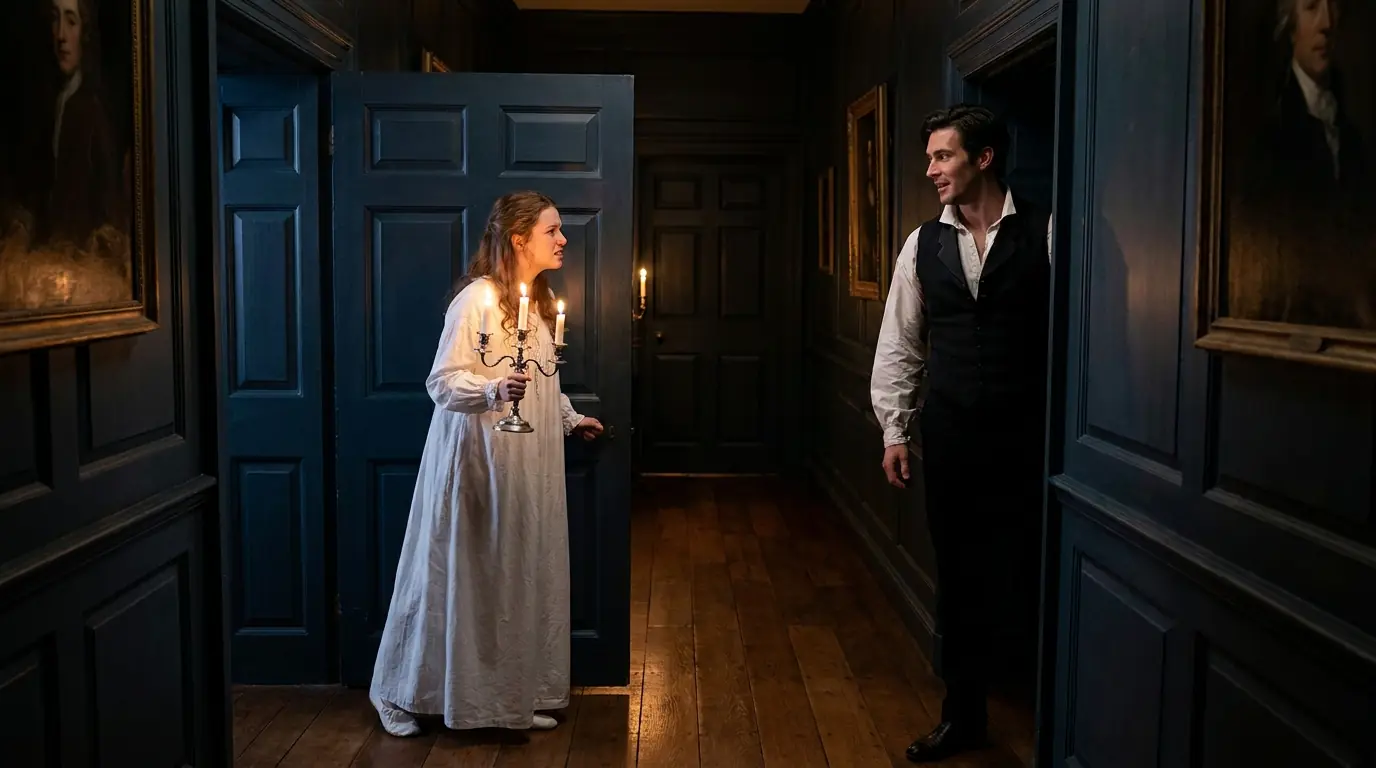
She threw back the covers and stood, grabbing the first weapon-like object she could find, a silver candelabra from her dresser, and marched toward her chamber door.
Her bare feet made no sound on the carpet as she stalked down the hallway, nightgown swishing around her ankles, hair coming loose from its braid in wild tendrils.
She did not care.
She was righteousness personified.
She was justice in cotton nightclothes.
She was standing in front of the blue guest chamber door.
She raised her fist and pounded on it with all the fury of two years of unrequited longing, channeled into pure righteous indignation.
“Open this door immediately,” she commanded in a fierce whisper-shout, mindful of waking the entire household, but determined to confront this moral outrage.
Footsteps approached.
The door opened.
A young woman Philippa vaguely recognized as Miss Caroline Harding, daughter of a wealthy merchant, stumbled out, her face flushed, her hair disheveled, her dress buttoned incorrectly.
“Lady Philippa!” she gasped, mortification written across her features. “I was just—we were merely—oh, heavens!”
She fled down the corridor like a rabbit escaping a fox.
And there, framed in the doorway, illuminated by the candlelight from within, stood Rupert Falomir, Duke of Thornley, in his shirt sleeves, no cravat, waistcoat unbuttoned, hair thoroughly mussed, and smiling at her with such genuine delighted surprise that her heart forgot how to beat properly.
For exactly three seconds, Philippa’s brain ceased all function.
He was looking at her, actually, truly looking at her, with those eyes she had dreamed about for two years.
Dark gray-blue, like storm clouds over the ocean.
They were even more beautiful than she had imagined.
He was looking at her, and she was wearing her nightgown, with her hair falling wild around her shoulders, holding a candelabra like a sword.
This was, without question, the worst moment of her entire life.
But then something inside her, some core of Marlowe pride that refused to be diminished even by complete humiliation, surged forward.
“How dare you?” she hissed, brandishing the candelabra. “Make such a racket at this unconscionable hour. This is a respectable household, Your Grace, not some, some disreputable gaming hell where you can entertain female visitors in the middle of the night.”
The Duke’s smile did not fade.
If anything, it grew wider, transforming his face from merely handsome to absolutely devastating.
“Lady Philippa,” he said, and she hated how much she loved hearing her name in his voice. “I assure you, this is a tremendous misunderstanding.”
“A misunderstanding?”
She advanced on him, pointing the candelabra like a weapon.
“I heard giggling, Your Grace. Whispers. The unmistakable sounds of impropriety.”
“Miss Harding merely wished to discuss—”
“Oh, I’m certain she wished to discuss many things,” Philippa snapped, “at one o’clock in the morning, in your bedchamber. How very intellectual of you both.”
Something flickered in his expression.
Surprise, amusement.
She could not tell and did not care.
“I came to this chamber merely because your father’s butler indicated it was mine for the evening,” he said, raising his hands in a gesture of innocence. “Miss Harding arrived of her own accord, claiming she wished to speak privately about—”
“I don’t care to hear your explanations.”
Philippa drew herself up to her full height, which was regrettably unimpressive compared to his six feet of aristocratic masculinity.
“I simply wished to sleep without being subjected to the sounds of your, your rakish behavior.”
“Rakish?”
He had the audacity to look entertained.
“My lady, I’ve been called many things, but—”
“Good night, Your Grace,” she interrupted, spinning on her heel with as much dignity as one could muster while barefoot and armed with a candelabra. “I trust you’ll conduct yourself with appropriate decorum for the remainder of the evening.”
She marched back to her chamber, slammed the door, and leaned against it, heart hammering wildly.
What had she just done?
She had confronted the Duke of Thornley in her nightgown, with wild hair and bare feet and a candelabra.
And he had smiled at her.
Actually smiled, like she was something wonderful instead of something ridiculous.
Philippa pressed her hands to her burning cheeks and tried to remember how to breathe.
This was a disaster, an absolute catastrophe.
By tomorrow morning, the entire household would know she had accosted the Duke in the middle of the night, dressed inappropriately, behaving like a madwoman.
Her reputation was ruined.
Her dignity was destroyed.
Her carefully cultivated image of proper young ladyhood had been shattered beyond repair.
She crawled back into bed and pulled the covers over her head, wishing desperately that she could somehow cease to exist.
But despite the mortification, despite the horror, despite knowing that tomorrow would bring consequences she could not even imagine, one thought kept circling through her mind like a persistent butterfly.
He smiled at me.
What Philippa did not know, could not know, was that in the blue guest chamber, Rupert Falomir, Duke of Thornley, renowned bachelor, sought-after marriage prospect, and generally considered one of the most eligible men in England, was experiencing something entirely unprecedented.
He was falling desperately, completely, irrevocably in love with a woman brandishing a candelabra in her nightgown, hair wild like a Valkyrie, eyes blazing with righteous fury.
With Lady Philippa Marlowe, who had just made it abundantly clear that she thought him an absolute scoundrel.
Rupert sat down on the edge of the bed and started laughing.
Not polite, restrained laughter, but genuine, uncontrollable mirth that shook his entire frame.
This was going to be interesting.
Philippa awoke to bright January sunlight streaming through her windows and the immediate crushing recollection of the previous night’s events.
She groaned and buried her face in her pillow.
It had not been a nightmare.
She had actually confronted the Duke of Thornley in her nightgown with a candelabra while wearing nothing but a cotton nightdress and righteous indignation.
“Good morning, my lady,” Martha said cheerfully, entering with a pitcher of warm water. “Happy New Year.”
“There is nothing happy about it,” Philippa mumbled into the pillow.
“My lady?”
Philippa sat up, resignation settling over her like a heavy cloak.
“Martha, I need you to be completely honest with me. How extensive is the household gossip about last night’s incident?”
Martha’s carefully neutral expression told her everything she needed to know.
“That bad?” Philippa asked weakly.
“Well.”
Martha set down the pitcher and busied herself selecting a morning dress from the wardrobe.
“The night footman mentioned to the head footman that he saw you in the corridor. The head footman mentioned it to Mrs. Henderson, who mentioned it to Cook, who mentioned it to me. Miss Harding’s maid apparently found her crying in her room, claiming she had been discovered in a compromising position and that you were wielding a weapon.”
Philippa closed her eyes.
“Wonderful. Absolutely wonderful.”
“Though, to be fair, my lady, most of the staff think it is rather admirable that you confronted His Grace about the noise. Mrs. Henderson said, and I quote, ‘Good for Lady Philippa, standing up for decency in her own home.’”
That was something, at least.
Small comfort, but comfort nonetheless.
“What dress would you prefer, my lady? The blue muslin or the green?”
“Something that makes me invisible,” Philippa muttered. “Do we have anything that renders one completely unnoticeable?”
“Sadly, no. But the green brings out your eyes quite nicely.”
Philippa submitted to Martha’s ministrations with the air of a condemned prisoner preparing for execution.
Her hair was dressed, her gown was fastened, her appearance was rendered perfectly acceptable for a young lady of quality.
None of it could hide the mortification burning in her cheeks.
“You’ll face it beautifully, my lady,” Martha said softly. “You’re a Marlowe. We don’t hide from scandal. We stare it down.”
“Martha, you’re not a Marlowe.”
“I’ve worked for your family since I was fourteen, my lady. I’m practically a Marlowe in spirit.”
Despite everything, Philippa smiled.
“Thank you. I shall attempt to channel my ancestral courage.”
She descended the main staircase with her head high and her stomach churning.
Voices drifted from the breakfast room: her father’s booming laugh, Giles’s lighter tones, the murmur of remaining overnight guests, and one voice that made her steps falter.
The Duke of Thornley, still here, still in her house, probably telling everyone about the madwoman who had attacked him with decorative lighting.
Philippa paused outside the breakfast room, gathered every scrap of dignity she possessed, and walked in.
Seven pairs of eyes turned toward her.
“Philippa.”
Her father rose from his seat with evident delight.
“Happy New Year, my dear. Come join us. We’ve been discussing the most extraordinary thing. His Grace has just informed us that he has decided to extend his stay in the country.”
Philippa’s eyes flew to the Duke despite her best intentions.
He was watching her with that same expression from last night, warm, amused, and something else she could not quite identify.
He stood, offering her a proper bow.
“Lady Philippa,” he said. “Good morning. I trust you slept well after the commotion last night.”
The room went silent.
Even the clinking of silverware ceased.
Philippa felt her face flame, but she held his gaze.
“Quite well, Your Grace, once the disturbances ceased, of course.”
“My deepest apologies for any inconvenience.”
His tone was perfectly polite, but his eyes were dancing with suppressed laughter.
“I assure you, it won’t happen again.”
“How very reassuring.”
“Please, Philippa, sit.”
Her father gestured to the empty chair, which was naturally directly across from the Duke, because the universe clearly enjoyed her suffering.
“His Grace was just explaining that he wishes to conduct some business with our local tenants regarding new farming techniques. Fascinating stuff, really. Who knew drainage systems could be so compelling?”
“Who indeed?” Philippa murmured, accepting the cup of tea a footman poured for her.
“And of course,” Giles added with barely contained glee. “We couldn’t possibly let His Grace stay at the inn. Dreadful place. So Father has invited him to remain here at Brackenmere for the fortnight.”
Philippa’s hand jerked, sloshing tea into her saucer.
“A fortnight,” she repeated faintly.
“Unless Lady Philippa objects.”
The Duke raised one eyebrow, challenge clear in his expression.
Every eye in the room turned to her expectantly.
She was trapped.
Absolutely, completely trapped.
If she objected, she would seem churlish and ungracious.
If she agreed, she would have to endure two weeks of proximity to the man she had just resolved to forget.
“Of course I don’t object,” she said, forcing a smile. “His Grace is most welcome to extend his stay as long as he wishes.”
“Excellent,” her father beamed. “Then it’s settled. Now, who wants more kippers?”
The meal proceeded with agonizing slowness.
Philippa focused intently on her food, determined not to look at the Duke.
This lasted approximately four minutes before curiosity overcame her.
He was talking to Giles about crop rotation.
He appeared genuinely interested.
His hands moved expressively as he spoke, well-formed hands with long fingers and a small scar across his right knuckle.
Stop staring at his hands, she commanded herself.
As if sensing her gaze, he glanced up, catching her eye.
He smiled.
She looked away immediately, heat flooding her cheeks for the hundredth time that morning.
“Lady Philippa,” came Lady Weatherbee’s voice from her left. “We must discuss the upcoming Whitmore ball. Will you be attending?”
“I haven’t decided,” Philippa said, grateful for the distraction.
“Oh, you simply must. It’s the first major ball of the season. Everyone who matters will be there.”
Lady Weatherbee leaned closer conspiratorially.
“Between you and me, I heard that Lord Ashford plans to propose to someone there, though who the fortunate lady might be remains a mystery.”
Philippa felt rather than saw the Duke’s attention shift toward their conversation.
“How romantic,” she said politely.
“Indeed, although—”
Lady Weatherbee’s eyes gleamed with gossip.
“There are rumors about a certain duke engaging in rather scandalous behavior last evening. Something about entertaining a young lady in his chambers. Of course, I told everyone that such tales must be wildly exaggerated.”
The table went silent again.
Philippa wanted to crawl under it and die.
“Indeed,” the Duke said smoothly, his voice carrying just enough edge to silence any further speculation. “Wildly exaggerated. Miss Harding merely wished to retrieve a book she had left in the drawing room. She had been informed incorrectly that it had been placed in my chamber. I directed her to the library instead. Hardly scandalous, though I understand how such innocent interactions can be misconstrued.”
It was a masterful lie, plausible enough to satisfy social conventions, delivered with just enough ducal authority to discourage questioning.
Lady Weatherbee tittered nervously.
“Of course, Your Grace. I meant no offense.”
“None taken.”
But the Duke was looking at Philippa as he said it, one eyebrow raised in a silent question.
Well.
She should have felt grateful.
He had just saved her reputation and Miss Harding’s with a simple fabrication.
No one would question a duke’s word.
Instead, she felt oddly insulted.
Did he think she needed his protection, his intervention?
“How gallant of Your Grace,” she said sweetly, “to protect a lady’s reputation with such creative storytelling.”
His smile grew.
“I’ve always believed that truth serves best when dressed in appropriate attire, Lady Philippa.”
“How very philosophical.”
“I do try.”
Their eyes locked across the table in silent challenge, and Philippa felt something shift in her chest, something dangerous and thrilling and entirely inappropriate.
This was not moving on.
This was the opposite of moving on.
“If you’ll excuse me,” she said, standing abruptly, “I’ve just remembered I promised to help with the inventory of the still room.”
“On New Year’s Day?” Giles looked skeptical.
“Household management waits for no holiday, brother dear.”
She fled before anyone could protest, leaving behind a table full of confused guests and one Duke who was definitely, absolutely, unmistakably smiling.
The still room was located in the oldest part of Bracken House, down a corridor that smelled pleasantly of dried herbs and beeswax.
Philippa had no actual business there, but Mrs. Henderson, the housekeeper, was too kind to contradict her.
“Lady Philippa,” the older woman said, looking up from her ledgers. “What a pleasant surprise.”
“I thought I might help with—”
Philippa gestured vaguely at the shelves of preserves and medicinals.
“Whatever needs helping with.”
Mrs. Henderson’s knowing smile suggested she understood perfectly.
“How thoughtful. Perhaps you could check the lavender sachets in the linen cupboard. I fear some might need replacing.”
It was busy work, and they both knew it.
But Philippa accepted it gratefully.
She spent the next hour in the quiet sanctuary of the linen cupboard, inhaling the scent of lavender and trying not to think about gray-blue eyes and devastating smiles.
She failed spectacularly.
Why had he lied to protect her reputation?
They barely knew each other.
In fact, until last night, she would have sworn he did not know she existed.
And why was he staying for a fortnight?
His excuse about farming techniques was absurd.
Dukes did not extend country visits to discuss drainage systems.
Unless—
No.
She refused to speculate.
That way led only to madness and disappointed hopes.
“My lady.”
Martha appeared in the doorway.
“Your father requests your presence in his study.”
Philippa’s stomach dropped.
“Did he say why?”
“No, my lady, but he seemed amused.”
That could not be good.
Lord Thaddeus Marlowe, Marquess of Brackenmere, was indeed amused.
He stood by the window of his study, hands clasped behind his back, radiating paternal satisfaction.
“Ah, Philippa, come in. Come in. Close the door, please.”
She obeyed, heart pounding.
“You wished to see me, Father?”
“I did indeed.”
He turned to face her, eyes twinkling.
“I’ve just had the most interesting conversation with the Duke of Thornley.”
Philippa’s throat went dry.
“Oh?”
“He has requested permission to call upon you.”
The world tilted sideways.
“Call upon me?” she repeated stupidly.
“Specifically, he wishes to take you driving tomorrow afternoon, weather permitting. He was most insistent. Said he wished to become better acquainted with our family.”
Her father’s smile grew.
“Particularly with you.”
“But why?”
“My dear girl, you’re intelligent, accomplished, and the daughter of a marquess. Why wouldn’t a duke wish to know you better?”
Because he had never noticed her existence until she had attacked him with a candelabra.
That was why.
“What did you tell him?” she asked weakly.
“That the decision was entirely yours. Of course, I won’t force you into any gentleman’s company, duke or otherwise.”
Her father studied her carefully.
“Though I confess I’m curious about your objection. Thornley is widely considered one of the finest matches in England. Wealthy, titled, intelligent, only thirty years of age. His mother speaks very highly of him.”
“All mothers speak highly of their sons.”
“True, but Dorothea Falomir is not given to exaggeration.”
He paused.
“She also mentioned something interesting when she departed last night. Said her son was finally showing signs of sense after years of bachelorhood. Any idea what she might have meant?”
Philippa shook her head mutely.
“Well.”
Her father crossed to his desk and picked up a book, signaling the interview’s end.
“The choice is yours, my dear. If you wish to accept the Duke’s invitation, I’ll inform him you are amenable. If not, I’ll convey your regrets with perfect politeness.”
This was her chance.
She could refuse, maintain her dignity, stick to her resolution about moving on.
She should absolutely refuse.
“I’ll accept,” she heard herself say.
Her father’s smile was knowing.
“Excellent. I’ll inform His Grace immediately. Now run along. I believe Giles was looking for you. Something about organizing charades for this evening.”
Philippa walked out of the study in a daze.
She had just agreed to go driving with the Duke of Thornley.
The Duke of Thornley who had, until twelve hours ago, never looked at her twice.
The Duke of Thornley whom she had confronted in her nightgown.
The Duke of Thornley who was now, for reasons that defied all logic and sanity, pursuing her acquaintance.
This was either the best or worst decision of her life.
She suspected she would find out tomorrow.
That evening’s charades proceeded exactly as charades always did in the Marlowe household, with excessive competitiveness, theatrical flourishes from Giles, and her father making increasingly obscure references to parliamentary procedure that no one understood.
The Duke of Thornley proved surprisingly adept at the game.
When it was his turn, he acted out Romeo and Juliet with such dramatic flair that even crusty old Sir Edward laughed.
Philippa tried to focus on her own performance, a creditable rendering of Pride and Prejudice, but found her attention constantly drifting to the Duke.
He caught her looking again and smiled again.
She was beginning to suspect he was doing it deliberately.
When the game concluded and guests began retiring for the evening, Philippa made her escape toward the stairs.
“Lady Philippa.”
She froze, recognizing his voice.
Slowly, she turned.
“Your Grace?”
He approached with that easy, confident stride that probably came from being a duke since age twenty-two.
“I wanted to thank you for agreeing to drive with me tomorrow.”
“I’m sure I don’t know what you mean. I agreed to allow my father to inform you that I was amenable. Slightly different.”
His lips twitched.
“My apologies for the semantic imprecision.”
“Accepted.”
They stood in the corridor, absurdly formal after the previous night’s encounter.
Philippa became acutely aware that they were alone, that the candlelight made his eyes look almost navy, that he smelled faintly of sandalwood and something else she could not identify.
“May I ask you something?” he said quietly.
“You may ask. I make no promises about answering.”
“Fair enough.”
He studied her face with disconcerting intensity.
“Last night, when you came to my door wielding that candelabra like Boudicca charging into battle, were you truly that outraged about the noise? Or was there something else?”
Philippa’s heart hammered.
“I don’t know what you’re suggesting.”
“I’m suggesting,” he said, stepping infinitesimally closer, “that perhaps you were already awake, already unable to sleep, and the noise provided a convenient excuse to do something impulsive.”
“That’s absurd.”
“Is it?”
“Completely.”
“Then why are your hands trembling?”
She looked down.
He was right.
Her hands were shaking slightly.
“Because I’m cold,” she lied.
“Philippa.”
Her name in his voice, informal and warm, sent shivers down her spine.
“I’m going to be very direct with you because I suspect you value honesty. I noticed you last night. Truly noticed you for the first time, and I haven’t been able to stop thinking about you since.”
She stared at him.
“You’re joking.”
“I assure you, I’m entirely serious.”
“You’ve never looked at me before last night. Not once in two years.”
His expression shifted to something like chagrin.
“I know, and I’m a fool for it. But I’m looking now.”
“Because I accosted you in my nightgown.”
“Because you showed me who you really are. Passionate, brave, magnificently furious, and completely yourself. Not the perfectly polite society lady at the dinner table, but the woman underneath. And she’s extraordinary.”
Philippa felt the world tilt again.
This could not be real.
Men like Rupert Falomir did not fall in love with women who attacked them with decorative lighting.
“I think,” she said carefully, “that you’ve confused mortification with attraction.”
“Have I?”
He smiled.
“Then tomorrow’s drive should prove enlightening for both of us.”
He bowed, turned, and walked away, leaving Philippa standing alone in the corridor, head spinning, heart racing, and every resolution about moving on crumbling into dust.
The weather the next afternoon was unreasonably perfect, crisp and clear, with pale winter sunlight turning the frost-covered grounds into something from a fairy tale.
Philippa dressed in her warmest carriage dress, a deep blue wool that Martha insisted made her look like a duchess already.
“Martha, please don’t.”
“Don’t what, my lady?”
“Don’t start planning a wedding. It’s one drive in a curricle, not a proposal.”
“Of course, my lady, though I’ve already discussed with Mrs. Henderson what flowers would look best in the church, and we both agree that—”
“Martha.”
“White roses with touches of lavender would be absolutely—”
“I’m leaving now,” Philippa announced, grabbing her pelisse.
“Oh, have a wonderful time, my lady.”
Philippa descended the main staircase to find the Duke already waiting in the entrance hall, looking unfairly handsome in a greatcoat that probably cost more than most people’s annual income.
“Lady Philippa.”
He offered his arm.
“You look lovely.”
“Thank you. You look—”
She gestured at him vaguely.
“Appropriately ducal.”
He laughed, a genuine warm sound that did dangerous things to her composure.
“I shall take that as a compliment.”
The curricle waiting outside was exactly what one would expect from a duke, perfectly sprung, gleaming with care, pulled by a matched pair of chestnuts that probably had better bloodlines than half the aristocracy.
He handed her up with practiced ease, then climbed up beside her, taking the reins from his groom.
“Where shall we go?” he asked.
“There’s a pleasant route through the Home Wood and along the river,” Philippa suggested. “Quite scenic, though the ground may be muddy from yesterday’s rain.”
“Perfect.”
They set off at a sedate pace, the horses’ hooves crunching on the gravel drive.
For several minutes, neither spoke.
Philippa focused on the landscape, hyperaware of his presence beside her, the warmth of his body despite the cold air, the competent way he handled the reins, and the faint scent of sandalwood.
“You’re very quiet,” he observed.
“I’m waiting.”
“For what?”
“For whatever game you’re playing to reveal itself.”
He glanced at her sharply.
“You think this is a game?”
“Isn’t it?”
She turned to face him directly.
“Two days ago, you wouldn’t have recognized me if I had served you tea. Now suddenly, you’re requesting drives and making pretty speeches about noticing me. Forgive my skepticism, Your Grace, but I’m not fool enough to believe in spontaneous transformation.”
“Even when it’s genuine?”
“Especially then.”
They rounded a bend, entering the deeper shade of the wood.
The curricle swayed gently over uneven ground.
“You’re right,” he said quietly. “I should explain.”
“That would be refreshing.”
He was silent for a moment, navigating around a particularly deep rut.
“Then. I didn’t notice you before because I was deliberately not noticing anyone.”
Philippa blinked.
“I beg your pardon?”
“For the past three years, I’ve been avoiding marriage with the dedication most men reserve for pursuing it. Every ball, every dinner, every social event, I attended out of obligation, but I made certain never to engage too deeply with any unmarried lady. To do so would invite expectations I had no intention of fulfilling.”
“How very considerate of you,” she said dryly.
“It wasn’t kindness. It was self-preservation.”
He continued.
“My mother has been attempting to marry me off since I reached my majority. Every season brings a new parade of acceptable candidates. All perfectly pleasant. All absolutely suitable.”
He paused.
“All completely wrong.”
“Wrong how?”
“Safe. Predictable. The kind of woman who would make an excellent duchess but a terrible wife. At least for me.”
He glanced at her.
“I want partnership, Philippa. Passion. Someone who challenges me, argues with me, makes me think and laugh and feel things beyond mere contentment.”
Her heart was beating too fast.
“And you think I’m that person because I yelled at you about noise?”
“I think you might be that person because you weren’t trying to be.”
He pulled the horses to a stop in a small clearing overlooking the river.
“Every other woman I’ve met has been performing for me. The perfect dance, the perfect conversation, the perfect feminine accomplishment. You weren’t performing. You were simply magnificently yourself.”
“I was mortified.”
“You were real.”
Philippa looked away toward the river flowing dark and swift below them.
“This is madness.”
“Probably.”
“We barely know each other.”
“True.”
“I spent two years trying to gain your attention, and you never looked at me once. Now you expect me to believe that one encounter in a corridor has changed everything.”
“I don’t expect you to believe anything,” he said softly. “I’m asking you to give me a chance to prove it’s real.”
She turned back to him, studying his face, searching for deception, for mockery, for any sign that this was some elaborate joke at her expense.
All she saw was sincerity.
“Why now?” she whispered. “Why, after all this time, am I suddenly visible to you?”
“Because I finally let myself look.”
He reached out slowly, giving her time to pull away, and took her gloved hand.
“Because sometimes we don’t recognize what we need until it quite literally bangs on our door demanding to be heard.”
Despite everything, despite years of disappointment, despite her resolution to move on, despite every rational reason to protect her heart, Philippa felt herself softening.
“I don’t know what to say.”
“Then don’t say anything. Just let me court you properly. Let me show you that this isn’t a game or a whim or temporary madness. Let me prove that I can be the man you deserve.”
“You don’t even know what I deserve.”
“Then help me learn.”
The air between them felt charged, electric.
Philippa was acutely aware that they were alone, unchaperoned, in a secluded spot, that his hand was still holding hers, that he was looking at her like she was something precious and rare.
“I’m not one of those perfect, suitable ladies,” she said, needing him to understand. “I have opinions, strong ones. I argue. I read radical philosophy and sometimes agree with it. I once told the Bishop of Winchester that his sermon about women’s proper place was theological nonsense. I’m not easy.”
His smile was brilliant.
“Thank heaven for that.”
“I’m serious, Rupert.”
His name slipped out without thought, and she saw his eyes darken at the sound of it.
“If you’re expecting some biddable, decorative wife who will smile and nod and never challenge you—”
“I’m expecting exactly what you’re describing,” he interrupted. “And I cannot wait.”
“You’re either very brave or very stupid.”
“Why not both?”
She laughed despite herself, and he grinned.
“There,” he said triumphantly. “That’s the real Philippa. Not the society lady with perfect manners, but the woman who laughs and argues and wields candelabras when provoked.”
“I’m never going to live down the candelabra, am I?”
“Absolutely not. I plan to tell our grandchildren about it.”
“Our—”
She stopped, heat flooding her cheeks.
“That’s extremely presumptuous.”
“Is it?”
He raised one eyebrow.
“You’ve agreed to let me court you.”
“I haven’t agreed to anything.”
“You haven’t refused, which from you, I’m counting as encouragement.”
“You’re impossible.”
“And you’re extraordinary.”
He squeezed her hand gently.
“Say you’ll give me a chance, Philippa. A real chance. Not the performance you gave me at dinner parties for two years, but the truth of who you are.”
She should refuse.
This was too fast, too uncertain, too risky for her carefully guarded heart.
But looking into his eyes, those gray-blue eyes she had dreamed about for so long, she found herself saying, “One fortnight. You’re staying for a fortnight. Let’s see if this, whatever this is, survives that long.”
His smile could have lit all of London.
“Challenge accepted.”
They drove back to Brackenmere House in companionable conversation, arguing cheerfully about everything from agricultural reform to whether Byron was a genius or a charlatan.
Philippa maintained both.
Rupert argued neither, which led to a spirited debate that lasted the entire journey.
When he helped her down from the curricle, his hands lingered at her waist just a moment longer than strictly necessary.
“Thank you for the drive,” she said, trying to sound normal despite her racing pulse.
“Thank you for the conversation. It’s refreshing to talk with someone who actually disagrees with me.”
“Get used to it. I disagree with most people about most things.”
“Delightful.”
They stood in the drive, absurdly reluctant to part until Giles appeared in the doorway.
“Philippa, there you are. Mother sent a letter. Apparently, she’s coming home early from Bath. She’ll arrive tomorrow.”
Philippa’s stomach dropped.
Their mother, Lady Constance Marlowe, was formidable, exacting, with very specific ideas about appropriate behavior for young ladies, and Philippa had just spent the afternoon driving unchaperoned with a duke after confronting said duke in her nightgown two nights prior.
This was going to be interesting.
Rupert, reading her expression, smiled.
“I look forward to meeting the Marchioness.”
“You say that now,” Philippa muttered.
“How terrifying can she be?”
“You’ll see.”
Lady Constance Marlowe arrived the next afternoon in a flurry of luggage, servants, and forcefully expressed opinions about the state of the roads between Bath and Berkshire.
“Appalling,” she declared, sweeping into Bracken’s entrance hall like a ship in full sail. “Absolutely appalling. I’ve written to the local magistrate three times about repairs, and has anything been done? Of course not. Thaddeus, why are you smiling? There’s nothing amusing about dangerous travel conditions.”
“My dear, you’ve been missed,” her husband said, kissing her cheek.
“Giles, you’ve grown. Have you been eating properly? You look thin. Philippa—”
She stopped, studying her daughter with sharp eyes.
“You look different.”
“I’m exactly the same, Mother.”
“No, you’re not. You’re—”
Lady Constance’s eyes narrowed.
“Glowing? Why are you glowing?”
“I’m not glowing.”
“She’s been driving with the Duke of Thornley,” Giles offered helpfully, earning a death glare from his sister.
“The Duke of what?”
Lady Constance’s attention sharpened like a hawk spotting prey.
“Thaddeus, why didn’t you mention in your letter that the Duke of Thornley was visiting?”
“Didn’t I? Must have slipped my mind.”
“Where is he now?”
“In the library, I believe,” Giles said, “discussing crop rotation with Father’s land steward. Fascinating stuff, really.”
“Fetch him.”
“Mother,” Philippa began.
“Now, Giles.”
Giles fled.
“Philippa, my study. Immediately.”
This was going to be worse than Philippa had anticipated.
Lady Constance’s study was a testament to organized efficiency, every book categorized, every letter filed, every surface clear of clutter.
She sat behind her desk like a general planning a campaign.
“Sit,” she commanded.
Philippa sat.
“Now explain to me exactly how you’ve managed to attract the attention of one of England’s most eligible bachelors in the span of—”
She consulted a letter on her desk.
“Three days.”
“It’s complicated.”
“Uncomplicate it.”
So Philippa told her.
Not everything, definitely not the candelabra incident, but enough.
The New Year’s Eve dinner, the Duke’s extended stay, the drive, his request to court her properly.
Lady Constance listened without interrupting, her expression unreadable.
When Philippa finished, her mother was silent for a long moment.
“Do you trust him?” she finally asked.
Philippa blinked.
Of all the questions she had expected, that was not one of them.
“I—I think so. Maybe. It’s too soon to be certain.”
“Good. Certainty at this stage would suggest either delusion or dishonesty, yours or his.”
Lady Constance leaned back in her chair.
“The Duke of Thornley has been avoiding marriage with impressive dedication for eight years. If he’s pursuing you, it’s not a whim.”
“How do you know?”
“Because Dorothea Falomir is one of my closest friends, and she has been complaining about her son’s bachelor status for the better part of a decade. If he’s finally showing interest in someone, she would have mentioned—”
Lady Constance stopped, a strange expression crossing her face.
“Actually, she did mention something in her last letter. Said her son had finally met his match, and that she had never seen him so thoroughly entangled. Entangled, her exact word.”
Lady Constance’s lips curved into a rare smile.
“She seemed quite pleased about it.”
A knock sounded at the door.
“Enter,” Lady Constance called.
Giles appeared, looking nervous.
“The Duke of Thornley, as requested.”
Rupert walked in, and Philippa had to admit he carried himself well, even under maternal scrutiny.
He bowed with perfect correctness.
“Lady Brackenmere, a pleasure to finally make your acquaintance. Your husband has spoken of you often.”
“Has he?”
It was not a question.
Lady Constance studied him with the intensity of a scientist examining a particularly interesting specimen.
“I understand you’ve been spending time with my daughter.”
“With your permission, I would like to continue doing so.”
“Why?”
The blunt question would have flustered most men.
Rupert did not even blink.
“Because she’s the most remarkable woman I’ve ever met, and I believe we could make each other genuinely happy.”
“Based on three days of acquaintance?”
“Based on recognizing in three days what I should have seen years ago.”
Lady Constance’s expression did not change, but something in her eyes softened fractionally.
“My daughter is not a prize to be won, Your Grace. She’s a person with her own will, her own mind, and her own future to determine.”
“I’m aware, and I have no intention of winning her. Only of convincing her that I’m worth the risk of trying.”
Silence stretched between them.
Philippa held her breath.
“Very well,” Lady Constance said finally. “You may continue your courtship under proper supervision, of course. No more unchaperoned drives.”
“Mother,” Philippa protested.
“Philippa, you are the daughter of a marquess, and he is a duke. Society will be watching every interaction with vulture-like intensity. We will give them nothing to discuss except the proper progression of a respectable courtship.”
She was right, of course.
Philippa knew it, even if she hated it.
“I understand completely,” Rupert said. “And I appreciate your allowing me the opportunity.”
“Don’t thank me yet. I’m a far more rigorous judge of character than my husband. If you disappoint my daughter, you’ll answer to me.”
“I wouldn’t dream of disappointing her.”
“See that you don’t.”
Lady Constance waved a dismissive hand.
“Now both of you out. I have correspondence to attend to.”
They escaped into the corridor, Giles following behind.
“Well,” Rupert said once they were safely out of earshot. “Your mother is terrifying.”
“I warned you.”
“Also magnificent. I can see where you get it from.”
Philippa felt warmth bloom in her chest.
“Careful, Your Grace. Flattery won’t work on me.”
“Who said I was flattering? I’m simply stating observable facts.”
“You’re impossible.”
“And you’ve already said that twice. You’ll need new insults if we’re to spend the next fortnight together.”
“Challenge accepted.”
Giles groaned.
“Please tell me you’re not going to spend two weeks flirting via argument because I’ll have to witness it, and I may expire from secondhand embarrassment.”
“Then don’t watch,” Philippa suggested sweetly.
“This is my house, too.”
“Actually, it’s Father’s house,” Rupert pointed out. “Technically, neither of you has ownership.”
“I’m leaving,” Giles announced. “Both of you are insufferable together.”
He stalked away, leaving them alone in the corridor.
“Your brother makes an excellent point,” Rupert said, turning to her with that devastating smile. “We are rather insufferable together.”
“Is that a bad thing?”
“Not even slightly.”
They stood there, grinning at each other like idiots, until a passing footman coughed politely, reminding them that they were very much not alone.
“I should go,” Philippa said reluctantly. “Help Mother settle in.”
“Of course. But tomorrow, would you like to walk in the gardens? Properly chaperoned, naturally, with Martha trailing behind us at a respectful distance.”
“Exactly.”
“I suppose I can endure that.”
“Your enthusiasm is overwhelming.”
“I’m pacing myself. I don’t want to give you false hope.”
“Too late for that, I’m afraid.”
He bowed and walked away, leaving Philippa leaning against the wall, trying to remember how to breathe normally.
This was dangerous.
This feeling, this hope, this impossible, wonderful thing growing between them.
But for the first time in two years, she thought it might actually be real.
The fortnight that followed was the strangest, most wonderful, most exasperating period of Philippa’s life.
True to Lady Constance’s decree, all interactions with the Duke were rigorously chaperoned.
Walks in the garden featured Martha trailing ten paces behind.
Conversations in the drawing room occurred under her mother’s watchful eye.
Even reading in the library together required Giles’s presence, which led to his increasingly dramatic complaints about being forced into servitude as a human propriety barrier.
And yet, despite, or perhaps because of, these restrictions, Philippa found herself falling helplessly, irrevocably in love.
It was not the grand gestures that did it.
It was the small moments.
The way Rupert listened when she argued passionately about criminal justice reform, not just waiting for his turn to speak, but actually considering her points and offering thoughtful counterarguments.
The morning he brought her a book of radical political philosophy he had ordered specially from London because she had mentioned wanting to read it.
The afternoon he spent an hour discussing horse breeding with her father’s head groom, genuinely interested despite having no need of the information, simply because the man’s expertise deserved respect.
The evening he played chess with Giles and deliberately lost the final game to spare the younger man’s pride, then never mentioned it.
The way he looked at her when he thought she was not paying attention, like she was a puzzle he wanted to spend his whole life solving.
“You’re staring again,” Martha observed one morning while dressing Philippa’s hair.
“I am not.”
“You are. You’ve been looking out that window toward the stables for ten minutes. His Grace is in the stables. This is not a coincidence.”
Philippa felt her cheeks warm.
“I was simply admiring the view.”
“Of the Duke or the stables?”
“Martha.”
“I’m simply observing, my lady, and I observe that you’re happier than I’ve seen you in years.”
That was true.
Despite the chaos of her emotions, despite the uncertainty, despite knowing that all of this could end badly, she was happy.
Terrifyingly, wonderfully happy.
On the tenth day of Rupert’s stay, the Dowager Duchess of Thornley arrived unexpectedly.
“Mother,” Rupert said, rising to greet her in the drawing room. “What are you doing here?”
“Coming to see what has so thoroughly captured my son’s attention that he has extended a three-day visit into a fortnight.”
Dorothea Falomir swept into the room, her sharp eyes cataloging everything.
“Ah, Lady Philippa. How lovely to see you again.”
Philippa curtsied.
“Your Grace.”
“No need for such formality. We’re practically family already, aren’t we?”
“Mother,” Rupert said warningly.
“What? I’m simply stating what everyone in London society is already discussing.”
The Dowager settled onto a settee with the air of someone preparing for entertainment.
“My son, the confirmed bachelor, has been rusticating in the country for ten days with a single unmarried lady. The betting books at White’s are absolutely filled with speculation about when the announcement will be made.”
Philippa felt the blood drain from her face.
“The betting books?”
“Three-to-one odds on an engagement before the end of January,” the Dowager said cheerfully. “Five-to-one on a wedding before the season ends. Lord Pembrooke has wagered quite a significant sum that Rupert will inevitably bungle things and remain unwed. I do hope you prove him wrong, my dear boy.”
“Thank you for that vote of confidence,” Rupert said dryly.
Lady Constance, who had been silently observing from her chair, spoke up.
“Dorothea, while I appreciate your directness, perhaps we might discuss this privately.”
“Why? Everyone knows what’s happening. Two intelligent young people discovering they’re suited. Why dance around it?”
“Because,” Lady Constance said with exaggerated patience, “not everything must be announced and analyzed publicly. Some things deserve to develop naturally without the weight of societal expectation.”
“But societal expectation is the grease that keeps the wheels of civilization turning.”
“That’s the most cynical metaphor I’ve heard this week.”
“Thank you. I’ve been practicing.”
Watching them bicker, Philippa felt some of her panic ease.
This was familiar territory.
Two formidable women who respected each other enough to argue honestly.
“Lady Philippa,” the Dowager said, turning to her suddenly. “Walk with me in the garden. Just us. Your mother can supervise from the window.”
It was phrased as an invitation, but Philippa recognized a command when she heard one.
“Of course, Your Grace.”
They walked in silence for several minutes, the Dowager’s pace surprisingly brisk for a woman of her years.
Finally, she spoke.
“My son has never been in love before.”
Philippa’s breath caught.
“Your Grace, I—”
“Let me finish. He has been pursued, certainly. Propositioned, definitely. Women have thrown themselves at him with all the subtlety of a cavalry charge. Some were after his title, some his wealth, some simply the bragging rights of catching England’s most eligible bachelor.”
The Dowager paused beside the frost-covered rose bushes.
“None of them wanted him. Not really. They wanted what he represented.”
“I’m not—”
“I know you’re not. That’s why I’m here.”
The Dowager turned to face her fully.
“You accosted my son in your nightgown, brandishing a candelabra and shouting about propriety. It was the least calculated, least strategic, most genuinely yourself thing any woman has ever done in his presence, and he fell for you like a stone dropping down a well.”
Philippa felt tears prick her eyes.
“I spent two years trying to get him to notice me.”
“I know. Constance told me. You did everything right. Perfect manners, perfect accomplishments, perfect presentation, and he never saw you because you were performing instead of being.”
The Dowager smiled.
“The irony, of course, is that the moment you stopped trying was the moment you succeeded.”
“So what do I do now?”
“Whatever you want. But know this. If you accept him, you’ll be getting a stubborn, occasionally infuriating, deeply principled man who will drive you mad at least three times a week. He’s also loyal to a fault, generous without expectation of return, and capable of loving with a depth that will probably terrify you.”
“It already does,” Philippa admitted.
“Good. Fear means you understand the stakes.”
The Dowager started walking again.
“He’s in the stables right now, by the way, planning something. Won’t tell me what, but he has that look he gets when he’s plotting something either brilliant or catastrophically stupid.”
“Should I be worried?”
“Probably, but I suspect you’ll enjoy it regardless.”
The Dowager’s prediction proved accurate that very evening.
Dinner had concluded, and the family had gathered in the drawing room, a cozy, informal affair now that most of the New Year’s guests had departed.
Philippa was engaged in a spirited debate with her father about parliamentary reform when Rupert stood.
“If I might interrupt,” he said, his voice carrying a note of nervousness Philippa had never heard before.
Everyone fell silent.
“Lord Brackenmere, Lady Brackenmere, I have a request to make.”
He looked directly at Philippa’s parents, though his gaze flickered briefly to her.
“I would like permission to propose marriage to your daughter.”
The room went completely still.
Philippa’s heart stopped beating entirely.
“You’re asking our permission before asking her,” Lady Constance said, one eyebrow raised.
“I’m asking your permission to ask her,” Rupert clarified. “I won’t presume to know her answer, but I would like the opportunity to present my case.”
“Your case?” Lord Thaddeus repeated, looking amused, as if marriage were a matter for legal argument.
“Isn’t it a partnership negotiated between equals with terms and conditions subject to mutual agreement?”
“Good heavens,” the Dowager murmured. “He’s actually going to argue his way into marriage. This is either brilliant or disastrous.”
“Rupert,” Philippa said, finding her voice at last. “What are you doing?”
“Exactly what I said I would. Proving that this is real.”
He turned to her fully.
“I told you I wanted partnership, passion, someone who challenges me. I’ve had ten days of that, Philippa. Ten days of the most engaging, frustrating, wonderful conversations of my life. Ten days of discovering that every assumption I had about what I wanted in a wife was completely wrong because I hadn’t met you yet.”
“This is mad,” she whispered.
“Probably. But here’s what I know. I don’t want to go back to London without you. I don’t want to attend another ball where you’re not my partner. I don’t want to face another parliamentary session without being able to discuss it with you afterward. I don’t want a life that doesn’t include arguing with you about philosophy over breakfast.”
“You hate philosophy.”
“I hate bad philosophy. Yours is excellent, even when I disagree with it.”
Despite everything, she felt herself smiling.
“So,” he said, taking a step closer, “before I ask you the question that will either make me the happiest man in England or confirm Lord Pembrooke’s belief that I’m destined for permanent bachelorhood, do I have your parents’ permission?”
Lord Thaddeus and Lady Constance exchanged glances.
Some wordless communication passed between them.
“You have our permission,” Lord Thaddeus said, “though I suspect our opinion matters less than our daughter’s.”
“It matters,” Rupert said quietly. “Family matters, which is why I wanted this to be done properly.”
He crossed to Philippa, dropped to one knee right there in the drawing room, with her entire family and his mother watching, and took her hand.
“Philippa Marlowe,” he said, his voice steady despite the vulnerability in his eyes. “Will you marry me? Will you argue with me about politics and philosophy? Will you challenge me when I’m being stubborn? Will you let me try every single day to deserve the extraordinary gift of your partnership?”
She looked down at him.
This man who had been invisible to her for so long, then suddenly, startlingly visible.
This duke who had fallen in love with her not despite her passionate, argumentative nature, but because of it.
“I have conditions,” she said.
His lips twitched.
“Of course you do.”
“I won’t stop reading radical philosophy just because you’re a duke and it might be politically inconvenient.”
“Agreed.”
“I won’t stop arguing with you, even in public, if I think you’re wrong.”
“I’m counting on it.”
“I want to be involved in the management of your estates. Real involvement, not decorative consultation.”
“Our estates. And absolutely yes.”
“I’m not interested in being a perfect duchess. I’m interested in being an effective one, which means I’ll probably offend people.”
“I’ll help you offend them.”
She felt tears gathering, but they were happy ones.
“You’re supposed to be discouraging me from making unreasonable demands.”
“There’s nothing unreasonable about any of that. It’s exactly who you are and exactly who I want you to be.”
“Then yes,” she said, the word coming out half laugh, half sob. “Yes, I’ll marry you.”
He surged to his feet, pulled her into his arms, and kissed her properly, thoroughly, in front of her parents and his mother and Giles, who made gagging sounds that everyone ignored.
When they finally broke apart, both breathless, the Dowager was dabbing her eyes with a handkerchief.
“About time,” she declared. “I’ve been waiting eight years for this boy to find some sense.”
“Sense had nothing to do with it,” Rupert said, not taking his eyes off Philippa. “This was complete madness from start to finish.”
“The best kind of madness,” Philippa agreed.
“The absolutely correct kind of wrong,” he added.
And then he was kissing her again, and she was kissing him back, and somewhere in the background, her mother was discussing wedding dates with the Dowager, and her father was opening champagne, and Giles was complaining that nobody had asked his permission.
But none of it mattered because Philippa Marlowe, who had spent two years trying to catch a duke’s attention and finally succeeded by giving up entirely, was exactly where she belonged.
In the arms of a man who loved her, not for her perfect manners or her strategic accomplishments, but for the wild, passionate, argumentative woman she had been too afraid to show him.
Until one winter night, when she had confronted him in her nightgown with a candelabra and accidentally started the greatest love story of her life.
Six months later, the wedding of His Grace, the Duke of Thornley, and Lady Philippa Marlowe was, by all accounts, the event of the season.
The ceremony at Saint George’s, Hanover Square, was attended by half of London society, including Lord Pembrooke, who had lost his bet and paid up with surprisingly good grace.
The bride wore white roses and lavender, exactly as Martha and Mrs. Henderson had predicted.
The groom could not stop smiling like a complete fool, according to his best man, Giles, who had ultimately forgiven the couple their insufferable behavior.
During the wedding breakfast, the Dowager Duchess gave a toast that had everyone laughing.
“To my new daughter-in-law,” she said, raising her glass, “who taught my son that the best partnerships are built on honesty, passion, and the occasional threat of violence via decorative lighting. May you argue happily for the next fifty years.”
Later, as they prepared to depart for their wedding journey, Rupert pulled Philippa aside.
“I have something for you,” he said, producing a wrapped parcel.
She opened it to find a silver candelabra.
Beautiful, ornate, and clearly expensive.
“So you’re never unarmed again,” he explained, grinning.
She laughed so hard she had to sit down.
“You’re ridiculous.”
“And you love me anyway.”
“Against all logic and reason, yes.”
“The best kind of love.”
“The absolutely correct kind of wrong.”
He kissed her, soft and sweet, then whispered against her lips, “Happy?”
“Devastatingly so.”
And she was.
This woman who had once thought happiness meant catching a duke’s attention now knew it meant something infinitely better.
Being seen, being challenged, being loved exactly as she was by a man who had been the wrong choice for two years until suddenly, magnificently, he became exactly right.
The end.