London, 1887.
Golden spring light slipped through the tall windows of Campbell Manor and spread across the marble floors like quiet fire. Lady Alice Campbell stood alone before the long mirror in her bedchamber, her dark hair pinned neatly at her neck, her face calm except for the faint tension around her eyes. At twenty-two, she was everything society praised in a young woman of position. She was graceful, well-taught, and admired.
In two weeks, she would become a duchess. She lifted her hands to smooth the lace at her collar, though it did not need it. Six months of planning had brought her to this moment. Every flower, every invitation, every place card had been chosen with care.
The wedding to Duke Henry Alford of Wolverton was already being spoken of as the event of the season. Her father spoke of it with pride. Her mother spoke of it with relief. Alice spoke of it with careful smiles.
She turned from the mirror and looked out over the gardens below. The hedges were trimmed perfectly, the paths clean and bright. Everything was in order. And yet, in the quiet moments when no one was watching, Alice sometimes felt as though she were standing outside her own life, watching it unfold without truly being part of it.
Henry was handsome and well-mannered. He said all the right things, but his eyes never lingered on her face for long. A soft knock broke her thoughts.
“Enter,” Alice said.
Mrs. Wilson, the housekeeper who had served the family since before Alice was born, stepped inside. Her presence always brought comfort. “Your mother requests you in the East Parlor, my lady. The seamstress has arrived for your final fitting.”
“Thank you, Mrs. Wilson. Please tell her I will be down shortly.”
When the door closed, Alice faced the mirror once more. This was the future she had been raised for. A good marriage, a respected name, comfort and duty bound together.
“Everything will be perfect,” she told herself.
The fitting lasted far longer than expected. Her mother insisted on adjustments so small they seemed invisible. By the time Alice was released, her shoulders ached and her nerves felt tightly wound.
“I need air,” she murmured, slipping away before another discussion could begin.
The gardens offered escape. Roses had begun to bloom, their scent heavy and sweet. Alice followed the stone path she had walked since childhood, breathing more freely with each step.
“You know my position is impossible,” Henry said. “The Campbell fortune is necessary if I am to restore Wolverton.”
Alice stopped. Her heart gave a sharp, sudden beat.
“And what of us?” came a woman’s voice, soft and familiar.
Alice’s fingers tightened around the stone edge of a statue.
“Patience,” Henry replied. “Once I am married, Alice will be busy with society duties. We will continue as we always have.”
Alice felt the ground tilt beneath her feet.
“I cannot bear seeing you wed to another,” the woman said, “even if she is my cousin.”
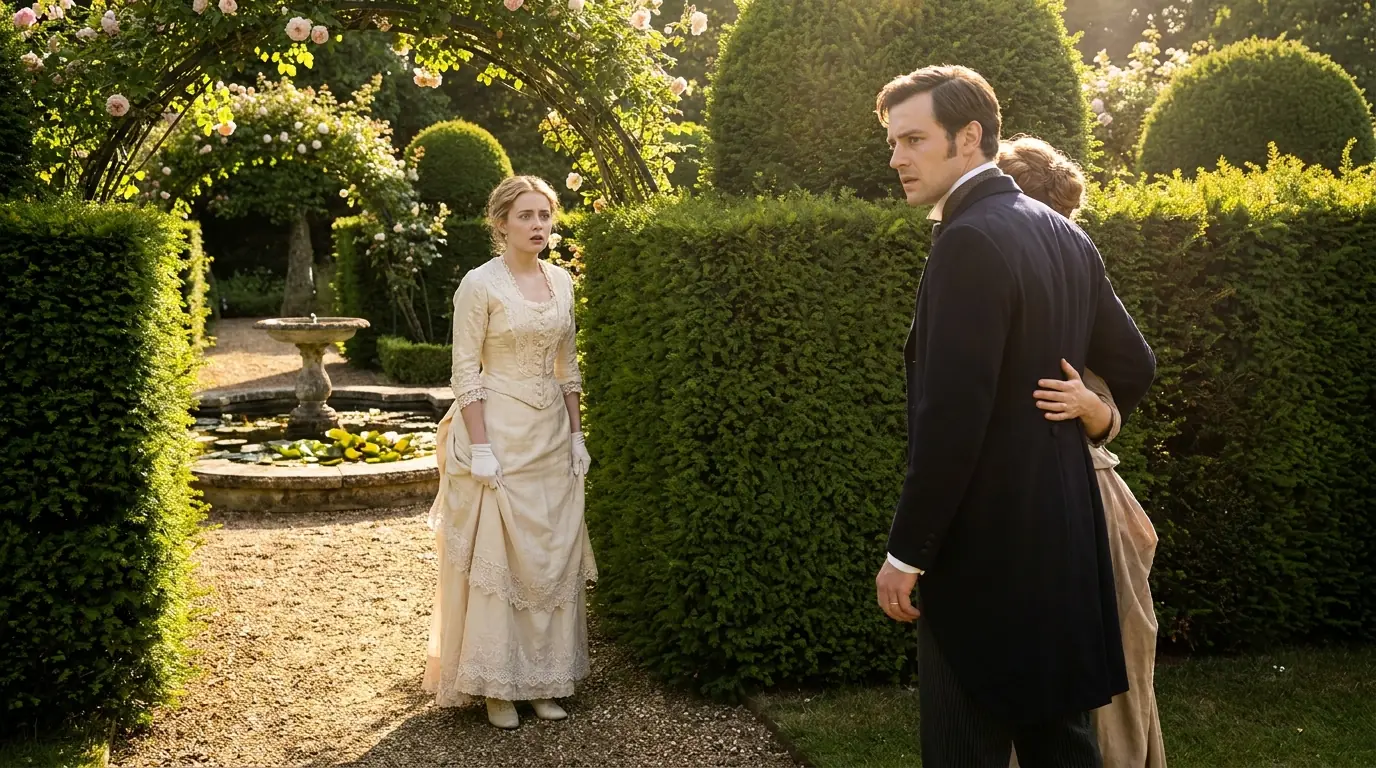
The hedge no longer hid the truth. Alice stepped forward. Henry stood holding Lady Penelope Winthrop, Alice’s cousin, his arms still wrapped around her. Their lips had only just parted.
“I see,” Alice said.
Her voice sounded strange to her own ears, calm and cold.
Henry released Penelope at once. His face lost its color. “Alice, this is not what it appears.”
“It appears my fiancé and my cousin have been engaged in a private arrangement behind my back.”
Penelope lowered her gaze, her cheeks red with shame.
“You must understand,” Henry said quietly. “Marriages in our world are arrangements. What we share does not need to interfere.”
A sharp clarity settled over Alice. All the missed glances, the careful distance, the sudden kindnesses Penelope had shown during wedding planning. It all made sense now.
“Our arrangement is over,” Alice said. “I will not be made a fool.”
Henry’s expression hardened. “Think of the scandal, your family.”
“How kind of you to worry about my reputation while dishonoring me,” she replied.
She turned and walked away, her back straight though her chest burned. She did not stop until she reached her room. There, the strength left her. She sank to the floor and allowed the tears to come.
By evening, grief had given way to resolve. The wedding was in two days. London would be watching. She could not proceed. She would not.
Alice moved to her writing desk and dipped her pen. She wrote to Lord Darcy Fisher, Earl of Dartmouth, a man known for quiet integrity, a man who watched more than he spoke. She asked for counsel, for refuge.
When his reply arrived at dawn, it was brief. She was welcome. A carriage would wait.
By noon, Alice left Campbell Manor quietly, dressed in plain traveling clothes. She carried only a small case. With each step away from the house, fear and freedom walked beside her.
The carriage carried her west, away from London, away from the life she had been promised. By the time the landscape changed and the sea came into view, she felt as though she had crossed more than miles.
Westcliff Hall stood on a cliff above the water, gray stone against the sky, strong and weathered. Lord Darcy himself waited at the door. “Lady Alice,” he said, bowing, “you honor my home.”
Inside, the house was warm and calm. No excess, no performance, just quiet strength. Rooms were prepared, a bath drawn, no questions asked.
That evening, Alice joined him for dinner. The conversation was gentle at first, safe. Weather, travel, books. Then he asked softly, “What brought you here?”
She told him the truth. He listened without interruption. When she finished, he said only, “You chose integrity over comfort. That takes courage.”
Later, as the sea whispered against the cliffs, Alice stood by her window and watched the moon on the water. She had left behind a duke, a wedding, and the life she had been trained to accept. What lay ahead, she did not know. But for the first time, the choice was her own.
And somewhere deep within, hope stirred.
Morning arrived at Westcliff Hall with the sound of seabirds and wind moving softly along the cliffs. Alice woke slowly, for a moment forgetting where she was. Then memory returned, not with panic, but with a steady calm she had never felt in London.
Three weeks had passed since her arrival, three weeks since she had walked away from her wedding and everything expected of her. Life at Westcliff Hall followed a gentler rhythm. There were no constant visitors, no whispered judgments behind fans, no endless fittings or expectations.
Lord Darcy rose early to attend estate matters, and Alice often joined him at breakfast. Their conversations were easy, thoughtful, and sincere. He never spoke down to her, never hurried her thoughts, never dismissed her opinions.
Alice began to help with his projects in the village. There was a small lending library being organized for the fishermen’s children, and she applied herself to the task with quiet enthusiasm. For the first time, her skills were used for something that mattered beyond appearances. She felt useful, respected, and seen.
Letters arrived.
At first, they were sharp and demanding. Her father insisted she return at once. Her mother spoke of duty and reputation. Later, the tone softened into pleading.
Alice answered politely but firmly. She would not return. She would not marry Henry.
Her sister Catherine wrote differently. She wrote with understanding, even relief. She admitted she had never trusted Henry’s intentions. Those letters became a comfort Alice did not know she needed.
One afternoon, Darcy invited Alice to ride with him along the cliffs. When he offered her a sidesaddle, she hesitated.
“I would prefer to ride properly,” she said quietly.
He studied her, then nodded. “So would I.”
The ride was exhilarating. The wind pulled at her hair. The sea stretched wide and wild beside them. Alice laughed, truly laughed, for the first time in years.
Darcy watched her with something close to wonder. “You seem different here,” he said as they reined their horses near the cliff’s edge.
“I feel different,” she replied, “as though I have finally stepped into my own life.”
As days passed, their companionship deepened. Evenings were spent in the library reading or discussing ideas Alice had never been encouraged to explore. Darcy spoke of philosophy, science, and responsibility. He listened when she spoke of her doubts, her fears, her anger at a system that valued obedience over truth.
Then the peace broke.
They were walking through the village one afternoon when a familiar voice called her name. Sir William Blackwood, an acquaintance from London, stood staring at her with open surprise.
“Lady Alice Campbell,” he said loudly. “Oh, it is true.”
Darcy stepped closer to her at once. Alice felt the cold return to her chest. Sir William’s eyes were already bright with gossip.
By the next morning, Alice knew the truth had escaped. London would be buzzing. A runaway bride hiding in the home of an unmarried earl. Society would not be kind.
That evening, Darcy spoke plainly. “There is a way to protect you,” he said. “Marriage.”
The word stunned her.
He explained carefully, “An engagement announced quickly would reshape the story. You would not be a woman fleeing scandal, but one choosing love over convenience.”
Alice listened in silence. She did not doubt his honor, but she feared repeating the same mistake, choosing safety over truth.
Before she could answer, the past arrived at Westcliff Hall in the form of Duke Henry Alford. He stood in the entrance hall as though he owned the space. His presence felt like a shadow from another life.
“I have come to take you home,” he said.
Alice faced him with a calm that surprised even herself. “There is no home for me there,” she replied.
Henry spoke of duty, of scandal, of forgiveness. Alice spoke of betrayal. When Lady Penelope arrived soon after, pale and anxious, the truth finally stood exposed.
Henry spoke openly of money, of arrangements, of necessity. Alice looked at her cousin with compassion rather than anger.
“Is this truly what you want?” she asked.
Penelope faltered. For the first time, doubt entered her eyes.
Then Darcy spoke. “Lady Alice has accepted my proposal,” he said.
The words rang through the room. Alice looked at him. She understood in that instant that this was not just protection. It was a choice, a real one.
“Yes,” she said clearly. “I have.”
Henry left in fury. Penelope stayed, shaken but free.
Later that night, Alice and Darcy stood together in the quiet hall. “You are not obligated,” Darcy said. “I would not have you choose me from fear.”
“I am choosing you from truth,” Alice replied.
For the first time, she knew what it meant to step forward without regret.
The days following Henry’s departure were filled with quiet change. Westcliff Hall, once only a place of refuge, became a place of decision. Alice felt the weight of what she and Darcy had declared, not with fear, but with seriousness. This was no hurried escape now. It was a future being shaped.
News of the engagement spread quickly. London reacted exactly as expected. Some called it reckless. Others whispered of impropriety. A few, quietly and with relief, admired her courage.
Alice received letters filled with disappointment, shock, and advice she did not ask for. She read them calmly, then set them aside. Their power over her had faded.
Her parents arrived two weeks later. They came prepared for conflict, but what they found unsettled them. Westcliff Hall was orderly and dignified. Darcy received them with respect. Alice stood beside him, not defiant, but certain.
Her father questioned Darcy closely, his estate, his intentions, his finances. Darcy answered without pride or apology. He spoke of responsibility, of partnership, of respect. He did not promise luxury beyond reason. He promised steadiness.
Alice’s mother watched them both closely. She noticed how Darcy listened when Alice spoke, how Alice no longer hesitated before answering. By the time they left, disappointment had softened into reluctant acceptance.
“If this is your choice,” her mother said quietly, “then I pray it brings you peace.”
“It already has,” Alice replied.
Lady Penelope remained at Westcliff Hall for a time, recovering from her own disillusionment. She and Alice spoke often, honestly. There were tears and apologies, but also forgiveness.
Penelope began to see how deeply she had been shaped by fear and dependency. “I don’t know who I am without him,” she admitted one evening.
“You will,” Alice said. “You just have to allow yourself time.”
Penelope left later with a new resolve, determined to live differently.
The wedding was planned without urgency or display. No grand London cathedral, no crowded ballroom. Instead, a small stone church near the village, overlooking the sea.
Darcy asked Alice what she wanted.
“Peace,” she said, “and truth.”
That was enough.
On the morning of the wedding, Alice dressed simply. The gown was ivory silk, modest and elegant. No heavy jewels, no elaborate veil.
As she looked in the mirror, she did not see a bride prepared to perform a role. She saw a woman stepping into a life she had chosen.
The church filled quietly. Villagers sat alongside family. The air smelled of salt and flowers. Sunlight streamed through old stained glass.
Darcy waited at the altar, calm but visibly moved. When Alice appeared, walking beside her father, he did not look away.
As she reached him, he whispered, “You are radiant.”
“I feel free,” she replied.
The vows were spoken slowly, with care. Each word meant something. When Darcy promised respect and partnership, Alice believed him. When Alice promised honesty and loyalty, she gave it willingly, not as duty, but as gift.
When he kissed her, it was gentle and certain.
They were married.
The celebration afterward was held on the lawn of Westcliff Hall. The sea stretched endlessly beyond them. Laughter drifted easily. There was no tension, no pretense. Alice noticed how relaxed everyone seemed, as though the house itself approved.
Her sister Catherine hugged her tightly. “I have never seen you like this.”
“Like what?”
“At peace.”
That evening, as the guests faded away and the sky deepened into gold and blue, Alice stood with Darcy on the terrace.
“Do you regret anything?” he asked softly.
She considered the question. “I regret the years I spent believing silence was strength,” she said, “but not the path that brought me here.”
Darcy smiled. “Then neither do I.”
Life settled into something steady and meaningful. Alice involved herself deeply in village affairs, education, and charity. Darcy encouraged her independence, never fearing it. Their marriage grew not from passion alone, but from shared purpose.
Henry faded into memory. News reached them that he sought another wealthy match, this time abroad. Alice felt nothing at the thought, no anger, no sorrow, only distance.
One evening, months later, Alice stood again at her window, watching the sea as she had on her first night at Westcliff Hall. Darcy joined her, his arm warm around her waist.
“Do you ever miss London?” he asked.
She shook her head gently. “I miss who I thought I was meant to be,” she said. “But I do not miss who I was.”
Darcy pressed his forehead to hers. “Then we have chosen well.”
Alice leaned into him, certain of that truth. She had organized the perfect wedding once, believing perfection meant approval.
Now, she understood.
Perfection was choosing herself.