Lady Eliza Hawthorne had made peace with her fate approximately three weeks after her twenty-first birthday, following her third unsuccessful season in London and a particularly tedious conversation with Lady Peyton about the correct way to arrange flowers.
The peace treaty she had negotiated with herself was simple. She would never marry for anything less than genuine affection, and she would absolutely never, under any circumstances, pretend to be stupid to attract a husband.
This was a radical position in 1840s England, where a woman’s intelligence was considered roughly as desirable as a third elbow.
The unfortunate consequence of this personal manifesto was that Eliza had spent the better part of three years watching every eligible gentleman in London gravitate toward young ladies who giggled at their jokes, never contradicted them, and possessed the intellectual curiosity of decorative cushions.
It was exhausting.
More exhausting still was maintaining her composure whilst watching Julian Wickliffe, Duke of Westwick, dance with those same young ladies season after season.
Julian Wickliffe.
Even thinking his name made Eliza’s traitorous heart perform acrobatics that would impress a circus troupe.
She had fallen desperately, hopelessly, ridiculously in love with him during her first season at a ball where he had actually spoken to her for nearly ten minutes about a book they had both read.
Ten glorious minutes during which he had looked at her, truly looked at her, and discussed Lord Byron’s poetry with genuine enthusiasm, not the patronizing tone most men adopted when forced to converse with women about literature.
Then Lady Arabella Fitzroy had appeared in a dress that probably cost more than a small cottage, and Julian had excused himself with perfect politeness.
Eliza had watched him dance with Arabella, then with the beautiful Miss Katherine Thornbury, then with the diamond of that season, Lady Victoria Sterling.
She had understood the message clearly.
A duke did not notice ordinary girls who read too much and had opinions about everything.
That had been three years ago. Three years of watching Julian from across ballrooms. Three years of seeing him surrounded by the most beautiful women in England.
Three years of carefully maintaining her dignity whilst her heart insisted on being foolish.
She had seen him perhaps two dozen times since that first conversation, always at a distance, always with some stunning creature on his arm or requesting his dance.
And now, this Tuesday morning in March, her mother had announced yet another tiresome visitor to their home in Mayfair.
“A very important guest of your father’s, darling,” Lady Hawthorne had said over breakfast, her tone suggesting this was somehow different from the parade of important guests who had been traipsing through their drawing room every week for as long as Eliza could remember. “Do wear something appropriate.”
Eliza had looked at her mother, really looked at her, and made a decision that was either brilliantly rebellious or catastrophically stupid, possibly both.
She was done.
Done with appropriate dresses that squeezed her ribs until she could barely breathe. Done with having her hair tortured into elaborate styles that gave her headaches.
Done with smiling politely at her father’s business associates and political allies whilst they droned on about topics they assumed she could not possibly understand.
If she had to endure another afternoon of aristocratic tedium, she would at least be comfortable.
Which was how, two hours later, Eliza found herself standing in her bedchamber, staring at her reflection with a mixture of satisfaction and mild horror.
The dress she had chosen was a disaster, a plain brownish-gray monstrosity that had been relegated to the back of her wardrobe three years ago after her mother had declared it absolutely unsuitable for anything except perhaps scrubbing floors.
It hung on her frame like a potato sack that had given up on life.
The color made her look vaguely jaundiced.
Perfect.
Her hair she had attempted to pin up herself, dismissing her lady’s maid with the excuse of a headache.
The result was, well, it was half pinned and half falling down, which created an effect that could charitably be described as recently caught in a windstorm, or less charitably as having not seen a mirror in several days.
She had forgotten jewelry entirely. No gloves, no shawl, nothing that suggested she had put any effort whatsoever into her appearance.
Martha, her lady’s maid, had actually gasped when she had seen her.
“Miss Eliza, you cannot. Lady Hawthorne will—”
“Lady Hawthorne will survive,” Eliza had said firmly, sweeping past her toward the stairs. “I’m properly covered, aren’t I? Nothing scandalous, just unimpressive.”
That had been the goal, unimpressive, forgettable, so thoroughly unremarkable that whatever important guest was visiting would barely register her presence.
She descended the main staircase with her head high, prepared for her mother’s inevitable disapproval.
The plan was simple. Appear for exactly the minimum amount of time required by politeness, say as little as possible, and retreat to the library at the first opportunity.
It was a good plan, a solid plan.
The plan lasted approximately four seconds after she entered the drawing room, because there, standing beside her father’s desk near the large windows overlooking the garden, dressed in an impeccably tailored dark blue coat that fit his broad shoulders in a way that should probably be illegal, was Julian Wickliffe, the Duke of Westwick.
The man she had loved in secret for three years.
The man who absolutely, positively should not be seeing her like this.
Eliza stopped so abruptly she nearly tripped over her own feet. Her hand shot out to grip the doorframe for support.
Every muscle in her body tensed with the overwhelming urge to flee. She took one step backward, then another.
Her mother’s hand clamped around her elbow like an iron manacle wrapped in silk.
“Eliza,” Lady Hawthorne said, her voice honey and utterly terrifying. “Do come greet our guest.”
Eliza’s father, the Marquis of Hawthorne, looked up from whatever document he and the Duke had been examining.
His expression flickered through several emotions in rapid succession: surprise, confusion, and what might have been suppressed amusement.
“Ah, Eliza,” her father said, his voice carefully neutral. “May I present His Grace, the Duke of Westwick. Your Grace, my daughter, Lady Eliza Hawthorne.”
This was hell.
This was actual, literal hell.
Julian turned toward her, and Eliza watched his expression with the fatalistic calm of someone watching her own execution.
She waited for the polite indifference, the barely concealed disappointment, perhaps even a flicker of pity for the Marquis’s unfortunate daughter, who apparently dressed herself in the dark.
What she saw instead made her breath catch in her throat.
Julian Wickliffe was staring at her with undisguised fascination.
His dark eyes, she had forgotten how dark they were, like aged whiskey and candlelight, traveled over her disheveled appearance not with disgust or disappointment, but with something that looked distinctly like delight.
One corner of his mouth curved upward in a smile that transformed his usually serious expression into something warm and genuine and utterly devastating.
“Lady Eliza,” he said, his deep voice carrying a note of warmth that sent shivers down her spine.
He stepped forward and bowed, a proper bow, not the perfunctory nod most men gave to unmarried ladies they considered beneath their notice.
“What an unexpected pleasure.”
Unexpected.
That was certainly one word for it.
Eliza’s mind raced through her limited options. She could faint, no, too dramatic. Claim sudden illness, no, too obvious. Simply turn and run, no, her mother still had her arm in a death grip.
She was trapped.
Utterly, completely trapped.
Very well, then. If fate had decided to humiliate her in front of the man she loved, she might as well face it with whatever dignity she could salvage.
Eliza straightened her shoulders and dropped into a curtsy that was technically correct, even if her horrendous dress bunched awkwardly around her knees.
“Your Grace. My father didn’t mention we’d be entertaining a duke today. Had I known, I might have dressed for the occasion.”
The words came out more tartly than she had intended.
Heat flooded her cheeks. Wonderful. Now she was being rude to a duke in addition to looking like an escaped scarecrow.
But Julian’s smile only widened.
“On the contrary, Lady Eliza, I find your attire refreshingly honest.”
Honest.
What an interesting word choice.
“How diplomatic of you, Your Grace,” Eliza heard herself say, “though I suspect your definition of honest is remarkably generous.”
Her mother’s fingers tightened warningly on her arm. Her father made a small sound that might have been a cough or a laugh hastily converted into a cough.
Julian, however, laughed outright, a genuine, delighted sound that lit up his entire face.
“I meant it as a compliment, Lady Eliza. Half the ladies in London spend hours preparing themselves for visitors, creating elaborate artifice. You apparently cannot be bothered with such nonsense.”
He said it like it was admirable, like her complete lack of preparation was somehow charming rather than mortifying.
Eliza stared at him, trying to understand what was happening.
This was not how dukes behaved toward ordinary young ladies, especially not ordinary young ladies who looked as if they had been dragged backward through a hedge.
“I—”
She started, then stopped, unsure what to say.
“Won’t you sit down, Eliza?” her father interjected smoothly, gesturing toward the settee near the fireplace. “His Grace and I were just concluding some business, but there’s no reason we cannot enjoy tea whilst we finish.”
Oh, heavens.
Tea.
That meant she would have to stay for at least half an hour, looking like this, with Julian Wickliffe watching her with that inexplicable expression of interest.
Her mother finally released her arm, and Eliza moved toward the indicated settee on legs that felt distinctly unsteady.
She sat, arranging her hideous dress as best she could, hyperaware of Julian taking a seat in the chair directly across from her.
He was still smiling at her.
Why was he still smiling at her?
A maid entered with the tea service, and Eliza’s mother began the ritual of pouring with practiced grace.
The conversation resumed, her father and Julian discussing something about agricultural improvements on the Duke’s estates in Yorkshire, but Eliza felt Julian’s gaze return to her repeatedly.
She tried to focus on her tea, tried to be invisible, tried to calculate the minimum amount of time before she could politely excuse herself and never show her face in civilized society again.
“Lady Eliza,” Julian said suddenly, interrupting her father mid-sentence about crop rotation. “I recall we once discussed Lord Byron at the Pembridge ball. Do you still read poetry?”
He remembered.
He remembered their conversation from three years ago.
Eliza looked up, teacup frozen halfway to her lips.
“I... yes, Your Grace, though I confess my reading tastes have expanded somewhat beyond poetry.”
“Oh?”
His dark eyes sparkled with genuine curiosity.
“What captures your interest these days?”
This felt like a trap. Men did not actually want to know what women read.
They wanted to hear about romantic novels or perhaps housekeeping manuals. But something in Julian’s expression, an openness, an authentic interest, made her answer honestly.
“I’ve been reading quite a bit of philosophy recently. John Stuart Mill’s essays on representative government. Some of Mary Wollstonecraft’s work as well.”
Her mother made a small pained sound. Her father’s eyebrows rose nearly to his hairline.
Julian leaned forward, his elbows resting on his knees, his entire attention focused on her with an intensity that made her heart race.
“Wollstonecraft? The Vindication? Good heavens, Lady Eliza, those are rather revolutionary texts for a young lady.”
Here it came, the polite dismissal, the subtle mockery.
“I’ve read them myself,” Julian continued. “Her arguments about education are particularly compelling, don’t you think? Though I suspect most of London society would consider us both radical for admitting as much.”
Eliza blinked, then blinked again.
“You’ve read Mary Wollstonecraft?”
“Why do you sound so surprised?” Julian’s smile turned slightly mischievous. “Did you assume dukes spent all their time hunting and gambling and discussing horseflesh?”
“Well, yes, actually.”
He laughed again, that warm, genuine sound that did dangerous things to her composure.
“Fair enough. Most of us do. But I find books infinitely more interesting than horses, and philosophy more engaging than cards.”
This couldn’t be real.
This had to be some sort of elaborate dream or perhaps a fever hallucination.
“Your Grace,” Eliza said carefully, “are you quite well? Only you seem to be having an actual conversation with me about books, which, in my experience, is not something gentlemen do with ladies.”
Her mother gasped. Her father looked torn between mortification and amusement.
Julian, blessed man, simply grinned.
“Perhaps you’ve been conversing with the wrong gentlemen, Lady Eliza.”
The afternoon dissolved into the strangest, most wonderful confusion of Eliza’s life.
Her father and Julian completed their business, something about irrigation systems and land management that ordinarily would have bored her to tears.
But every few minutes, Julian would direct a question to her about books, about her opinions on current political debates, about whether she thought the new railway expansion would fundamentally alter English society.
He asked like he actually cared about her answers, like her thoughts mattered, like she was a person whose intelligence he respected rather than a decorative object to be admired and dismissed.
And the way he looked at her, not at her hideous dress or her disastrous hair, but at her face, her eyes, as if she was the most fascinating person in the room.
It was intoxicating, terrifying, completely inexplicable.
An hour passed, then another. Her mother had long since given up trying to steer the conversation toward more appropriate topics.
Her father watched the exchange with an expression Eliza could not quite interpret.
Finally, Julian rose to take his leave.
“Lord Hawthorne, thank you for your time and expertise. I’m confident our collaborative approach to the Yorkshire estates will prove most beneficial.”
He turned to Eliza’s mother.
“Lady Hawthorne, thank you for your hospitality.”
Then he looked at Eliza, and his expression softened into something that made her heart perform impossible acrobatics.
“Lady Eliza, this has been the most enjoyable afternoon I’ve spent in London in... well, perhaps ever.”
Eliza stood, her horrendous dress bunching awkwardly again.
“Your Grace, I suspect you’re being absurdly kind, given that I look like I’ve been sleeping rough in Hyde Park.”
“I think,” Julian said quietly, his dark eyes holding hers, “you look like someone who doesn’t waste time on pretense. It’s remarkably attractive.”
He bowed to her, another proper, respectful bow.
And then he was gone, following her father into the hallway.
Eliza stood frozen in the drawing room, her tea long since cold, her mind reeling.
What in heaven’s name had just happened?
Her mother moved to her side, her expression a complicated mixture of disapproval and something that looked like cautious hope.
“Eliza, what on earth was that?”
“I have absolutely no idea,” Eliza admitted. “I wore my worst dress specifically to be unmemorable.”
“Well,” her mother said dryly, “you certainly failed at that objective. The Duke of Westwick looked at you as if you had hung the moon and stars.”
That was impossible.
That was absurd.
“Eliza,” her father called from the doorway. “Might I have a word?”
She followed him into his study on unsteady legs. He closed the door and leaned against his desk, studying her with an expression she recognized from childhood, the look he got when he was trying to solve a particularly complex problem.
“Did you know the Duke was visiting today?” he asked finally.
“Absolutely not. If I had known, I would have—”
She gestured helplessly at her dress.
“Well, I certainly wouldn’t have looked like this.”
Her father’s lips twitched.
“The Duke seems remarkably unbothered by your creative fashion choices.”
“I don’t understand it,” Eliza confessed. “He’s the most eligible man in England. He could have his pick of any lady in London. Beautiful, accomplished, properly dressed ladies. Why would he possibly be interested in—”
She could not finish the sentence. It was too painful.
Her father moved closer, his expression gentling.
“My dear girl, perhaps that’s precisely why. Perhaps he is tired of beautiful, accomplished ladies who are performing for him. Perhaps he finds your authenticity refreshing.”
“Authenticity?” Eliza repeated flatly. “Is that what we’re calling catastrophically underdressed and socially inappropriate?”
“I’m calling it being yourself,” her father said. “And apparently, the Duke of Westwick finds yourself rather captivating.”
Eliza sank into the chair beside his desk, her mind still spinning.
“This doesn’t make sense. People like him don’t notice people like me.”
“People like him,” her father said gently, “are usually surrounded by pretense and performance and people wanting things from them. You treated him like a person. You argued with him about philosophy. You were honest about your appearance rather than making excuses. My dear, you have no idea how rare that is.”
“But—”
“The Duke asked if he might call again,” her father interrupted. “Tomorrow afternoon, if that’s acceptable to you.”
Eliza’s head snapped up.
“He what?”
“He specifically asked permission to call on you, Eliza. Not on me, not on the family generally. On you.”
The world tilted sideways.
“Tomorrow?”
“Tomorrow,” her father confirmed. “And Eliza, perhaps this time, wear whatever makes you comfortable. Clearly, your instincts were better than anyone expected.”
Eliza walked back to her bedchamber in a daze.
Martha met her at the door, took one look at her expression, and asked, “Miss, are you quite well?”
“The Duke of Westwick,” Eliza said slowly, testing the words, “is calling tomorrow, specifically to see me.”
Martha squealed, actually squealed with delight.
“Miss. Oh, Miss Eliza, the Duke. We must plan your dress immediately. We must—”
“No,” Eliza said firmly. “No planning, no elaborate preparation. If Julian Wickliffe—”
She caught herself using his Christian name and felt heat flood her cheeks.
“If the Duke is truly interested in me, then he is interested in the actual me, not some polished, performative version.”
Martha looked skeptical, but nodded.
“As you wish, miss.”
Eliza moved to her window, looking out over the London street below.
Somewhere in this city, Julian Wickliffe was going about his ducal business, probably already forgetting this strange afternoon.
Except he had asked to call again.
He had looked at her like she mattered. He had remembered their conversation from three years ago, and he had smiled at her, truly smiled, when she had been wearing the worst dress in Christendom and hair that looked like a bird’s nest.
Perhaps, Eliza thought, pressing her hand against her racing heart, perhaps the universe wasn’t cruel after all.
Perhaps it simply had a very strange sense of timing.
Tomorrow, she would find out if this inexplicable afternoon had been real or merely a wonderful hallucination brought on by wishful thinking.
Tomorrow, Julian Wickliffe would return, and Eliza, for possibly the first time in three years, allowed herself the dangerous luxury of hope.
Eliza spent that evening in a state that could only be described as controlled panic.
She tried to read, her usual refuge from overwhelming emotions, but found herself staring at the same paragraph of Mill’s essay on liberty for twenty minutes without comprehending a single word.
Her mind kept replaying the afternoon’s events like a music box stuck on the same melody.
The way Julian had looked at her, the way he had laughed, the way he had leaned forward when she spoke, as if her words actually mattered.
It couldn’t be real.
Men like Julian Wickliffe did not fall for women like her, especially not when she had been dressed like an unemployed governess.
At dinner, her mother tried to engage her in conversation about appropriate topics for tomorrow’s call.
“Perhaps discuss the weather, dear, or inquire about his estates, but do try not to argue about philosophy.”
But Eliza barely tasted her food.
Her father watched her with that inscrutable expression he had worn earlier, occasionally smiling into his wine glass.
By the time she retired to her bedchamber, Eliza had convinced herself that she had imagined the entire thing.
Julian would send a polite note in the morning explaining that he had been unexpectedly called away to Yorkshire or Scotland or anywhere that wasn’t here.
Dukes did not actually call on unremarkable young ladies just because they had had one interesting conversation.
She was wrong.
The next afternoon, at precisely three o’clock, their butler announced, “His Grace, the Duke of Westwick.”
Eliza, who had been attempting to appear casual while simultaneously perched on the edge of the drawing room settee for the past forty minutes, nearly dropped the book she had been pretending to read.
Julian entered the room and stopped immediately, his dark eyes finding her with unnerving precision, his face lit with that same warm smile from yesterday, the smile that suggested he was genuinely pleased to see her.
He was even more handsome than she remembered.
Today he wore a charcoal-gray coat that made his broad shoulders look impossibly wider, his dark hair slightly mussed as if he had been running his fingers through it.
There was a slight crease between his brows that suggested he had been concentrating on something serious just before arriving.
“Lady Eliza,” he said, his deep voice sending pleasant shivers down her spine. “I hope I’m not intruding.”
“Your Grace,” Eliza managed, standing and dropping into a curtsy.
She had chosen a dress today, a simple day dress in pale blue that Martha had insisted was perfectly appropriate without being overly formal, and had actually allowed her maid to properly arrange her hair.
The result was presentable, if not remarkable.
She had half expected Julian to look disappointed when he saw her properly dressed, as if yesterday’s disaster had held some bizarre appeal that today’s respectability lacked.
Instead, he looked thoughtful.
His gaze traveled over her neat appearance, and one eyebrow lifted slightly.
“You look lovely, Lady Eliza, though I confess I was rather charmed by yesterday’s ensemble.”
Heat flooded her cheeks.
“Your Grace, you’re either remarkably kind or remarkably dishonest. That dress was a catastrophe.”
“It was honest,” he said, moving closer. “You wore exactly what you wanted to wear without caring what anyone thought. I found that rather liberating to witness.”
Her mother, who had been sitting discreetly near the window with her embroidery, made a small pleased sound.
Julian turned to her with impeccable politeness.
“Lady Hawthorne, I hope you’ll forgive my requesting a few moments of your daughter’s time. Perhaps a walk in your garden? It’s a remarkably pleasant afternoon.”
Eliza’s mother looked as if Christmas had arrived early.
“Of course, Your Grace. Eliza, do take your shawl. The gardens are quite lovely this time of year.”
Two minutes later, Eliza found herself walking beside the Duke of Westwick through her mother’s prized rose garden.
A proper chaperone, her mother, was watching from the drawing room window at a distance that was technically appropriate whilst being far enough away that their conversation would remain private.
For several moments, neither spoke. Eliza’s heart hammered so loudly she was certain Julian could hear it.
This was bizarre.
This was impossible.
This was—
“I’ve been thinking about you since yesterday,” Julian said abruptly.
Eliza nearly tripped over her own feet.
“I beg your pardon?”
He stopped walking and turned to face her, his expression serious now.
“Lady Eliza, I’m going to be remarkably forward with you, which may be inappropriate, but I suspect you’d prefer honesty to polite dancing around the subject.”
“I... yes, actually, I would.”
“Good.”
He took a breath, and Eliza saw something she had never expected to see on the face of England’s most eligible bachelor.
Nervousness.
“I’ve attended approximately forty social events this season. Balls, soirées, musicales, dinner parties. At each one, I’ve been surrounded by accomplished, beautiful young ladies who laugh at my jokes, agree with everything I say, and perform elaborate displays designed to catch my attention.”
Eliza felt her heart sinking.
Of course, he was going to explain why those women were preferable to odd girls who wore horrible dresses.
“It’s exhausting,” Julian continued, “being constantly performed for, never knowing if someone is genuinely interested in conversation or merely interested in becoming a duchess. I’ve spent three years feeling like an object to be acquired rather than a person to be known.”
He moved closer, and Eliza’s breath caught.
“And then yesterday, I walked into your father’s drawing room and saw you, windswept hair, truly terrible dress, looking at me like you’d rather be literally anywhere else. And you were the most refreshing thing I’d seen in years.”
“Refreshing,” Eliza repeated faintly. “That’s a diplomatic word for disastrous.”
“No,” Julian said firmly. “Honest. Real. When I asked about your reading, you didn’t pretend to only read poetry or romantic novels. You told me you had been reading Mary Wollstonecraft and didn’t care if I found it inappropriate.”
He smiled slightly.
“When I commented on your appearance, you didn’t make excuses or simper. You practically called me a liar to my face.”
A surprised laugh escaped her.
“That was appallingly rude of me.”
“That was gloriously honest,” he corrected. “Lady Eliza, do you know how many genuine conversations I’ve had with young ladies in the past three years? Conversations where they actually disagreed with me or challenged my opinions or said something unpredictable?”
Eliza shook her head.
“None,” Julian said flatly. “Not one until yesterday. Until you.”
They had reached a small bench beneath an arbor heavy with climbing roses.
Julian gestured to it, and Eliza sat, her mind reeling. He settled beside her, close enough that she could smell his cologne, something woody and expensive, and turned to face her.
“I’m not explaining this well,” he admitted. “I’m making it sound like I only value you for being different, which is reductive and unfair. The truth is, Lady Eliza, I’ve been half in love with you since the Pembridge ball three years ago.”
The world stopped.
“What?”
The word emerged as barely a whisper.
Julian smiled ruefully.
“We spoke for perhaps ten minutes about Byron. You quoted passages from Don Juan from memory and explained why you thought Childe Harold’s Pilgrimage was overrated. You argued with me, genuinely argued with passion and intelligence, and I remember thinking, finally, finally, someone interesting.”
“But you left,” Eliza said, her voice cracking. “Lady Arabella arrived, and you left.”
“Because I was terrified,” Julian admitted. “You were utterly captivating, and I was a young duke who had been told his entire life that marriage was a strategic decision. I convinced myself that attraction and genuine interest weren’t sufficient foundations for courtship. I told myself I needed to be practical.”
“To choose someone appropriate and accomplished and beautiful,” Eliza finished quietly.
“You are beautiful,” Julian said with such conviction that her head snapped up. “Good God, Eliza, you’re beautiful. But more than that, you’re brilliant and funny and honest, and you don’t pretend to be less than you are to make men comfortable.”
Eliza stared at him, trying to process words that contradicted everything she had believed about herself for three years.
“Your Grace—”
“Julian,” he interrupted. “Please, Eliza, call me Julian.”
The intimacy of using his Christian name felt dangerous.
Thrilling.
Terrifying.
“Julian,” she said carefully, testing the name on her tongue. “I’ve spent three years watching you dance with the most beautiful women in England. Women who are charming and accomplished and elegant. Why would you possibly—”
“Because those women bore me senseless,” he said bluntly. “I’ve danced with Lady Victoria Sterling six times. She has never expressed a single opinion that wasn’t carefully calculated to agree with whoever she was speaking to.”
He continued, “I’ve sat beside Miss Katherine Thornbury at four dinner parties. She speaks exclusively about the weather and her skill at watercolors. Lady Arabella, brilliant, beautiful Lady Arabella, once spent an entire evening telling me about her new bonnets.”
Despite herself, Eliza laughed.
“I don’t want a wife who performs for me,” Julian continued. “I don’t want someone who sees me as a title to acquire. I want someone who argues about philosophy. Someone who wears terrible dresses when she can’t be bothered with propriety. Someone who looks at me like I’m a person rather than a prize.”
His hand moved to cover hers on the bench between them.
His touch was warm, gentle, achingly careful.
“Someone like you, Eliza.”
Eliza looked down at their hands, her throat tight with emotion.
“I don’t understand. Yesterday morning I was nobody. The Marquis’s ordinary daughter who had failed to secure a husband after three seasons. And now you’re saying—”
“You were never nobody,” Julian said fiercely. “You were always remarkable. I was simply too cowardly to pursue what I actually wanted instead of what everyone expected me to want.”
“And what do you want?”
The question emerged barely above a whisper.
Julian’s thumb traced small circles on the back of her hand.
“I want to court you, Eliza. Properly, openly. I want to spend afternoons discussing books and arguing about politics. I want to learn what makes you laugh and what makes you angry and what you dream about when you’re alone.”
He paused, his dark eyes searching hers.
“I want you to know that someone sees you, truly sees you, and finds you absolutely extraordinary.”
Tears pricked at Eliza’s eyes.
Three years.
Three years of believing she was too much and not enough simultaneously. Three years of watching Julian from afar and assuming he would never notice her. Three years of carefully managed disappointment.
And now he was here, holding her hand, saying impossible things in his deep, serious voice.
“This is mad,” she managed. “People will think you’ve lost your senses courting someone like me.”
“Let them think what they like,” Julian said. “I’ve spent too much time caring about other people’s opinions. I’m done with that.”
Eliza looked at him, really looked at him, and saw something she had missed before.
Beneath the ducal confidence and the devastating handsomeness, Julian Wickliffe was lonely.
He was tired of being performed for.
He wanted what she had always wanted, to be known for who he actually was rather than what he represented.
“I’ve loved you for three years,” she blurted out, then immediately wanted to sink into the earth and disappear. “Oh, heavens, I shouldn’t have said that. That’s far too forward.”
Julian’s face transformed. His smile was brilliant, joy radiating from every feature.
“Say it again.”
“Absolutely not.”
“Please, Eliza, say it again.”
“I will not. It was mortifyingly inappropriate, and—”
He leaned closer, his free hand coming up to cup her jaw gently.
“Eliza Hawthorne, you are the most wonderful surprise of my life. And if you’ve loved me for three years whilst I was too blind to see what was right in front of me, then I have considerable time to make up for.”
His thumb brushed across her cheek, and Eliza’s breath caught.
They were technically in view of her mother’s window. This was perfectly appropriate by the standards of 1840s courtship, but the intimacy of the gesture made her feel like they were the only two people in the world.
“May I court you?” Julian asked softly. “Properly, with your parents’ blessing and society’s knowledge. May I take you driving in Hyde Park and escort you to the opera and bore you with agricultural discussions about Yorkshire sheep farming?”
Eliza laughed, tears spilling over despite her best efforts to contain them.
“You’re serious? You’re actually serious?”
“Devastatingly serious,” he confirmed. “Say yes, Eliza. Give me the chance to prove I’m worthy of three years of your secret affection.”
There were a thousand reasons to be cautious, to protect her heart, to question his motivations, to wonder if this was some elaborate dream from which she would wake devastated.
But Julian was looking at her like she was precious, like she mattered, like she was enough exactly as she was.
“Yes,” Eliza whispered. “Yes, Julian, you may court me.”
His smile could have powered every gas lamp in London.
“Thank God. I was prepared to grovel if necessary.”
“I would have enjoyed watching that,” Eliza admitted.
“I’m certain you would have.”
He stood, helping her to her feet.
“Now, shall we inform your parents that I’ve utterly lost my senses and intend to pursue their brilliant, argumentative, wonderfully honest daughter?”
“They’ll think you’ve gone mad.”
“Excellent,” Julian said cheerfully. “I’ve always wanted to be the source of scandalized gossip. It builds character.”
They walked back toward the house, Eliza’s hand tucked into the crook of Julian’s arm.
Through the drawing room window, she could see her mother watching them with an expression of barely contained excitement.
“Julian,” Eliza said as they approached the terrace. “What happens when you realize I’m not actually extraordinary? When the novelty of my honesty wears off, and you remember that there are dozens of beautiful, accomplished ladies who would make much more suitable duchesses?”
He stopped walking and turned to face her, his expression serious.
“Eliza, I’ve spent three years surrounded by those ladies. I know exactly what they offer. What I don’t know, what I’m desperate to discover, is everything about you.”
He smiled softly.
“Your favorite books and your least favorite social obligations, and whether you can play the pianoforte, or if you share my complete inability to carry a tune.”
“I’m a terrible musician,” Eliza confessed. “Absolutely dreadful.”
“Perfect,” Julian said. “We can be dreadful together. I once made my music teacher quit by attempting to play Mozart.”
Despite herself, Eliza laughed.
“That’s actually impressive.”
“I have hidden depths of incompetence,” he assured her. “You’ll discover them all, I promise.”
They entered the drawing room to find both of Eliza’s parents waiting with barely concealed curiosity.
Her mother’s embroidery lay forgotten in her lap. Her father had emerged from his study and stood by the fireplace, trying to appear casual whilst clearly desperate to know what had transpired in the garden.
Julian addressed them formally, but Eliza could see the suppressed smile playing at the corners of his mouth.
“Lord Hawthorne, Lady Hawthorne, I’ve had the honor of requesting permission to formally court your daughter. With your blessing, I’d like to call upon Lady Eliza regularly and escort her to appropriate social engagements.”
Eliza’s mother looked as if she might faint from happiness.
Her father’s expression shifted to something more calculating, not suspicious, but protective.
“Your Grace,” the Marquis said carefully. “Might I ask what your intentions are regarding my daughter?”
“Honorable,” Julian said immediately. “Completely honorable. I intend to court Lady Eliza properly, to give her time to determine whether my regard is returned, and should she find me acceptable, to eventually request her hand in marriage.”
The words hung in the air like bells.
Marriage.
Julian had just announced his intention to marry her.
Eliza felt lightheaded.
Her father studied Julian for a long moment, then glanced at Eliza. Whatever he saw in her expression must have satisfied him, because he nodded slowly.
“Very well, Your Grace. You have my permission to court Eliza. However, I expect you to treat her with appropriate respect and consideration.”
“I wouldn’t dream of doing otherwise,” Julian assured him.
Her mother had apparently lost the ability to speak and simply nodded enthusiastically.
Julian stayed for another hour, taking tea and engaging in conversation that was perfectly proper and appropriate, whilst simultaneously catching Eliza’s eye repeatedly and smiling like they shared a wonderful secret.
Which, Eliza supposed, they did.
When he finally took his leave, he bowed over Eliza’s hand and held it perhaps a moment longer than strictly necessary.
“Tomorrow afternoon, might I take you driving in Hyde Park around four, when all of society will be present to witness the Duke of Westwick courting the incomparable Lady Eliza Hawthorne?”
“You want to make a spectacle,” Eliza realized.
“I want everyone to know,” Julian corrected. “I’ve wasted three years. I’m not wasting another moment hiding what I want.”
After he left, Eliza’s mother immediately burst into excited chatter about what Eliza should wear for Hyde Park, which bonnets would be most flattering, which shawls would best complement which dresses.
Her father caught Eliza’s eye and gestured toward his study. She followed, grateful for a moment of relative quiet.
“Are you certain about this, my dear?” he asked gently. “The Duke is, well, he’s rather overwhelming. His attentions will come with considerable public scrutiny.”
“I know,” Eliza said. “Papa, I’ve loved him for three years. I know that sounds ridiculous, but—”
“It doesn’t sound ridiculous at all,” her father interrupted. “I fell in love with your mother after one dance. These things happen.”
He paused.
“But love alone isn’t always sufficient for happiness. Can you trust him, Eliza? Can you trust that his regard is genuine?”
Eliza thought about Julian’s nervous confession in the garden, about the loneliness in his eyes when he spoke about being constantly performed for, about the way he had looked at her in her terrible dress and seen something worth pursuing.
“Yes,” she said quietly. “I can trust him. He’s as lonely as I’ve been, Papa, just for different reasons.”
Her father pulled her into a hug, rare for him, which made it even more precious.
“Then I’m happy for you, darling girl. Though I suspect your mother is already planning a wedding that will bankrupt us all.”
Eliza laughed against his shoulder.
“I haven’t even properly courted yet.”
“Details,” her father said dryly. “Minor, insignificant details.”
That night, Eliza lay in bed staring at the ceiling, her mind replaying every word, every gesture, every smile from the past two days.
Tomorrow, she would ride through Hyde Park beside Julian Wickliffe, and all of London would see.
All those beautiful ladies who danced with him would witness the Duke of Westwick courting the Marquis’s unremarkable daughter.
The thought should have terrified her.
Instead, she felt something that might have been triumph.
She had worn her worst dress and captured the heart of the man she loved.
If that wasn’t proof that honesty was its own reward, Eliza didn’t know what was.
Tomorrow, the real challenge would begin.
Learning to believe she deserved this impossible happiness.
But tonight, she would allow herself the luxury of joy.
The scandal broke over London society like a summer thunderstorm approximately seventeen minutes after Julian and Eliza’s first public appearance in Hyde Park.
Eliza had worried about her dress, a lovely but unremarkable pale yellow walking dress that Martha had insisted was perfect.
She had worried about her bonnet, a simple straw affair with modest ribbon trim.
She had worried about what to say, how to sit properly in Julian’s elegant curricle, whether she would somehow humiliate herself in front of half the ton.
She had not anticipated the sheer spectacle that was Julian Wickliffe courting someone openly.
He arrived at precisely four o’clock in a curricle that was clearly designed to be noticed.
Glossy black with ducal insignia on the doors, pulled by perfectly matched grays that probably cost more than most people’s houses.
Julian himself looked devastatingly handsome in a dark blue coat and buff-colored breeches, his dark hair slightly windswept in that artfully careless way that Eliza suspected actually required considerable effort.
He handed her into the curricle with exquisite care, his touch lingering on her gloved hand a moment longer than necessary.
“You look beautiful,” he murmured, low enough that only she could hear.
“I look perfectly ordinary,” Eliza corrected, settling her skirts.
“Oh, you look like yourself,” Julian said, climbing up beside her and taking the reins. “Which makes you considerably more interesting than anyone else we’re about to encounter.”
Hyde Park at four o’clock on a pleasant March afternoon was a crush of elegant vehicles, immaculate horses, and society’s most fashionable members displaying themselves like peacocks.
Eliza recognized dozens of faces, ladies from her previous seasons, gentlemen who danced with her once and never asked again, matrons whose approval could make or break a young lady’s reputation.
Every single one of them stopped talking when Julian’s curricle entered the park.
“Oh dear,” Eliza muttered. “This is rather dramatic.”
“Wait for it,” Julian said cheerfully, guiding the horses into the fashionable circuit around the Serpentine.
Lady Peyton nearly drove her barouche into a tree, gaping at them.
Miss Katherine Thornbury, one of the beautiful ladies Julian had danced with countless times, stared with an expression somewhere between shock and dismay.
Lady Arabella Fitzroy, resplendent in a riding habit that probably cost more than Eliza’s entire wardrobe, pulled her horse to a complete stop and simply watched them pass with narrowed eyes.
“Everyone is staring,” Eliza hissed.
“Excellent,” Julian said, nodding politely to a cluster of dowagers whose expressions suggested they were witnessing something scandalous. “That’s rather the point.”
“The point of what?”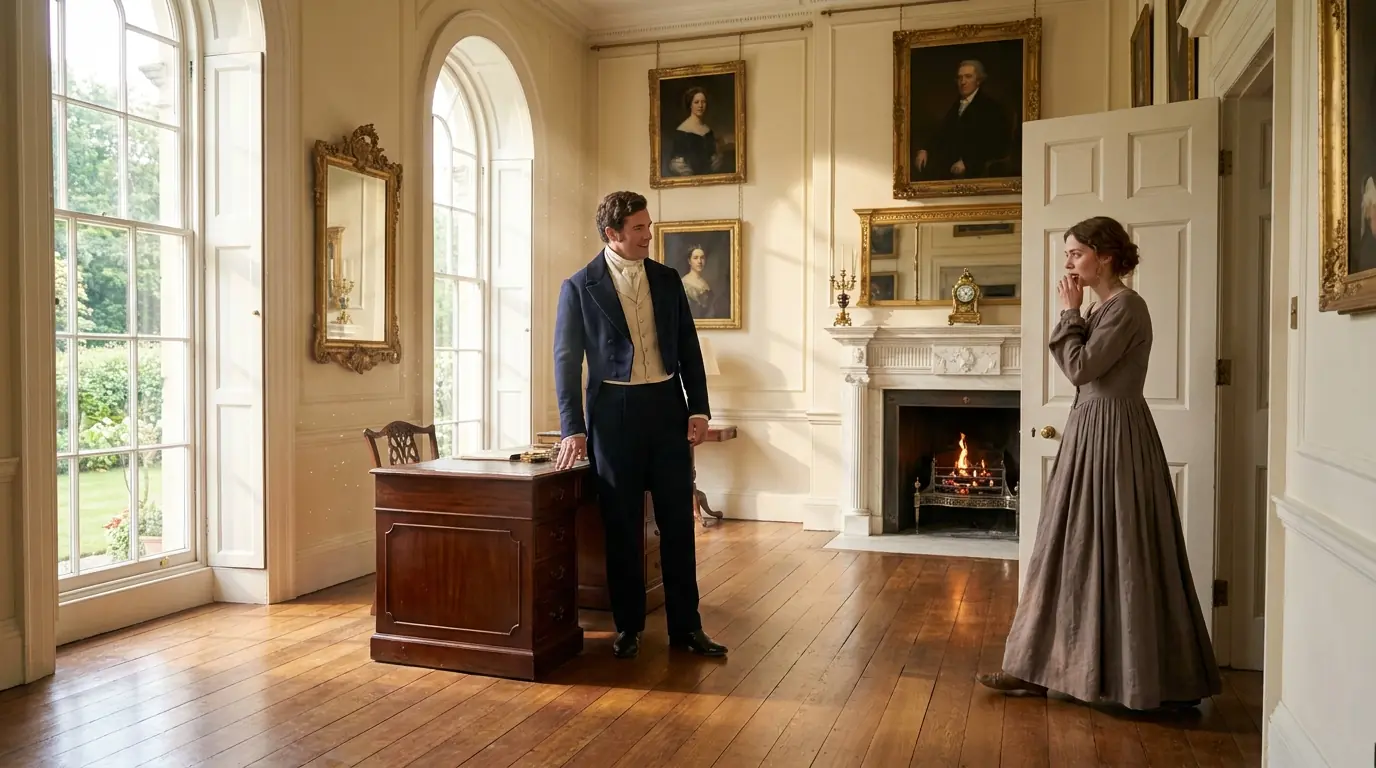
“Making it clear that I’m unavailable,” Julian explained, steering them past Lord and Lady Winchester’s elegant phaeton. “I’ve spent three years being diplomatically evasive about my marital intentions. This—”
He gestured between them.
“Is me being explicitly clear about where my interests lie.”
An elderly gentleman Eliza did not recognize actually removed his hat and bowed deeply as they passed.
Julian returned the gesture with perfect aristocratic dignity whilst simultaneously murmuring to Eliza, “That’s Lord Ashford. He’ll tell at least fifteen people about this before dinner.”
“You’re enjoying this,” Eliza realized. “You’re actually enjoying creating a scandal.”
“Not a scandal,” Julian corrected. “A statement. There’s a difference.”
He glanced at her, his dark eyes warm.
“Are you uncomfortable? We can leave if you’d prefer.”
Eliza considered. She had spent three years being invisible, being overlooked, being considered unremarkable.
Now the Duke of Westwick was publicly claiming her attention in front of everyone who had dismissed her.
“No,” she said slowly. “I think I’m rather enjoying it, too.”
Julian’s answering smile was brilliant.
“There’s my brave girl.”
They completed one circuit of the park, then another. Each pass generated more whispers, more stares, more barely concealed shock.
Julian remained perfectly composed, acknowledging acquaintances with polite nods, whilst keeping his attention primarily on Eliza, asking about her opinions on the spring weather, whether she thought the new plantings near the Serpentine were an improvement, if she had read the latest installment of Dickens’s serialized novel.
Perfectly ordinary conversation that was made remarkable simply by who was having it.
On their third circuit, they encountered the inevitable confrontation.
Lady Victoria Sterling, diamond of the previous season, possessor of perfect blonde ringlets and a smile that had launched a thousand marriage proposals, positioned her elegant phaeton directly in their path, forcing Julian to stop.
“Your Grace,” Lady Victoria said, her voice carrying that particular tone of aristocratic sweetness that Eliza had learned meant trouble. “What a surprise to see you. And Lady Eliza. How unexpected.”
“Lady Victoria,” Julian replied with perfect politeness. “Lovely afternoon, isn’t it?”
Lady Victoria’s blue eyes flickered between them, calculating.
“Indeed, Your Grace. I believe you’d promised me a drive in the park. Was that not mentioned at the Peyton soirée last week?”
“I believe you may be misremembering,” Julian said smoothly. “I made no such commitment.”
The lie was polite but obvious. Eliza had seen Julian dance with Lady Victoria at that very soirée. She had watched from across the room, managing her jealousy with practiced discipline.
Lady Victoria’s smile froze.
“I see. How interesting that your memory differs from mine.”
“Memory is a fallible thing,” Julian agreed. “Now, if you’ll excuse us—”
“Lady Eliza,” Lady Victoria interrupted, turning her attention fully to Eliza with an expression that suggested a snake evaluating a particularly small mouse. “I don’t believe we’ve been properly introduced, though we’ve certainly seen each other at various events. You’ve been rather quiet during the past few seasons, haven’t you?”
The implication was clear.
Unremarkable.
Forgettable.
Beneath notice.
Something in Eliza snapped.
Perhaps it was three years of swallowing similar barbs. Perhaps it was the feel of Julian’s solid presence beside her. Perhaps it was simply that she was exhausted of pretending to be invisible.
“Quiet, yes,” Eliza agreed pleasantly. “I found that silence often reveals more than conversation, Lady Victoria. One notices the most fascinating things when one simply observes.”
Lady Victoria’s perfect smile tightened.
“Indeed. And what fascinating things have you observed?”
“Oh, countless things,” Eliza said. “For instance, I’ve observed that some people confuse attention with genuine interest. That desperation, no matter how beautifully packaged, remains desperation. That manufactured charm is considerably less appealing than authentic character.”
Julian made a sound that might have been a cough or a suppressed laugh.
Lady Victoria’s face flushed pink.
“How extraordinarily rude, Lady Eliza. Your Grace, surely you don’t condone such—”
“I find Lady Eliza’s honesty refreshing,” Julian interrupted, his voice carrying an edge of steel beneath the polite tone. “Now, if you’ll truly excuse us, Lady Victoria, we have other engagements.”
He guided the horses past Lady Victoria’s phaeton with deliberate care, leaving the diamond of last season staring after them with an expression that promised retribution.
Once they were out of earshot, Julian turned to Eliza with undisguised admiration.
“That was magnificent. Absolutely magnificent.”
“That was appalling,” Eliza corrected, her heart racing. “I was unspeakably rude to her.”
“She was condescending to you first,” Julian pointed out. “You simply refused to accept it. There’s a difference.”
“The ton will crucify me for it.”
“The ton,” Julian said firmly, “can go hang. Besides, within a week you’ll be seen as witty rather than rude. That’s how these things work when you’re courting a duke.”
He said it so matter-of-factly that Eliza almost believed him.
They completed two more circuits, during which at least six more people stopped them to exchange pleasantries that were thinly veiled fishing expeditions for information, before Julian finally guided them out of the park.
Instead of immediately returning to her parents’ home, however, he turned the curricle down a quieter street lined with elegant townhouses.
“Where are we going?” Eliza asked.
“I thought you might enjoy seeing my London residence,” Julian said. “With appropriate chaperones. Naturally, my aunt lives with me. My father’s sister, Lady Margaret Wickliffe. She’s been desperate to meet you since I mentioned I was courting someone.”
“You told your aunt about me?”
“I told everyone about you,” Julian said. “My steward in Yorkshire, my secretary, the butler, the cook. I believe I may have mentioned you to my horse. I’ve been rather enthusiastic.”
Eliza laughed despite her nerves.
“Your horse must have been fascinated.”
“Brutus is an excellent listener,” Julian said seriously. “He rarely interrupts.”
The Wickliffe London townhouse was elegant but not ostentatious, a four-story building in Grosvenor Square with perfectly maintained gardens and an air of quiet wealth that did not need to announce itself.
A footman appeared immediately as they pulled up, taking charge of the horses whilst Julian helped Eliza down.
“Nervous?” he asked quietly.
“Terrified,” Eliza admitted. “Your aunt is going to think you’ve lost your mind.”
“My aunt,” Julian said, leading her up the steps, “is going to adore you. She’s been telling me for three years that I need to find someone with substance rather than just beauty.”
The interior of the townhouse was beautiful, high ceilings, elegant moldings, artwork that suggested generations of accumulated wealth.
But somehow it felt lived in rather than like a museum, books scattered on side tables, a half-finished embroidery project on a chair, fresh flowers in vases that looked recently arranged.
“Julian,” a woman’s voice called from the drawing room. “Is that you? Did you bring her? You promised you’d bring her.”
A moment later, a woman swept into the entrance hall and stopped, staring at Eliza with undisguised curiosity.
Lady Margaret Wickliffe was perhaps fifty, with graying hair arranged fashionably and kind eyes that reminded Eliza distinctly of Julian’s. She wore a day dress of deep green that was elegant without being fussy, and her expression was one of barely contained excitement.
“Aunt Margaret,” Julian said formally, though his tone was warm. “May I present Lady Eliza Hawthorne? Eliza, my aunt, Lady Margaret Wickliffe.”
“Oh, she’s perfect,” Lady Margaret said immediately, abandoning all pretense of formal introduction to clasp Eliza’s hands warmly. “Absolutely perfect. Julian, you didn’t mention she had such intelligent eyes.”
“I mentioned several things about her,” Julian protested.
“Yes, yes, clever and honest and reads philosophy,” his aunt waved dismissively. “But you didn’t mention the eyes. Very important eyes.”
She pulled Eliza toward the drawing room.
“Come, my dear, tell me absolutely everything. How did you capture my nephew’s attention? He’s been impervious to every eligible lady in England for three years.”
Eliza found herself seated on a comfortable sofa whilst Lady Margaret poured tea and peppered her with questions that were nosy, but somehow not offensive.
Julian settled in a nearby chair, watching the interaction with an expression of poorly concealed satisfaction.
“I wore a terrible dress,” Eliza finally explained, succumbing to Lady Margaret’s persistent interrogation. “The worst dress you’ve ever seen, brown and shapeless and absolutely dreadful. I decided I couldn’t be bothered impressing whatever tedious visitor my father was entertaining.”
Lady Margaret laughed delightedly.
“And instead, you accidentally impressed a duke. That’s wonderfully ironic.”
“That’s what I thought,” Eliza admitted. “I still don’t entirely understand it.”
“Don’t you?”
Lady Margaret glanced at Julian.
“My dear, Julian has spent three years being performed for by women who see him as a title rather than a person. You treated him like he was ordinary. That’s intoxicating to someone who spent his entire life being treated as extraordinary.”
“But he is extraordinary,” Eliza protested, then immediately blushed at her own vehemence.
Julian’s expression softened.
“See, Aunt Margaret? She argues even when complimenting me. It’s absolutely marvelous.”
They spent two hours in Lady Margaret’s drawing room, conversation flowing easily from books to politics to a lengthy discussion about whether the new railway expansion would fundamentally alter English society.
Lady Margaret held her own in the debate, and Eliza found herself genuinely enjoying the exchange.
This was what she had always wanted, to be treated as if her thoughts mattered, to engage in real conversation rather than vapid pleasantries, to be herself without apology.
Finally, as the afternoon stretched toward evening, Julian escorted her home.
At her parents’ doorstep, he held her hand a moment longer than necessary.
“Tomorrow evening, there’s a dinner party at the Salisbury estate,” he said quietly. “I’d like to escort you. Fair warning, it will be considerably less pleasant than today. Various people will be unpleasant to you because they’re jealous or confused or simply cruel.”
“And you want me to attend anyway?”
“I want you beside me,” Julian corrected. “But I won’t force you into uncomfortable situations. If you’d prefer to wait until society adjusts to us courting—”
“No,” Eliza interrupted. “If we’re doing this, we’re doing it properly. I won’t hide.”
Julian’s smile could have lit London.
“That’s my brave girl.”
He bowed over her hand, his lips brushing her knuckles in a gesture that sent heat racing up her arm.
Then he was gone, leaving Eliza standing on the doorstep with her heart racing and her future suddenly impossibly bright.
Her mother pounced the moment she entered the house.
“Tell me everything, every single detail. What did people say? Was everyone staring? Did anyone cut you? Did the Duke—”
“Mama, breathe,” Eliza laughed. “It was intense and wonderful and terrifying.”
Her father emerged from his study, his expression concerned.
“Eliza, are you well?”
“I’m courting the Duke of Westwick,” Eliza said, testing the words. “Half of London watched it happen. Lady Victoria Sterling was unpleasant, and I was rude in return. Julian’s aunt thinks I’m perfect, and tomorrow we’re attending a dinner party where people will likely be even more unpleasant.”
She paused, realizing something.
“And I don’t care. For the first time in three years, I genuinely don’t care what any of them think.”
Her father pulled her into another rare hug.
“That’s my girl,” he said quietly. “That’s my fierce, brilliant girl.”
That night, Eliza lay in bed, replaying the afternoon. The stares, the whispers, Lady Victoria’s barely concealed hostility, Julian’s steady presence beside her, his aunt’s immediate acceptance, the way Julian had looked at her like she was precious.
Three days ago, she had been nobody, the Marquis’s unremarkable daughter who had failed to secure a husband. Now she was the woman courting the Duke of Westwick.
And instead of feeling overwhelmed, she felt powerful.
Tomorrow would bring new challenges. More stares, more whispers, more people questioning why Julian had chosen her.
But tomorrow she would face them with Julian beside her, and that, Eliza realized, made all the difference.
The Salisbury dinner party was every bit as dreadful as Julian had warned, and somehow worse.
Eliza arrived on Julian’s arm, wearing her finest evening dress, a deep burgundy silk that Martha had declared absolutely stunning, and immediately felt underdressed.
Every other lady present wore gowns that probably cost enough to feed a family for a year, dripping with jewels that caught the candlelight like stars.
Lady Arabella Fitzroy wore emeralds the size of quail eggs. Miss Katherine Thornbury was wrapped in pearls that must have taken three generations to accumulate.
Even Lady Victoria Sterling, whose hostility had apparently only intensified since their Hyde Park encounter, wore diamonds that made Eliza’s simple garnet necklace look like costume jewelry from a market stall.
“Stop it,” Julian murmured in her ear as they were announced.
“Stop what?”
“Comparing yourself,” he said quietly. “You look beautiful. They look expensive. There’s a difference.”
Lord and Lady Salisbury greeted them with careful politeness that did not quite mask their curiosity.
The dinner was arranged with typical aristocratic precision, couples separated, conversations orchestrated, every detail designed to facilitate appropriate social interaction.
Eliza found herself seated between Lord Ashford, the elderly gentleman who had bowed to them in Hyde Park, and a younger man she did not recognize.
Julian was across the table and three seats down, close enough to see, but too far for private conversation.
She watched him charm Lady Peyton on his left, while simultaneously deflecting obvious flirtation from the young lady on his right.
He caught Eliza’s eye twice and smiled in a way that suggested he would rather be anywhere else.
“Lady Eliza,” Lord Ashford said, turning his attention to her as the first course was served. “I must confess to considerable curiosity. How did you capture the Duke of Westwick’s notoriously elusive heart?”
It was delicately phrased, but essentially asked, what makes you special enough for a duke?
“I wore a terrible dress and argued with him about philosophy,” Eliza said honestly. “Apparently, that was more interesting than agreeing with everything he said whilst wearing expensive clothing.”
Lord Ashford laughed, a genuine, surprised sound.
“I like you, Lady Eliza. You remind me of my late wife. She never bothered with polite lies either.”
The younger man on her other side, introduced as Mr. Peter Thornbury, Katherine’s older brother, was less charming.
He spent most of the dinner making pointed comments about sudden elevations in circumstance and unexpected attachments that were clearly directed at her.
Eliza endured it with what she hoped was dignified silence.
Across the table, she saw Julian’s jaw tighten each time Mr. Thornbury made a particularly cutting remark, but the formality of the dinner prevented him from intervening.
After what felt like seventeen years, the ladies withdrew to the drawing room whilst the gentlemen remained with their port and cigars.
This, Eliza knew from experience, was when the real assessment would happen.
Lady Salisbury arranged herself on the most prominent sofa and gestured for everyone to sit.
Eliza chose a chair slightly apart from the main group, hoping to avoid direct confrontation.
No such luck.
“Lady Eliza,” Lady Arabella said sweetly, her emerald earrings catching the lamplight. “We’re all simply dying to understand. What is it like courting the Duke? He’s been so resistant to attachment these past years.”
The question sounded innocent. The undertone suggested, what trick did you use?
“His Grace has been kind enough to seek my company,” Eliza said carefully. “I find him to be intelligent, thoughtful, and considerably more interesting than most gentlemen of my acquaintance.”
“How diplomatic,” Miss Katherine Thornbury murmured. “Though I suppose one must be diplomatic when one’s position is precarious.”
Eliza’s hands tightened in her lap.
“I’m not certain I understand your meaning, Miss Thornbury.”
“Don’t you?” Catherine’s smile was poisonous. “Courtships are such uncertain things. They can end so quickly, especially when based on novelty rather than genuine compatibility.”
“Catherine,” Lady Salisbury said warningly.
But Catherine was not finished.
“I’m simply saying that the Duke has always preferred ladies of exceptional beauty and accomplishment. I’m certain Lady Eliza has many fine qualities, but one does wonder how long such an unconventional choice will hold his interest.”
The room fell silent.
Every lady present watched Eliza, waiting to see how she would respond to this direct attack.
Eliza could feel her cheeks burning. Part of her wanted to flee, to escape this drawing room of beautiful, accomplished women who clearly thought she did not belong.
Part of her wanted to defend herself, to list every conversation she had had with Julian, every moment where he had looked at her like she mattered.
But a larger part, the part that had worn her worst dress and refused to apologize for reading philosophy, was simply angry.
“Miss Thornbury,” Eliza said quietly, her voice steady despite her racing heart, “I appreciate your concern for the Duke’s romantic welfare, though I cannot help but notice that you seem remarkably invested in his choices for someone who, if memory serves, he has never courted himself.”
Catherine’s face flushed.
“I—”
“The Duke has explained his preferences to me quite clearly,” Eliza continued. “He spent three years surrounded by ladies who perform for him rather than engage with him. Ladies who see him as a title to acquire rather than a person to know, ladies who would rather agree with everything he says than risk genuine conversation.”
She met Catherine’s gaze directly.
“If that is what you consider exceptional accomplishment, then I’m quite glad to be lacking in it.”
Lady Arabella made a small sound that might have been admiration or shock.
Lady Salisbury’s expression was carefully neutral.
Catherine stood abruptly.
“I think I shall join the gentlemen. This conversation has become tiresome.”
After she swept from the room, the remaining ladies stared at Eliza with varying expressions: respect, wariness, calculation.
“Well,” Lady Arabella said finally, “that was extraordinarily interesting.”
The gentlemen rejoined them shortly after, and Julian immediately gravitated to Eliza’s side.
He took one look at her face and frowned.
“What happened?” he murmured.
“Miss Thornbury happened,” Eliza said quietly. “I may have been somewhat sharp with her.”
“Good,” Julian said with satisfaction. “She deserved it. She’s been making pointed comments about my surprising choice all evening.”
They managed to escape the party relatively early, Julian citing a prior engagement that Eliza suspected was entirely fictional.
In his curricle, driving through London’s lamplit streets, Eliza finally allowed herself to relax.
“That was dreadful,” she admitted.
“That was society,” Julian corrected. “Filled with people who are jealous or bored or simply cruel for entertainment.”
He glanced at her.
“But you held your own beautifully. Lord Ashford told me you were magnificently honest, which from him is high praise indeed.”
“Miss Thornbury thinks I’m not good enough for you.”
“Miss Thornbury spent two entire seasons trying to capture my attention and failed,” Julian said bluntly. “Her opinion is remarkably unimportant to me.”
He pulled the curricle to a stop outside her parents’ home but did not immediately help her down.
Instead, he turned to face her, his expression serious in the lamplight.
“Eliza, I need you to understand something. The next few weeks are going to be difficult. People will say cruel things. They’ll question why I chose you. They’ll try to undermine your confidence and make you doubt yourself.”
“I know,” Eliza said quietly.
“But I need you to hold on to this truth. I am courting you because you are exactly what I’ve been searching for. Not despite your honesty, but because of it. Not despite your intelligence, but because of it. Not despite your refusal to perform and pretend, but because of it.”
His hand covered hers on the seat between them.
“You are not a novelty that will wear off. You are not a mistake I’ll regret. You are the woman I’ve been half in love with for three years, and I’m finally brave enough to pursue what I actually want.”
Tears pricked at Eliza’s eyes.
“What if they’re right? What if six months from now you realize—”
“Eliza.”
Julian’s voice was firm.
“In six months, I intend to marry you. In a year, I intend to wake up beside you every morning and discuss philosophy over breakfast. In five years, I intend to watch you terrify our children with your intelligence whilst I look on in proud admiration.”
He said it so matter-of-factly that Eliza’s breath caught.
“You want to marry me?”
“Obviously,” Julian said. “I’m courting you, aren’t I? Did you think I was doing this for entertainment?”
“I—”
Eliza struggled for words.
“We’ve only been courting for four days.”
“I’ve loved you for three years,” Julian corrected. “The courtship is merely a formality to satisfy society’s expectations. And speaking of which—”
He reached into his coat and withdrew a small velvet box.
Eliza’s heart stopped.
“This is highly irregular,” Julian admitted, opening the box to reveal a ring, a sapphire surrounded by small diamonds that caught the lamplight beautifully. “We should wait. I should court you properly for months. Ask your father’s permission formally. Propose in some romantic setting.”
He looked at her, his dark eyes intense.
“But I’ve waited three years already, and I don’t want to wait any longer. Lady Eliza Hawthorne, would you do me the extraordinary honor of becoming my duchess?”
The world narrowed to Julian’s face, the ring sparkling in the box, the impossible question hanging between them.
“This is mad,” Eliza whispered.
“Completely,” Julian agreed. “But I’ve discovered I quite enjoy madness, particularly when it involves you.”
Eliza looked at the ring, then at Julian’s face, hopeful and nervous and utterly sincere.
She thought about three years of watching him from afar. Three years of believing he would never notice her. Three years of carefully managed loneliness.
And now he was here, offering her everything she had ever wanted.
“Yes,” she said, her voice breaking. “Yes, Julian, I’ll marry you.”
His smile transformed his face.
He slipped the ring onto her finger. It fit perfectly, as if it had been made for her, and then he was kissing her hand, her wrist, following some propriety rule she could not remember, while simultaneously making her heart race.
“We’ll announce it properly,” he said, his voice rough with emotion. “Tomorrow at the Pembridge ball. I want everyone who doubted us to understand that this is real and permanent, and—”
“Julian,” Eliza interrupted. “Stop talking.”
He looked up, startled.
“Just let me enjoy this moment,” she said softly. “Before tomorrow’s chaos, before society’s judgment, just this. You and me, and this impossible happiness.”
Julian settled beside her on the curricle seat, his arm around her shoulders, her head resting against his chest.
They sat like that for several minutes, listening to London’s nighttime sounds, the ring heavy and perfect on Eliza’s finger.
“I love you,” Julian said quietly. “I should have said that first, before the proposal, before everything. I love you, Eliza. Your brilliant mind and your sharp tongue and your absolute refusal to be anything but yourself.”
“I love you, too,” Eliza whispered. “I’ve loved you since the Pembridge ball three years ago, when you actually discussed poetry with me like I was a person rather than a decorative object.”
“Best conversation I’d had in years,” Julian admitted. “Followed by three years of cowardice whilst I pursued what everyone else expected rather than what I actually wanted.”
“You’re pursuing it now.”
“I’m pursuing you now,” he corrected. “And I intend to spend the rest of my life making sure you never doubt how extraordinary you are.”
Eventually, propriety demanded they part. Julian walked her to her door, proper chaperonage be damned, and kissed her hand one final time.
“Tomorrow,” he said. “Tomorrow we tell everyone. Tomorrow we make it official.”
“Tomorrow,” Eliza agreed.
She floated into the house to find both her parents waiting in the entrance hall, clearly having heard the curricle arrive some time ago and wondering why she had not immediately come inside.
Eliza held up her left hand, the sapphire catching the lamplight.
Her mother actually screamed, a small, delighted sound that would probably have mortified her under other circumstances.
Her father’s expression shifted through several emotions before settling on something that looked like satisfied inevitability.
“He asked tonight,” her father said.
“He asked tonight,” Eliza confirmed. “Unconventionally, irregularly, and perfectly.”
“Oh, my darling girl,” her mother said, pulling her into a fierce hug. “You’re going to be a duchess, the Duchess of Westwick.”
“I’m going to be Julian’s wife,” Eliza corrected quietly. “The title is secondary.”
Her father nodded approvingly.
“That’s exactly the right perspective, though your mother isn’t wrong. Being a duchess comes with considerable responsibility and scrutiny.”
“I know,” Eliza said. “Tomorrow we announce it at the Pembridge ball. Everyone who’s been cruel or dismissive will know that Julian chose me permanently.”
“And you’re ready for that?” her father asked gently. “For the attention, the judgment, the jealousy.”
Eliza thought about Miss Thornbury’s cutting remarks, Lady Victoria’s barely concealed hostility, the dozens of beautiful, accomplished ladies who had expected Julian to choose one of them.
“I’m ready,” she said firmly. “Because Julian loves me, not some performance of who he thinks I should be, but the actual me. And that’s worth facing whatever society throws at us.”
Her mother squeezed her hand.
“That’s my fierce girl.”
That night, Eliza lay in bed staring at the ring on her finger. The sapphire glowed in the candlelight, a physical reminder that this impossible thing was real.
Tomorrow, the ton would gossip. They would question and judge and speculate.
Some would be genuinely happy for them. Others would be cruel.
But tomorrow night she would stand beside Julian Wickliffe as his publicly acknowledged fiancée, as the future Duchess of Westwick, as the woman who had captured the heart of the man she had loved for three years simply by being herself.
The season of 1840 would be remembered for many things, Eliza thought.
But mostly it would be remembered as the season when Lady Eliza Hawthorne wore her worst dress and accidentally secured the match of the decade.
Tomorrow, the real adventure would begin.
But tonight, she would allow herself pure, uncomplicated joy.
Epilogue
One year later, the Duchess of Westwick stood in the nursery of the Yorkshire estate, watching her husband hold their three-month-old son with a mixture of devotion and terror that made her heart swell.
“He’s so small,” Julian said for perhaps the hundredth time. “Are babies supposed to be this small? Are we certain he’s healthy?”
“He’s perfectly healthy,” Eliza assured him, settling into the rocking chair beside the window. “The physician confirmed it yesterday and last week and the week before that.”
“He could have grown since yesterday,” Julian argued, carefully adjusting his grip on baby Thomas Julian Wickliffe, who seemed utterly unbothered by his father’s anxiety. “Babies grow, don’t they?”
“Not quite that quickly, love.”
It had been a year since their engagement announcement at the Pembridge ball, a night that had gone down in London’s social history as one of the most dramatic events of the decade.
Eliza still smiled, remembering Lady Victoria’s expression when Julian had publicly declared his engagement to the most remarkable woman in England.
The wedding, three months later, had been smaller than society expected. Julian had insisted on intimacy over spectacle, but beautiful nonetheless.
Lady Margaret had wept. Eliza’s father had made a speech that somehow incorporated both agricultural references and genuine emotion.
Her mother had organized everything with military precision while simultaneously crying at inappropriate moments.
And Eliza had married the man she had loved for years, wearing a dress she had actually chosen herself, and feeling, for the first time in her life, completely confident in who she was.
The first months of marriage had been an adjustment. Julian’s estates required management. His responsibilities as a duke were considerable.
London society had continued to watch them with varying degrees of fascination and skepticism, waiting to see if the unconventional match would last.
It had not only lasted, it had flourished.
They had moved to the Yorkshire estate six months ago when Eliza discovered she was carrying their child. London had been scandalized that the Duke would abandon the season, but Julian had been unmoved.
“My wife is more important than any ball,” he told anyone who asked. “And if society cannot understand that, then society can hang.”
Now, watching him gently rock their son whilst murmuring nonsense about crop rotation and philosophy, Eliza felt so full of happiness she might burst.
“You’re staring,” Julian observed, not looking up from Thomas.
“I’m admiring,” Eliza corrected. “There’s a difference.”
“Are you admiring me or admiring how well I’m managing not to drop our son?”
“Both, actually.”
Julian finally looked up, his dark eyes warm with affection.
“Come here.”
Eliza moved to his side, and Julian wrapped his free arm around her waist, pulling her close.
Thomas made a small sound of contentment, apparently pleased to have both parents nearby.
“We made this,” Julian said softly, looking at their son. “This tiny, perfect person. How did we manage that?”
“Well, when a duke and a duchess love each other very much—”
“Eliza.”
Julian laughed.
“That’s not what I meant.”
“I know.”
She leaned against him, breathing in his familiar scent.
“But sometimes I need to make inappropriate jokes or I become overwhelmed by how happy I am.”
Julian kissed the top of her head.
“Overwhelmed by happiness. What a remarkable problem to have.”
A knock at the door interrupted them, and Lady Margaret entered, followed by Eliza’s parents, who were visiting for the week.
“Oh, you two,” Lady Margaret said, her expression fond. “You look like a painting. Portrait of young family in perfect domestic bliss.”
“We’re working on the bliss part,” Julian said. “I’m still convinced Thomas might shatter if I hold him wrong.”
“He survived nine months inside Eliza,” the Marquis pointed out. “I think he can handle his father’s embrace.”
They spent the afternoon, as they often did, conversation flowing easily from politics to literature to good-natured arguments about agricultural improvements.
Thomas was passed around like a very precious, slightly fragile parcel, each adult marveling at his tiny perfection.
Later, after her parents and Lady Margaret had retired, Eliza and Julian sat in the library, her favorite room in the entire estate, with floor-to-ceiling books and windows overlooking the Yorkshire moors.
Julian was reading some agricultural report whilst Eliza worked on correspondence.
This was their routine, comfortable silence punctuated by occasional conversation, the peaceful domesticity they had both craved without realizing it.
“Eliza,” Julian said suddenly, “do you ever think about that afternoon, when you came downstairs in that terrible dress?”
Eliza looked up from her letter to Lady Margaret’s friend, who had requested advice on managing tenant disputes.
“Sometimes. Why?”
“I’ve been thinking about it all day,” Julian admitted. “About how different our lives would be if you had dressed appropriately.”
“If I had tried to impress you instead of being myself, we might not have married,” Eliza said quietly.
“Exactly.”
Julian set aside his papers and moved to sit beside her.
“I might have had one polite conversation with you and moved on, assuming you were like every other lady I had met. I might have married someone appropriate and suitable and spent the rest of my life being profoundly lonely.”
He took her hand, his thumb tracing over her wedding ring.
“But you wore that terrible dress. You argued with me about philosophy. You treated me like a person rather than a title. And you changed my entire life.”
“Julian—”
“Let me finish,” he said gently. “A year ago, I stood in your parents’ drawing room and saw you, windswept and disheveled and absolutely perfect, and realized I had been wasting my life pursuing what everyone expected rather than what I actually wanted.”
His dark eyes held hers.
“You taught me that authenticity matters more than perfection. That being seen is more valuable than being admired. That love is about knowing someone completely and choosing them anyway.”
Tears pricked at Eliza’s eyes.
“You taught me the same things. That I didn’t need to diminish myself to be lovable, that my intelligence and opinions weren’t flaws to hide but strengths to celebrate, that the right person would love me for who I actually am.”
“The right person does love you,” Julian said softly. “Desperately, completely, for exactly who you are.”
They sat like that for a long moment, hands clasped, years of loneliness and longing finally transformed into contentment.
“Do you think Thomas will inherit your stubbornness or mine?” Julian asked eventually.
“Both, probably,” Eliza laughed. “The poor child doesn’t stand a chance.”
“He’ll be brilliant and argumentative and absolutely impossible to manage,” Julian said with satisfaction. “Just like his mother.”
“And charming and overprotective and prone to agricultural obsessions,” Eliza countered. “Just like his father.”
From the nursery down the hall, Thomas made a small crying sound, not distressed, just announcing his presence.
They both stood immediately, moving in perfect synchronization toward their son.
Julian reached the nursery first and lifted Thomas carefully, making soothing sounds whilst rocking him gently.
“Hello, little man,” he murmured. “Did you miss us? We were only gone for an hour.”
Eliza watched them, her husband and son, and felt so full of love she could barely breathe.
This was what she had waited for, what she had hoped for during three years of watching Julian from afar.
Not just the romance, not just the title, but this.
A partnership of equals. A love based on genuine understanding. A family built on authenticity rather than performance.
“Eliza,” Julian said, looking up from Thomas. “Come here. I want to hold both of you.”
She moved to his side, and Julian wrapped them both in his embrace.
His wife and son, his chosen family, his unexpected happiness.
“Thank you,” he said quietly.
“For what?”
“For wearing that terrible dress. For being yourself. For loving me.”
He kissed her forehead gently.
“For giving me this life I didn’t know I needed.”
“Thank you for seeing me,” Eliza whispered. “For looking past all the beautiful, accomplished ladies and seeing something worth pursuing in an ordinary girl who read too much and had too many opinions.”
“You were never ordinary,” Julian said firmly. “You were always extraordinary. I just needed to be brave enough to recognize it.”
Thomas made another small sound, and they both laughed.
“He agrees with me,” Julian said. “Clearly, our son is already brilliant.”
“He’s three months old.”
“Brilliance starts early,” Julian insisted.
They stood there in the nursery, lit by lamplight and the last rays of sunset through the window, the Yorkshire moors stretching endless beyond.
A duke and his duchess and their tiny son, building a life based on love rather than obligation, authenticity rather than performance.
Somewhere in London, the season continued. Beautiful ladies competed for eligible gentlemen. Mothers schemed and plotted. Society judged and gossiped and performed its elaborate mating rituals.
But here in Yorkshire, the Duke and Duchess of Westwick had already found what everyone else was seeking: genuine connection, authentic love, and the profound peace of being truly known by another person.
It had started with the worst dress in Christendom.
It had become the greatest love story of their generation.
And as Julian kissed his wife whilst holding their son, both of them laughing at something Thomas did that wasn’t actually remarkable but felt miraculous because he was theirs, Eliza thought about that long-ago afternoon when she descended the stairs determined to be unmemorable.
She had failed spectacularly at being unmemorable.
But she had succeeded at something far more important.
Being herself.
And that, it turned out, had been enough to change everything.
“I love you,” she said to Julian, simple and true.
“I love you, too,” he replied, his voice warm with certainty. “My brilliant, argumentative, wonderfully authentic wife.”
Thomas gurgled, apparently adding his agreement.
And the family stood together in their Yorkshire sanctuary, building a life that defied society’s expectations and fulfilled every hope they had secretly harbored.
The worst dress in Christendom, it turned out, had been the beginning of the very best life imaginable.