No one understood why the little girl walked toward the burned boy when every adult stepped away from him.
The summer afternoon should have been gentle. The lawns of Hartley Estate in upstate New York shimmered under warm light, trimmed so perfectly they looked painted. Ladies in pale dresses laughed softly beneath white tents, and men spoke of railroads and money as if the future belonged only to them.
Children were meant to play in neat groups, watched closely, corrected often, reminded who they were and where they belonged. Eliza Hartwell did not belong in neat groups. At six years old, she had already learned that curiosity brought scolding and kindness brought warnings.
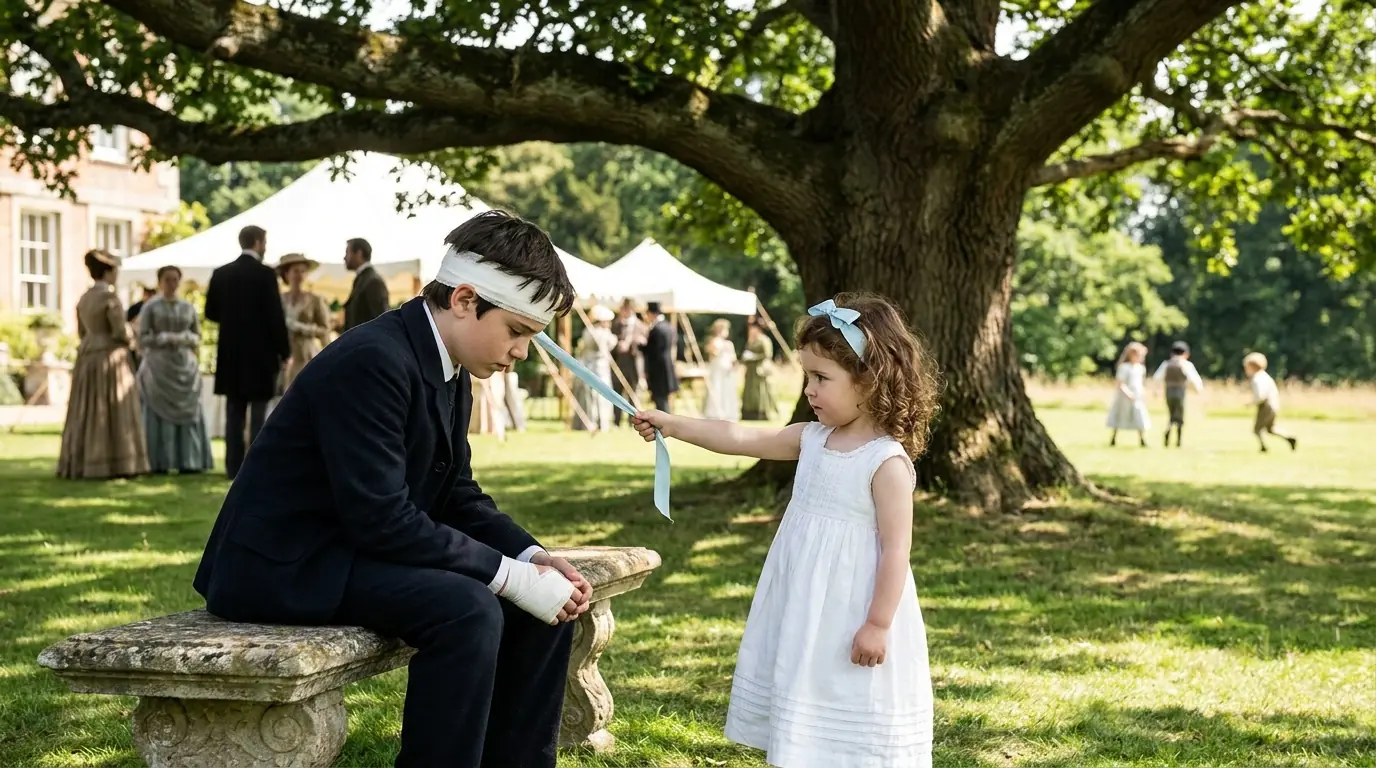
Her white dress itched at the collar, and her shoes were too tight. She slipped away from the lawn games and wandered toward the old oak at the edge of the garden, where voices grew quiet and adults stopped watching so closely.
That was where she saw him.
He sat alone on a stone bench beneath the tree. His body folded inward as if he wished to vanish into the rock. Thick bandages wrapped his head and neck. Burned skin showed through in red and white patches that looked angry and raw.
His hands were damaged, too, the skin tight and shiny, fingers stiff as if they hurt to move. The other children had stared earlier. Then they had whispered. Then they had been pulled away.
Eliza had heard the adults speak in low voices. Fire. Accident. Tragedy. Poor child. Never the same.
She did not hear fear in those words. She heard distance.
So she walked toward him.
The boy did not look up when she sat beside him. He stared at the ground, jaw tight, breathing careful, the way people breathe when they are holding back tears. Eliza studied him the way she studied injured birds she sometimes found near the barn at home, slowly and without judgment.
“Does it hurt?” she asked, her voice simple and steady.
He flinched but said nothing.
Eliza reached into her pocket and pulled out a ribbon. Pale blue silk, smooth and soft. She had saved it because it felt important, though she had not known why until now.
“My mama says pretty things help when you are sad,” she said. “You can have it.”
The boy turned his head then. One eye was hidden by bandage, but the other looked at the ribbon as if it were impossible. His scarred fingers closed around it carefully, like it might break if he held it too tight.
For one brief moment, the boy forgot the fire, forgot the pain, forgot the way people looked at him now. Then a sharp voice cut across the garden.
“Eliza.”
Her mother came fast, face tight with fear and anger mixed together. She grabbed Eliza’s arm and pulled her back hard enough to hurt.
“Get away from him,” she said. “Do not touch that. What were you thinking?”
Eliza cried out in confusion, reaching back toward the boy as she was dragged away. She did not understand what she had done wrong. She had only seen someone alone.
The boy watched them go, the ribbon clenched in his damaged hand. He heard the whispers start again. He saw the way adults avoided his eyes.
Something hardened inside him that day. He tucked the ribbon away where no one would find it. And he learned a lesson that would shape the rest of his life.
Kindness was rare.
Fear was power.
Eighteen years passed.
By 1893, Sebastian Winterborne was no longer the burned child beneath the oak tree. He was the Duke of Winterborne, master of a vast estate in the Hudson Valley, owner of rail interests, mines, and banks that reached across the eastern states.
Men spoke his name with caution, some with fear. He did not attend society events. He did not host parties. He did not smile for mirrors.
His scars had not faded. They ran from temple to jaw, down his neck, across his hands. People tried not to stare. They failed.
Sebastian learned to use that failure. In business meetings, he watched men lose confidence the longer they looked at him. In negotiations, he stayed silent until others filled the space with mistakes.
He destroyed rivals without raising his voice.
At Winterborne Hall, servants respected him. He paid well, listened carefully, and protected loyalty like a weapon. Crossing him ruined lives. Serving him well meant safety.
He lived alone by choice. Late at night, when the house was quiet, Sebastian sometimes opened a small wooden box and touched the faded blue ribbon inside. He told himself it was only a reminder of weakness, of a time before he understood how the world worked.
He told himself that the girl had forgotten him.
That belief shattered on an October morning.
Harrison, his estate manager, entered Sebastian’s study with unusual hesitation.
“There is an artist on the grounds, Your Grace,” Harrison said. “From New York City, commissioned by the Historical Estates Society.”
Sebastian’s expression went cold. “I approved no such thing.”
“It appears a junior clerk responded in error,” Harrison said. “She is already set up in the east gallery.”
Sebastian considered refusing. He hated portraits, hated being studied. But refusal meant attention. Questions. Pity.
“Fine,” he said. “One portrait. Nothing more.”
He returned to his papers, but after several hours, curiosity pulled him from his chair. He moved through the hallways without sound and stopped at the gallery door.
A woman stood inside, her back to him. She was small, dark hair pinned simply, wearing a gray dress marked with paint. She studied the old portraits with focus and confidence.
She turned when he cleared his throat. She did not flinch.
“Your Grace,” she said calmly, dipping into a neat curtsy. “I am Eliza Hartwell. I will be painting your portrait.”
Sebastian studied her face, waiting for the usual reaction. It never came. She looked at him like he was ordinary, professional, curious, unafraid.
“I require three sittings,” she continued. “Morning light works best. I work quickly.”
Her voice was steady. Her eyes never wavered. Sebastian felt something shift beneath his ribs.
“Very well,” he said. “Tomorrow morning.”
She nodded, already turning back to her easel. That night, Sebastian slept poorly. The name Hartwell echoed in his mind like a bell he could not silence.
Morning came gray and cool. Sebastian dressed with care he did not admit to himself. When he entered the gallery, Eliza was already there, arranging her tools.
She moved him with gentle authority, adjusting his posture, angling his shoulders. Her hands touched him without hesitation.
“Paint what you see,” Sebastian said when she hesitated.
She stepped close and studied his face with interest, not pity.
“Your scars tell a story,” she said softly. “Survival. Strength.”
No one had ever said that to him.
As the charcoal moved across the canvas, the silence between them felt strange and safe. Sebastian spoke more than he had in years. He told her about the fire, the isolation, the power he built from it.
Eliza listened.
Days passed, then weeks. And one afternoon, as autumn leaves fell outside the gallery windows, Sebastian mentioned the garden party at Hartley Estate.
Eliza went still. Her brush lowered.
“I was there,” she said quietly.
He looked at her.
“I never forgot you,” she continued, her voice trembling but sure. “I searched for you for years.”
Sebastian’s breath caught. The promise made beneath the oak tree rose from the past, alive and impossible.
And for the first time since he was ten years old, the Duke of Winterborne felt fear, not of the world, but of hope.
Sebastian stood very still after Eliza spoke. The world felt narrow to the gallery, to the quiet space between them, to the truth that had waited eighteen years to be spoken aloud. He looked at her as if seeing her for the first time, and also as if he had always known her.
“You searched for me,” he said.
Eliza nodded. Her hands shook slightly, so she pressed them together.
“I did not know your name at first, only the estate, only the boy with the ribbon. When I learned you had inherited the title and disappeared, I thought I was too late. But then I learned where you lived. I found a way.”
Sebastian turned away, walking to the window. His reflection in the glass showed the scars he had spent his life learning to weaponize. For the first time, they felt exposed.
“I kept it,” he said quietly.
Eliza looked at him, not understanding.
“The ribbon,” he continued. “I kept it all these years.”
Her breath caught. She stepped toward him, stopping just behind his shoulder.
“I hoped you might,” she said. “But I never believed I deserved that much.”
Sebastian turned then. He reached into his coat and removed the small wooden box. He opened it and placed the faded blue ribbon in her palm.
Eliza pressed it to her chest. Tears slid down her face without sound.
“I meant it,” she whispered. “I meant every word.”
“So did I,” Sebastian said.
The distance between them closed without decision. His scarred hands framed her face. When he kissed her, it was careful at first, as if afraid the moment would break.
Then it deepened, years of loneliness and restraint giving way. They did not speak for a long time afterward. When they did, it was not about the past.
It was about now.
Over the following days, the gallery became their shared world. Eliza painted with renewed intensity. Sebastian stayed longer than required, sitting beside her, watching the portrait take shape.
The man on the canvas was scarred and powerful. His gaze was steady. There was no apology in the image.
“You see me?” Sebastian said one morning.
“I always did,” Eliza replied.
Their happiness was quiet, careful. Sebastian had lived too long without hope to trust it easily. That was when Lord Ashford arrived.
He was invited for business, a minor noble with ambitions and charm. Tall, handsome, everything Sebastian was not. Ashford noticed Eliza immediately.
He lingered in the gallery, offered compliments too smooth to be innocent, asked about her work, her future, her plans. Eliza remained polite but distant. Sebastian watched from the shadows, something unfamiliar tightening in his chest.
Jealousy was new to him. It burned without logic.
One afternoon, he found Ashford walking with Eliza in the garden, his hand resting on her arm. Sebastian crossed the lawn with cold purpose.
“Lord Ashford,” he said.
Ashford turned, surprise flickering across his face before smoothing into a smile. “Your Grace.”
“You are dismissed.”
The tone left no room for discussion. Ashford bowed and withdrew, his interest only sharpened by resistance. Eliza turned to Sebastian, eyes bright.
“You are angry,” she said.
“I am protective,” Sebastian replied.
She smiled. “Good.”
That night, in the quiet of Winterborne Hall, Sebastian spoke words he had never planned to say.
“Marry me.”
Eliza did not laugh. She did not hesitate.
“Yes,” she said. “I have been waiting.”
Their engagement was announced at dinner. Ashford masked his reaction well, but Sebastian saw the defeat in his eyes.
Three weeks later, they entered a grand ballroom in New York City, hand in hand. The whispers followed them. The stares.
Sebastian held Eliza close, his presence a shield. Then Eliza’s mother appeared.
The woman who had torn her away beneath the oak tree stood frozen across the room, shock hardening into anger. She approached, ignoring Sebastian entirely.
“Eliza,” she said sharply. “You are making a mistake.”
Eliza did not step back. Sebastian moved forward.
“Madam,” he said, his voice calm and lethal. “You will leave us.”
“You cannot possibly think,” the woman began.
“I am the Duke of Winterborne,” Sebastian said. “And you will not speak to my future wife again.”
The room fell silent. Eliza’s mother saw something in his eyes then. Not rage, certainty.
She turned and left.
Eliza looked at Sebastian with pride that made his chest ache. They married quietly at Winterborne Hall. No crowds. No spectacle. Only vows spoken with absolute truth.
Years later, when people spoke of the Duke and Duchess of Winterborne, they spoke of power and grace. But Sebastian knew the truth.
It all began with a ribbon and a promise the world said should be forgotten.
He was glad they had been wrong.
Marriage did not soften Sebastian Winterborne. It sharpened him.
The morning after the wedding, he woke before dawn as he always had. But for the first time in decades, he did not rise alone.
Eliza slept beside him, her dark hair spread across his shoulder, her breathing slow and steady. For a long moment, he simply watched her, trying to understand how a life once defined by absence now felt so full it almost frightened him.
He had built his world on control. Eliza changed that without taking anything away.
Winterborne Hall transformed quietly, not with grand renovations or public celebrations, but with warmth. Eliza filled empty rooms with canvases and light. She laughed with servants. She sketched in the gardens.
People stopped whispering when she passed because she met every gaze without fear. Sebastian watched it happen with something close to awe.
He supported her work openly. Galleries sought her paintings. Patrons competed for commissions. When critics questioned why the Duke allowed his wife such independence, Sebastian answered simply that she belonged to herself.
That answer unsettled people more than his scars ever had.
Their marriage was not without challenge. Society tested them. Invitations arrived wrapped in politeness and judgment. Some guests stared too long at Sebastian’s face.
Others underestimated Eliza’s influence. They learned quickly.
Sebastian remained ruthless in business, but now his vengeance had focus. He dismantled threats to Eliza’s career with quiet efficiency.
A patron who insulted her talent found his funding vanish. A critic who mocked her marriage discovered his reputation dissolving in a month.
Eliza never asked him to do these things. He did them because love, once found, made him dangerous.
Years passed. Winterborne became known not only for wealth, but for loyalty. Workers stayed. Artists gathered. Ideas flourished.
Sebastian still kept the wooden box in his private study. Inside lay the faded blue ribbon and a new white one Eliza had given him on their first anniversary.
Promises kept. Promises renewed.
One autumn evening, as firelight warmed the study, Eliza found him holding the ribbons.
“You were thinking again,” she said, smiling as she sat beside him.
“I am remembering,” Sebastian replied.
She leaned against him. “Do you regret anything?”
He considered the question carefully. “No,” he said at last. “I regret believing for so long that kindness was weakness.”
Eliza kissed his scarred cheek, just as she always did, without hesitation.
“Sometimes,” she said, “kindness is the bravest thing a person can offer.”
Sebastian believed her.
Their story spread quietly, carried by whispers and witness rather than spectacle. A scarred Duke. A woman who refused to look away. A promise made in childhood that survived time and cruelty.
And in that truth, they built a life no fire could ever destroy.
The world had tried to teach them fear.
They chose love instead.